“We have given you everything that you need to be successful. So don’t come back here talking about how the world is unfair when you haven’t done your part.” – Clair Huxtable (Paraphrased from Season 3)
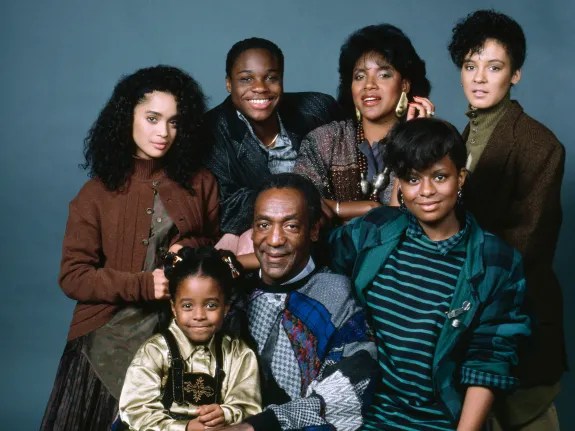
When Cliff and Clair built something extraordinary, their children inherited it but did any of them carry it forward? In American television history, few fictional families have made a more indelible mark than the Huxtables of The Cosby Show. Airing from 1984 to 1992, the series offered America and particularly Black America an aspirational portrait: Cliff Huxtable, a beloved OB/GYN, and Clair Huxtable, a formidable attorney, raising five children in a Brooklyn Heights brownstone steeped in jazz, fine art, intellectual ambition, and cultural pride. The Huxtables were not just upper-middle class. They were gateway members of the Black elite, the kind of family that might be found at National Association of Guardsmen dinners or invited into the ranks of the Boulé. Their home was a living museum of African American excellence.
And yet. As we trace the trajectories of Sandra, Denise, Theo, Vanessa, and Rudy into adulthood, something quietly disappointing emerges. A family that had every institutional advantage, strong support for education, professional networks, cultural capital, and financial stability underwritten across three generations produced children who largely did not carry the baton. They did not extend the Huxtable legacy into institutions. They did not invest in African American infrastructure. They did not, with few exceptions, even marry in ways that amplified the family’s reach and potential. This is not an indictment of fictional characters for its own sake. It is an examination through the lens of HBCU Money’s ongoing conversation about intergenerational Black wealth and institutional stewardship of what the Huxtable children represent as cultural symbols. And what they represent, ultimately, is a cautionary tale.
Before assessing the children, it is worth honoring the foundation. Cliff and Clair Huxtable are the product of struggle that extends behind them. Cliff’s father, Russell Huxtable, served in the 761st Tank Battalion in World War II, the celebrated Black Panther division, and in all likelihood was denied the full benefits of the G.I. Bill that built the postwar White middle class. As HBCU Money has previously detailed, the denial of those benefits to over 1.5 million Black veterans created a wealth gap whose effects ripple forward to this day, touching the institutional depletion of Black-owned banks, hospitals, and schools that once numbered in the hundreds and now count in the dozens. Cliff and Clair, then, are not simply successful professionals. They are the realized fruits of generations of sacrifice. Their Brooklyn brownstone, their art collection, their dinner-table debates about Howard and Hillman — all of it is downstream of ancestors who fought, were denied, and fought again. To understand the children’s failures as legacy-bearers, we must first appreciate the extraordinary engine their parents and grandparents built for them.
What makes the children’s failure so stark is precisely the scale of that engine. In 2012, Columbia Journalism Review examined the Forbes claim that 70 percent of its 400 wealthiest Americans had made their fortunes “entirely from scratch.” The analysis, drawing on research from United for a Fair Economy’s “Born on Third Base” report, found the opposite was true: at least 62 percent of those billionaires had inherited significant wealth, received substantial family startup capital, or were raised in upper-class households. Only 35 percent were raised poor or middle class, compared to 95 percent of the broader American public. The report’s conclusion cuts to the bone of any generational wealth conversation: even $50,000 in startup capital or inheritance is a decisive advantage over someone with identical capability but no money. The Huxtable children were not born on third base, but unlike most African Americans they were at least on first base while many of their “teammates” have not even entered the stadium. Cliff and Clair did not merely survive the structural violence that denied their parents and grandparents a fair start; they converted that survival into professional excellence, cultural capital, financial stability, and a home that stood as a monument to Black achievement. The question the CJR data forces is unambiguous: if the wealthiest Americans built their fortunes not from scratch but from the compounding advantage of family resources, why did the Huxtable children who had more familial advantage than most of those 400 build so little of institutional consequence?
The eldest child, Sandra, is where the inheritance miscalculations begin and they begin before she makes a single adult choice. Before a word is written about what Sandra did with her education, there is a prior question that deserves to sit at the center of this analysis: why did two devoted Hillman alumni send their most academically gifted child to Princeton? Cliff and Clair Huxtable are Hillman College. Hillman is not incidental to who they are it is the institution that formed them, connected them, and gave their family its cultural identity across generations. And yet, when their most academically promising child stood at the crossroads that the show literally framed as one of her defining early choices — follow the family to Hillman, or strike out for the Ivy League — the Huxtables pointed her toward Princeton. The show treated this as a triumph. From an HBCU Money perspective, it is the first inheritance miscalculation of the Huxtable legacy.
This is not an argument against academic excellence or elite institutions. It is an argument about what Black families, particularly those with deep roots in HBCU culture, signal to their children when they direct their best and brightest away from Black institutions and toward predominantly white ones as the pinnacle of achievement. The implicit message is corrosive: Hillman is good enough for us, but Princeton is better for you. That message does not build HBCU endowments. It does not recruit future alumni donors. It does not produce the generation of Black professionals who return to HBCU campuses as board members, major gift donors, and named building benefactors. It produces graduates who feel their greatest obligation is to their PWI alma mater and historically, that’s exactly where the money has gone. As HBCU Money has noted, there are today more PWI endowments worth over $1 billion than there are HBCUs and a meaningful portion of that endowment wealth was built from the donations of Black professionals who were guided, as children of achievement, toward white institutions.
Sandra arrives on screen already wearing the credential: a Princeton graduate studying pre-law, the embodiment of Black Ivy achievement. Clair calls her daughter “potentially the greatest legal mind of this century.” That praise is not parental hyperbole, it is the reasonable projection of a Princeton education, two elite professionals as parents, and a home saturated with cultural ambition. What Sandra does instead is marry Elvin Thibodeaux and open The Thibodeaux Wilderness Store. As HBCU Money explored in its January 2024 piece, the wilderness store was not inherently indefensible; the U.S. sporting goods industry grew from $15.6 billion in 1992 to $64.5 billion by 2021, and Dick’s Sporting Goods, built from a $300 grandmother’s loan, made its founder’s son a billionaire. The mathematical possibility was never the problem. The failure was one of vision, capital deployment, and institutional backing; the family’s reluctance to invest, and Sandra and Elvin’s matching refusal to accept help. Two wrongs, as that earlier article argued, do not make a generational wealth. But the deeper critique is this: Sandra never came back to Hillman in any institutional sense. She never endowed a chair. Never established a scholarship. Never directed her family’s wealth or her professional energy back toward the institution her parents loved. The Princeton credential, which should have been a bridge between Black elite achievement and Black institutional investment, became an endpoint. The store failed. The tragedy of Sandra is not just what she did after Princeton. It begins with the choice her parents made before she ever stepped foot on that campus.
Denise Huxtable is the most magnetic of the five children and, arguably, the most symbolically significant failure. She is the Huxtable who attends Hillman College; the same HBCU that both her parents and her grandparents attended, the institution that forms the emotional and cultural spine of the Huxtable family’s identity. Her enrollment at Hillman in the spin-off A Different World produced one of the most notable real-world cultural effects of the entire Cosby Show franchise: applications to HBCUs increased by 14 percent the year after Denise began her Hillman storyline, while predominantly white institutions saw their first measurable decline in Black enrollment since the civil rights era. And then she drops out. Denise receives five D grades, one C, and seven incompletes before leaving Hillman, becoming the first member of the Huxtable family to fail to complete a college education. She drifts to Africa, works briefly as a wildlife photographer’s assistant, and returns to the family home having eloped with Lt. Martin Kendall, a naval officer she met abroad, and having become stepmother to his young daughter Olivia. The man she marries is not aspiring toward general’s stars. He is a mid-career naval lieutenant, relocated from posting to posting, eventually landing in Singapore.
There is dignity in what Denise eventually does. She develops an interest in teaching children with learning disabilities and enrolls at Medgar Evers College, an HBCU in Brooklyn by every measure that matters: its founding mission, its community, its culture, and its commitment. She finds her way toward something purposeful. But the distance between what Denise represented; a Huxtable at Hillman, the embodiment of Black institutional continuity and what she became is a distance measured in dropped batons. She never builds a school. She never founds a program. She never directs her considerable aesthetic intelligence toward any African American institutional project. She is the Huxtable who had the clearest path to deepening the family’s connection to HBCU culture and instead left it behind.
Theo Huxtable’s arc is the most honorable of the five children and deserves genuine credit. He overcomes an undiagnosed dyslexia, matures into a young man of real purpose, turns down a job in San Francisco to remain with a community that needs him, and enters graduate school. There is something meaningful in a child of Huxtable privilege choosing to direct his life toward the margins of society rather than its apex. That is not nothing. That is, in fact, the beginning of the right instinct. But before we arrive at where Theo ended up, we need to ask the same question we asked about Sandra: where did he go to school, and was that the right choice? Theo attends New York University; a large, expensive, predominantly white research university in Greenwich Village. The show treats this as the natural college choice for a Brooklyn kid who struggled academically, a place that would give him a second chance in a familiar city. And perhaps, from a purely logistical standpoint, it made sense to keep him close to home while he found his footing after being diagnosed with dyslexia.
But the answer was not NYU. The answer was Medgar Evers College. Medgar Evers sits in central Brooklyn — Crown Heights, a subway ride from the Huxtable brownstone in Brooklyn Heights. The federal government classifies it as a Predominantly Black Institution rather than an HBCU — a bureaucratic distinction that, in the HBCU Money universe, carries the weight of a technicality, not a truth. Medgar Evers is an HBCU by every measure that actually matters. It is a UNCF partner institution. It is a member of the Thurgood Marshall College Fund. It was born in 1970 out of direct community activism by the people of central Brooklyn; the NAACP, the Bedford-Stuyvesant Restoration Corporation, local elected officials who understood that their neighborhood needed its own institution of higher learning. It is named for a civil rights martyr. Betty Shabazz, the widow of Malcolm X, taught there for more than twenty years. The Center for Black Literature lives there. The DuBois Bunche Center for Public Policy is there. Medgar Evers College is HBCU in soul, in mission, and in community and it is in Brooklyn. The Huxtables’ Brooklyn.
And here is where the Huxtable failure compounds itself. Families like Cliff and Clair; professionally connected, financially capable, civically respected are precisely the people who could have fought to close the gap between what Medgar Evers is and what Washington formally acknowledges it to be. Chicago State University, with a student body that is overwhelmingly Black and low-income, carries the same PBI designation rather than HBCU status. Dozens of institutions across the country serve Black communities with HBCU-level commitment but without HBCU-level federal funding. The designation gap costs these schools millions in Title III funding, research grants, and federal endowment challenge grants that accredited HBCUs can access. A Clair Huxtable — attorney, community leader, pillar of Black Brooklyn — lobbying Congress, organizing alumni coalitions, and using her professional platform to press for Medgar Evers’ reclassification is not a fantasy. It is the exact kind of institutional advocacy her career and her community position made possible. Instead, the show gives us a Clair who wins arguments at the dinner table and leaves Medgar Evers to fight Washington alone.
The Huxtables are the most prominent Black professional family in all of Brooklyn Heights, and in their borough minutes from their front door there is a college built for and by the Black community of Brooklyn, struggling for resources, struggling for endowment, struggling for the kind of civic engagement and professional support that families exactly like the Huxtables are positioned to provide. There is no record of either Cliff or Clair sitting on the Medgar Evers advisory board. No named program. No scholarship in the grandparents’ honor. No visiting lecture series. No mention whatsoever of the institution that their very own neighborhood built and that needed them. Theo at Medgar Evers, supported by two professional parents who lived in the same borough, engaged with the institution as board members, donors, and mentors, is not just a plausible scenario. It is the scenario that the Huxtable family’s proximity and resources all but demanded. A family of Cliff and Clair’s stature investing in Medgar Evers could have changed what that institution became: better-resourced, better-endowed, better-connected to the professional class of Black Brooklyn. Instead, the Huxtables sent Theo to Greenwich Village and left Medgar Evers to fend for itself with a four-year graduation rate that, at certain points in its history, hovered in the single digits not because the students were incapable, but because the resources were not there.
If proximity truly was not the binding constraint or if Cliff and Clair were willing to send Theo somewhere that required real travel, then the conversation expands further. There are no federally designated HBCUs in New York State, but the two closest to Brooklyn are both in Pennsylvania and neither is out of reach. Cheyney University, the oldest HBCU in the United States, founded in 1837, sits just 118 miles from Manhattan: approximately two and a half hours by car or just over two hours by Amtrak. Lincoln University, the first degree-granting HBCU in the country, is 45 miles southwest of Philadelphia, a direct trip down the Northeast corridor that any Huxtable parent could have made on a weekend. If the argument for NYU was proximity and family support, Medgar Evers ends that argument at the subway. Cheyney and Lincoln end it at the Turnpike.
Beyond geography lies a deeper case. Theo Huxtable is a student with dyslexia who struggled in large, anonymous academic environments and nearly failed out before receiving his diagnosis. What he needed was not the stimulation of a 50,000-student research university where introductory classes are held in lecture halls of hundreds. What he needed was the pedagogical intimacy of a small, nurturing HBCU — and the HBCU world has precisely those schools. Consider Wiley University in Marshall, Texas, founded in 1873, whose entire academic model is built around small class sizes, one-on-one faculty interaction, and the kind of professor-student relationship that does not allow a struggling learner to fall through the cracks. Consider Texas College, a small community-based institution with a tight-knit, family-oriented culture explicitly designed to support students who need to be held, not processed. Consider Tougaloo College in Mississippi, with an enrollment of fewer than 700 students, consistently ranked among the top performers in social mobility among all American colleges. Consider Morris College in Sumter, South Carolina, or Talladega College in Alabama; institutions whose small scale is their greatest asset, whose promise is that no promising young Black man will disappear.
Cliff and Clair had the resources to visit. They had the networks to surround Theo with mentors wherever he landed. They had the institutional imagination or should have had it to understand that sometimes a student with Theo’s profile does not need the energy of a world city. He needs a campus where the dean knows his name. He needs a professor who calls him at night when he misses class. The Huxtable name on a Cheyney building, a Huxtable-funded center for dyslexia research at Lincoln, a Theo Huxtable endowed scholarship at Medgar Evers, these are not fantasies. These are the logical outcomes of a family with Cliff and Clair’s resources making the intentional decision to invest their son’s educational journey in HBCU soil. Instead, Theo goes to NYU, another PWI enriched by a Huxtable child, and Medgar Evers College, Brooklyn’s own institution, built by the community the Huxtables called home, goes without the endowment gift, the advisory board seat, the named scholarship, the professional mentorship network that a family of their standing could have provided. His graduate school path is honorable. His commitment to his community is real. But a student with dyslexia, from one of the most celebrated HBCU families in fictional Black America, bypassed the institution at his own doorstep and the show never even noticed the loss.
Vanessa Huxtable does something her sister Denise notably failed to do: she actually attends and, as far as the show establishes, remains enrolled at an HBCU, Lincoln University in Pennsylvania, one of the oldest HBCUs in the country, whose alumni include Langston Hughes, Thurgood Marshall, and Kwame Nkrumah. It is not a consolation prize. It is a seat at a table with one of the most storied histories in African American higher education. But to what end? The show’s most memorable storyline for adult Vanessa is her relationship with Dabnis Brickey, a man in his late twenties whom she meets in college and who works as a head of maintenance. The two become engaged — but never marry. The relationship fizzles. While no person should be defined by their partner’s profession, the pairing raises, in the HBCU Money context, a meaningful question about partnership, institutional alignment, and the direction of shared ambition. The Huxtable-Brickey engagement was not a story about two people building something together. It was a storyline about immaturity and mismatch that dissolved before it could become anything more. The sharper critique is not about who Vanessa dated. It is about what she did with a Lincoln University education. Did she engage with Lincoln’s extraordinary alumni network? Did she pursue work connected to the Huxtable family’s values — legal advocacy, cultural preservation, community economics? The show leaves almost all of this unanswered. The seat at Lincoln mattered. What she built from it is the open question the show never bothered to answer.
Rudy Huxtable is still a child when The Cosby Show ends, and intellectual honesty demands we extend her a grace the other children do not require. What is observable is that she grows up in perhaps the most insulated version of the Huxtable home ; deeply loved, deeply protected, and surrounded by the consequences, both positive and cautionary, of her older siblings’ choices. The show offers very little to suggest she was being actively groomed for social leadership or institutional legacy-building. Her path might have been the most consciously shaped of any of the five had Cliff and Clair chosen to channel all of the lessons learned from Sandra, Denise, Theo, and Vanessa into an intentional curriculum of institutional stewardship for their youngest child. We do not know that they did. What we do know is that the pattern, up to the point the show ends, offers little reason for optimism.
The deepest critique of the Huxtable children is not about their individual career choices, their romantic partners, or even their ambition — or lack of it. It is about the complete absence of any institutional engagement with the structures that made the Huxtable family possible. Not one of the five children joins a historically Black fraternity or sorority. Not one enters politics or public service. Not one runs for a seat on the board of the Urban League, launches a scholarship at Hillman, funds an endowed chair at Lincoln, or establishes any program in their grandparents’ names. The Huxtable home is filled with African American art — jazz records, paintings, sculptures — but there is no evidence the children are being raised as collectors, as donors to HBCU museums, or as future trustees of Black cultural institutions. They were surrounded by the symbols of Black institutional life, but they were not explicitly taught to steward those institutions. They were given the language of cultural sophistication without being assigned the responsibility of its perpetuation. The Huxtable home was a museum. But museums require curators. And no Huxtable child ever seemed to take on that role.
What makes this absence so significant in the HBCU Money context is the backdrop against which it plays out. The number of African American-owned banks has fallen from 134 to just 16. Black-owned hospitals have dwindled from 500 to one. African American boarding schools, once numbering 100, now count four. The institutional infrastructure of Black America is in retreat, not because there is no talent or wealth in the community, but because too few people with the access and resources of the Huxtable children are directing those resources back into institutions. The fictional Huxtables had what the real community desperately needs: capital, networks, education, and cultural cachet. The tragedy is that none of it flowed back.
What if Sandra had taken her Princeton education and gone to an HBCU law school, then proceeded to build an energy law firm serving African Diaspora entrepreneurs from solar startups in Ghana to infrastructure companies across the Caribbean? What if she and Elvin had built the Thibodeaux Wilderness Store into a publicly traded conglomerate backed by HBCU endowment investments, making it the most valuable Black-owned company in America with Hillman’s medical school bearing the Huxtable name and its law school bearing Clair’s maiden name, Hanks? What if Denise had channeled her Afrocentric aesthetic into a global fashion brand headquartered in Accra, something that built African American designers into an international pipeline? What if Theo had used his personal experience with dyslexia and his graduate education to found a school for neurodiverse learners at Medgar Evers, an institution that bore his grandparents’ names and outlasted him? What if Vanessa had leveraged her Lincoln education and her sharp analytical mind into running for City Council, or building a media company dedicated to the stories of young Black women? What if all five siblings had pooled a fraction of their family’s resources to purchase and preserve Black historic sites in New York, to endow scholarships at Hillman and Lincoln, to donate pieces of the Huxtable art collection to HBCU museums, ensuring that the cultural wealth of their home did not simply disappear when the brownstone changed hands? These are not fantasy scenarios. They are the logical extension of what the Huxtable family had. They are the stories the show could have told — and didn’t.
The Huxtable children are not villains. They are, in most cases, decent people doing reasonable things. Theo’s commitment to his community center is admirable. Vanessa’s presence at Lincoln University is more than Denise managed. Even Sandra’s wilderness store venture, however mismanaged, represented an entrepreneurial impulse that properly capitalized and institutionally supported could have been something transformative. The failure is not in their character. The failure is in the absence of an explicit, intentional framework for what it means to be a Huxtable to inherit something extraordinary and be responsible for making it more extraordinary still. Cliff and Clair gave their children love, education, culture, and financial security. What they appear not to have transmitted with equal force is the obligation that comes with all of that: the obligation to perpetuate and expand the institutions that made the family possible.
The lesson for African American professional and elite families reading this is not to judge the Huxtable children. It is to look at your own household and ask: are we transmitting not just opportunity, but obligation? Are we teaching our children that the family’s resources are not just a safety net for their individual lives, but a seed investment in the African American institutions that need them? Are we grooming them for stewardship, or only for comfort? Intergenerational wealth transfer must come with intergenerational expectations not just for financial preservation, but for institutional expansion. Marriage, career, civic engagement, and cultural investment are not separate categories. They are interconnected levers of legacy. The Huxtables had their hands on every one of those levers. The tragedy is that their children let most of them go.
The Cosby Show gave us something rare and precious: a vision of African American prosperity that was tender, intellectually rigorous, and unashamedly aspirational. Cliff and Clair Huxtable remain among the most powerful positive representations of Black professional excellence in the history of American television. Their home, their values, their love for each other and their community, all of it remains instructive and affirming. But the show also, perhaps inadvertently, offered a sobering glimpse into what happens when the relay baton is passed without sufficient preparation of the runner. Sandra, Denise, Theo, Vanessa, and Rudy were given everything their grandparents were denied and their parents fought to build. With the notable exception of Theo’s honorable commitment to education and community, and the partial credit of Vanessa’s HBCU enrollment, the children did not translate that extraordinary inheritance into institutional advancement for Black America. Cliff and Clair built an account of extraordinary depth; financial, cultural, social, and institutional. Their children drew from it without meaningfully replenishing it. They provided their own children and extended families a remarkable safety net. But the account, measured against the potential of the lineage and the need of African American institutions, was left dangerously overdrawn.
Legacy is not a finish line. It is a relay race. The Huxtables ran a magnificent first two legs. The question their children’s stories pose to every Black professional family watching from the stands is simply this: when the baton reaches you, how far will you carry it?
Disclaimer: This article was assisted by ClaudeAI.