Tag Archives: Black intermarriage gender gap

Homeownership and Power: Why African American Men Should Be Inspired—Not Intimidated—By African American Women Who Buy Homes

Black men like all men need to recognize that their worth in a relationship is and should be more than financial. That being said, for African America who has never reached 50% homeownership rate, to have men upset is on a level of a Eddie Murphy comedy – or Shakespeare tragegy. Take your pick. — William A. Foster, IV

In 1903, Maggie Lena Walker chartered the St. Luke Penny Savings Bank in Richmond, Virginia, becoming the first woman of any race in the United States to found and preside over a bank. She did not build it as a monument to her own ambition. She built it as infrastructure, a vessel through which the pennies of domestic workers and laundresses could become mortgages, storefronts, and a department store on Broad Street. Walker understood a principle African America has had to relearn in every generation since: an asset only compounds if there is an institution designed to hold it. A single woman’s initiative was never the story. The structure she built around it was.

That principle — asset first, institution second — is the correct lens for a trend now reshaping African American household formation, and it is being widely misread as a referendum on Black manhood rather than what it actually is. According to the National Association of Realtors’ 2025 Profile of Home Buyers and Sellers, single women account for 39 percent of all Black home purchases, nearly matching the 42 percent share held by married couples and far exceeding the single-women share among White (20 percent), Asian American/Pacific Islander (19 percent), or Hispanic (18 percent) buyers. NAR’s deputy chief economist Jessica Lautz notes that Black women have consistently outpaced women of every other racial and ethnic group as homebuyers — a pattern she attributes to a demographic “leaning especially hard on property as a tool for long-term wealth and stability.”

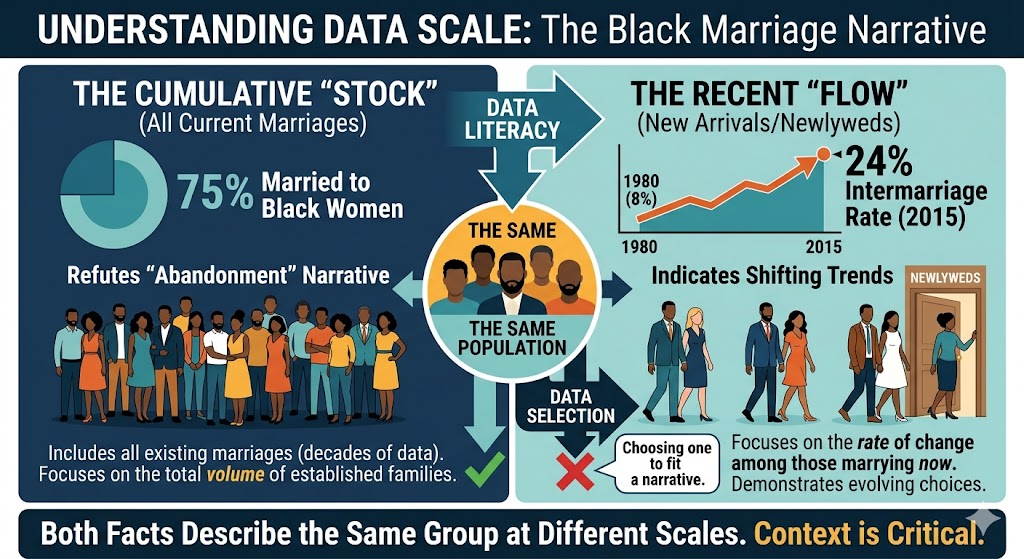
That explanation is accurate as far as it goes, but a rigorous accounting of the data requires a second layer Lautz’s framing does not reach: is this trend driven primarily by preference, or is it also driven by a contracting marriage market that leaves a growing share of Black women building wealth alone by structural necessity rather than by choice? Both can be true simultaneously, and treating them as mutually exclusive is the same interpretive error HBCU Money has flagged before when Black men cite the 75 percent figure, the share of married Black men wed to Black women, as proof that no structural shift is underway in Black partnership formation. That figure is real. So is the fact that Black men have posted the fastest-growing intermarriage rate of any male demographic group in the country, tripling from 8 percent of newly married Black men in 1980 to 24 percent by 2015, concentrated heavily among the most educated and highest-earning men. Among newly married Black adults overall, the gender gap in intermarriage runs 12 points in men’s favor — 24 percent of men to 12 percent of women. Among college graduates specifically, that gap widens to 17 points: 30 percent of Black male college graduates intermarry, against 13 percent of Black female college graduates.

Read against the NAR data, this is not a coincidence sitting beside another coincidence. It is one mechanism producing two visible outcomes. A marriage market in which credentialed Black women face a same-race partner pool contracting faster than any other group’s, compounded by incarceration’s well-documented effect on the available Black male population and a decades-long educational attainment gap that has moved decisively in women’s favor, is a marriage market with a measurable supply-demand imbalance on the women’s side of the ledger. Homeownership is one of the few asset classes a person can acquire entirely alone, without waiting on a partner who may not arrive on the expected timeline or at all. Framed this way, the surge in single Black women’s home purchases looks less like elective wealth-building and more like an institutionally rational hedge against a partnership market that is not behaving the way it does for other groups of women.

This is an accounting, not an accusation, and the distinction matters for how the community responds to it. It is not a claim that any individual man has abandoned anyone, and it is not a claim that any individual woman is buying a home out of desperation rather than ambition — both things NAR’s own qualitative data contradict, since single women report treating homeownership as a deliberate, prioritized financial goal, not a fallback. It is a claim that the aggregate pattern has a structural driver worth naming honestly, because institutions built to respond to “women choosing wealth-building” and institutions built to respond to “a rising share of women building wealth alone because the partnership market has structurally narrowed for them” are not the same institutions, and African America needs the second kind at least as much as the first.

Every functioning institution has a balance sheet, a division of roles based on comparative advantage, and a mechanism for retaining and compounding the capital that enters it. HBCU Money applies this logic routinely to banks, universities, and credit unions. It applies with equal force to the family and it requires the family, as an institution, to be designed for two distinct entry conditions rather than one: capital entering through a partnership, and capital entering through a woman building alone who may or may not partner later. A family-governance framework that only knows how to receive equity once a marriage has already formed is a framework that fails a growing share of the very women generating the equity it is supposed to hold.

Where partnership does form, the economics remain exactly as favorable as they were before this data was added to the picture. A household in which one partner already holds home equity is not a household where one officer outranks another; it is a balance sheet that begins with collateral instead of without it, refinanceable into business capital, deployable as a down payment on a second unit, combinable with a partner’s income to acquire block-level property neither could reach alone. None of that requires the man’s asset to arrive first or match hers in size; it requires a governance norm that allocates roles by comparative advantage rather than gender-coded ego, the same norm any competently run institution already applies to its officers. The men who read a partner’s equity as a threat rather than as capital entering the household are the ones least equipped to benefit from precisely this kind of coordination.

But the institutional response cannot stop at “coordinate better once partnered,” because the data says a meaningful and growing share of the ecosystem’s most credentialed women will be building wealth solo, for a period that may not be temporary. That is where African America’s institutional thinness compounds the problem. A Black-owned bank or credit union — a Citizens Trust, a OneUnited, a Hope Credit Union — is well positioned to build savings and refinance products for solo women building equity as a first-class household unit, not merely as a pre-partnership placeholder waiting to merge into someone else’s balance sheet. Family governance infrastructure; trusts, estate documentation, succession planning for how a solo-acquired home transfers to children, siblings, or reinvests into a next acquisition has to be built around the reality that a growing number of these estates will not have a second adult name on the deed, ever. HBCU business and law programs at Tougaloo, at Fort Valley State, at Coppin State, at Savannah State are positioned to teach family financial governance as a competency that includes solo wealth-holding as a designed-for outcome, not an edge case.

None of this changes the invitation at the center of this piece. A man who understands the full accounting, that Black women are buying homes at a record pace both because they are choosing to and because a structurally contracting partner pool makes solo acquisition a rational institutional hedge has more reason to be inspired, not less. Her closing is not a verdict on him individually; in aggregate, it is a population-level response to conditions that include, among other things, the very intermarriage pattern concentrated among men with his own credentials. That 12-point gap among the overall population widens to 17 points among the college-educated, unmatched by any other racial group in the country, and grows precisely with the credentials, a bachelor’s degree, a stable income, that also predict homeownership readiness. The honest response to that accounting is not resentment and it is not denial. It is building the coordination where partnership exists and building the infrastructure to support solo wealth-holding where it does not because both are now permanent features of the same institutional landscape, and the family, understood as an institution, has to be designed for both.

Maggie Lena Walker did not build her bank for women who were waiting on a partner to arrive before their savings counted. She built it to hold the capital of women who were already building, on whatever timeline their circumstances gave them. The single Black woman closing on a home in 2026 has done her part twice over; she has cleared discriminatory underwriting alone, and she has done it inside a marriage market that data shows is measurably tighter for her than for women of any other group. Whether that asset becomes the founding capital of a functioning family institution, or simply one more well-earned equity position with no institutional structure built to receive it, depends on whether the ecosystem is honest enough to build for the conditions that actually produced it.

Disclaimer: This article was assisted by ClaudeAI.
Two Truths: Yes, Black Men Marry Black Women. They Also Lead the Country in Not Doing That

If you torture the data long enough, it will confess to anything. — Ronald Coase

A particular kind of rhetorical move has become standard in Black online discourse around marriage, and it goes roughly like this: Black women claim that Black men are abandoning them for women of other races. Black men respond that the data proves this is false, that the overwhelming majority of Black men who marry do in fact marry Black women. They cite the statistics. They declare the narrative debunked. They move on, satisfied that they have won the argument with evidence.

They have not won the argument. They have answered a question that was not quite being asked, using data that does not quite say what they think it says while simultaneously being correct. This is the uncomfortable, clarifying reality that neither side of this debate has been willing to sit with: both claims are true, they are not in contradiction, and the failure to understand why is fundamentally a failure of data literacy.

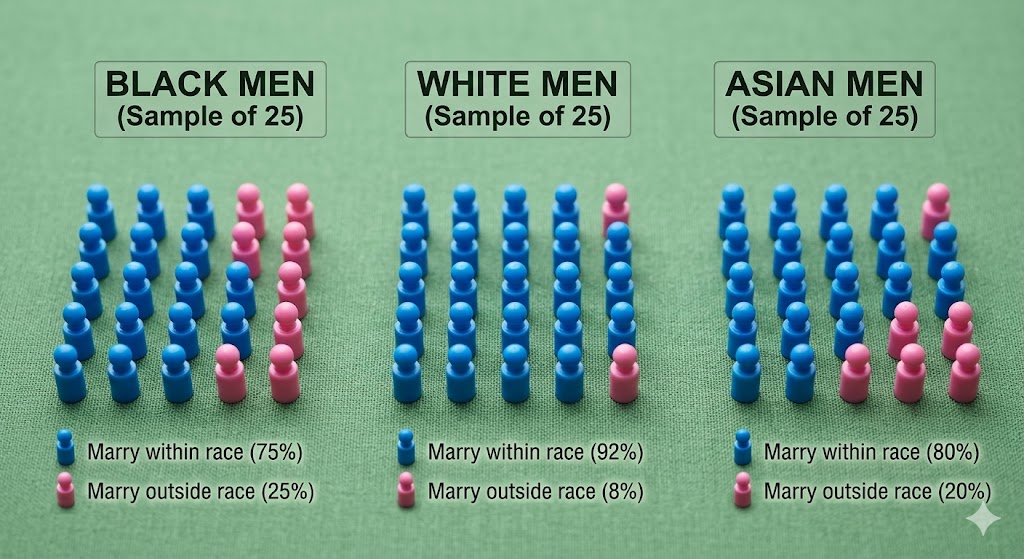
The statistics are not in dispute. According to Pew Research Center analysis of U.S. Census data, roughly 75 percent of married Black men are married to Black women. Among newly married Black men, a more precise cohort that captures current behavior rather than accumulated stock, approximately 64 percent marry Black women. These are majority figures. They are decisive. Any claim that Black men have broadly turned away from Black women as partners cannot survive contact with those numbers, and Black men who cite them in their defense are citing real data correctly.

But here is what that same data also shows, in the same reports, on the same pages: among all groups of men in America, Black men have experienced the fastest-growing intermarriage rate over the past four decades, a rise that is without parallel in the data. In 1980, 8 percent of newly married Black men wed outside the race. By 2015, that figure had reached 24 percent, a tripling of the rate over 35 years, while the Black share of the marriage market remained essentially constant. No other male group comes close to that rate of change.

Intermarriage Rates Among Newly Married Adults, by Race and Gender (Pew Research Center, 2015)

GroupMenWomenGender Gap
Black24%12%12 pts (M higher)
Hispanic26%28%2 pts (F higher)
Asian21%36%15 pts (F higher)
White12%10%2 pts (M higher)

Source: Pew Research Center, “Intermarriage in the U.S. 50 Years After Loving v. Virginia” (2017). Newly married = wed within the prior 12 months.

The comparison table requires some careful reading. Hispanic men, at 26 percent, have a nominally higher intermarriage rate than Black men in absolute terms. But Hispanic intermarriage rates have been essentially flat since 1980, shaped by the consistent arrival of immigrant cohorts who marry within their community before subsequent generations integrate more broadly. The Hispanic figure is demographically stable. The Black male figure is demographically dynamic — it moved, substantially and consistently, across a generation.

Intermarriage Rate Trajectory Among Newly Married Men, 1980 vs. 2015 (Pew Research Center)

Group (Men)1980 Rate2015 Rate
Black men8%24% (+16 pts)
Hispanic men~26%26% (flat)
Asian men26%21% (slight decline)
White men4%12% (+8 pts)

Source: Pew Research Center. Hispanic 1980 figure reflects early ACS-era estimates; trajectory reflects relative stability across the period.

The trajectory table is where the Black male pattern becomes impossible to explain away. A rate that triples over 35 years, in a population whose share of the marriage market did not meaningfully change, is not demographic noise. It is a structural signal. Something changed in the conditions under which Black men form partnerships and the data points consistently toward the same structural variable: education and income mobility. Black men who attain a bachelor’s degree intermarry at 30 percent. Black men without a college degree intermarry at 17 percent. The intermarriage rate is not evenly distributed across the Black male population. It concentrates among those with the credentials and income that predict integration into majority-white professional and social environments.

These two facts are majority intra-racial marriage, fastest-growing intermarriage rate among men describe the same population, measured at different scales. The first is an absolute majority statement. The second is a relative and directional statement about change over time. Neither cancels the other. A community can be predominantly endogamous and simultaneously the demographic group whose male intermarriage rate has grown faster than any other in the country. Both coordinates are necessary to accurately describe the terrain. Choosing to cite only one of them is not data literacy. It is data selection which is a different thing entirely, and always in service of a conclusion reached before the data was consulted.

The impulse behind the selective reading is understandable, even if the execution is flawed. Black men have spent years being characterized in cultural commentary as disloyal, as chasing proximity to whiteness, as leveraging any financial or social ascent to exit the community that produced them. That characterization is often unfair, often reductive, and frequently deployed without statistical grounding of its own. The defensive response, reaching for data that proves the accusation false, is a natural one. But a defensive reading of data is still a compromised reading. When you approach a dataset looking for vindication rather than understanding, you will find the numbers that vindicate you and stop there. The 75 percent figure becomes a shield. The trajectory becomes inconvenient and gets left on the table.

This is precisely what data illiteracy looks like in practice. It is not ignorance of numbers. It is the selective deployment of real numbers to foreclose rather than advance understanding. The person citing the 75 percent is not making a statistical error. They are making an interpretive error by treating a partial truth as a complete one, and treating the absence of explicit contradiction as confirmation. The result is a community that believes it has examined the evidence and settled the question, when in reality it has examined the portion of the evidence that was comfortable and set down the rest.

The gender gap column in the first table is where the conversation should actually be happening. Among every other racial group, the gender intermarriage gap is narrow or runs in the direction of women with Hispanic women and men are essentially equal; Asian women dramatically exceed Asian men; white men and women are within two percentage points of each other. Among Black Americans, the gap is 12 percentage points, and it runs entirely in the direction of men. That gap has been present since at least 1980, and it widens sharply with education: among newly married Black college graduates, 30 percent of men intermarry compared to 13 percent of women. The more education, the wider the gap.

This asymmetry matters because it is not offset. When a Black man marries outside the race, there is no symmetric compensating behavior among Black women. The pool of available same-race partners for Black women, particularly credentialed, economically stable Black women contracts in direct proportion to the Black male intermarriage rate, without equivalent contraction on the other side. Combined with the well-documented effects of incarceration rates on the available Black male population and an educational attainment gap that has shifted decisively toward Black women over three decades, the structural picture that emerges is one of a marriage market with a meaningful and measurable supply-demand imbalance. That imbalance has quantifiable downstream consequences for household wealth formation, given that married households across all racial groups accumulate significantly more wealth than single ones.

None of this is an accusation. It is an accounting. And the distinction matters enormously for how Black communities engage with the question. An accusation calls for defense. An accounting calls for analysis. The man who hears the trajectory data as an indictment of his personal character is reading sociology as if it were a court proceeding. The figures say nothing about any individual’s choices or motivations. They describe population-level patterns with structural determinants, determinants that are, importantly, amenable to institutional response if the community is willing to read the data honestly enough to identify what the actual levers are.

Learning to read data better means, first, understanding the difference between absolute levels and rates of change, and refusing to treat a snapshot as a substitute for a trend. It means placing a number in comparative context not just asking what percentage, but compared to whom, over what period, and moving in which direction. It means sitting with findings that complicate the narrative you prefer, rather than mining the dataset for the figure that ends the conversation on your terms. And it means understanding that two statistics can both be true, can appear to pull in different directions, and can together describe something more accurate and more useful than either describes alone.

Black men are not abandoning Black women en masse. That is true, and the data supports it. Black men have also recorded the fastest-growing intermarriage rate of any male demographic group in America, a rate that has tripled since 1980 and that concentrates among the most educated and economically mobile. That is also true, and the same data supports it. The community that can hold both facts simultaneously without defensiveness and without accusation and ask what structural conditions produce that pattern and what the downstream consequences are for Black household formation and wealth accumulation, is engaging in the kind of rigorous self-examination that serious institutional development requires. The community that cites one number and declares the conversation over is having a different discussion entirely. It is the one that feels better, about a problem it has decided not to fully understand.

Disclaimer: This article was assisted by ClaudeAI.