
Tag Archives: HBCU boosters

The 1.8% Problem: What the Wealth Data Says About NIL’s HBCU Gap

“In a race-based capitalist society, it’s not what you know — it’s what you own.” – Dr. Claud Anderson
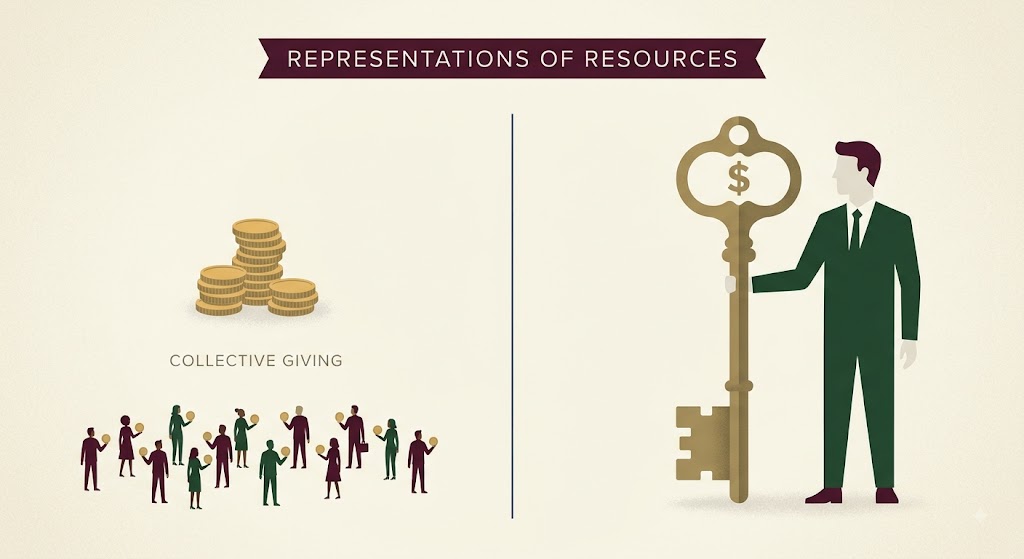
In 1975, a small manufacturing town watched its largest employer announce a new headquarters two counties over. The mayor called a meeting of the leading families and asked them to match the incentive package the rival town had offered. The families were respected, well-connected, active in every civic club in the region but not one of them owned the mill, the bank, or the rail line that had made the town matter in the first place. They owned homes, pensions, and good names. The headquarters left. Two decades later, when a regional grocery distributor scouted the same corridor for a new warehouse hub, it wasn’t the town’s civic reputation that won the deal, it was the fact that, by then, three local families owned the land, the trucking contracts, and the cold-storage facility the distributor needed to move product. Ownership, not affection, decided where capital went.

That distinction between people who care about an institution and people who own enough to move capital toward it is the one that has been missing from nearly every conversation about Name, Image and Likeness and the widening chasm between Historically Black Colleges and Universities and their Power Four counterparts. The prevailing HBCU theory of the NIL era held that Black America’s demonstrable, generational devotion to its football and basketball programs would translate into competitive collective fundraising once the NCAA’s amateurism rules fell. It has not, and it will not, because the premise was never about devotion. It was about ownership, and on that metric the arithmetic was never close.

Consider what happened in West Texas this summer. Texas Tech’s football stadium, known for decades as Jones AT&T Stadium, was renamed Galaxy Stadium in a naming-rights agreement reported at $75 million, replacing AT&T as the venue’s corporate partner. Galaxy Digital is a cryptocurrency and AI-infrastructure company that operates a large data campus in nearby Dickens County, currently undergoing a multibillion-dollar expansion. Its founder and chief executive, Mike Novogratz, is a Princeton graduate. AT&T, the company that held the naming rights before it, is led by John Stankey, a graduate of Loyola Marymount and UCLA. Neither man has any alumni tie to Texas Tech. The deal was not an act of institutional loyalty. It was a commercial transaction, a company with regional infrastructure interests buying brand proximity to a media asset with roughly 60,000 seats and a television footprint. Around the same time, Ripple became the first cryptocurrency sponsor to appear on a college jersey, at the University of Kansas, the alma mater of Ripple’s chief executive, Brad Garlinghouse, but a decision made unilaterally by a founder who controls his company’s marketing budget, not a fundraising campaign that mobilized thousands of small donors.

Compare that to the version of “alumni giving” available to HBCUs. Mark Cuban, a 1981 graduate of Indiana University and among the wealthiest men to build his fortune from a single company he founded and sold, has been a steady donor to his alma mater: roughly five million dollars for a sports media center in 2015, six million for the rugby program, and an undisclosed “big number” more recently funneled toward Indiana’s transfer portal recruiting. These are genuinely generous gifts from a genuinely engaged alumnus. They are also, by an order of magnitude or more, smaller than what a single infrastructure company paid for a stadium’s name. That gap is the entire story. When the money comes from an alumnus who happens to own a company outright, the number is real but bounded by one person’s balance sheet. When the money comes from a corporation with no alumni relationship at all, the number reflects what an asset, the media rights, the stadium, the media market, is worth on the open market, and it dwarfs even the most generous individual gift.

HBCUs have access to neither lever at scale, and the reason is visible in the numbers rather than in sentiment. HBCU Money’s 2024 Annual Wealth Report, drawing on Federal Reserve data, put total African American household assets at roughly $7.1 trillion. Private businesses — the asset class that actually produces boosters capable of writing nine-figure checks — accounted for just $330 billion of that, or 4.7% of African American household assets, and only 1.8% of all U.S. household private business assets. For a population that is roughly 13 to 14% of the country, a 1.8% share of the nation’s private business wealth is not a gap; it is close to an absence, and it is the single most underrepresented major asset category in the entire report relative to population share. Corporate equities and mutual fund shares told the same story from a different angle: also $330 billion, also 4.7% of Black household assets, but a mere 0.7% of total U.S. household equity holdings meaning African American households are not meaningfully participating in the ownership side of public markets either.

What African American households do hold, in scale, is retirement income tied to employment. Defined benefit pension entitlements totaled $1.73 trillion or 24.4% of all African American household assets, and 9.7% of the nation’s defined benefit pension assets, by far the highest representation of any asset category relative to population share. Add defined contribution plans like 401(k)s, another $880 billion and 12.4% of assets, and pension entitlements alone account for nearly 37% of everything African American households own — more than real estate, more than every other asset class combined except real estate itself. That is not a portfolio built by owners. It is a balance sheet built by workers: people whose wealth exists because an employer, public or private, guaranteed them a retirement benefit in exchange for decades of labor, not because they held equity in the enterprise itself. The wealth is real, and the institutions that produced it, often public-sector employers and unionized industries, deserve credit for building it. But a pension check, however large in aggregate, cannot write a stadium naming-rights deal. Only ownership can, and ownership is precisely the asset class where the data shows African American households are furthest from parity.

This is not a story about HBCU alumni failing to show up. It is a story about a capital-formation deficit that predates NIL by a century, rooted in exclusion from mainstream lending, redlining that kept Black-owned enterprise from accumulating the commercial real estate and equity positions that compound into founder-scale wealth, and a labor-market history that concentrated African American economic participation in employment rather than ownership, a history the wealth data confirms is still very much the present, not just the past. NIL simply exposed, in real time and in dollar figures anyone can look up, a gap that institutional strategists have been describing in more abstract terms for years. The mistake was believing that emotional intensity, the unmatched loyalty HBCU alumni show their bands, their homecomings, their institutions could substitute for what only ownership scale provides. It cannot. A hundred thousand donors giving fifty dollars each produces five million dollars and an enormous amount of goodwill. It does not produce seventy-five million dollars, because the mathematics of collective small-dollar giving and the mathematics of a single balance sheet decision operate on entirely different curves.

The strategic response, then, cannot be a better fundraising pitch. It has to be a redirection of where HBCU athletic and institutional leadership spend their effort. Conference-level collective bargaining, SWAC and MEAC schools pooling media rights and NIL infrastructure rather than competing individually for the same small donor base, captures at least some of the scale economics that individual HBCUs cannot achieve alone. Building actual venture and private equity vehicles modeled on efforts like Ariel Investments’ Project Black, which exists explicitly to grow Black-owned enterprises to the scale where their founders become the next generation of nine-figure donors, addresses the underlying ownership gap rather than the symptom. HBCU athletic departments should pursue infrastructure and commercial partnerships on the same terms Galaxy Digital pursued Texas Tech; as deals tied to real assets (media rights, campus real estate, facility co-location) rather than appeals to conscience from companies with no alumni connection to lose sleep over. And alumni giving programs should shift from one-time gifts toward equity-bearing vehicles — alumni investment funds tied to HBCU-linked enterprises — that convert working-professional generosity into compounding ownership stakes rather than annual write-offs.

None of this closes the gap by next season. The wealth data suggests the honest horizon for building an HBCU-linked ownership class capable of matching this kind of capital is measured in decades, not fundraising cycles, the private business share of African American wealth has moved only marginally year over year even as pensions and real estate continued compounding. But the alternative of continuing to ask a donor base of working professionals to out-fundraise infrastructure companies and telecom giants was never a strategy. It was a hope mistaken for one.

Disclaimer: This article was assisted by ClaudeAI.
The Real Game: PWI Athletics Win with Wealth, Not Athletes—And HBCUs Can’t Chase That Model

“The wealthiest boosters and donors to a PWI rarely ever played sports, but they did go build companies and a lot of wealth. Boosters spend hundreds of millions a year to compete with their friends and business competition from rival schools. The money spent is a bigger game than what happens on the field.” – William A. Foster, IV

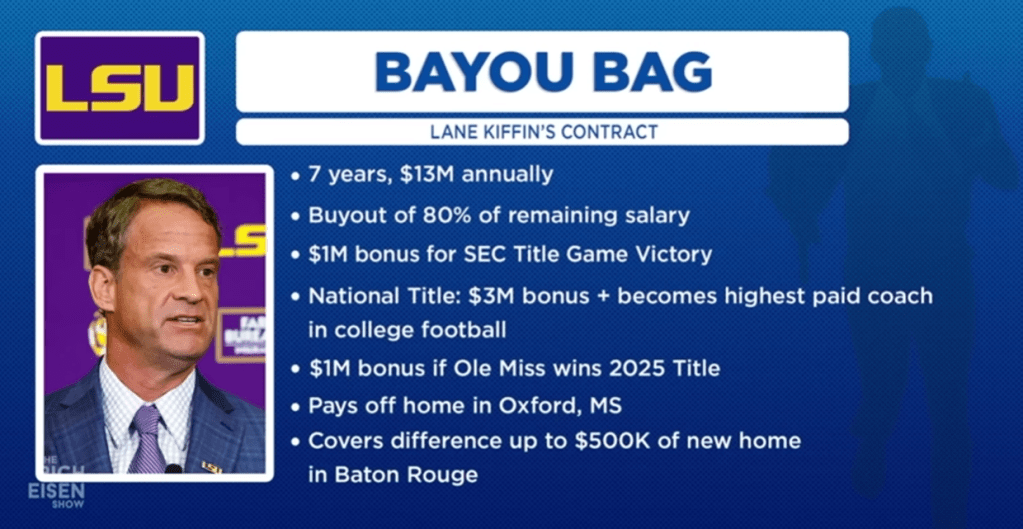
Courtesy of The Rich Eisen Show

The image circulating across sports media this week says everything without trying to explain anything at all. LSU’s new contract offer to Lane Kiffin — seven years at $13 million annually, stacked with multimillion-dollar bonuses, home buyouts, and housing subsidies looks less like a coaching contract and more like a sovereign wealth transaction. It is the kind of deal only an institution backed by generational wealth, mega-boosters, and a national alumni base at the upper end of the economic ladder could produce. Yet every few months a familiar chorus resurfaces insisting that if “only the top African American athletes chose HBCUs,” the financial gap in college athletics would close. The narrative is compelling, emotional, and rooted in cultural longing, but it remains economically false.

The fantasy is seductive: if only more premier African American athletes chose HBCUs, our athletic programs could compete with Predominantly White Institutions (PWIs). If only we could land that five-star recruit, sign that top quarterback, or attract that elite basketball prospect, everything would change. The dream persists in alumni conversations, on social media, and in aspirational fundraising campaigns. But the dream is built on a fundamental misunderstanding of what actually drives college athletic success and it’s costing HBCUs resources they can’t afford to waste. The numbers tell a story that talent alone cannot rewrite.

Lane Kiffin’s new contract with LSU pays him approximately $13 million annually, making him one of the highest-paid coaches in college football. To put this in perspective, Southern University’s entire athletic department operates on total revenues of $18.2 million for fiscal year 2025-2026. One coach at a PWI earns over 70 percent of what an entire HBCU athletic department generates in revenue. This isn’t an aberration it’s the system working exactly as designed.

The disparity becomes even starker when you examine what funds these massive operations. According to an audit report, Southern University Athletics had total revenue of $17.3 million and expenses of $18.9 million in fiscal year 2023, creating a deficit of $1.5 million. Meanwhile, PWI athletic departments operate with budgets in the hundreds of millions. The athletes on the field, no matter how talented, cannot bridge this chasm.

What truly separates PWI athletic programs from HBCU programs isn’t the talent of 18-22 year-olds playing the games. It’s the economic power of the institutions behind them specifically, the size, wealth, and giving capacity of their alumni bases. According to Georgetown University, PWI graduates earn an average of $62,000 annually, compared to HBCU graduates who earn around $51,000. But the income gap is just the beginning of the story. The real disparity lies in generational wealth accumulation and the sheer number of potential donors.

Major PWIs have alumni bases numbering in the hundreds of thousands, often spanning generations of families who have accumulated significant wealth over decades. These institutions benefit from alumni who are CEOs, hedge fund managers, real estate developers, and executives at Fortune 500 companies. Their boosters can write seven-figure checks without blinking. When they want to retain a coach or upgrade facilities, they simply open their checkbooks.

HBCUs represent around 3% of America’s colleges, yet account for less than 1% of total U.S. endowment wealth. The endowment funding gap stands at approximately $100 to $1—for every $100 a PWI receives in endowment money, HBCUs receive $1. This isn’t just about annual giving; it’s about the compound interest of generational investment that HBCUs have never had the opportunity to build.

Corporate sponsors don’t pay for athletic excellence they pay for eyeballs and access to affluent consumer bases. When companies decide where to invest their marketing dollars, they’re calculating the purchasing power and professional networks they can reach through an institution’s alumni base. A company sponsoring a PWI athletic program gains access to hundreds of thousands of alumni with significant disposable income and decision-making power in corporations. The athletes are just the entertainment that delivers this audience. The actual product being sold is access to the alumni network—for recruiting employees, marketing products, and building business relationships.

This is why even if every top African American athlete chose HBCUs, the sponsorship dollars wouldn’t automatically follow. The economic fundamentals would remain unchanged. Companies invest based on return on investment calculations that are tied to alumni wealth and network size, not solely to on-field performance.

The belief that athletic success drives institutional prosperity is perhaps the most dangerous delusion facing HBCU leadership. Even among PWIs, only a tiny fraction of athletic programs actually turn a profit. Most operate at a loss that’s subsidized by the broader university budget, student fees, and institutional transfers. Southern University’s budget shows $2.2 million in “Non-Mandatory Transfer” and $1.4 million in “Athletic Subsidy”—meaning the institution itself must subsidize athletics with nearly $3.6 million in institutional funds. This is money diverted from academic programs, faculty salaries, research, and student services to keep athletic programs afloat.

The PWI athletic model works for PWIs not because athletics are inherently profitable, but because they can afford the losses. They have massive endowments, substantial state funding, and alumni donor bases that can absorb deficits while still funding academic excellence. HBCUs don’t have this luxury. When an HBCU runs a $1.5 million athletic deficit while struggling to pay competitive faculty salaries, upgrade outdated classroom technology, or fund research initiatives, the opportunity cost is devastating. That deficit represents scholarships not awarded, professors not hired, and academic programs not developed.

Some HBCU advocates point to conference television deals and NCAA tournament appearances as potential revenue sources. But here again, the math is unforgiving. Major PWI conferences negotiate billion-dollar television contracts because they deliver large, affluent viewing audiences that advertisers covet. The Big Ten and SEC don’t command massive TV deals because their athletes are more talented they command them because their alumni bases represent valuable consumer demographics. The SWAC and MEAC can’t replicate these deals because they don’t deliver the same audience size and purchasing power, regardless of the talent on the field. Even if HBCUs somehow assembled teams that won national championships, the structural economic advantages would remain with PWIs.

Here’s what proponents of athletic investment don’t want to acknowledge: the marginal difference in talent between a five-star recruit and a three-star recruit is minimal compared to the massive difference in institutional resources. A slightly more talented roster cannot overcome a 10-to-1 or 100-to-1 resource disadvantage.

Consider the logistics: While an HBCU football program might struggle to afford charter flights for the team, PWI programs have dedicated planes, state-of-the-art training facilities, nutritionists, sports psychologists, and medical staffs that rival professional franchises. They have recruiting budgets that allow them to identify and court prospects nationally. They have video coordinators, analysts, and support staff that outnumber many HBCU athletic departments entirely. The game is won with infrastructure, coaching depth, medical support, nutrition, facilities, and recovery technology not just with the athletes on scholarship. And these resources require the kind of sustained, massive funding that only comes from large, wealthy alumni bases and major corporate partnerships.

There is an alternative model that makes sense for HBCUs: the Ivy League approach. Ivy League schools have chosen not to compete in the athletic arms race. They don’t offer athletic scholarships for football. They emphasize academic excellence while maintaining competitive but not dominant athletic programs. Their alumni networks and institutional prestige are built on academic achievement, research output, and professional success not athletic championships.

For HBCUs, this model offers a realistic path forward. Focus resources on academic excellence, research capabilities, and entrepreneurship. Build prestige through intellectual output, not athletic performance. Create value through what HBCUs have always done best: developing future leaders, producing groundbreaking research, and serving their communities.

The Ivy League proves that institutional prestige and alumni loyalty can thrive without major athletic success. No one questions Harvard’s or Yale’s institutional value because their football teams don’t win national championships. Every dollar spent trying to compete in the PWI athletic model is a dollar not invested in what could actually transform HBCU economic outcomes: research infrastructure, entrepreneurship programs, endowment building, and academic excellence.

Research shows that more than half of all students at HBCUs experience some measure of upward mobility, and upward mobility is about 50 percent higher at HBCUs than PWIs. This is the actual competitive advantage HBCUs possess their ability to transform the economic trajectories of students from under-resourced communities. This mission deserves full investment, not the scraps left over after athletic departments consume resources. If HBCUs invested the millions currently subsidizing athletic deficits into research grants, business incubators, technology transfer offices, and endowed professorships, they could create sustainable revenue streams while fulfilling their core mission. They could become engines of wealth creation for African American communities rather than junior varsity versions of PWI athletic programs.

Admitting you can’t win an unwinnable game isn’t defeat it’s strategic wisdom. HBCUs should stop trying to beat PWIs at a game rigged by structural economic advantages they will never possess. Instead, they should redefine success on their own terms.

This means:

Rightsizing athletic budgets to reflect institutional resources and priorities, accepting that competing for national championships in revenue sports isn’t financially viable or strategically wise.

Investing in niche sports and athletic experiences that can be competitive without massive resource requirements and that build campus community without drowning budgets.

Redirecting resources toward academic distinction, particularly in high-demand fields like STEM, healthcare, and technology where HBCU graduates can command premium salaries and build generational wealth.

Building research infrastructure that attracts grants, creates intellectual property, and establishes HBCUs as innovation centers rather than athletic also-rans.

Developing entrepreneurship ecosystems that turn students into business owners and job creators, building the kind of economic power that generates sustained institutional support.

Creating HBCU-specific tournaments and competitions where these institutions can showcase their talents to their communities without subsidizing PWI athletic departments through guarantee games.

The African American community’s love for HBCU athletics is real and deep. The pageantry of HBCU homecomings, the tradition of the bands, the pride of seeing young Black excellence on display these matter. But love sometimes means making hard choices about where to invest limited resources for maximum impact. The question isn’t whether HBCUs should have athletic programs. The question is whether they should bankrupt their academic missions chasing a competitive model they can never win, designed by and for institutions with 100 times their resources.

One coach earning $13 million. One entire athletic department operating on $18 million. The math isn’t subtle. The choice shouldn’t be either.

Until HBCUs build alumni bases with the size, wealth, and giving capacity to compete in the modern college athletic arms race, pursuing the PWI model isn’t ambition it’s financial suicide. The path to HBCU prosperity runs through classrooms and laboratories, not football stadiums and basketball arenas. It’s time to stop chasing someone else’s game and start winning our own.

Disclaimer: This article was assisted by ClaudeAI.