
“In a race-based capitalist society, it’s not what you know — it’s what you own.” – Dr. Claud Anderson
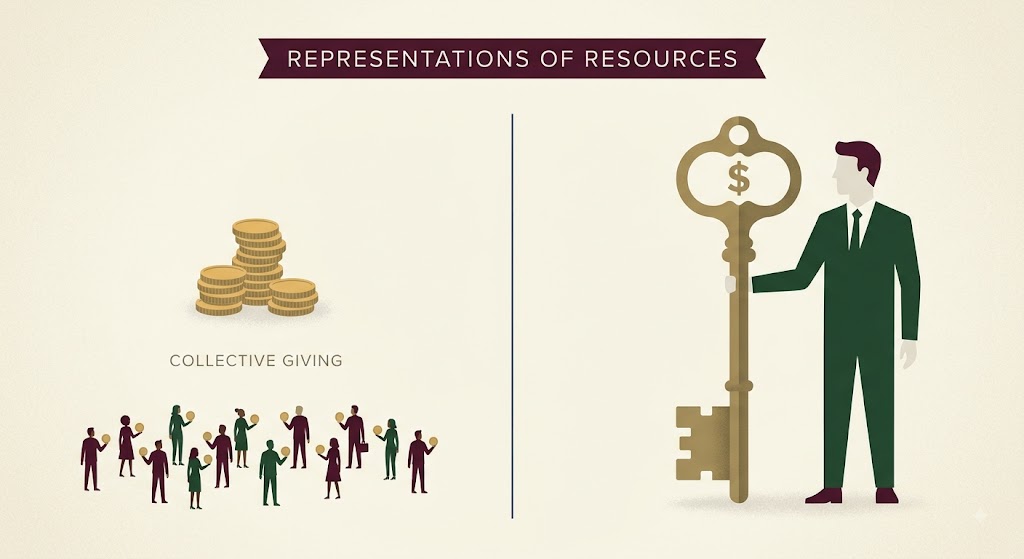
In 1975, a small manufacturing town watched its largest employer announce a new headquarters two counties over. The mayor called a meeting of the leading families and asked them to match the incentive package the rival town had offered. The families were respected, well-connected, active in every civic club in the region but not one of them owned the mill, the bank, or the rail line that had made the town matter in the first place. They owned homes, pensions, and good names. The headquarters left. Two decades later, when a regional grocery distributor scouted the same corridor for a new warehouse hub, it wasn’t the town’s civic reputation that won the deal, it was the fact that, by then, three local families owned the land, the trucking contracts, and the cold-storage facility the distributor needed to move product. Ownership, not affection, decided where capital went.
That distinction between people who care about an institution and people who own enough to move capital toward it is the one that has been missing from nearly every conversation about Name, Image and Likeness and the widening chasm between Historically Black Colleges and Universities and their Power Four counterparts. The prevailing HBCU theory of the NIL era held that Black America’s demonstrable, generational devotion to its football and basketball programs would translate into competitive collective fundraising once the NCAA’s amateurism rules fell. It has not, and it will not, because the premise was never about devotion. It was about ownership, and on that metric the arithmetic was never close.
Consider what happened in West Texas this summer. Texas Tech’s football stadium, known for decades as Jones AT&T Stadium, was renamed Galaxy Stadium in a naming-rights agreement reported at $75 million, replacing AT&T as the venue’s corporate partner. Galaxy Digital is a cryptocurrency and AI-infrastructure company that operates a large data campus in nearby Dickens County, currently undergoing a multibillion-dollar expansion. Its founder and chief executive, Mike Novogratz, is a Princeton graduate. AT&T, the company that held the naming rights before it, is led by John Stankey, a graduate of Loyola Marymount and UCLA. Neither man has any alumni tie to Texas Tech. The deal was not an act of institutional loyalty. It was a commercial transaction, a company with regional infrastructure interests buying brand proximity to a media asset with roughly 60,000 seats and a television footprint. Around the same time, Ripple became the first cryptocurrency sponsor to appear on a college jersey, at the University of Kansas, the alma mater of Ripple’s chief executive, Brad Garlinghouse, but a decision made unilaterally by a founder who controls his company’s marketing budget, not a fundraising campaign that mobilized thousands of small donors.
Compare that to the version of “alumni giving” available to HBCUs. Mark Cuban, a 1981 graduate of Indiana University and among the wealthiest men to build his fortune from a single company he founded and sold, has been a steady donor to his alma mater: roughly five million dollars for a sports media center in 2015, six million for the rugby program, and an undisclosed “big number” more recently funneled toward Indiana’s transfer portal recruiting. These are genuinely generous gifts from a genuinely engaged alumnus. They are also, by an order of magnitude or more, smaller than what a single infrastructure company paid for a stadium’s name. That gap is the entire story. When the money comes from an alumnus who happens to own a company outright, the number is real but bounded by one person’s balance sheet. When the money comes from a corporation with no alumni relationship at all, the number reflects what an asset, the media rights, the stadium, the media market, is worth on the open market, and it dwarfs even the most generous individual gift.
HBCUs have access to neither lever at scale, and the reason is visible in the numbers rather than in sentiment. HBCU Money’s 2024 Annual Wealth Report, drawing on Federal Reserve data, put total African American household assets at roughly $7.1 trillion. Private businesses — the asset class that actually produces boosters capable of writing nine-figure checks — accounted for just $330 billion of that, or 4.7% of African American household assets, and only 1.8% of all U.S. household private business assets. For a population that is roughly 13 to 14% of the country, a 1.8% share of the nation’s private business wealth is not a gap; it is close to an absence, and it is the single most underrepresented major asset category in the entire report relative to population share. Corporate equities and mutual fund shares told the same story from a different angle: also $330 billion, also 4.7% of Black household assets, but a mere 0.7% of total U.S. household equity holdings meaning African American households are not meaningfully participating in the ownership side of public markets either.
What African American households do hold, in scale, is retirement income tied to employment. Defined benefit pension entitlements totaled $1.73 trillion or 24.4% of all African American household assets, and 9.7% of the nation’s defined benefit pension assets, by far the highest representation of any asset category relative to population share. Add defined contribution plans like 401(k)s, another $880 billion and 12.4% of assets, and pension entitlements alone account for nearly 37% of everything African American households own — more than real estate, more than every other asset class combined except real estate itself. That is not a portfolio built by owners. It is a balance sheet built by workers: people whose wealth exists because an employer, public or private, guaranteed them a retirement benefit in exchange for decades of labor, not because they held equity in the enterprise itself. The wealth is real, and the institutions that produced it, often public-sector employers and unionized industries, deserve credit for building it. But a pension check, however large in aggregate, cannot write a stadium naming-rights deal. Only ownership can, and ownership is precisely the asset class where the data shows African American households are furthest from parity.
This is not a story about HBCU alumni failing to show up. It is a story about a capital-formation deficit that predates NIL by a century, rooted in exclusion from mainstream lending, redlining that kept Black-owned enterprise from accumulating the commercial real estate and equity positions that compound into founder-scale wealth, and a labor-market history that concentrated African American economic participation in employment rather than ownership, a history the wealth data confirms is still very much the present, not just the past. NIL simply exposed, in real time and in dollar figures anyone can look up, a gap that institutional strategists have been describing in more abstract terms for years. The mistake was believing that emotional intensity, the unmatched loyalty HBCU alumni show their bands, their homecomings, their institutions could substitute for what only ownership scale provides. It cannot. A hundred thousand donors giving fifty dollars each produces five million dollars and an enormous amount of goodwill. It does not produce seventy-five million dollars, because the mathematics of collective small-dollar giving and the mathematics of a single balance sheet decision operate on entirely different curves.
The strategic response, then, cannot be a better fundraising pitch. It has to be a redirection of where HBCU athletic and institutional leadership spend their effort. Conference-level collective bargaining, SWAC and MEAC schools pooling media rights and NIL infrastructure rather than competing individually for the same small donor base, captures at least some of the scale economics that individual HBCUs cannot achieve alone. Building actual venture and private equity vehicles modeled on efforts like Ariel Investments’ Project Black, which exists explicitly to grow Black-owned enterprises to the scale where their founders become the next generation of nine-figure donors, addresses the underlying ownership gap rather than the symptom. HBCU athletic departments should pursue infrastructure and commercial partnerships on the same terms Galaxy Digital pursued Texas Tech; as deals tied to real assets (media rights, campus real estate, facility co-location) rather than appeals to conscience from companies with no alumni connection to lose sleep over. And alumni giving programs should shift from one-time gifts toward equity-bearing vehicles — alumni investment funds tied to HBCU-linked enterprises — that convert working-professional generosity into compounding ownership stakes rather than annual write-offs.
None of this closes the gap by next season. The wealth data suggests the honest horizon for building an HBCU-linked ownership class capable of matching this kind of capital is measured in decades, not fundraising cycles, the private business share of African American wealth has moved only marginally year over year even as pensions and real estate continued compounding. But the alternative of continuing to ask a donor base of working professionals to out-fundraise infrastructure companies and telecom giants was never a strategy. It was a hope mistaken for one.
Disclaimer: This article was assisted by ClaudeAI.
 HBCU Money