Tag Archives: climate change

Elon Musk Is Wrong: Humanity And The Earth Do Not Need EVs, It Need A Carless Society

“In every walk with nature, one receives far more than he seeks.” – John Muir. 
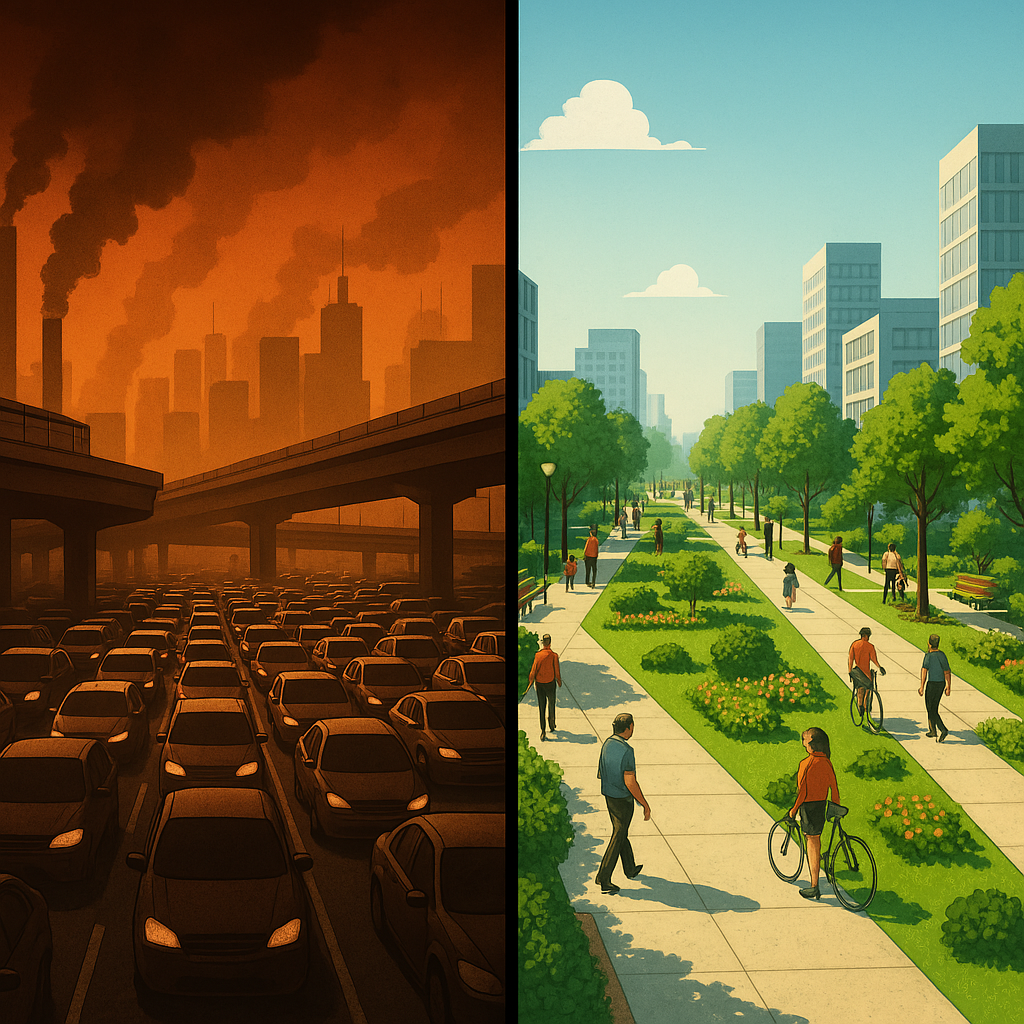
The car did not just change how we move. It changed what we built, what we valued, and who we decided could be left behind. Getting out from under it will require more than a better battery.

In 1956, a city planner in Birmingham, Alabama, submitted a highway routing proposal that would thread the new interstate system directly through Titusville, one of the city’s most prosperous African American neighborhoods. The route was not selected because it was the most efficient path from point A to point B. It was selected because the land was cheap and cheap, in that era, was another word for Black. The families displaced did not receive relocation assistance equal to what they lost. The businesses did not reopen elsewhere. The churches, the insurance offices, the barbershops, the fraternal lodges that had made Titusville a functioning community were scattered. What had been a neighborhood became a slab of elevated concrete moving white commuters from the suburbs to downtown and back. Birmingham was not unusual. From the Tremaine neighborhood in Los Angeles to Rondo in Saint Paul to Overtown in Miami, the same story played out in city after city, funded by the federal government and executed with asphalt. The car did not just reshape American cities. It demolished specific ones, in specific places, inhabited by specific people, for the convenience of everyone else.

This history is the necessary starting point for any honest reckoning with where the automobile has brought us, and why Elon Musk’s vision of an electrified car culture is not a solution to the problem but a continuation of it under a different brand name. The electric vehicle has been marketed as the clean future of personal transportation; zero emissions at the tailpipe, climate guilt absolved, the open road preserved. It is a compelling product. It is not a compelling answer. Because the problem was never just what cars burn. The problem is what cars demand: of land, of household budgets, of city design, of public investment, of the communities that get sacrificed whenever the automobile’s appetite for space needs to be fed.

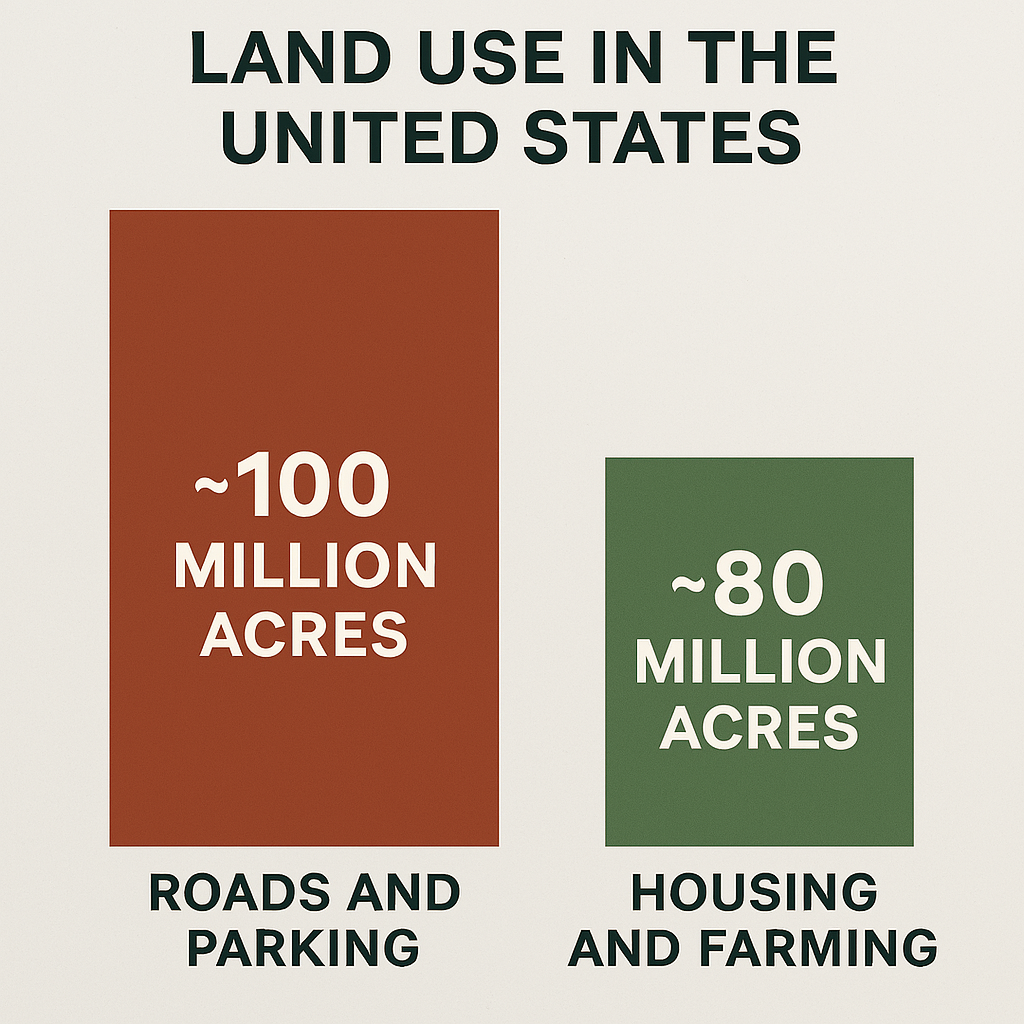
Start with the land. The United States has devoted more than 100 million acres to automobile infrastructure. Roads and highways alone consume roughly 63,000 square miles of land, an area approximately the size of the state of Florida. In dense cities, up to 40 percent of developable land is given over to streets and parking. Los Angeles has more parking spaces than it has people, with estimates placing the number around 18.6 million spots. That land does not produce food. It does not house families. It does not generate the kind of economic activity that funds schools, libraries, or public health systems. It stores machines that sit idle approximately 95 percent of the time. Every one of those acres is an acre that cannot be a home, a garden, a park, a clinic, or a business. The car does not merely use land. It consumes it, and it consumes it permanently, because once you have built a city around the assumption of universal car ownership, every subsequent decision like where to put the grocery store, where to locate the employer, how wide to make the sidewalk, whether to build a sidewalk at all follows from that original premise. You do not escape the logic by electrifying the vehicle. You just power the prison with renewable energy.

Then there is what cars cost the people who own them. In the United States, the average household spends more than $10,000 per year on vehicle ownership, maintenance, fuel, and insurance. For a working-class family earning $50,000 a year, that is 20 cents of every dollar earned going out the door before groceries, rent, or healthcare are even considered. Car ownership is not, for most Americans, a consumer preference. It is a compelled expense, the price of living in a country that built its cities to require a car for every adult who wants to participate in economic life. You need a car to get to the job. You need the job to afford the car. It is a circular dependency that has been engineered into the physical shape of the American landscape over 70 years of federal highway spending and local zoning codes written to mandate parking minimums and prohibit the kind of density that would make transit viable. An electric vehicle does not break that dependency. It makes it slightly cleaner while keeping it fully intact.

The environmental case against EVs as a solution is equally straightforward, even if it gets less attention than the tailpipe emissions story. Electric vehicles require lithium, cobalt, and rare earth metals extracted from mining operations that carry their own significant environmental and human costs much of it borne by communities in Africa Core and South America with limited political leverage to resist it. EV batteries degrade over time and create toxic disposal challenges that the industry does not yet have a credible plan to manage at scale. The electricity that charges those batteries comes, in large portions of the United States, from natural gas and coal-fired power plants. And the roads those vehicles drive on are made of cement and asphalt, which together represent some of the largest sources of industrial carbon emissions in the construction sector. The electric vehicle reduces the carbon footprint of the vehicle itself. It does not reduce the carbon footprint of the system the vehicle requires to function. Musk is not selling sustainability. He is selling the most expensive component of an unsustainable system and calling it a revolution.

The deeper problem with the EV framework is that it forecloses the conversation we actually need to be having, which is about city design. The countries and cities that have most dramatically reduced their transportation emissions and improved their residents’ quality of life have not done so by switching their car fleets from gasoline to electric. They have done so by building cities where you do not need a car to live a full life. In Amsterdam, nearly 40 percent of all trips are made by bicycle. In Tokyo, the train station is the center of commerce, culture, and daily life not the parking garage. In Bogotá, a citywide investment in bus rapid transit and protected bike infrastructure transformed mobility for millions of people who had never been able to afford a car, electric or otherwise. These are not utopian thought experiments. They are functioning cities with lower transportation costs, lower carbon emissions, lower traffic fatality rates, and measurably higher quality of life by most measures than the car-dependent American metropolitan model.
The concept gaining the most traction in serious urban planning and economic research is the “15-minute city” — an urban environment designed so that work, school, groceries, healthcare, and recreation are all accessible within a 15-minute walk or bike ride from home. The idea sounds simple, but its implications are radical. It requires reversing 70 years of zoning policy that has separated where people live from where they work and shop. It requires investing in transit systems rather than highways. It requires eliminating parking minimums that force developers to build garages instead of apartments. It requires, in other words, making a deliberate decision to build cities for people rather than for the machines people currently have no choice but to use. Every one of those decisions is available to American cities right now. Minneapolis has already eliminated single-family zoning citywide. Several American cities have abolished parking minimums. Raleigh, Sacramento, and Spokane are among those that have begun allowing higher-density housing near transit corridors. The policy tools exist. What has been missing is the political will to use them, and a cultural framework that makes the necessity clear.

The political will question brings us back to Musk, because the EV industry’s dominance of the transportation policy conversation has not been a neutral outcome of superior technology. It has been the result of enormous lobbying investment, enormous marketing spend, and the structurally convenient alignment between the EV industry’s interests and the desires of the affluent consumer class that has historically set the terms of American transportation policy. An EV costs, on average, significantly more than a comparable gasoline vehicle. The federal tax credits designed to incentivize EV adoption have disproportionately benefited households with sufficient income and tax liability to claim them. The charging infrastructure being built to serve EVs is concentrated along highway corridors and in affluent urban neighborhoods, not in the lower-income communities where transportation costs consume the highest share of household income and where the greatest public health benefits from reduced tailpipe emissions would be realized. The EV transition, as currently structured, is a premium product for a premium market, marketed as a solution for everyone.

What would a genuine solution look like? It would look like the $200 billion the United States spends annually on road maintenance being progressively redirected toward transit, protected bike infrastructure, and the land use reforms that make both viable. It would look like parking minimums being eliminated in every American city and the resulting land being converted to housing, urban agriculture, and green space. It would look like the elevated highways that bisected Titusville and Rondo and Overtown being removed as has already happened in San Francisco, Milwaukee, and Seoul and the land beneath them being returned to the communities they displaced. It would look like a federal transportation policy that measures success not in lane-miles of highway constructed but in the percentage of Americans who can get to work, school, and the doctor without owning a vehicle.

None of this requires eliminating every car in America. It requires being honest about what the car has cost us and making different choices with the public money that has, for 70 years, been used to optimize for the automobile at the expense of everything else. The planet is not in danger because we drive gasoline-powered cars. It is in danger because we built an entire civilization on the assumption that every adult would own and operate a private motor vehicle, and then constructed a global economy to supply, fuel, insure, park, and repair that vehicle in perpetuity. Swapping the engine type does not change the assumption. It just makes it quieter.

Elon Musk is not a visionary in any meaningful sense of that word when it comes to transportation. He is a very effective entrepreneur (we think) who has identified a product that allows affluent consumers to feel better about a behavior they were already committed to. That is a legitimate business. It is absolutely not a solution to climate change, to urban inequality, to the destruction of walkable communities, or to the 40,000 Americans who die in traffic collisions every year. Those problems require something the EV industry cannot sell: a different way of organizing the relationship between human beings and the places they inhabit. That reorganization begins not in a factory in Texas but in a city council chamber, a zoning board hearing, a transit agency budget meeting, and the accumulated small decisions about what we build, where we build it, and who we decide it is for. The age of the car will end. The only question is whether we end it deliberately, on terms we choose, or whether we wait for the consequences of not choosing to end it for us.

Disclaimer: This article was assisted by ClaudeAI.

Why 1890 HBCUs Must Develop A Joint Tree Nursery: Sowing Legacy, Profit, and Power

“Since new developments are the products of a creative mind, we must therefore stimulate and encourage that type of mind in every way possible.” – George Washington Carver

The 1890 Land-Grant HBCUs were created not out of generosity but from segregation. And yet, over 130 years later, these institutions have carved out vital roles in agricultural education, food systems innovation, and land stewardship within the African American community. With the ever-growing climate crisis, shrinking agricultural landholdings for African Americans, and a glaring need for sustainable economic engines, the case for a joint tree nursery among the 1890 HBCUs is less an idea and more an imperative. The time for silos is over. A joint nursery would allow the 1890s to consolidate resources, amplify research, and plant the seeds—literally and economically—of a new generational legacy.

The Decline of African American Landownership and Ongoing Discrimination

In 1910, African Americans owned between 16–19 million acres of farmland. The years around this period would also see the Red Summer of 1919, when African Americans were violently targeted and lynched—many as punishment for owning land and asserting agency. Today, that number has dwindled to just 5.3 million acres as of 2022, according to the USDA’s Census of Agriculture, representing less than 0.6% of all U.S. farmland.

The decline is not just the result of economic shifts—it is the result of orchestrated policies and racially motivated practices. From the USDA’s long-standing discriminatory loan denials to heirs’ property laws that have gutted intergenerational land transfer, the path of African American landownership has been riddled with legal landmines. The Pigford v. Glickman settlement acknowledged this in part, but much of the damage remains.

The 2022 USDA Census also shows that Black producers make up just 1.4% of all U.S. farmers and generate only 0.5% of all farm-related income. These are not just agricultural figures—they are a ledger of institutional neglect.

A tree nursery jointly stewarded by the 1890 HBCUs could serve as a bulwark against further erosion. It would offer seedlings, training, and enterprise development that support African American landowners, reinforcing land retention, sustainable usage, and intergenerational economic viability.

Political Hostilities Facing HBCUs

Despite their vital role in education, research, and community development, HBCUs—especially 1890 land-grant institutions—have faced persistent political and financial challenges. These institutions continue to experience disparities in state and federal funding compared to predominantly white institutions (PWIs). Some of the key political hostilities facing HBCUs include:

  • Underfunding and Resource Disparities: Many 1890 HBCUs receive significantly less funding than their 1862 land-grant counterparts. Studies have shown that some states fail to allocate matching funds as required by federal law, putting HBCUs at a financial disadvantage.
  • Legislative Attacks on DEI Initiatives: In recent years, political efforts to limit diversity, equity, and inclusion (DEI) programs have targeted HBCUs and other minority-serving institutions. These measures threaten scholarship opportunities, faculty recruitment, and student support services.
  • Land-Grant Inequities: Unlike 1862 land-grant universities, 1890 HBCUs were historically excluded from receiving direct land allocations, resulting in fewer resources to develop agricultural research and extension programs. This inequity continues to hinder the growth of HBCU-led agricultural initiatives.
  • Institutional Wealth Gap: A stark difference exists between the endowments of 1890 HBCUs and their 1862 counterparts. Many 1862 land-grant universities have endowments in the billions, while 1890 HBCUs often operate with significantly smaller financial reserves. This gap limits their ability to invest in infrastructure, research, and large-scale agricultural projects. By collaborating, 1890 HBCUs can leverage collective resources to overcome these financial disparities.
  • Bureaucratic Challenges in Federal Funding: While the federal government provides grants and research funding for HBCUs, bureaucratic red tape often delays disbursement, limiting their ability to expand programs and infrastructure.
  • Hostile Political Climates in Some States: Certain state governments have attempted to merge or close HBCUs under the guise of budget cuts, despite the institutions’ strong academic contributions. These efforts undermine the historical and cultural significance of HBCUs in providing equitable education.

By establishing a joint tree nursery, 1890 HBCUs can leverage collective power to secure funding, build partnerships, and showcase the tangible benefits of investing in Black-led agricultural and environmental initiatives.

Benefits of Developing a Joint 1890 HBCU Tree Nursery

Environmental Sustainability and Climate Change Mitigation

Deforestation and land degradation disproportionately affect African American communities, contributing to environmental injustices such as poor air quality and increased vulnerability to natural disasters. A joint tree nursery among all 1890 HBCUs would:

  • Provide seedlings for reforestation projects in Black-owned lands and underserved communities
  • Help mitigate climate change by sequestering carbon dioxide through afforestation and agroforestry initiatives
  • Promote soil conservation and reduce erosion, particularly in the South, where agricultural practices have historically led to soil depletion

Economic Empowerment and Job Creation

A tree nursery initiative would not only benefit HBCU students and faculty but also offer economic opportunities to local landowners. Potential benefits include:

  • Revenue Generation: HBCUs can sell tree seedlings to farmers, municipalities, and reforestation programs, creating an additional income stream
  • Employment Opportunities: These nurseries can provide jobs for students, alumni, and community members in nursery management, forestry, and agribusiness sectors
  • Support for Black Farmers: Providing affordable seedlings and training on agroforestry practices can help African American landowners diversify their income and maximize land productivity

The Economic Benefits of the Timber Industry

The timber industry presents a lucrative opportunity for African American landowners and HBCUs. A joint tree nursery can serve as a foundation for engaging in sustainable forestry and timber production. Some key economic benefits include:

  • High Market Demand: The U.S. timber industry generates over $300 billion annually, with growing demand for sustainable wood products in construction, paper, and bioenergy sectors
  • Long-Term Investment: Timberland is a valuable asset that appreciates over time, providing generational wealth-building opportunities for Black landowners
  • Carbon Credit Market: African American landowners can participate in carbon credit programs by managing timberlands for carbon sequestration, receiving financial incentives for maintaining forests
  • HBCU Forestry Programs: Expanding forestry education at HBCUs can produce a new generation of Black professionals in timber management, conservation, and agribusiness
  • Sustainable Agroforestry: Integrating tree farming with traditional agriculture can enhance soil health, improve biodiversity, and create additional revenue streams for small-scale farmers

Enhancing Agricultural Education and Research

Many 1890 HBCUs already have robust agricultural programs. Establishing a joint tree nursery would further enrich their curricula by:

  • Offering hands-on training in silviculture, agroforestry, and nursery management
  • Creating research opportunities in sustainable land management, biodiversity conservation, and climate resilience
  • Facilitating collaborations with government agencies, non-profits, and private sector partners in reforestation and urban greening initiatives

Cross-Institutional Leverage: Strength in Numbers

A joint venture allows for economies of scale. Rather than every 1890 HBCU creating a small, under-resourced nursery, a consortium-based model allows for regional specialization and centralized management. One school could lead genetic research, another logistics, and another economic modeling. By specializing within the larger system, each institution contributes to a whole far greater than its parts.

Shared governance would also model cooperative economics for students and landowners alike—an important lesson in collective power for African American institutions that have long been made to compete rather than collaborate.

Community Wealth Building

The ultimate beneficiaries of this nursery aren’t just students or the HBCUs themselves—but the millions of African American families with access to underutilized or at-risk land. With the right training, seedlings, and partnerships, that land can be revitalized. It can produce not only timber but herbs, fruits, shade, and carbon credits.

The nursery becomes the beginning of a longer story—of community land trusts, green business corridors, and intergenerational financial literacy built around land-based wealth.

Seeding Sovereignty: A Strategic Call to Action

Developing a joint tree nursery among all 1890 HBCUs is more than an agricultural endeavor. It is an act of economic strategy, cultural restoration, environmental justice, and institutional collaboration. It’s about controlling the seed, the soil, and the story.

HBCUs have always been tasked with doing more with less. The joint nursery is an opportunity to do more—together—and build an enduring institutional asset rooted in cooperation, conservation, and community wealth.

Moreover, this initiative holds symbolic power. In the act of planting trees, 1890 HBCUs will be planting legacy—sending a signal that African American institutions are prepared not only to survive hostile economic climates, but to thrive through collective will. Trees are not short-term investments; they require long-term vision, care, and commitment—just like the kind of intergenerational institution-building African America must embrace.

The nursery would also be an anchor institution for Black innovation in climate tech, agroforestry finance, and regional ecosystem services. The act of growing trees connects economics with ecology, and by anchoring that process within the halls and lands of 1890 HBCUs, we bring knowledge production, carbon markets, and green workforce development under African American institutional ownership.

This is more than sustainability—it is sovereignty. The type of sovereignty that rewrites narratives around Black land loss, economic disempowerment, and environmental marginalization. In a future where climate, capital, and culture will increasingly intersect, the 1890 HBCUs must see a joint tree nursery not as a boutique project but as a national imperative rooted in Pan-African strategy and local resilience.

The seeds of sovereignty are ready. The land is waiting. The only question is whether the institutions tasked with leading our communities into the future will plant now, or later—when the cost of delay may be too great to bear.

The Finance & Tech Week In Review – 6/10/17

Every Saturday the HBCU Money staff picks ten articles they were intrigued by and think you will enjoy for some weekend reading impacting finance and tech.

3 ways to make rich #Africa work for poor Africans / WEF wef.ch/2t2glab

After replacing 90% of employees with robots, this company’s productivity soared / WEF wef.ch/2s93K5r

Does more financial development lead to more or less economic volatility? / St. Louis Fed bit.ly/2qWCaYq

Big animals, small budgets: why poorer countries are leading the conservation charge / WEF wef.ch/2qvnymv

What kind of financial challenges did small businesses face last year, & how did they address them? / St. Louis Fed bit.ly/2svCmic

China’s Clean Air Challenge: $3 Billion Air Pollution from Transport in Chengdu / Renewable Cities buff.ly/2s0xTX4

US Coral Reefs Not Likely To Last More Than A Few Decades / Clean Technica ow.ly/RmT930ctq9J

People’s blood sugar levels respond differently to different breads. / Science News ow.ly/i3x730ctq67

Study: Dogs understand fair play, and not because of humans / New Atlas newatl.as/2sMhWlx

Ripped-off ravens sure can hold a grudge / New Atlas newatl.as/2rVH752

The Finance & Tech Week In Review – 1/14/17

zu3yfgjbqpaifw5vkjxp

Every Saturday the HBCU Money staff picks ten articles they were intrigued by and think you will enjoy for some weekend reading impacting finance and tech.

  • How will we power the planet without wrecking the climate? / Nova PBS to.pbs.org/2jNIxx1
  • Small businesses are prime targets for cyberattacks: SIEM-as-a-service can help / CIO Online ow.ly/13Te307ZH8Z
  • Mini fire extinguishers inside lithium batteries may stop blazes / New Scientist bit.ly/2im4hjc
  • Harvester ants farm by planting seeds to eat once they germinate / New Scientist bit.ly/2im9Y0M
  • Here’s how much Tesla will require EV owners to pay to charge up / CIO Online ow.ly/qsm1307ZGKf

The Finance & Tech Week In Review – 1/7/17

zu3yfgjbqpaifw5vkjxp

Every Saturday the HBCU Money staff picks ten articles they were intrigued by and think you will enjoy for some weekend reading impacting finance and tech.

Mozambique’s poverty reduction was only half as fast as what Sub-Saharan Africa achieved.@WBPubs wrld.bg/fGUH307nxky

Is economics education failing?@wef wef.ch/2hXUMa2

These are the values shared by the most innovative companies@wef wef.ch/2i5cXKr

Climate change and growth risks@nberpubs bit.ly/2iZxJZh

Faster and cheaper than Concorde, meet the next-generation supersonic passenger jet@wef wef.ch/2jbYf0R

Your walk could be a password that connects devices on your body@newscientist ow.ly/6XK2307MkQn

Dell’s new laptop leaves the power cord in the past@nwtls ow.ly/vaj8307MkGZ

This robot can beat you at chess, then serve you coffee@CIOonline ow.ly/Xhph307Mkwc

Scar-free wound healing could be on its way@nwtls ow.ly/iNLh307Mks7

Baltimore Bike Share Arrives With 40% Electric Fleet@cleantechnica  ow.ly/GCKt307Mkjs