Category Archives: Investing

What Berkshire Buys Next: The Five Giants That Fit Buffett’s Playbook

In Omaha, Berkshire Hathaway’s cash pile has grown so large that even Wall Street marvels at its inertia. With over $380 billion in cash and short-term Treasuries, the conglomerate is sitting on more dry powder than most central banks. Yet Warren Buffett and his successor, Greg Abel, have long maintained that capital must only move when the odds of permanent capital loss are near zero.

Now, with global markets resetting post-2020 stimulus and inflation anchoring valuations, the question becomes: what could Berkshire buy next that would be both large enough to matter and philosophically sound enough to pass Buffett’s test of simplicity, durability, and trust?

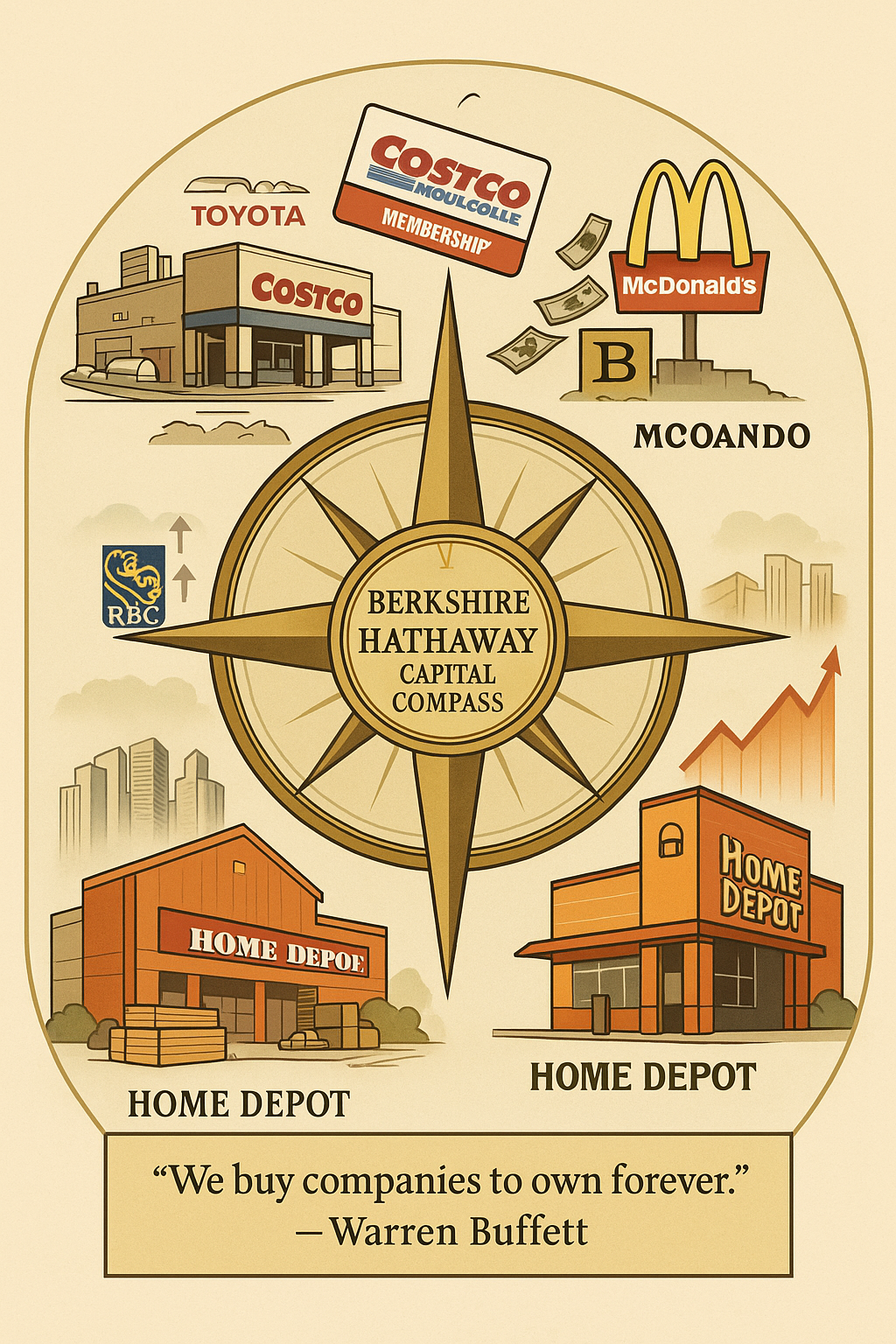
The five most plausible candidates — Costco, McDonald’s, Home Depot, Royal Bank of Canada, and Toyota — each satisfy that mix of prudence, predictability, and permanence that defines Berkshire’s century-long strategy of buying “businesses, not tickers.”

Buffett’s philosophy has been remarkably consistent for over six decades: buy simple, cash-rich, moated businesses led by trustworthy managers. Berkshire’s model of quasi-permanent ownership, decentralized operations, and disciplined capital allocation has made it the corporate equivalent of a sovereign wealth fund — except its sovereign is capitalism itself.

Greg Abel, the man expected to succeed Buffett, has only reinforced this model. Coming from Berkshire Energy, Abel represents the “real economy” side of the house preferring tangible assets, regulated returns, and predictable cash flow over the exuberance of speculative innovation.

Hence, the next Berkshire deal is not likely to be an AI startup or fintech disrupter. It will be a “forever asset” — a company that compounds quietly and defends its margins under any macro regime.

Given Berkshire’s sheer scale of over $1 trillion in market capitalization a target must have an enterprise value north of $200 billion to meaningfully “move the needle.” Anything smaller, and the math of compounding becomes negligible.

🧩 The Berkshire Universe: Themes and Tendencies

Berkshire’s portfolio reads like a map of the American and global economy’s most reliable arteries:

CategoryCore HoldingsTraits
FinancialsAmEx, Bank of America, Moody’s, ChubbHigh ROE, capital-light, recurring revenue
Consumer StaplesCoca-Cola, Kraft Heinz, DiageoGlobal brands, predictable demand
Energy / IndustrialsChevron, Occidental, MitsubishiReal assets, inflation hedge
TechnologyApple, Amazon (small), VeriSignCash-rich ecosystems
Infrastructure / InsuranceBNSF Railway, BH ReinsuranceTangible durability, “float” generation

This structure provides a blueprint for what comes next: reinforcement, not reinvention. Berkshire rarely pivots; it doubles down on what works. It will seek businesses that (1) resemble what it already understands, and (2) offer inflation-protected earnings streams in a world of higher nominal rates.

From the universe of firms valued between $200 billion and $450 billion, only a handful exhibit the balance of predictability, management integrity, and strategic fit Berkshire demands.

A closer look through Buffett’s filters narrows the field to Costco, McDonald’s, Home Depot, Royal Bank of Canada, and Toyota. Each operates in a sector Berkshire already knows and each represents a bridge between the company’s past and its post-Buffett future.

1. Costco Wholesale (Ticker: COST)

The Cult of Value Meets the Culture of Discipline

Buffett has long admired Costco’s operating model. It is a retailer that sells everything from fresh salmon to fine jewelry but in truth, it sells trust. Its membership model generates annuity-like revenue, while its relentless efficiency and scale provide a durable moat against both inflation and digital disruption.

Charlie Munger, Buffett’s late partner, once served on Costco’s board and famously said, “Costco is one of the most admirable capitalistic institutions in the world.” That legacy alone makes a partial acquisition symbolically powerful.

While a full buyout (market cap ≈ $405 billion) may be too expensive, a 20–30% stake would make sense. It would give Berkshire exposure to global consumer spending and provide a stabilizing counterpart to its stake in Apple, a brand built on loyalty, not leverage.

In the age of shrinking retail margins, Costco remains an inflation hedge, its pricing power born from scale, not greed. Buffett has always preferred such quiet dominance.

2. McDonald’s (Ticker: MCD)

Fast Food, Slow Capital

If there were ever a brand that personifies Buffett’s doctrine of “durable competitive advantage,” it is McDonald’s. With over 40,000 locations in 100+ countries and a business model centered on franchised cash flow, McDonald’s is the quintessential predictable earner.

Its asset-light structure means free cash flow margins north of 25%, while its real-estate footprint functions as an embedded REIT. In a world of digital payments, delivery, and global inflation, McDonald’s pricing agility is unmatched. It can raise prices by 5% globally without denting demand, a privilege of brand addiction.

Moreover, McDonald’s cultural synergy with Coca-Cola (another Berkshire cornerstone) cannot be overstated. Both are global empires built on ubiquity, habit, and nostalgia. A merger of ownership philosophy, if not of products, would anchor Berkshire’s consumer-staples dynasty for another half-century.

At ~$218 billion market cap, McDonald’s is one of the few full-scale acquisitions Berkshire could realistically afford outright.

3. Home Depot (Ticker: HD)

Owning the American Rebuild

Buffett once said that he bets on the “resilience of the American homeowner.” Home Depot, valued around $372 billion, is the most efficient expression of that belief.

As infrastructure spending rises and housing shortages intensify, Home Depot sits at the crossroads of construction, repair, and consumer credit. Its business model converts cyclical demand into steady dividend growth. For Berkshire, already owning materials firms and insulation producers, a significant stake in Home Depot would complete a “vertical household economy” from supply chain to consumer.

Its store footprint and brand loyalty parallel BNSF’s railroad network: both are national arteries essential to the domestic economy. Buffett loves owning irreplaceable distribution infrastructure and Home Depot’s logistics system is precisely that.

4. Royal Bank of Canada (Ticker: RY)

The Conservative Bank That Would Make Carnegie Smile

Berkshire’s financial core is deep, but largely American. A Royal Bank of Canada acquisition would expand its footprint across North America’s second-largest and most stable financial system.

RBC’s strengths are conservative underwriting, dominant market share in wealth management, and a culture of steady, compounding profitability which mirror Buffett’s historical love of American Express and Bank of America.

Moreover, Canada’s heavily regulated banking environment protects incumbents from competition. Berkshire thrives in such “wide-moat oligopolies.”

At a market cap of $208 billion, the bank is small enough for a full acquisition but large enough to deploy Berkshire’s idle cash meaningfully. It would also diversify currency exposure and hedge U.S. economic concentration, a quiet, Abel-style move.

5. Toyota Motor Corp. (Ticker: TM)

Japan’s Crown Jewel of Industrial Resilience

Berkshire already owns minority stakes in five major Japanese trading houses, a calculated bet on the nation’s industrial discipline. Extending that strategy into Toyota would be the logical next step.

Toyota’s balance sheet, manufacturing excellence, and hybrid-vehicle leadership make it a quintessential “Buffett business” hidden inside an automaker. Unlike the tech-saturated EV startups, Toyota’s philosophy of gradual innovation, prudence, and reliability mirrors Berkshire’s own.

The two even share a cultural ethos: long-termism over trend-chasing.

At roughly $268 billion market cap, a 10–20% strategic stake would echo Buffett’s Japanese diversification theme without the regulatory complexity of a full acquisition. It would also position Berkshire for the eventual rise of hybrid and hydrogen vehicles in emerging markets, aligning with its energy portfolio’s shift toward renewables.

💰 Financial Feasibility: Deploying $250 Billion Wisely

Even Berkshire’s cash hoard has limits. Deploying $150–$250 billion must pass both the Buffett test (certainty of cash flow) and the Abel test (inflation resilience).

A possible portfolio of acquisitions could look like this:

TargetMarket Cap (USD)Likely ApproachStrategic Rationale
Costco$405B20–30% stakeGlobal retail + subscription revenue
McDonald’s$218BFull acquisitionCash flow, brand power, inflation hedge
Home Depot$372B20–30% stakeU.S. infrastructure exposure
Royal Bank of Canada$208BFull acquisitionNorth American financial expansion
Toyota$268B10–20% stakeJapan industrial diversification

In total, such a deployment would utilize around $200 billion, leaving liquidity for buybacks and opportunistic purchases.

This mirrors Berkshire’s historical pattern: buying large minority stakes in global champions, then waiting for market corrections to accumulate more — the “silent control” strategy that has defined its rise.

Strategic Summary: The Post-Buffett Blueprint

The post-Buffett Berkshire era will be one of institutional continuity, not radical change. Greg Abel’s likely leadership ensures that the company remains disciplined, risk-averse, and industrially grounded.

These five potential acquisitions — Costco, McDonald’s, Home Depot, Royal Bank of Canada, and Toyota — collectively represent Berkshire’s five pillars of permanence:

  1. Consumer Trust (Costco) – Loyalty as an economic moat.
  2. Everyday Habit (McDonald’s) – Cash flow as culture.
  3. Infrastructure (Home Depot) – Building the backbone of America.
  4. Finance (RBC) – Conservative capital compounding.
  5. Industry (Toyota) – Global operational excellence.

Each adds a layer of diversification without diluting Berkshire’s DNA. Together, they form a defensive fortress against inflation, technological disruption, and economic cycles — precisely the environment Berkshire was built to survive.

For HBCU endowments and African American institutional investors, Berkshire’s approach holds a powerful parallel. The key lesson is patience married to scale. Berkshire’s compounding model demonstrates how disciplined reinvestment — not speculative churn — builds generational wealth.

Like Berkshire, HBCU financial ecosystems can create “institutional compounding engines” by investing in enterprises that share cultural familiarity, operational durability, and intergenerational value. Buffett calls it “the joy of owning good businesses forever.”

For African American institutions, that translates to owning — not merely funding — the infrastructure of our own economies.

Berkshire Hathaway stands at an inflection point. The post-Buffett era will not be about reinvention but reaffirmation — proving that its model of ethical capitalism can persist without its founding prophet.

The five plausible acquisitions ahead — Costco, McDonald’s, Home Depot, Royal Bank of Canada, and Toyota — are not just balance-sheet moves; they are philosophical statements.

Each embodies what Buffett has called the “virtue of patience in a speculative age.” And as markets oscillate between AI euphoria and geopolitical anxiety, Berkshire remains what it has always been: a monument to quiet power and compounding discipline.

For long-term investors — from sovereign funds to HBCU endowments — that discipline remains the truest asset class of all.

Disclaimer: This article was assisted by ChatGPT.
Pan-African Capital: HBCU Endowments, African American Banks, and Kenya’s Growth Story

“When HBCU endowments and African American banks act together, they stop being small players. They become a financial force that nations must reckon with.” – HBCU Money Editorial Board

In the next several decades, the fault lines of global growth will not run through New York or London but through Nairobi, Lagos, and Accra. Kenya, sitting at the intersection of East Africa’s financial corridor and global trade routes, has become a laboratory for innovation in fintech, agriculture, and infrastructure. Yet despite centuries of cultural, spiritual, and blood connections, African America remains structurally absent from this new frontier of opportunity. Our financial institutions and HBCU endowments are under-leveraged in international markets, particularly in Africa, even as Asian, European, and Middle Eastern investors carve out dominant positions. For African American financial institutions and HBCU endowments, Kenya represents more than just an emerging market. It is a strategic stage for institutional wealth-building, geopolitical leverage, and reconnecting the African Diaspora through shared prosperity. The opportunity lies not simply in making isolated investments but in creating transatlantic joint ventures that bring together capital, expertise, and institutional strategy.

Kenya is more than safari brochures and tourist postcards. Its economy has quietly matured into one of Africa’s most diversified. With a GDP of over $110 billion and growth rates consistently outperforming many global peers, Kenya is often referred to as East Africa’s economic anchor. Nairobi has developed into the region’s financial hub, hosting multinational headquarters, stock exchange operations, and a robust startup ecosystem. Agriculture remains central, with Kenya exporting coffee, tea, and horticultural products while seeking to expand into value-addition agribusiness. Technology is another frontier, with Nairobi’s “Silicon Savannah” serving as a magnet for fintech, led by the global success of M-Pesa. Rapid urbanization fuels infrastructure and real estate demand, while Kenya’s leadership in geothermal and renewable energy has made it a global model. For African American institutions, the attraction lies not only in the growth metrics but in the alignment of needs: Kenya seeks patient capital, educational partnerships, and trusted diaspora allies, while African American institutions seek diversification, higher yields, and independence from U.S.-centric markets.

Despite African America’s aggregate $1.8 trillion in consumer spending, the community’s institutional capital remains modest. Only a handful of Black-owned banks, credit unions, and venture firms exist, and most hold under $1 billion in assets. HBCU endowments combined are less than $4 billion—an amount dwarfed by single Ivy League endowments. Yet within these constraints lies enormous potential. African American financial institutions already possess the regulatory infrastructure to pool and allocate capital, while HBCU endowments, though smaller in scale, carry moral weight and symbolic capital that can unlock global partnerships. Together, these institutions can create vehicles for international deployment of African American wealth, something that has been absent throughout our history. Imagine a pooled investment fund where Howard University, Spelman College, and Florida A&M commit $25 million collectively, matched by $25 million from Black-owned banks. That $50 million fund could be deployed into Kenyan agritech ventures, renewable energy projects, or commercial real estate. The collaboration would be historic: an African Diaspora financial ecosystem investing directly in Africa’s future.

The reasons to prioritize such engagement are strategic. Diversification is one. U.S. capital markets are increasingly low-yield for small institutional investors, while African markets offer higher growth potential and uncorrelated returns. Another is first-mover advantage. Unlike European or Asian investors, African American institutions do not carry the baggage of colonial relationships, which makes trust-based partnerships more viable. Transnational investment also provides institutional leverage. Just as Jewish, Irish, and Italian communities have leveraged diaspora ties for economic and political power, African Americans can build similar networks of influence. Beyond finance, there is the educational pipeline. HBCUs can link faculty, students, and alumni into research, study abroad, and entrepreneurial ventures tied to investments in Kenya. And finally, there is legacy. These investments address the absence of transgenerational institutional wealth that has long defined the African American economic condition.

The structures to achieve this vision can be diverse. A Diaspora investment fund pooling capital from HBCU endowments, Black-owned banks, and other African American institutions could professionally manage investments in Kenya. Public-private partnerships could align capital with Kenya’s infrastructure push in transport, energy, and housing. Venture capital and startup accelerators in Nairobi could connect HBCU students with Africa’s entrepreneurial scene while generating equity returns. Real estate investment trusts, driven by Nairobi’s urbanization, could provide stable income streams. Even education-linked ventures in e-learning and vocational training could generate both profit and intellectual reciprocity.

The barriers are real but not insurmountable. Kenya requires foreign investors to comply with incorporation, licensing, and work permit laws, which demand careful navigation. Currency risk from fluctuations in the Kenyan shilling must be hedged. Information gaps are wide, with many African American institutions unfamiliar with African business environments, highlighting the need for trusted partnerships and research. The relatively small scale of HBCU endowments makes collaboration indispensable. Above all, transparent governance and professional management are critical to avoid reputational risk. Yet none of these barriers are unique. European, Asian, and African investors face them daily and manage to thrive.

This is not only an economic project but a political one. The creation of a formal African American–Kenya Investment Council, for example, could coordinate through the Four Points Chamber of Commerce, HBCUs, and Kenyan universities to advocate for favorable treaties, tax incentives, and research collaborations. African American institutions investing abroad alter the narrative at home: no longer just a constituency asking for inclusion, but a global economic player with interests that stretch across the Atlantic. Such evolution creates leverage in Washington, Wall Street, and international forums.

Take agritech as a concrete example. Kenya’s agricultural sector employs over 60 percent of its labor force, yet productivity remains limited by technology and infrastructure. African American banks could co-finance ventures in irrigation, cold storage, and logistics platforms. HBCUs such as Tuskegee and Prairie View A&M could supply expertise in agricultural science and training. The returns could be strong, while the ventures also address food security and climate resilience—issues central to Africa’s stability. This is an example of investment tied not only to financial return but to global relevance.

The deeper point is that these ventures embed African American institutions into Africa’s growth story. They create a new narrative where HBCU students intern at Nairobi startups, Kenyan entrepreneurs raise capital from African American banks, and families on both sides of the Atlantic see tangible proof that the Diaspora is not fragmented but interwoven. In a world where capital dictates influence, these ties are transformative. They represent not just diversification but restoration, an opportunity to re-knit the fabric of a dispersed people through shared prosperity.

The cost of inaction is steep. China has entrenched itself in Kenya and across Africa through the Belt and Road Initiative. Gulf states are investing heavily in energy and real estate. European firms continue to capture opportunities in agriculture and infrastructure. If African American institutions remain passive, they will again watch as others define Africa’s economic trajectory, forfeiting both profits and influence. Worse, they will remain locked in a domestic cycle of undercapitalization and marginalization, failing to establish the transatlantic presence that could transform their institutional standing.

For too long, African America has celebrated individual success while neglecting institutional power. The result has been wealth without leverage and influence without permanence. Kenya and the wider African continent present a chance to reverse this trajectory. African American financial institutions and HBCU endowments can seize the opportunity by building joint investment vehicles that are ambitious, strategic, and collaborative. To invest in Kenya is to invest not only in profitable ventures but in the future of a Diaspora united by shared capital, shared strategy, and shared destiny. The transatlantic bridge is waiting to be built. The question is whether African America will summon the courage, coordination, and vision to cross it.

Step-by-step practical framework that African American financial institutions and HBCU endowments could follow to launch their first $50 million joint Kenya investment fund:

Imagine a handful of African American bank CEOs and HBCU endowment chiefs sitting together in a boardroom. The room is filled with cautious optimism. They know that together, they control billions in assets. What they don’t yet have is a proven model for working together to extend institutional power abroad. That meeting marks the first step: the coalition. A steering committee is formed, with voices from banking, academia, and outside advisors who know Kenya’s economic landscape. Their mandate is clear—launch a fund that delivers returns, but also anchors a new Pan-African economic relationship.

Step 1: Establish a Foundational Coalition

  • Identify core partners: Secure commitments from 3–5 African American banks and 5–7 HBCUs with at least $50M in combined investable capital.
  • Set up a steering committee: Include representatives from bank leadership, HBCU endowment managers, and external advisors with Africa market expertise.
  • Define purpose: Clearly state the dual mission: generating strong financial returns while building a bridge for institutional Pan-African economic partnerships.

The first order of business is to commission a feasibility study. Consultants with expertise in Kenya’s political economy, regulatory framework, and sector opportunities are hired. They map out the terrain: Kenya’s fast-growing fintech sector, renewable energy projects feeding off abundant solar and wind, agribusiness tied to both domestic and export markets, and logistics hubs serving East Africa’s gateway economy. Risks are weighed—currency volatility, regulatory hurdles, political cycles—but so are opportunities. The committee sees promise.

Step 2: Commission a Feasibility Study

  • Hire consultants with Kenya expertise: Legal, financial, and political economy experts based in both the U.S. and Kenya.
  • Sector focus analysis: Prioritize sectors Kenya is inviting foreign direct investment into—agriculture, fintech, renewable energy, real estate, and logistics.
  • Risk assessment: Evaluate currency volatility, repatriation policies, political stability, and regulatory compliance.

Next, the legal and financial scaffolding of the fund takes shape. They agree on a traditional GP/LP structure based in the U.S. for investor familiarity, with a Kenyan arm for local operations. Banks pledge their first tranches—perhaps $5M each. HBCUs, with smaller endowments but a deep sense of mission, contribute $2–3M apiece. Collectively, the first commitments reach $30M, enough to begin building credibility. The remaining capital will come from outside partners.

Step 3: Create the Legal & Financial Structure

  • Fund structure: Decide whether the vehicle will be a private equity fund, venture fund, or blended finance model.
  • Jurisdiction: Likely establish a U.S.-based LP/GP model for investor confidence, with a Kenyan subsidiary or partnership entity.
  • Capital commitments: Each bank and HBCU pledges proportional investments. Example: 3 banks commit $5M each, 7 HBCUs commit $2–3M each, plus matching funds from development finance institutions.

Those partners are cultivated carefully. Calls are made to the African Development Bank, IFC, and the U.S. International Development Finance Corporation. Each sees value in a diaspora-led fund connecting capital from the African American community to African markets. Meanwhile, Kenyan pension funds and cooperatives are invited to co-invest. Diaspora high-net-worth individuals are offered side-car vehicles. With these anchor and matching partners, the fund’s $50M target is within reach.

Step 4: Secure Anchor & Matching Partners

  • DFIs and multilaterals: Approach institutions like African Development Bank (AfDB), U.S. International Development Finance Corporation (DFC), and IFC for co-investments.
  • Kenyan institutions: Partner with local pension funds, cooperatives (SACCOs), or universities to establish local credibility and co-ownership.
  • Diaspora investors: Offer side-car investment vehicles for African American and African diaspora high-net-worth individuals.

Governance is another priority. The steering committee transforms into an investment committee, balanced between African American institutional leaders and Kenyan business experts. An advisory board is established with specialists in agriculture, energy, real estate, and fintech. Transparency is emphasized—annual impact reports will detail not only financial returns, but jobs created, student exchanges launched, and trade flows increased.

Step 5: Build Governance & Accountability Mechanisms

  • Investment committee: Balance between African American institutional reps and Kenyan business leaders.
  • Advisory board: Include sector specialists in agriculture, energy, fintech, etc.
  • Transparency: Publish annual reports and impact metrics, not just financial returns, but job creation and trade flows between HBCUs and Kenya.

Deal flow comes next. Nairobi-based investment professionals are hired to scout opportunities, vet local entrepreneurs, and structure partnerships. At the same time, HBCUs begin linking their own academic programs—business schools, agricultural research centers, and engineering departments—into the fund’s sector priorities. Student projects and faculty research now have real-world investment applications in Kenya.

Step 6: Develop Pipeline & Deal Flow

  • Partnership with Kenyan government: Leverage incentives offered to foreign investors, including tax breaks and special economic zones.
  • Local deal scouts: Hire Nairobi-based professionals to source deals in priority sectors.
  • HBCU connections: Link research and student projects to sectors targeted by the fund (e.g., agricultural science programs tied to Kenyan agribusiness investments).

With structure, governance, and deal flow in place, the fund launches its pilot tranche. $10M is deployed across two or three projects. A solar mini-grid company extending power to rural communities. A fintech platform simplifying mobile payments. A mid-sized agribusiness processing exports for global markets. These are not moonshots—they are solid, scalable enterprises that demonstrate both impact and return. The performance of this pilot will be watched closely. If successful, it will unlock the remainder of the $50M and set the stage for larger ambitions.

Step 7: Launch Pilot Investments ($10M tranche)

  • Start small within the $50M: Deploy $10M across 2–3 companies/projects.
  • Focus on scalable businesses: Renewable energy mini-grids, fintech payment platforms, or agri-processing facilities.
  • Monitor performance closely: Use pilot results to refine risk models, build confidence among stakeholders, and attract more investors.

Within 18 months, the pilot investments begin to show results. Jobs are created. Returns begin to flow. Confidence builds. The remaining capital is deployed, spreading across a diversified portfolio. HBCUs launch student and faculty exchanges with Kenyan institutions tied to the fund’s sectors. African American banks begin opening lines of credit to U.S. businesses interested in exporting to East Africa. The fund is no longer just an experiment—it is an institution in itself.

Step 8: Expand and Institutionalize

  • Scale to full $50M deployment: After 12–18 months of pilot success, release additional tranches.
  • Knowledge transfer: Create HBCU student and faculty exchange programs tied to investments.
  • Secondary fundraising: Use strong pilot performance to raise an additional $100M+ follow-on fund.

As momentum grows, the fund takes steps toward permanence. A Nairobi office is established, staffed by African American and Kenyan professionals alike. Training programs create a pipeline for HBCU students to intern in Kenya and Kenyan students to study at HBCUs. Over time, this exchange deepens the cultural and economic ties the fund was designed to spark.

Step 9: Create Long-Term Infrastructure

  • Permanent office in Nairobi: Establish a joint African American–Kenyan fund management company.
  • Training & pipeline development: Develop internship pipelines for HBCU students in Kenya, and Kenyan students at HBCUs.
  • Institutional trust: Turn the fund into a long-term institutional asset class for African American banks and HBCUs.

After five years, success is measured in multiple ways. Financially, the fund delivers returns in line with its targets—perhaps 12–15% IRR. Institutionally, it has created a precedent: HBCUs and African American banks can collaborate on global investments. Socially, it has created jobs in Kenya, exported knowledge and partnerships, and brought students and faculty into real-world economic diplomacy. Most importantly, it has built trust. Trust between African American institutions and African markets. Trust that this model can be scaled.

Step 10: Measure Success & Reinvest

  • Financial benchmarks: Target 12–15% IRR across diversified investments.
  • Social impact: Jobs created in Kenya, number of HBCU students/faculty involved, new African American businesses entering African markets.
  • Recycling capital: Reinvest returns into next-generation funds, building compounding institutional wealth.

With trust comes ambition. A second fund is planned—this time $100M, then $500M. The coalition envisions a Pan-African investment platform, deploying billions across sectors and countries. HBCUs, once thought of only as educational institutions, now sit at the table of international finance. African American banks, once dismissed as niche, now act as global intermediaries for diaspora capital.

The $50M Kenya fund was never just about money. It was about proving the power of joint institutionalism. It was about showing that African American capital, when organized and directed abroad, can generate wealth, influence, and opportunity for generations. And it was about establishing a roadmap that others can follow—a playbook for diaspora-led investment that starts in Kenya but could extend across the African continent.

Disclaimer: This article was assisted by ChatGPT.

Debt Fit for a Queen (and Her King): Why Beyoncé and Jay-Z’s $110 Million Mortgage Is a Lesson in Black Wealth Strategy

“The wealthy don’t fear debt they master it. While others pay to own, they borrow to control.” — HBCU Money

In the hills of Bel Air, where the gates are high and the price of privacy even higher, a royal couple reigns not with crowns or thrones, but with compound interest, limited liability companies, and a mastery of capital structuring. This month, Beyoncé and Jay-Z made headlines again, not for a new album or tour, but for a second mortgage. The couple whose combined net worth now exceeds $3 billion, per Forbes secured an additional $57.8 million mortgage on their $88 million Bel Air estate. This raises their total mortgage debt on the property to $110.6 million. For many, it triggered confusion: Why would billionaires take out debt especially this much? They own the intellectual property rights to chart-topping albums, entire music catalogs, clothing lines, venture funds, and streaming services. They’re not short on liquidity. But for those fluent in institutional wealth-building, the move is textbook. It’s what banks do. What private equity does. What families like the Rockefellers, Rothschilds, and yes, now the Carters, do: they leverage good debt to expand their control over assets, preserve liquidity, and legally reduce taxes. As the headlines obsess over the couple’s $637,244 monthly burn rate including mortgage and property taxes we must step back and understand the real play at work.

The Structure of Power: Debt as a Wealth Instrument

There are two kinds of debt in America, debt you drown in, and debt you climb on. The former is predatory and suffocating: payday loans, credit card interest, subprime mortgages. The latter is engineered and liberating: investment real estate, operating capital, bridge financing. This second category, good debt is what powers Wall Street, Silicon Valley, and, increasingly, the portfolios of Black billionaires. When Beyoncé and Jay-Z financed their Bel Air estate rather than pay in cash, it wasn’t a lack of funds it was a maximization of strategy. With interest rates still historically low by long-term standards, the effective cost of borrowing is cheaper than the opportunity cost of deploying equity elsewhere. That $110 million in borrowed capital is likely earning multiples elsewhere in touring infrastructure, private equity ventures, tech startups, and, of course, real estate. The Carter empire does not rely on liquidating assets to make acquisitions. It builds on leverage, like any institution should.

Cash Is King, Debt Is the Horse It Rides

Jay-Z once rapped, “I’m not a businessman. I’m a business, man.” And that business understands that cash flow is oxygen. In a high-inflation, high-yield environment, holding liquidity is more valuable than owning a paid-off house in Bel Air. Let’s model it simply:

  • Suppose the couple borrowed $110 million at a 3.5% interest rate.
  • The annual cost is approximately $3.85 million.
  • That same $110 million deployed into touring, film production, or venture investments yielding 10% generates $11 million annually.

Net result? Over $7 million in arbitrage.

This is how institutions think. Not in terms of how much they “own,” but in how much capital they control and multiply. African American families and institutions should take note: Being debt-free is not synonymous with being economically powerful. Control, not ownership alone, is the more sophisticated metric of power.

The Bel Air Property: Trophy or Tool?

It’s tempting to dismiss the Bel Air estate as just another status symbol, a personal flex. But that’s the wrong lens.

For the Carters, real estate like music catalogs, business equity, and IP is a balance sheet line item. This home, aside from its lifestyle function, serves several institutional purposes:

  1. Collateralization – The home is a high-value, appreciating asset. It anchors future lending.
  2. Credit Enhancement – With reliable payment performance, it increases the couple’s access to cheap capital.
  3. Tax Optimization – Interest payments on a mortgage of this type can be partially deducted, even under current tax caps.

Moreover, the couple reportedly pays $100,343 monthly in property taxes, more than the annual income of the median U.S. household. But again, context matters. Their global income and asset base far outpace such obligations, and that property tax provides further tax deduction possibilities depending on structure.

A Note to the Emerging Class: Institutional Thinking Required

The divide in America today is less about income and more about how wealth thinks. Many African American households are still taught to see debt as something to eliminate completely often because of the trauma associated with its misuse. The wealth class, by contrast, uses debt as a financial tool.

The Carters didn’t get here by mistake. Their trajectory offers lessons that should be taught in HBCU finance classrooms and African American family wealth summits alike:

  • Leverage is not a vice if it is structured.
  • A mortgage is not debt when the return exceeds the cost.
  • Liquidity is more powerful than ownership in times of economic opportunity.
  • Institutions survive because they think beyond the personal.

This is especially important for HBCU alumni and African American families looking to build dynastic wealth. Too often, debt is only associated with student loans and credit cards. Rarely is it discussed as an accelerant for asset acquisition, tax minimization, or capital scaling.

Building the Empire: What the Rest of Us Can Learn

You don’t need a Bel Air zip code to think like an institution. The Carter model can be scaled:

  1. Buy Investment Property
    Use mortgage debt to buy a duplex, triplex, or quadplex where tenants cover your mortgage and generate passive income.
  2. Preserve Your Capital
    Avoid putting 100% down on assets. Leverage 20–30% and maintain the rest for emergencies or investments.
  3. Learn the Tax Code
    Understand how to deduct interest, depreciate properties, and structure your finances to reduce liability legally.
  4. Think Generationally
    Set up trusts, LLCs, and estate plans. Don’t just buy for today—structure for tomorrow.
  5. Teach the Next Generation
    Share strategies at the dinner table. Incorporate wealth-building into family conversations and HBCU alumni networks.

From Debt-Averse to Debt-Aware: A Cultural Pivot

For African America, there must be a shift from being debt-averse to being debt-aware. Not reckless, but informed. Not afraid, but empowered. Beyoncé and Jay-Z’s move may make for juicy tabloid fodder, but the real story is about capital strategy. With every refinance, with every debt restructuring, they’re deepening their institutional footprint. We often praise their performances, their music, their style. But perhaps we should spend more time studying their moves not just on stage, but on paper. Their empire isn’t built on vibes it’s built on vehicles, vision, and valuation strategy.

The Carter Codex

The narrative shouldn’t be, “Beyoncé and Jay-Z are spending $637,000 a month.” It should be, “Beyoncé and Jay-Z have leveraged a property to unlock hundreds of millions in investment capital while maintaining their lifestyle and optimizing their taxes.” That’s the story HBCU students in finance departments should be analyzing. That’s the story African American financial advisors should be breaking down. That’s the story Black families gathering for holiday dinners should be dissecting. Because wealth isn’t what you show it’s what you can withstand, what you can structure, and what you can scale. In a country that often denies African America the full benefits of capitalism, the Carter family is rewriting the playbook. Not with debt as a burden. But with debt as a bridge.

Disclaimer: This article was assisted by ChatGPT.

Working Hard For The Money: African America Comes In Dead Last When It Comes To Passive Income

“If you don’t find a way to make money while you sleep, you will work until you die.” — T. Harv Eker

Consider two farmers working adjacent plots of land. The first rises before dawn every morning, tills his soil by hand, plants his seeds, and harvests his crop himself. He is disciplined, tireless, and skilled. The second farmer also works diligently, but years ago he invested in irrigation systems, acquired additional acreage, and hired capable hands to manage the daily operations. Each morning, while both men are productive, the second farmer’s land is already generating yield before he laces his boots. By harvest season, the gap between them is not a matter of effort it is a matter of systems.

Now imagine that the first farmer was legally prohibited, for generations, from owning irrigation equipment. That he was denied title to additional acreage by the institutions that financed everyone else’s expansion. That every time he accumulated enough surplus to invest in infrastructure, external forces — legal, financial, social — interrupted the accumulation. By the time those prohibitions were lifted, the second farmer’s systems had compounded across decades. His children inherited not just land, but infrastructure. The first farmer’s children inherited his work ethic, and little else.

This is not a parable about laziness or ambition. It is a precise structural description of the passive income gap that defines African American economic life in the early twenty-first century and understanding it in those terms is the prerequisite to closing it.

In the American imagination, wealth is synonymous with work. The culture celebrates grit, discipline, and the relentless pursuit of the paycheck. Yet the country’s most economically durable families rarely labor for their living in the conventional sense. Their fortunes compound quietly through investments, dividend-paying equities, rental properties, and business interests that operate independent of their daily involvement. The accumulation of such passive income streams is not merely a personal finance preference it is the mechanism through which wealth reproduces itself across generations. And according to data from the U.S. Census Bureau and the Federal Reserve, African American households are more structurally excluded from that mechanism than any other major demographic group in the country.

Only approximately seven percent of Black households report receiving passive income of any kind whether from rental properties, interest-bearing instruments, dividends, or business ownership. By comparison, roughly twenty-four percent of white households report such income. The disparity in amounts is equally stark: the median passive income for Black families barely reaches two thousand dollars annually, compared to nearly five thousand dollars for white households. These are not marginal differences. They represent a fundamental divergence in how wealth is structured and reproduced and they do not emerge from differences in financial discipline or cultural values. They emerge from history operating through institutions.

The mechanics of that history are well documented, even if their ongoing consequences are frequently underestimated. For much of the twentieth century, the institutional infrastructure of American wealth-building was explicitly closed to Black participation. Federal mortgage programs underwrote suburban homeownership for millions of white families in the postwar decades while systematically excluding Black applicants through redlining and racially restrictive covenants. The GI Bill, nominally universal, was administered through local institutions that largely denied Black veterans access to its most wealth-generating provisions, the low-interest mortgages and business loans that seeded a generation of white middle-class asset ownership. Stock brokers ignored Black neighborhoods. Community banks serving Black depositors were chronically undercapitalized and disproportionately targeted for closure. The Freedman’s Savings Bank, established specifically to channel Black economic activity into formal financial infrastructure, was mismanaged into collapse within a decade of its founding, an early and formative lesson in institutional betrayal that resonates through surveys of Black financial trust to this day.

The result of these compounding exclusions is a wealth ecosystem structurally oriented toward earned income rather than asset income. Black households are more likely to rely entirely on wages and salaries, less likely to hold inherited financial assets, and more burdened by student loan debt, a combination that severely constrains the capital available for investment in income-generating assets. Asset inequality is, in this respect, more consequential than income inequality. A household can earn a substantial salary and still possess near-zero wealth if it holds no appreciating assets. Without passive income streams, every financial obligation must be met from current earnings, leaving no margin for accumulation, no buffer against disruption, and nothing to transmit to the next generation. The passive income gap is therefore not merely a measure of present financial well-being it is a structural indicator of generational economic capacity.

Chart: Chamber of Commerce using U.S. Census Bureau’s 2019 American Community Survey

The equity markets represent the most accessible entry point into passive income for households without inherited capital. The proliferation of low-cost index funds and exchange-traded funds has dramatically lowered the technical and financial barriers to market participation. A diversified position in a broad market index fund can now be established with modest, regular contributions, and fractional share platforms have effectively eliminated the minimum capital requirements that once made meaningful market participation inaccessible for many lower- and middle-income investors. Among Black households, market participation has increased measurably in recent years, accelerated in part by the financial disruptions and digital financial education that accompanied the pandemic period. Dividend reinvestment plans which automatically direct dividend payments into additional share purchases allow even small positions to compound without requiring additional capital contributions. These are not trivial instruments. Deployed consistently over time, they are the infrastructure through which institutional endowments and old-money family offices have maintained their positions across generations. They are now, for the first time in any meaningful sense, structurally available to households without inherited wealth.

Real estate has historically functioned as the second pillar of American household wealth accumulation, and its role in the passive income gap is correspondingly significant. The Black homeownership rate stood at approximately 44 percent as recently as 2022 — a figure notably lower than it was when the Fair Housing Act was passed in 1968, reflecting not merely the legacy of discriminatory exclusion but also the continuing structural disadvantages that Black households face in mortgage markets, including higher denial rates, less favorable loan terms, and reduced access to the equity-rich suburban markets where appreciation has been most concentrated. Homeownership is not, by itself, a passive income strategy but it is the entry point through which most households access the equity necessary to finance investment property acquisition. The ownership gap is therefore a compounding disadvantage: it reduces both wealth and the capacity to generate wealth-from-wealth.

Emerging platforms have begun to partially address this barrier through fractional real estate investment vehicles that allow individuals to acquire positions in income-generating properties without the capital requirements of direct ownership. Models built around real estate investment trusts provide exposure to rental income streams at low entry thresholds. More structurally interesting are the cooperative investment models emerging in cities including Birmingham, Baltimore, and Chicago, where Black investors are pooling capital to acquire multi-family residential properties and distributing rental income proportionally among participants. These arrangements draw on a long tradition of cooperative capital formation, the rotating savings circles and community lending mechanisms that have historically served as informal substitutes for formal financial infrastructure in excluded communities and are now being formalized and scaled through digital coordination tools and legal structures designed for collective ownership. The model is neither novel nor experimental in the broader historical context; variations on it have been used by Jewish, Chinese, and Caribbean diaspora communities as mechanisms for capital accumulation in the absence of full access to mainstream financial markets. Its resurgence in African American communities reflects both necessity and strategic clarity.

Business ownership represents perhaps the most consequential pathway to passive income, particularly for businesses structured to operate without requiring the founder’s continuous direct involvement. The income generated by a well-organized business is qualitatively different from wages as it is not capped by hours worked and can, in principle, be transmitted to heirs through equity transfer. Yet Black-owned businesses face systematic barriers to the capital necessary to reach the scale at which passive ownership becomes possible. A 2021 analysis by the Brookings Institution found that Black-owned businesses were roughly half as likely to receive funding as their white-owned counterparts, and received approximately one-third as much capital even when controlling for creditworthiness. The consequence is a concentration of Black entrepreneurship at the micro-enterprise level, where businesses are structurally dependent on the founder’s labor and consequently cannot generate the passive returns that characterize institutional-scale business ownership.

Digital business models have partially disrupted this barrier. Information products like online courses, subscription content, software tools, and digital publications require relatively low startup capital and can generate recurring revenue without proportional increases in labor. The emergence of platform infrastructure for content monetization has created genuine passive income streams for creators and educators operating at modest scale. These are not transformative institutional mechanisms on their own, but they represent a meaningful point of entry for households seeking to establish income streams beyond wages, and they are increasingly being pursued with strategic intentionality by individuals embedded in broader networks of Black financial education and community investment.

The cultural dimension of financial trust cannot be analytically separated from the structural picture. Survey data consistently document lower levels of trust in financial institutions among Black Americans — a pattern that persists even after controlling for income and education levels. This distrust is not irrational. It reflects an accurate historical assessment of institutional behavior: from the collapse of the Freedman’s Bank in 1874 to the predatory lending practices that concentrated subprime mortgage products in Black neighborhoods during the 2000s housing cycle, the relationship between Black households and formal financial institutions has been characterized by recurring exploitation and exclusion. The result is that a meaningful portion of the passive income gap reflects not ignorance of investment vehicles but rational caution about the institutions through which those vehicles are accessed. Closing the gap therefore requires not only financial education but institutional reconstruction, the development of Black-owned and Black-serving financial infrastructure that can provide access to capital markets through institutions whose incentive structures are aligned with their depositors’ and investors’ interests.

Community development financial institutions, Black-owned credit unions, and the financial operations of HBCUs themselves represent the institutional layer through which this reconstruction must occur. HBCU endowments, though modest relative to their peer institutions at predominantly white universities, serve as collective investment vehicles for the institutional community — and their growth is directly linked to the capacity of these institutions to generate passive income that funds scholarships, research, and operational independence. An HBCU with a three-hundred-million-dollar endowment generating a five-percent annual return has fifteen million dollars of non-tuition, non-appropriation income available for strategic deployment. An HBCU with a thirty-million-dollar endowment has one-tenth that capacity. The endowment gap is, at the institutional level, an exact structural analog of the household passive income gap and it carries the same generational implications. Institutions that cannot generate income from assets must perpetually depend on current revenue, limiting their strategic horizon to the immediate fiscal year and rendering them structurally unable to absorb disruption or invest in long-term capacity.

The policy dimension of this problem demands a more clear-eyed analysis than it typically receives, particularly given the political environment in which African American institutions now operate. The standard progressive policy toolkit — baby bonds, expanded retirement account access, first-time homebuyer assistance — rests on a premise that is increasingly difficult to sustain: that the federal government is a reliable or even neutral partner in the project of Black wealth-building. The current political configuration has demonstrated, with considerable consistency, that federal programs nominally universal in design are administered in ways that do not correct for existing disparities. Baby bonds are instructive precisely because their limitations reveal the problem. A program that provides every child an equal account at birth does not close a gap, it freezes it. A Black child beginning life in a household with negligible net worth, in a neighborhood with depressed property values, attending an underfunded school, and likely to carry disproportionate student debt into adulthood does not need the same starting account as a white child born into inherited equity and institutional access. Equal treatment applied to unequal conditions produces unequal outcomes. That is not a reform strategy. It is a restatement of the problem in more palatable language.

The more productive analytical frame is institutional self-sufficiency where the deliberate construction of economic infrastructure that does not depend on federal goodwill for its operation. This means directing capital toward Black-owned banks and credit unions capable of underwriting mortgages and business loans within the ecosystem, rather than routing every dollar of financial activity through institutions whose risk models and lending criteria systematically disadvantage Black borrowers. It means building the capitalization of HBCU endowments and community development financial institutions to the level where they can function as genuine sources of patient capital by financing real estate development, seeding early-stage enterprises, and providing the long-term investment infrastructure that currently exists almost exclusively outside the Black institutional ecosystem. And it means pursuing, at the state and municipal level, the targeted policy interventions that remain viable where federal action has become unreliable: land trusts, community investment tax credits, procurement preferences for Black-owned firms, and regulatory frameworks that support cooperative ownership structures. The political geography of the United States still contains jurisdictions where these instruments are achievable. The strategic priority is to concentrate and coordinate their use.

The passive income gap is ultimately a structural problem with structural solutions. For African American households, the accumulation of income-generating assets has been systematically disrupted across generations by explicit policy and institutional exclusion. What has emerged is a wealth ecosystem oriented almost entirely toward labor income — economically fragile, generationally limited, and structurally disconnected from the compounding mechanisms through which durable wealth reproduces itself. Addressing this gap requires coordinated action across multiple institutional levels: household investment behavior, community capital formation, HBCU endowment strategy, Black-owned financial infrastructure, and federal policy. No single mechanism is sufficient. The challenge is to build, simultaneously, the individual financial practices and the institutional architecture through which those practices can achieve scale.

The farmers in the opening parable were not separated by work ethic. They were separated by infrastructure — by access to the systems that allow effort to compound. The task before African American institutions and households is not to work harder. It is to build the irrigation.


Final Takeaways: Actionable Steps

🔹 Step 1: Open a brokerage account (Fidelity, Vanguard, or Charles Schwab) and start investing in stocks, ETFs, or REITs.
🔹 Step 2: If possible, buy a rental property or start with REITs for real estate exposure.
🔹 Step 3: Automate savings & investments through 401(k), Roth IRA, or Robo-advisors.
🔹 Step 4: Explore low-risk passive businesses.
🔹 Step 5: Consider group investing with family or community investment clubs.

It’s Complicated: The 2019-2020 HBCU Graduate Student Loan Debt Report

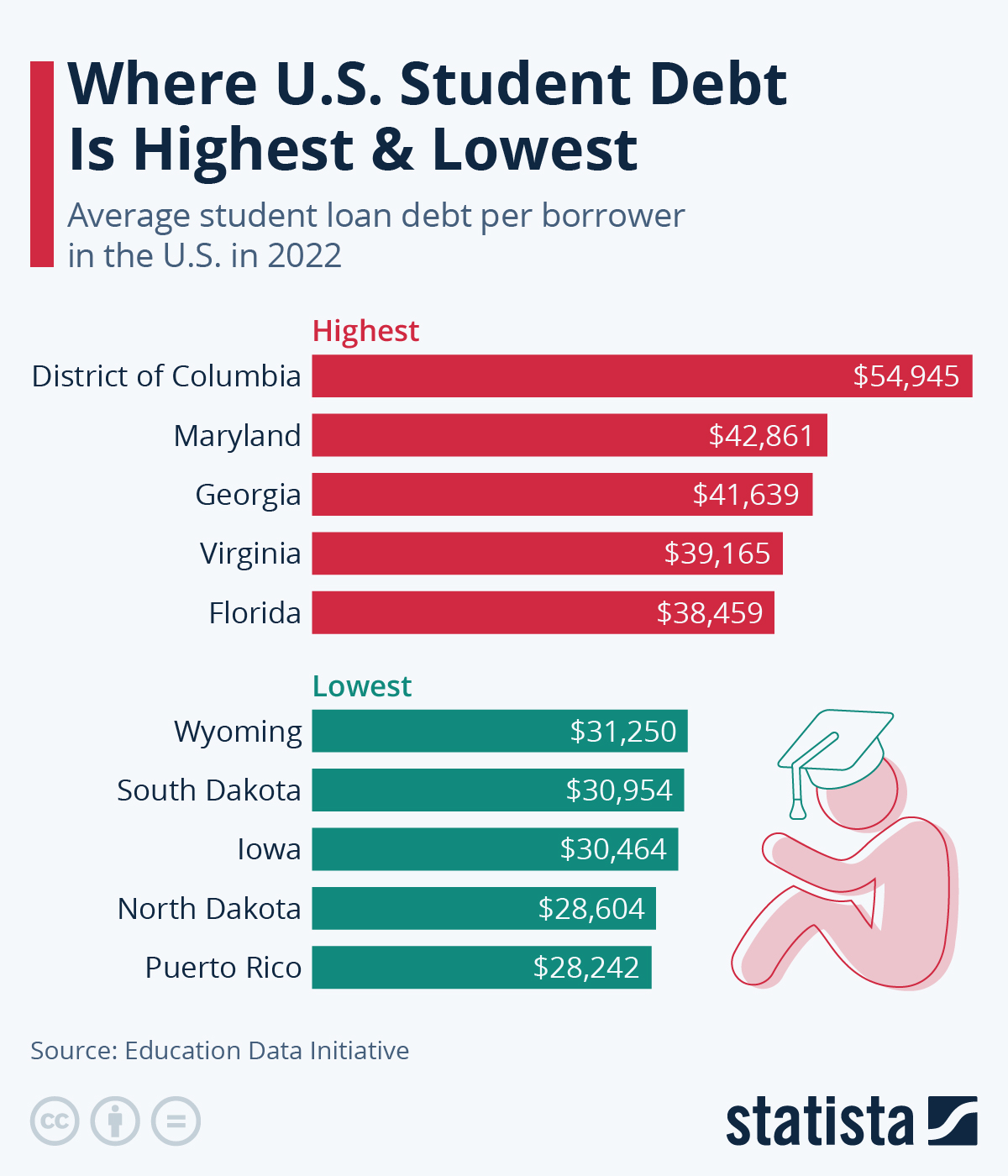
Chart: Where U.S. Student Debt Is Highest & Lowest | Statista

The most recent student loan data is an extremely hard gauge to use given its lag time. This data is the latest data available by ICAS, but also is pre-COVID and pre-George Floyd. The latter in that situation potentially produced a significant increase in student loan debt by students as many sought to help themselves and their families through financial aid refunds. COVID exposed African America’s acute financial fragility through poor health insurance, jobs with high exposure to COVID risk, and more. To the latter, in the post-George Floyd that also occurred where hundreds of millions poured into HBCU coffers led by MacKenzie Scott in levels never seen before and COVID relief funding through the CARES Act to colleges and universities witnessed HBCUs providing an immense amount of financial relief to its students to try and stem the debt tide.

HBCU graduates actually have some good news in that their median debt dropped approximately 8 percent from our last report while their PWI counterparts at major endowed institutions remained virtually unchanged. The bad news is that the percentage of HBCU graduates with debt remains unchanged while their PWI counterparts at major endowed institutions graduating with debt dropped almost 20 percent. This expands the gap of HBCU/PWI students graduating with debt from a previous 46 percentage points difference to now 52 percentage points in this latest report.

Numbers in parentheses shows the comparative results from the universities of the 30 largest endowments:

Median Total Debt of HBCU Graduates – $31,422 ($24,479)

Proportion of HBCU Graduates with debt – 85% (33%)

Median Private Debt of HBCU Graduates – $17,386 ($44,622)

Proportion of HBCU Graduates with private debt – 7% (5%)

Source: The Institute for College Access & Success

Looking at the numbers even further shows that HBCU Graduates debt is almost 30 percent higher than their PWI major endowed counterparts. This despite HBCUs being significantly cheaper, HBCU Graduates suffer from a student body that acutely comes from families that lack family assets and stability to assist. It is highlighted in the private debt component where PWI counterparts have significantly higher amounts of private debt. Potentially speaking to the borrowing power of those PWI families beyond federal financial aid.

It may be a few years before updated data from within the COVID era is available, but basic extrapolation suggest that even with the donations received after George Floyd and the CARES Act that HBCUs simply still lack the endowments to make up for the acute lack of African American household wealth combined with less than 10 percent of African Americans choosing HBCUs. The latter means that HBCUs operate with smaller alumni pools. These smaller pools means a smaller nominal giving of the alumni who do give and a significantly smaller probability that the HBCU can create a percentage of alumni who go onto become wealthy donors.

In the end, HBCU alumni who care about this must make available scholarship to a wider net of HBCU students while in school. Focusing on creating scholarship that is available to every student who is academically eligible and giving less emphasis to GPA. The large majority of any HBCU graduation class has GPAs between 2.0 and 3.0 and are the ones most likely to be left out of having any ability to decrease their student loan burdens making them almost never to be in a position to become donors.

By expanding eligibility requirements, scholarships can provide financial relief to those who need it most—students who are often balancing academics with work, family responsibilities, and other challenges. Many of these students demonstrate resilience, dedication, and a commitment to completing their education, yet traditional scholarship models disproportionately favor high achievers with GPAs above 3.5. While academic excellence should be celebrated, financial aid should not solely be reserved for the top percentage of students.

A broader approach to scholarships will help create a stronger alumni network in the long run, as more graduates will leave school with reduced debt, making them more likely to support their alma mater financially and contribute to future scholarship funds.

Previous HBCU Graduate Student Loan Reports

The 2016-2017 HBCU Graduate Student Loan Report

Good News/Bad News: Percentage Of HBCU Graduates With Debt Drops But Debt Loads Increase

90 Percent of HBCU Graduates Have Student Loan Debt