Category Archives: Business

Two Wrongs Do Not Make A Generational Wealth: Elvin, Sondra, The Huxtables – And A Wilderness Store

You are the bows from which your children as living arrows are sent forth. – Khalil Gibran

Building wealth in this country is hard. Building African American wealth in this country feels like trying to send a man to the moon, but airplanes have not even been invented yet, you are blind, your hands are tied behind your back, and there is a constant threat of someone threatening to kill you because you breathed wrong that day – as you try to send a man to the moon. This is not just hyperbolic speak. The Brookings Institution reported that European Americans in the bottom 20th percentile have a 500 percent greater chance of reaching the top than their bottom 20th percentile African American counterparts.

This is in large part rooted in two key economic moments in African America’s economic history. First, post Civil War when African Americans were supposed to be given what would be equivalent to 160 million acres of land, Andrew Johnson reneged in typical European American fashion as the Native Americans can attest to on seemingly every treaty they tried to agree to. The 160 million acres of land is impossible to truly value in some ways in today’s dollars because of opportunities for development and where exactly that land would have been is unknown. However, using the USDA’s land valuation as an elementary measuring stick, “The United States farm real estate value, a measurement of the value of all land and buildings on farms, averaged $3,800 per acre for 2022, up $420 per acre (12.4 percent) from 2021.” Based on that $3,800 per acre valuation holding constant, then African America’s 160 million acres would be worth $608 billion. Again, this is just a valuation of that land holding constant as farm land. Given the urbanization of the United States over the past 150 years, it is safe to say that a good portion of that 160 million acres would have been developed and could move the value of that land into the trillions. The $608 billion would be worth almost $15,000 per every African American man, woman, and child today. It is in fact almost 40 percent of African America’s $1.6 trillion in buying power alone and almost 25 percent of African America’s $2.6 trillion in real estate holdings today.

Then there is the grand slam policy that truly dug a grave for African America’s economic future, America’s post World War II G.I. Bill that Russell Huxtable, Dr. Huxtable’s father and army veteran in the 761st tank battalion (Season 3 Episode 11 “War Stories), would have been likely denied along the rest of the 1.5 million African American soldiers who served in World War II. The G.I. Bill arguably built the wealth gap today as we known it because it provided government funds in a way never seen before and not seen since to a group in this particular case to European American veterans to go to college, buy homes that today are alone worth trillions to their descendants, start companies which have created trillions in wealth. It should be noted that a good deal of that wealth has flowed back into PWIs coffers over the years, where there are today more PWI endowments with $1 billion or more in value than there are HBCUs – who have yet to see even one of our institutions reach such endowment value. The government sponsored leverage to European Americans and denial to African Americans contributes today to the institutional depletion of African American owned banks that have dwindled from 134 to just 16 left as of 2023, African American owned hospitals from 500 to 1, African American boarding schools from 100 to 4, and the list goes on and on. And while Russell and Anna Huxtable did well for their children, the denial of those early access to capital would show up generations later in the form of fear that would have Dr. and Mrs. Huxtable encouraging their child and her partner to choose security over risk. It also causes Sandra and Elvin to be irrationally independent and not look to the Huxtables as initial investors in their wilderness store.

It is one of the more memorable storylines told within The Cosby Show’s universe. Elvin Thibodeaux and his bride the former Sandra Huxtable inform Dr. Huxtable and Mrs. Huxtable, Esq. that they are both abandoning the tried and true formula of doctor and lawyer professions to be entrepreneurs. After Mrs. Huxtable talks Dr. Huxtable off the cliff from Elvin’s announcement, it is then Dr. Huxtable’s turn to do the same for Mrs. Huxtable, Esq. who learns that her daughter plans to join her husband in their entrepreneurial journey and to quote Mrs. Huxtable’s feelings about her daughter’s husband “dragging” her daughter into this endeavor, “and ruin what is potentially the greatest legal mind of this century”. Mrs. Huxtable demands that Sandra repay her $79,648.22, the amount the Huxtables paid for Sandra to attend Princeton. Today, that same Princeton education would cost $83,140 per year or $332,560 for four years for perspective. Not only do Sandra and Elvin push forward with extreme begrudging support the Huxtables they do so as Sandra is pregnant with what everyone believes is one child that we know turns out to be twins who are aptly named, Winnie and Nelson as an ode to the Mandelas. Sondra and Elvin refusal to ask for any help or initially take any help finds them living in a slum apartment with a slumlord where the water coming out of the faucet is brown and a myriad of other problems. Ironically, it is Denise who brings the warring parties together and both sides apologize, make amends, and Sondra and Elvin agree (for the sake of the babies) that they will seek new housing with financial assistance from the Huxtables.

However, The Thibodeaux Wilderness Store (TWS) viewed through the lens of a sporting goods store would be part of an industry in the United States alone that has grown from $15.6 billion in 1992 to $64.5 billion as of 2021 according to Statista. An increase of over 400 percent. Led by the U.S. largest publicly traded sporting goods store, Dick’s Sporting Goods valued at $10 billion. The largest individual shareholder is the son of the founder, Edward Stack who has a 10 percent ownership of the company and a net worth of $1.9 billion according to Forbes. Now imagine for a moment instead of Dick Stack’s grandmother giving him a loan of $300 to start Dick Sporting Goods that the Huxtables give Sandra and Elvin the amount needed to start The Thibodeaux Wilderness Store that becomes worth $10 billion and would be the most valuable publicly traded African American owned company. Whereby, the Huxtable-Thibodeaux family clan is worth $1.9 billion and making them solidly among African America’s wealthiest.

Thibodeaux Wilderness Store as a company is easily the largest employer of African Americans in the country employing over 50,000 workers. Dr. and Mrs. Huxtable, Esq. become Hillman’s largest donors with the Huxtable name adorning Hillman’s medical school and Hanks (Claire’s maiden name) adorning the Hillman law school transforming Hillman into the only second full service HBCU along with Howard University. They are taken public by an African American investment banking firm and a percentage of the company’s stock is purchased and held by Hillman and other HBCU endowments. Their corporate banking sits with an African American owned bank that allows the bank to in turn provide loans to thousands of small African American businesses and potential African American homebuyers. This is the power of transformative wealth – it quite literally can transform if it is in the hands of the right people. However, as we see it takes a family taking the risk to build a firm backed by the capital, security, and support of the family and community around them. The latter is exactly what the Huxtables had to offer Elvin and Sondra as they sought to build their company.

Encouraging firm building within African American/HBCU families is vital to build generational wealth. Dr. and Mrs. Huxtable, Esq.’s jobs as doctor and lawyer, respectively allows a family to build up the capital base and stability needed to take on the risk of starting a firm. To take the family to the next level requires both their stability and their willingness to see their children and grandchildren take risk the stability provides. We often lose sight of this in thinking that high paying jobs are the thing that will build generational wealth when they are still ultimately just that – jobs. In both respects the Huxtables are vital and Sondra and Elvin are vital in the evolution of a family’s resources. Fighting the urge to settle is hard for many African American families because stability has been and is still a generational fight for many African American families with over 20 percent of African American families still trying to climb out of poverty, the largest among any ethnic group in the U.S., is easy to understand the reluctance. Yet, that reluctance is costing us greatly in our ability to create generational wealth for our families and transformative wealth for African American institutions and communities. Sondra and Elvin ultimately needed to embrace the help of the Huxtables and the Huxtables needed to embrace the risk of Sondra and Elvin. This is how we move forward, this is how we close the gap, and this is how we change the lives of 40 plus million that make up African America.

Report Shows 8 Out Of 10 HBCU States Are Best States For African American Entrepreneurs

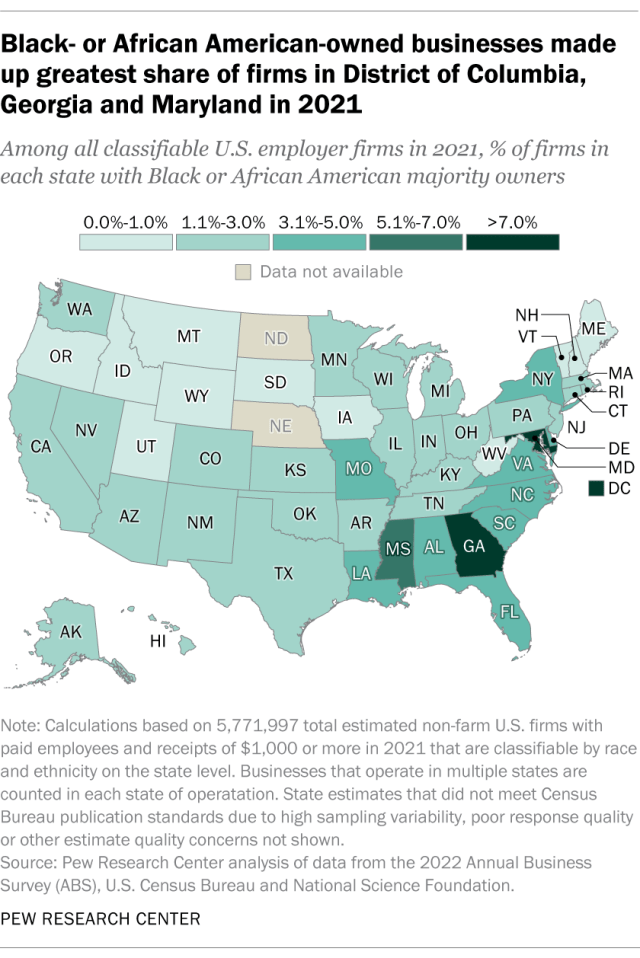
A report by Merchant Maverick, a comparison site that reviews small business software and services, highlighted the top ten states for African American entrepreneurs in 2022. The results showed that eight of those states were home to HBCUs and the other two were Nevada and New Mexico, respectively. It certainly is likely that HBCUpreneurs are driving the African American entrepreneurship in these states. Unfortunately, it maybe more indirectly than intentionally. It does suggest though that with more intentional infrastructure these states could see even more boom in entrepreneurship for HBCUpreneurs. What is that intentional infrastructure? Incubators, accelerators, mentorship, and financing programs located on the campuses of HBCUs or through their alumni associations in partnership with African American Financial Institutions (AAFIs).

Virginia: Thanks to a trio of top five metrics, Virginia ranks soundly in the No. 1 spot. Black-run businesses employ 2.18% of the Old Dominion’s workforce (2nd nationally), and there are 755 Black-owned employer businesses per 1 million people (3rd nationally). Black-owned businesses also average an annual payroll of $437K, which ranks 5th overall. The state previously fared well in some of our other data reports — Virginia finished as the 4th-best state for Black women-owned businesses, and it ranked 10th in our recent best states for women-led startup report. In an effort to grow local minority-run businesses and encourage contracts with those businesses, the Virginia state government operates a directory of all certified small businesses within the state.

Maryland: With Black residents comprising 31% of the population, Maryland has the highest percentage of Black residents of any state on the East Coast, and the 4th-highest in the nation. As such, it shouldn’t be much of a surprise that Maryland has many Black business owners. The Free State ranks 1st nationally for the most Black-owned businesses per 1 million people (1,213), and also ranks 1st in percent of the workforce employed by Black-owned businesses (3.49%). Black-owned Maryland businesses additionally average a very respectable annual payroll of $465K, which is the 4th-highest in the nation. The state government offers several tools for minority business owners, including funding, small business certifications, and assistance programs.

Texas: While no metric clearly stands out, Texas ranks highly thanks to consistency. Black entrepreneurs may find it profitable to start a business in the Lone Star State — Black business owners average an annual income of $64,240 (10th overall) and Black-run businesses in the state average an annual payroll of $337K (17th overall). All of this cash can go further in Texas because the state lacks income tax. Resources available to local Black businesses include the Texas Black Expo and the Dallas Black Chamber of Commerce, both of which are organizations that aim to assist underserved businesses.

For the full report, visit Merchant Maverick here.

2021’s FDIC National Survey of Unbanked and Underbanked Households – African America’s Highlights

  • Among households with income between $30,000 and $50,000, 8.0 percent of African American households were unbanked compared with 1.7 percent of European American households.
  • Despite being the lowest unbanked group at 1.7 percent, African Americans earning $75,000 or more are still almost 600 percent more unbanked than their European American counterparts at the same income level. The largest gap among all income levels reported.
  • Among households with income between $50,000 and $75,000, 64.8 percent of African American households had a credit card or bank personal loan, whereas 81.3 percent of European American households did so.
  • Unbanked among African Americans has dropped from 16.8 percent in 2017 down to 11.3 percent in 2021. A reduction of almost 33 percent. European Americans have the lowest unbanked rate at 2.1 percent followed by Asian Americans at 2.9 percent.
  • 21.4 percent of African American single-mother households were unbanked in 2021, compared with 8.0 percent of European American single-mother households.
  • Interest in having a bank account was also higher among African American unbanked households (32.0 percent were very or somewhat interested in having an account in 2021).
  • African American households comprised 12.8 percent of the overall household population, they made up 41.1 percent of the recently unbanked.
  • Use of Prepaid Cards by Bank Account Ownership and Selected Household Characteristics was highest among African Americans at 12.3 percent and lowest among Asian Americans at 4.6 percent.
  • Three in four African American banked households (76.5 percent) used bank accounts to save or keep money safe, a lower share than among households of other races and ethnicities. For example, 85.2 percent of European American banked households saved or kept money safe using bank accounts in 2021.
  • African American banked households saved or kept money safe using prepaid cards compared with 1.2 percent of European American banked households.
  • In 2021, 49.9 percent of African American households had a credit card or bank personal loan, compared with 78.8 percent of European American households.
  • 36 percent of African American households are underbanked/unbanked.
  • Rent-to-Own Service or Payday, Pawn Shop, Tax Refund Anticipation, or Auto Title Loan is used by 7.6 percent of African American households.

To read the full FDIC National Survey of Unbanked and Underbanked Households, click here.

Virginia State University Alumnus Owned Investment Firm Makes First Investment In Africa

Without change there is no innovation, creativity, or incentive for improvement. Those who initiate change will have a better opportunity to manage the change that is inevitable. – William Pollard

Over the past few years, Founder & CIO, William A. Foster, IV of 15 & 40, a multi-asset investment firm, had been looking to extend its portfolio beyond the shores of the United States. In particular, the firm has become keen on making their first investment in Africa. Through a previous professional relationship that opportunity would come to pass. Mr. Foster was previously head of acquisitions and Regan Mutumbo was previously head of operations at a private real estate investment firm based in Atlanta, GA. It was Mr. Mutumbo’s leadership that actually brought Mr. Foster into the real estate investment firm’s fold and they formed a fast professional relationship that would be the foundation of the later investment. The investment was a classic case of the importance of building a strong professional network and the fruit of opportunities it can bear years later.

15 & 40 invested a ten percent stake in Ciya, a ride sharing app company located in the Democratic Republic of Congo’s capital city of Kinshasa. It is the firm’s first investment on the continent, but according to Mr. Foster this is just the beginning. “Our plan is to have a major capital footprint across the Diaspora buoyed with strategic concentration in Africa.” More than just capital though, Mr. Mutumbo has met with Mr. Foster in monthly brainstorming sessions to help with the strategy and direction of Ciya. Showcasing the circulation of intellectual capital on a Diasporic scale. The company is named for Mr. Mutumbo’s mother and is his way to honor her legacy. He also is adamant about being part of the foundation that spurs economic development for the Democratic Republic of Congo and Mr. Foster’s Pan-African investment views make it an ideal match for both.

The World Book’s Economic Situation on the Democratic Republic of Congo:

“Economic growth picked up to 8.6% in 2022, keeping the strong momentum from 2021 (6.2%). Mining sector investment and exports remain the key drivers of growth, owing to capacity expansion and recovery in global demand. However, growth in non-mining sectors (particularly services) was modest, slowing down to 3.0% in 2022, from 4.5% in 2021. Stronger export earnings could not offset higher food and fuel bills, and lead to a wider current account deficit estimated at 2.9% of GDP in 2022 (from -1.0% in 2021). Nevertheless, foreign direct investments (FDI) and external financing contributed to build up reserves, reaching 7.9 weeks of imports in 2022, from 5.4 weeks a year earlier, and limiting excessive exchange rate fluctuations. Higher global energy and food prices due to the ongoing war in Ukraine exerted upward pressures on domestic inflation, lifting the average inflation rate from 9.1% in 2021 to 9.2% in 2022.

The fiscal deficit deteriorated to 2.7% in 2022 (from 0.8% in 2021) as improved revenue mobilization could not fully offset higher capital and current spending. Domestic revenues peaked at 15.6% of GDP in 2022, owing to favorable commodity prices and digitalization of the revenue collection process, while expenditures (19.7% of GDP) increased due to exceptional security spending and arrears repayments, in addition to wage adjustments and fuel subsidies. The medium-term outlook for DRC is favorable with growth estimated at 7.5% by 2025. However, DRC’s economy remains vulnerable to commodity price swings and growth performance of major trading partners which might be disturbed by geopolitical conflicts. The continued economic consequences of the war in Ukraine, through rising global food costs and higher oil prices, could exert stronger pressure on fiscal deficit, inflation, and household consumption thus exacerbating poverty and inequality.

Given persistent conflicts in the East, DRC’s immediate challenge is to strengthen security and maintain political and macroeconomic stability while stepping up ongoing reforms to ensure sustainable growth.”

It speaks to a broader opportunity of African America’s ability to leverage American capital and invest mightily alongside their African brethren and create a transcontinental partnerships that for the first time would put a healthy relationship between capital and investment on both sides of the Atlantic. Instead of hostile lending and investment from European Americans, Europeans, and Asians that has been the traditional order of business for African investment, this lays the ground work for a mutually beneficial relationships that should see both sides prosper. “We are here to build and connect institutions of the African Diaspora. For my firm it really is that simple.”, said Mr. Foster. He hopes that HBCUs in particular along with their endowments, foundations, and alumni associations can leverage their collective capital that would allow them to make major investments throughout Africa.

Visit Ciya by clicking here.

Why Do HBCUs Not Bank With Black Banks?

It could all be so simple But you‘d rather make it hard, loving you is like a battle and we both end up with scars. – Lauryn Hill

Something that should be so simple, HBCUs and other African American organizations, businesses, and other African American institutions have made not just a battle but sometimes it feels like a war. That battle, getting African American institutions to bank with the African American banking system with banks and/or credit unions owned and controlled by – African Americans. It is economic development 101 for other groups, but for African America it is seemingly Calculus III. Based on HBCU Money’s internal research on the matter only two, a PBI and HBCU, are believed to bank with a Black-owned bank. That means that just like the over 90 percent of African Americans who go to college not choosing HBCUs, well over 90 percent of HBCUs do not bank with a Black-owned bank. And in both cases, neither (AAOBs or HBCUs) are able to fulfill their potential as they would with the patronage and investment of those they were built to serve.

We asked the AI app Nova for their take on why HBCUs do not bank with African American owned banks and here was its answer: “There are a few reasons why many HBCUs may not bank with Black-owned banks. One reason is that larger, more established banks often offer more resources and services that HBCUs may need, such as investment services or customized financial solutions. Additionally, some HBCUs may feel more comfortable with larger, more established banks that have a long history of working with educational institutions. However, there has been a growing movement encouraging HBCUs to support Black-owned banks and businesses as a way to promote economic empowerment within the Black community. Many Black-owned banks have a strong commitment to supporting HBCUs, and may offer specialized products and services tailored to their needs.”

Despite AI being quite learned in its contribution to this. There are as they say – levels to this. Not least among them is the plight of public HBCUs lacking autonomy. It would take a massive student and alumni uprising in order to get a public HBCUs moved to an African American owned bank. Ultimately, public HBCUs are controlled by a board or if they are in a system, then a system’s board. In either case, the state’s flagship PWIs carrying the most financial weight and tend to be determinate of how all public universities in the state will behave and most certainly likely where they will bank. And while it is complicated to wrangle the institutional banking of public HBCUs into African American owned banks, their proxy organizations like alumni associations and foundations that serve them should not have anywhere near the issue of banking Black. Then there are the private HBCUs who have far more autonomy with their banking decisions and yet it seems potentially only one private HBCU actually banks Black. It is almost befuddling in the case of the Alabama and Georgia HBCUs not to bank Black. They both have two African American Owned Banks in headquartered in their states. Morehouse specifically just a few years ago had one of their alumni bring back African American owned banking to Oklahoma when alumnus Kevin Perry purchased controlling interest in First Security Bank & Trust. In fact, 14 of the 15 states and territories where there are African American owned banks have HBCUs/PBIs in them with Wisconsin being the lone exception.

African America’s flagship HBCU, Howard University, two years ago entered into a partnership with PNC Bank to create the PNC National Center for Entrepreneurship housed at Howard University. PNC’s Foundation providing Howard University with a rather obtuse $3.4 million a year grant for five years. PNC Bank is based in Pittsburgh,PA, its executive team in 2022 commanded $81 million in compensation, and the bank has assets over $550 billion – an amount that is over 100 times the size of all 16 remaining African American Owned Banks’ assets combined. We think Marcus Garvey just rolled over in his grave. Meanwhile, right in Howard University’s backyard is Industrial Bank, an African American Owned Bank with $723 million in assets, meaning PNC Bank has over 760 times the amount of assets of Industrial. There is in fact only one African American Owned Bank that has over $1 billion in assets, Liberty Bank & Trust in Louisiana.

That HBCU presidents and AAOB CEOs do not have closer relationships simply speaks to the island mentality that African American institutions as a whole have. Although our community loves to parrot the harsh reality of an African American dollar that does not circulate in our community’s even 6 hours while “the average lifespan of the dollar is approximately 28 days in Asian communities, 19 days in Jewish communities, 17 days in white communities”, according to a piece by the FAMUAN (see how we are circulating HBCU media capital). This has done nothing to make HBCU administrators understand that the circulation of the African American institutional dollar is far more impactful than the African American consumer collar. Despite as recently as 2017, there were four African American Owned Banks with HBCU alumni as CEOs. It is also not just on HBCUs, but AAOBs should be doing a better job of heavily pursuing those HBCUs that do have the autonomy to decide where they bank and forging deep relationships with them at multiple levels.

By forging that relationship HBCUs and AAOBs can multiply the probability of opportunities and profitability. That way when an HBCU alum creates the next Google, SpaceX, FedEx, or other Fortune 500 company, then they will already know the importance of banking with an AAOB and hiring HBCU alumni. It will be understood because the intentionality of our ecosystem’s success will be modeled and molded and as a result our community is empowered with success a rule and not the outlier it operates in now as so many of us continue to try and build a nation as an island instead of forging together.