Tag Archives: investing

Virginia State University Alumnus Owned Investment Firm Makes First Investment In Africa

Without change there is no innovation, creativity, or incentive for improvement. Those who initiate change will have a better opportunity to manage the change that is inevitable. – William Pollard

Over the past few years, Founder & CIO, William A. Foster, IV of 15 & 40, a multi-asset investment firm, had been looking to extend its portfolio beyond the shores of the United States. In particular, the firm has become keen on making their first investment in Africa. Through a previous professional relationship that opportunity would come to pass. Mr. Foster was previously head of acquisitions and Regan Mutumbo was previously head of operations at a private real estate investment firm based in Atlanta, GA. It was Mr. Mutumbo’s leadership that actually brought Mr. Foster into the real estate investment firm’s fold and they formed a fast professional relationship that would be the foundation of the later investment. The investment was a classic case of the importance of building a strong professional network and the fruit of opportunities it can bear years later.

15 & 40 invested a ten percent stake in Ciya, a ride sharing app company located in the Democratic Republic of Congo’s capital city of Kinshasa. It is the firm’s first investment on the continent, but according to Mr. Foster this is just the beginning. “Our plan is to have a major capital footprint across the Diaspora buoyed with strategic concentration in Africa.” More than just capital though, Mr. Mutumbo has met with Mr. Foster in monthly brainstorming sessions to help with the strategy and direction of Ciya. Showcasing the circulation of intellectual capital on a Diasporic scale. The company is named for Mr. Mutumbo’s mother and is his way to honor her legacy. He also is adamant about being part of the foundation that spurs economic development for the Democratic Republic of Congo and Mr. Foster’s Pan-African investment views make it an ideal match for both.

The World Book’s Economic Situation on the Democratic Republic of Congo:

“Economic growth picked up to 8.6% in 2022, keeping the strong momentum from 2021 (6.2%). Mining sector investment and exports remain the key drivers of growth, owing to capacity expansion and recovery in global demand. However, growth in non-mining sectors (particularly services) was modest, slowing down to 3.0% in 2022, from 4.5% in 2021. Stronger export earnings could not offset higher food and fuel bills, and lead to a wider current account deficit estimated at 2.9% of GDP in 2022 (from -1.0% in 2021). Nevertheless, foreign direct investments (FDI) and external financing contributed to build up reserves, reaching 7.9 weeks of imports in 2022, from 5.4 weeks a year earlier, and limiting excessive exchange rate fluctuations. Higher global energy and food prices due to the ongoing war in Ukraine exerted upward pressures on domestic inflation, lifting the average inflation rate from 9.1% in 2021 to 9.2% in 2022.

The fiscal deficit deteriorated to 2.7% in 2022 (from 0.8% in 2021) as improved revenue mobilization could not fully offset higher capital and current spending. Domestic revenues peaked at 15.6% of GDP in 2022, owing to favorable commodity prices and digitalization of the revenue collection process, while expenditures (19.7% of GDP) increased due to exceptional security spending and arrears repayments, in addition to wage adjustments and fuel subsidies. The medium-term outlook for DRC is favorable with growth estimated at 7.5% by 2025. However, DRC’s economy remains vulnerable to commodity price swings and growth performance of major trading partners which might be disturbed by geopolitical conflicts. The continued economic consequences of the war in Ukraine, through rising global food costs and higher oil prices, could exert stronger pressure on fiscal deficit, inflation, and household consumption thus exacerbating poverty and inequality.

Given persistent conflicts in the East, DRC’s immediate challenge is to strengthen security and maintain political and macroeconomic stability while stepping up ongoing reforms to ensure sustainable growth.”

It speaks to a broader opportunity of African America’s ability to leverage American capital and invest mightily alongside their African brethren and create a transcontinental partnerships that for the first time would put a healthy relationship between capital and investment on both sides of the Atlantic. Instead of hostile lending and investment from European Americans, Europeans, and Asians that has been the traditional order of business for African investment, this lays the ground work for a mutually beneficial relationships that should see both sides prosper. “We are here to build and connect institutions of the African Diaspora. For my firm it really is that simple.”, said Mr. Foster. He hopes that HBCUs in particular along with their endowments, foundations, and alumni associations can leverage their collective capital that would allow them to make major investments throughout Africa.

Visit Ciya by clicking here.

HBCU Money™ Turns 11 Years Old

By William A. Foster, IV

“The happiness of your life depends upon the quality of your thoughts: therefore, guard accordingly, and take care that you entertain no notions unsuitable to virtue and reasonable nature.” – Marcus Aurelius

As we embark on our 11th year here at HBCU Money, we are not slowing down with the work we have before us. Our desire to continue to be a strong monetary and fiscal voice for the HBCU community is ever present. Covering the HBCUpreneurs who are growing amazing businesses, the business schools who are shaping tomorrow’s African American private sector leadership, HBCU economists who become the first to ever sit on the Federal Reserve board, and so much more. Our community has a voice and stories that need to be told, discussions that need to be broaden, and the hard questions that need to be asked. We have been there for it all and will continue to be there for years to come.

Thank you to everyone who has been there since the beginning and who has come to rely and trust that quality will always come first. In this day where sensationalism seems to be ruling over substance, HBCU Money and sibling blogs will continue to stand firm that there are those who desire and want to have their intelligence valued. That thinking beyond the headlines has not become a lost art.

Holding true to the saying, it is a marathon and not a sprint.

Ariel Capital’s 2020 Black Investor Survey: African America’s Continued Fight To Close The Investment Gap

“On March 23, 2020, the S&P 500 fell 2.9%. In all, the index dropped nearly 34% in about a month, wiping out three years’ worth of gains for the market. It all led to a 76.1% surge for the S&P 500 and a shocking return to record heights. This run looks to be one of the, if not the, best 365-day stretches for the S&P 500 since before World War II. Based on month-end figures, the last time the S&P 500 rose this much in a 12-month stretch was in 1936, according to Howard Silverblatt, senior index analyst at S&P Dow Jones Indices.” – CBS News

Ariel Capital released their 2020 Black Investor Survey and the results show that there is reason to be pessimistic today, but potentially optimistic for tomorrow. The survey focuses on middle class African American and European American households earning over $50K in 2019. Some key financial points outside of this survey that should be taken into context though are poverty for African American stands at 21.2 percent versus 9.0 percent for European Americans. This high rate of poverty for African Americans means that middle class African Americans, as noted in the survey, are more likely to have high levels of assistance to family and friends which provides a damper on higher investing capabilities. These high levels of poverty are highly reflective of the median wealth gap between African and European Americas, $24,100 versus $188,200, respectively. African America continues to suffer from weak institution building and therefore the ability for its economic and financial ecosystem to strengthen continues to be suffocated. Firms like Ariel Capital and other African American financial institutions need more investment and support from other African American institutions, like HBCUs, in order to scale and create more employment, wealth, and economic opportunities beyond the grassroots level.

KEY HIGHLIGHTS:

  • The deep-rooted gap in stock market participation between the groups persists, with 55% of Black Americans and 71% of white Americans reporting stock market investments.
  • 63% of Black Americans under the age of 40 now participate in the stock market, equal to their white counterparts.
  • Ownership rates of 401(k) plans are now similar between Black and white Americans (53% vs. 55%).
  • White 401(k) plan participants put 26% more per month toward their retirement accounts than Black 401(k) plan participants ($291 vs. $231).
  • Black Americans are less likely than white Americans to own almost every kind of financial vehicle, with the exception of whole life insurance, which is favored in the Black community.
  • They are also less likely than white Americans to have written wills, financial plans, or retirement plans.
  • For Black Americans, disparities grow every month; while they save $393 per month, white Americans are saving 76% more ($693 per month).
  • Black Americans are also far less likely to have inherited (23% vs. 51%) or expect to inherit wealth (15% vs. 35%).
  • Black Americans are less likely to work with financial advisors (21% vs. 45% of whites).
  • Student loan delay or deferral was reported as being three times more common among Black Americans (16%) than whites (5%).
  • More than twice as many Black 401(k) participants (12% vs. 5%) borrowed money from their retirement accounts.
  • Almost twice as many Black Americans (18% vs. 10%) dipped into an emergency fund.
  • And 9% of Black Americans (vs. 4% of white Americans) say they asked their family or friends for financial support in 2020, while 18% of Black Americans and 13% of white Americans acknowledged giving financial support to family and friends last year.
  • Among Black Americans, 10% discussed the stock market with their families growing up, while 37% discuss the stock market with their families now (compared to 23% and 36%, respectively, for white Americans).
The chart above tracks the participation in the stock market through individual stocks, mutual funds, or ETFS. For African and European Americans, 2020 is an all-time low of participation since tracking began in January 1998. However, the gap of participation has closed from 24 percentage points in 1998 to 16 percentage points in 2020. Primarily due to the all-time low of European America’s participation falling by 10 percentage points and African America’s falling by only 2 percentage points. The closest the gap has been was in 2001 and 2002 when it was 10 percentage points and in 2002 saw African America break through 70 percentage points the only time in the survey’s history when we reached 74 percent.

HBCUs can play a significant role in closing the investment gap by introducing students to HBCU alumni who have gone on to become investors and financial advisors – thus circulating both intellectual and financial capital within the HBCU ecosystem. Even more so, they can assist in ensuring students set up investment accounts like a Roth IRA during their freshmen year and throughout matriculation. The earlier students are engaged in investing the more compounding can work for them over their lifetime which in turn makes for wealthier alumni, larger future donations, stronger African American communities, and more value proposition for HBCUs to promote within the African American community.

Texas Southern University Host NAREB’s Black Homeownership Summit

“We need to intentionally invest in health, in home ownership, in entrepreneurship, in access to democracy, in economic empowerment. If we don’t do these things, we shouldn’t be surprised that racial inequality persists because inequalities compound.” – Pete Buttigieg

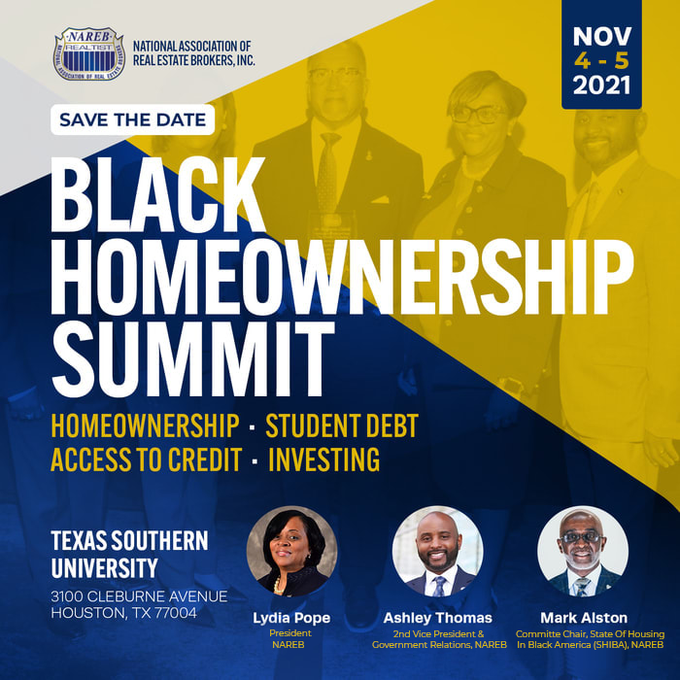
On the campus of Texas Southern University on November 4th and 5th, the National Association of Real Estate Brokers, an organization representing the interest of African American real estate professionals, hosted a homeownership summit with focuses on not only homeownership, but also student debt, access to credit, and investing. The importance of such an event being held on an HBCU campus can not be understated.

Intertwining African American institutions with each other has long been a struggle for the community’s development with African American institutions often operating on islands instead of a connected ecosystem. Events like NAREB’s Black Homeownership Summit at Texas Southern University helps highlight the power, potential, and scalability of what happens when African American (and Diaspora) institutions work together. What better place to address Black homeownership after all than on the campus of an HBCU? Soon to be African American graduates and professionals will be at the vanguard of trying to close the acute homeownership crisis that African America continues to face (graph below).

One of the keynote speakers at the NAREB Black Homeownership Summit event was Teresa Bryce Bazemore, CEO and President of the Federal Home Loan Bank of San Francisco, speaking exclusively to HBCU Money about the event said, “We need all the parties in the housing finance industry and other stakeholders to collectively work to eliminate the barriers to homeownership. In this new environment, all consumers including Black and Brown people should be able to participate equally in the dream of homeownership. We need initiatives that can help potential buyers with improving their credit, saving for down payments and understanding the entire home buying process from A to Z. We also need to make sure that the lending rules are equitable.”

HBCU Money’s Suggested Five Initiatives For HBCUs Can/Should Be But Not Limited Too:

  • Making financial literacy a mandatory part of matriculation for HBCU students. This can be done through the financial aid office, workshops, or a class.
  • Providing HBCU students work study jobs that go into the community at African American K-12 schools and teaching financial literacy.
  • Partnering with African American owned banks and credit unions. Due to their deposit bases, many African American owned banks and credit unions simply can not participate in the primary mortgage market and there are few to none African American owned non-bank mortgage lenders. This leaves the African American community in an extremely vulnerable position to predatory lending as has been demonstrated and shown time and time again. HBCUs are a key to growing assets within African American financial institutions through students, alumni, and institutionally.
  • Offering more scholarships for ALL students. Scholarships are purposed to reduce student loan debt, but they are often resigned to high achieving students despite the majority of students being in the middle. This becomes highly problematic for African Americans who usually do not have the familial wealth to assist in paying down or off their student loan debt. HBCUs while cheaper than our PWI counterparts on the whole could be doing even more to reduce the student loan debt burden for African American students by ensuring that any student who is academically eligible has an opportunity to reduce their student loan debt burden. This provides an opportunity upon graduation that more of their initial paycheck is going towards wealth building and potential homeownership rather than debt burden.
  • Encouraging the use of startups like HBCU Real Estate, who has part of their mission statement to use a portion of their profits to provide down payment assistance for HBCU alumni who seek to purchase primary or investment properties.

Homeownership and real estate ownership have long been a cornerstone to establishing generational wealth in the United States. Despite this, the African American homeownership has never crossed over the 50 percent threshold and according to MarketWatch and has always maintained a 20-30 percentage point gap between African and European Americans. African America’s civilian noninsittuional population as of October 2021 was 33.7 million and its civilian labor force is 20.6 million and the African American labor force 20 and over is 19.9 million. Assuming that 44 percent of the 19.9 million are homeowners (8.7 million), it would take approximately 1.5 million more African Americans to become homeowners to get African America above 51 percent. Based on the most recent data provided by Zillow, the typical value of U.S. homes is $308,220 as of September 2021. Between 1999 and 2021, the median price has almost tripled from $111,000 to $308,220. This means in order for those 1.5 million to acquire homes they would need down payments of approximately $16.2 billion using FHA’s 3.5 percent down financing or $10,800 per potential African American homebuyer. While it does not on the surface seem like a lot to many, that number represents almost 45 percent of the African American median net worth, but a mere 6 percent of European American median net worth.

Just for perspective on that $16.2 billion, there are no African Americans with a net worth more than that, but there are 45 Americans whose single net worth exceeds $16.2 billion. The road to achieving more African American homeownership will be no small task, but events like NAREB/Texas Southern will go a long way in us doing the hard work together, lifting the heavy load together, and ultimately achieving our goal together.

12 Things Your HBCU Alumni Association/Chapter Needs To Do To Be Financially Successful

“Planning is bringing the future into the present so that you can do something about it now.” – Alan Lakein

Far too many HBCU Alumni Associations and Chapters have been asleep at the wheel for far too long financially. They have conducted themselves like a child who says they want to start a lemonade stand, but refuses to take the time to make a plan of acquiring lemons, sugar, water, and certainly not building a lemonade stand. There is more time spent playing with their friends and then seemingly complaining that their friends do not support their lemonade stand – that does not exist. It is enough to drive one mad. We have laid out twelve steps that HBCU alumni associations and chapters need to do to make themselves financially integral and sustainable for the future to meet the financial needs of both African America and the HBCUs they serve.

  1. Move banking accounts to African American owned banks and/or credit unions. It is utterly baffling that HBCUs and HBCU Alumni Associations/Chapters at this point still have not done this very elementary point of economic development given the acute presence of the #BankBlack movement over the past few years. Public HBCUs have more red tape by being state institutions and there are significant political dynamics at play there, but private HBCUs and HBCU alumni associations/chapters at private or public HBCUs at this point simply have no excuse.
  2. Invest in technology, especially financial technology. If HBCU Alumni Associations/Chapters want younger alumni involvement as they claim then they have to come into the 21st century – do you realize we are two decades into the 21st century and some HBCU foundations, alumni associations/chapters do not have a functioning web presence. This is where typically you would insert a mind blown emoji or gif. It is unfathomable and inexcusable at this point. HBCU Alumni Associations/Chapters need a web and social media presence independent of the mother institution for a myriad of reasons that should be readily apparent without great explanation. Alumni associations/chapters can work out an agreement with their schools to create work study that involves social media work and web development for those students who are interested and have the necessary skillset. Otherwise, spend the money and pay for a real web designer and social media manager – it is worth it. Financial technology – accepting payment by Venmo, CashApp, etc. should not be groundbreaking it should be standard. There are a plethora of financial technology available for nonprofit organizations. This should be the job of the treasurer at both the national and chapter levels to find technology that can improve the financial efficiency.
  3. Collect information on your members. Know your association/chapters strengths and weaknesses. If you plan on doing education outreach with your alumni association/chapter, it may help knowing who in the organization that has a background and connections in education. Need to put on an event? It may help to know the alumnus who worked in event planning or knows someone who does. Other information should be household income, level of education, home ownership, etc. The more information the better (we will explain the value of this in another point). But not knowing what assets you have is a dearth of proper planning and strategy.
  4. Write a business plan. If you do not know where you are going, any road will get you there. This opaque behavior is stressfully true with HBCU Alumni Associations/Chapters. We have an alumni association/chapter, now what? Having a written plan of what you want to accomplish, why, and how is paramount to any organization. HBCU Alumni Associations/Chapters are no different. The business plan should be reviewed and updated every 3-4 years to ensure that goals are on track . A review committee made up of internal and external members would be advised.
  5. Create a revenue and investment committee. These can be one committee or two committees, but it needs to exist. Beyond dues, how does the association/chapter plan to make money? Thinking of ways that revenue can be generated and those ideas presented to the association and chapter would be vital. Seriously, because have we not killed the annual golf tournament? Someone on this committee needs to have an investment background and if there is no one in the chapter with it, then invite a local financial adviser to sit on the committee in a volunteer role to help.
  6. Raise dues. There was just a collective gasp from everyone just now. However, creativity. Right now, most associations/chapters charge annual dues of $25-35 annually. Going to a monthly model of $5-10 can skyrocket annual dues revenue to $60-120 which is an increase of over 100 percent in dues revenue and it is an amount that few will miss. Implementing financial technology can allow this to be automated around alumni pay periods.
  7. Produce a newsletter and sale local advertising. Remember the roster of your membership and the data we talked about collecting. This is extremely valuable in putting together a media kit that you can use to sell local advertising in. Most alumni associations/chapters send out newsletters anyway. The ability to monetize that in the most optimal way requires being able to tell potential advertisers who they are reaching. Imagine being able to simply sell ten advertisements a year with twelve month commitments that each pay $50 per month. This is $6,000 in new annual revenue for the chapter from local businesses and relationship building.
  8. Hire a financial adviser. It can be the aforementioned one or a different one, but this also needs to be done. Associations/Chapters should be generating far more income than they do with the collective financial ability at their disposal. As an entity, your association/chapter can have a brokerage account that invest in stocks and bonds – not just sitting in a checking and savings account losing purchasing power. Ensure that the financial adviser is credible. There are even African American brokerage firms that can provide accounts and advising all under one roof. Again, we are not going to fundraise our way to institutional wealth. Our organizations’ money needs to be making money while it “sleeps” because money never sleeps.
  9. Purchase real estate. Now that you have a financial adviser, your chapter should also retain a real estate adviser to help build a rental property portfolio. Remember, we just created $6,000 in new annual revenue via the newsletter. You also raised dues from $25 to $60 and with the $35 surplus on a chapter of just twenty alumni that provides and extra $700 annually. In line with your investment income from your brokerage is also rental income. The association/chapter can focus on purchasing everything from single-family to commercial properties. If chapters purchased near their HBCU, it could help stem off any potential gentrification as many HBCUs are seeing, but in little position to do anything about. They could also purchase real estate locally where their chapter is located. This would provide the association/chapter another stream of revenue and diversified real estate holdings.
  10. Invest in African American small businesses. This could be done in conjunction with African American owned banks/credit unions. If a small business could not qualify for a SBA loan, then the chapter could work out a deal with the bank that would allow them to review the investment on the bank’s recommendation. The chapter would then either invest in the business with equity or provide a loan and act as a shadow lender. We know this is something desperately needed for many African American small businesses who are trying to grow and for some reason or another lack access to traditional financial products. Imagine a local African American kid comes to the bank with the next great social media company, but he needs $38,000 to get it going and does not qualify, but the bank says they have a program that may work to help him. The chapter invest the $38,000 for a 50 percent stake and acts as a passive investor while the kid builds his dream. Why $38,000? This is the amount Mark Zuckerberg and classmate Eduardo Saverin invested to get Facebook off the ground in 2004. A company now worth $840 billion and a 50 percent stake would be worth $420 billion – from a $38,000 investment. Not to mention the potential to secure jobs and internships for your HBCU’s students and alumni as the company grew.
  11. Endow internships at local organizations. HBCU alumni constantly complain about our students not having access to opportunity. Well, now with your new found financial wealth you can buy them access just like everyone else does for their community. The Museum of Natural Science in New York, Miami, Houston, etc. sure do appreciate that $100,000 donation your association/chapter gave them to hire a paid summer internship. The condition? That intern needs to come from your HBCU. Now, a student from your HBCU gets a paid summer internship, work experience in a field of their interest, and most importantly builds their professional network.
  12. Be transparent. Associations and chapters need to ensure that members feel like they know and understand what is going on. Part of this is improving the membership’s financial aptitude through financial literacy so that they understand the decisions being made on some level. Have a quarterly review of the financial portfolio and an annual audit. Trust is vital and for African American organizations that trust is built through transparency.

HBCU Alumni Associations & Chapters should be the symbol of group economics for African America. Instead, the actions have been more hat in hand with the rest of African American organizations who could, but do not leverage their capability. The infrastructure is there for HBCU Alumni Associations & Chapters to be financial forces if the proper financial strategy and plan is implemented. It is time to stop playing and start planning, there is a lemonade stand to build.