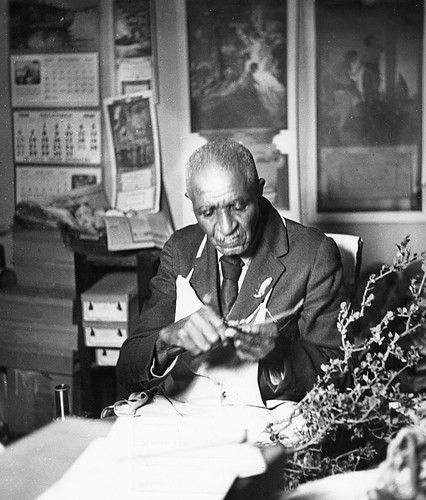
Dr. George Washington Carver (January 5, 1864-January 5, 1943) was an American scientist, botanist, educator, and inventor. Carver is best known for his research into alternative crops to cotton, such as peanuts, soybeans, and sweet potatoes. He wanted poor farmers to grow these alternative crops to aid in the nutrition of farm families and to provide another source of cash income to improve the farmers quality of life. Dr. Carver is shown at work at Tuskegee University in September 1938. Photo Courtesy National Archives and Records Administration. r
HBCUs continue to go backwards in the research field according to the latest National Science Foundation data. In 2015, research expenditures for the top 20 HBCUs combined for $425.7 million, while 2017 combines for $424.7 million. Over the past five years, HBCU research expenditures have dropped almost 4.7 percent or a loss of $20.7 million.
The top ranked HBCU, Howard University, ranked 203rd and the twentieth ranked HBCU, Virginia State University, ranked 325th among America’s college research landscape.
The MEAC maintains their dominance with eight schools versus the SWAC’s four.
Division II/III schools also comprise four schools on the list.
1890 HBCUs, land-grant universities, dominate the top twenty with eleven of the top HBCU research universities.
All HBCUs combined account for $537.8 million in research expenditures. There are 45 PWI/HWCUs who have research budgets above this amount individually.
Rank. HBCU. Previous Year In Parentheses.
Howard University – $45.8 million ($41.0 million)
Florida A&M University – $37.6 million ($45.4 million)
N.C. A&T State Univ. – $37.4 million ($33.8 million)
Morehouse School of Medicine – $36.9 million ($38.8 million)
Alabama A&M University – $31.7 million ($30.3 million)
Jackson State University – $22.8 million ($23.8 million)
Delaware State University – $20.8 million ($21.3 million)
Tennessee State University – $18.1 million ($19.5 million)
Meharry Medical College – $16.8 million ($14.8 million)
Tuskegee University – $16.5 million ($16.5 million)
Hampton University – $16.6 million ($14.2 million)
Alcorn State University – $16.1 million ($8.2 million)
Charles R. Drew University – $15.7 million ($13.4 million)
Morgan State University – $15.0 million ($15.7 million)
S.C. State University – $14.3 million ($13.1 million)
N.C. Central University – $14.1 million ($12.5 million)
Prairie View A&M University – $14.0 million ($12.6 million)
Xavier University of LA. – $12.4 million ($12.1 million)
Langston University – $11.5 million ($11.2 million)
Virginia State University – $10.8 million ($8.1 million)
TOP 20 COMBINED TOTAL: $424.7 million ($425.7 million)
Additional Notes:
The HWCU-HBCU gap for research among top 20 research institutions is $53:1
Top 20 HWCUs Combined: $22.7 billion ($23.2 billion)
How many HBCUs have you donated money too? Below are the jump pages for every SWAC/MEAC school and/or foundation’s giving page. We challenge HBCU alumni to give to their own and as many HBCUs as possible.
There are 21 HBCUs between the SWAC/MEAC. That means there are 21 opportunities to give that stretch from Texas to Maryland and impact the institutional opportunities of tens of thousands of African American students, their families, and our communities. How many will you impact?
HBCU Money’s second annual gathering of presidential salaries at the nation’s public HBCUs.
HIGHLIGHTS
The highest paid public HBCU presidents’ list is dominated by the SWAC/MEAC who comprise 10 of the 11 highest paid presidents with the MEAC leading the way with six.
America’s top 5 paid public university presidents’ compensation ($10.3 million) is more than five times greater than the top 5 paid public HBCU university presidents’ ($2.05 million) on our list.
1890 HBCUs, land-grant institutions, comprise 5 out of the 9 HBCUs present.
Ray Belton – Southern Univ. System – $452,000
Austin Lane – Texas Southern University – $437,800
David Wilson – Morgan State University – $432,754
Harold Martin – North Carolina A&T State Univ. – $380,210
Larry Robinson* – Florida A&M University – $347,344
Glenda Baskin-Glover – Tennessee State Univ. – $321,596
Mickey Burnim – Bowie State University – $318,664
James Clark – South Carolina State Univ. – $230,000
Roderick Paige* – Jackson State University – $170,387
Elmira Mangum* – Florida A&M University – $107,471
Carolyn Meyers* – Jackson State University – $90,166
Glorious shall be the battle when the time comes to fight for our people and our race. – Marcus Garvey
It is often preached that one of the major obstacles to African American economic development is the inability for the African American dollar to circulate within the community. This is often viewed on an individual level by where African Americans shop or eat, but what about at the institutional level? Do African American businesses and institutions like HBCUs also have a role to play in the circulation of the dollar? The answer is without a doubt, yes. Perhaps even more so and more impactful than anything individuals can do. Yet, it seems that when it comes to real estate development and student housing, specifically HBCUs have missed a golden opportunity to circulate millions of dollars within the African American economic ecosystem. To be more blunt, they have failed. That land development is not more revered is somewhat remiss given the lore of the 40 acres and a mule legacy within our communities, but our lack of strategic integration has become others opportunities.
American Campus Communities is a real estate investment trust (REIT) that was co-founded in 1993 by Bill Blayless. Its primary developments are as their name suggest focused on college and universities both on and off campus and primarily housing with some retail mixed in. They have built 206 developments spread across 96 colleges of which 11 have been built on 7 HBCU campuses. Prairie View A&M University, which has a twenty year relationship with ACC, has the most with four developments with the most recent one opening in 2017. ACC as they are known by their ticker symbol is publicly traded with a market capitalization of $6.1 billion and annual revenue of almost three-quarters of a billion dollars. They have a unique niche in the campus housing development space. However, the story does not simply end there.
If HBCUs are going to do business with developers that are not African American and more importantly HBCU alumni, then there should be something that compels them to do so. A company with an outstanding track record for diversity, a stake of the company in their endowment portfolio, etc. Yet, further examination of American Campus Communities leaves serious questions about exactly who is making the decisions to use them for HBCUs. Of the company’s executive team, senior officers, and board of directors there is not one African American present and no HBCU alumni present either. In fact, there are no ethnic minorities period on the aforementioned groups and only a handful of women. What are decisions like this saying to our community that we so passionately claim to be saying we have the interest of? Are we to believe that there are no African American real estate developers who we trust or are worthy of such projects?
Bob Johnson, Sharon Johnson, and Quintin Primo, three African American real estate developers with a combined net worth of almost $2 billion, have developed multi-faceted real estate development corporations and are nationally known certainly would seem more than capable of handling the multi-millions worth of development that happens at HBCUs. There are likely hundreds if not thousands of local African American developers as well like Sharone Mayberry in Houston, Texas who renovated Unity Bank, the only African American owned bank in Texas, and is leading the efforts of renovation in Houston’s historic Third Ward.
It is hardly a surprise that some of these HBCUs are being directed who to use or even having it chosen for them as six of the seven HBCUs who have ACC developments are state schools with Clark Atlanta University being the one private school. Being a public university means that public politics from the gubernatorial office and state politicians have a heavy influence on who receives government and public contracts for work throughout the state. This probably comes with a concerted lobbying effort by ACC to select politicians who make the decisions. The autonomy that state/public schools among the smaller schools (see HBCUs) often marginalizes their decision making while the state’s flagships tend to have the political capital to leverage their own autonomous decisions as it relates to almost every facet of their strategic decision making.
To be clear, this is not a suggestion that all American Campus Communities needs to do is add a token African American to their executive team or board and all is right in the world. That would still not create institutional circulation of the African American dollar and ultimately that is what this is about. If embracing the true circulation and creating a multiplying effect it would take HBCUs concerting with African American financial institutions to sell the bonds that would raise the funds for such construction, then taking that funding and having a request for proposals that ensured HBCU engineers, architects, and developers were a healthy percentage of those who were vying for the bid. Something akin to the Rooney Rule that the NFL uses in ensuring minority coaches get interviewed for head coaching positions that come available. The fact that HBCUs do not seem to be making a more vigorous effort to do this is troublesome.
Time and time again, African American institutions, be it HBCUs, churches, or businesses operate in their own bubble and are not more purposeful in integrating themselves, which makes the dollar within our communities even more difficult to circulate and therefore antagonistic to our institutional economic development. Alumni must deepen their resolve to be involved in not only fundraising for HBCUs, but auditing where those dollars go once they are received. It would be prudent if alumni demanded accountability of just how much of the annual services and products were bought from businesses owned by HBCU alumni. There is a long way to go in moving the needle on circulating our dollars more effectively, but a $10 meal at an African American restaurant versus hundreds of millions in development deals between HBCUs and our own real estate developers is a stark difference in getting us there.
HBCUs continue to go backwards in the research field according to the latest National Science Foundation data. In 2014, research expenditures for the top 20 HBCUs combined for $445.4 million, while 2015 combines for $425.7 million. This represents a 4.4 percent drop year over year and 5.5 percent drop from two years ago.
The top ranked HBCU is Howard University at 197 and the twentieth ranked Xavier University of Louisiana is listed at 326 in America’s college research landscape.
MEAC maintains the way with eight schools versus the SWAC dropping to three after Alcorn State University gave way to XUL.
Division II/III schools also comprise four schools on the list, an increase from two in 2014.
1890 HBCUs, land-grant universities, make up for seven of the twenty top HBCU research universities.
Rank. HBCU. Previous Year In Parentheses.
Howard University – $47.3 million ($40.7M)
Florida A&M University – $46.5 million ($46.4M)
North Carolina A&T State Univ. – $35.2 million ($35.0M)
Morehouse School of Medicine – $33.4 million ($41.9M)
Alabama A&M University – $29.2 million ($29.5M)
Tuskegee University – $25.7 million ($24.9M)
Jackson State University – $23.9 million ($26.6M)
University of the Virgin Islands – $20.6 million ($20.4M)
Tennessee State University – $20.0 million ($20.1M)
Delaware State University – $16.0 million ($17.7M)
Hampton University – $14.9 million ($11.2M)
Charles Drew University of Medicine – $14.1 million ($20.7M)
Meharry Medical College – $14.0 million ($19.0M)
Fayetteville State University – $13.7 million ($14.7M)
Morgan State University – $13.6 million ($15.7M)
Prairie View A&M University – $13.1 million ($12.3M)
South Carolina State University – $12.6 million ($12.7M)
North Carolina Central University – $12.4 million ($11.5M)
Clark Atlanta University – $9.9 million ($9.2M)
Xavier University of LA. – $9.6 million ($9.3M)
TOP 20 COMBINED TOTAL: $425.7 million ($445.4 million)
Additional Notes
The HWCU-HBCU gap for research among top 20 research institutions is 50:1
Top 20 HWCUs Combined: $21.1 billion ($23.2 billion)
Top 20 Average HWCU – $1.1 billion vs. Top 20 Average HBCU – $21.3 million
Top 20 Median HWCUs – $990 million vs. Top 20 Median HBCU – $15.5 million
















 HBCU Money