Tag Archives: investing

What Berkshire Buys Next: The Five Giants That Fit Buffett’s Playbook

In Omaha, Berkshire Hathaway’s cash pile has grown so large that even Wall Street marvels at its inertia. With over $380 billion in cash and short-term Treasuries, the conglomerate is sitting on more dry powder than most central banks. Yet Warren Buffett and his successor, Greg Abel, have long maintained that capital must only move when the odds of permanent capital loss are near zero.

Now, with global markets resetting post-2020 stimulus and inflation anchoring valuations, the question becomes: what could Berkshire buy next that would be both large enough to matter and philosophically sound enough to pass Buffett’s test of simplicity, durability, and trust?

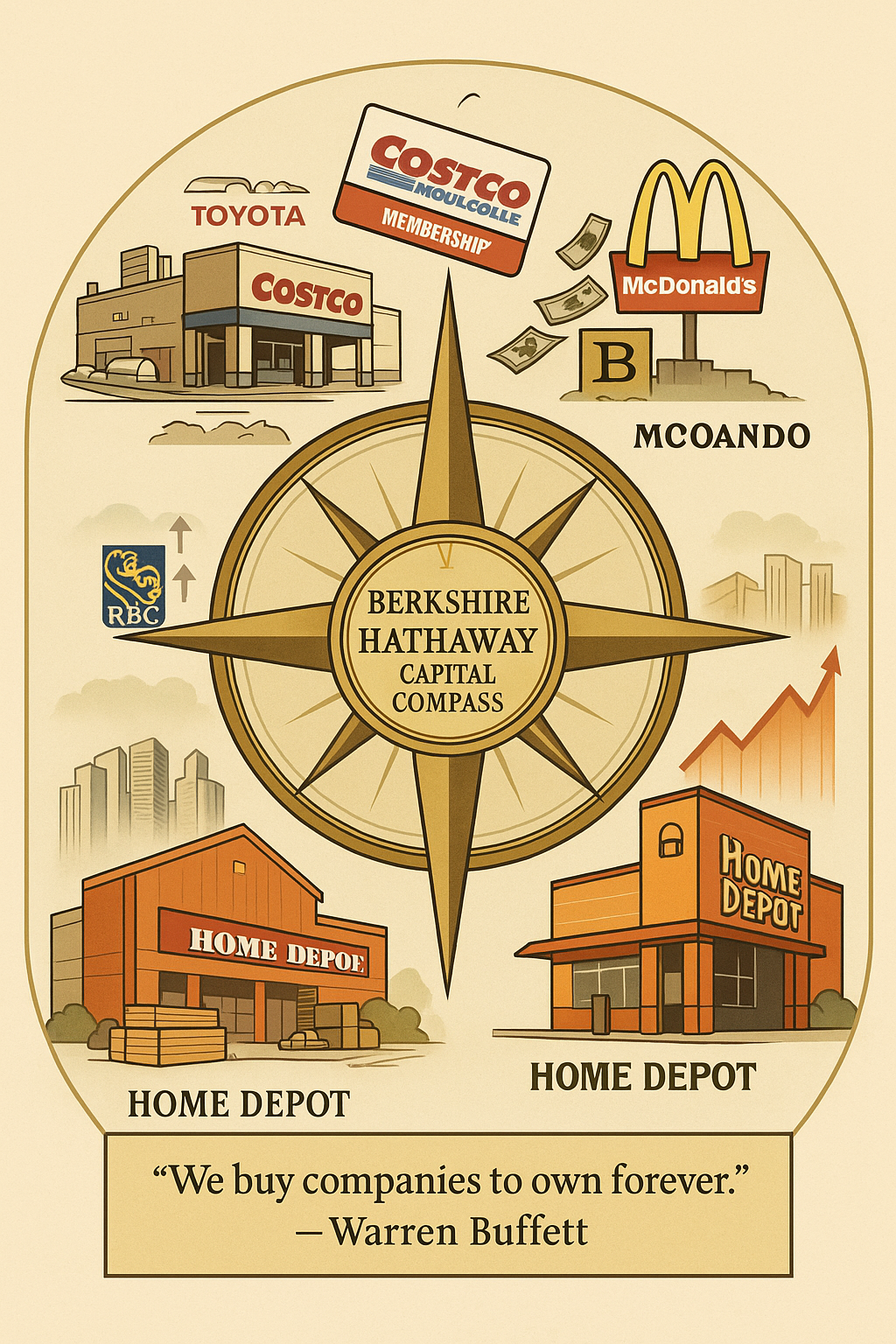
The five most plausible candidates — Costco, McDonald’s, Home Depot, Royal Bank of Canada, and Toyota — each satisfy that mix of prudence, predictability, and permanence that defines Berkshire’s century-long strategy of buying “businesses, not tickers.”

Buffett’s philosophy has been remarkably consistent for over six decades: buy simple, cash-rich, moated businesses led by trustworthy managers. Berkshire’s model of quasi-permanent ownership, decentralized operations, and disciplined capital allocation has made it the corporate equivalent of a sovereign wealth fund — except its sovereign is capitalism itself.

Greg Abel, the man expected to succeed Buffett, has only reinforced this model. Coming from Berkshire Energy, Abel represents the “real economy” side of the house preferring tangible assets, regulated returns, and predictable cash flow over the exuberance of speculative innovation.

Hence, the next Berkshire deal is not likely to be an AI startup or fintech disrupter. It will be a “forever asset” — a company that compounds quietly and defends its margins under any macro regime.

Given Berkshire’s sheer scale of over $1 trillion in market capitalization a target must have an enterprise value north of $200 billion to meaningfully “move the needle.” Anything smaller, and the math of compounding becomes negligible.

🧩 The Berkshire Universe: Themes and Tendencies

Berkshire’s portfolio reads like a map of the American and global economy’s most reliable arteries:

CategoryCore HoldingsTraits
FinancialsAmEx, Bank of America, Moody’s, ChubbHigh ROE, capital-light, recurring revenue
Consumer StaplesCoca-Cola, Kraft Heinz, DiageoGlobal brands, predictable demand
Energy / IndustrialsChevron, Occidental, MitsubishiReal assets, inflation hedge
TechnologyApple, Amazon (small), VeriSignCash-rich ecosystems
Infrastructure / InsuranceBNSF Railway, BH ReinsuranceTangible durability, “float” generation

This structure provides a blueprint for what comes next: reinforcement, not reinvention. Berkshire rarely pivots; it doubles down on what works. It will seek businesses that (1) resemble what it already understands, and (2) offer inflation-protected earnings streams in a world of higher nominal rates.

From the universe of firms valued between $200 billion and $450 billion, only a handful exhibit the balance of predictability, management integrity, and strategic fit Berkshire demands.

A closer look through Buffett’s filters narrows the field to Costco, McDonald’s, Home Depot, Royal Bank of Canada, and Toyota. Each operates in a sector Berkshire already knows and each represents a bridge between the company’s past and its post-Buffett future.

1. Costco Wholesale (Ticker: COST)

The Cult of Value Meets the Culture of Discipline

Buffett has long admired Costco’s operating model. It is a retailer that sells everything from fresh salmon to fine jewelry but in truth, it sells trust. Its membership model generates annuity-like revenue, while its relentless efficiency and scale provide a durable moat against both inflation and digital disruption.

Charlie Munger, Buffett’s late partner, once served on Costco’s board and famously said, “Costco is one of the most admirable capitalistic institutions in the world.” That legacy alone makes a partial acquisition symbolically powerful.

While a full buyout (market cap ≈ $405 billion) may be too expensive, a 20–30% stake would make sense. It would give Berkshire exposure to global consumer spending and provide a stabilizing counterpart to its stake in Apple, a brand built on loyalty, not leverage.

In the age of shrinking retail margins, Costco remains an inflation hedge, its pricing power born from scale, not greed. Buffett has always preferred such quiet dominance.

2. McDonald’s (Ticker: MCD)

Fast Food, Slow Capital

If there were ever a brand that personifies Buffett’s doctrine of “durable competitive advantage,” it is McDonald’s. With over 40,000 locations in 100+ countries and a business model centered on franchised cash flow, McDonald’s is the quintessential predictable earner.

Its asset-light structure means free cash flow margins north of 25%, while its real-estate footprint functions as an embedded REIT. In a world of digital payments, delivery, and global inflation, McDonald’s pricing agility is unmatched. It can raise prices by 5% globally without denting demand, a privilege of brand addiction.

Moreover, McDonald’s cultural synergy with Coca-Cola (another Berkshire cornerstone) cannot be overstated. Both are global empires built on ubiquity, habit, and nostalgia. A merger of ownership philosophy, if not of products, would anchor Berkshire’s consumer-staples dynasty for another half-century.

At ~$218 billion market cap, McDonald’s is one of the few full-scale acquisitions Berkshire could realistically afford outright.

3. Home Depot (Ticker: HD)

Owning the American Rebuild

Buffett once said that he bets on the “resilience of the American homeowner.” Home Depot, valued around $372 billion, is the most efficient expression of that belief.

As infrastructure spending rises and housing shortages intensify, Home Depot sits at the crossroads of construction, repair, and consumer credit. Its business model converts cyclical demand into steady dividend growth. For Berkshire, already owning materials firms and insulation producers, a significant stake in Home Depot would complete a “vertical household economy” from supply chain to consumer.

Its store footprint and brand loyalty parallel BNSF’s railroad network: both are national arteries essential to the domestic economy. Buffett loves owning irreplaceable distribution infrastructure and Home Depot’s logistics system is precisely that.

4. Royal Bank of Canada (Ticker: RY)

The Conservative Bank That Would Make Carnegie Smile

Berkshire’s financial core is deep, but largely American. A Royal Bank of Canada acquisition would expand its footprint across North America’s second-largest and most stable financial system.

RBC’s strengths are conservative underwriting, dominant market share in wealth management, and a culture of steady, compounding profitability which mirror Buffett’s historical love of American Express and Bank of America.

Moreover, Canada’s heavily regulated banking environment protects incumbents from competition. Berkshire thrives in such “wide-moat oligopolies.”

At a market cap of $208 billion, the bank is small enough for a full acquisition but large enough to deploy Berkshire’s idle cash meaningfully. It would also diversify currency exposure and hedge U.S. economic concentration, a quiet, Abel-style move.

5. Toyota Motor Corp. (Ticker: TM)

Japan’s Crown Jewel of Industrial Resilience

Berkshire already owns minority stakes in five major Japanese trading houses, a calculated bet on the nation’s industrial discipline. Extending that strategy into Toyota would be the logical next step.

Toyota’s balance sheet, manufacturing excellence, and hybrid-vehicle leadership make it a quintessential “Buffett business” hidden inside an automaker. Unlike the tech-saturated EV startups, Toyota’s philosophy of gradual innovation, prudence, and reliability mirrors Berkshire’s own.

The two even share a cultural ethos: long-termism over trend-chasing.

At roughly $268 billion market cap, a 10–20% strategic stake would echo Buffett’s Japanese diversification theme without the regulatory complexity of a full acquisition. It would also position Berkshire for the eventual rise of hybrid and hydrogen vehicles in emerging markets, aligning with its energy portfolio’s shift toward renewables.

💰 Financial Feasibility: Deploying $250 Billion Wisely

Even Berkshire’s cash hoard has limits. Deploying $150–$250 billion must pass both the Buffett test (certainty of cash flow) and the Abel test (inflation resilience).

A possible portfolio of acquisitions could look like this:

TargetMarket Cap (USD)Likely ApproachStrategic Rationale
Costco$405B20–30% stakeGlobal retail + subscription revenue
McDonald’s$218BFull acquisitionCash flow, brand power, inflation hedge
Home Depot$372B20–30% stakeU.S. infrastructure exposure
Royal Bank of Canada$208BFull acquisitionNorth American financial expansion
Toyota$268B10–20% stakeJapan industrial diversification

In total, such a deployment would utilize around $200 billion, leaving liquidity for buybacks and opportunistic purchases.

This mirrors Berkshire’s historical pattern: buying large minority stakes in global champions, then waiting for market corrections to accumulate more — the “silent control” strategy that has defined its rise.

Strategic Summary: The Post-Buffett Blueprint

The post-Buffett Berkshire era will be one of institutional continuity, not radical change. Greg Abel’s likely leadership ensures that the company remains disciplined, risk-averse, and industrially grounded.

These five potential acquisitions — Costco, McDonald’s, Home Depot, Royal Bank of Canada, and Toyota — collectively represent Berkshire’s five pillars of permanence:

  1. Consumer Trust (Costco) – Loyalty as an economic moat.
  2. Everyday Habit (McDonald’s) – Cash flow as culture.
  3. Infrastructure (Home Depot) – Building the backbone of America.
  4. Finance (RBC) – Conservative capital compounding.
  5. Industry (Toyota) – Global operational excellence.

Each adds a layer of diversification without diluting Berkshire’s DNA. Together, they form a defensive fortress against inflation, technological disruption, and economic cycles — precisely the environment Berkshire was built to survive.

For HBCU endowments and African American institutional investors, Berkshire’s approach holds a powerful parallel. The key lesson is patience married to scale. Berkshire’s compounding model demonstrates how disciplined reinvestment — not speculative churn — builds generational wealth.

Like Berkshire, HBCU financial ecosystems can create “institutional compounding engines” by investing in enterprises that share cultural familiarity, operational durability, and intergenerational value. Buffett calls it “the joy of owning good businesses forever.”

For African American institutions, that translates to owning — not merely funding — the infrastructure of our own economies.

Berkshire Hathaway stands at an inflection point. The post-Buffett era will not be about reinvention but reaffirmation — proving that its model of ethical capitalism can persist without its founding prophet.

The five plausible acquisitions ahead — Costco, McDonald’s, Home Depot, Royal Bank of Canada, and Toyota — are not just balance-sheet moves; they are philosophical statements.

Each embodies what Buffett has called the “virtue of patience in a speculative age.” And as markets oscillate between AI euphoria and geopolitical anxiety, Berkshire remains what it has always been: a monument to quiet power and compounding discipline.

For long-term investors — from sovereign funds to HBCU endowments — that discipline remains the truest asset class of all.

Disclaimer: This article was assisted by ChatGPT.

HBCU Money’s 2024 African American Owned Bank Directory

All banks are listed by state. In order to be listed in our directory the bank must have at least 51 percent African American ownership. You can click on the bank name to go directly to their website.

KEY FINDINGS:

  • 14 of the 18 African American Owned Banks saw increases in assets from 2023.
  • African American Owned Banks (AAOBs) are in 16 states and territories. Key states absent are Maryland, Missouri, New York, and Virginia.
  • Adelphi Bank (OH) is the most recent African American Owned Bank started in 2023. Prior to that no African American owned bank had been started in 23 years.
  • Alabama and Georgia each have two AAOBs.
  • African American Owned Banks have approximately $6.4 billion of America’s $23.6 trillion bank assets (see below) or 0.027 percent. The apex of African American owned bank assets was in 1926 when AAOBs held 0.2 percent of America’s bank assets or 10 times the percentage they hold today.
  • African American Owned Banks comprise 12 percent of Minority-Owned Banks (151), but only control 1.75 percent of FDIC designated Minority-Owned Bank Assets.
  • 2024 Median AAOBs Assets: $191,590,000 ($168,701,000)
  • 2024 Average AAOBs Assets: $355,448,000 ($326,097,000)
  • TOTAL AFRICAN AMERICAN OWNED BANK ASSETS 2024: $6,398,070,000 ($5,867,738,000)

ALABAMA

ALAMERICA BANK

Location: Birmingham, Alabama

Founded: January 28, 2000

FDIC Region: Atlanta

Assets: $17,741,000

Asset Change (2023): UP 2.7%

COMMONWEALTH NATIONAL BANK

Location: Mobile, Alabama

Founded: February 19, 1976

FDIC Region: Atlanta

Assets: $66,375,000

Asset Change (2023): DOWN 0.8%

DISTRICT OF COLUMBIA

INDUSTRIAL BANK

Location: Washington, DC

Founded: August 18, 1934

FDIC Region: New York

Assets: $755,175,000

Asset Change (2023): UP 2.2%

GEORGIA

CARVER STATE BANK

Location: Savannah, Georgia

Founded: January 1, 1927

FDIC Region: Atlanta

Assets: $106,700,000

Asset Change (2023): UP 30.3%

CITIZENS TRUST BANK

Location: Atlanta, Georgia

Founded: June 18, 1921

FDIC Region: Atlanta

Assets: $793,469,000

Asset Change (2023): UP 7.0%

ILLINOIS

GN BANK

Location: Chicago, Illinois

Founded: January 01, 1934

FDIC Region: Chicago

Assets: $64,685,000

Asset Change (2023): UP 1.2%

LOUISIANA

LIBERTY BANK & TRUST COMPANY

Location: New Orleans, Louisiana

Founded: November 16, 1972

FDIC Region: Dallas

Assets: $1,076,349,000

Asset Change (2023): UP 2.6%

MASSACHUSETTS

ONEUNITED BANK

Location: Boston, Massachusetts

Founded: August 02, 1982

FDIC Region: New York

Assets: $756,367,000

Asset Change (2023): UP 0.1%

MICHIGAN

FIRST INDEPENDENCE BANK

Location: Detroit, Michigan

Founded: May 14, 1970

FDIC Region: Chicago

Assets: $644,122,000

Asset Change (2023): UP 6.1%

MISSISSIPPI

GRAND BANK FOR SAVINGS, FSB

Location: Hattiesburg, Mississippi

Founded: January 1, 1968

FDIC Region: Dallas

Assets: $252,934,000

Asset Change (2023): UP 57.0%

NORTH CAROLINA

MECHANICS & FARMERS BANK

Location: Durham, North Carolina

Founded: March 01, 1908

FDIC Region: Atlanta

Assets: $498,118,000

Asset Change (2023): UP 15.9% 

OHIO

ADELPHI BANK

Location: Columbus, Ohio

Founded: January 18, 2023

FDIC Region: Chicago

Assets: $68,154,000

Asset Change (2023): UP 55.1%

OKLAHOMA

FIRST SECURITY BANK & TRUST

Location: Oklahoma City, Oklahoma

Founded: April 06, 1951

FDIC Region: Dallas

Assets: $174,740,000

Asset Change (2023): UP 46.4%

PENNSYLVANIA

UNITED BANK OF PHILADELPHIA

Location: Philadelphia, Pennsylvania

Founded: March 23, 1992

FDIC Region: New York

Assets: $53,275,000

Asset Change (2023): DOWN 4.4%

SOUTH CAROLINA

OPTUS BANK

Location: Columbia, South Carolina

Founded: March 26, 1999

FDIC Region: Atlanta

Assets: $662,589,000

Asset Change (2023): UP 26.2%

TENNESSEE

CITIZENS SAVINGS B&T COMPANY

Location: Nashville, Tennessee

Founded: January 4, 1904

FDIC Region: Dallas

Assets: $181,740,000

Asset Change (2023): UP 3.1%

TEXAS

UNITY NB OF HOUSTON

Location: Houston, Texas

Founded: August 01, 1985

FDIC Region: Dallas

Assets: $201,440,000

Asset Change (2023): DOWN 3.6%

WISCONSIN

COLUMBIA SAVINGS & LOAN ASSOCIATION 

Location: Milwaukee, Wisconsin

Founded: January 1, 1924

FDIC Region: Chicago

Assets: $24,097,000

Asset Change (2023): DOWN 12.0%

SOURCE: FDIC

HBCU Money’s 2023 African American Owned Bank Directory

All banks are listed by state. In order to be listed in our directory the bank must have at least 51 percent African American ownership. You can click on the bank name to go directly to their website.

OTHER KEY FINDINGS:

  • 11 of the 17 African American Owned Banks saw increases in assets from 2022.
  • African American Owned Banks (AAOBs) are in 16 states and territories. Key states absent are Maryland, Missouri, New York, and Virginia.
  • Adelphi Bank (OH) is the first African American Owned Bank (AAOB) started in 23 years.
  • Alabama and Georgia each have two AAOBs.
  • African American Owned Banks have approximately $5.8 billion of America’s $23.2 trillion bank assets (see above) or 0.02 percent. The apex of African American owned bank assets was in 1926 when AAOBs held 0.2 percent of America’s bank assets or 10 times the percentage they hold today.
  • African American Owned Banks control 1.7 percent of FDIC designated Minority-Owned Bank Assets.
  • 2023 Median AAOBs Assets: $168,701,000 ($150,072,000)
  • 2023 Average AAOBs Assets: $326,097,000 ($325,391,000)
  • TOTAL AFRICAN AMERICAN OWNED BANK ASSETS 2023: $5,867,738,000 ($5,531,655,000)

ALABAMA

ALAMERICA BANK

Location: Birmingham, Alabama

Founded: January 28, 2000

FDIC Region: Atlanta

Assets: $17,282,000

Asset Change (2022): UP 9.5%

COMMONWEALTH NATIONAL BANK

Location: Mobile, Alabama

Founded: February 19, 1976

FDIC Region: Atlanta

Assets: $66,944,000

Asset Change (2022): UP 9.2%

DISTRICT OF COLUMBIA

INDUSTRIAL BANK

Location: Washington, DC

Founded: August 18, 1934

FDIC Region: New York

Assets: $739,181,000

Asset Change (2022): UP 2.2%

GEORGIA

CARVER STATE BANK

Location: Savannah, Georgia

Founded: January 1, 1927

FDIC Region: Atlanta

Assets: $81,906,000

Asset Change (2022): DOWN 2.5%

CITIZENS TRUST BANK

Location: Atlanta, Georgia

Founded: June 18, 1921

FDIC Region: Atlanta

Assets: $741,413,000

Asset Change (2022): DOWN 8.1%

ILLINOIS

GN BANK

Location: Chicago, Illinois

Founded: January 01, 1934

FDIC Region: Chicago

Assets: $63,898,000

Asset Change (2022): DOWN 11.1%

LOUISIANA

LIBERTY BANK & TRUST COMPANY

Location: New Orleans, Louisiana

Founded: November 16, 1972

FDIC Region: Dallas

Assets: $1,048,899,000

Asset Change (2022): DOWN 3.4%

MASSACHUSETTS

ONEUNITED BANK

Location: Boston, Massachusetts

Founded: August 02, 1982

FDIC Region: New York

Assets: $755,706,000

Asset Change (2022): UP 1.6%

MICHIGAN

FIRST INDEPENDENCE BANK

Location: Detroit, Michigan

Founded: May 14, 1970

FDIC Region: Chicago

Assets: $607,167,000

Asset Change (2022): UP 29.6%

MISSISSIPPI

GRAND BANK FOR SAVINGS, FSB

Location: Hattiesburg, Mississippi

Founded: January 1, 1968

FDIC Region: Dallas

Assets: $161,125,000

Asset Change (2022): UP 38.9%

NORTH CAROLINA

MECHANICS & FARMERS BANK

Location: Durham, North Carolina

Founded: March 01, 1908

FDIC Region: Atlanta

Assets: $429,605,000

Asset Change (2022): UNCHANGED 

OHIO

ADELPHI BANK

Location: Columbus, Ohio

Founded: January 18, 2023

FDIC Region: Chicago

Assets: $43,945,000

Asset Change (2022): N/A

OKLAHOMA

FIRST SECURITY BANK & TRUST

Location: Oklahoma City, Oklahoma

Founded: April 06, 1951

FDIC Region: Dallas

Assets: $119,349,000

Asset Change (2022): UP 50.9%

PENNSYLVANIA

UNITED BANK OF PHILADELPHIA

Location: Philadelphia, Pennsylvania

Founded: March 23, 1992

FDIC Region: New York

Assets: $55,719,000

Asset Change (2022): DOWN 6.2%

SOUTH CAROLINA

OPTUS BANK

Location: Columbia, South Carolina

Founded: March 26, 1999

FDIC Region: Atlanta

Assets: $524,934,000

Asset Change (2022): UP 29.5%

TENNESSEE

CITIZENS SAVINGS B&T COMPANY

Location: Nashville, Tennessee

Founded: January 4, 1904

FDIC Region: Dallas

Assets: $176,277,000

Asset Change (2022): UP 17.5%

TEXAS

UNITY NB OF HOUSTON

Location: Houston, Texas

Founded: August 01, 1985

FDIC Region: Dallas

Assets: $209,014,000

Asset Change (2022): UP 1.3%

WISCONSIN

COLUMBIA SAVINGS & LOAN ASSOCIATION 

Location: Milwaukee, Wisconsin

Founded: January 1, 1924

FDIC Region: Chicago

Assets: $27,374,000

Asset Change (2022): UP 11.6%

SOURCE: FDIC

African Americans Own $570.3 Billion Of America’s Stock Market Value – It Should Be $6 Trillion

“Investing should be more like watching paint dry or watching grass grow. If you want excitement, take $800 and go to Las Vegas.” – Paul Samuelson

A big number means absolutely nothing without context. Saying someone has a lot or a little of something does not tell you much of anything without a control variable to compare it to. This is absolutely one of the most troublesome things in conversation with many in African America where a number is presented like African America’s $1.5 trillion in buying power without asking – is that what is should be? How does it compare on a per person basis with other groups? What percentage of the overall buying power is it? It is in fact only 8 percent of America’s buying power while African America constitutes 12 percent of the U.S. population. Arguably then, African America’s buying power should be closer to $2.1 trillion or 40 percent greater than it is. When it comes to financial numbers we tend to personalize them thinking about if we (an individual) personally had that amount of money as opposed that amount of money spread across 40 million people or the budget necessary to run an entire institution versus a household. Again, context is not only important but imperative to understand what a number means and what it is actually telling you.

In 2020, the total equity market value of the U.S. stock market was $40.7 trillion according to Siblis Research. We asked Nova AI how much of the stock market is actually owned by African Americans, “A 2020 report by The Center for Economic and Policy Research, Black Americans held approximately 1.4% of the total value of U.S. listed public companies.” That amount equals out to the aforementioned $570.3 billion and at first glance it sounds like a tremendous amount, but further analysis says otherwise. First, it is a value that is equal to only 1.4 percent of the total equity market value. Secondly, if African America owned a representative amount of the total equity market value in correlation to our population (12 percent) it would be worth $6.1 trillion or almost 11 times the current ownership value. Lastly, how much would that workout per African American? The $570.3 billion equals out to $12,160 per African American while the $6.1 trillion would work $129,990 per African American. That is every African American man, woman, and child. For a household of four, it is the difference between a family having stock ownership value of less than $50,000 per household versus almost $600,000 per household.

The impact of such a difference is almost hard to truly imagine and/or quantify. Homeownership would skyrocket through 50 percent for the first time in African America’s history without question. African American student loan debt would plummet. HBCU endowments would skyrocket. African American banks, businesses, and nonprofits would flourish in ways not seen since the early 1900s. Access to mental and physical health would be a norm instead of a dogfight. Life expectancy would increase substantially. African American poverty would see significant drops. Marriage for African American would likely see a boom. The list goes on and on. A family with $600,000 in equity market value conservatively would produce $24,000 annually (4 percent yield) in dividend income for the household which is taxed at a lower rate than earned income (your job) and therefore would have African American households keeping more of their money. It would also establish a multigenerational emergency fund for an African American household. Something that seems almost unheard for the vast majority of us.

Headwinds for African American families to invest continue to be mountainous. African American median income is lowest among all groups and those African Americans who do find themselves with middle and high incomes tend to find themselves providing for immediate and extended families at a much higher rate than our European American counterparts. In 401(K)’s this shows up as European Americans contribute almost $300 a month while African Americans are just over $200. It may not sound like a huge difference, but when coupled over decades and compounding returns it can have a substantial impact on wealth building. There is also the severe lag in taxable investment accounts for African Americans. The majority of African American investors participate in the stock market strictly through their 401(K) and perhaps a IRA – both of which have annual contribution limits on them. Taxable investment accounts have unlimited contributions, easier to borrow against, more investment options, and easier to access in case of emergency, but according to a FINRA Foundation report, “Among African American respondents, 22 percent reported having a taxable investment account in 2012. The number rose to 26 percent in 2018 (see above).” In comparison, European and Asian American taxable accounts were at 35 and 41 percent, respectively. The latter two groups with higher median incomes, higher investment contributions, and as one sees significantly more taxable investment accounts make it a no wonder why their equity market value is significant head and shoulders above ours.

The answer while not a perfect one lies in group (small scale) and institutional (large scale) investing (ex. Investment Club: Definition, Advantages, How To Start One). Some downsides to group investing is finding likeminded people, consistent participation, employment volatility, less liquidity in case of an emergency. Upsides are more capital to scale investments with and generate greater returns, access to investments quicker allowing for compounding to take place longer, less individual risk, For instance, there is Black-owned real estate investment firm that offers mortgage notes at 20 percent annually, but the minimum is $5,000 to purchase a note. Saving $5,000 in a year is hard for a lot of households and if they can save that much they certainly do not want to lock it up in a note. With group investing perhaps with five people, then each is only responsible for $1,000 or just over $80 a month. Now your $1,000 is earning 20 percent when otherwise it would not be because of the minimum.

Institutional investing is arguably where the answer truly lies. African American institutions like our banks and credit unions, businesses, nonprofits, HBCU alumni associations and chapters, D9 organizations, HBCU endowments, and more do very little institutional investing. Instead, like many African American households most African American institutions hold the majority of their capital in cash and non-interest bearing accounts. The idea of our institutions being institutional investors even if they owned nothing more than vanilla ETFs (exchange-traded funds) like the SPY ETF (S&P 500) which is one of the safest entrees into the stock market investing seems like inventing fire for many African American institutions. Had any African American institution invested just $10,000 in the market in 2008 and held through 2021 that value would have increased over 400% to almost $43,000. Instead, most institutions like our households sat in cash and saw their $10,000 decline in value due to inflation and almost zero interest rates in savings accounts. The Divine 9 for instance has approximately 4 million members, if they could get 15 percent of that membership to give an extra $10 a year that would be $6 million per year able to invest in the stock market allowing the Divine 9 to be a substantive institutional investor and obviously on a scale that probably none of them could wield on their own without stress. That so many African American institutions have limited exposure to the stock market or none at all is arguably by far the greatest constraint on how much of the stock market’s value African America owns.

African America too often is looking to solve institutional problems with individual solutions. Workarounds, imagination, and institutional solutions are what is required if we are going to address much of the systemic mountains before us.

Virginia State University Alumnus Owned Investment Firm Makes First Investment In Africa

Without change there is no innovation, creativity, or incentive for improvement. Those who initiate change will have a better opportunity to manage the change that is inevitable. – William Pollard

Over the past few years, Founder & CIO, William A. Foster, IV of 15 & 40, a multi-asset investment firm, had been looking to extend its portfolio beyond the shores of the United States. In particular, the firm has become keen on making their first investment in Africa. Through a previous professional relationship that opportunity would come to pass. Mr. Foster was previously head of acquisitions and Regan Mutumbo was previously head of operations at a private real estate investment firm based in Atlanta, GA. It was Mr. Mutumbo’s leadership that actually brought Mr. Foster into the real estate investment firm’s fold and they formed a fast professional relationship that would be the foundation of the later investment. The investment was a classic case of the importance of building a strong professional network and the fruit of opportunities it can bear years later.

15 & 40 invested a ten percent stake in Ciya, a ride sharing app company located in the Democratic Republic of Congo’s capital city of Kinshasa. It is the firm’s first investment on the continent, but according to Mr. Foster this is just the beginning. “Our plan is to have a major capital footprint across the Diaspora buoyed with strategic concentration in Africa.” More than just capital though, Mr. Mutumbo has met with Mr. Foster in monthly brainstorming sessions to help with the strategy and direction of Ciya. Showcasing the circulation of intellectual capital on a Diasporic scale. The company is named for Mr. Mutumbo’s mother and is his way to honor her legacy. He also is adamant about being part of the foundation that spurs economic development for the Democratic Republic of Congo and Mr. Foster’s Pan-African investment views make it an ideal match for both.

The World Book’s Economic Situation on the Democratic Republic of Congo:

“Economic growth picked up to 8.6% in 2022, keeping the strong momentum from 2021 (6.2%). Mining sector investment and exports remain the key drivers of growth, owing to capacity expansion and recovery in global demand. However, growth in non-mining sectors (particularly services) was modest, slowing down to 3.0% in 2022, from 4.5% in 2021. Stronger export earnings could not offset higher food and fuel bills, and lead to a wider current account deficit estimated at 2.9% of GDP in 2022 (from -1.0% in 2021). Nevertheless, foreign direct investments (FDI) and external financing contributed to build up reserves, reaching 7.9 weeks of imports in 2022, from 5.4 weeks a year earlier, and limiting excessive exchange rate fluctuations. Higher global energy and food prices due to the ongoing war in Ukraine exerted upward pressures on domestic inflation, lifting the average inflation rate from 9.1% in 2021 to 9.2% in 2022.

The fiscal deficit deteriorated to 2.7% in 2022 (from 0.8% in 2021) as improved revenue mobilization could not fully offset higher capital and current spending. Domestic revenues peaked at 15.6% of GDP in 2022, owing to favorable commodity prices and digitalization of the revenue collection process, while expenditures (19.7% of GDP) increased due to exceptional security spending and arrears repayments, in addition to wage adjustments and fuel subsidies. The medium-term outlook for DRC is favorable with growth estimated at 7.5% by 2025. However, DRC’s economy remains vulnerable to commodity price swings and growth performance of major trading partners which might be disturbed by geopolitical conflicts. The continued economic consequences of the war in Ukraine, through rising global food costs and higher oil prices, could exert stronger pressure on fiscal deficit, inflation, and household consumption thus exacerbating poverty and inequality.

Given persistent conflicts in the East, DRC’s immediate challenge is to strengthen security and maintain political and macroeconomic stability while stepping up ongoing reforms to ensure sustainable growth.”

It speaks to a broader opportunity of African America’s ability to leverage American capital and invest mightily alongside their African brethren and create a transcontinental partnerships that for the first time would put a healthy relationship between capital and investment on both sides of the Atlantic. Instead of hostile lending and investment from European Americans, Europeans, and Asians that has been the traditional order of business for African investment, this lays the ground work for a mutually beneficial relationships that should see both sides prosper. “We are here to build and connect institutions of the African Diaspora. For my firm it really is that simple.”, said Mr. Foster. He hopes that HBCUs in particular along with their endowments, foundations, and alumni associations can leverage their collective capital that would allow them to make major investments throughout Africa.

Visit Ciya by clicking here.