Tag Archives: HBCU

Dr. King’s Dream is Dead: African America Must Focus On Its Own Institutional Sovereignty and Survival

“I fear I may have integrated my people into a burning house.” – Dr. Martin Luther King, Jr.

By William A. Foster, IV

For my parents and grandparents not many years ago, it was the White Citizens Council, Ku Klux Klan, Bull Connor, George Wallace, and more. Today, it is MAGA, ICE, Donald Trump, Charlie Kirk, and more. African America long held out hope that we would be in someway accepted into America’s fabric. We contributed centries of free labor capital, centuries of cultural capital, and did it all under an umbrella of racial terrorism. This hope was held without so much as an apology or reparation. The Civil Rights Movement of which much of my family was a part of from my mother’s letter to Dr. King himself that now sits in the archives of Boston College to part of our family that was forced to relocate to Jamaica by the US government, likely Hoover’s FBI. They fought for equal protections and equal opportunities, but it was and has always been a fool’s errand. A group in power will never voluntarily relinquish that power and European Americans are no exception to that rule. The problem is and has always been that only African America was fighting for reconciliation. It has been a dance between two dance partners where one is constantly stomping on the feet of the other, stealing money out of our pockets as they swirl us around, and smiling at us while putting a knife nine inches in our back and pulling it out six inches while calling it progress.

As a child, my sister and I had the privilege of attending Wee Care, an African American primary school in Prairie View, Texas in the town where our family’s illustrious HBCU, Prairie View A&M University is located and where my mother has taught students, developed faculty, and served in leadership for almost five decades. Unfortunately for us, the school only went up to the first grade at which time my mother was forced to choose her “best” option. My mother’s best option was an overwhelmingly European American Catholic school in the heart of Tomball, Texas, at the time a fairly known small Texas town – with all of the small town Texas dynamics when it came to race. Only my second and fifth grade teachers were nice to me. One was really young and the other a hippy. In sixth and seventh grade at another predominantly European American Catholic school I would experience the first time being called the N word by a fellow classmate. Even in the resulting aftermath of the fight I was blamed by the principal for being violent. Imagine that. The African American private schools were limited and given the distance from where we lived almost impossible for my mother to change us to an African American school where we would be culturally safe. That though was not the whole story. You see my classmates through elementary in particular were thought to be lifetime friends, but in my later years I would learn a valuable lesson from a graduate program I would attend in Boston at a Jewish institution. Do not confuse friendship and loyalty. I am thankful to this day for the lessons from that institution because it opened my eyes to so much in the world of navigating power dynamics. It was in those lessons that I realized that many of my so called friends from elementary were also loyal to causes that would see me and my family back on a plantation if the winds blew in the right direction and they saw no moral or ideological conflict.

From that point on, I realized that what I must lean into is the institutional development of my own people. From African America to the African Diaspora and that the connectivity of our institutions would be our strength and saving grace. But alas, many of us still yearned for acceptance into PWIs, European American corporations even though we do not think of them as such that is exactly who they are owned by when you examine their ownership, and predominantly European American neighborhoods. To access whiteness is seen as progress and success. In every place we lived, I largely remember us always being the only African American family in the neighborhood. Something I know that none of my childhood “friends” ever thought about or crossed their mind. Their families would never move into an African American community and be the only one. They saw our spaces as hostile even though we have always been overly welcoming even to our detriment, but as I said being the only African American family in a predominantly European American community was often seen as “progress” for many in our community. It was a mistake, a violent psychological mistake that still harms many of us to this day. The same way Ruby Bridges, a six-year old child, had to be escorted by Federal agents into a school because we assumed the fight for desegregation was making America true to its values. We were wrong then and we have been wrong about what Ameria’s values actually are.

Dr. King said in his famous speech, “I have a dream that one day this nation will rise up and live out the true meaning of its creed. We hold these truths to be self-evident that all men are created equal. I have a dream that one day out in the red hills of Georgia the sons of former slaves and the sons of former slaveowners will be able to sit down together at the table of brotherhood. I have a dream that one day even the state of Mississippi, a state sweltering with the heat of oppression, will be transformed into an oasis of freedom and justice. I have a dream that my four little children will one day live in a nation where they will not be judged by the color of their skin but by their character. I have a dream today. I have a dream that one day down in Alabama, with its vicious racists, with its governor having his lips dripping with the words of interposition and nullification; that one day right down in Alabama little black boys and black girls will be able to join hands with little white boys and white girls as sisters and brothers. I have a dream today.”

The dream is dead. It was a dream that required two parties to reconcile their past with only one willing to do so while suffering the brutality that has persisted since 1619. Dr. King’s speech was given on August 28, 1963 and two weeks later on September 15, 1963, the KKK bombed 16th Street Baptist Church and killed four African American girls: Addie Mae Collins (age 14, born April 18, 1949), Carol Denise McNair (age 11, born November 17, 1951), Carole Rosamond Robertson (age 14, born April 24, 1949), and Cynthia Dionne Wesley (age 14, born April 30, 1949). My mother was born in 1949. It could have easily been her. There are countless African American deaths at the hands of racial terrorism that we will never know about. The Red Summer of 1919 when the most African Americans (on record) were lynched. An entire Civil War just decades prior was waged over whether or not the United States should or should continue to be a country rooted in the slave economy. The complexity by which the North and South were guilty of profiting from – looking at you Harvard and others and have never rectified. The bloodshed, terror, and violence has been endless and it has not receded.

“I wouldn’t give it no more thought than wringing a cat’s neck! And there ain’t a court in Mississippi that’d convict me for it.” Frank Bailey’s, a character in Mississippi Burning, quote in regards to killing African Americans. This is and has been America’s attitude towards African America in its entirety. Not just individuals, but our institutions and communities as well. The underfunding of HBCUs or the burning of countless towns from Rosewood to Tulsa, our death and demise is sport and entertainment. African America has constantly believed that we could appeal to the morality of fellow Americans and “Christians”. We could work hard enough and show them our humanity. Imagine us thinking we need to prove to them we were hard working, civil, or human. It is both comical and insulting. But like many centuries ago, we have since the end of the Civil Rights Movement returns to working hard for everyone but ourselves and our institutions. That time needs to be over and we need to return to the principles and efforts that built towns like Rosewood, Greenwood, 100 HBCUs, 100 African American boarding schools, and over 500 African American owned hospitals. It is time to abandon any hope that peace can be achieved. Our sovereignty and survival is all that matters going forward. There are no more olive branches to be had. Not even from those that call themselves moderates or liberals because far too often we have seen them fall silent or pushed us to assimilate into spaces that did not empower us, did not provide institutional ownership to us, and often were spaces that were paternalistic and just as hostile to us as their conservative cousins. No, there are no more olive branches to be had because our survival depends on it.

Dr. John Henrik Clarke, a noted Pan-African historian, and someone who I consider an unofficial mentor said that any African American who is looking to devise a plan must look at our communities as nation-states and therefore must consider these fundamental pillars:

How will my people be housed?

How will my people be educated?

How will my people be fed?

How will my people be defended?

The answers to these questions can no longer be grassroots, they have to be institutional and they have to be thought about in a way that recognizes that our sovereign nation-state is adjacent to an adversary who has and will invade us. It is not a question of if they will, but when will they because they have so many times before. Unfortuantely, we cannot ask Dr. King what his thoughts about his “Dream” for America would be today because at the age of 39 he was assassinated. He was assassinated three years after his contemporary Malcolm X was assasinated and five years after Medgar Evers was assassinated in his driveway. Medgar Evers just two months before the “I Have A Dream” speech would take place. He was not blind to what America was for African America and he was certainly not blind to how our adversaries saw us or the lengths they were willing to go to in order to silence us. For the last 50 plus years since Dr. King’s passing African America has tried to make a peace that we should now see is not possible. It is time for the Dream Redefined and that dream should start and stop with actions that provide for the institutional sovereignty and survial of African America period.

A Merger of (Potential) Might: Why Prairie View A&M and Texas Southern Should Combine Their Foundations to Challenge the Endowment Establishment

It is reason, and not passion, which must guide our deliberations, guide our debate, and guide our decision. – Barbara Jordan

In the gilded halls of America’s elite universities, financial firepower is both a symbol and source of dominance. Endowments—the great silent engines of academia—determine not only which students get scholarships but which schools can recruit Nobel-calibre faculty, fund original research, and shape public policy. At the apex of this order stands UTIMCO, the University of Texas and Texas A&M’s investment juggernaut, with more than $70 billion under management. Below, far below, exist the undercapitalised yet ambitious Historically Black Colleges and Universities (HBCUs) of Texas.

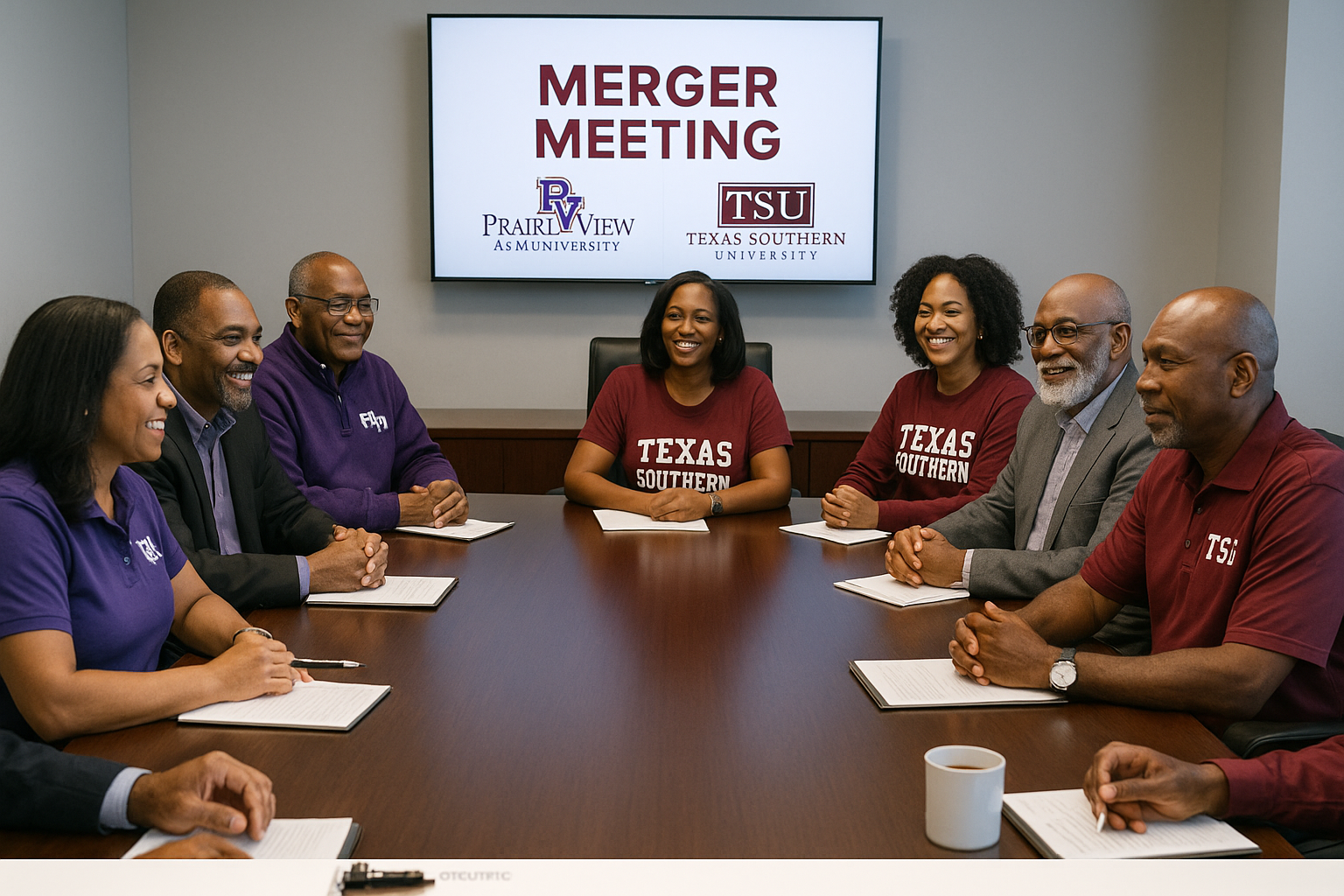
Two of the state’s largest HBCUs—Prairie View A&M University (PVAMU) and Texas Southern University (TSU)—have long histories, loyal alumni, and vital missions. What they do not have is institutional wealth. PVAMU’s foundation reported a modest $1.83 million in net assets in 2022. TSU’s foundation, better capitalised, holds $22.7 million. Combined, that amounts to just $24.5 million. For comparison, Rice University, less than 50 miles from either campus, holds an endowment north of $7.8 billion.

That yawning disparity matters. But it also presents an opportunity: a merger of the two foundations into a single, more potent philanthropic and investment entity. Done properly, it could reorient how Black higher education competes—not by appealing to fairness or guilt, but through scale, strategy, and institutional force.

A Rebalancing Act

To understand the potential of a PVAMU-TSU foundation merger, one must first grasp the dynamics of university endowments. Large endowments benefit from economies of scale, granting them access to exclusive investment opportunities—private equity, venture capital, hedge funds—often unavailable to smaller players. They attract the best fund managers, demand lower fees, and can weather market volatility without compromising their missions. Small foundations, by contrast, tend to be conservatively invested, costly to manage per dollar, and too fragmented to punch above their weight.

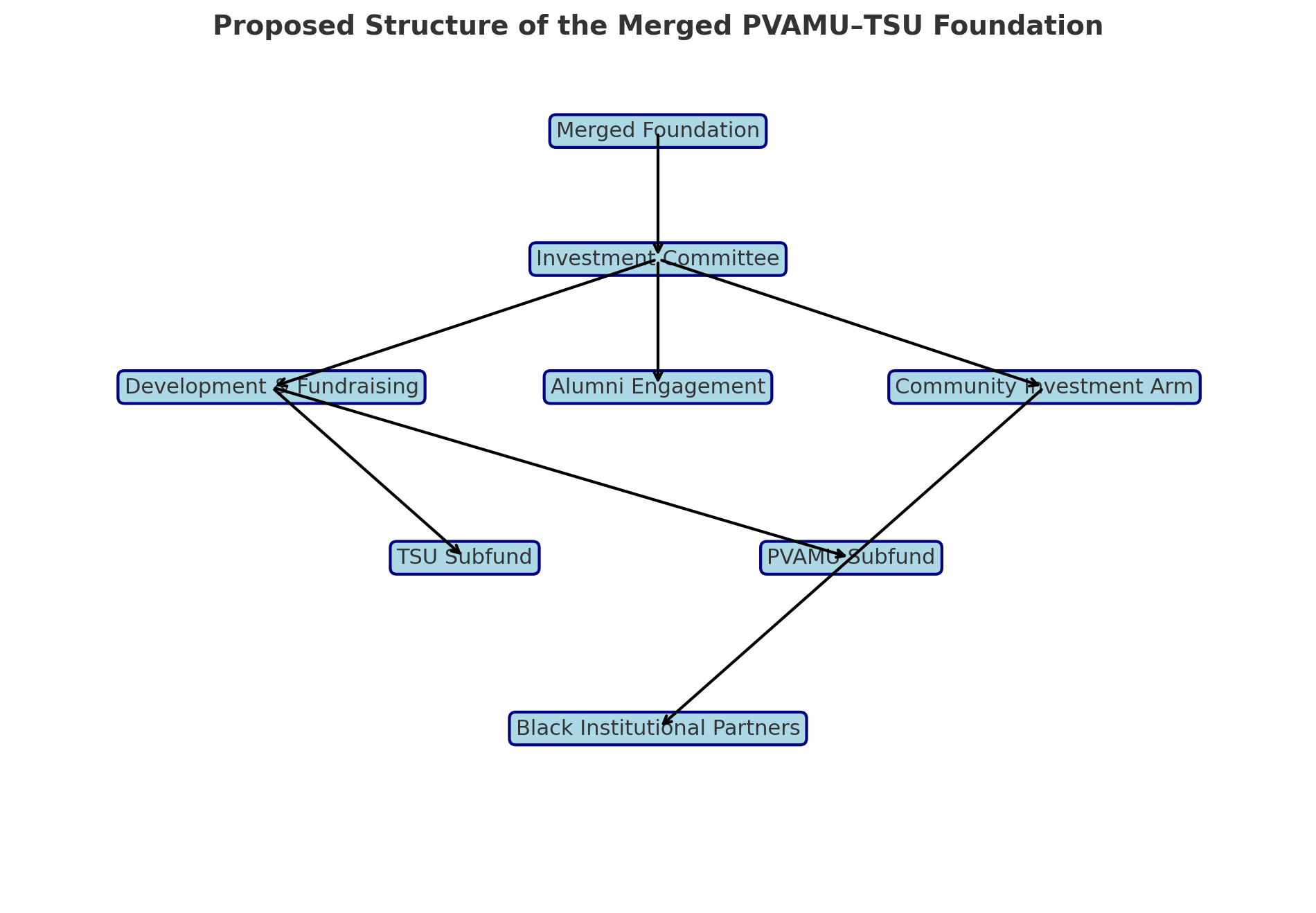
A consolidated HBCU foundation in Texas would be small compared to UTIMCO, but large relative to its peers. With a $25 million corpus as a starting point, the new entity could position itself for growth by professionalising its investment strategy, adopting a more ambitious donor engagement plan, and forming partnerships with Black-owned banks, family offices, and community institutions. Call it the Texas Black Excellence Fund, or perhaps, more simply, the TexHBCU Endowment.

To be sure, the legal and logistical barriers to such a merger are real. Foundation boards guard their autonomy jealously. Alumni pride can turn parochial. Governance models would need careful negotiation to ensure representation and avoid turf wars. But the arguments in favour are compelling.

The Power of One

First, a merger would cut overhead. Legal, accounting, auditing, and compliance costs—duplicated today—could be streamlined. A joint fundraising apparatus could create a single point of entry for corporate partners and high-net-worth donors. Branding efforts would gain coherence: instead of competing for attention, the institutions would stand together as a symbol of Black institutional unity and strength.

Second, scale invites leverage. A $25 million foundation cannot change the world overnight, but it can attract co-investments, engage in pooled funds, and perhaps even launch a purpose-driven asset management firm in the model of UTIMCO. If successful, this would be the first Black-led institutional investor of serious size in Texas—capable not only of managing endowment funds but of influencing broader economic flows across Black Texas.

Third, the merger would send a strategic signal to policymakers and philanthropic networks. It would say, in effect: “We are no longer asking for permission to grow. We are building the engine ourselves.” That tone matters. Too often, HBCUs are framed as needing rescue. A merged foundation flips that narrative. It becomes an asset allocator, a market participant, a builder of capital rather than a petitioner of it.

UTIMCO: A Goliath in the Crosshairs?

No one expects a $25 million fund to challenge a $70 billion behemoth. But that is not the point. UTIMCO’s dominance is as much political as it is financial. Its influence flows from its role as gatekeeper to resources, shaping everything from campus architecture to graduate fellowships. The merged HBCU foundation would not dethrone UTIMCO—it would decentralise power by becoming a second pole.

Indeed, the comparison may inspire mimicry. Just as UTIMCO serves multiple institutions, so too could a joint HBCU foundation. Prairie View and Texas Southern are only the beginning. Over time, the model could scale to include other Black-serving institutions across Texas and the South. This would amplify investment impact and accelerate institutional wealth-building.

Moreover, such a foundation could adopt an unapologetically developmental investment strategy. Where UTIMCO optimises for returns, the TexHBCU fund could optimise for both returns and racial equity—by investing in Black entrepreneurs, affordable housing, climate-resilient infrastructure, or educational tech. The dual mandate—profit and purpose—would not be a hindrance but a hallmark.

Regional Stakes

Prairie View sits on a rural hilltop. Texas Southern sprawls in urban Houston. But their communities are deeply connected—culturally, economically, demographically. A combined foundation could create regional development strategies that go beyond scholarship aid.

Imagine a venture fund seeding Black-owned start-ups in Houston’s Third Ward. A real estate initiative turning vacant lots into mixed-income housing for PVAMU students and local residents. A workforce development fund retraining returning citizens for green jobs across both cities. Each dollar invested becomes more than a balance sheet entry; it becomes a force for transformation.

This matters not just to students and faculty, but to the broader Texas economy. Black Texans make up 13% of the state population but own less than 3% of its small businesses. Educational attainment gaps persist. Institutional neglect deepens. The merger would not fix all this—but it would give the community a new tool for shaping its destiny.

Copy, Then Paste

If the model works, it would not stay in Texas. Southern University in Louisiana has multiple campuses and foundations that could benefit from consolidation. So does the University System of Maryland’s HBCUs. Indeed, the entire sector could adopt a federated endowment strategy—unified in purpose but distributed in governance.

HBCUs have long suffered from institutional atomisation. They are asked to compete individually in a system that rewards consolidation. Merging foundations is not just a finance play—it is a strategy for survival and sovereignty.

The Alternative: Stagnation

Critics may say a merger is too ambitious. That it risks alumni backlash or donor confusion. That it could take years to execute. But delay is itself a cost. Each year the foundations remain separate is another year of opportunity lost. Another year where millions in potential returns go unrealised. Another year where larger institutions deepen their lead.

PVAMU and TSU have histories to be proud of. But institutional pride must not become institutional inertia. A merger is not surrender—it is evolution.

In the long arc of higher education, moments of boldness define legacy. This is one of those moments. Two foundations. One future. Let the uniting begin.

Balancing the Ledger: A Comprehensive Analysis of Athletics vs. Research Spending (MEAC/SWAC vs. SEC/Big 10)

“Since new developments are the products of a creative mind, we must therefore stimulate and encourage that type of mind in every way possible.” – George Washington Carver

In the financially stratified ecosystem of American higher education, institutions are increasingly confronted with a binary tension: to invest in athletic visibility or academic viability. For universities across the NCAA spectrum, especially those in the MEAC and SWAC conferences compared to their counterparts in the SEC and Big Ten, this decision is less about preference and more about resource constraints and strategic direction. Yet, data reveals a persistent imbalance in how these priorities manifest, and more critically, the long-term costs of these choices.

Conference Dynamics: Institutional Identity and Capital Exposure

The MEAC and SWAC are defined by institutions that are predominantly Historically Black Colleges and Universities (HBCUs). These universities have traditionally operated under capital scarcity, navigating chronic underfunding while serving as incubators of social mobility for African American communities. Their mission, often grounded in equity and community uplift, limits their ability to generate large commercial revenues through athletics. This is not due to a lack of talent or audience, but because media deals, booster contributions, and government funding disproportionately favor PWI institutions.

By contrast, the SEC and Big Ten represent the economic elite of collegiate athletics and academia. With flagship state universities at their helm, these conferences are buttressed by multi-billion-dollar endowments, large donor bases, and lucrative broadcast contracts. Their budgets allow for investments in both athletics and research without having to cannibalize one to fund the other. In essence, they play the game with more capital and fewer trade-offs.

Athletics Budgets: Symbolism vs. Strategy

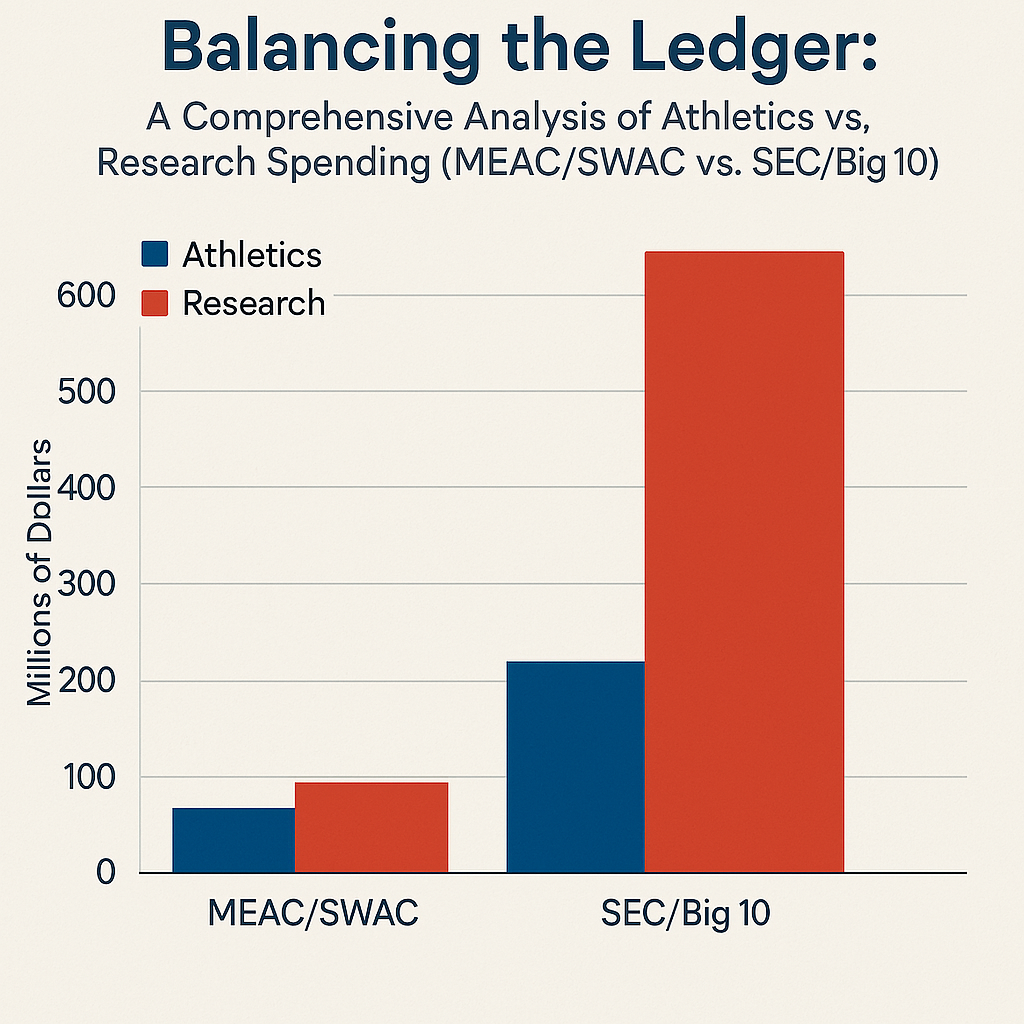
MEAC and SWAC institutions report average athletics expenditures between $11 million and $12 million annually. Notable programs like North Carolina A&T and Prairie View A&M may hover slightly higher, but Mississippi Valley State and others operate on budgets as low as $3.9 million. These figures pale in comparison to SEC schools like Alabama or Texas A&M, where athletic spending exceeds $150 million. The Big Ten’s Ohio State leads all with $215 million dedicated to athletics alone.

While athletic programs at HBCUs serve as cultural centers and enrollment drivers, their limited revenue-generating capacity renders them economically unsustainable without substantial subsidization. Many are forced to divert institutional funds, raise student fees, or solicit local donations just to keep programs afloat. In contrast, SEC and Big Ten programs function as media properties, brand engines, and financial assets, often contributing revenue back to their academic institutions.

Athletics at HBCUs carry significant intangible value, cultural pride, alumni engagement, community identity, but these cannot substitute for financial sustainability. The opportunity cost of maintaining expensive athletic programs without equivalent return on investment demands strategic scrutiny.

Research Spending: The Forgotten Core

Where the real divergence occurs is in research investment. MEAC and SWAC research expenditures are overwhelmingly modest. With the exceptions of Howard University ($122 million) and Florida A&M ($41 million), most institutions sit between $2 million and $25 million in annual research activity. These figures reflect decades of underinvestment and insufficient infrastructure, not a lack of capacity or talent.

Meanwhile, SEC and Big Ten institutions routinely surpass $500 million in annual research outlays. Schools like Michigan ($1.67 billion), Wisconsin ($1.36 billion), and Penn State ($996 million) operate on a scale comparable to government agencies and national labs. They attract large NIH, NSF, and Department of Defense grants. They lead clinical trials, generate patents, and build interdisciplinary research parks.

This disparity is not simply numerical; it is strategic. Research drives federal grants, patents, corporate partnerships, and endowment growth. It also attracts high-performing faculty and students, serving as the foundation of institutional longevity and economic influence.

The Ratio That Tells the Future

The athletics-to-research spending ratio offers a lens into institutional philosophy:

  • Norfolk State: 2:1 athletics to research
  • Jackson State: 0.7:1
  • Mississippi Valley State: 6:1
  • Alabama: 0.15:1
  • Michigan: 0.11:1
  • Wisconsin: 0.11:1

While SEC and Big Ten schools spend more on athletics than HBCUs, they also spend exponentially more on research. The imbalance within HBCUs is a reflection not of poor prioritization, but of systemic capital deprivation. These ratios also underscore how HBCUs are often forced to choose between visibility and viability, between entertainment and innovation, because they lack the financial bandwidth to pursue both.

Research as Revenue: Commercialization and the Innovation Economy

University research is not merely an academic endeavor it is a gateway to commercialization. Inventions born in labs often become patents. Patents become licensing agreements. Licensing revenue, in turn, flows back into the institution. The University of Florida’s development and commercialization of Gatorade yielded more than $280 million over time. Stanford’s involvement in launching Google and Hewlett-Packard has helped fuel its $36 billion endowment. Wisconsin’s WARF fund manages $4 billion in research-derived assets.

This model is not just aspirational; it is replicable. But replication requires infrastructure, policy, and intention.

Building the Infrastructure: A Two-Track Strategy for HBCUs

Campus Infrastructure

  1. Strengthen Technology Transfer Offices (TTOs): These serve as the conversion points from research to revenue. TTOs are responsible for managing patents, evaluating commercial potential, and negotiating licensing agreements.
  2. Invest in Innovation Facilities: Makerspaces, incubators, wet labs, and data science centers can all be built in underused buildings or retrofitted spaces.
  3. Embed Commercialization in Curriculum: Courses in IP law, venture creation, product development, and ethics should be available to both undergraduates and graduate students.
  4. Create Campus Accelerators: Provide seed funding, pitch competitions, and alumni mentorship. These accelerators can be industry-specific (e.g., AgTech at Tuskegee, FinTech at Howard).
  5. Celebrate Wins: Every patent, startup, or licensing deal should be internally recognized and externally marketed. Visibility breeds validation and investment.

Capital Infrastructure

  1. Black-Owned Banks: Offer startup lines of credit and financial education embedded in innovation ecosystems. These institutions can also hold endowment funds or manage cash flow from royalty revenues.
  2. Diaspora Sovereign Wealth Funds: Channel African and Caribbean capital into HBCU startups and joint ventures. Funds like Nigeria’s NSIA or Pan-African VC firms could provide growth capital.
  3. HBCU Venture & Endowment Funds: Seeded by Black VC firms, family offices, and institutional investors. These funds can create co-investment syndicates for promising faculty or student ventures.
  4. Donor-Advised Funds (DAFs): Enable alumni to contribute to IP pipelines through tax-efficient giving. DAFs could also be matched by corporate sponsors or philanthropic partners.

Building Strategic Partnerships for Scale

HBCUs need not operate in silos. Strategic collaboration can accelerate commercialization and R&D outcomes:

  • Inter-HBCU R&D Collaboratives: Morgan State and FAMU could co-sponsor patent consortiums.
  • Cross-registration commercialization programs with PWIs like Johns Hopkins or Emory.
  • Statewide HBCU innovation districts tied to workforce pipelines and rural development.

From the Lab to the Ledger: Case Studies in ROI

  1. University of Florida – Gatorade: In the 1960s, UF researchers developed a hydration drink to help football players endure Florida’s brutal heat. The result, Gatorade, has yielded over $280 million in licensing revenue. These funds helped UF build research infrastructure, attract top scientists, and grow its endowment.
  2. Stanford University – Silicon Valley: Stanford was not always wealthy. Its proximity to innovation and its open policies toward student and faculty entrepreneurship led to the creation of Google, Cisco, and more. Today, Stanford’s alumni-founded companies generate trillions in global market value.
  3. University of Wisconsin – WARF: Established in 1925, the Wisconsin Alumni Research Foundation has monetized research in Vitamin D, stem cells, and imaging. With over $4 billion in assets, WARF reinvests in faculty, students, and commercialization pipelines.
  4. MIT – Ecosystem Builders: MIT’s Deshpande Center and The Engine Fund act as innovation pipelines that commercialize tough tech. MIT startups have created over 4.6 million jobs globally.

What HBCUs Must Avoid: Dependency Without Ownership

Too often, HBCUs have served as intellectual suppliers while other institutions and corporations reap the financial rewards. Faculty develop ideas, only for those patents to be captured by universities with larger TTOs. Students build prototypes, only to license them under incubators unaffiliated with their home campus.

To shift this paradigm, ownership must be embedded from the start. That means building institutional IP portfolios and teaching students the economics of invention.

A Circular Ecosystem Rooted in Culture and Capital

StakeholderRole in the Pipeline
Black-Owned BanksStartup capital, credit access, and embedded finance literacy
Diaspora Wealth FundsStrategic investment, global partnerships, and joint IP deals
African American NPOsStakeholder investors, endowment builders, and R&D supporters
Black Media & AlumniNarrative shaping, promotional power, and advocacy
HBCU TTOs & LeadershipPatent management, research development, and startup formation

Final Calculations: Wealth Is Institutional, Not Individual

The data from MEAC, SWAC, SEC, and Big Ten schools paints a vivid picture of the financial landscape of higher education. While SEC and Big Ten schools show that it is possible to be excellent in both athletics and academics, MEAC and SWAC institutions face tougher choices due to structural inequalities and historical underfunding.

As conversations around equity, student success, and public accountability continue, this kind of comparative data is essential. Whether aiming for a championship or a Nobel Prize, universities must remember that their ultimate mission is to educate, innovate, and uplift communities.

University research isn’t just about publications and academic prestige it’s a launchpad for innovation, economic growth, and financial sustainability. When strategically supported, it becomes a core driver of commercialization, entrepreneurship, and long-term prosperity through patents and endowment growth.

Many HBCUs and smaller institutions already are incubators of brilliance but they’ve been left out of the research-to-wealth pipeline due to underfunding and limited infrastructure. With targeted investments and smart policy, they can flip the script and become not just engines of education, but engines of innovation and wealth creation.

Disclaimer: This article was assisted by ChatGPT.

Where Is The African American MBA At HBCUs?

“I built a conglomerate and emerged the richest black man in the world in 2008 but it didn’t happen overnight. It took me 30 years to get to where I am today. Youths of today aspire to be like me but they want to achieve it overnight. It’s not going to work. To build a successful business, you must start small and dream big. In the journey of entrepreneurship, tenacity of purpose is supreme.” — Aliko Dangote

It could be argued that many HBCUs do not see themselves as African American institutions. They just happen to be a college where African American students are the predominant student population – for now. A place where you may happen to find more African American professors than you would elsewhere. But in terms of intentionally being a place looking to serve the social, economic, and political interests of African America and the African Diaspora as a whole not so much. Schools like Harvard and the Ivy League in general seek to serve WASP interests, BYU and Utah universities serve Mormon interests, there is a litany of Catholic universities led by the flagship the University of Notre Dame serving Catholic interests, and around 30-40 women’s colleges serving women’s interests. Arguably, none are more intentional though than Jewish universities who seek to serve Jewish Diasporic interests. They do so intentionally and unapologetically. It is highlighted in two prominent dual programs.

Brandeis University, “founded in the year of Israel’s independence, Brandeis is a secular, research-intensive university that is built on the foundation of Jewish history and experience and dedicated to Jewish values such as a respect for scholarship, critical thinking and making a positive difference in the world.”

Master of Arts in Jewish Professional Leadership and Social Impact MBA In partnership with the Heller School for Social Policy and Management: “If you want to become a Jewish community executive, this program will give you the skills and expertise you need: a strong foundation in both management and nonprofit practices, as well as a deep knowledge of Judaica and contemporary Jewish life. You’ll take courses taught by scholars across the university, including management courses focused on nonprofit organizations and courses specific to the Jewish community.”

Master of Arts in Jewish Professional Leadership and Master in Public Policy: “If you want to become a professional leader who can effect positive change for the Jewish community at the policy level, you’ll need policy analysis and development skills as well as knowledge of Judaic studies and contemporary Jewish life — all of which our MA-MPP track is designed to impart. This track will teach you how to both assess policy and practice and design and implement strategic solutions.”

In the United States, the racial wealth gap remains stubbornly wide. For every dollar of wealth held by the average white household, the average Black household holds just 14 cents, according to the Federal Reserve. While policy debates rage on, a quieter revolution could be ignited in the lecture halls and boardrooms of Historically Black Colleges and Universities (HBCUs). It is time for these institutions to take the lead in launching a new kind of MBA—one rooted in African American entrepreneurship.

This would not be a symbolic gesture of representation. Rather, it would be a radical recalibration of business education in service of economic sovereignty. The proposed African American MBA, anchored at HBCUs, would fuse conventional business acumen with a deep focus on building and scaling Black-owned enterprises—injecting capital, credibility, and cultural context into the fight for economic justice.

A Different Kind of MBA

Traditional MBA programs—whether in Boston, Palo Alto, or London—have long celebrated entrepreneurship, but they rarely address the distinct structural barriers faced by African American founders: racialized lending, limited intergenerational capital, and investor bias, among others. An African American MBA would tackle these head-on.

Students would learn to navigate venture capital ecosystems that have historically excluded them, build business models designed for resource-scarce environments, and craft growth strategies anchored in community reinvestment. The curriculum would include case studies of Black-owned business successes and failures, from the Johnson Publishing Company to the modern fintech startup Greenwood Bank.

Such a program would not just train entrepreneurs; it would cultivate what economist Jessica Gordon Nembhard refers to as “economic democracy”—an ownership-driven economy where Black communities produce and own the value they generate.

From Theory to Practice

For this model to work, HBCUs must go beyond coursework. They must build ecosystems.

At the core of the program would be university-based business incubators providing capital, mentorship, and workspace. Students could launch ventures with real funding—from alumni-backed angel networks or Black-owned community development financial institutions (CDFIs). Annual pitch competitions would create visibility and momentum, offering grants, equity investment, or convertible notes to top-performing student ventures.

A tight integration with Black-owned businesses, supply chains, and financial institutions would form the scaffolding. Students might spend time embedded in legacy enterprises like McKissack & McKissack, or cutting-edge startups in healthtech, agritech, and media.

These ecosystems would provide fertile ground for venture creation while catalyzing local job growth. In doing so, they would re-anchor HBCUs as engines of regional economic development, not just academic training grounds.

The HBCU Edge

HBCUs are uniquely positioned to own this space. They already produce 80% of the nation’s Black judges, half of its Black doctors, and a third of its Black STEM graduates. Yet despite this outsized impact, their business schools have yet to consolidate around a unifying purpose.

By championing entrepreneurship explicitly tailored to African American realities, HBCUs could claim a domain left underserved by Ivy League and flagship public institutions.

Moreover, HBCUs benefit from strong community credibility, a network of engaged alumni, and access to philanthropic capital increasingly earmarked for racial equity. With ESG mandates guiding corporate philanthropy and DEI budgets under scrutiny, there is untapped potential for long-term partnerships with companies seeking measurable social impact through supplier diversity, mentorship, or procurement commitments.

Risks and Realities

Skeptics will ask: Will such a degree be taken seriously in the broader market? Will it pigeonhole students into “Black businesses” instead of the Fortune 500? The answer lies in the performance of the ventures it produces. Success, not symbolism, will be the ultimate validator.

Indeed, many of the world’s most transformative businesses have emerged from institutions that bet on community-specific models. Consider how Stanford’s proximity to Silicon Valley allowed it to incubate global tech companies—or how Israel’s Technion helped power a startup nation.

An African American MBA need not limit its graduates to one demographic. Rather, it provides a launchpad from which Black entrepreneurs can build scalable, inclusive ventures rooted in lived experience. And in doing so, change the face of entrepreneurship itself.

The Road Ahead

If a handful of HBCUs lead the way—Howard, Spelman, North Carolina A&T, and Texas Southern come to mind—they could collectively establish a national center of excellence for African American entrepreneurship. Over time, this could grow into a consortium offering joint degrees, online programming, and cross-campus business accelerators.

The long-term vision? A Black entrepreneurial ecosystem rivaling that of Cambridge or Palo Alto, but infused with the resilience, cultural currency, and social mission uniquely forged by African American history.

This would not merely be an academic experiment. It would be a new chapter in a centuries-old story—one where the descendants of slaves become the architects of capital.

Focusing an African American MBA program offered by HBCUs on entrepreneurship could be transformative for fostering economic growth and self-sufficiency within the Black community. Here’s how such a program might look:

Program Vision and Goals

  • Empower Black Entrepreneurs: Equip students with the tools and networks to build successful businesses that create wealth and opportunities within African American communities.
  • Address Systemic Barriers: Focus on overcoming challenges like access to capital, discriminatory practices, and underrepresentation in high-growth industries.
  • Build Community Wealth: Promote entrepreneurship as a pathway to closing the racial wealth gap and revitalizing underserved areas.

Curriculum Highlights

Core MBA Foundations:

  • Finance for Entrepreneurs: Teach how to secure funding, manage cash flow, and create financial models tailored to African American small and medium enterprises (SMEs).
  • Marketing and Branding: Strategies for building culturally relevant brands that resonate with diverse audiences.
  • Operations and Scaling: Guidance on running efficient operations and scaling businesses sustainably.

Specialized Courses:

  • Tomorrow’s Entrepreneurship: Building ventures with dual goals of profit, community impact, and focus on industries of the future.
  • Navigating VC and Angel Investments: Training on pitching to investors, negotiating terms, and understanding equity structures.
  • Black-Owned Business Case Studies: Analyze successes and failures of prominent African American entrepreneurs. Much like the Harvard Business Review that sells case studies there would be an opportunity for HBCU business schools to create a joint venture for the HBCU Business Review and sell case studies relating to African American entrepreneurship.

Hands-On Experiences

Business Incubator:

  • A dedicated incubator at the HBCU to provide seed funding, mentorship, and workspace for students to develop their ventures.

Real-World Projects:

  • Partner students with local Black-owned businesses to solve real business challenges.

Annual Pitch Competitions:

  • A platform for students to showcase business ideas to potential investors, with prizes and funding opportunities.

Partnerships and Networks

Corporate and Community Collaborations:

  • Partnerships with companies that prioritize supplier diversity programs to provide procurement opportunities for graduates.
  • Collaborations with established Black entrepreneurs for mentorship and guest lectures.

Access to Capital:

  • Establish a dedicated fund or partnership with Black-owned financial institutions to provide startup capital.

Measurable Outcomes

  • Startups Launched: Track the number of new businesses started by graduates.
  • Jobs Created: Measure the economic impact of those businesses in local communities.
  • Community Investment: Monitor how much revenue is reinvested into underserved neighborhoods.

In contrast to institutions that intentionally serve specific cultural, religious, or ideological communities, many HBCUs appear to operate as predominantly African American in demographic composition rather than as institutions deeply invested and intentional in advancing the collective social, economic, and political interests of African Americans and the African Diaspora. While other universities—whether Ivy League institutions catering to elite WASP traditions, religious universities fostering faith-based leadership, or Jewish universities purposefully cultivating Jewish communal leadership—explicitly align their missions with the advancement of their respective communities, HBCUs often lack this same level of strategic intent. If HBCUs wish to remain vital and relevant in the future, they may need to more deliberately embrace their role as institutions committed to the upliftment of African American communities, not just as spaces where Black students and faculty are well-represented, but as powerful engines of social transformation.

It’s Complicated: The 2019-2020 HBCU Graduate Student Loan Debt Report

Chart: Where U.S. Student Debt Is Highest & Lowest | Statista

The most recent student loan data is an extremely hard gauge to use given its lag time. This data is the latest data available by ICAS, but also is pre-COVID and pre-George Floyd. The latter in that situation potentially produced a significant increase in student loan debt by students as many sought to help themselves and their families through financial aid refunds. COVID exposed African America’s acute financial fragility through poor health insurance, jobs with high exposure to COVID risk, and more. To the latter, in the post-George Floyd that also occurred where hundreds of millions poured into HBCU coffers led by MacKenzie Scott in levels never seen before and COVID relief funding through the CARES Act to colleges and universities witnessed HBCUs providing an immense amount of financial relief to its students to try and stem the debt tide.

HBCU graduates actually have some good news in that their median debt dropped approximately 8 percent from our last report while their PWI counterparts at major endowed institutions remained virtually unchanged. The bad news is that the percentage of HBCU graduates with debt remains unchanged while their PWI counterparts at major endowed institutions graduating with debt dropped almost 20 percent. This expands the gap of HBCU/PWI students graduating with debt from a previous 46 percentage points difference to now 52 percentage points in this latest report.

Numbers in parentheses shows the comparative results from the universities of the 30 largest endowments:

Median Total Debt of HBCU Graduates – $31,422 ($24,479)

Proportion of HBCU Graduates with debt – 85% (33%)

Median Private Debt of HBCU Graduates – $17,386 ($44,622)

Proportion of HBCU Graduates with private debt – 7% (5%)

Source: The Institute for College Access & Success

Looking at the numbers even further shows that HBCU Graduates debt is almost 30 percent higher than their PWI major endowed counterparts. This despite HBCUs being significantly cheaper, HBCU Graduates suffer from a student body that acutely comes from families that lack family assets and stability to assist. It is highlighted in the private debt component where PWI counterparts have significantly higher amounts of private debt. Potentially speaking to the borrowing power of those PWI families beyond federal financial aid.

It may be a few years before updated data from within the COVID era is available, but basic extrapolation suggest that even with the donations received after George Floyd and the CARES Act that HBCUs simply still lack the endowments to make up for the acute lack of African American household wealth combined with less than 10 percent of African Americans choosing HBCUs. The latter means that HBCUs operate with smaller alumni pools. These smaller pools means a smaller nominal giving of the alumni who do give and a significantly smaller probability that the HBCU can create a percentage of alumni who go onto become wealthy donors.

In the end, HBCU alumni who care about this must make available scholarship to a wider net of HBCU students while in school. Focusing on creating scholarship that is available to every student who is academically eligible and giving less emphasis to GPA. The large majority of any HBCU graduation class has GPAs between 2.0 and 3.0 and are the ones most likely to be left out of having any ability to decrease their student loan burdens making them almost never to be in a position to become donors.

By expanding eligibility requirements, scholarships can provide financial relief to those who need it most—students who are often balancing academics with work, family responsibilities, and other challenges. Many of these students demonstrate resilience, dedication, and a commitment to completing their education, yet traditional scholarship models disproportionately favor high achievers with GPAs above 3.5. While academic excellence should be celebrated, financial aid should not solely be reserved for the top percentage of students.

A broader approach to scholarships will help create a stronger alumni network in the long run, as more graduates will leave school with reduced debt, making them more likely to support their alma mater financially and contribute to future scholarship funds.

Previous HBCU Graduate Student Loan Reports

The 2016-2017 HBCU Graduate Student Loan Report

Good News/Bad News: Percentage Of HBCU Graduates With Debt Drops But Debt Loads Increase

90 Percent of HBCU Graduates Have Student Loan Debt