“In every walk with nature, one receives far more than he seeks.” – John Muir.
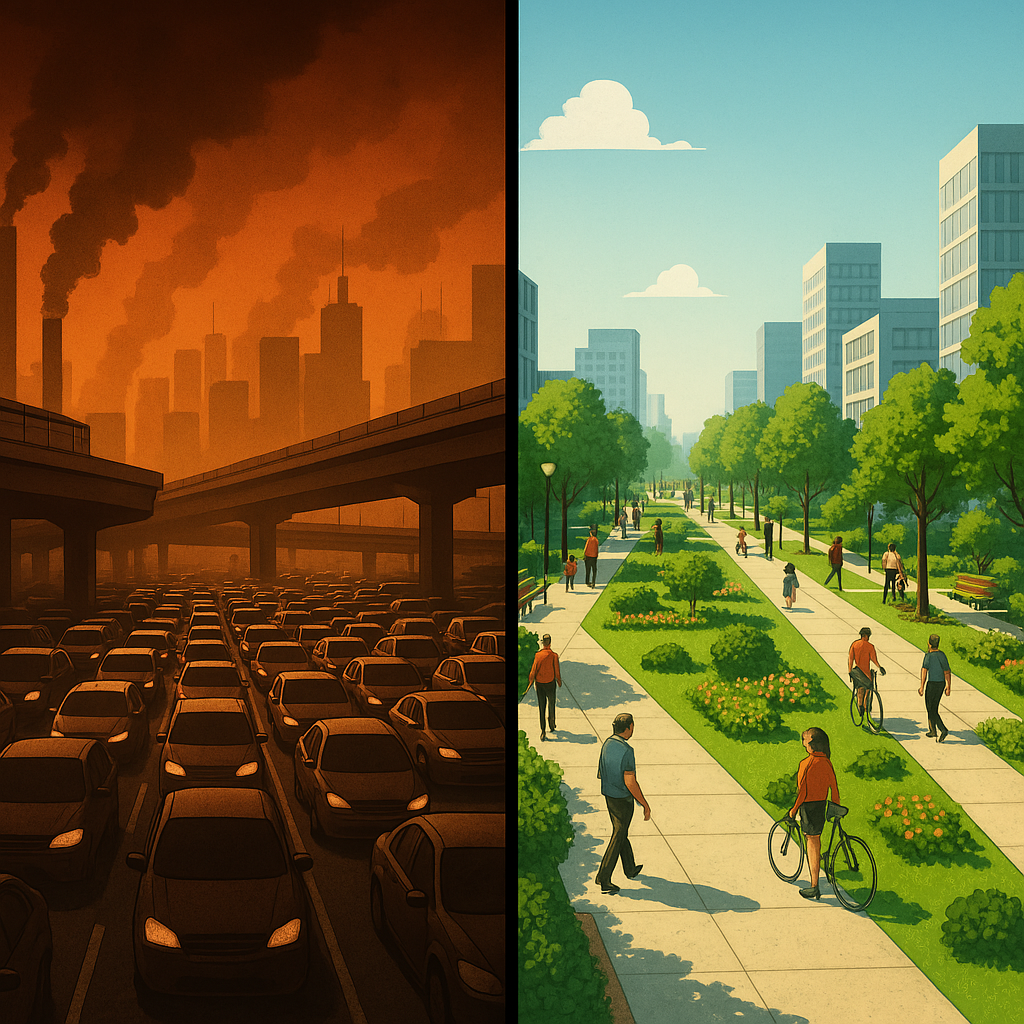
The car did not just change how we move. It changed what we built, what we valued, and who we decided could be left behind. Getting out from under it will require more than a better battery.
In 1956, a city planner in Birmingham, Alabama, submitted a highway routing proposal that would thread the new interstate system directly through Titusville, one of the city’s most prosperous African American neighborhoods. The route was not selected because it was the most efficient path from point A to point B. It was selected because the land was cheap and cheap, in that era, was another word for Black. The families displaced did not receive relocation assistance equal to what they lost. The businesses did not reopen elsewhere. The churches, the insurance offices, the barbershops, the fraternal lodges that had made Titusville a functioning community were scattered. What had been a neighborhood became a slab of elevated concrete moving white commuters from the suburbs to downtown and back. Birmingham was not unusual. From the Tremaine neighborhood in Los Angeles to Rondo in Saint Paul to Overtown in Miami, the same story played out in city after city, funded by the federal government and executed with asphalt. The car did not just reshape American cities. It demolished specific ones, in specific places, inhabited by specific people, for the convenience of everyone else.
This history is the necessary starting point for any honest reckoning with where the automobile has brought us, and why Elon Musk’s vision of an electrified car culture is not a solution to the problem but a continuation of it under a different brand name. The electric vehicle has been marketed as the clean future of personal transportation; zero emissions at the tailpipe, climate guilt absolved, the open road preserved. It is a compelling product. It is not a compelling answer. Because the problem was never just what cars burn. The problem is what cars demand: of land, of household budgets, of city design, of public investment, of the communities that get sacrificed whenever the automobile’s appetite for space needs to be fed.
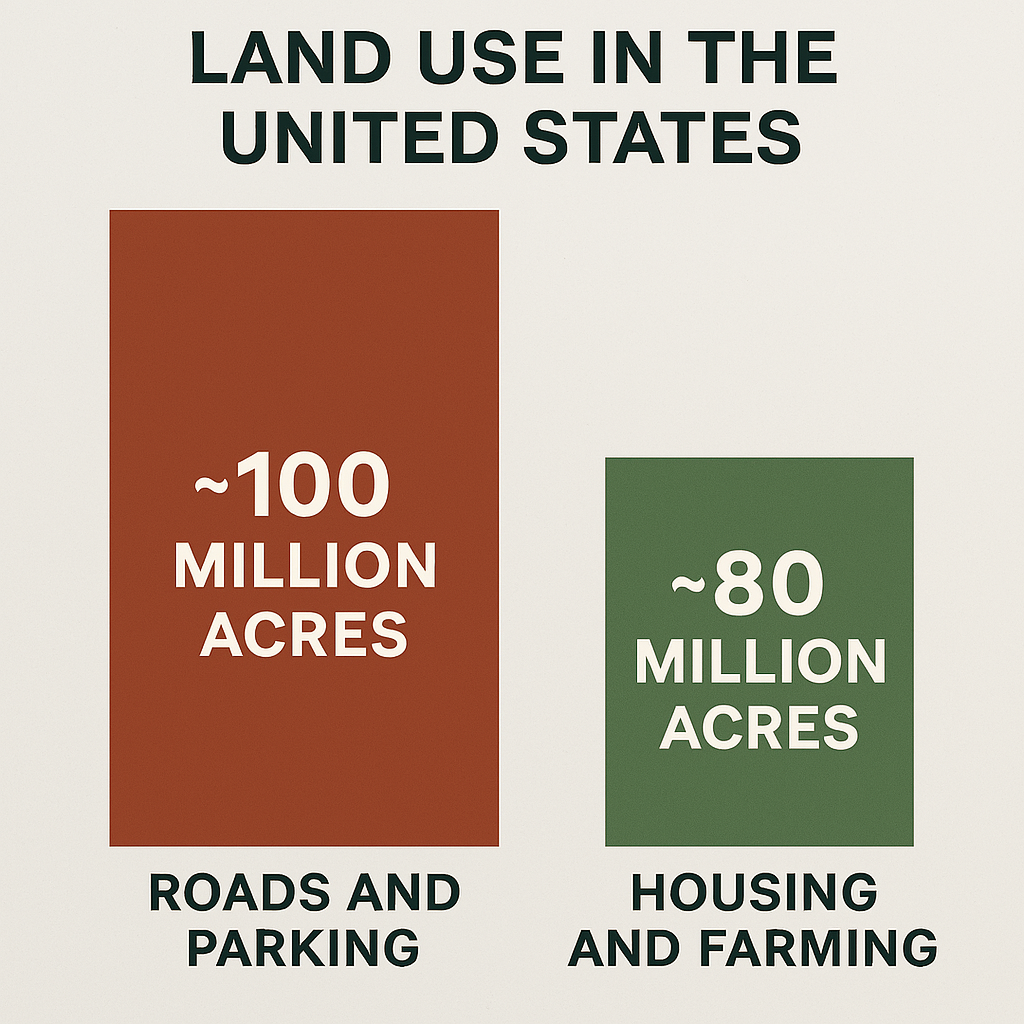
Start with the land. The United States has devoted more than 100 million acres to automobile infrastructure. Roads and highways alone consume roughly 63,000 square miles of land, an area approximately the size of the state of Florida. In dense cities, up to 40 percent of developable land is given over to streets and parking. Los Angeles has more parking spaces than it has people, with estimates placing the number around 18.6 million spots. That land does not produce food. It does not house families. It does not generate the kind of economic activity that funds schools, libraries, or public health systems. It stores machines that sit idle approximately 95 percent of the time. Every one of those acres is an acre that cannot be a home, a garden, a park, a clinic, or a business. The car does not merely use land. It consumes it, and it consumes it permanently, because once you have built a city around the assumption of universal car ownership, every subsequent decision like where to put the grocery store, where to locate the employer, how wide to make the sidewalk, whether to build a sidewalk at all follows from that original premise. You do not escape the logic by electrifying the vehicle. You just power the prison with renewable energy.
Then there is what cars cost the people who own them. In the United States, the average household spends more than $10,000 per year on vehicle ownership, maintenance, fuel, and insurance. For a working-class family earning $50,000 a year, that is 20 cents of every dollar earned going out the door before groceries, rent, or healthcare are even considered. Car ownership is not, for most Americans, a consumer preference. It is a compelled expense, the price of living in a country that built its cities to require a car for every adult who wants to participate in economic life. You need a car to get to the job. You need the job to afford the car. It is a circular dependency that has been engineered into the physical shape of the American landscape over 70 years of federal highway spending and local zoning codes written to mandate parking minimums and prohibit the kind of density that would make transit viable. An electric vehicle does not break that dependency. It makes it slightly cleaner while keeping it fully intact.
The environmental case against EVs as a solution is equally straightforward, even if it gets less attention than the tailpipe emissions story. Electric vehicles require lithium, cobalt, and rare earth metals extracted from mining operations that carry their own significant environmental and human costs much of it borne by communities in Africa Core and South America with limited political leverage to resist it. EV batteries degrade over time and create toxic disposal challenges that the industry does not yet have a credible plan to manage at scale. The electricity that charges those batteries comes, in large portions of the United States, from natural gas and coal-fired power plants. And the roads those vehicles drive on are made of cement and asphalt, which together represent some of the largest sources of industrial carbon emissions in the construction sector. The electric vehicle reduces the carbon footprint of the vehicle itself. It does not reduce the carbon footprint of the system the vehicle requires to function. Musk is not selling sustainability. He is selling the most expensive component of an unsustainable system and calling it a revolution.
The deeper problem with the EV framework is that it forecloses the conversation we actually need to be having, which is about city design. The countries and cities that have most dramatically reduced their transportation emissions and improved their residents’ quality of life have not done so by switching their car fleets from gasoline to electric. They have done so by building cities where you do not need a car to live a full life. In Amsterdam, nearly 40 percent of all trips are made by bicycle. In Tokyo, the train station is the center of commerce, culture, and daily life not the parking garage. In Bogotá, a citywide investment in bus rapid transit and protected bike infrastructure transformed mobility for millions of people who had never been able to afford a car, electric or otherwise. These are not utopian thought experiments. They are functioning cities with lower transportation costs, lower carbon emissions, lower traffic fatality rates, and measurably higher quality of life by most measures than the car-dependent American metropolitan model.
The concept gaining the most traction in serious urban planning and economic research is the “15-minute city” — an urban environment designed so that work, school, groceries, healthcare, and recreation are all accessible within a 15-minute walk or bike ride from home. The idea sounds simple, but its implications are radical. It requires reversing 70 years of zoning policy that has separated where people live from where they work and shop. It requires investing in transit systems rather than highways. It requires eliminating parking minimums that force developers to build garages instead of apartments. It requires, in other words, making a deliberate decision to build cities for people rather than for the machines people currently have no choice but to use. Every one of those decisions is available to American cities right now. Minneapolis has already eliminated single-family zoning citywide. Several American cities have abolished parking minimums. Raleigh, Sacramento, and Spokane are among those that have begun allowing higher-density housing near transit corridors. The policy tools exist. What has been missing is the political will to use them, and a cultural framework that makes the necessity clear.
The political will question brings us back to Musk, because the EV industry’s dominance of the transportation policy conversation has not been a neutral outcome of superior technology. It has been the result of enormous lobbying investment, enormous marketing spend, and the structurally convenient alignment between the EV industry’s interests and the desires of the affluent consumer class that has historically set the terms of American transportation policy. An EV costs, on average, significantly more than a comparable gasoline vehicle. The federal tax credits designed to incentivize EV adoption have disproportionately benefited households with sufficient income and tax liability to claim them. The charging infrastructure being built to serve EVs is concentrated along highway corridors and in affluent urban neighborhoods, not in the lower-income communities where transportation costs consume the highest share of household income and where the greatest public health benefits from reduced tailpipe emissions would be realized. The EV transition, as currently structured, is a premium product for a premium market, marketed as a solution for everyone.
What would a genuine solution look like? It would look like the $200 billion the United States spends annually on road maintenance being progressively redirected toward transit, protected bike infrastructure, and the land use reforms that make both viable. It would look like parking minimums being eliminated in every American city and the resulting land being converted to housing, urban agriculture, and green space. It would look like the elevated highways that bisected Titusville and Rondo and Overtown being removed as has already happened in San Francisco, Milwaukee, and Seoul and the land beneath them being returned to the communities they displaced. It would look like a federal transportation policy that measures success not in lane-miles of highway constructed but in the percentage of Americans who can get to work, school, and the doctor without owning a vehicle.
None of this requires eliminating every car in America. It requires being honest about what the car has cost us and making different choices with the public money that has, for 70 years, been used to optimize for the automobile at the expense of everything else. The planet is not in danger because we drive gasoline-powered cars. It is in danger because we built an entire civilization on the assumption that every adult would own and operate a private motor vehicle, and then constructed a global economy to supply, fuel, insure, park, and repair that vehicle in perpetuity. Swapping the engine type does not change the assumption. It just makes it quieter.
Elon Musk is not a visionary in any meaningful sense of that word when it comes to transportation. He is a very effective entrepreneur (we think) who has identified a product that allows affluent consumers to feel better about a behavior they were already committed to. That is a legitimate business. It is absolutely not a solution to climate change, to urban inequality, to the destruction of walkable communities, or to the 40,000 Americans who die in traffic collisions every year. Those problems require something the EV industry cannot sell: a different way of organizing the relationship between human beings and the places they inhabit. That reorganization begins not in a factory in Texas but in a city council chamber, a zoning board hearing, a transit agency budget meeting, and the accumulated small decisions about what we build, where we build it, and who we decide it is for. The age of the car will end. The only question is whether we end it deliberately, on terms we choose, or whether we wait for the consequences of not choosing to end it for us.
Disclaimer: This article was assisted by ClaudeAI.