Tag Archives: public transportation

Elon Musk Is Wrong: Humanity And The Earth Do Not Need EVs, It Need A Carless Society

“In every walk with nature, one receives far more than he seeks.” – John Muir. 
The car did not just change how we move. It changed what we built, what we valued, and who we decided could be left behind. Getting out from under it will require more than a better battery.

In 1956, a city planner in Birmingham, Alabama, submitted a highway routing proposal that would thread the new interstate system directly through Titusville, one of the city’s most prosperous African American neighborhoods. The route was not selected because it was the most efficient path from point A to point B. It was selected because the land was cheap and cheap, in that era, was another word for Black. The families displaced did not receive relocation assistance equal to what they lost. The businesses did not reopen elsewhere. The churches, the insurance offices, the barbershops, the fraternal lodges that had made Titusville a functioning community were scattered. What had been a neighborhood became a slab of elevated concrete moving white commuters from the suburbs to downtown and back. Birmingham was not unusual. From the Tremaine neighborhood in Los Angeles to Rondo in Saint Paul to Overtown in Miami, the same story played out in city after city, funded by the federal government and executed with asphalt. The car did not just reshape American cities. It demolished specific ones, in specific places, inhabited by specific people, for the convenience of everyone else.

This history is the necessary starting point for any honest reckoning with where the automobile has brought us, and why Elon Musk’s vision of an electrified car culture is not a solution to the problem but a continuation of it under a different brand name. The electric vehicle has been marketed as the clean future of personal transportation; zero emissions at the tailpipe, climate guilt absolved, the open road preserved. It is a compelling product. It is not a compelling answer. Because the problem was never just what cars burn. The problem is what cars demand: of land, of household budgets, of city design, of public investment, of the communities that get sacrificed whenever the automobile’s appetite for space needs to be fed.

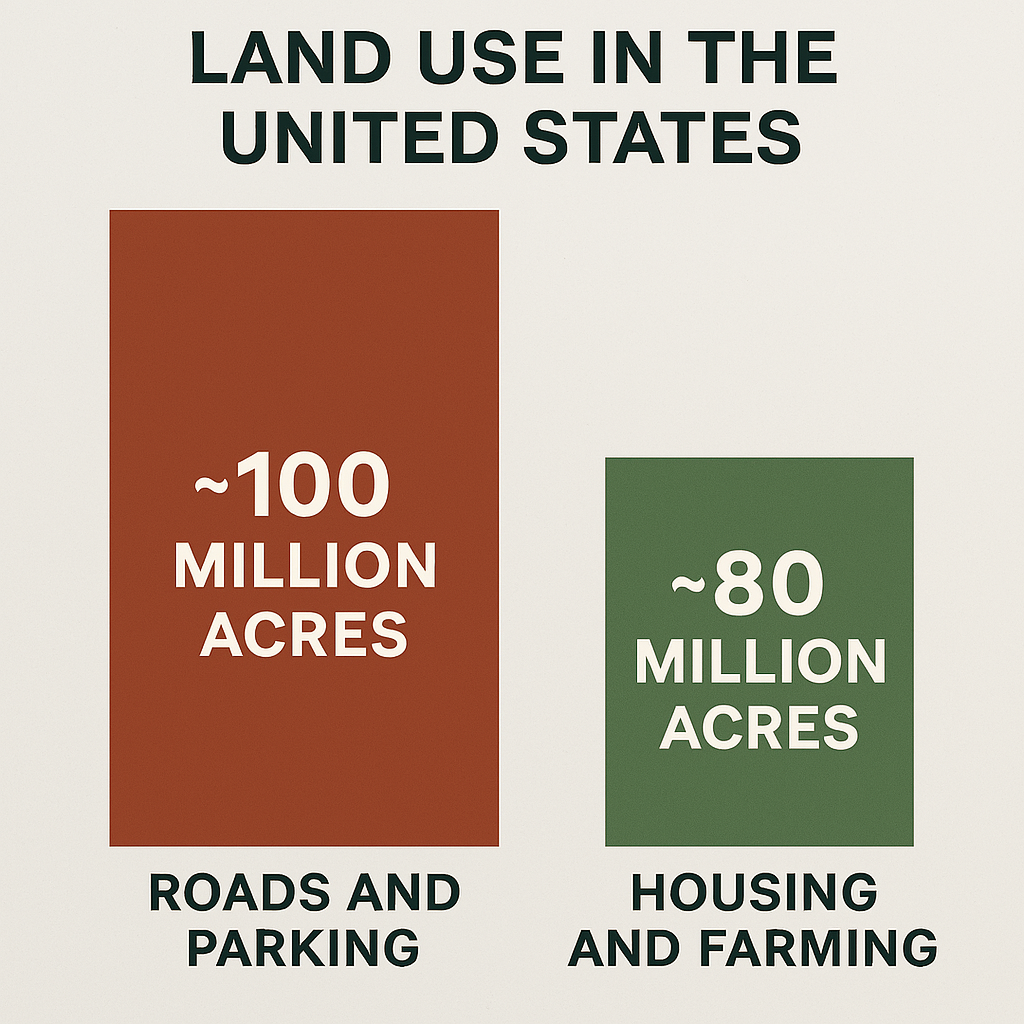
Start with the land. The United States has devoted more than 100 million acres to automobile infrastructure. Roads and highways alone consume roughly 63,000 square miles of land, an area approximately the size of the state of Florida. In dense cities, up to 40 percent of developable land is given over to streets and parking. Los Angeles has more parking spaces than it has people, with estimates placing the number around 18.6 million spots. That land does not produce food. It does not house families. It does not generate the kind of economic activity that funds schools, libraries, or public health systems. It stores machines that sit idle approximately 95 percent of the time. Every one of those acres is an acre that cannot be a home, a garden, a park, a clinic, or a business. The car does not merely use land. It consumes it, and it consumes it permanently, because once you have built a city around the assumption of universal car ownership, every subsequent decision like where to put the grocery store, where to locate the employer, how wide to make the sidewalk, whether to build a sidewalk at all follows from that original premise. You do not escape the logic by electrifying the vehicle. You just power the prison with renewable energy.

Then there is what cars cost the people who own them. In the United States, the average household spends more than $10,000 per year on vehicle ownership, maintenance, fuel, and insurance. For a working-class family earning $50,000 a year, that is 20 cents of every dollar earned going out the door before groceries, rent, or healthcare are even considered. Car ownership is not, for most Americans, a consumer preference. It is a compelled expense, the price of living in a country that built its cities to require a car for every adult who wants to participate in economic life. You need a car to get to the job. You need the job to afford the car. It is a circular dependency that has been engineered into the physical shape of the American landscape over 70 years of federal highway spending and local zoning codes written to mandate parking minimums and prohibit the kind of density that would make transit viable. An electric vehicle does not break that dependency. It makes it slightly cleaner while keeping it fully intact.

The environmental case against EVs as a solution is equally straightforward, even if it gets less attention than the tailpipe emissions story. Electric vehicles require lithium, cobalt, and rare earth metals extracted from mining operations that carry their own significant environmental and human costs much of it borne by communities in Africa Core and South America with limited political leverage to resist it. EV batteries degrade over time and create toxic disposal challenges that the industry does not yet have a credible plan to manage at scale. The electricity that charges those batteries comes, in large portions of the United States, from natural gas and coal-fired power plants. And the roads those vehicles drive on are made of cement and asphalt, which together represent some of the largest sources of industrial carbon emissions in the construction sector. The electric vehicle reduces the carbon footprint of the vehicle itself. It does not reduce the carbon footprint of the system the vehicle requires to function. Musk is not selling sustainability. He is selling the most expensive component of an unsustainable system and calling it a revolution.

The deeper problem with the EV framework is that it forecloses the conversation we actually need to be having, which is about city design. The countries and cities that have most dramatically reduced their transportation emissions and improved their residents’ quality of life have not done so by switching their car fleets from gasoline to electric. They have done so by building cities where you do not need a car to live a full life. In Amsterdam, nearly 40 percent of all trips are made by bicycle. In Tokyo, the train station is the center of commerce, culture, and daily life not the parking garage. In Bogotá, a citywide investment in bus rapid transit and protected bike infrastructure transformed mobility for millions of people who had never been able to afford a car, electric or otherwise. These are not utopian thought experiments. They are functioning cities with lower transportation costs, lower carbon emissions, lower traffic fatality rates, and measurably higher quality of life by most measures than the car-dependent American metropolitan model.
The concept gaining the most traction in serious urban planning and economic research is the “15-minute city” — an urban environment designed so that work, school, groceries, healthcare, and recreation are all accessible within a 15-minute walk or bike ride from home. The idea sounds simple, but its implications are radical. It requires reversing 70 years of zoning policy that has separated where people live from where they work and shop. It requires investing in transit systems rather than highways. It requires eliminating parking minimums that force developers to build garages instead of apartments. It requires, in other words, making a deliberate decision to build cities for people rather than for the machines people currently have no choice but to use. Every one of those decisions is available to American cities right now. Minneapolis has already eliminated single-family zoning citywide. Several American cities have abolished parking minimums. Raleigh, Sacramento, and Spokane are among those that have begun allowing higher-density housing near transit corridors. The policy tools exist. What has been missing is the political will to use them, and a cultural framework that makes the necessity clear.

The political will question brings us back to Musk, because the EV industry’s dominance of the transportation policy conversation has not been a neutral outcome of superior technology. It has been the result of enormous lobbying investment, enormous marketing spend, and the structurally convenient alignment between the EV industry’s interests and the desires of the affluent consumer class that has historically set the terms of American transportation policy. An EV costs, on average, significantly more than a comparable gasoline vehicle. The federal tax credits designed to incentivize EV adoption have disproportionately benefited households with sufficient income and tax liability to claim them. The charging infrastructure being built to serve EVs is concentrated along highway corridors and in affluent urban neighborhoods, not in the lower-income communities where transportation costs consume the highest share of household income and where the greatest public health benefits from reduced tailpipe emissions would be realized. The EV transition, as currently structured, is a premium product for a premium market, marketed as a solution for everyone.

What would a genuine solution look like? It would look like the $200 billion the United States spends annually on road maintenance being progressively redirected toward transit, protected bike infrastructure, and the land use reforms that make both viable. It would look like parking minimums being eliminated in every American city and the resulting land being converted to housing, urban agriculture, and green space. It would look like the elevated highways that bisected Titusville and Rondo and Overtown being removed as has already happened in San Francisco, Milwaukee, and Seoul and the land beneath them being returned to the communities they displaced. It would look like a federal transportation policy that measures success not in lane-miles of highway constructed but in the percentage of Americans who can get to work, school, and the doctor without owning a vehicle.

None of this requires eliminating every car in America. It requires being honest about what the car has cost us and making different choices with the public money that has, for 70 years, been used to optimize for the automobile at the expense of everything else. The planet is not in danger because we drive gasoline-powered cars. It is in danger because we built an entire civilization on the assumption that every adult would own and operate a private motor vehicle, and then constructed a global economy to supply, fuel, insure, park, and repair that vehicle in perpetuity. Swapping the engine type does not change the assumption. It just makes it quieter.

Elon Musk is not a visionary in any meaningful sense of that word when it comes to transportation. He is a very effective entrepreneur (we think) who has identified a product that allows affluent consumers to feel better about a behavior they were already committed to. That is a legitimate business. It is absolutely not a solution to climate change, to urban inequality, to the destruction of walkable communities, or to the 40,000 Americans who die in traffic collisions every year. Those problems require something the EV industry cannot sell: a different way of organizing the relationship between human beings and the places they inhabit. That reorganization begins not in a factory in Texas but in a city council chamber, a zoning board hearing, a transit agency budget meeting, and the accumulated small decisions about what we build, where we build it, and who we decide it is for. The age of the car will end. The only question is whether we end it deliberately, on terms we choose, or whether we wait for the consequences of not choosing to end it for us.

Disclaimer: This article was assisted by ClaudeAI.
Public Transportation & Infrastructure: Apple Should Help Kill The Car Not Invest In It

In 2024, Apple quietly killed its electric vehicle project. After nearly a decade of speculation, leaked prototypes, and engineering talent poached from Detroit and Stuttgart, the announcement arrived with a shrug. Markets barely moved. What looked like a retreat was, on closer inspection, something more interesting — a door left open to a far more consequential ambition.

Apple was never going to win by building another car. The automotive market is brutally competitive, capital-intensive, and increasingly commoditised at the electric end. Tesla, BYD, and Rivian are fighting that war. The smarter bet — and the one Apple is uniquely positioned to make — is building the platform that makes car ownership less necessary in the first place.

This is not a utopian argument. It is a business one.

The global infrastructure gap is estimated at $94 trillion by 2040, according to the World Bank. American water systems lose roughly 6 billion gallons of treated water daily through deteriorating pipes. The U.S. electrical grid, designed for a centralised fossil fuel economy, is structurally ill-suited for the distributed renewable future that both climate policy and energy economics now demand. Passenger rail — a basic connective tissue across Europe and Asia — remains an afterthought across vast stretches of the United States. Traffic congestion drains an estimated $179 billion from the American economy annually in lost time and fuel. Vehicle emissions contribute to more than 60,000 premature deaths each year in the U.S. alone.

These are not niche concerns. They are the failing arteries of modern life. And very few companies on earth are better positioned than Apple to redesign them.

Apple already integrates hardware, software, and services with a precision that no competitor has matched at scale. Its chip design produces some of the most energy-efficient processors ever built. Its cloud infrastructure, sensor technology, and payment systems span billions of devices across every continent. Its supply chain discipline and design sensibility are, by any measure, world-class. The question is not whether Apple has the capability to enter the infrastructure space. The question is whether it has the strategic imagination to try.

Consider transit. Apple would not need to lay track, operate buses, or run a single vehicle. What it could build is the operating layer — AI-optimised routing drawing on Apple Maps data, seamless ticketing through Apple Wallet, personalised journey planning through Siri, real-time crowd flow management at interchange hubs, and demand-responsive electric shuttles for lower-density districts. The iPhone would become, in effect, a passport to a life less dependent on car ownership — and all the financial and environmental costs that car ownership imposes.

The economics of this argument are well established, even if they remain politically underappreciated. Every dollar invested in public transit generates roughly five dollars in broader economic returns, according to the American Public Transportation Association. Transit-oriented development raises property values, expands tax bases, and improves labour market access for workers priced out of car ownership. Cities that invest in dense, multimodal systems reduce emissions, reclaim public space, and generate measurable public health gains. The infrastructure of movement is not a social expenditure. It is a productive one.

The opportunity extends beyond transit. Apple’s energy-efficient chip architecture translates naturally to smart grid management, where modular, predictive systems are precisely what is needed to integrate distributed solar, battery storage, and dynamic demand response. Apple sensors and cloud infrastructure already exist at the scale required to monitor water systems in real time — detecting pipe failures, tracking quality, and optimising pressure through smart valves. Apple Pay processes billions of transactions. The components for an Apple Water platform or an Apple Grid service layer are, in many respects, already assembled. What is missing is the strategic decision to point them at a larger problem.

The water case is particularly stark. The U.S. Environmental Protection Agency estimates that $472 billion in maintenance investment is required over the next twenty years simply to sustain existing water infrastructure — before a single mile of new pipe is laid. Globally, nearly one in three people lacks reliable access to safe drinking water. The market for intelligent water management — leak detection, quality monitoring, pressure optimisation — is enormous and structurally underserved. Apple’s skill in miniaturising technology, combining sensors with privacy-grade cloud processing, and delivering consumer-grade interfaces for complex data makes it an unusually credible entrant.

For Apple, the strategic logic is also a defensive one. iPhone sales have plateaued. Its Services division faces antitrust scrutiny across multiple jurisdictions. Its cash reserves — exceeding $160 billion — are an asset in search of a return that consumer electronics can no longer reliably provide. Infrastructure, by contrast, offers recurring revenue through service agreements and municipal contracts, structural diversification away from device cycles, and long-term relevance at a civilisational rather than product level. The infrastructure market is not glamorous. But it is enormous, it is durable, and it is ripe for the kind of systemic redesign that Apple has historically done better than anyone.

The risks are genuine and should not be minimised. Apple is famously secretive, consumer-oriented, and averse to the slow-moving regulatory complexity that infrastructure demands. City contracts are messier than product launches. Margins are narrower. Failures are public and politically costly. But Apple has navigated hostile regulatory environments before — in financial services, in healthcare, in China. Its high public trust and strong ESG record are genuine assets in a domain where government partnerships require demonstrated credibility over time. And crucially, Apple would not need to own pipes, track, or transmission lines. It would build the intelligent systems layered atop them — and license those systems to governments, utilities, and citizens at scale.

The model already exists in adjacent industries. Schneider Electric and Siemens have built large, profitable businesses selling digital operating layers to physical infrastructure owners. Veolia manages water and energy systems for municipalities across the developed and developing world. These are not Apple-scale companies in terms of design capability or brand trust. Apple entering this space would not be a departure from what it does. It would be an extension of it — at a higher level of ambition.

What would this look like in practice? In dense cities, an Apple Transit platform could reduce car usage, lower emissions, and return public space to pedestrians and parks. In smaller cities and rural regions — places too dispersed for high-frequency bus networks but underserved by the on-demand platforms that have flourished in major metros — demand-responsive electric shuttles dynamically routed through Apple Maps could reconnect communities that car dependence has quietly strangled. In energy markets, an Apple Grid service could allow households to manage solar and storage through iOS, enable peer-to-peer energy trading between neighbours, and give grid operators the real-time visibility they need to prevent blackouts in a renewables-heavy system. In water, an Apple Water platform could give cities the predictive maintenance tools they currently lack, and give households transparent, real-time visibility into their consumption and the health of their local system.

None of this requires Apple to become a utility or a transport operator. It requires Apple to become what it has always been at its best: the company that builds the operating system everyone else runs on.

Steve Jobs once described the computer as a bicycle for the mind — a tool that amplifies human capability far beyond what either could achieve alone. The infrastructure of the coming century needs exactly that kind of amplification. Roads that manage themselves. Grids that think. Water systems that speak before they fail. Transit that fits around people’s lives rather than demanding they organise their lives around it.

The real disruption in mobility is not a better electric vehicle. It is a better alternative to vehicles altogether — and the broader infrastructure intelligence that makes modern life function without the waste, the inequity, and the environmental cost that the 20th century model baked in.

Apple has the cash, the capability, and the moment. The question is whether it has the ambition to match.

Disclaimer: This article was assisted by ClaudeAI.
City Bus Stops: An Underutilized Force For Education

Users do not care about what is inside the box, as long as the box does what they need done. – Jef Raskin

By William A. Foster, IV

It was one evening some years ago that my father and I had a debate in my  parents living room about an article that I read in the New York Times concerning prep schools versus public schools and how much they spend per student. The New York Times stated that Philips Exeter Academy in 2008 spent $63,500 per student annually, while a report from the Organization for Economic Cooperation and Development shows that the U.S. as a whole spends about $12,000 per student annually. My father could not understand what PEA could possibly be spending over five times the amount on. I said to him it was the difference between showing a kid a map of India and taking them there. That being said, as someone who comes from a family of educators and being a community college professor for a period of time and seeing just what happens when an adult has had a weak K-12 experience, I often ponder ways in which communities can go about closing education gaps among groups and strengthening the education infrastructure.

Perhaps the worst kept secret is that groups who come from disadvantaged backgrounds have a chronic gap when it comes to education. By age three, children from lower income homes have heard 30 million fewer words. The national high school graduation rate for African Americans is 73 percent, which is almost 10 percentage points lower than the national average and 14 percentage points lower than European Americans. There have been calls for a universal Pre-K, which sounds good in theory but probably will ultimately do just as much harm as the current system. Many have argued that the U.S. does not spend enough on education, this despite the OECD saying that the U.S. actually spends more than any other country on education. The report according to CBS News that, “In 2010, the United States spent 7.3 percent of its gross domestic product on education, compared with the 6.3 percent average of other OECD countries.” This appears to be not a case of not spending too much, but spending it poorly. As an economist and investor myself, one of the most important things for my firm is capital allocation. It is not just a matter of how much we are spending, but where and how we are allocating that spending. Simply spending more is not always an answer to fixing problems as many on the political left suggest, but neither is allowing students to go to better schools through vouchers a sensible alternative as those on the political right suggest which would have devastating effects on the economics of poor and middle class communities. In essence, what is needed is a better creation of supplemental education for those communities. Supplemental education is the ability to access learning away from the four walls of a school.

For many upper income families, museums, summer camps, and private tutors provide the moonshot to the education they receive during their K-12 matriculation. These experiences and building blocks add to a substantive educational gap between the haves and have nots and while there are always many fascinating high brow proposals of how to fix education for underserved communities, we often ignore the simplest. Two things of note should be focused on to that respect. First, provide supplemental education where the people you hope to reach spend their time. Secondly, keep it simple. Academics, again I come from a family of them, while I admire their ability to convey information, they are at times too smart for their own good. In other words, they can make one plus one into the next coming of Einstein’s theory of relativity if you give them enough time. For underserved communities though it is often at the foundational level where they are most deficient. An issue that then cascades and compounds year after year as they progressed through secondary and then into adulthood. It was the simple foundation that they missed and that their kids are missing that could have moved their trajectory. So how do cities both meet the people where they are and more importantly where their time is “hostage” and and also keep it simple? Bus stops.

1 Million Milestone

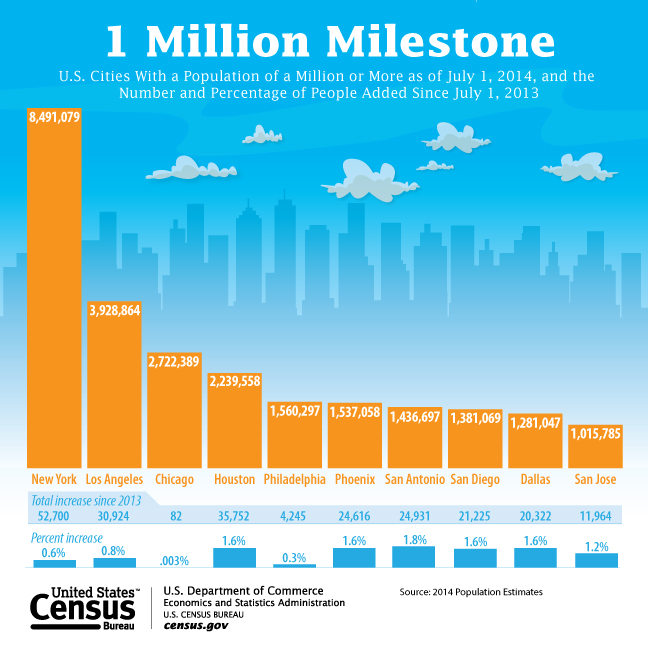
That is right, bus stops. New York City has 16,350 of them, Los Angeles has 15,967 bus stops, Chicago has 10,813 bus stops, and Houston has approximately 9,000 according to a Twitter inquiry. These are the four largest urban cities in the United States of America with a combined population of 17.5 million, a number equivalent to 5.4 percent of the entire U.S. population. The four cities ability to serve low income and middle class families is obviously magnified just by the probability of the sheer size of the populations they have that will fall within those confines. The poverty levels for the four aforementioned cities is also surprisingly inversely correlated to their public transpiration size with New York City’s 20.3 percent, L.A.’s 22 percent, Chicago’s 22.6 percent, and Houston’s 22.9 percent. According to Pew Research Center, “Americans who are lower-income, black or Hispanic, immigrants or under 50 are especially likely to use public transportation on a regular basis.” There is not enough research to show a correlation to public transportation’s reduction in poverty, but one can access that the easement of which labor can move farther distances allows for more economic opportunities to be gained. Therefore, if a low-income community has access to affordable public transportation and their own community lacks economic opportunity, the ease by which they can move into areas of stronger economic prowess may allow them work opportunities they may not otherwise have available. However, while there maybe no correlation, there is opportunity to educate and we know that correlates to reducing poverty.

Imagine for a moment that each bus stop, both children and adults, are introduced to a digital screen (think those annoying “commercials” at gas station pumps) that circulates a plethora of vocabulary words, basic mathematics problems,  and science and history clips. Just the basics, but again fundamental. If a city really wants to get out of the box, even introducing lessons in financial, health, and government literacy. If done in concert with the school districts in the city, teachers at the elementary through college levels could be featured in these videos and those teachers targeted in bus stops within their teaching area. This may also go a long way into reestablishing what many now complain about as the broken bond between parents, their children, and the teachers who educate them. The videos produce a familiarity for the teacher in the same way that people develop affinities for celebrities they have never met. Of course, in this age where municipals are tight on funds, just how does all of this get paid for? This is a financial journalism publication after all. The PPP (Private-Public Partnership) model would be most advantageous. Companies in the city, New York City, Houston, and Chicago have 143 Fortune 1000 companies combined, would foot the majority of the bill for the producing of the digital content and refitting of the bus stops. Just what those companies would receive in return beyond goodwill and basic advertising would be left up to the leadership of the city to negotiate.

I grew up in a household and family where education and learning was not only a family value and expectation, it was something I was immersed in as I reflect in what seemed like at all times. There were always books around, much of my life existed on a college campus as my mother has been a professor for almost four decades, trips to museums, engagement with the arts, and as a result me and my sister’s probability of succeeding was given a great advantage over many of our peers. Education is a wholistic lifestyle that one is immersed throughout their lives. The sooner that immersion, the more often that immersion, then probability of success is sure to follow. My sister and I were at an advantage, we were a privileged pair whose family can trace our educational heritage back four generations to my great-grandfather and great-grandmother who were college graduates. That is not the reality for most low income and middle class families. They are families trying to take that next step, even if they do not know which step to take often. In order to increase their probability towards that success, cities have to acknowledge that they are often in poor schools to begin with and that they need more, much more. The best return on investment is often achieved in using the infrastructure that already exist and that meets citizens where they are.

As Jef Raskin alludes to in his quote, communities will not care where quality education happens be it in a school or at a bus stop, so long as it happens.  The ability to convert bus stops into head start and continuing education facilities for a city is something that truly does what needs to be done.