Category Archives: Lifestyle

Owning The Diamond: Why HBCU Women Entrepreneurs Should Buy a Women’s Pro Baseball Team

“Let us put our moneys together; let us use our moneys; let us put our moneys out at usury among ourselves, and reap the benefits ourselves.” – Maggie L. Walker, pioneering African American banker and businesswoman:

It is not enough to cheer from the stands.
IIt is not enough to cheer from the stands. If HBCU women entrepreneurs and the institutions that produced them are serious about building generational wealth, influence, and visibility in the global sports economy, then ownership, not participation, must be the goal. The emergence of the Women’s Pro Baseball League (WPBL) offers just such a moment. Four inaugural franchises in Los Angeles, San Francisco, New York, and Boston mark the first professional women’s baseball league in the United States since 1954. And yet, amid this historic announcement, one question should echo across the HBCU landscape: Who will own a piece of it?

Ownership in sports is about more than trophies it’s about capital, culture, and control. While athletes inspire, it is owners who shape the economic ecosystem: negotiating television contracts, setting standards for pay equity, deciding where teams are located, and determining which communities benefit from their presence. In American sports, Black ownership remains vanishingly rare. Fewer than a handful of African Americans have ever held majority stakes in professional teams across all major leagues. Among women, ownership representation is even smaller. Yet the HBCU ecosystem comprising over a hundred institutions, $4 billion in endowment capital (though still dwarfed by their PWI counterparts), and a growing class of wealthy and capable alumni possesses both the human and institutional capital to change that reality. Buying a WPBL franchise would be a powerful signal: that African American women are no longer content to merely play or support the game, but to own the infrastructure of it.

The WPBL represents a once-in-a-century opportunity. The last women’s professional baseball league folded in 1954 when postwar America reverted to its gendered labor norms and refused to institutionalize women’s success on the field. Today, that same sport returns in a vastly different economy one defined by media fragmentation, digital storytelling, and institutional investing that rewards niche audiences and strong narratives. Women’s sports are on the rise. The WNBA just received a $75 million investment round from Nike, Condoleezza Rice, Laurene Powell Jobs, and others. Women’s college basketball ratings have exploded, drawing more viewers than some men’s sports. The National Women’s Soccer League has seen team valuations grow fivefold in the past five years. Investors are realizing what the data already shows: undervalued leagues often yield outsized returns once visibility and infrastructure catch up.

The WPBL sits at this exact inflection point. Early investors will not just shape the league they will define its culture, inclusivity, and profitability. This is why HBCU women entrepreneurs, backed by HBCU endowments and alumni capital, should move swiftly. Ownership here is not a vanity project it is a long-term equity position in the fastest-growing frontier of professional sports.

Start-up sports franchises are not the billion-dollar investments of the NFL or NBA. The WPBL’s initial teams are expected to sell for figures in the mid-seven to low-eight figures: expensive, yes, but feasible through a syndicate model combining entrepreneurial capital and institutional backing. A $15 million franchise, for instance, could be financed with $5 million in equity from HBCU women entrepreneurs, $3 million in matching commitments from HBCU endowments through a joint-venture investment arm, $5 million in debt financing via an African American–owned bank or credit union consortium, and $2 million in naming rights, sponsorship pre-sales, and city incentives.

Such a structure distributes risk while maximizing institutional leverage. It also allows for a reinvestment loop: returns from franchise appreciation, media deals, or merchandising could feed back into the endowments that helped fund the acquisition, growing HBCU wealth through private equity in sports. At a modest ten percent annualized return over fifteen years, a $3 million endowment investment could grow to more than $12.5 million, even before accounting for franchise appreciation. The social return of visibility, leadership, and influence would be immeasurable.

HBCU women entrepreneurs already lead some of the most innovative ventures in the country from fintech to fashion to wellness. They have built companies with leaner budgets, higher risk tolerance, and community-driven missions. That same acumen could translate seamlessly into sports ownership. A women-led ownership group rooted in HBCU culture would bring authenticity to a league whose audience is already primed for inclusive storytelling. They would not merely own a team they would shape its identity around empowerment, intellect, and cultural sophistication. Imagine a team whose executive suite reflects Spelman’s academic rigor, Howard’s creative dynamism, and FAMU’s entrepreneurial grit.

Moreover, the investment aligns with HBCU women’s long history of institution building. From Mary McLeod Bethune’s founding of Bethune-Cookman University to Maggie Lena Walker’s creation of the first Black woman–owned bank, African American women have always been at the forefront of merging mission with market. Buying a professional sports franchise is simply a modern continuation of that legacy.

Most HBCU endowments remain undercapitalized. Collectively, they total roughly $4 billion, compared to Harvard’s $50 billion alone. That gap underscores why traditional endowment investing centered on conservative asset classes may not close the wealth chasm. Sports equity, particularly in emerging women’s leagues, represents a hybrid investment: cultural capital meets growth asset. Endowments could carve out a modest allocation for strategic co-investment vehicles aimed at ownership in minority- or women-led sports ventures. Such a move would not only produce potential returns but reposition HBCU endowments as active agents in wealth creation, mirroring how elite universities use their endowments as venture capital arms. The same institutions that once nurtured the first generations of African American scholars could now nurture the first generation of African American women sports owners.

The path to ownership would unfold in phases: coalition building, institutional partnerships, financial structuring, branding, and media engagement. The first step would be forming an HBCU Women Sports Ownership Council an alliance of HBCU alumnae entrepreneurs, investors, attorneys, and sports professionals. Its mission would be to identify a WPBL franchise opportunity, conduct due diligence, and negotiate terms. Next, endowments, foundations, and alumni associations could serve as anchor investors via a pooled HBCU Sports Ownership Fund. African American–owned financial institutions would provide credit facilities, ensuring that capital circulation strengthens Black banking. The team’s branding could reflect HBCU values of intellect, resilience, and excellence. Annual “HBCU Heritage Games,” scholarships for women in sports management, and partnerships with K–12 baseball programs would ensure the franchise deepens institutional impact.

By the time Opening Day 2027 arrives, the vision becomes real. A stadium in Atlanta or Houston cities with deep HBCU roots roars with excitement. The team, perhaps named The Monarchs in tribute to the Negro Leagues, takes the field in uniforms stitched by a Black-owned apparel company. The owner’s suite is filled not with venture capitalists, but HBCU women—founders, engineers, bankers, educators—raising glasses to history. Every ticket sold funds scholarships. Every broadcast includes HBCU branding. Every victory multiplies across the ecosystem, from the university’s endowment statement to the little girl in the stands whispering, “She looks like me.” That is the multiplier effect of ownership.

A defining mark of this ownership group’s legacy should not only be who owns the team but who benefits from it. When an HBCU-led syndicate buys a women’s professional baseball team, it must ensure that every dollar of the fan experience circulates through Black and HBCU-centered businesses. Ownership without ecosystem-building simply recreates dependency; real power multiplies through participation.

An HBCU women’s ownership group has the chance to build an authentically circular sports economy, where concession stands, catering services, and retail vendors reflect the same entrepreneurial DNA as the team itself. The model for this begins with women like Pinky Cole, founder of Slutty Vegan, who transformed plant-based dining into a cultural and economic phenomenon through purpose-driven branding and community investment. Her ability to merge food, culture, and empowerment offers a blueprint for how HBCU women entrepreneurs could anchor the ballpark experience in ownership and identity.

Complementing this vision is the role of HBCU-owned service enterprises like Perkins Management Services Company, founded by Nicholas Perkins, a Fayetteville State University alumnus and owner of Fuddruckers. Perkins Management operates food services across HBCUs and federal institutions, combining operational scale with cultural competence. Partnering with Perkins Management to run stadium concessions or hospitality would ensure that the team’s operations mirror the ownership group’s values efficiency, reinvestment, and excellence.

Such an approach would transform the stadium into an economic hub for HBCU enterprise. Food vendors would come from HBCU alumni-owned companies. Uniform suppliers could source from HBCU textile programs. Merchandise stands could feature HBCU student designs. Hospitality contracts would prioritize HBCU-affiliated culinary programs. The music during games could feature HBCU marching bands or alumni artists. Even the stadium’s artwork could highlight HBCU painters and photographers, ensuring every sensory detail honors the ecosystem that made the ownership possible. A fan buying food or merchandise would not just be a consumer they’d be participating in a shared mission to strengthen African American institutions.

This reimagined sports environment would also offer internships, apprenticeships, and consulting opportunities for HBCU students and faculty. Business students could study operations. Communication majors could intern with the PR team. Engineering departments could advise on stadium energy efficiency. Each partnership would turn the franchise into a living classroom of applied HBCU excellence.

At a time when major leagues outsource globally, a women’s baseball franchise owned by HBCU women could reimagine localization and reinvestment as competitive advantage. Every game day would circulate dollars through a self-sustaining ecosystem that feeds back into HBCU entrepreneurship. Because when the ballpark itself is powered by HBCU women’s enterprise from boardroom to concession stand it ceases to be a venue. It becomes a living institution.

If the Women’s Pro Baseball League truly takes off, early ownership will be the golden ticket. African American investors have often entered markets too late once valuations skyrocket and access narrows. Now, before the WPBL matures, is the time for HBCU institutions and their entrepreneurial alumnae to act collectively. The call is not for charity but for strategy. Pooling even a fraction of the capital that circulates annually among HBCU alumni could change the power dynamic in sports forever. Endowments could stake equity. Alumni could invest through private funds. Students could study the economics of their own institution’s franchise. The result would be a feedback loop of wealth, wisdom, and visibility.

The first women’s professional baseball league in seventy years deserves first-of-its-kind ownership and no community is more qualified to deliver it than HBCU women. Because when HBCU women own the field, the entire game changes.

Disclaimer: This article was assisted by ChatGPT.

Are New Mexico, Maine, Puerto Rico, and the U.S. Virgin Islands the Only Social, Economic, and Politically Safe Territories for African Americans?

“Every great dream begins with a dreamer. Always remember, you have within you the strength, the patience, and the passion to reach for the stars to change the world.” — Harriet Tubman

For African Americans, safety has never been an assumed part of citizenship. It has always been an earned condition won through vigilance, strategy, and often migration. Whether fleeing the violent collapse of Reconstruction or the economic despair of the Jim Crow South, Black Americans have long measured geography as a question of survival. Today, in an America increasingly polarized by race, ideology, and inequality, that calculation has returned. Many are quietly asking: where can African Americans live, work, and raise families with peace of mind? The answer, surprisingly, may not be in traditional Black strongholds like Atlanta, Washington, D.C., or Houston, but in four unlikely places—New Mexico, Maine, Puerto Rico, and the U.S. Virgin Islands—where moderation, multicultural coexistence, and relative political calm offer something rare: a sense of safety that is not performative, but lived.

New Mexico’s reputation as a cultural crossroads has made it one of the few states where African Americans can exist without being framed entirely through America’s racial binary. Its tri-cultural balance among Native American, Hispanic, and White populations disperses dominance. Here, no single identity owns the political landscape. For African Americans who comprise about two percent of the population that means a degree of breathing room. Racial prejudice still exists, but it rarely defines every interaction. The social climate is cooperative, rooted in shared marginalization rather than supremacy. Albuquerque, Las Cruces, and Santa Fe have become quiet havens for African American educators, small-business owners, and retirees seeking both affordability and dignity.

Economically, New Mexico offers something most metropolitan centers have lost: a manageable cost of living and accessible capital. Housing remains attainable. Land ownership long denied to African Americans through discriminatory lending remains within reach for the working and middle class. The rise of renewable energy, sustainable agriculture, and technology hubs has also created new entry points for Black entrepreneurship. In Albuquerque’s South Valley or near Santa Fe’s art cooperatives, one can find a small but visible community of African Americans carving lives that are not merely about surviving but thriving without the constant defensive posture that characterizes so many other states. Safety here is less about walls and more about balance, a social equilibrium where race is a fact, not a fault line.

Maine, on the other hand, is proof that peace can coexist with isolation. Its African American population is minuscule, but its civic culture is built on moderation and integrity. The state’s “town meeting” governance style, where citizens vote directly on local issues, nurtures accountability rarely seen elsewhere. For African Americans who relocate to Portland, Bangor, or Augusta, that transparency matters. Racism in Maine exists, but it lacks institutional depth. More often, African Americans report curiosity over hostility, and when discrimination does occur, it tends to meet public rebuke rather than official silence.

Politically, Maine is refreshingly pragmatic. It elects moderates and independents, resists extremist rhetoric, and maintains a social compact where neighbors generally still speak to each other across ideological lines. For African Americans weary of coded politics, it feels like a return to something America once promised, a functioning democracy. The result is a form of safety rooted not in numbers, but in governance. A place where you can walk, vote, and live without fearing that tomorrow’s election will determine whether your humanity is negotiable.

But safety does not always mean the mainland. Beyond the continental U.S., Puerto Rico and the U.S. Virgin Islands present another dimension of refuge one built on shared African lineage and the lived realities of Caribbean identity. For African Americans seeking both cultural familiarity and distance from America’s racial fatigue, these territories offer a paradoxical safety: not post-racial, but post-obsessive.

Puerto Rico, long a bridge between Latin America and the U.S., exists in an in-between space that defies racial simplification. Its majority Afro-Latino population gives race a different vocabulary one where color is noticed but hierarchy is more fluid. African Americans arriving there encounter both kinship and complexity. In cities like San Juan or Ponce, African American expatriates blend into an Afro-diasporic continuum that feels familiar yet distinct. The island’s economic struggles are real: bankruptcy, hurricanes, and colonial neglect have left deep scars but its community resilience and shared sense of oppression produce solidarity rather than hostility. For African Americans, that means an environment where “Blackness” is neither exoticized nor demonized, but part of the island’s social DNA.

Economically, Puerto Rico also provides opportunities for African Americans seeking new beginnings in real estate, tourism, or renewable energy sectors. The island’s special tax status and evolving investment laws have attracted mainland professionals and entrepreneurs, some of whom are African American innovators bringing capital and ideas into local partnerships. In this sense, Puerto Rico is not only a sanctuary but also a frontier, a place where the African Diaspora’s ingenuity can meet an economy in reinvention. For those seeking cultural reconnection, the island’s Afro-Boricua traditions like bomba music, Loíza’s festivals, and the rhythms of African pride create an echo of belonging that many African Americans have long been denied in the continental United States.

Then there is the U.S. Virgin Islands, a cluster of Caribbean jewels that quietly symbolize what safe, small-scale Black governance can look like. On St. Thomas, St. Croix, and St. John, African-descended people form the majority. That demographic fact changes everything. Here, African Americans are not minorities but members of a larger Black polity with its own traditions, institutions, and history. The islands’ governance, while tied to Washington, reflects local leadership rooted in Afro-Caribbean sensibilities. For African Americans relocating from the mainland, this translates into a rare psychological experience: existing in a majority-Black jurisdiction where public policy, education, and business life are not filtered through White validation. Safety here is political self-determination.

Economically, the U.S. Virgin Islands are not without challenge like high import costs, hurricane vulnerability, and limited diversification test resilience but they offer something profound in return: cultural sovereignty. African Americans who move there often describe an adjustment period followed by a deep sense of exhale. The smallness of scale fosters community accountability, and the absence of constant racial tension allows ambition to flow without invisible friction. One can walk into a bank, a classroom, or a government office and see reflections rather than reminders of marginalization.

Taken together, New Mexico, Maine, Puerto Rico, and the U.S. Virgin Islands form a loose constellation of calm, a diaspora of safety within the larger storm of American contradiction. What unites them is not homogeneity, but a commitment to civility and shared humanity. Each location offers a different version of safety: political moderation in Maine, cultural equilibrium in New Mexico, diasporic kinship in Puerto Rico, and demographic sovereignty in the Virgin Islands. For African Americans navigating the exhaustion of a national identity under siege, these places suggest that peace might still be found without surrendering pride or progress.

The broader question, however, remains: why must African Americans still seek safety within the very nation they helped build? The resurgence of racial authoritarianism, book bans, and economic inequality reveals a hard truth that safety for African Americans is still conditional, still regional, still a choice rather than a guarantee. Yet, migration has always been the community’s answer to oppression. From the Underground Railroad to the Great Migration, movement has been both resistance and renaissance. Harriet Tubman’s words remain instructive: “Every great dream begins with a dreamer.” Migration, for African Americans, has always been dreaming in motion.

New Mexico and Maine show what governance without racial hysteria looks like. Puerto Rico and the Virgin Islands show what culture looks like when Blackness is normalized rather than marginalized. Together, they present a vision of what the United States could be if its diversity were truly reconciled with its democracy. They remind African America that safety is not about retreating from the nation but reimagining its geography of belonging.

Still, each of these places carries limitations. In New Mexico and Maine, African Americans may find safety but also scarcity with few cultural institutions, churches, or schools designed with them in mind. In Puerto Rico and the Virgin Islands, economic instability and natural disaster risks complicate long-term security. Yet, in all four, there exists something invaluable: the absence of daily racial siege. That reprieve can be transformative. It gives space for creativity, family stability, and the rebuilding of wealth without the constant drag of social mistrust.

As the nation’s politics grow more volatile, African American institutions (HBCUs, banks, and foundations) should view these geographies not simply as refuges but as development frontiers. Instead of imagining new HBCU presences in the Caribbean, they can expand partnerships with the University of the Virgin Islands already a proud HBCU anchoring the region to create joint research programs, faculty exchanges, and diasporic economic initiatives that strengthen both the mainland and the islands or research partnerships with Puerto Rican universities. Imagine Black-owned renewable energy firms anchoring in New Mexico, or a cooperative investment network expanding into Maine’s emerging industries. Safety, after all, is not just the absence of harm it’s the presence of opportunity.

There is a growing possibility that the 21st-century African American migration will not be toward cities of hustle, but toward territories of harmony. Where one can walk into a classroom, café, or coastal market and not feel their presence as provocation. Where the conversation around “diversity” is not theoretical but lived. The call of these four places is subtle but powerful: build where you can breathe.

If history is cyclical, then the current search for safety is not retreat but renewal. Each of these geographies offers a mirror to what African America has always done transform uncertainty into community. From the deserts of the Southwest to the coasts of New England and the Caribbean, a new map of refuge is emerging. Whether the destination is the Sandia Mountains, Casco Bay, San Juan’s Old Town, or Charlotte Amalie’s harbor, the journey is the same: toward dignity.

In the end, the question may not be whether these are the only safe places, but whether they are the first to show what safety could mean in practice. For a people whose freedom has always been self-forged, safety is never static it is strategy. And in that strategy, migration remains both memory and mission.

Disclaimer: This article was assisted by ChatGPT.

Leave The Bands At Home: HBCU Football Should Leave Their Bands Behind For Road Games

“Pragmatism is good prevention for problems.” – Amit Kalantri

The unspeakable may be the fiscally responsible

It seems almost unthinkable. An HBCU football game without BOTH bands at halftime. It has happened before, though only in exceptional cases: an emergency back home, a suspended band, or budgetary chaos. But to purposely and preemptively not take one’s band on the road? In HBCU culture, it feels akin to breaking the thirteenth commandment—Thou Shall Not Not Make ‘Em Dance—or committing some kind of cultural apostasy. Yet, for all its sacredness, perhaps it is time to break the spell.

At the core of this radical idea lies a rather mundane but pressing question: money. Football remains a major cost centre for most HBCUs. Marching bands, while sources of school pride and cultural magnetism, are not cheap to move. Between buses, meals, lodging, uniforms, and instrument logistics, taking a full band of 150+ members on the road can easily cost upwards of $50,000 per trip—especially if the destination is cross-country or involves air travel. Multiply that over several away games and a program could be looking at a mid-six-figure expenditure for the season. For many financially struggling HBCUs, this is no longer tenable.

The Holy Trifecta: Football, Bands, and Black Culture

At HBCUs, the band is often a co-headliner alongside the football team. In fact, at many institutions, the halftime show garners more social media views than the football game itself. The human formations, the drumline cadences, the high-stepping majorettes—it is part performance art, part cultural ritual. This makes the suggestion to leave bands behind feel almost blasphemous. It would strip the game of a vital sensory component, some argue, and deflate the inter-institutional competition that thrives on the duality of football and music.

Yet, it is precisely because of the power and prestige of the band that its role should be more strategically deployed. Bands are brand equity, not just background music. And that equity can be preserved—even enhanced—by rationing its presence and reallocating its costs.

Opportunity Cost and the Marching Million

Take the example of a mid-tier HBCU football program with four away games and a 160-member band. Transporting that band to all four games (via coach buses and lodging in modest hotels) might cost around $45,000 per game, or $180,000 total. Now imagine what else $180,000 could fund:

  • A student internship fund supporting 60 summer internships with $3,000 stipends;
  • A marketing campaign aimed at boosting out-of-state recruitment;
  • Repairs to the music department’s aging instruments and facilities;
  • A reserve fund for the band itself, to increase scholarships or buy newer uniforms.

The fact that this trade-off rarely enters the conversation reflects how entrenched the band has become as a required amenity for HBCU athletics. But institutions facing increasing competition for enrollment, state budget cuts, and inflationary pressure must start examining what truly maximizes impact—and what has become tradition for tradition’s sake.

Enter the Bandlight Policy

A “Bandlight” policy—where the band does not travel to away games unless deemed a high-profile or high-impact matchup (such as classics or homecoming of an opposing school)—could preserve institutional pride while enabling budget reprioritization. To soften the cultural blow, this policy could be paired with livestreamed pregame performances from home, aired during halftime of away games, or partnerships with local high schools or community colleges to fill the halftime slot. In effect, HBCUs would still “show up” culturally—just not logistically.

Moreover, rival institutions could enter into alternating-year agreements where only one band travels per year to the same matchup, thereby cutting costs in half while preserving some tradition. Or the entire conference could collectively implement policies to standardize expectations.

Revenue Substitutes: Making Absence Profitable

There is also the question of replacement: if the band is not traveling, what can be put in its place—socially and economically?

  1. High School Recruitment Fairs: Away games, especially those in recruiting hotbeds like Atlanta, Dallas, or Memphis, could feature pre-game recruitment fairs or pop-up university expos that target prospective students. Hosted in the parking lots or auxiliary spaces near stadiums, these expos would draw interest beyond the usual alumni tailgating crowds and create a broader community impact.
  2. Alumni Investment Summits: Rather than just tailgates and chants, HBCUs could host micro-investment forums or alumni networking mixers tied to away games. These could feature information on planned giving, institutional capital needs, and legacy endowments. Such events reinforce the university’s brand as an enduring institution—not just a weekend pastime.
  3. Cultural Diplomacy Exchange: At many PWIs (Predominantly White Institutions), the visiting HBCU band often provides the primary Black cultural presence on campus. By not sending the band, HBCUs could instead host curated cultural experiences: pop-up film screenings of Black directors, panel discussions on African American history, or mini art exhibitions. These events would still showcase the university’s heritage—just in a different form.
  4. Digital Monetization: Finally, there is room for digital alternatives. Bands could record exclusive halftime content back on campus for broadcast during away game livestreams. With the right sponsorship and media packaging, this could even generate revenue—especially if made accessible to the broader HBCU diaspora via streaming platforms or partnerships with outlets like HBCU Go or KweliTV.

Making Room for Exceptions: The Classics, Championships, and Cultural Diplomacy

No policy should be absolute, and the “Bandlight” approach must leave room for strategic exceptions. Certain games carry weight not just in terms of school pride, but institutional visibility, alumni engagement, and revenue generation. These events—such as the Bayou Classic, Magic City Classic, Florida Classic, or Celebration Bowl—should remain exempt from the policy due to their national reach and cultural cachet.

In these cases, the financial and branding benefits of both bands being present far outweigh the costs. These events are often broadcast on national television, command six- or seven-figure sponsorships, and serve as major alumni gathering points. Not showing up in full force—band and all—would send the wrong message about the value of HBCU pageantry.

Similarly, championship games or playoffs should remain occasions where bands accompany the team, reinforcing institutional pride at the highest level of competition.

Lastly, special exceptions could be granted for “Cultural Diplomacy Games,” where HBCUs play PWIs in regions with limited exposure to African American cultural institutions. These matchups offer an opportunity to expand HBCU brand identity and cultural influence—missions that justify a larger financial investment.

By clearly defining such exceptions, institutions can retain flexibility without undermining the integrity of a more fiscally responsible standard for regular-season games.

From Brass to Bank: Strengthening Endowments Through Smart Savings

Perhaps the most compelling reason to consider limiting band travel is the long-term impact it could have on strengthening HBCU endowments—a chronic weakness in the financial armor of most historically Black colleges and universities. Endowments are not merely rainy-day funds; they are the bedrock of institutional independence, providing reliable income streams for scholarships, faculty retention, infrastructure improvements, and strategic initiatives. Yet, the vast majority of HBCUs remain dangerously undercapitalized.

As of 2024, only one HBCU—Howard University—has an endowment exceeding $1 billion. By comparison, over 50 predominantly white institutions boast endowments larger than $1 billion, and the average Ivy League endowment surpasses $10 billion. The gap in financial flexibility means that most HBCUs remain reliant on tuition, federal grants, and unpredictable philanthropic cycles. Closing this endowment divide must be a generational project—and rethinking every cost center, including football and band logistics, is a prudent step.

Let us revisit the travel cost scenario: an HBCU saves $180,000 annually by not sending its marching band to four away games. If that amount were instead directed into an endowment or investment fund yielding a 10% annual return, compounded over 30 years, the return on the first year’s investment alone would grow to approximately $3.1 million. But in practice, this contribution would not be a one-time deposit—it would be made every year for 30 years.

Each $180,000 annual deposit would compound over a different span of time—from 30 years down to 1 year for the final contribution. When we sum the compounded growth of all 30 annual contributions, the total value by year 30 is not merely $3.1 million, but a remarkable $32.6 million.

This is the true power of consistent, disciplined investing. What might seem like a relatively small annual sacrifice—foregoing band travel to four away games—can, when reinvested wisely, build a financial pillar for an HBCU that could support hundreds of scholarships, faculty lines, or capital improvements. Across multiple institutions, such strategy would not just close the endowment gap—it could transform it into a long-term competitive advantage. Using the future value formula:

FV = P × [(1 + r)^t – 1] / r
FV = $180,000 × [(1.10)^30 – 1] / 0.10
FV ≈ $3.1 million

Now imagine 40 HBCUs adopting this policy. If each institution redirected $180,000 annually into an endowment with a 10% annual return, the combined value of those contributions over 30 years would grow to an extraordinary $1.3 billion.

This isn’t speculative—it is mathematical certainty backed by compounding returns. What begins as a quiet cost-saving measure becomes a billion-dollar transformation of Black institutional capital. It is the kind of long-term vision HBCUs need to build financial independence and power. Leaving the bands at home, selectively and strategically, could finance a future where they never again play second fiddle to structural underfunding.

Such funds could be reserved for band scholarships, new instruments, music department endowments, or general institutional advancement. Equally important, this shift demonstrates fiscal maturity to large philanthropic donors who seek assurance of sustainability and capital stewardship. In this light, the silence of a band on one Saturday becomes a long crescendo toward institutional resilience.

Band Camp Economics and Reallocation Potential

Consider also the economic pressures on the bands themselves. Marching bands at HBCUs are often underfunded even as they serve as ambassadors and talent pipelines. Travel budgets could be redirected internally:

  • Higher stipends for band scholarships, which could attract more top talent;
  • Expanded outreach to middle and high school band programs to sustain the pipeline;
  • Better faculty-to-student ratios for music education;
  • New instrument purchases, particularly for percussion and brass sections, which endure high wear and tear.

An internal reallocation of $150,000–$250,000 annually per school could mean the difference between merely surviving and thriving for a band program.

The Cultural Blowback—and Counterarguments

Naturally, such a policy will meet resistance—not only from fans but from within. Band members may feel shortchanged on travel experiences. Alumni may bristle at what they see as a cultural dilution. Game promoters may worry about reduced ticket sales if the bands are not both present.

But it is precisely because bands matter so much that they should be protected from burnout and underinvestment. If leaving them home three or four times per year increases their overall budget, performance level, and recruitment reach, is that not a worthy trade?

Besides, culture evolves. Just as HBCUs have moved from AM radio to YouTube, from pamphlets to TikTok, so too can band culture adapt to a new hybrid reality—where physical presence is not the only measure of visibility or power.

A Conference-Wide Model: The SWAC and MEAC Could Lead

If this is to be implemented, it would ideally not be school by school, but as a conference-wide reform. Both the Southwestern Athletic Conference (SWAC) and the Mid-Eastern Athletic Conference (MEAC) could establish guidelines that limit band travel to key games while preserving equity among member institutions.

Such a policy might include:

  • A rotating system where each team brings its band to only half of its away games;
  • Revenue-sharing from livestreamed halftime performances;
  • Incentives for home teams to offer cultural hospitality to offset the absence of the visiting band.

It would also open new possibilities for sponsorship. Corporate partners who understand the influence of HBCU bands could be enlisted to underwrite digital halftime content or band scholarships—an easier pitch if funds are not being spent on transport and logistics.

March Differently, Spend Smarter

Culture is not weakened by strategy. In fact, when deployed wisely, it is made more resilient. Leaving the bands at home for select away games is not a betrayal of HBCU tradition—it is a restructuring of it to survive and thrive in a new era.

In a time when HBCUs are asked to do more with less, the question is not whether the bands should still matter. Of course they do. The question is whether they should have to march themselves into financial depletion to prove it.

Better to let them rest, regroup—and when they do appear, make it unforgettable.

Disclaimer: This article was assisted by ChatGPT.

What If Bronny James Were A Doctor?

“Our children can’t be what they can’t see.” — Marian Wright Edelman

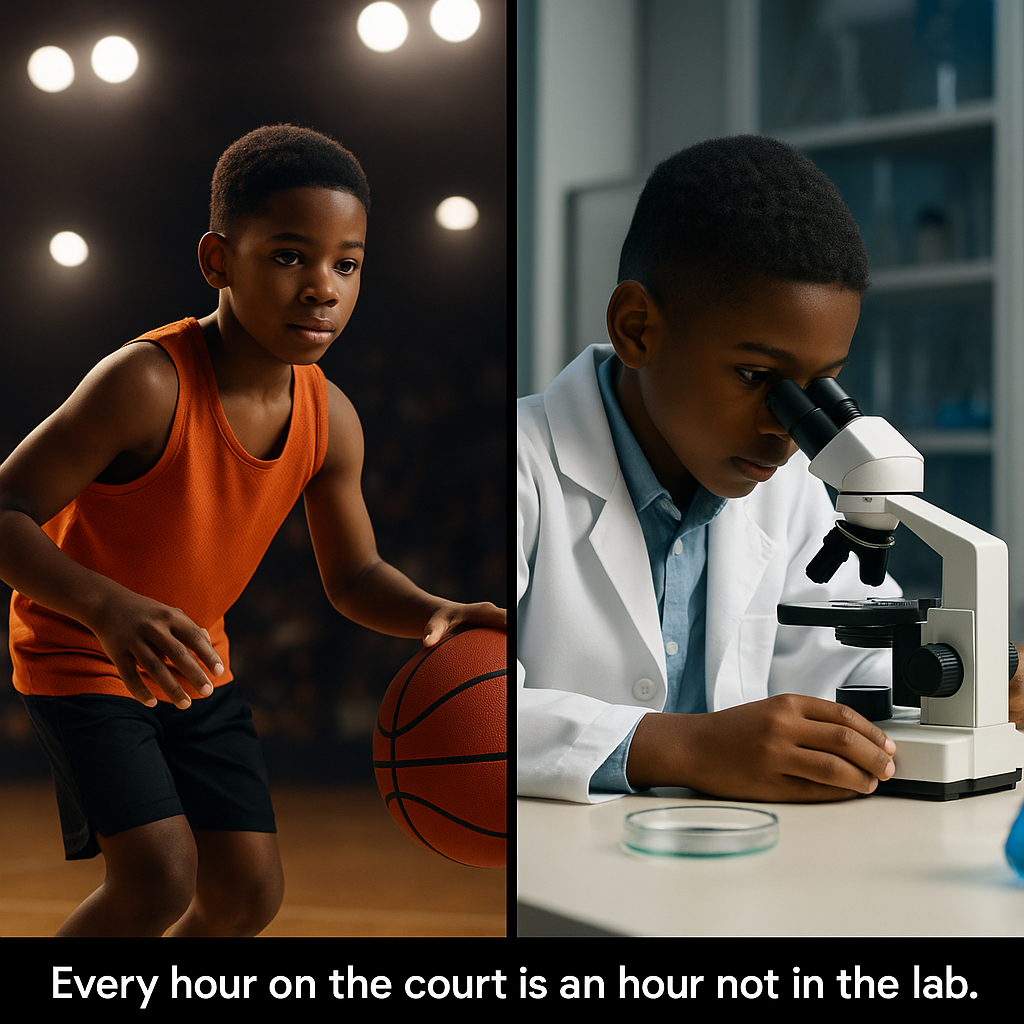
In August 2015, HBCU Money asked a provocative question: What if LeBron James were a doctor? It was more than a hypothetical. It was a cultural critique of how African American communities disproportionately invest their most visible male potential into athletics rather than professions like medicine, law, or academia. The premise was simple: what if the best of us were guided toward healing rather than hoops?

At that time, Bronny James was only 10 years old. He was already receiving national media coverage and projected to follow in the footsteps of his famous father. Ten years later, we know how the story unfolded: Bronny James is now 20 years old, an NBA player for the Los Angeles Lakers, having been selected 55th overall in the 2024 NBA Draft. He and LeBron have made history as the NBA’s first active father–son duo. But as we revisit that original question, we offer a new one for this moment:

What if Bronny James were a doctor?

The Pipeline That Still Leaks

In the decade since the original article, the numbers have moved very little. Black men remain just 2.9% of medical school applicants in the United States. While the total percentage of Black physicians has risen slightly to 5.2%, Black male doctors remain critically underrepresented in the field. The pipeline is still broken—too narrow, too leaky, and too unprotected.

Meanwhile, sports pipelines are expanding. Black male participation in college athletics remains high: 44% in NCAA Division I basketball and 40% in football. Yet only a fraction make it to the pros, and even fewer achieve career longevity. While Bronny James may earn an estimated $33 million over five years in the NBA, that sum when spread over a lifetime equates to about $750,000 annually pro-rated from age 21 to 65. By contrast, a primary care physician earning $280,000 annually over a 35-year career will earn nearly $10 million, with the added benefits of job security, community impact, and longevity.

Imagining Dr. Bronny James

What if Bronny James had chosen to study medicine instead of basketball?

He would now be entering his second year of medical school, perhaps at Morehouse, Howard, or Meharry. He would be poring over medical textbooks, studying cardiovascular anatomy, shadowing trauma surgeons, and preparing for his USMLE Step 1 exam. Instead of prepping for NBA Summer League, he’d be interning at the Cleveland Clinic or doing a rural health rotation through an HBCU pipeline program.

Bronny would not trend on Twitter. He would not have endorsement deals. But one day, he would help save lives. He might build a medical clinic in Akron, establish scholarships for Black boys in pre-med tracks, or serve as a thought leader in health equity. His white coat would carry power every bit as influential as his jersey and perhaps more transformative.

Investing in the Wrong Dream?

The culture of African American investment in financial, emotional, and institutional remains lopsided. Parents spend thousands each year on club sports, trainers, uniforms, and travel tournaments. The AAU circuit is a multi-billion-dollar enterprise. But few parents are encouraged or supported to invest similarly in chess clubs, science fairs, or summer medical programs. The problem isn’t sports. The problem is singularity. We teach Black boys to put all their ambition into the least likely path to success. That is not empowerment it is misallocation.

Sports should be one of the dreams. Not the dream.

And cultural influencers like celebrities, churches, schools, and even HBCUs must widen the lens of what is considered aspirational. Because when African American boys only see themselves celebrated on the court or field, they are conditioned to believe that’s the only route to greatness.

The Hospital That Could Change Everything

Now imagine a future where LeBron and Savannah James decide to reshape the health destiny of Black Ohio not just through education, but through medicine. In partnership with Central State University and Wilberforce University, the James family announces the creation of the Savannah & LeBron James Medical Center, a state-of-the-art teaching and research hospital in Dayton, Ohio. The hospital would be co-owned by the two HBCUs, offering an unprecedented model of HBCU institutional control and healthcare delivery.

At its helm? Dr. Bronny James, a board-certified trauma surgeon and hospital executive, returned from medical training with a mission not just to serve, but to system-build. Through a strategic pipeline, students from the I PROMISE School in Akron, established by the James family, would be funneled into dual-admissions programs at Wilberforce and Central State, beginning in middle school. African American students interested in health sciences would receive mentorship, MCAT preparation, research internships, and full scholarships in exchange for a five-year service commitment at the hospital.

The hospital would:

  • Serve as a Level 1 trauma center for the Midwest Black Belt.
  • Anchor a Black-owned HMO focused on preventive care and wellness.
  • House medical research departments focused on sickle cell, hypertension, and diabetes, disproportionately affecting Black populations.
  • Be staffed by a growing cadre of Black doctors, nurses, and technicians, trained from within the HBCU system.

It would be the first modern, Black-owned academic medical center in America in over a century.

Not just a facility but a movement.

HBCUs as Healthcare Engines

This is the next evolution for HBCUs. No longer content to only educate they must now employ, own, and lead. Currently, Meharry, Howard, and Morehouse are the most visible HBCU medical institutions, but they are not sufficient to serve a national population. HBCUs like Central State and Wilberforce can and should partner with philanthropists to enter the healthcare delivery space. Hospitals, urgent care clinics, dental schools, nursing programs—these are all industries HBCUs can lead, if given the capital and political will.

The Savannah & LeBron James Medical Center would become a model for how celebrity philanthropy can shift from access to ownership. The James family has built schools. Now they can build systems. Systems that outlast careers. Systems that create intergenerational empowerment. And Dr. Bronny James? He would not just be a doctor. He would be a symbol of new possibilities.

Culture, Media, and The Battle for Imagination

The Bronny we know exists because the culture invested in him—from trainers to scouts to sports media coverage. But imagine if that same investment were redirected into medicine.

What if:

  • ESPN tracked the top Black high school biology students?
  • SpringHill Company aired a documentary series on Black med students at HBCUs?
  • Nike sponsored lab coats instead of just sneakers?

Culture tells children what to value. The question is whether we value Black intellect enough to mass-produce it.

Father–Son Legacy: A New Kind of First

LeBron and Bronny made history as the NBA’s first active father-son duo. But what if they made history again this time as a father-son pair who reshaped African American health care? Imagine LeBron standing beside Bronny at the ribbon-cutting of the James Medical Center. One created legacy through sport. The other, through healing. That is a legacy few families could rival. That is the kind of dynasty African America needs now.

Final Thoughts: From Possibility to Policy

“What if Bronny James were a doctor?” is no longer a question about a single person. It is a challenge to families, schools, HBCUs, and philanthropists. It is a policy challenge: to build educational pipelines, mentorship structures, and HBCU-led medical institutions that keep Black talent from slipping through the cracks. It is a cultural challenge: to celebrate and invest in intellect and professionalism with the same intensity we invest in athletics. It is a power challenge: to shift from participation to ownership in one of the most critical sectors of our economy health care. The original article asked the question. Now, let us answer it—with vision, capital, and courage. Because if Bronny James were a doctor—and led a Black-owned hospital rooted in HBCU strength we would not just be saving lives.

We would be saving futures.

Schools For Husbands and Wives: Preparing African American Couples for Partnership and Institutional Power

“The family is the nucleus of civilization.” — Will Durant

When news broke from Senegal that so-called “schools for husbands” were being used to lower maternal and newborn mortality rates, the headlines focused on the novelty of men being taught to wash dishes, attend prenatal visits, and support women’s healthcare. Yet beneath the surface, Senegal’s program is not just about chores or even just about health, it is about reshaping cultural norms so that households operate as functional units rather than fractured spaces of authority and neglect. In a country where patriarchal structures often keep women from making life-saving decisions without a man’s permission, Senegal’s government and community leaders recognized that sustainable change had to address the power imbalance between men and women.

This insight carries an important lesson for African America. The African American family is facing a structural crisis. Only 38 percent of African American children grow up in two-parent households compared to 78 percent of white children, and the numbers are even more stark when considering households of generational stability, wealth accumulation, and transmission of institutional knowledge. The decline of the two-parent household in African America has had profound consequences not just for children, but for adults who often enter adulthood without ever having witnessed sustained partnership between equals.

What if African America had its own version of Senegal’s schools expanded to include both husbands and wives, and designed for straight couples and LGBTQ couples alike? A “School for Husbands and Wives” could become a powerful cultural and institutional lever, equipping African Americans with the skills, expectations, and frameworks to build households that are not only emotionally healthy but also institutionally productive.

Why African America Needs Schools for Husbands and Wives

African Americans live in a paradox: on the one hand, they are among the most religiously active groups in the country, with churches historically serving as community hubs. On the other hand, African American households are disproportionately fragmented. The reasons are historical and structural—slavery destroyed family continuity, Jim Crow restricted marriage rights, mass incarceration and discriminatory welfare policies tore apart families, and modern labor and housing policies continue to erode family stability.

The consequence is that too many African Americans enter relationships without having observed healthy models of partnership. This absence manifests itself in multiple ways:

  • Gender distrust: Many African American men and women view each other as competitors rather than partners, shaped by economic inequality and media stereotypes.
  • Power imbalances: Without clarity on roles, relationships often collapse under stress: financial, emotional, or social.
  • Institutional gaps: Families are the basic units of institutions. When African American families are weak, African American institutions remain undercapitalized and undercoordinated.

This reality is not confined to heterosexual couples. LGBTQ African Americans, who face both external discrimination and internal cultural tension, often have even fewer family blueprints to draw upon. Whether in straight or queer relationships, the challenge remains: how do two people form a sustainable partnership when their models are fragmented, mistrust abounds, and institutional frameworks are weak?

A School for Husbands and Wives would take on this challenge directly, teaching the mechanics of partnership in the same way Senegal’s program teaches men the mechanics of maternal health support. But instead of focusing solely on chores or permissions, the African American model would expand to include economics, conflict resolution, institution building, and cultural grounding.

The Senegalese Model: A Starting Point

Senegal’s schools for husbands use respected community figures like imams, former soldiers, and elders to teach men about women’s rights, maternal health, and shared responsibilities. The success lies in reframing: chores are not humiliating, they are acts of love; women’s health decisions are not threats, they are family investments; shared authority is not weakness, it is strength.

For African Americans, a School for Husbands and Wives could use a similar approach: respected voices drawn from the community like professors, entrepreneurs, cultural leaders, and married couples who have sustained long-term partnerships would teach relationship and family skills as community investments. The aim would be to destigmatize conversations about partnership and create new models where none exist.

Curriculum for Partnership

What would a School for Husbands and Wives look like in African America?

  1. Economics of Partnership
    • Teaching couples how to pool resources effectively, manage debt, invest in assets, and prioritize institutional wealth over individual consumption.
    • Lessons on real estate, life insurance, trusts, and estate planning—so that households become wealth anchors, not debt traps.
  2. Conflict Resolution and Communication
    • Many couples replicate cycles of mistrust they observed growing up. Training in conflict resolution, active listening, and equitable compromise would be central.
    • Both straight and LGBTQ couples would benefit from structured conversations on navigating cultural stigma, managing extended family expectations, and sustaining emotional intimacy.
  3. Household Labor Distribution
    • Senegal emphasizes men helping with chores to reduce women’s burdens. In African America, the conversation must extend further: both partners share responsibility for cooking, cleaning, parenting, and professional ambitions.
    • The school would also address how unpaid labor at home directly connects to economic outcomes, productivity, and career success for both partners.
  4. Cultural and Historical Grounding
    • African American couples would be taught the history of the African American family as an institution under assault—from slavery to mass incarceration.
    • By understanding the intentionality of these assaults, couples would better grasp the importance of intentional partnership as resistance.
  5. Parenting as Institutional Strategy
    • Children should be raised not just with love, but with strategy: to become contributors to African American institutional wealth and culture.
    • Parents would learn to combine elements of “tiger” and “gentle” parenting—discipline and nurture balanced toward the goal of institutional power.

Straight and LGBTQ Couples Together

Too often, discussions of African American family structure exclude LGBTQ couples, reinforcing division where there should be solidarity. A School for Husbands and Wives would explicitly include both straight and LGBTQ couples, recognizing that the core challenges of partnership communication, trust, economic strategy, cultural grounding are universal.

In fact, LGBTQ couples often demonstrate resilience in building intentional families under hostile conditions, a skillset that all African Americans can learn from. By including diverse couple models, the school would normalize different family structures while emphasizing the shared goal: strong, functioning partnerships that build institutions.

Institutional Implications

African American institutions such as HBCUs, banks, businesses, nonprofits are only as strong as the families that sustain them. Wealth is built in households before it is transferred to institutions. If African American households remain fragmented, then institutions will remain weak.

A School for Husbands and Wives could therefore be sponsored or housed by HBCUs, serving both as a community program and as a research lab. Partnerships with African American financial institutions could integrate financial literacy into the curriculum. Faith institutions, cultural centers, and civic organizations could all play roles in teaching and sustaining graduates of the program.

The benefits would ripple:

  • Higher marriage stability rates among African Americans.
  • Greater pooling of household income, increasing wealth accumulation.
  • Stronger parenting, producing children with higher educational attainment and cultural grounding.
  • Increased institutional giving and investment, as families with stability contribute more to churches, HBCUs, and community organizations.

Policy and Public Health Dimensions

A School for Husbands and Wives should not be seen only as a cultural innovation, but also as a public health and policy strategy. The lack of stable households directly correlates with higher rates of poverty, incarceration, and health disparities. Policymakers could frame such schools as preventative investments, much like job training or nutrition programs.

Public funding, alongside philanthropic investment from African American institutions, could help establish pilot programs in cities with large African American populations. These schools could even be tied to existing healthcare infrastructure such as community health clinics so that relationship education is linked to wellness checkups, parenting support, and financial literacy programs.

If Senegal can link male training to maternal survival, African America can link couple training to family survival.

Lessons from Senegal’s Caution

Senegal’s experience shows that change is incremental and contested. Some men embrace new roles; others resist. Likewise, in African America, not everyone will accept the idea of formal schools for partnership. Some will argue that love is natural and cannot be taught. Others will resist LGBTQ inclusion. Some will see the program as unnecessary “therapy culture.”

But institutions are built through intentionality, not accident. Just as one studies law to become a lawyer or finance to become a banker, so too must African Americans study partnership if they are to build families that function as institutional engines.

A Vision Forward

Imagine a future where every African American couple, before or after marriage, participates in a School for Husbands and Wives. They leave not only with a deeper love for each other but with tools for building wealth, resolving conflict, and raising children with purpose. They learn to see themselves as not just individuals, but as co-founders of a household institution.

The Senegalese model shows us that cultural change is possible when men are trained to view equality as strength. African America can expand that vision: training both husbands and wives, straight and queer, to view partnership as the foundation of institutional survival.

Just as Senegal’s schools for husbands aim to save lives, African America’s schools for husbands and wives would aim to save legacies.ve legacies.