
Tag Archives: African American Economy

Delay As Strategy: Why Democrats Must Stall The Federal Reserve Chair Confirmation Until After The 2026 Midterms

If the Democrats can not hold the line of the Federal Reserve’s independence, then America as we know it is over. The U.S. dollar as the world’s reserve currency will be on life support and foreign countries will be expeditious in the pulling of the plug because trust in the U.S. financial system will be no more. – William A. Foster, IV
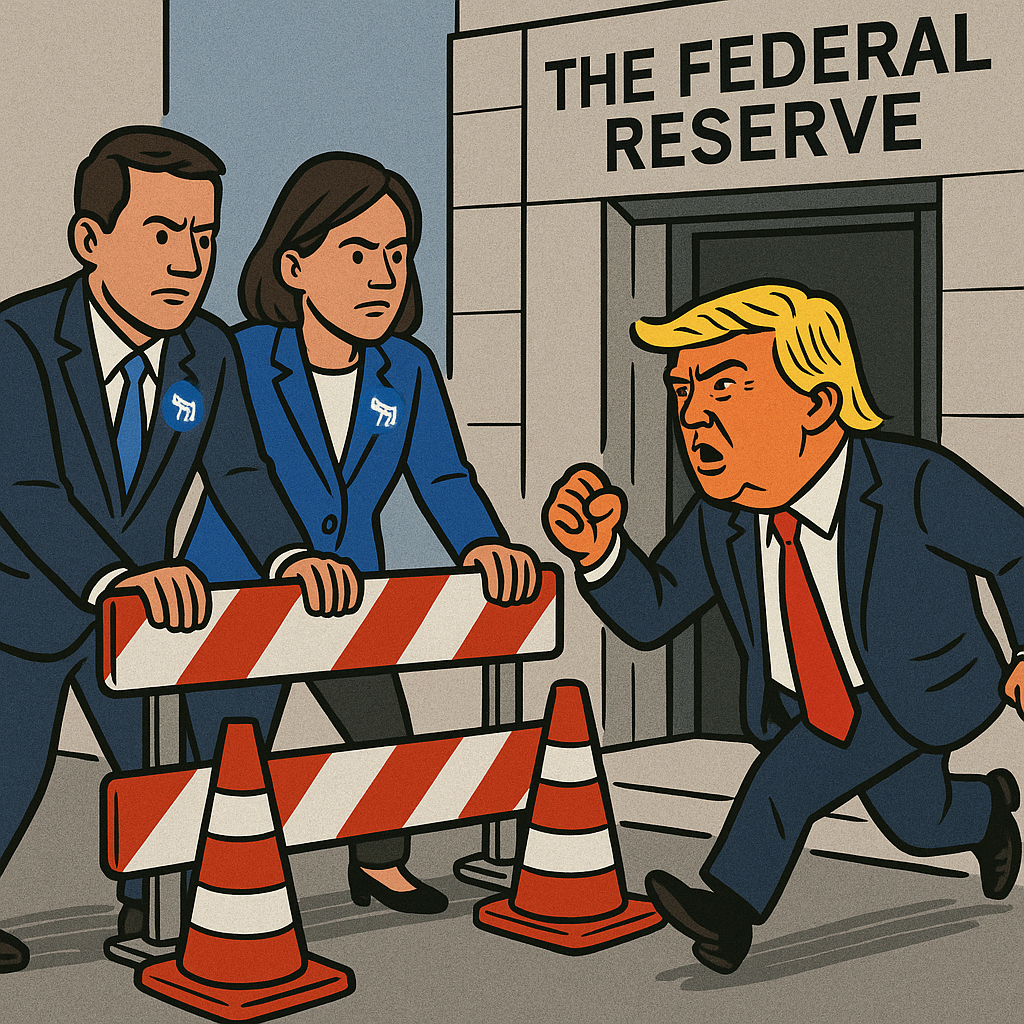
Jerome Powell leaves the Federal Reserve on May 15th. His likely successor, Kevin Warsh, is a wealthy former governor with convenient monetary views and a notable reluctance to say obvious things plainly. Democrats have the procedural votes to slow his confirmation. Whether they have the institutional will to use them is a different question and the answer matters more than most people realise.

The Federal Reserve does not often feature in discussions of HBCUs. It should. The interest rate at which a small Black-owned bank in Memphis can borrow money, the credit conditions facing a first-generation homeowner in Atlanta, the yield that a university endowment in Alabama can realistically expect on its bond portfolio: all of these are shaped, in ways direct and indirect, by the policy choices made inside the Eccles Building in Washington. The selection of a new Federal Reserve chair is, among other things, a decision about whose economy gets managed.

That is what makes the confirmation of Kevin Warsh, President Donald Trump’s nominee to succeed Jerome Powell, more consequential than the usual Washington pageant of hearings, hedged testimony, and partisan positioning. Warsh appeared before the Senate Banking Committee on April 21st. By the end of the day, a reasonably clear picture had emerged not just of his monetary philosophy, but of his character. It was not a flattering portrait.

Start with the money, because with Warsh the money is unavoidable. Financial disclosure forms filed ahead of the hearing placed his personal holdings at between $135 million and $226 million, concentrated heavily in two positions in the Juggernaut Fund LP, a vehicle associated with billionaire investor Stanley Druckenmiller, for whom Warsh has worked as a partner. His wife, Jane Lauder, granddaughter of cosmetics entrepreneur Estée Lauder, has an estimated personal fortune of around $1.9 billion. By comparison, Jerome Powell, the man Warsh would replace, disclosed assets of roughly $19.5 million, held mostly in index funds and municipal bonds. Ben Bernanke, who chaired the Fed during the 2008 financial crisis, stepped down in 2014 with assets of at most $2.3 million, mostly in retirement accounts. The message encoded in Warsh’s disclosure is not that rich people cannot run central banks. It is that the man who will make decisions about credit access for working Americans has never had occasion to worry about credit access himself.

The hearing did nothing to soften that impression. Warsh was asked, at one point, a question that should not require courage to answer: who won the 2020 presidential election? The answer is documented, certified by Congress, and not remotely in dispute among anyone operating in good faith. Warsh declined to say it plainly. He noted instead that “this body certified that election”—a formulation so carefully calibrated to avoid displeasing the president who nominated him that it managed to be both technically accurate and substantively evasive. Paul Krugman, the Nobel Prize-winning economist, called Warsh Trump’s “sock puppet.” Senator Elizabeth Warren used the same phrase. The comparison is uncharitable. It is also, on the evidence of the hearing, not easily rebutted.

Warsh was equally reluctant to defend Fed Governor Lisa Cook (Spelman), who faces politically motivated scrutiny from the administration, or to express support for Powell, who is the subject of a Justice Department investigation that Republican Senator Thom Tillis of North Carolina has used as a pretext to block Warsh’s own confirmation vote—a piece of procedural irony that illuminates just how thoroughly this nomination has been consumed by partisan mechanics. A nominee unable to defend his soon-to-be colleagues from transparently political attacks is, at minimum, a nominee who has chosen to demonstrate that loyalty to the president outranks loyalty to the institution he is asking to lead.

What might a Warsh-led Federal Reserve actually look like? The hearing offered some clues, and they are worth examining seriously rather than dismissing as political noise. The Council on Foreign Relations, reviewing his stated priorities, identified three broad themes: a return to the Fed’s core mandate of price stability and maximum employment, a stricter approach to inflation targeting, and a reduced reliance on quantitative easing and forward guidance. None of these is inherently unreasonable as a policy preference. The question is how they interact with the distributional realities of the American economy.

When the Federal Reserve tightens monetary conditions, raises interest rates, reduces the supply of credit, the effects are not equally distributed. Large corporations with investment-grade credit ratings refinance their debt through instruments that most individuals never encounter. Small businesses, particularly those operating in underserved communities with thinner banking relationships, find that credit simply disappears, or becomes prohibitively expensive. Families with secure equity in their homes can ride out a tightening cycle. Families trying to enter the housing market for the first time, often with smaller down payments and less financial buffer, are priced out. African American households, for reasons rooted in decades of discriminatory lending, exclusion from wartime wealth-building programmes, and constrained intergenerational asset transfer, are disproportionately represented in that second group. They enter recessions earlier, recover later, and bear more of the cost of monetary medicine administered for conditions they did not cause.

HBCUs sit at the intersection of several of these vulnerabilities. They operate with endowments that are, on average, a fraction of those at comparable predominantly white institutions partly because their alumni were, for generations, systematically excluded from the wealth accumulation that fuels philanthropic giving. They educate a student population that carries above-average debt loads into a labour market that does not always reward them proportionally. And despite the existence of a network of Black-owned banks and Minority Depository Institutions across the South and Midwest, only two HBCUs currently bank with Black-owned financial institutions. The rest rely on large money-center banks—the same institutions with documented histories of predatory lending to African American borrowers and communities. The irony is structural: HBCUs are among the most visible anchors of African American institutional life, yet their banking relationships run through the very sector that has most consistently extracted wealth from the communities they serve. The monetary environment matters to HBCUs not as a background condition but as an operational reality, and the institutions managing their accounts have rarely been the ones most attentive to their interests.

Into this context arrives a nominee who has, according to an analysis by Employ America, a nonpartisan inflation research group, demonstrated a pattern of supporting tight money when Democrats hold the White House and easy money when Republicans do. Warsh has also expressed the view that productivity gains from artificial intelligence could justify lower interest rates than would otherwise be warranted. That is a philosophically coherent position, though it happens to align precisely with what the current administration has made clear it wants: lower rates, delivered promptly. The convergence of Warsh’s stated views with the president’s stated preferences is, one might say, remarkable in its consistency.

All of which brings the discussion to the Senate, and to the question of what Democrats should do with the leverage they currently possess. The arithmetic is not complicated. Invoking cloture, the procedural step that ends debate and allows a confirmation vote, requires 60 votes. Republicans hold 53 seats. Democrats, including two independents who caucus with them, hold 47. That is more than enough to block confirmation indefinitely. Not to delay it. To block it. The mechanism differs from the Garland blockade when Republicans held the majority in 2016 and simply refused to schedule hearings; Democrats today are in the minority and must deny cloture but the constitutional leverage is equivalent and the outcome is identical. No confirmation without Democratic cooperation. The real obstacle is not parliamentary. It is political. Democrats have a long and costly institutional history of treating procedural restraint as a virtue even when their opponents have long since abandoned the same courtesy, and of discovering, too late, that the other side was keeping score.

Republicans offered the definitive tutorial in this kind of institutional resolve in 2016, when the Senate majority, led by Mitch McConnell, refused to consider President Obama’s nomination of Merrick Garland to the Supreme Court for nearly a year, on the stated grounds that a new president should make the selection. The stated grounds were pretextual. The real grounds were power. The manoeuvre was widely criticised as a breach of constitutional norms. It was also completely effective. The Supreme Court was reshaped for a generation. The lesson drawn by McConnell’s critics that norms of procedural deference were worth preserving regardless of how the other side behaved has not aged especially well. The lesson drawn by McConnell himself, that institutional power belongs to those willing to use it without apology, has proved considerably more durable. Democrats are not in the majority. They do not need to be. They need only hold together, deny cloture, and decline to confirm a nominee who has already failed the most basic test of the job. If Merrick Garland could be refused a hearing on thinner grounds, Kevin Warsh can be refused a confirmation vote on these.

Democrats who delay Warsh’s confirmation need not invent a pretext. The grounds are substantive and readily defensible. The nominee’s financial disclosures are among the most complex ever submitted for this position, listing roughly 1,800 individual assets, many classified under confidentiality agreements that prevent him from identifying the underlying holdings. He has pledged to divest within 90 days of confirmation, but the Senate is not obligated to extend that trust in advance. His confirmation hearing raised, rather than resolved, questions about his independence from the executive branch. A thorough vetting is not obstruction. It is the job.

The midterm elections in November 2026 add a further dimension that Democrats would be foolish to ignore. Monetary policy works with a lag. Rate decisions made in the spring are felt by households in the autumn. A newly confirmed Fed chair eager to demonstrate usefulness to the administration that appointed him would have both the motive and the means to generate a short-term economic improvement—lower mortgage rates, looser credit, a consumer spending bounce—timed to arrive just as voters are making up their minds about which party to support. That Democrats would have facilitated this outcome through premature confirmation is not an argument they would enjoy making to their constituents.

A sustained blockade, by contrast, forces a public conversation about what kind of institution the Federal Reserve should be. It creates an opportunity to put into the congressional record testimony from economists who study monetary policy’s distributional effects, from community bankers who work in markets the Federal Reserve’s balance sheet decisions directly affect, and from HBCU administrators who can explain, in terms that general audiences can understand, how interest rate policy shapes the financial landscape of institutions that serve some of the most economically vulnerable students in American higher education. The Fed’s decisions are made in public. Their consequences for working Americans—and especially for African American communities—are rarely discussed in the rooms where those decisions get made. A confirmation blockade is that conversation, conducted at a volume that cannot be ignored.

The Federal Reserve’s independence is not a natural condition. It is a political achievement, and like all political achievements, it requires active defence from those with the means to provide it. A nominee who cannot bring himself to say who won a presidential election—a question whose answer is written in congressional certification and judicial record—has already told the market, and the public, something important about how he understands that independence. The Senate does not have to accept that answer. Democrats have the votes to reject it. The question is whether they have the will to use them without flinching, without offering off-ramps to colleagues tempted by the false comfort of bipartisan procedural cooperation, and without eventually concluding that confirmation on unfavourable terms is preferable to the discomfort of sustained opposition. It is not. Warsh should not be confirmed. He should be blocked. The precedent for doing so was set by the people now asking Democrats to stand down.

For African American institutions, and for the HBCUs that represent their most durable infrastructure, the lesson is one they have had occasion to learn repeatedly: the rules of the game are made by those who show up and insist on making them. Monetary policy is not race-neutral, however much it presents itself as such. The cost of credit, the availability of capital, the conditions under which wealth can be built and transmitted across generations—these are not technical abstractions. They are the material of institutional survival. The question of who chairs the Federal Reserve is, among other things, a question about whose survival the institution is organised to protect. That question deserves a full and unhurried answer.

Disclaimer: This article was assisted by ClaudeAI.

HBCU Money Presents: African America’s 2024 Annual Wealth Report

African American household wealth reached $5.6 trillion in 2024, marking a half-trillion-dollar increase that signals both progress and persistent structural challenges in the nation’s racial wealth landscape. While the topline growth appears encouraging, the composition reveals a familiar pattern: wealth remains overwhelmingly concentrated in illiquid assets, with real estate and retirement accounts comprising nearly 60% of total holdings. The year’s most dynamic growth came from corporate equities and mutual fund shares, which surged 22.2% to $330 billion—yet this represents less than 5% of African American assets and a mere 0.7% of total U.S. household equity holdings, underscoring how far removed Black households remain from the wealth-generating mechanisms of capital markets.

The liability side of the ledger tells an equally sobering story. Consumer credit climbed to $740 billion in 2024, now representing nearly half of all African American household debt and growing at more than double the rate of asset appreciation. This shift toward unsecured, high-interest borrowing—particularly as it outpaces home mortgage debt—suggests that rising asset values are not translating into improved financial flexibility or reduced economic vulnerability. What makes this dynamic even more troubling is the extractive nature of the debt itself: with African American-owned banks holding just $6.4 billion in combined assets, it’s clear that the vast majority of the $1.55 trillion in African American household liabilities flows to institutions outside the community. This means that interest payments, fees, and the wealth-building potential of lending relationships are being systematically siphoned away from Black-owned financial institutions that could reinvest those resources back into African American communities, perpetuating a cycle where debt burdens intensify even as the capital generated from servicing that debt enriches institutions with no vested interest in Black wealth creation.

ASSETS

In 2024, African American households held approximately $7.1 trillion in total assets, an increase of more than $500 billion from 2023, with corporate equities and mutual fund shares recording the fastest year-over-year growth from a relatively small base, even as wealth remained heavily concentrated in real estate and retirement accounts—together accounting for more than 58% of total assets.

Real Estate

Total Value: $2.24 trillion

Definition: Real estate is defined as the land and any permanent structures, like a home, or improvements attached to the land, whether natural or man-made.

% of African America’s Assets: 34.2%

% of U.S. Household Real Estate Assets: 5.1%

Change from 2023: +4.3% ($100 billion)

Real estate remains the dominant asset class for African American households, accounting for over one-third of total household assets. While modest appreciation continued in 2024, ownership remains highly concentrated in primary residences rather than income-producing or institutional real estate, limiting liquidity and leverage potential.

Consumer Durable Goods

Total Value: $620 billion

Definition: Consumer durables, also known as durable goods, are a category of consumer goods that do not wear out quickly and therefore do not have to be purchased frequently. They are part of core retail sales data and are considered durable because they last for at least three years, as the U.S. Department of Commerce defines. Examples include large and small appliances, consumer electronics, furniture, and furnishings.

% of African America’s Assets: 8.8%

% of U.S. Household Durable Good Assets: 6.2%

Change from 2023: +3.3% ($20 billion)

Corporate equities and mutual fund shares 

Total Value: $330 billion

Definition: A stock, also known as equity, is a security that represents the ownership of a fraction of the issuing corporation. Units of stock are called “shares” which entitles the owner to a proportion of the corporation’s assets and profits equal to how much stock they own. A mutual fund is a pooled collection of assets that invests in stocks, bonds, and other securities.

% of African America’s Assets: 4.7%

% of U.S. Household Equity Assets: 0.7%

Change from 2023: +22.2% ($60 billion)

Defined benefit pension entitlements

Total Value: $1.73 trillion

Definition: Defined-benefit plans provide eligible employees with guaranteed income for life when they retire. Employers guarantee a specific retirement benefit amount for each participant based on factors such as the employee’s salary and years of service.

% of African America’s Assets: 24.4%

% of U.S. Household Defined Benefit Pension Assets: 9.7%

Change from 2023: +7.5% ($40 billion)

Defined contribution pension entitlements

Total Value: $880 billion

Definition: Defined-contribution plans are funded primarily by the employee. The most common type of defined-contribution plan is a 401(k). Participants can elect to defer a portion of their gross salary via a pre-tax payroll deduction. The company may match the contribution if it chooses, up to a limit it sets.

% of African America’s Assets: 12.4%

% of U.S. Household Defined Contribution Pension Assets: 6.0%

Change from 2023: +4.8% ($40 billion)

Private businesses

Total Value: $330 billion

% of African America’s Assets: 4.7%

% of U.S. Household Private Business Assets: 1.8%

Change from 2023: +3.1% ($10 billion)

Other assets

Total Value: $770 billion

Definition: Alternative investments can include private equity or venture capital, hedge funds, managed futures, art and antiques, commodities, and derivatives contracts.

% of African America’s Assets: 10.9%

% of U.S. Household Other Assets: 2.7%

Change from 2023: +6.9% ($50 billion)

LIABILITIES

“From 2023 to 2024, African American household liabilities rose by approximately $100 billion, with consumer credit, now representing nearly 48% of all liabilities, driving the majority of the increase and reinforcing structural constraints on net wealth accumulation despite rising asset values.”

Home Mortgages

Total Value: $780 billion

Definition: Debt secured by either a mortgage or deed of trust on real property, such as a house and land. Foreclosure and sale of the property is a remedy available to the lender. Mortgage debt is a debt that was voluntarily incurred by the owner of the property, either for purchase of the property or at a later point, such as with a home equity line of credit.

% of African America’s Liabilities: 50.3%

% of U.S. Household Mortgage Debt: 5.8%

Change from 2023: +4.0% ($30 billion)

Consumer Credit

Total Value: $740 billion

Definition: Consumer credit, or consumer debt, is personal debt taken on to purchase goods and services. Although any type of personal loan could be labeled consumer credit, the term is more often used to describe unsecured debt of smaller amounts. A credit card is one type of consumer credit in finance, but a mortgage is not considered consumer credit because it is backed with the property as collateral. 

% of African American Liabilities: 47.7%

% of U.S. Household Consumer Credit: ~15.0%

Change from 2023: +10.4% ($70 billion)

Other Liabilities

Total Value: $30 billion

Definition: For most households, liabilities will include taxes due, bills that must be paid, rent or mortgage payments, loan interest and principal due, and so on. If you are pre-paid for performing work or a service, the work owed may also be construed as a liability.

% of African American Liabilities: 2.0%

% of U.S. Household Other Liabilities: ~2.8%

Change from 2023: 0% (No material change)

Source: Federal Reserve

Monetary Illiteracy In The Halls Of Power: When Grandstanding Replaces Governing

“It is the mark of an educated mind to be able to entertain a thought without accepting it.” — Aristotle

Each time Federal Reserve Chair Jerome Powell appears before Congress, particularly the House Financial Services Committee, a rare opportunity presents itself—one that could improve financial literacy at the highest levels of government and foster substantive dialogue on monetary policy’s profound impact on American households, businesses, and institutions. But that opportunity is almost always wasted.

Instead, the public is forced to endure yet another performance of political theater where elected officials, both Democrat and Republican, seem more concerned with going viral than going deep—more focused on five-minute gotchas than on fifty-year policy ramifications.

And for African America, whose economic institutions and family wealth face historic and systemic precarity, this continued dysfunction is not simply frustrating. It is dangerous.

The Purpose of Oversight or a Stage for Soundbites?

The Federal Reserve is arguably the most powerful economic institution in the world. Its chair, currently Jerome Powell, wields incredible influence over interest rates, inflation, labor markets, and the credit system. A hearing before Congress should be a time when policymakers probe deeply, ask sophisticated questions, and help inform the public through their own understanding.

Instead, what unfolds is often little more than ideological posturing. Members of Congress use their time to push personal or party agendas, cherry-pick statistics, or lob loaded questions with no intent of hearing the answer.

This isn’t oversight. It’s political performance art.

The House Financial Services Committee, charged with overseeing financial institutions, capital markets, and economic stability, must rise above this. Its role should be more than ceremonial. It should be educational—to itself and to the American people. But the overwhelming sense watching Powell’s recent testimonies is that most of the committee members lack even a basic understanding of how monetary policy functions, let alone how to interrogate it effectively.

Why It Matters for HBCUs and African American Economic Institutions

African America does not have the luxury of political and financial ignorance.

When inflation creeps higher, it isn’t just a line in a Bloomberg terminal. It is the difference between a Black student being able to afford books for the semester or choosing between groceries and tuition. It is a Black-owned small business having to lay off an employee because a loan’s interest rate jumped from 6% to 11%.

The lack of thoughtful interrogation of Powell’s monetary strategy reflects a more structural problem. There is a scarcity of African American economists in monetary policy circles. The Federal Reserve’s own ranks remain largely devoid of HBCU graduates, and few members of the House Financial Services Committee themselves come from economically marginalized backgrounds or have spent real time examining the consequences of macroeconomic policy on communities of color.

Yet these are the same communities most sensitive to interest rate swings, credit market freezes, or inflationary spikes.

And still, with this knowledge, Black America’s representatives—those on the committee and those adjacent—too often use their time during hearings for moral appeals or political slogans. But where is the policy meat? Where is the specificity? Where is the courage to press Powell on structural inequality in the Federal Reserve’s frameworks?

The Federal Reserve and the Myth of Neutrality

To be fair, the Federal Reserve, under Powell or any other chair, does not operate in a vacuum. But the institution often touts its political independence as a form of virtue. That independence, however, should not be mistaken for neutrality. The Fed’s policies have winners and losers.

From 2020 to 2022, the Fed’s monetary expansion saved financial markets—but also exploded asset prices, exacerbating wealth inequality. Homeowners gained equity. Renters fell behind. Banks consolidated more power while local lenders and community institutions—like Black banks—continued to struggle.

The committee could have questioned Powell on these outcomes. It could have demanded a racial wealth gap impact assessment of every major monetary policy decision. It could have interrogated how interest rate hikes disproportionately hurt historically marginalized borrowers. But those questions are never asked.

Instead, Powell is interrupted mid-sentence. Politicians talk over him. They make proclamations but ask no follow-ups. This behavior isn’t just disrespectful—it’s dangerous. And it’s a gross misuse of public time.

What HBCUs Can Teach Congress About Learning

At an HBCU, you learn that education is both a privilege and a weapon. It is something to be studied, sharpened, and used to build institutions. That approach—one rooted in discipline, humility, and preparation—is entirely missing from the House Financial Services Committee’s handling of monetary policy.

If a professor at Spelman or Howard or North Carolina A&T asked students to prepare a critique on central banking and one of those students responded with vague accusations or irrelevant political banter, they would be challenged to do better. Because rigor matters.

Imagine, instead, what would happen if HBCU economics departments had a seat at the table. Imagine if the committee regularly invited young scholars from Hampton, Morehouse, and FAMU to submit briefs or participate in Q&A sessions. Imagine a committee that used Powell’s visit as a chance to uplift new Black monetary scholars, who are often overlooked despite deep institutional knowledge.

There is no reason why an HBCU-trained economist should not be Chair of the Federal Reserve one day. But for that to happen, both access and expectation must change. We must expect more of Congress—and we must prepare ourselves to be in those seats.

The Price of Ignorance Is Paid in Communities Like Ours

Grandstanding doesn’t stabilize mortgage rates.

Political theater doesn’t ensure access to affordable credit.

Viral clips won’t help a Black farmer secure the funding needed to plant next season.

When the committee wastes its opportunity to genuinely understand and shape monetary policy, it abdicates responsibility for protecting those most vulnerable to economic volatility. Black communities cannot afford that negligence.

For instance, Powell was not questioned about how inflation-targeting might undervalue employment gains in Black communities. Nor was he asked whether the Fed’s models even consider racial employment disparities in real time. These are the kinds of questions that would surface if the committee viewed itself as learners—not performers.

A Call for Financial Statesmanship

What is needed in Congress is not just political courage but intellectual humility. An understanding that financial literacy is not just for constituents but must be a discipline practiced by lawmakers themselves.

The House Financial Services Committee could evolve into a place of high economic inquiry, a model of bipartisan dialogue around shared economic goals. But that will require members who read the footnotes of policy briefs, not just the headlines. Who consult experts across ideology. Who admit what they don’t know and ask better questions in return.

It also means creating a pipeline of informed staffers, many of whom should be HBCU-trained. Imagine a rotating fellowship where top students in finance and economics at Prairie View or Tuskegee serve one-year policy internships with members of Congress. Not only would this improve committee function, but it would democratize who gets to shape monetary discourse in the long run.

A Missed Opportunity That Cannot Keep Being Missed

Chair Powell is not infallible. His policies deserve scrutiny. But if the scrutiny is shallow, the Fed wins by default. Monetary policy deserves robust challenge—but that challenge must come with intellectual integrity, not political antics.

African American families, students, and business owners live with the real-world consequences of interest rate decisions every single day. They deserve elected officials who treat these hearings not as soundbite factories, but as classrooms—where hard questions are asked, where policies are dissected, and where the future is imagined more inclusively.

The Federal Reserve will always operate in the shadows unless Congress holds up a light. But to shine that light effectively, the House Financial Services Committee must first turn its cameras inward and ask whether it is performing or learning.

Because for communities like ours, the cost of their ignorance is far too high.

This Week in the Economy: May 5–9, 2025

Analyzing the U.S. Economic Calendar Through the Lens of African American Economic Empowerment

Monday, May 5

  • S&P Final U.S. Services PMI (Apr): 51.0 (Prev: 51.4)
  • ISM Services Index (Apr): 50.4% (Prev: 50.8%)

A cooling services sector raises concerns for Black-owned businesses and workers concentrated in service-based industries. Marginal growth may mean tighter margins and slower hiring, especially in personal care, retail, and small hospitality—fields where many African American entrepreneurs and employees operate.


Tuesday, May 6

  • U.S. Trade Deficit (Mar): -$136.0B (Prev: -$122.7B)

The growing trade deficit highlights America’s deepening reliance on imports, reinforcing structural challenges for domestic manufacturing. This imbalance is particularly troubling for aspiring Black manufacturers and export-driven enterprises that struggle to compete with cheaper foreign supply chains and lack equitable access to capital or infrastructure.


Wednesday, May 7

  • FOMC Meeting & Fed Chair Powell Press Conference
  • Consumer Credit (Mar): $11.0B (Prev: -$800M)

The Federal Reserve’s direction this week is critical. Interest rate policy affects African American households disproportionately, with higher borrowing costs hitting hardest among those with lower credit scores and less generational wealth. A rise in consumer credit signals that families—many Black households included—may be increasingly relying on debt to maintain basic living standards amid inflation. The burden of debt is rising, not falling.


Thursday, May 8

  • Initial Jobless Claims (May 3): 230,000 (Prev: 241,000)
  • U.S. Productivity (Q1): -0.5% (Forecast: +1.5%)
  • Wholesale Inventories (Mar): +0.5% (Prev: +0.3%)

Jobless claims are stable, but national figures obscure racial disparities. Black unemployment remains consistently higher than average. Meanwhile, negative productivity numbers may point to slower wage growth—again affecting African American workers in roles offering limited career mobility. Rising wholesale inventories suggest slowing consumer demand, which could hit Black-owned consumer goods businesses that often operate without deep cash reserves.


Friday, May 9

  • Fed Governor Lisa Cook Speech (6:45 AM ET)
  • Multiple Fed Speakers Throughout Day

All eyes will be on Lisa Cook, the first Black woman on the Fed’s Board of Governors. Her remarks may provide valuable insight into how the central bank views labor market equity and inflation’s disproportionate impact on communities of color. The deluge of Fed speeches will shape interest rate sentiment and financial market reactions—affecting everything from mortgage rates for HBCU alumni to capital access for Black banks, credit unions, and small businesses.


HBCU Money Perspective:
This week’s economic events carry clear signals for the African American economy. Slower service sector growth, rising debt reliance, and stagnant productivity reinforce the need for systemic change—particularly in access to capital, support for Black manufacturing, and inclusive monetary policy. As Fed policy direction becomes clearer, HBCUs, Black-owned financial institutions, and policy advocates must prepare to assertively engage with these shifts to protect and grow Black wealth.