
Tag Archives: Black wealth inequality

A Permanent Emergency: Black Homelessness & the Housing Cost Trap

Where you live should not determine whether you live. — Dr. Martin Luther King Jr.
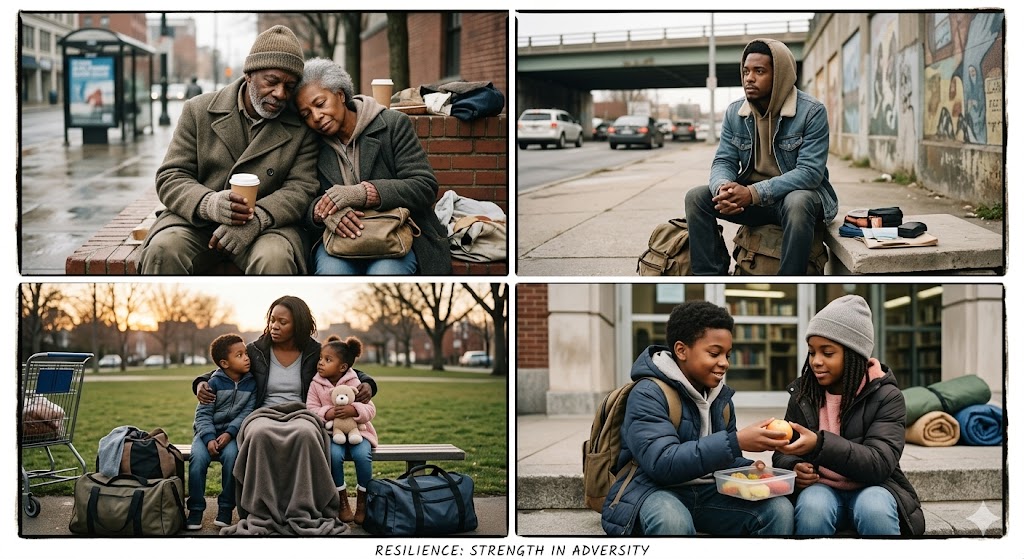
There is a kind of emergency that does not announce itself with sirens. It settles instead into the permanent infrastructure of a city into shelter intake forms, into eviction court dockets, into the quiet calculus of a family deciding which bill goes unpaid this month so the rent does not. It becomes, over time, not an emergency at all but a condition: expected, budgeted for, managed at the margins, never resolved. Black homelessness in America has become that kind of emergency. It is measured every January, reported every summer, and addressed with the institutional energy of a problem that everyone has agreed, without saying so directly, will not be solved.

On a single night in January 2024, the federally mandated Point-in-Time census counted more than 240,000 people experiencing homelessness who identified as Black, African American, or African. That figure represented 31.6 percent of everyone sleeping in shelters, tents, cars, or on city streets in a country where Black Americans represent 13.7 percent of the population. The disproportionality is not new. What is new is the magnitude: 2024 produced the largest raw count of unhoused Black Americans ever recorded in the Department of Housing and Urban Development’s modern Point-in-Time series. The trend line does not suggest an aberration. It suggests a permanent condition whose scale is still expanding.

The arithmetic of the crisis is straightforward. Zillow’s national rental index placed the average advertised lease at approximately $2,100 per month in early 2025. A parallel Apartment List survey, which strips luxury units from its methodology, pegged the median at $1,398. A reasonable blended figure sits near $1,700 per month or $20,400 per year. That is not the price of comfort. It is the price of a mailing address, a bathroom that locks, and a bed that belongs to no one else. Multiply that annual cost by 240,000 unhoused Black individuals and the minimum annual bill for basic housing stability comes to $4.9 billion. Finance professionals design endowments to distribute approximately 5 percent of principal annually without eroding real value. The corpus required to generate $4.9 billion in perpetuity is approximately $98 billion, call it $100 billion. That is the number. It is not an estimate or an aspiration. It is arithmetic.

To understand why that number has never been assembled, it is necessary to understand what produced the crisis it would address. The Census Bureau defines households paying more than 30 percent of income toward housing as cost-burdened. In 2023, 56.2 percent of Black renter households met that definition. The Federal Reserve’s 2022 Survey of Consumer Finances reported median Black household wealth at $44,900, roughly 15 percent of the $285,000 median for white households. The Black homeownership rate sits between 44 and 45 percent, compared to 74 percent for non-Hispanic white households. Home equity is the primary mechanism by which American families absorb life shocks — job loss, illness, family dissolution — without falling into housing instability. A community with a homeownership rate 30 points below the national white average has 30 points less cushion against every emergency that precedes homelessness. This is not a coincidence of individual financial behavior. It is the compounded output of subsidized mortgage programs that excluded Black borrowers, exclusionary zoning that confined Black families to undervalued land, and GI Bill benefits that built the white middle class while systematically denying equivalent access to Black veterans. The policy record is not ambiguous. The consequences are still being counted every January.

The community’s own financial institutions offer the starkest measure of the structural gap. According to HBCU Money’s 2024 African American Owned Bank Directory, African American-owned banks hold $6.4 billion in total assets across 18 institutions. The 2025 African American Owned Credit Union Directory documents 205 active credit unions holding $8.15 billion in assets serving 726,929 members. The entire African American-owned financial institution sector between every bank, every credit union in the country, combined controls approximately $14.5 billion. The endowment required to permanently resolve Black homelessness is seven times that figure. African American households hold $7.1 trillion in total assets according to HBCU Money’s 2024 Annual Wealth Report, and command approximately $1.8 trillion in annual buying power, yet corporate equities and mutual fund shares, the asset class that most reliably converts income into intergenerational capital, represent less than 5 percent of African American holdings and a mere 0.7 percent of total U.S. household equity assets. Consumer credit has climbed to $740 billion, now approaching parity with Black mortgage debt of $780 billion, a near 1:1 ratio that represents a fundamental inversion of healthy household finance (3:1 being seen as the baseline for a health household finance). The topline wealth figures are real. The structural vulnerabilities beneath them are equally real. A community whose financial institutions control $14.5 billion in assets is not positioned to self-capitalize a $100 billion endowment, not now, and not without a generational shift in how African American institutional capital is accumulated, retained, and deployed.

HBCU campuses are not observers of this crisis. They are inside it. A 2020 Hope Center survey of nearly 5,000 students at 14 HBCUs found that 46 percent had experienced food insecurity in the prior 30 days, 55 percent had experienced housing insecurity in the prior year, and 20 percent had been homeless at some point during that academic year. One in five students at institutions whose entire institutional mission is economic mobility trying to complete coursework from a couch, a car, or a shelter. The 2021 Howard University student occupation of the Blackburn Center brought national visibility to conditions that students at dozens of HBCUs navigate without cameras: mold, rodent infestation, deferred maintenance that years of constrained operating budgets cannot absorb. At institutions like Alcorn State University, Coppin State University, and Edward Waters University, the competition between student housing needs and every other institutional priority is not a policy question. It is a weekly budget decision. An HBCU cannot produce the physicians, engineers, and policy architects that African American communities require if the students admitted to those programs cannot secure the stability that sustained academic work demands.

The conventional philanthropic response to a crisis of this scale would invoke a combination of federal investment, corporate giving, and foundation capital. That architecture has not assembled for Black housing, and the current environment offers no evidence that it will. Federal housing policy has moved in the opposite direction from what the scale of Black housing instability requires. Corporate philanthropy directed toward racial equity initiatives contracted sharply following 2023, as major corporations withdrew or quietly defunded commitments made in 2020. Foundation capital, while more durable, has never operated at the scale this problem requires and has shown no institutional appetite to do so. The community has waited across multiple political cycles for external capital to arrive at the necessary scale. It has not arrived. There is no credible reason, given the current political and philanthropic environment, to expect that it will.

What remains, then, is the harder question, the one that the data forces and that no external institution is positioned to answer. African American households hold $7.1 trillion in assets. African American consumers generate $1.8 trillion in annual spending, $64 billion of which flows into higher education, much of it leaving the Black institutional ecosystem entirely. The financial infrastructure of 205 credit unions and 18 banks exists, undercapitalized but functional, as a potential deployment mechanism for any capital that could be directed toward it. The institutional networks of HBCUs, Black nonprofits, and community land trusts represent governance capacity that has been demonstrated across generations. None of this adds up, in its current configuration, to $100 billion. But it raises the question that Black institutional leadership has not yet had to answer at this scale: what would it take to get there from within, and what is the cost, measured in bodies counted each January, of not trying.

That question does not have a comfortable answer. The honest answer may be that the problem is larger than what any single generation of institutional actors can resolve, that the structural deficit created by four centuries of policy violence cannot be closed by the institutions those policies were designed to prevent from forming. That possibility deserves to be named plainly rather than papered over with funding architectures that do not exist. What can be said with equal plainness is this: the external path has been tried across multiple administrations, multiple philanthropic cycles, and multiple corporate giving moments. The count goes up every January. Whatever the solution is, if one exists at this scale, it will have to be generated from within the African American community and our institutions whose members are being counted. There is no other honest conclusion available from the data.

The Sliding Scale: 10 Infrastructure Categories

1. African American Emergency Shelter Networks
The Salvation Army, Catholic Charities, and Gospel Mission dominate this space almost entirely. There is no Black-led national shelter network equivalent. Individual Black churches operate shelter programs locally but with no coordination, no shared data, and no pooled capital. This is the most visible absence and arguably the easiest to begin at city level — a single congregation with property can open beds. The barrier is operating capital, not concept.

2. African American Eviction Prevention Funds
Eviction is the primary on-ramp to homelessness for Black renters who are not chronically unhoused. Right-to-counsel programs — where they exist — reduce eviction rates 50–80 percent. African American-owned credit unions are the logical vehicle for rapid emergency rental assistance lending because they already have underwriting relationships in these communities. This is financial infrastructure, not charity: a revolving loan fund capitalized through credit unions and HBCU alumni networks could catch families before they hit shelters.

3. African American Tenant Legal Defense Organizations
The eviction court system is structurally adversarial. Landlords routinely appear with counsel; tenants routinely appear alone. Black bar associations in major cities — the Cook County Bar Association, the Wiley Branton Inn of Court in D.C., the Charles Houston Bar Association — have the professional infrastructure to organize pro bono tenant defense clinics. What they lack is a coordinated national framework and stable funding to make this a standing operation rather than an episodic volunteer effort.

4. African American Community Land Trusts
This is the one category with genuine Black institutional roots. The community land trust model traces directly to the Civil Rights Movement — New Communities Inc., founded in 1969 in Albany, Georgia, is credited as the original CLT model in the U.S., created specifically to prevent displacement of Black communities through community-owned land. The Africatown Community Land Trust in Seattle has established mixed-use spaces supporting Black-owned businesses and over 100 affordable rental units. The Crescent City Community Land Trust in New Orleans has focused on racial equity, permanently affordable housing, and restoring Black businesses in the Seventh Ward. The model works. It is undercapitalized and geographically fragmented. A national network of Black-led CLTs with pooled acquisition capital would be the most durable long-term housing infrastructure available.

5. African American-Owned Property Management Companies
This is an underexamined gap. Affordable housing units exist in Black communities. Who manages them determines where operating revenues go — and currently, most flows to firms with no institutional relationship to those communities. Black-owned property management companies operating within affordable housing portfolios would retain fees inside the ecosystem while also setting service standards in buildings that disproportionately house Black tenants.

6. African American Transitional Housing Organizations
Between emergency shelter and permanent housing is a gap that kills stability: transitional housing with wrap-around services for 6–24 months. This is where formerly incarcerated individuals, domestic violence survivors, and people exiting addiction treatment fall through. Black churches collectively hold the physical assets — underutilized buildings, parking lots, adjacent parcels — to host transitional housing at scale. The barrier is the operational and clinical infrastructure to run such programs, which requires coordination beyond what individual congregations can typically sustain.

7. HBCU Student Emergency Housing Funds
This is the most institutionally natural starting point for the network. HBCUs already have the administrative infrastructure, the student relationships, and the moral authority. A national HBCU Student Housing Emergency Fund — capitalized through alumni associations and administered through financial aid offices — would address the 20 percent homelessness rate the Hope Center documented without requiring new institutions. It requires only that existing institutions add a function.

8. African American Credit Counseling and Housing Stability Organizations
The path back from housing instability runs through credit repair, budgeting support, and landlord negotiation — skills that cost nothing to teach but require trusted institutional relationships to deliver. African American-owned credit unions already have member financial counseling as part of their charter obligations. Expanding and formalizing that function specifically around housing stability would leverage existing infrastructure at minimal additional cost.

9. African American Mental Health and Addiction Recovery Housing
Chronic homelessness — the population that does not resolve with a voucher or a loan — is disproportionately driven by untreated mental illness and addiction. This is the hardest category and the one where the African American institutional ecosystem has the least current capacity. Black-led behavioral health organizations exist in most major cities but are chronically underfunded and have no residential housing component. Sober living homes, recovery residences, and mental health step-down housing operated by Black-led organizations would address the population that no other category reaches.

10. African American Housing Data and Advocacy Infrastructure
None of the above can be built, funded, or defended without data. The Point-in-Time count is federal data collected by local Continuums of Care that are rarely Black-led. There is currently no African American-owned institution systematically tracking Black housing instability, eviction rates, credit denial rates, and shelter utilization at national scale and publishing it as a public resource. HBCU Money’s Annual Wealth Report is the closest thing. A dedicated African American Housing Data Collaborative — potentially housed within an HBCU research center — would give every other institution on this list the evidence base to make its case.

Disclaimer: This article was assisted by Claude AI.

The Impossible Mathematics: African America’s $480 Billion or $1.5 Trillion Debt Dilemma

Debt is part of the human condition. Civilization is based on exchanges – on gifts, trades, loans – and the revenges and insults that come when they are not paid back. – Margaret Atwood

The mathematics of African American household debt present a stark choice: either eliminate $480 billion in consumer credit or add $1.5 trillion in mortgage debt. These are the pathways to achieving the 3:1 mortgage-to-consumer-credit ratio that European, Hispanic, and other American households maintain as a baseline of financial health. The first option requires African Americans to reduce consumer borrowing by 65% while maintaining current mortgage levels. The second demands increasing mortgage debt by 185% from $780 billion to $2.22 trillion while holding consumer credit constant. Neither path is realistic in isolation, yet both illuminate the extraordinary structural challenge facing Black households attempting to build wealth in an economy designed to extract it.

The current debt profile of $780 billion in mortgages against $740 billion in consumer credit represents an almost perfect inversion of healthy household finance. To understand the magnitude of correction required, consider what a 3:1 ratio would mean in practice. If African American households maintained their current $780 billion in mortgage debt, consumer credit would need to fall to $260 billion, a reduction of $480 billion. Alternatively, if consumer credit remained at $740 billion, mortgage debt would need to rise to $2.22 trillion, an increase of $1.44 trillion. The symmetry of these impossible requirements reveals how far African American household finance has diverged from sustainable wealth-building patterns.

The consumer credit reduction scenario appears superficially more achievable. After all, paying down debt requires discipline and sacrifice rather than access to new credit markets. Yet the practical barriers are immense. Consumer credit serves multiple functions in African American households, not all of them discretionary. Medical debt, a significant component of consumer credit, reflects the reality that Black Americans face higher rates of chronic illness while having lower rates of health insurance coverage and higher out-of-pocket costs. Transportation debt, often in the form of auto loans that blur the line between consumer and secured credit, reflects the necessity of vehicle ownership in a nation with limited public transit and residential patterns shaped by decades of housing discrimination that placed Black communities far from employment centers.

Even the portion of consumer credit that finances consumption rather than necessity spending reflects structural constraints. When median Black household income remains roughly 60% of median white household income, and when emergency savings remain inadequate due to lower wealth accumulation, consumer credit becomes a volatility buffer—a way to smooth consumption when irregular expenses arise. The Federal Reserve’s Survey of Household Economics and Decisionmaking consistently shows that Black households are significantly more likely than white households to report that they could not cover a $400 emergency expense without borrowing or selling something. This is not improvidence; it is the predictable result of income and wealth gaps that leave no margin for error.

Reducing consumer credit by $480 billion would require African American households to collectively pay down debt at a rate of approximately $40 billion per month for a year, or $3.3 billion per month for twelve years, assuming no new consumer debt accumulation. Given that African American households currently carry 15% of all U.S. consumer credit while representing 13% of the population, this would require Black households to dramatically outperform all other groups in debt reduction while maintaining living standards and weathering economic volatility without the credit cushion that has become structurally embedded in their financial lives.

The mortgage expansion scenario presents different but equally formidable challenges. Adding $1.44 trillion in mortgage debt would require African American homeownership to expand dramatically or existing homeowners to take on substantially larger mortgages. Current African American homeownership stands at approximately 45%, compared to 74% for white households. Yet even closing this gap entirely would be insufficient. To generate $1.44 trillion in new mortgage debt at the median Black home value of $242,600 (according to BlackDemographics.com analysis of Census data), African American homeownership would need to reach 87%—a rate no demographic group in American history has ever achieved. For context, white homeownership peaks at 74%, Asian American homeownership reaches approximately 63%, and Hispanic homeownership stands around 51%. The mortgage expansion path requires Black households to exceed the performance of every other demographic group by more than 13 percentage points while navigating credit markets that systematically disadvantage them.

More realistic would be existing homeowners trading up to more expensive properties or extracting equity through cash-out refinancing. Yet here too the barriers are substantial. The 2025 LendingTree analysis showing 19% denial rates for Black mortgage applicants reveals that even creditworthy Black borrowers face systematic disadvantages in accessing mortgage credit. For those who do gain approval, interest rate disparities mean that Black borrowers pay higher costs for the same debt, reducing the wealth-building potential of homeownership while increasing monthly payment burdens.

There is also the question of whether massive mortgage expansion would even be desirable. The 2008 financial crisis demonstrated the dangers of over-leveraging households on housing debt. While the crisis hit all communities, African American households suffered disproportionate wealth destruction, losing 53% of their wealth between 2005 and 2009 compared to 16% for white households. This reflected both predatory lending practices that steered Black borrowers toward subprime mortgages and the concentration of Black wealth in housing, which meant that home price declines destroyed a larger share of Black household balance sheets. Adding $1.44 trillion in mortgage debt without addressing underlying income inequality, employment instability, and institutional weakness would simply create a larger foundation upon which the next crisis could inflict even greater damage.

Nor would shifting the focus toward investment properties rather than primary residences solve this vulnerability. While rental properties offer income generation and different tax treatment, they would further concentrate African American wealth in real estate potentially pushing the share from the current 60% of assets concentrated in real estate and retirement accounts to 75% or higher in property holdings alone. When real estate markets crash, they crash comprehensively, taking both owner-occupied homes and rental properties down together. The 2008 crisis demonstrated this brutally: Black investors who had built portfolios of rental properties lost everything when tenants couldn’t pay rent during the recession, forcing investors to carry multiple mortgages they couldn’t service, leading to cascading foreclosures across their entire property holdings. Investment real estate offers no escape from concentration risk when households lack the liquid assets, diversified portfolios, and institutional support systems necessary to weather market downturns. With African American households holding just $330 billion in corporate equities and mutual funds—a mere 4.7% of their assets—there simply isn’t enough non-real-estate wealth to cushion the impact of property market volatility, regardless of whether the properties are owner-occupied or investment holdings.

The geographic dimension of mortgage expansion presents additional complications. African American homeownership is concentrated in markets where home values have historically appreciated more slowly than in majority-white submarkets. A recent Redfin analysis found that homes in majority-Black neighborhoods appreciated 45% less than homes in majority-white neighborhoods over a fifteen-year period, even after controlling for initial home values and location. This means that even substantial increases in mortgage debt may not generate proportional wealth accumulation if the underlying properties do not appreciate at competitive rates. The legacy of redlining, racial zoning, and exclusionary land use policies has created a geography of disadvantage where Black homeownership builds less wealth per dollar of debt than white homeownership.

The institutional barriers to either path are equally daunting. African American-owned banks hold just $6.4 billion in assets, while African American credit unions hold $8.2 billion. Together, these institutions control less than $15 billion in lending capacity. If these institutions were to facilitate a $480 billion reduction in consumer credit by offering debt consolidation loans at lower rates, they would need to increase their asset base by more than thirtyfold. If they were to finance a $1.44 trillion increase in mortgage debt, they would need to grow nearly hundredfold. Neither is feasible within any realistic timeframe, meaning that any significant shift in African American debt composition must flow through institutions owned by other communities, the same institutions whose discriminatory practices and wealth extraction mechanisms created the current imbalance.

There are no African American-owned credit card companies, no Black-controlled mortgage servicers of scale, no African American commercial banks with the balance sheet capacity to originate billions in mortgage debt. This institutional void means that even if African American households collectively decided to restructure their debt profiles, they would lack the institutional infrastructure to execute that restructuring on their own terms. Every loan refinanced, every new mortgage originated, every credit card balance transferred would enrich institutions outside the community, perpetuating the extraction cycle even as households attempted to escape it.

The policy environment offers little assistance. The Federal Housing Administration, which once provided a pathway to homeownership for millions of Americans, has become a more expensive option than conventional mortgages for many borrowers, with mortgage insurance premiums that never fall away. Fannie Mae and Freddie Mac, the government-sponsored enterprises that dominate the mortgage market, have made reforms to reduce racial disparities in underwriting, but these changes have been modest and face political resistance. Consumer Financial Protection Bureau regulations that might limit predatory lending face uncertain enforcement in a political environment hostile to financial regulation.

State and local down payment assistance programs exist but remain underfunded relative to need. Employer-assisted housing programs, which some corporations have established to help employees become homeowners, rarely reach the Black workers who need them most, both because African Americans are underrepresented in the professional class jobs these programs typically target and because the programs often require employment tenure that Black workers, facing higher job instability, are less likely to achieve.

The theoretical third path—simultaneous reduction in consumer credit and expansion of mortgage debt—might seem to offer a middle ground. If African American households could reduce consumer credit by $240 billion while increasing mortgage debt by $720 billion, the 3:1 ratio could be achieved through a more balanced adjustment. Yet this scenario simply combines the barriers of both approaches: it requires access to mortgage credit that discrimination constrains, while also requiring debt paydown that income and wealth gaps make difficult, all while navigating through institutions that lack alignment with Black community interests.

What makes the entire framing particularly troubling is that it treats symptoms rather than causes. The 3:1 ratio that other communities achieve is not the result of superior financial planning or cultural advantage. It reflects higher incomes that reduce the need for consumer credit to smooth consumption, greater wealth that provides emergency buffers without borrowing, better access to mortgage credit at favorable terms, stronger financial institutions serving their communities, and residential patterns that allow homeownership to build wealth efficiently. African American households face the inverse of each advantage: lower incomes, less wealth, worse credit access, weaker institutions, and housing markets structured to extract rather than build wealth.

Pursuing a 3:1 ratio without addressing these structural factors would be like treating a fever without addressing the underlying infection. The ratio is a symptom of deeper pathologies: systematic wage discrimination that has suppressed Black income for generations, wealth destruction through urban renewal and highway construction that demolished Black business districts, redlining and racial covenants that prevented Black families from accessing appreciating housing markets during the great postwar suburban expansion, mass incarceration that removed millions of Black men from the labor force and branded millions more as essentially unemployable, and the steady erosion of the institutional infrastructure that might have provided some counterweight to these forces.

The data from HBCU Money’s 2024 African American Annual Wealth Report shows African American households with $7.1 trillion in assets and $1.55 trillion in liabilities, yielding approximately $5.6 trillion in net wealth. Yet this wealth is overwhelmingly concentrated in illiquid assets, real estate and retirement accounts comprising nearly 60% of holdings. The modest $330 billion in corporate equities and mutual fund shares represents just 0.7% of total U.S. household equity holdings. This concentration in illiquid assets means that even households with substantial paper wealth lack the liquidity to manage volatility without consumer credit, while also lacking the income-producing assets that might reduce dependence on labor income.

The comparison with other minority communities is instructive. According to the FDIC’s Minority Depository Institution program, Asian American banks control $174 billion in assets, Hispanic American banks hold $138 billion, while African American banks manage just $6.4 billion. These disparities reflect different histories of exclusion and different patterns of institutional development, but they also reveal possibilities. Hispanic and Asian American communities have managed to build and sustain financial institutions at scales that enable meaningful intermediation of community capital. African American communities have not, and the debt crisis is one manifestation of this institutional failure.

The question is not really whether African American households should reduce consumer credit by $480 billion or increase mortgage debt by $1.44 trillion. Neither is achievable through household-level decisions alone, and both would leave unchanged the extraction mechanisms and institutional weaknesses that created the crisis. The question is whether the structural conditions that make the current debt profile inevitable like income inequality, wealth gaps, discriminatory credit markets, institutional underdevelopment can be addressed at a scale and pace sufficient to prevent the debt trap from closing entirely.

The urgency is real. Consumer credit growing at 10.4% annually while mortgage debt grows at 4.0% and assets appreciate even more slowly suggests an accelerating divergence. Each year, the gap widens. Each year, the extraction intensifies. Each year, the institutional capacity to respond weakens as Black-owned banks close and credit unions remain trapped at subscale. The mathematics of debt restructuring, stark as they are, pale beside the mathematics of compounding disadvantage where each year’s extraction reduces the capacity to resist next year’s, creating a downward spiral from which escape becomes progressively more difficult.

The $480 billion or $1.5 trillion question is not really about debt reduction or mortgage expansion. It is about whether a community can restructure its household finances while lacking institutional control over the credit markets it must navigate, while facing discrimination at every point of access, while generating wealth that flows immediately out of the community through interest payments, fees, and rent extraction. The answer, based on current trajectories, appears to be no. The alternative is building the institutional infrastructure, addressing the income and wealth gaps, reforming the credit markets that requires a scale of intervention that African America’s current political and economic institutional conditions make unlikely. And so the debt trap closes, slowly but inexorably, converting nominal wealth gains into real wealth extraction, one interest payment at a time.

Disclaimer: This article was assisted by ClaudeAI.