Author Archives: hbcumoney

FAMU Alumna & Atlanta Cigar Week Co-Founder Octavia Toliver is Adding New Flavor to the Old Boys’ Club of Cigars

On any given day, you can find Herficionado, Octavia Toliver’s moniker, just about anywhere from the cigar shop to a rooftop terrace puffing on a cigar and planning her next move as she takes the cigar industry by storm. A storm that she hopes will continue to change the demographics of those who embrace a good stogie on a beautiful afternoon and present opportunities as far as the eye can see, smoke clouds aside. The cigar world has traditionally been the stomping grounds of old white business men, but Ms. Toliver’s “feminine perspective” as she puts it is bringing elegance, style, and a breath of knowledge that runs cigar circles around many of her male counterparts who dare try to see her as  just a beautiful face. Nor is she alone as the #SOTL or Sisters Of The Leaf are a rapidly growing and yet underappreciated segment in the cigar world. According to the CDCP, women cigar smokers have grown from 1/10th of 1 percent in the 1980s to 2 percent of U.S. women’s population. It may not sound like a lot, but 2 percent is equivalent to 3.2 million women. As such, Ms. Toliver has become an influencer and innovator within the industry and HBCU Money was able to catch up with her for interview.

What is your HBCU background? I achieved a B.A. in English from Rattler Nation better known as Florida A&M University. Never ask a (southern) lady her age OR graduation year.

We are sure you get asked this a lot, but what got you interested in cigars? I was introduced to cigars by a guy who took me on a date to a cigar bar 10 years ago. I don’t remember his name, but I remember the cigars! Lol.

In light of the #MeToo and #TimesUp movements where women are empowering themselves to push back against sexual harassment in their respective spaces. How do you believe women are treated within the cigar industry? What improvements would you like to see in respect to women within the industry? The cigar industry is obviously male-dominated, so there are still some instances in which women are treated as just pretty faces. A woman can know more about cigars than any man, but if she’s very attractive, she will never be considered an authority, by some guys. This hasn’t been my experience, completely, because I’ve gotten tremendous support from men in the industry, but I’ve definitely felt the resistance from some. I’m not really sure if there is an improvement that can/will be made. I just advise all of the SOTL’s (Sisters Of The Leaf) to keep carrying themselves with class so that eventually the guys will come around. Or they won’t and we’ll start more of our own cigar companies! *wink*

For HBCU students who may have an interest in the industry, what advice would you give them on getting started? Frequent your local cigar lounge or shop! Hang out, ask questions, try various profiles! Join a Facebook cigar group! There are tens if not hundreds of thousands of people online who are just waiting to teach others about cigars! Just like with any other industry, educate yourself and go for it.

Tell our audience about what led to the creation and mission behind you co-founding the Atlanta Cigar Week? Atlanta Cigar Week was created from a desire to showcase Atlanta as the top cigar market in the country. We have almost 100 cigar shops and lounges so we wanted to show the country what we have to offer. ACW2017, we executed 13 events in 7 days! We had a great turnout, but we’re expecting even more attendees and sponsors for 2018. We are also expanding to Dubai in May, and hopefully at least one other city before the end of the year!

Do you think your HBCU experiences prepared you in any special way for the work and life you live today? I’m not sure if it prepared me for my work, but my experience at an HBCU was a great bridge from childhood to my adult life. FAMU was my first experience where minorities were the majority. I’m from a city that is sometimes called the Redneck Riviera, but it was just HOME to me. In retrospect, I now see that my perspective of black people was quite limited. Attending an HBCU opened my eyes a great deal because there students from many backgrounds who just all happened to be black. When we speak of diversity, we’re usually referring to people of different ethnicities or races, but I had never seen such diversity in people of the same race. I now live in Atlanta which is the same on a much larger scale.

What is one of your fondness HBCU memory? One of my fondest memories was Set Fridays at FAMU. As a freshman, I lived in a dorm only a few yards away from the set, which was a courtyard on campus. On Fridays, vendors would come set up tables and food stands! There would be music playing, and all of the students would hang out in between classes. I LOVED it because everyone would put on their flyest outfits, and the Greeks would always come stroll through. The camaraderie out there was absolutely beautiful.

You can follow Octavia Toliver on Instagram at @herficionado for all of her latest projects and events.


HBCU Money’s 2017 Top 10 HBCU Endowments

HBCU endowments after a sluggish few years have bounced back with a spring in their step. Half of this year’s list has double digit gains in their endowment’s market value, which is the best showing since 2014. There are certainly some strong arguments of what has led to this turnaround in the past 365 days. One thing for sure is the strong stock market helped all universities and colleges in increased values. There has also been a renewed interest HBCU engagement among the African American community in general with increased admissions and donations across many HBCU institutions. This always bodes well for future endowments given that much of alumni giving is a numbers game. With the economy by many estimates on growing yet shaky ground, future market value growth for HBCU endowments may rest even more so in the pockets of alumni to steady the ship when rough waters approach so that will be something to keep an eye on.

We can only hope that Howard University (despite this year’s absence) is creeping towards the billion dollar endowment mark because the gap between the Top 10 HWCU/PWI endowments and the Top 10 HBCU/PBI endowments seems to only balloon year after year, with the gap increasing from an approximately $140 billion in 2010 to the current almost $200 billion. A gap that for perspective is twice as much as the world’s richest man, Jeff Bezos, entire net worth. As it stands now, there are 100 HWCU/PWIs with a billion dollar endowment or greater and 10 with a market value of $10 billion and greater.

Although they are far from the Top 10, Texas College continues to impress with their endowment’s market value growth, placing 9th out of the 818 colleges and universities that reported to this year’s NACUBO survey with 33.8 percent growth. Whatever is going on in Tyler, Texas, we encourage others to take note.

1. Howard University – Unreported**

2. Spelman College – $366 056 (5.5%)

3.  Hampton University – $279 093 (10.0%)

4.  Meharry Medical College – $153 653 (7.7%)

5. Florida A&M University – $113 000 (-0.1%)

6.  Tennessee State University – $55 840 (11.1%)

7.  University of the Virgin Islands – $55 549 (1.1%)

8.  North Carolina A&T State University  – $55 231 (14.9%)

9.  Texas Southern University – $54 171 (12.5%)

10. . Virginia State University – $51 122 (11.6%)

Take a look at how an endowment works. Not only scholarships to reduce the student debt burden but research, recruiting talented faculty & students, faculty salaries, and a host of other things can be paid for through a strong endowment. It ultimately is the lifeblood of a college or university to ensure its success generation after generation.


*Note: The change in market value does NOT represent the rate of return for the institution’s investments. Rather, the change in the market value of an endowment from FY2016 to FY2017 reflects the net impact of: 1) withdrawals to fund institutional operations and capital expenses; 2) the payment of endowment management and investment fees; 3) additions from donor gifts and other contributions; and 4) investment gains or losses.

**Howard University did not report their endowment, but has been ranked number one since our list began. As such, we acknowledge the high probability that they remain as such.

Additional Notes:
NACUBO Average Endowment – $704 527 (8.9%)
NACUBO Median Endowment – $130 963 (6.0%)
Top 10 HWCU Endowments combined – $198.4 billion                                        Top 10 HBCU Endowments combined – $1.9 billion

Source: National Association of College & University Business Officers

HBCU Money™ Turns 6 Years Old

By William A. Foster, IV

“When everything seems to be going against you, remember that the airplane takes off against the wind, not with it.” – Henry Ford

The path to success has never been a straight line. That is true in anything we hope to accomplish in life. For HBCU Money, growing out of our infancy into a mature company has been a painstaking process to say the least. As we turn 6 years old, there are a lot of questions that are at the forefront of this journey that we are in the process of answering.

It is my belief that for the first time since we started, we maybe gifted the resources needed to truly grow and mature as a media asset to the HBCU community and to the financial journalism community. I purposely quieted our ranks last year as we published very little. This year may prove to be more of the same as ensure a clarity of the path in which we will move forward, but we will be heard from. It iss a chance to settle the spirit of our offices and take a step back and truly understand what needs to be done going forward to get us to where we truly want to be with this medium.

I am steadfast in the future of HBCU Money being an important voice in how our institutions and their stories are told. Thank you to all who continue to support that mission.

The Conundrum Of HBCUs & American Campus Communities

Glorious shall be the battle when the time comes to fight for our people and our race. – Marcus Garvey

It is often preached that one of the major obstacles to African American economic development is the inability for the African American dollar to circulate within the community. This is often viewed on an individual level by where African Americans shop or eat, but what about at the institutional level? Do African American businesses and institutions like HBCUs also have a role to play in the circulation of the dollar? The answer is without a doubt, yes. Perhaps even more so and more impactful than anything individuals can do. Yet, it seems that when it comes to real estate development and student housing, specifically HBCUs have missed a golden opportunity to circulate millions of dollars within the African American economic ecosystem. To be more blunt, they have failed. That land development is not more revered is somewhat remiss given the lore of the 40 acres and a mule legacy within our communities, but our lack of strategic integration has become others opportunities.

American Campus Communities is a real estate investment trust (REIT) that was co-founded in 1993 by Bill Blayless. Its primary developments are as their name suggest focused on college and universities both on and off campus and primarily housing with some retail mixed in. They have built 206 developments spread across 96 colleges of which 11 have been built on 7 HBCU campuses. Prairie View A&M University, which has a twenty year relationship with ACC,  has the most with four developments with the most recent one opening in 2017. ACC as they are known by their ticker symbol is publicly traded with a market capitalization of $6.1 billion and annual revenue of almost three-quarters of a billion dollars. They have a unique niche in the campus housing development space. However, the story does not simply end there.

If HBCUs are going to do business with developers that are not African American and more importantly HBCU alumni, then there should be something that compels them to do so. A company with an outstanding track record for diversity, a stake of the company in their endowment portfolio, etc. Yet, further examination of American Campus Communities leaves serious questions about exactly who is making the decisions to use them for HBCUs. Of the company’s executive team, senior officers, and board of directors there is not one African American present and no HBCU alumni present either. In fact, there are no ethnic minorities period on the aforementioned groups and only a handful of women. What are decisions like this saying to our community that we so passionately claim to be saying we have the interest of? Are we to believe that there are no African American real estate developers who we trust or are worthy of such projects?

Bob Johnson, Sharon Johnson, and Quintin Primo, three African American real estate developers with a combined net worth of almost $2 billion, have developed multi-faceted real estate development corporations and are nationally known certainly would seem more than capable of handling the multi-millions worth of development that happens at HBCUs. There are likely hundreds if not thousands of local African American developers as well like Sharone Mayberry in Houston, Texas who renovated Unity Bank, the only African American owned bank in Texas, and is leading the efforts of renovation in Houston’s historic Third Ward.

It is hardly a surprise that some of these HBCUs are being directed who to use or even having it chosen for them as six of the seven HBCUs who have ACC developments are state schools with Clark Atlanta University being the one private school. Being a public university means that public politics from the gubernatorial office and state politicians have a heavy influence on who receives government and public contracts for work throughout the state. This probably comes with a concerted lobbying effort by ACC to select politicians who make the decisions. The autonomy that state/public schools among the smaller schools (see HBCUs) often marginalizes their decision making while the state’s flagships tend to have the political capital to leverage their own autonomous decisions as it relates to almost every facet of their strategic decision making.

To be clear, this is not a suggestion that all American Campus Communities needs to do is add a token African American to their executive team or board and all is right in the world. That would still not create institutional circulation of the African American dollar and ultimately that is what this is about. If embracing the true circulation and creating a multiplying effect it would take HBCUs concerting with African American financial institutions to sell the bonds that would raise the funds for such construction, then taking that funding and having a request for proposals that ensured HBCU engineers, architects, and developers were a healthy percentage of those who were vying for the bid. Something akin to the Rooney Rule that the NFL uses in ensuring minority coaches get interviewed for head coaching positions that come available. The fact that HBCUs do not seem to be making a more vigorous effort to do this is troublesome.

Time and time again, African American institutions, be it HBCUs, churches, or businesses operate in their own bubble and are not more purposeful in integrating themselves, which makes the dollar within our communities even more difficult to circulate and therefore antagonistic to our institutional economic development. Alumni must deepen their resolve to be involved in not only fundraising for HBCUs, but auditing where those dollars go once they are received. It would be prudent if alumni demanded accountability of just how much of the annual services and products were bought from businesses owned by HBCU alumni. There is a long way to go in moving the needle on circulating our dollars more effectively, but a $10 meal at an African American restaurant versus hundreds of millions in development deals between HBCUs and our own real estate developers is a stark difference in getting us there.

The Lessons of Harvey: Businesses Need To Be Integrated Into City’s Emergency Plans

“As cities have grown rapidly across the nation, many have neglected infrastructure projects and paved over green spaces that once absorbed rainwater.” –  Charles Duhigg

By William A. Foster, IV

One of my favorite shows is Star Trek and one of the most memorable characters was from the Voyager series, Seven of Nine. She was a former Borg, a species that strived for perfection and efficiency. Despite being separated from the Borg, she remained rooted in their values of striving for perfection and efficiency. Humanity often is very reactive at times in its striving for efficiency. This is especially true when it comes to natural disasters. Often times when we think we are prepared for the absolute worse, Mother Nature says, “Hold my drink.” and proceeds to exceed even our expectations of just what is possible from her. Worst case scenarios by municipalities have been time and time again blown out of the water (no pun intended) over the past few decades as climate change appears to be bringing about more volatile natural disasters.

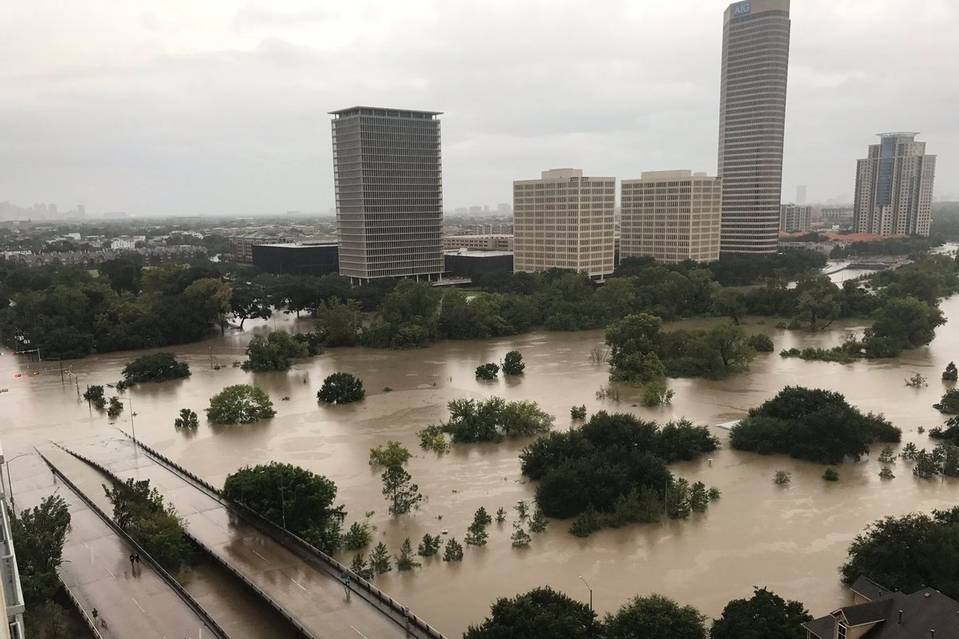
Over the past decade, Houston has seen a population boom since the Great Recession. While the rest of the country struggled Houston thrived and expanded almost 22 percent over the period thanks to triple digit oil prices. A construction boom inside Houston’s inner loop, historically a place most Houstonians avoided, took root. To the point, developers could not build fast enough for the population influx coming in from around the country. In the process though some serious infrastructure problems have started to arise. Houston was already notorious for flooding, now as developers took lots where once a single-family residence stood and put three to four townhouses on them, green space drastically reduced and the notorious flooding has become even worse with water having virtually nowhere to go. Enter, Harvey.

To be fair, Harvey is an unusual beast of spectacular fashion, although Irma may prove to be the start of a trend. Somewhere between 10-15 trillion gallons are what is expected to have dropped into the city of Houston after Hurricane and Tropical Storm Harvey was done. It is an unprecedented event for the fourth-largest city in the United States. To put it in perspective, imagine the entire state of Delaware which is comparable to Greater Houston’s almost 2300 square miles of geography, with six times the population being submerged under water. Greater Houston’s population is well over six million and the last time a mass evacuation was tried twelve years ago, more people died in the evacuation than in the actual storm. It would likely require Houston a week or two to have a calm organized evacuation that did not overwhelm the city and state’s highways and roads. And perhaps at this point, trying to evacuate people is just the wrong idea. There are so many logistical and socioeconomic problems with trying to do so, all one needs is to look back on Hurricane Katrina for a reality check of why it is nearly impossible to do so.

So how can a city like Houston and others learns from the lessons of Harvey? Often times, what we need is right in front of our face. In the case of Harvey, the case is no different. Having to drive throughout the city during the storm where virtually every business was closed something striking occurred to me. Office buildings that were over ten stories were ghost ships, while most shelters are assigned to schools and churches that are usually no more than two stories. The office building ghost ships,  that is to say that there was absolutely no one in them are an untapped asset in the city’s emergency infrastructure. As of 2015, Houston had 50 office buildings under construction totaling almost 18 million square feet of space. The locations of these buildings are widespread like Houston covering areas like downtown, the Energy Corridor/West Houston, the Woodlands (north), and others around the city creating a virtual net of buildings that if properly prepared with their owners could have been used at emergency shelters far above the flooding waters and much shorter distances to travel for Houstonians than what was comprised. The city’s major convention center, George R. Brown Center, was turned into the central hub of evacuation. Unfortunately, Houston’s geography is expansive. The city at its widest points can easily take almost two hours to get to the city center by car when traffic is not impaired. Couple that with low storied churches and schools and it is easy to see why office buildings which are more plentiful throughout the city could be a vital addition to emergency planning. What obstacles could be holding them back?

I suspect three main issues. One, the city’s planning department would need to ensure future buildings include potential emergency use in the developer’s plans. It would also require these buildings, their owners, and their tenants to be part of any emergency planning committee that would go into action should it be required. Almost the equivalent of a volunteer emergency force. Second, the additional cost that could be associated with fitting current and future buildings for such a task must be shouldered somehow. These costs that could certainly be offset by favorable tax credits for a period of time, municipal subsidizing, etc. The third issue would be security of sensitive information. I can not stress how vital this would be in considering which office buildings to consider given the sensitivity of identity theft both on a individual and institutional level. Again, all three of these things are logistical things that can be handled accordingly.

Every time we think we have seen the worst that Mother Nature has to throw at us, the ante seems to be upped just a little (or lot) more. We are continuing to change the dynamics by which we interact with our environment and in turn how the environment interacts with us. The burden of just how we handle future stresses that the natural disasters may pose will take a more broad minded and efficient strategy than what we currently use. Moving and evacuating large bodies of people will only get less and less likely in cities where density is increasing. One of the key to taking on a lot of weight is to spread out the weight so that it is properly balanced. The same goes for cities when it comes to disasters.