Monthly Archives: July 2025

Ohio’s Unclaimed Billions Could Empower Central State and Wilberforce Instead of Enriching the NFL

You can’t have political power unless you have economic power. You can’t have economic power unless you own something. — Dr. Claud Anderson

In the quiet towns of Wilberforce, Ohio, two institutions — Central State University and Wilberforce University — have stood for generations as monuments of African American intellectual resilience and historical fortitude. Founded in eras when the very idea of African American higher education was radical, both institutions have graduated engineers, entrepreneurs, theologians, and teachers who seeded entire Black communities with knowledge and leadership. Yet, in 2025, they remain financially fragile — their endowments barely grazing the thresholds needed for robust institutional health.

Meanwhile, Governor Mike DeWine just approved $600 million in state funds — sourced from Ohio’s $4.8 billion in unclaimed assets — to support the Cleveland Browns’ new domed stadium in Brook Park, an NFL franchise owned by billionaires. The Haslam Sports Group, the Browns’ owners, is contributing an additional $1.2 billion to the project, and Cuyahoga County is expected to round out the financing with another $600 million. The stadium, estimated at $2.4 billion, is framed as a jobs and tourism engine — the typical rationale for professional sports subsidies. But beneath the surface lies a deeply racialized economic pattern: Black bodies as capital, Black institutions as afterthoughts.

Let us state this plainly — $200 million in endowment funding (split between Central State and Wilberforce University) would account for just 4.17% of the $4.8 billion in unclaimed assets Ohio plans to repurpose. Yet it would transform the future of two of America’s most storied HBCUs, whose total combined endowments likely do not reach even $20 million today.

The $200 Million That Could Rebuild Black Educational Futures

An endowment is the economic engine of institutional independence. It enables faculty hiring, scholarships, research labs, infrastructure repair, and the kind of multi-generational planning that insulates a university from the unpredictable winds of politics and philanthropy.

  • Central State University, Ohio’s only public HBCU, receives state support — but suffers from persistent underfunding compared to Ohio’s predominantly white public institutions.
  • Wilberforce University, a private HBCU affiliated with the African Methodist Episcopal Church and the first college owned and operated by African Americans, has been in survival mode for decades, enduring accreditation threats and enrollment declines — largely due to chronic financial starvation.

A $100 million endowment per institution, conservatively managed with a 5% annual drawdown, would provide each HBCU with $5 million per year in perpetuity. That’s enough to:

  • Offer full-ride scholarships to dozens, if not hundreds, of students.
  • Endow faculty chairs in business, STEM, and African American studies.
  • Fund campus maintenance and restoration for aging facilities.
  • Launch centers focused on African American policy, agriculture, or entrepreneurship.
  • Reduce reliance on tuition and thus open doors to more low-income students.

In short, it would empower these institutions to build, not just survive.

Meanwhile, the Billionaire NFL Franchise Gets a Taxpayer Bailout

The Cleveland Browns’ new stadium is not just an economic development plan — it’s a public-funded monument to private wealth. Let us remember: The NFL is a tax-exempt cartel whose franchises are operated by billionaires and whose profits — through broadcast rights, luxury boxes, and merchandise — soar year after year.

The public rationale for subsidizing stadiums is that they will generate jobs, tourism, and long-term economic vitality. Yet, study after study from economists across ideological spectrums consistently shows that these promises are overstated or entirely unfounded. Most NFL stadiums create a short-term construction boom, followed by long-term debt and opportunity costs.

But perhaps more galling is this: the economic lifeblood of the NFL is disproportionately Black men. While roughly 13% of the U.S. population is Black, nearly 60% of NFL players are African American. These players, often trained in underfunded high schools, many from single-parent households and first-generation college trajectories, generate billions — yet the communities and institutions from which they originate remain underdeveloped and neglected.

It is a grotesque inversion: Black talent builds white wealth, while Black institutions remain marginal.

Black Athletes, White Wealth, and the Poverty of Institutional Ownership

The NFL, and by extension the Cleveland Browns, benefits from a system where the labor is Black, but the ownership is almost entirely white. Out of 32 NFL teams, only one have non-white principal owners: Shahid Khan, a Pakistani-American who owns the Jacksonville Jaguars.

Meanwhile, no HBCU alum holds equity in any major professional sports franchise, despite HBCUs being core contributors to the American athletic pipeline that fuels leagues like the NFL and NBA.

Despite producing generations of elite athletes, coaches, and sports executives, no collective of HBCU alumni has leveraged its wealth or influence to acquire equity in a major professional sports franchise, leaving the economic rewards of Black athletic labor concentrated elsewhere.

Imagine a model where Ohio had used even half of the $600 million to create a Black Education & Sports Endowment, partially controlled by a consortium of HBCUs, Black public schools, and community development organizations. The returns from that endowment could support thousands of students, community health centers, literacy programs, and STEM labs for generations.

Instead, we see yet another example of extractive economics, where African American physical, cultural, and intellectual capital is used to build empires for others, while Black institutions — including HBCUs — remain dependent on begging, philanthropy, and hope.

Why Unclaimed Funds Should Serve The Forgotten

Ohio’s decision to redirect $1.7 billion in unclaimed funds to cover state expenditures is fiscally creative — but morally questionable. These are not “free” funds. They are monies left in dormant bank accounts, uncashed checks, unclaimed insurance payouts — many of which disproportionately belong to low-income individuals who lacked the resources or knowledge to retrieve them.

Data suggests that Black Americans are disproportionately represented among unclaimed property holders — in part due to higher levels of economic displacement, address changes, and financial exclusion. Redirecting these funds to subsidize an NFL franchise, instead of redressing the institutional and educational gaps that created that unclaimed status, is a betrayal.

Ohio could have:

  • Created a permanent Black Higher Education Trust, benefiting Central State and Wilberforce.
  • Used 5% of unclaimed funds — about $240 million — to fund Black-led public health initiatives in underserved areas.
  • Directed even 1% of those funds — roughly $48 million — to finance land acquisition and economic development for Black-owned businesses.

Instead, we’ve chosen to rescue billionaires from spending their own money.

HBCU Endowments Are An Economic Empowerment Issue — And the Gateway to Political Power

Endowments are more than just financial assets. They are strategic tools of power — insulating institutions from political winds, enabling bold experimentation, and giving their stakeholders the leverage to influence policy, not just plead for it.

For African America, the chronic undercapitalization of HBCUs is not merely a funding gap — it is an economic power vacuum that undercuts the entire community’s ability to advocate effectively for systemic redress.

While Williams College and Bowdoin College — small liberal arts schools with fewer than 2,500 students — boast endowments of $3.7 billion and $2.58 billion respectively, many HBCUs operate with endowments under $50 million, and some under $10 million. This discrepancy is not accidental. It is the compounding result of centuries of exclusion from generational wealth accumulation, philanthropic networks, and public investment.

Until African American institutions — especially HBCUs — are armed with independent and sizable capital, they will remain vulnerable to the whims of legislatures, accreditation bodies, and philanthropic trends. Worse, they will lack the institutional might to challenge inequity in courtrooms, boardrooms, and ballot boxes.

The fight for reparations, education equity, health justice, and fair housing requires leverage — and leverage requires capital. Political power without economic power is temporary and transactional. But economic power institutionalized through endowments can translate into permanent seats at the table, not just access to it.

Endowing HBCUs, then, is not a charitable gesture. It is a foundational strategy for African American sovereignty and redress. Without institutions that are capable of outlasting election cycles and media trends, African America will continue fighting uphill with borrowed tools and limited voice.

Ohio had a chance to fund that future. Instead, it chose to subsidize a stadium — once again reminding us: until we build our own institutions, we will always be asked to cheer from the stands while others profit from our play.merican educational infrastructure for the next 100 years. Instead, he invested in a stadium with a 20-year shelf life.

Choose the Future You Fund

In 2029, a new domed stadium will open in Brook Park. It will gleam with LED lights and imported steel. It will be filled with cheering fans on Sundays and concerts on Saturdays. The Browns may even win a playoff game or two.

But just 50 miles away, on the campuses of Wilberforce and Central State, students will still walk cracked sidewalks. Professors will still work on contracts. Students will still withdraw for financial reasons.

Unless Ohio chooses to invest in the institutions that nurture and protect Black futures, those futures will continue to be harvested but never planted.

This is not just about football. It is about the future of Black Ohio. And whether our institutions will ever be allowed to rise beyond survival — and into sovereignty.

Disclaimer: This article was assisted by ChatGPT.

The American Brain Drain: Could the Next Superpower Rise from U.S. Talent Exodus?

“Talent wins games, but teamwork and intelligence wins championships.” – Michael Jordan

America’s diversity leaving Ellis Island. (AI)

The 20th century bore witness to a dramatic shift in global power as the United States cemented its status as the world’s foremost superpower. A pivotal contributor to this ascent was the influx of foreign intellectual capital—most notably following World War II, when a cadre of German scientists, engineers, and thinkers were transplanted to American soil under Operation Paperclip. Today, history may be rhyming: a quiet but consequential outflow of talented Americans is underway, and it may herald the ascent of a new global power.

Paperclip’s Precedent

America’s victory in the Cold War owed much to borrowed brilliance. Operation Paperclip, a covert government initiative, spirited more than 1,600 German technologists across the Atlantic. Among them was Wernher von Braun, whose pioneering work in rocketry helped put a man on the moon. The absorption of such expertise turbocharged America’s scientific and military prowess, transforming it into an unrivalled innovator on the global stage.

This historical lesson is instructive: when knowledge migrates, power often follows. Should today’s American émigrés find fertile ground elsewhere, the implications could be similarly seismic.

Why the Exodus?

More Americans, particularly the skilled and educated, are eyeing exits. The motivations are myriad:

  1. Living Costs and Economic Pressures – Astronomical housing prices, stagnating real wages, and an eroding middle class are prompting professionals to seek prosperity elsewhere. Countries like Canada, Germany and Portugal combine affordability with opportunity.
  2. Fractured Politics – Deepening partisanship, institutional paralysis, and cultural polarization—exacerbated by the MAGA movement—have left many disillusioned with America’s trajectory.
  3. Healthcare and Wellbeing – The United States remains the only wealthy nation without universal healthcare. By contrast, expatriates praise the peace of mind afforded by European and Asian systems.
  4. Remote Work’s Liberation – The pandemic redefined where work happens. For many, the logic of staying tethered to a high-cost, high-stress American city has evaporated.
  5. Emerging Market Allure – Some are lured by dynamism abroad. Nations once considered periphery are now innovation hubs. The pull is not only economic but aspirational.

Contenders for the Crown

Which nations might inherit America’s intellectual capital—and potentially its mantle? Only a handful, those with welcoming immigration regimes and ambitious national strategies, are poised to benefit.

Canada

Long the polite alternative to its southern neighbour, Canada is quietly absorbing talent at scale. Toronto and Vancouver, buoyed by tech booms and liberal visa policies, have become sanctuaries for America’s disaffected coders, scientists, and entrepreneurs.

Germany

As the EU’s economic engine, Germany combines formidable infrastructure with a commitment to industrial leadership. Berlin’s start-up scene and Bavaria’s engineering prowess offer rich pickings for those with ambition.

Portugal

Once peripheral, Portugal now leads in lifestyle migration. The Golden Visa scheme, coupled with a burgeoning tech ecosystem in Lisbon and Porto, makes it an attractive landing spot for digital nomads and founders alike.

Australia

Far-flung but forward-looking, Australia blends quality of life with economic resilience. Melbourne and Sydney are magnets for talent, helped by pathways to permanent residency.

Singapore

The Lion City is capitalism distilled: efficient, safe, and strategically situated. Its government aggressively courts foreign expertise, and its tech, finance, and logistics sectors are world-class. Few places convert brainpower into GDP as ruthlessly.

Ghana

Perhaps the most surprising contender, Ghana has recast itself as a Pan-African beacon. Through initiatives like the “Year of Return” and incentives for diaspora entrepreneurs, it is reversing the historical brain drain. With growing tech and finance sectors and remarkable political stability, Accra may become a nucleus for Black global talent.

HBCUs Look to Africa

Among the emigrants are graduates of America’s Historically Black Colleges and Universities (HBCUs). These institutions, long ignored in the mainstream, are now exporting a new vanguard of Black intellectuals and professionals.

In nations like Ghana, Nigeria, and Rwanda, HBCU alumni are finding not only economic opportunity but also cultural affirmation. Business-friendly policies, grants of land, and dual citizenship are part of the welcome mat. Crucially, these professionals are not just seeking refuge—they are shaping the future of African innovation.

Africa’s universities and research institutions are likewise tapping into this talent pipeline. Joint ventures, think tanks, and faculty exchanges hint at a new Pan-African intellectual economy—one rooted in both heritage and ambition.

America’s Loss

What happens when a country loses its best minds?

  1. Innovation Decays – Fewer patent filings, less scientific output, and diminished R&D. The United States risks ceding supremacy in emerging fields like AI, biotech, and clean energy.
  2. Economic Hollowing – Entrepreneurs take jobs and capital with them. Venture funding flows to where start-ups congregate.
  3. Soft Power Slips – America’s influence derives not just from military might but from cultural prestige and intellectual leadership. An exodus of thinkers imperils both.
  4. Strategic Risk – Just as the U.S. turned German rocket science into military advantage, others may now do the same with American AI or biotech expertise.

Can the Tide Be Turned?

Reversing this trend requires boldness:

  • Healthcare Reform – Without universal care, the U.S. will continue to appear brutal and bizarre to its own citizens.
  • Education and Infrastructure Investment – STEM pipelines and next-gen transit systems can rekindle optimism.
  • Immigration Overhaul – Welcoming the world’s best talent, while retaining its own, should be a bipartisan imperative.
  • Depolarisation – A republic in perpetual gridlock cannot inspire confidence.

A New Centre of Gravity?

Brain drain is not new. But in an age where ideas, not armies, shape empires, its impact is profound. If America does not reckon with its internal contradictions, it may soon find that the next superpower was made in America—by Americans—somewhere else.

Disclaimer: This article was assisted by ChatGPT.

From Classrooms to Cleanrooms: What HBCUs Must Do to Compete with PWIs in Deep Tech and Semiconductor Innovation

“A lot of kids growing up today aren’t told that you can be whatever you want to be. I am living proof you can do that. If you have the talent and the passion, you can build the future.” – Mark Dean, Black IBM engineer and inventor who co-created the personal computer and holds three of IBM’s original nine PC patents

In late June 2025, HEXAspec—a Rice University spinout—captured a $500,000 National Science Foundation (NSF) Partnership for Innovation grant for its breakthrough work in thermal management for GPUs. In a tech world grappling with the environmental and efficiency challenges of artificial intelligence (AI) and high-performance computing, the achievement turned heads across academic, investment, and scientific communities alike. Yet amid the applause lies a hard truth: not one HBCU was remotely close to competing for that same prize. Not because HBCUs lack talent, but because they lack the systemic infrastructure to harvest, incubate, and capitalize on that talent.

The chasm between HBCUs and predominantly white institutions (PWIs) in deep tech commercialization is as wide as it is worrisome. Deep tech—defined by transformative innovation in areas like semiconductors, quantum computing, and climate technology—requires long-term capital, robust research infrastructure, and high-trust, high-dollar partnerships with government and industry. These are precisely the things HBCUs have historically been denied or underinvested in. The question now is not whether HBCUs can catch up—but whether they will prioritize institutional shifts necessary to stop losing by default.

The Innovation Economy: The New Gateway to Power

Today’s innovation economy is no longer driven by consumer startups hawking mobile apps. Instead, it is being shaped by semiconductors, AI infrastructure, clean energy technologies, and advanced materials. These domains form the core of what the Department of Commerce calls “national critical capabilities”—a short list of sectors that will dictate U.S. competitiveness in the coming century.

The federal government, through the CHIPS and Science Act, the Inflation Reduction Act, and NSF initiatives like the Engines program, has made clear where it will direct its attention—and money. However, most of that funding has flowed to elite PWIs like MIT, Stanford, and Rice. Why? Because those institutions have built systems that convert faculty research into startups, license technologies to Fortune 500 companies, and aggressively pursue government grants through dedicated offices with seasoned staff and alumni connections.

HBCUs, by contrast, often find themselves trapped in subsistence mode—juggling shrinking state funding, donor droughts, and outdated infrastructure. Even when they do produce brilliant scientists and engineers, they are often siphoned off by PWIs, venture capital firms, or federal labs where their IP contributions enrich other institutions.

The goal for HBCUs is not just to get a slice of the pie—it is to own the bakery.

Why HBCUs Are Losing in Deep Tech (And How To Fix It)

1. No Institutionalized Commercialization Pathways

Rice University’s HEXAspec didn’t win a grant because of luck. It emerged from the university’s Liu Idea Lab for Innovation and Entrepreneurship (Lilie), which exists solely to help faculty and students translate research into viable companies. Most HBCUs do not have such a lab—or even a dedicated Office of Technology Transfer.

To compete, HBCUs must institutionalize commercialization in their mission. This means establishing:

  • Internal seed funding mechanisms for promising research
  • Technology transfer offices with experienced patent lawyers and startup advisors
  • Accelerator programs targeting deep tech verticals
  • Alumni angel networks to fund spinouts

Without these, ideas will remain trapped in the lab—and the economic fruits will go elsewhere.

2. Lack of Research Infrastructure in Key Industries

Semiconductors, materials science, and energy storage require state-of-the-art labs, cleanrooms, and expensive machinery. These are multi-million-dollar commitments most HBCUs currently lack. But waiting for philanthropy or state generosity to fund them is a losing strategy.

Instead, HBCUs should pursue regional consortia to co-own such infrastructure. For example, a Deep South Semiconductor Consortium could bring together Jackson State, Tuskegee, Southern University, and Prairie View A&M to jointly invest in fabrication labs, wafer testing facilities, and AI research clusters. Land-grant HBCUs have both the land and the federal designation to attract such funding—if they are organized and bold.

3. Underleveraged Alumni Networks

MIT alumni fund startups before most even have a name. At HBCUs, alumni often wait for a call to contribute to scholarships or athletic departments. There is little systemic cultivation of alumni as early-stage investors, strategic partners, or board members in research spinouts.

This must change. Institutions like Howard, Morehouse, and NC A&T should be grooming alumni with industry experience to invest in campus spinouts. HBCU endowments should allocate a small percentage to internal venture capital—seeding their own companies instead of investing in white-led VC funds that ignore Black founders.

4. Faculty Incentives and Sabbaticals

Many HBCU faculty juggle overwhelming teaching loads, with little time or incentive for research commercialization. Unlike PWIs, where professors routinely take sabbaticals to commercialize research or sit on startup boards, HBCUs rarely support such flexibility.

Presidents and provosts must restructure faculty contracts to reward commercialization, encourage patent filings, and support teaching reductions for faculty leading deep tech ventures. Faculty must become institutional entrepreneurs, not just employees.

Federal Funding Alone Won’t Save Us

Yes, HBCUs have been historically underfunded. Yes, they face structural racism. But federal funding, when it comes, should meet us halfway—not pull us from the basement. Competing for NSF grants requires grant writers, internal review committees, and aggressive outreach. When Rice University wins NSF money, it’s because the institution has a playbook.

HBCUs need a playbook. The White House’s Initiative on HBCUs can fund technical assistance centers focused on grant acquisition, proposal design, and intellectual property strategy. These centers should live at HBCUs, not just be managed by consulting firms and retired PWI administrators with no stake in HBCU sovereignty.

Deep Tech is a Strategic Asset. HBCUs Must Treat it as Such.

In 2025, global supply chains are being rewritten. Semiconductor control is no longer just an industry issue—it is national security. Nations are forming tech alliances. Cities are building innovation districts. And investors are backing companies with decade-long R&D timelines because the rewards are generational.

HBCUs must enter this arena with the same clarity and urgency as any geopolitical actor. The institutions that helped engineer Black America’s ascent during segregation must now help engineer Black America’s role in the Fourth Industrial Revolution. That means going far beyond DEI rhetoric and focusing on institutional capital, not just human capital.

What a Competitive HBCU Ecosystem Could Look Like

Imagine this:

  • Howard University launches a Deep Tech Lab with funding from Black-led venture capital firms.
  • NC A&T, already a top producer of Black engineers, builds a quantum computing facility co-owned with MIT Lincoln Lab, with graduates flowing into DARPA-backed projects.
  • Fisk University, with its elite physics tradition, leads a semiconductor materials initiative funded through an HBCU Engines grant from NSF.
  • HBCU United, a new consortium of 30 HBCUs, pools $100M in alumni capital to invest in research commercialization, faculty sabbaticals, and patent acquisition.

This is not fantasy. It is simply the result of what happens when HBCUs start behaving like institutions of power—not institutions asking for inclusion.

Compete or Be Colonized (Again)

The innovation economy is not just about startups and science. It is about who will own the 21st century. If HBCUs do not build internal capacity to compete in the deep tech space, they will become labor farms—training brilliant Black minds who will go on to build white wealth.

Rice University’s HEXAspec is a signal — and a threat. It tells us what’s possible. The question is whether HBCUs will treat it as a wake-up call or another missed opportunity.

In the words of Frederick Douglass, “Power concedes nothing without a demand.” It’s time HBCUs demand more—of themselves and of the systems they are meant to challenge. The lab coats may be new, but the game remains the same: compete, or be colonized.

Disclaimer: This article was assisted by ChatGPT.

African America’s June 2025 Jobs Report – 6.8%

Overall Unemployment: 4.1%

African America: 6.8%

Latino America: 4.8%

European America: 3.6%

Asian America: 3.5%

Analysis: European Americans’ unemployment rate has remained steady for four straight months with virtually no change in unemployment rate. Asian Americans decreased 10 basis points and Latino Americans decreased 30 basis points from May, respectively. African America’s unemployment rate increased by 80 basis points from May.

AFRICAN AMERICAN EMPLOYMENT REVIEW

AFRICAN AMERICAN MEN: 

Unemployment Rate – 6.9%

Participation Rate – 68.8%

Employed – 9,752,000

Unemployed – 721,000

African American Men (AAM) saw a increase in their unemployment rate by 170 basis points in June. The group had a mild rebound in their participation rate in June by 30 basis points. African American Men lost 117,000 jobs in June and saw their number of unemployed increase by 181,000.

AFRICAN AMERICAN WOMEN: 

Unemployment Rate – 5.8%

Participation Rate – 60.9%

Employed – 10,248,000

Unemployed – 634,000

African American Women saw a decrease in their unemployment rate by 40 basis points in June. The group decreased their participation rate in June by 80 basis points. African American Women lost 84,000 jobs in June and saw their number of unemployed decrease by 50,000.

AFRICAN AMERICAN TEENAGERS:

Unemployment Rate – 19.2%

Participation Rate – 30.0%

Employed – 651,000

Unemployed – 155,000

African American Teenagers unemployment rate increased by 480 basis points. The group saw their participation rate increased by 210 basis points in June. African American Teenagers added 10,000 jobs in May and saw their number of unemployed also decrease 41,000.

African American Men-Women Job Gap: African American Women currently have 496,000 more jobs than African American Men in June. This is an increase from 463,000 in May.

CONCLUSION: The overall economy added 147,000 jobs in June while African America lost 193,000 jobs. From CNN, “It is becoming harder for Americans to find work: The average duration of unemployment rose from 21.8 weeks to 23 weeks, and the share of unemployed workers who have been out of a job for 27 weeks or longer rose to 23.3%, edging closer to a three-year high. Trump’s tariffs — and the dizzying back and forth on implementing them and pausing them — has caused many businesses to stall major decision-making or spending, including hiring.”

Source: Bureau of Labor Statistics

No, Your (Black) Parents Are Never Giving You Your Birth Certificate

“History is not everything, but it is a starting point. History is a clock that people use to tell their political and cultural time of day.” – Dr. John H. Clarke

“I am 32 years old. I am married. I just had a baby. I called my parents for my birth certificate… these people gave me a photocopy.” — J.J. McAvoy

Cue the collective Black laughter that says, “Yeah… that tracks.”

For many African Americans—and children of Black immigrants—this scenario isn’t just relatable. It’s practically law. There exists in our households an unwritten yet universally enforced mandate: You do not own your documents. Your parents do. Whether you’re 12, 22, or 42, asking for your birth certificate is like requesting access to national security archives—at best, you’ll get a heavily redacted photocopy; at worst, a reminder that “they’re in a safe place” and no further information will be disclosed.

Yet what begins as a meme-worthy moment veiled in humor reveals something deeper—intergenerational trauma, immigration anxieties, institutional distrust, and the invisible threads of caretaking and control that define Black familial life.

Birth Certificates, Blackness, and Bureaucracy

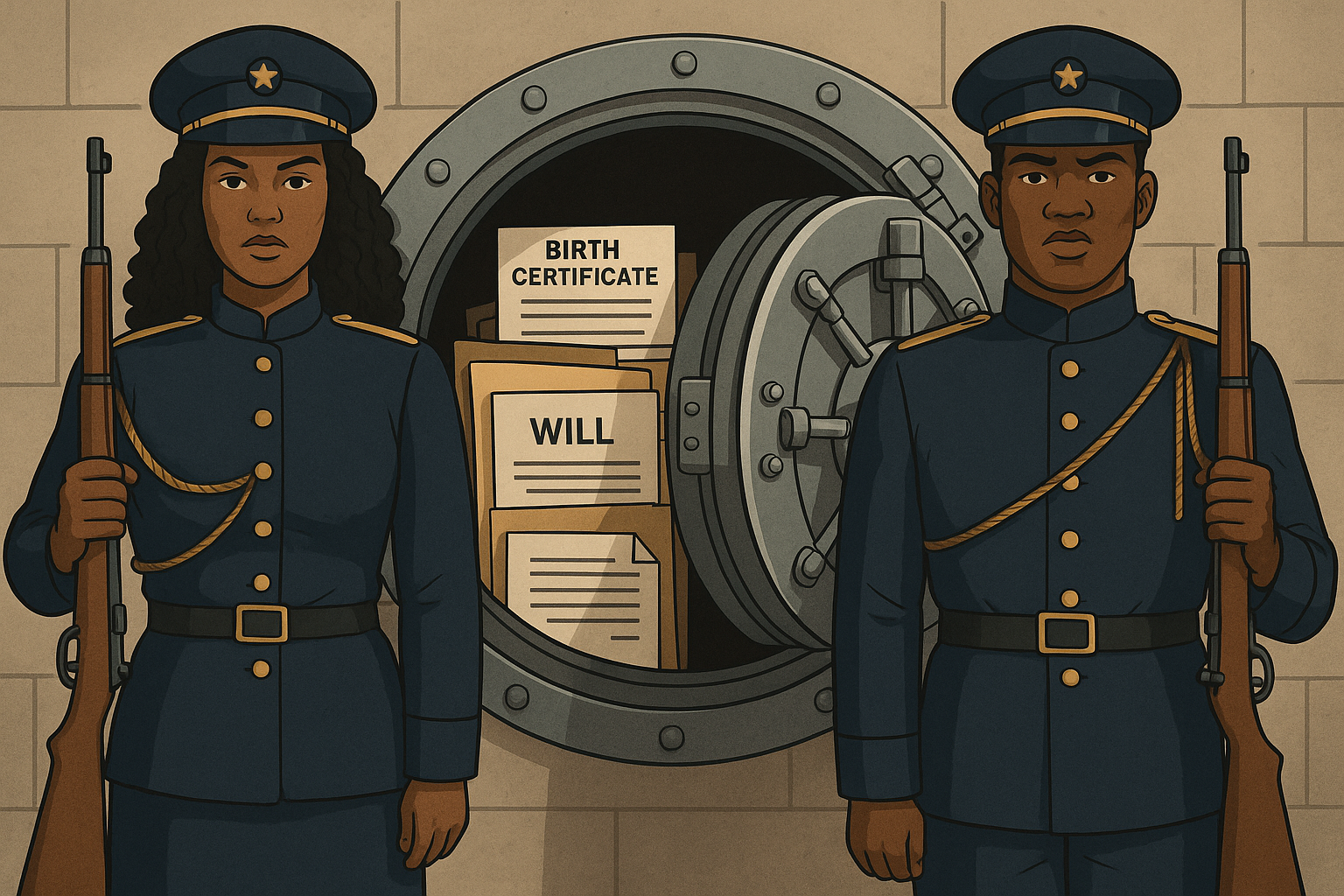
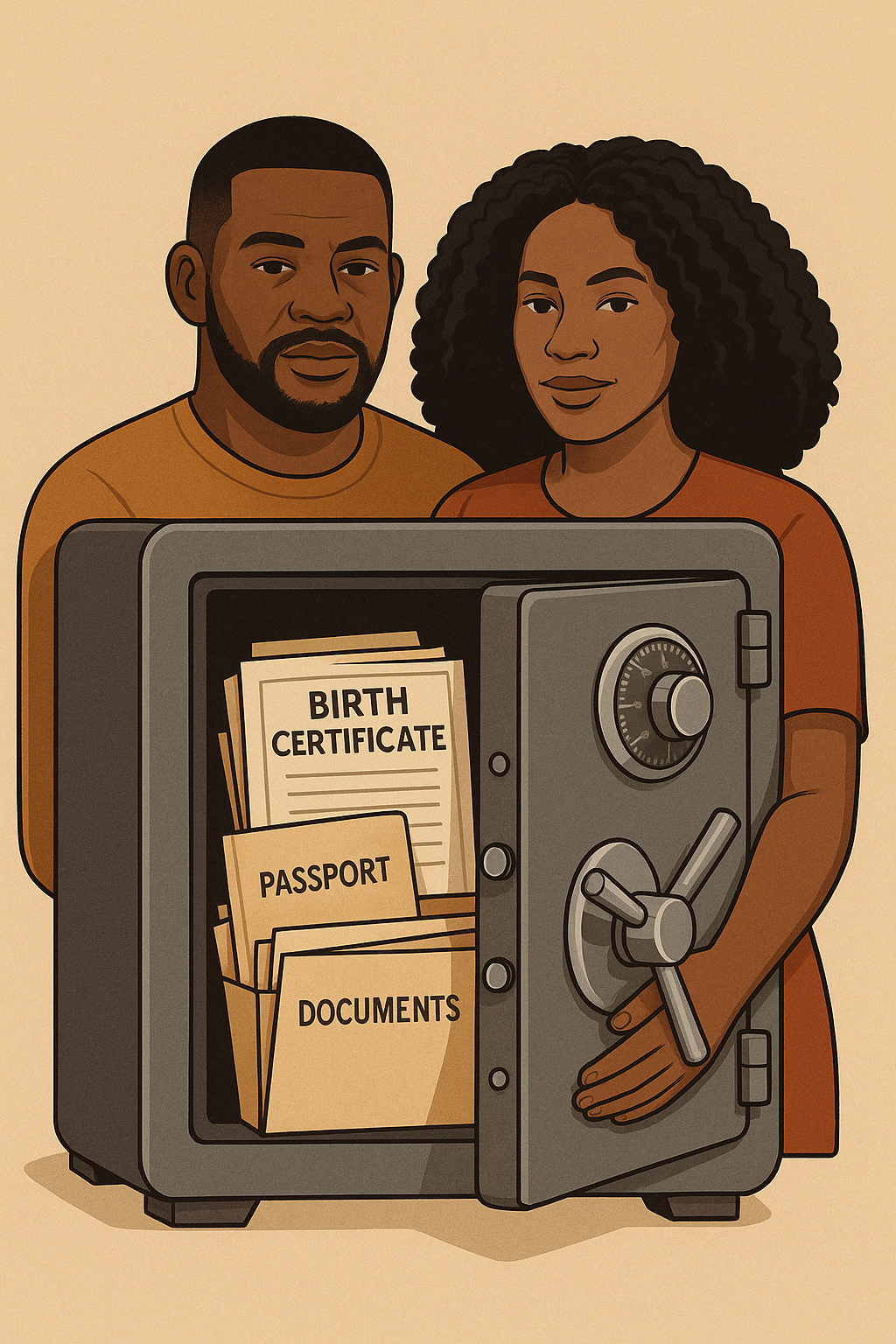
Black people in America—and Black immigrants especially—understand the stakes of documentation in ways others simply don’t. It’s not just paper. It’s protection. It’s legitimacy. It’s survival. From the days of freedmen who needed freedom papers to prove they weren’t property, to Caribbean and African immigrants who were taught by necessity to file away every school record, immunization report, and ID in a manila envelope the size of a novel manuscript—documents are currency. And parents? They’re the vault.

HBCUs have long understood this dynamic, too. Campus move-in days often feature parents armed with accordion folders bulging with immunization forms, financial aid papers, and—yes—original birth certificates that will never see a dorm room drawer. Even at 18, as a student legally responsible for yourself, the assumption is clear: your documentation stays in the family archives unless and until it’s needed. And only your parents decide what constitutes “needed.”

The (Unspoken) Reasons Why

So why don’t our parents just hand it over?

1. Institutional Distrust:
Historically, Black people have had good reason to distrust American institutions. From stolen land deeds to denied voter registrations to medical exploitation like the Tuskegee Study, paperwork—or the lack thereof—has been used as both sword and shield. Birth certificates especially were once used to deny African Americans social services, employment, and even their very existence in the eyes of the state.

Holding onto that paper is, in some ways, holding onto power.

2. Immigration Mentality:
Immigrant parents—particularly from African, Caribbean, and Latinx backgrounds—often operate under the logic that documentation must be preserved, not just for legal reasons, but because replacement is not guaranteed. Many come from countries where losing a document meant spending days in government offices, or worse, being permanently excluded from education or employment. The habit of over-documenting is one born from necessity, not paranoia.

3. Generational Control:
Let’s be honest—sometimes, it’s a control thing. Documents are a symbol of adulthood, of autonomy. But in many Black families, adulthood is earned, not merely reached by age. Holding onto your birth certificate is just one more way to remind you that your elders are still in charge. Even if you have a spouse, a job, a mortgage, and a child of your own.

4. Sentimentalism & Safeguarding:
There’s also a layer of emotional preservation at play. For some parents, especially mothers, the birth certificate is a living memory. The hospital receipt, the baby bracelet, the inked footprints—these items are sacred. Giving them to you feels like giving away a piece of your infancy they’ve guarded like treasure.

A Cultural Running Joke… But Also a Warning

On Black Twitter, TikTok, and Instagram, stories like jjmcavoy’s are met with likes, laughs, and a flood of similar testimonies:

  • “I’m 38 and my mom just mailed me my baby teeth, but not my social security card.”
  • “My dad keeps the birth certificates in the Bible. You’ll never find them.”
  • “I asked my aunt for my birth certificate once. She said, ‘For what? You tryna run away?’”

These shared experiences are part of the Black collective memory—and they help build community through humor. But embedded in that comedy is a stark lesson: we don’t always feel safe in the system, so we create our own.

In Black America, documentation isn’t just paperwork—it’s protection. And when trust in state infrastructure is low, your parents become your bureaucratic buffer. They don’t trust “the system” to have your back, so they keep it all—just in case.

HBCUs and Documentation Culture

Within the context of HBCUs, this culture plays out in subtle but impactful ways.

Admissions Counselors at HBCUs are often more patient and understanding when a student says, “My mom has that,” in response to requests for transcripts or ID. They’ve heard it before—maybe they’ve lived it.

Financial Aid Officers are used to parents showing up to sign forms, not out of necessity, but tradition.

Registrars know that some students may not know their Social Security numbers off the top of their heads, because those numbers are still in a locked filing cabinet three states away.

This familiarity becomes a quiet advantage in navigating Black student life, especially when compared to predominantly white institutions (PWIs), where rigid adherence to individual responsibility can feel jarring.

When the System Fails, the Family Files

African American communities have long developed workarounds for systems that marginalize them. Oral histories compensate for redlined census data. Church records double as unofficial archives. Grandmothers are genealogists, tracing kinfolk across counties based on memory and letters, not legal filings.

Our parents’ refusal to give up your birth certificate is not just about withholding—it’s about preserving. Preserving your existence, your legacy, your ability to say “I am here, and I can prove it.”

Navigating the Handoff

Eventually, there comes a time when you must take ownership of your documentation. Whether it’s applying for a passport, enrolling your child in school, or—like Ms. McAvoy—giving birth to the next generation, adulthood demands paperwork. But the transition is rarely smooth.

So how do you make the leap from child to custodian?

1. Create a Formal Ask
Instead of casually requesting it, frame the conversation around responsibility. “I’m building my family file. I’d like to keep originals of all my documents for safekeeping and future planning.”

2. Offer a Digital Archive
Scan and share. Offer to digitize the family’s entire document archive as a service. You’ll likely earn enough goodwill to walk away with your originals.

3. Understand Their Fear
Recognize that their reluctance comes from love, not spite. Thank them for safeguarding you all these years—and assure them you’ll carry the baton forward.

4. Seize the Entrepreneurial Opportunity
This entire dilemma opens a major door for innovation. A Black entrepreneur could launch a culturally responsive document safekeeping and digital archiving startup designed specifically for African American families. Think of it as a cross between Dropbox, Notarize, and a legacy planning firm—infused with cultural empathy. This could include secure cloud storage, physical document lockers, and mobile apps with prompts for family milestones, estate planning, or even generational wealth transfers. Black-owned banks and credit unions are especially well-positioned to expand into this space, offering document protection services as part of their wealth-building and financial literacy programs. Imagine opening a savings account and also being offered a secure vault for your family’s vital records. In a world where trust and service matter, this is not just a business—it’s a cultural preservation mission.

Final Thought: A Legacy Worth More Than Paper

No, your Black parents are probably not going to give you your birth certificate—at least not without some emotional negotiation. And maybe, just maybe, that’s okay. Because behind their hoarding of paperwork is a story of resilience. Of protection. Of love in a world that hasn’t always treated our existence as worthy of documentation, let alone preservation.

They’ve held onto the receipts of your life because they knew someone had to.

So yes, laugh about the photocopy. Roll your eyes at the manila envelope. But when you finally get that official, embossed, gold-stamped certificate in your hands—thank them.

Because while you may just see a piece of paper, they saw proof that you mattered.

And they’ve been safeguarding that proof your whole life.

Disclaimer: This article was assisted by ChatGPT.