Tag Archives: entrepreneurship

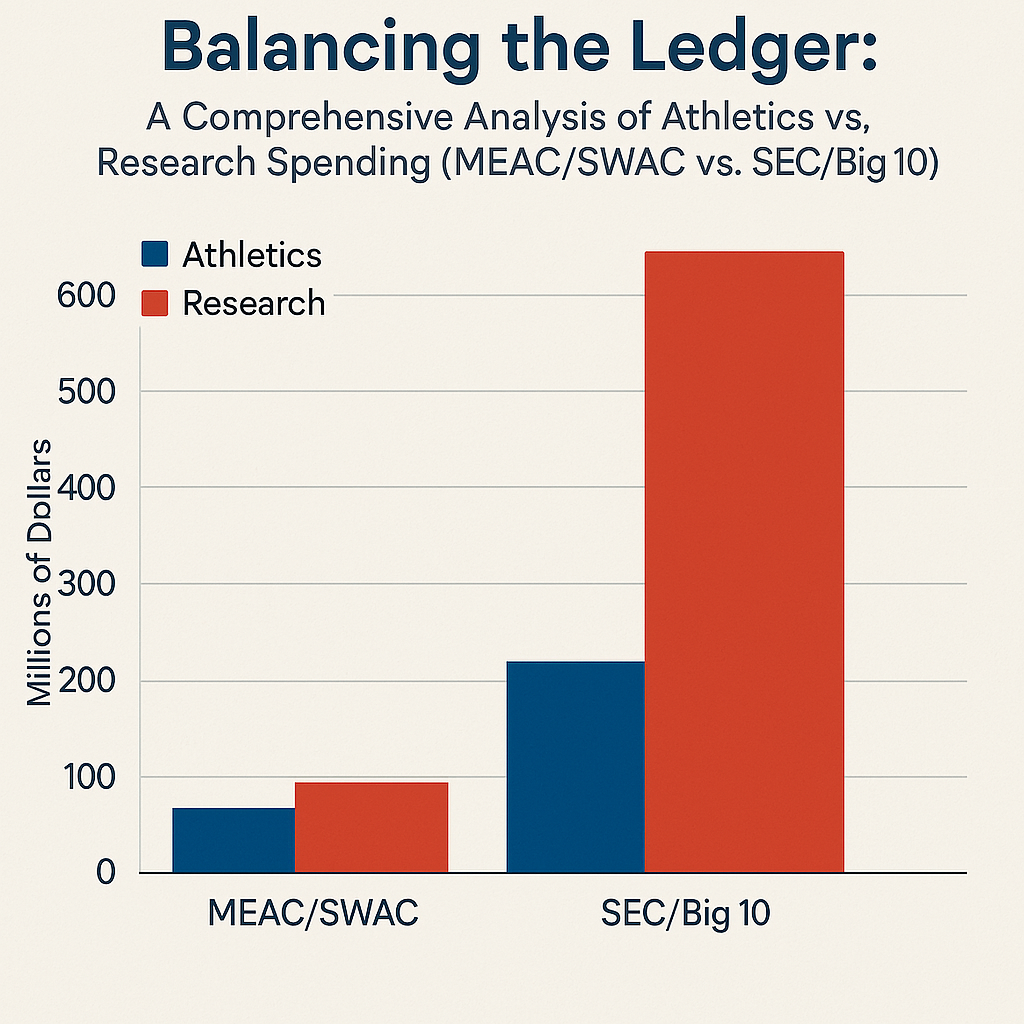
Balancing the Ledger: A Comprehensive Analysis of Athletics vs. Research Spending (MEAC/SWAC vs. SEC/Big 10)

“Since new developments are the products of a creative mind, we must therefore stimulate and encourage that type of mind in every way possible.” – George Washington Carver

In the financially stratified ecosystem of American higher education, institutions are increasingly confronted with a binary tension: to invest in athletic visibility or academic viability. For universities across the NCAA spectrum, especially those in the MEAC and SWAC conferences compared to their counterparts in the SEC and Big Ten, this decision is less about preference and more about resource constraints and strategic direction. Yet, data reveals a persistent imbalance in how these priorities manifest, and more critically, the long-term costs of these choices.

Conference Dynamics: Institutional Identity and Capital Exposure

The MEAC and SWAC are defined by institutions that are predominantly Historically Black Colleges and Universities (HBCUs). These universities have traditionally operated under capital scarcity, navigating chronic underfunding while serving as incubators of social mobility for African American communities. Their mission, often grounded in equity and community uplift, limits their ability to generate large commercial revenues through athletics. This is not due to a lack of talent or audience, but because media deals, booster contributions, and government funding disproportionately favor PWI institutions.

By contrast, the SEC and Big Ten represent the economic elite of collegiate athletics and academia. With flagship state universities at their helm, these conferences are buttressed by multi-billion-dollar endowments, large donor bases, and lucrative broadcast contracts. Their budgets allow for investments in both athletics and research without having to cannibalize one to fund the other. In essence, they play the game with more capital and fewer trade-offs.

Athletics Budgets: Symbolism vs. Strategy

MEAC and SWAC institutions report average athletics expenditures between $11 million and $12 million annually. Notable programs like North Carolina A&T and Prairie View A&M may hover slightly higher, but Mississippi Valley State and others operate on budgets as low as $3.9 million. These figures pale in comparison to SEC schools like Alabama or Texas A&M, where athletic spending exceeds $150 million. The Big Ten’s Ohio State leads all with $215 million dedicated to athletics alone.

While athletic programs at HBCUs serve as cultural centers and enrollment drivers, their limited revenue-generating capacity renders them economically unsustainable without substantial subsidization. Many are forced to divert institutional funds, raise student fees, or solicit local donations just to keep programs afloat. In contrast, SEC and Big Ten programs function as media properties, brand engines, and financial assets, often contributing revenue back to their academic institutions.

Athletics at HBCUs carry significant intangible value, cultural pride, alumni engagement, community identity, but these cannot substitute for financial sustainability. The opportunity cost of maintaining expensive athletic programs without equivalent return on investment demands strategic scrutiny.

Research Spending: The Forgotten Core

Where the real divergence occurs is in research investment. MEAC and SWAC research expenditures are overwhelmingly modest. With the exceptions of Howard University ($122 million) and Florida A&M ($41 million), most institutions sit between $2 million and $25 million in annual research activity. These figures reflect decades of underinvestment and insufficient infrastructure, not a lack of capacity or talent.

Meanwhile, SEC and Big Ten institutions routinely surpass $500 million in annual research outlays. Schools like Michigan ($1.67 billion), Wisconsin ($1.36 billion), and Penn State ($996 million) operate on a scale comparable to government agencies and national labs. They attract large NIH, NSF, and Department of Defense grants. They lead clinical trials, generate patents, and build interdisciplinary research parks.

This disparity is not simply numerical; it is strategic. Research drives federal grants, patents, corporate partnerships, and endowment growth. It also attracts high-performing faculty and students, serving as the foundation of institutional longevity and economic influence.

The Ratio That Tells the Future
The athletics-to-research spending ratio offers a lens into institutional philosophy:

  • Norfolk State: 2:1 athletics to research
  • Jackson State: 0.7:1
  • Mississippi Valley State: 6:1
  • Alabama: 0.15:1
  • Michigan: 0.11:1
  • Wisconsin: 0.11:1

While SEC and Big Ten schools spend more on athletics than HBCUs, they also spend exponentially more on research. The imbalance within HBCUs is a reflection not of poor prioritization, but of systemic capital deprivation. These ratios also underscore how HBCUs are often forced to choose between visibility and viability, between entertainment and innovation, because they lack the financial bandwidth to pursue both.

Research as Revenue: Commercialization and the Innovation Economy

University research is not merely an academic endeavor it is a gateway to commercialization. Inventions born in labs often become patents. Patents become licensing agreements. Licensing revenue, in turn, flows back into the institution. The University of Florida’s development and commercialization of Gatorade yielded more than $280 million over time. Stanford’s involvement in launching Google and Hewlett-Packard has helped fuel its $36 billion endowment. Wisconsin’s WARF fund manages $4 billion in research-derived assets.

This model is not just aspirational; it is replicable. But replication requires infrastructure, policy, and intention.

Building the Infrastructure: A Two-Track Strategy for HBCUs

Campus Infrastructure

  1. Strengthen Technology Transfer Offices (TTOs): These serve as the conversion points from research to revenue. TTOs are responsible for managing patents, evaluating commercial potential, and negotiating licensing agreements.
  2. Invest in Innovation Facilities: Makerspaces, incubators, wet labs, and data science centers can all be built in underused buildings or retrofitted spaces.
  3. Embed Commercialization in Curriculum: Courses in IP law, venture creation, product development, and ethics should be available to both undergraduates and graduate students.
  4. Create Campus Accelerators: Provide seed funding, pitch competitions, and alumni mentorship. These accelerators can be industry-specific (e.g., AgTech at Tuskegee, FinTech at Howard).
  5. Celebrate Wins: Every patent, startup, or licensing deal should be internally recognized and externally marketed. Visibility breeds validation and investment.

Capital Infrastructure

  1. Black-Owned Banks: Offer startup lines of credit and financial education embedded in innovation ecosystems. These institutions can also hold endowment funds or manage cash flow from royalty revenues.
  2. Diaspora Sovereign Wealth Funds: Channel African and Caribbean capital into HBCU startups and joint ventures. Funds like Nigeria’s NSIA or Pan-African VC firms could provide growth capital.
  3. HBCU Venture & Endowment Funds: Seeded by Black VC firms, family offices, and institutional investors. These funds can create co-investment syndicates for promising faculty or student ventures.
  4. Donor-Advised Funds (DAFs): Enable alumni to contribute to IP pipelines through tax-efficient giving. DAFs could also be matched by corporate sponsors or philanthropic partners.

Building Strategic Partnerships for Scale

HBCUs need not operate in silos. Strategic collaboration can accelerate commercialization and R&D outcomes:

  • Inter-HBCU R&D Collaboratives: Morgan State and FAMU could co-sponsor patent consortiums.
  • Cross-registration commercialization programs with PWIs like Johns Hopkins or Emory.
  • Statewide HBCU innovation districts tied to workforce pipelines and rural development.

From the Lab to the Ledger: Case Studies in ROI

  1. University of Florida – Gatorade: In the 1960s, UF researchers developed a hydration drink to help football players endure Florida’s brutal heat. The result, Gatorade, has yielded over $280 million in licensing revenue. These funds helped UF build research infrastructure, attract top scientists, and grow its endowment.
  2. Stanford University – Silicon Valley: Stanford was not always wealthy. Its proximity to innovation and its open policies toward student and faculty entrepreneurship led to the creation of Google, Cisco, and more. Today, Stanford’s alumni-founded companies generate trillions in global market value.
  3. University of Wisconsin – WARF: Established in 1925, the Wisconsin Alumni Research Foundation has monetized research in Vitamin D, stem cells, and imaging. With over $4 billion in assets, WARF reinvests in faculty, students, and commercialization pipelines.
  4. MIT – Ecosystem Builders: MIT’s Deshpande Center and The Engine Fund act as innovation pipelines that commercialize tough tech. MIT startups have created over 4.6 million jobs globally.

What HBCUs Must Avoid: Dependency Without Ownership

Too often, HBCUs have served as intellectual suppliers while other institutions and corporations reap the financial rewards. Faculty develop ideas, only for those patents to be captured by universities with larger TTOs. Students build prototypes, only to license them under incubators unaffiliated with their home campus.

To shift this paradigm, ownership must be embedded from the start. That means building institutional IP portfolios and teaching students the economics of invention.

A Circular Ecosystem Rooted in Culture and Capital

StakeholderRole in the Pipeline
Black-Owned BanksStartup capital, credit access, and embedded finance literacy
Diaspora Wealth FundsStrategic investment, global partnerships, and joint IP deals
African American NPOsStakeholder investors, endowment builders, and R&D supporters
Black Media & AlumniNarrative shaping, promotional power, and advocacy
HBCU TTOs & LeadershipPatent management, research development, and startup formation

Final Calculations: Wealth Is Institutional, Not Individual

The data from MEAC, SWAC, SEC, and Big Ten schools paints a vivid picture of the financial landscape of higher education. While SEC and Big Ten schools show that it is possible to be excellent in both athletics and academics, MEAC and SWAC institutions face tougher choices due to structural inequalities and historical underfunding.

As conversations around equity, student success, and public accountability continue, this kind of comparative data is essential. Whether aiming for a championship or a Nobel Prize, universities must remember that their ultimate mission is to educate, innovate, and uplift communities.

University research isn’t just about publications and academic prestige it’s a launchpad for innovation, economic growth, and financial sustainability. When strategically supported, it becomes a core driver of commercialization, entrepreneurship, and long-term prosperity through patents and endowment growth.

Many HBCUs and smaller institutions already are incubators of brilliance but they’ve been left out of the research-to-wealth pipeline due to underfunding and limited infrastructure. With targeted investments and smart policy, they can flip the script and become not just engines of education, but engines of innovation and wealth creation.

Disclaimer: This article was assisted by ChatGPT.

Has The Internet Become A Utility? No, But It Is Close

 Opportunity has power over all things. — Sophocles

I have constantly made the argument that just because you put someone on a nuclear submarine does not mean they will innately figure out how to pilot it. In fact, disaster is more likely to happen. Just giving someone access to information does not mean they will automatically know how to better themselves unless that portal is strictly designed to do so. However, the internet is filled with as much junk (if not more) than useful information. People will therefore gravitate to what they have learned to comprehend. There is the argument that having water in your home is better than not, but what if that water is more toxic than clean. The faucet becomes deadly, not helpful.

What is a utility? The dictionary defines a public utility as “a business enterprise, as a public-service corporation, performing an essential public service and regulated by the federal, state, or local government.”

Based on this definition, the internet does not quite fit the criteria of a public utility—at least, not yet. While the internet has certainly become an essential service in modern society, it lacks the same level of regulation and universal accessibility that defines traditional utilities like electricity, water, and gas. These utilities are tightly controlled to ensure consistency, affordability, and access for all, regardless of socioeconomic status. The internet, by contrast, is still largely managed by private corporations that set their own prices, establish service areas, and determine the quality of the connection users receive. This has led to disparities in access, with high-speed broadband readily available in affluent urban areas while rural and lower-income communities often struggle with slow or unreliable connections.

One of the biggest distinctions between the internet and traditional utilities is the role of regulation. Electricity and water services are heavily regulated because they are deemed necessary for survival and public welfare. In contrast, the internet operates in a more laissez-faire environment. While governments have attempted to introduce regulations such as net neutrality—intended to ensure equal access to all online content—these efforts have faced pushback from major telecommunications companies. The debate over whether the internet should be classified as a public utility is an ongoing one, with proponents arguing that universal access is a fundamental right in an increasingly digital world, while opponents fear overregulation could stifle innovation and increase costs.

Despite these challenges, the internet has become nearly indispensable in daily life. It is the backbone of modern communication, education, commerce, and entertainment. Job applications, telehealth services, remote work opportunities, and access to government resources all depend on a reliable internet connection. The COVID-19 pandemic underscored just how vital internet access is, as schools transitioned to online learning and businesses adopted work-from-home models. Those without reliable internet were left at a severe disadvantage, further exacerbating existing inequalities.

Another factor to consider is infrastructure. Traditional utilities operate on a centralized infrastructure model, where a single provider (often a government-regulated entity) manages distribution to all consumers. The internet, however, consists of a decentralized network of private providers, each controlling different segments of the infrastructure. While this decentralization has allowed for rapid innovation and expansion, it has also led to fragmentation, where service quality and pricing vary widely based on geographic location. In areas with limited competition, internet providers can charge high fees for subpar service, leaving consumers with little recourse.

Cost is another key element in the utility debate. Utilities like water and electricity are subject to price regulations to prevent excessive charges. The internet, however, remains largely unregulated in this regard, with broadband costs in the United States being some of the highest in the world. Many low-income households cannot afford high-speed internet, effectively locking them out of opportunities that require online access. This digital divide reinforces socioeconomic disparities, as those with consistent internet access gain educational and economic advantages over those who are disconnected.

Moreover, the quality of the internet experience is not uniform. Unlike water, which is expected to be safe to drink regardless of where you live, the internet experience varies widely based on available bandwidth, provider policies, and regional infrastructure. Some communities suffer from data caps, throttling, and unreliable service, while others enjoy ultra-fast fiber-optic connections. This inconsistency highlights another major difference between the internet and true public utilities.

If the internet were to become a public utility, significant changes would need to occur. Governments would have to step in to ensure equitable access, set fair pricing standards, and improve infrastructure in underserved areas. Public broadband initiatives, such as municipal networks, have already been proposed and implemented in some areas, offering lower-cost, high-speed options as an alternative to private ISPs. However, these efforts are often met with legal and political challenges, as existing providers fight to maintain their market dominance.

The argument that the internet should be classified as a utility stems from its necessity in modern life. Just as society determined that water, electricity, and gas are essential for a functioning household, the internet is increasingly seen as an essential service. Many believe that access to the digital world should not be a privilege but a right. However, until regulations catch up with this reality, the internet remains in a gray area—essential, but not yet universally protected and regulated like a true public utility.

To enhance the discussion on the internet’s status as a utility, it’s essential to examine the digital divide—the gap between those who have access to modern information and communication technologies and those who do not. Despite advancements in global connectivity, significant disparities persist both within the United States and worldwide.

Global Perspective

As of 2022, approximately 2.7 billion people, or one-third of the world’s population, remained without internet access. Additionally, 53% lacked access to high-speed broadband, limiting their ability to engage fully in the digital economy.

The divide is more pronounced between high-income and low-income countries. In high-income nations, internet usage stands at about 93%, whereas in low-income countries, only 27% of the population is online. This discrepancy highlights the infrastructural and economic challenges faced by developing regions in achieving digital parity.

Gender disparities also contribute to the global digital divide. Globally, 70% of men use the internet compared to 65% of women. Women account for a disproportionate share of the offline population, outnumbering male non-users by 17%. This gap underscores the need for targeted initiatives to promote digital inclusion among women.

United States Perspective

In the United States, while 95% of adults use the internet and 90% own a smartphone, only 80% have high-speed internet at home. This indicates that a significant portion of the population still lacks reliable broadband access, affecting their ability to participate fully in digital activities.

Income disparities significantly influence internet access. In 2019, 44% of adults in households earning below $30,000 annually did not have broadband services. This lack of access can hinder opportunities for education, employment, and access to essential services.

Educational attainment also plays a role in digital connectivity. Adults with higher education levels are more likely to have internet access, highlighting the intersection between education and digital inclusion.

Racial and ethnic disparities further exacerbate the digital divide. In 2021, 71% of White non-Hispanics used a PC or tablet, compared to 57% of African Americans and 54% of Hispanics. These differences can perpetuate existing inequalities in education and employment opportunities.

Implications

The digital divide has far-reaching consequences. Individuals without reliable internet access face challenges in job applications, accessing healthcare, and participating in educational opportunities. For instance, during the COVID-19 pandemic, students without home internet struggled with remote learning, exacerbating educational inequalities.

Addressing the digital divide is crucial for ensuring equitable access to information and opportunities. Potential solutions include investing in infrastructure to expand broadband access, implementing affordable internet programs, and enhancing digital literacy initiatives. Bridging this gap is essential for the internet to be considered a true utility, accessible and beneficial to all.

The digital divide—the gap between those with access to modern information and communication technologies and those without—profoundly affects various sectors, notably entrepreneurship and Historically Black Colleges and Universities (HBCUs).

Impact on Entrepreneurship

Entrepreneurs rely heavily on digital tools for marketing, sales, communication, and operations. Limited access to high-speed internet and digital technologies hampers business growth and innovation.

  • Rural Entrepreneurs: In the United States, rural small businesses face significant challenges due to inadequate broadband access. This deficiency restricts their ability to expand customer bases through online sales and reduces operational efficiencies. Research indicates that limited broadband access correlates with reduced business innovation in rural areas, as it impedes the adoption of cloud-based technologies essential for modern business operations.
  • Women Entrepreneurs in Developing Countries: The high cost of mobile data and unreliable internet connectivity disproportionately affect female entrepreneurs in developing nations. A survey across 96 countries revealed that 45% of women in business lack regular internet access due to expense and connectivity issues, hindering their capacity to market products, communicate with customers, and receive payments.
  • General Entrepreneurial Challenges: The digital divide limits access to digital finance, reducing diversified funding sources for disadvantaged groups. This constraint affects the ability to engage in open innovation processes, as individuals without access to information and communication technologies (ICT) cannot participate effectively in the digital economy.

Impact on HBCUs

Historically Black Colleges and Universities play a crucial role in providing higher education to African American communities. However, many HBCUs face challenges related to the digital divide.

  • Infrastructure Limitations: A significant number of HBCUs are located in areas with limited broadband access, often referred to as “broadband deserts.” This lack of high-speed internet hampers the institutions’ ability to offer digital learning resources and affects students’ educational experiences.
  • Funding and Resources: HBCUs have historically been underfunded, limiting their capacity to invest in necessary digital infrastructure and technology. This financial constraint exacerbates the digital divide, affecting the quality of education and the institutions’ competitiveness.
  • Digital Literacy and Inclusion: Despite these challenges, HBCUs are actively working to bridge the digital divide by fostering digital literacy and inclusivity. Initiatives include collaborative assignment designs and amplifying student voices to enhance digital learning experiences.

Efforts to Bridge the Gap

Addressing the digital divide requires concerted efforts from governments, private sectors, and educational institutions.

  • Investments in Infrastructure: Allocating funds to improve broadband infrastructure in underserved areas is crucial. For instance, federal agencies have directed significant financial support towards technology initiatives in HBCUs to enhance digital equity.
  • Public-Private Partnerships: Collaborations between corporations and educational institutions can lead to substantial improvements in digital infrastructure. Such partnerships aim to enhance technology access and digital literacy among students and the broader community.
  • Policy Initiatives: Governments can implement policies to reduce the cost of mobile data and internet services, making them more affordable for entrepreneurs and educational institutions. Such measures are vital in developing countries where the cost remains a significant barrier.

The digital divide significantly impacts entrepreneurship and HBCUs by limiting access to essential digital tools and resources. Addressing this issue is critical for fostering economic growth, innovation, and educational equity.

Ultimately, the question of whether the internet should become a utility comes down to societal priorities. If we agree that digital access is fundamental to education, employment, healthcare, and civic engagement, then steps must be taken to ensure it is available to all, regardless of income or location. This may mean rethinking current regulatory frameworks, expanding public broadband initiatives, or enforcing stricter oversight of internet service providers. Until then, the internet remains on the verge of utility status—vital, but not yet universally accessible or regulated in the way that other essential services are.

Where Is The African American MBA At HBCUs?

“I built a conglomerate and emerged the richest black man in the world in 2008 but it didn’t happen overnight. It took me 30 years to get to where I am today. Youths of today aspire to be like me but they want to achieve it overnight. It’s not going to work. To build a successful business, you must start small and dream big. In the journey of entrepreneurship, tenacity of purpose is supreme.” — Aliko Dangote

It could be argued that many HBCUs do not see themselves as African American institutions. They just happen to be a college where African American students are the predominant student population – for now. A place where you may happen to find more African American professors than you would elsewhere. But in terms of intentionally being a place looking to serve the social, economic, and political interests of African America and the African Diaspora as a whole not so much. Schools like Harvard and the Ivy League in general seek to serve WASP interests, BYU and Utah universities serve Mormon interests, there is a litany of Catholic universities led by the flagship the University of Notre Dame serving Catholic interests, and around 30-40 women’s colleges serving women’s interests. Arguably, none are more intentional though than Jewish universities who seek to serve Jewish Diasporic interests. They do so intentionally and unapologetically. It is highlighted in two prominent dual programs.

Brandeis University, “founded in the year of Israel’s independence, Brandeis is a secular, research-intensive university that is built on the foundation of Jewish history and experience and dedicated to Jewish values such as a respect for scholarship, critical thinking and making a positive difference in the world.”

Master of Arts in Jewish Professional Leadership and Social Impact MBA In partnership with the Heller School for Social Policy and Management: “If you want to become a Jewish community executive, this program will give you the skills and expertise you need: a strong foundation in both management and nonprofit practices, as well as a deep knowledge of Judaica and contemporary Jewish life. You’ll take courses taught by scholars across the university, including management courses focused on nonprofit organizations and courses specific to the Jewish community.”

Master of Arts in Jewish Professional Leadership and Master in Public Policy: “If you want to become a professional leader who can effect positive change for the Jewish community at the policy level, you’ll need policy analysis and development skills as well as knowledge of Judaic studies and contemporary Jewish life — all of which our MA-MPP track is designed to impart. This track will teach you how to both assess policy and practice and design and implement strategic solutions.”

In the United States, the racial wealth gap remains stubbornly wide. For every dollar of wealth held by the average white household, the average Black household holds just 14 cents, according to the Federal Reserve. While policy debates rage on, a quieter revolution could be ignited in the lecture halls and boardrooms of Historically Black Colleges and Universities (HBCUs). It is time for these institutions to take the lead in launching a new kind of MBA—one rooted in African American entrepreneurship.

This would not be a symbolic gesture of representation. Rather, it would be a radical recalibration of business education in service of economic sovereignty. The proposed African American MBA, anchored at HBCUs, would fuse conventional business acumen with a deep focus on building and scaling Black-owned enterprises—injecting capital, credibility, and cultural context into the fight for economic justice.

A Different Kind of MBA

Traditional MBA programs—whether in Boston, Palo Alto, or London—have long celebrated entrepreneurship, but they rarely address the distinct structural barriers faced by African American founders: racialized lending, limited intergenerational capital, and investor bias, among others. An African American MBA would tackle these head-on.

Students would learn to navigate venture capital ecosystems that have historically excluded them, build business models designed for resource-scarce environments, and craft growth strategies anchored in community reinvestment. The curriculum would include case studies of Black-owned business successes and failures, from the Johnson Publishing Company to the modern fintech startup Greenwood Bank.

Such a program would not just train entrepreneurs; it would cultivate what economist Jessica Gordon Nembhard refers to as “economic democracy”—an ownership-driven economy where Black communities produce and own the value they generate.

From Theory to Practice

For this model to work, HBCUs must go beyond coursework. They must build ecosystems.

At the core of the program would be university-based business incubators providing capital, mentorship, and workspace. Students could launch ventures with real funding—from alumni-backed angel networks or Black-owned community development financial institutions (CDFIs). Annual pitch competitions would create visibility and momentum, offering grants, equity investment, or convertible notes to top-performing student ventures.

A tight integration with Black-owned businesses, supply chains, and financial institutions would form the scaffolding. Students might spend time embedded in legacy enterprises like McKissack & McKissack, or cutting-edge startups in healthtech, agritech, and media.

These ecosystems would provide fertile ground for venture creation while catalyzing local job growth. In doing so, they would re-anchor HBCUs as engines of regional economic development, not just academic training grounds.

The HBCU Edge

HBCUs are uniquely positioned to own this space. They already produce 80% of the nation’s Black judges, half of its Black doctors, and a third of its Black STEM graduates. Yet despite this outsized impact, their business schools have yet to consolidate around a unifying purpose.

By championing entrepreneurship explicitly tailored to African American realities, HBCUs could claim a domain left underserved by Ivy League and flagship public institutions.

Moreover, HBCUs benefit from strong community credibility, a network of engaged alumni, and access to philanthropic capital increasingly earmarked for racial equity. With ESG mandates guiding corporate philanthropy and DEI budgets under scrutiny, there is untapped potential for long-term partnerships with companies seeking measurable social impact through supplier diversity, mentorship, or procurement commitments.

Risks and Realities

Skeptics will ask: Will such a degree be taken seriously in the broader market? Will it pigeonhole students into “Black businesses” instead of the Fortune 500? The answer lies in the performance of the ventures it produces. Success, not symbolism, will be the ultimate validator.

Indeed, many of the world’s most transformative businesses have emerged from institutions that bet on community-specific models. Consider how Stanford’s proximity to Silicon Valley allowed it to incubate global tech companies—or how Israel’s Technion helped power a startup nation.

An African American MBA need not limit its graduates to one demographic. Rather, it provides a launchpad from which Black entrepreneurs can build scalable, inclusive ventures rooted in lived experience. And in doing so, change the face of entrepreneurship itself.

The Road Ahead

If a handful of HBCUs lead the way—Howard, Spelman, North Carolina A&T, and Texas Southern come to mind—they could collectively establish a national center of excellence for African American entrepreneurship. Over time, this could grow into a consortium offering joint degrees, online programming, and cross-campus business accelerators.

The long-term vision? A Black entrepreneurial ecosystem rivaling that of Cambridge or Palo Alto, but infused with the resilience, cultural currency, and social mission uniquely forged by African American history.

This would not merely be an academic experiment. It would be a new chapter in a centuries-old story—one where the descendants of slaves become the architects of capital.

Focusing an African American MBA program offered by HBCUs on entrepreneurship could be transformative for fostering economic growth and self-sufficiency within the Black community. Here’s how such a program might look:

Program Vision and Goals

  • Empower Black Entrepreneurs: Equip students with the tools and networks to build successful businesses that create wealth and opportunities within African American communities.
  • Address Systemic Barriers: Focus on overcoming challenges like access to capital, discriminatory practices, and underrepresentation in high-growth industries.
  • Build Community Wealth: Promote entrepreneurship as a pathway to closing the racial wealth gap and revitalizing underserved areas.

Curriculum Highlights

Core MBA Foundations:

  • Finance for Entrepreneurs: Teach how to secure funding, manage cash flow, and create financial models tailored to African American small and medium enterprises (SMEs).
  • Marketing and Branding: Strategies for building culturally relevant brands that resonate with diverse audiences.
  • Operations and Scaling: Guidance on running efficient operations and scaling businesses sustainably.

Specialized Courses:

  • Tomorrow’s Entrepreneurship: Building ventures with dual goals of profit, community impact, and focus on industries of the future.
  • Navigating VC and Angel Investments: Training on pitching to investors, negotiating terms, and understanding equity structures.
  • Black-Owned Business Case Studies: Analyze successes and failures of prominent African American entrepreneurs. Much like the Harvard Business Review that sells case studies there would be an opportunity for HBCU business schools to create a joint venture for the HBCU Business Review and sell case studies relating to African American entrepreneurship.

Hands-On Experiences

Business Incubator:

  • A dedicated incubator at the HBCU to provide seed funding, mentorship, and workspace for students to develop their ventures.

Real-World Projects:

  • Partner students with local Black-owned businesses to solve real business challenges.

Annual Pitch Competitions:

  • A platform for students to showcase business ideas to potential investors, with prizes and funding opportunities.

Partnerships and Networks

Corporate and Community Collaborations:

  • Partnerships with companies that prioritize supplier diversity programs to provide procurement opportunities for graduates.
  • Collaborations with established Black entrepreneurs for mentorship and guest lectures.

Access to Capital:

  • Establish a dedicated fund or partnership with Black-owned financial institutions to provide startup capital.

Measurable Outcomes

  • Startups Launched: Track the number of new businesses started by graduates.
  • Jobs Created: Measure the economic impact of those businesses in local communities.
  • Community Investment: Monitor how much revenue is reinvested into underserved neighborhoods.

In contrast to institutions that intentionally serve specific cultural, religious, or ideological communities, many HBCUs appear to operate as predominantly African American in demographic composition rather than as institutions deeply invested and intentional in advancing the collective social, economic, and political interests of African Americans and the African Diaspora. While other universities—whether Ivy League institutions catering to elite WASP traditions, religious universities fostering faith-based leadership, or Jewish universities purposefully cultivating Jewish communal leadership—explicitly align their missions with the advancement of their respective communities, HBCUs often lack this same level of strategic intent. If HBCUs wish to remain vital and relevant in the future, they may need to more deliberately embrace their role as institutions committed to the upliftment of African American communities, not just as spaces where Black students and faculty are well-represented, but as powerful engines of social transformation.

Circulating The HBCU Business Dollar: HBCU Money Partners With Proud Product For The HBCU Money Logo Tee

HBCU Money has partnered with Proud Product to sell its HBCU Money Logo Tee through the HBCU Grad online store, creating a powerful collaboration that promotes both HBCU pride and financial empowerment. This partnership is a strategic move that brings together two brands dedicated to uplifting Historically Black Colleges and Universities (HBCUs) and fostering economic growth within the Black community.

HBCU Money is known for its commitment to financial literacy, economic development, and wealth-building strategies specifically tailored for HBCU students, graduates, and supporters. By teaming up with Proud Product, a brand that celebrates HBCU culture and academic excellence through apparel, this collaboration expands the reach of HBCU Money’s mission.

HBCU Grad’s Shopify-based platform provides an accessible and well-established marketplace for HBCU-themed merchandise, making it easier for supporters to purchase the HBCU Money Logo Tee. This partnership allows HBCU Money to leverage HBCU Grad’s e-commerce expertise and existing customer base while reinforcing a shared vision of empowering HBCU communities.

The HBCU Money Logo Tee, available in heather gray, is more than just a t-shirt—it represents a movement focused on financial awareness and economic independence. By purchasing this shirt through Proud Product, buyers are not only expressing their school spirit but also supporting two HBCU-owned brands that prioritize education, financial stability, and generational wealth.

This collaboration is an example of how HBCU-focused businesses can work together to amplify their impact. By joining forces, HBCU Money and Proud Product are strengthening the culture, supporting Black entrepreneurship, and promoting a message of financial empowerment—one t-shirt at a time.

Report Shows 8 Out Of 10 HBCU States Are Best States For African American Entrepreneurs

A report by Merchant Maverick, a comparison site that reviews small business software and services, highlighted the top ten states for African American entrepreneurs in 2022. The results showed that eight of those states were home to HBCUs and the other two were Nevada and New Mexico, respectively. It certainly is likely that HBCUpreneurs are driving the African American entrepreneurship in these states. Unfortunately, it maybe more indirectly than intentionally. It does suggest though that with more intentional infrastructure these states could see even more boom in entrepreneurship for HBCUpreneurs. What is that intentional infrastructure? Incubators, accelerators, mentorship, and financing programs located on the campuses of HBCUs or through their alumni associations in partnership with African American Financial Institutions (AAFIs).

Virginia: Thanks to a trio of top five metrics, Virginia ranks soundly in the No. 1 spot. Black-run businesses employ 2.18% of the Old Dominion’s workforce (2nd nationally), and there are 755 Black-owned employer businesses per 1 million people (3rd nationally). Black-owned businesses also average an annual payroll of $437K, which ranks 5th overall. The state previously fared well in some of our other data reports — Virginia finished as the 4th-best state for Black women-owned businesses, and it ranked 10th in our recent best states for women-led startup report. In an effort to grow local minority-run businesses and encourage contracts with those businesses, the Virginia state government operates a directory of all certified small businesses within the state.

Maryland: With Black residents comprising 31% of the population, Maryland has the highest percentage of Black residents of any state on the East Coast, and the 4th-highest in the nation. As such, it shouldn’t be much of a surprise that Maryland has many Black business owners. The Free State ranks 1st nationally for the most Black-owned businesses per 1 million people (1,213), and also ranks 1st in percent of the workforce employed by Black-owned businesses (3.49%). Black-owned Maryland businesses additionally average a very respectable annual payroll of $465K, which is the 4th-highest in the nation. The state government offers several tools for minority business owners, including funding, small business certifications, and assistance programs.

Texas: While no metric clearly stands out, Texas ranks highly thanks to consistency. Black entrepreneurs may find it profitable to start a business in the Lone Star State — Black business owners average an annual income of $64,240 (10th overall) and Black-run businesses in the state average an annual payroll of $337K (17th overall). All of this cash can go further in Texas because the state lacks income tax. Resources available to local Black businesses include the Texas Black Expo and the Dallas Black Chamber of Commerce, both of which are organizations that aim to assist underserved businesses.

For the full report, visit Merchant Maverick here.