
The South never stopped fighting the Civil War. It was the Cold War before the Cold War with USSR and it has been the Cold War after the USSR collapsed. America’s greatest war has always been within. The North, then and for too long thereafter thought it could give an inch and welcome its southern brethren back, but a mile and then some were taken. At this moment, all that remains for the South to conquer is the taking of the North’s financial capital from New York and it will have – checkmate. The South has risen and won. – William A. Foster, IV
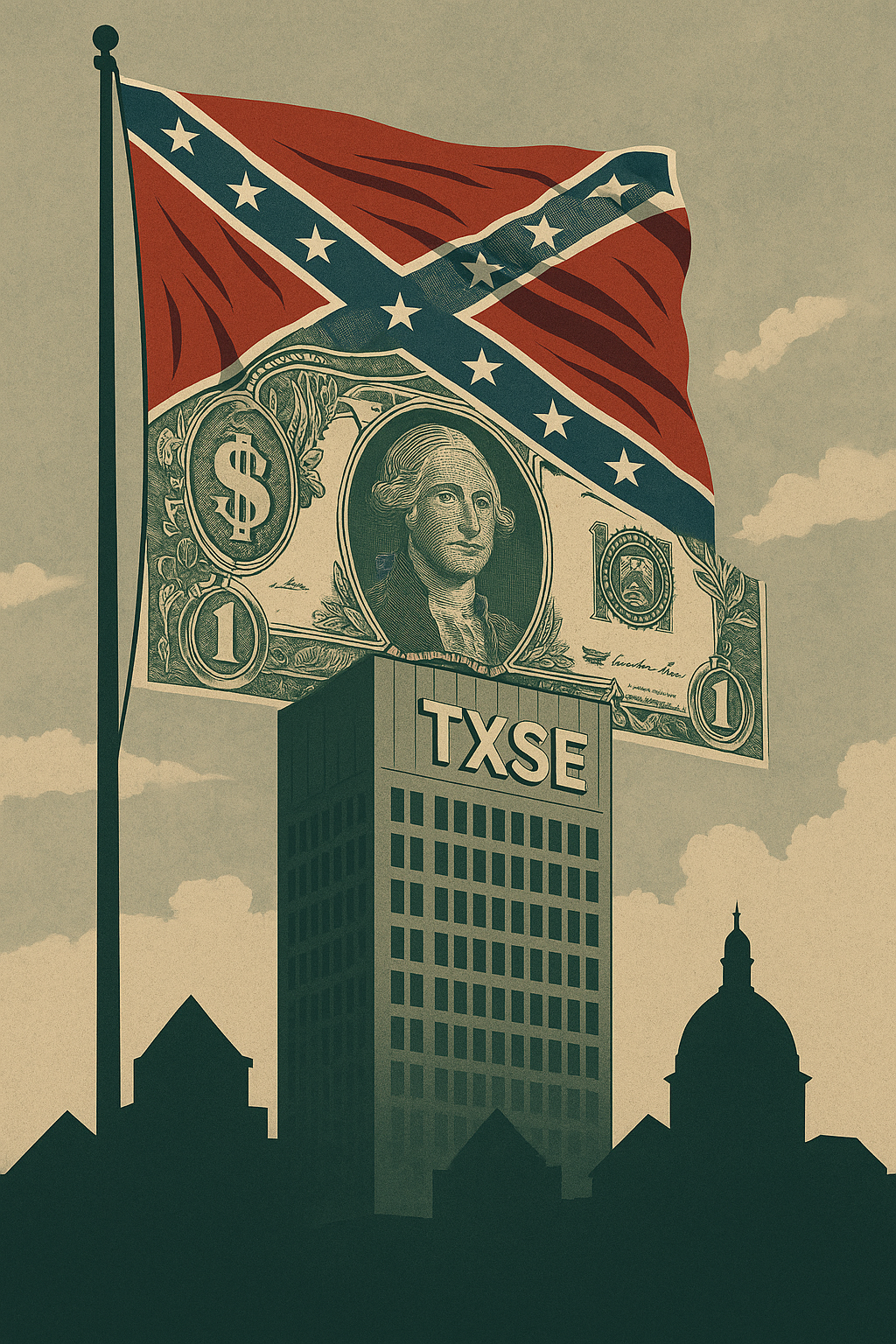
The United States has never had a single center of financial power, but it has never had one this far south either. The Texas Stock Exchange — TXSE — formally launching in 2025, is not a regional curiosity. It is the institutional centerpiece of a coordinated effort to reshape who controls the rules of American capital markets, and the African American institutional ecosystem has not yet reckoned with what that means for its long-term economic position.
Founded in 2023 and capitalized with $120 million in initial funding from investors including BlackRock, Citadel Securities, Charles Schwab, and Virtu Financial, TXSE is aiming directly at the New York Stock Exchange and Nasdaq. Its headquarters are in Dallas. Its leadership includes former Texas Governor Rick Perry and former Dallas Federal Reserve President Richard Fisher. Its pitch to potential issuers is a governance environment that its founders describe as more CEO-friendly: reduced compliance requirements, streamlined listing rules, and a posture explicitly hostile to the accountability frameworks that have, however imperfectly, created some structural space for African American institutional participation in mainstream capital markets. For the African American institutional ecosystem — HBCUs, Black-owned banks and credit unions, Black-owned companies, professional associations, and the community development financial institutions that serve communities mainstream finance has historically ignored — this is not a distant policy question. It is a direct threat to the ownership architecture that the community is still trying to build.
To understand TXSE requires understanding the political economy of the modern South, and that requires a historical anchor. During Reconstruction, African Americans built consequential institutional infrastructure against enormous opposition: Black-owned banks, insurance companies, newspapers, and colleges that competed credibly in American economic and civic life. That infrastructure was not dismantled by market forces. It was dismantled by the same mechanism that has constrained African American institutional ownership in every era — control the rules of the game, and you control who benefits from playing it. The Freedman’s Savings Bank collapsed after federal mismanagement stripped depositors of $3 million in assets. The Greenwood District of Tulsa, the most concentrated expression of African American commercial ownership in the country’s history, was burned in 1921 with official sanction. Across the South and beyond, Black-owned enterprises were regulated out of existence, denied credit access, or destroyed. The consistent instrument was institutional architecture — the deliberate construction of financial rules that embedded the interests of one group at the expense of another. The Texas Stock Exchange is that instrument, updated for the twenty-first century.
Texas has rapidly positioned itself as the national headquarters of the movement to strip social and governance accountability from investment and corporate decision-making. In 2023, Governor Greg Abbott signed legislation banning state contracts with any firm that considers environmental, social, or governance factors in its investment decisions. The state legislature has moved to constrain public pension fund managers from incorporating anything beyond narrow financial return metrics, explicitly prohibiting the mission-aligned investing frameworks that community development financial institutions and HBCU-linked endowment vehicles depend on to justify participation in community-anchored development projects. Florida has enacted parallel restrictions. Oklahoma’s state treasurer blacklisted more than a dozen financial institutions for their stated climate commitments. Tennessee, Georgia, and a growing list of other states are constructing the same legal and financial infrastructure, all oriented toward the same goal: a parallel financial order governed by Southern political priorities, insulated from federal regulatory oversight and from the investment norms of the institutions that have grudgingly made room for African American institutional participation. What HBCU Money has documented over years of covering African American institutional finance by highlighting the slow erosion of Black-owned banks, the chronic undercapitalization of HBCU endowments, the failure of institutional capital to circulate within the African American ecosystem is now confronting a coordinated counterforce operating with the full backing of state governments, sovereign-scale endowments, and the largest names in global finance.
TXSE’s proposed listing standards deserve careful scrutiny because their effect on African American institutional economic participation is structural, not incidental. The exchange plans to impose earnings tests and revenue thresholds that would disqualify an estimated thirty percent or more of companies currently listed on Nasdaq, a category that includes a disproportionate share of minority-led, cooperatively structured, mission-driven, and early-stage enterprises. The cooperative structures, community development financial institutions, and early-stage technology firms that represent the growth edge of African American institutional economic activity are precisely the kinds of entities these standards are calibrated to exclude. Simultaneously, Texas has enacted legislation limiting shareholder lawsuits unless investors own at least three percent of a company’s shares. That threshold effectively neutralizes most activist shareholders, including African American pension funds, HBCU endowment investment vehicles, and minority-focused fund managers that rarely accumulate the concentrated positions necessary to meet that bar. The combination is a governance architecture designed to concentrate power among already-powerful institutional insiders and to diminish the accountability levers that African American institutional investors have worked to develop. This is not an accident of design. It is the design.
The University of Texas Investment Management Company — UTIMCO — manages the combined endowments of both the University of Texas System and the Texas A&M System. Together, these pools constitute one of the largest publicly managed academic endowment complexes in the United States, surpassing Harvard in combined assets under management. UTIMCO has, under sustained pressure from the Texas conservative political establishment, moved aggressively to align its investment posture with the ideological priorities of state leadership. It has reduced exposure to investment vehicles that incorporate social or governance accountability factors and directed assets toward domestic energy production, real estate, and financial instruments consistent with what its political overseers consider appropriate. UTIMCO’s scale gives it significant market-moving influence. Its alignment whether formal or informal with the TXSE project represents a formidable concentration of institutionally managed capital operating explicitly outside the accountability frameworks that African American institutional investors have built their participation strategies around. HBCU endowments hold a combined base that, while growing, remains dwarfed by what UTIMCO alone commands. The strategic implication is direct: when the largest endowment systems in the South are operating with an investment philosophy that excludes the governance accountability frameworks African American institutions depend on, the negotiating position of those institutions in the broader capital market is weakened.
The direct risks to African American institutional ownership are compounding across three distinct dimensions. The first concerns the exclusion of Black-led enterprises from the visibility, liquidity, and valuation premiums that accompany public market access. HBCU Money has documented that African American-owned employer businesses generated $212 billion in combined revenue in 2022 — a figure that, while representing meaningful growth, amounts to 0.43 percent of total U.S. business revenue for a community that constitutes over fourteen percent of the population. The exchange listing premium with the ability to attract institutional capital, establish a public valuation, and access the equity markets for growth financing has historically been one of the structural mechanisms that translates enterprise scale into compounding institutional wealth. TXSE’s listing standards are calibrated against the cooperative enterprises, CDFIs, and early-stage technology firms at the growth edge of African American institutional economic activity. Without access to a major exchange platform, these firms face persistent disadvantages in attracting the institutional capital that would allow them to scale. Over time, this structural exclusion deepens the ownership gap not through any single discriminatory act, but through the cumulative operation of market design.
The second dimension of risk concerns HBCU endowments and the broader African American institutional investment ecosystem. As HBCU Money has reported, African American-owned banks currently hold approximately $6.4 billion in combined assets — down from forty-eight institutions in 2001 to just seventeen today, and down from a peak share of 0.2 percent of total U.S. banking assets in 1926 to 0.027 percent today. HBCU endowments are managed, in most cases, through large fund managers some of whom are direct investors in the TXSE. As the exchange scales and as its listed companies grow in market capitalization, passive investment vehicles and actively managed funds will increasingly hold TXSE-listed assets as a matter of index composition and portfolio construction. HBCU endowment pools, pension funds serving African American public employees, and investment vehicles managed on behalf of Black institutional clients could find themselves indirectly capitalizing an exchange whose structural design, governance philosophy, and political alignment work against African American institutional interests. Annual interest payments transferred from Black households to non-Black financial institutions are estimated at approximately $120 billion — more than half of what all Black-owned businesses generate in revenue in an entire year. TXSE’s governance model is structured to compound that dynamic, not to reverse it.
The third and most consequential dimension concerns the governance architecture within which African American institutional ownership operates in publicly listed companies more broadly. The decades-long effort to increase African American representation in corporate governance, to build institutional investor coalitions capable of pressing for equitable accountability, and to develop shareholder advocacy tools that translate institutional capital into institutional voice has depended on an exchange and regulatory environment that, however reluctantly, created minimum conditions for accountability. TXSE’s governance philosophy centered on limiting shareholder litigation, reducing disclosure requirements, and eliminating the governance frameworks that allowed accountability advocacy to function would, if it achieves the national scale it is pursuing, erode the leverage that African American institutional investors have slowly accumulated. This is not a threat to abstract norms. It is a threat to the concrete mechanisms through which African American institutional capital translates into institutional power.
There is a cultural branding dimension to TXSE that should not be dismissed as mere marketing, because culture and capital are not separate categories they are the same category expressed differently. TXSE supporters have embraced the ‘Y’all Street’ branding, positioning Dallas as the spiritual and institutional opposite of what they call ‘woke capital.’ The slogans — ‘Texas roots. Global reach,’ ‘Built for CEOs, not bureaucrats’ — are explicit declarations of institutional identity. They communicate to potential issuers what governance norms the exchange will enforce, and they communicate to African American institutional stakeholders what norms will be conspicuously absent. An exchange that markets itself as the home of American finance divorced from social accountability is not making a neutral statement about regulatory philosophy. It is announcing its constituency. For the African American institutional ecosystem, that announcement should carry the same interpretive weight as any other structural signal about where capital will and will not flow.
The strategic response available to African American institutions is not the construction of a competing exchange. That framing misreads both the competitive dynamics of exchange infrastructure and the actual leverage points available. Exchanges are winner-take-most infrastructure. TXSE enters the market with $120 million in capitalization, the institutional backing of the largest names in global finance, and the network effects of a state government willing to direct sovereign-scale endowment capital in its direction. A Black-led exchange starting from zero cannot compete with that on equivalent terms in the near term, and proposing otherwise is not strategy — it is aspiration dressed as a plan. The more consequential response is coordinated institutional non-participation: the deliberate, organized withdrawal of African American institutional capital from TXSE’s orbit, combined with the systematic redirection of that capital toward institutions and instruments that serve African American ownership interests. This is not the high road. It is the only road with actual traction.
Executing that response, however, requires an honest accounting of which African American institutions are actually free to act and that accounting begins with the distinction between public and private HBCUs. The majority of HBCUs are public institutions, and the majority of public HBCUs are located in precisely the Southern states that are constructing the Southern Capital Doctrine. Southern University operates under the authority of the Louisiana Board of Regents. Florida A&M is a Florida state institution. North Carolina A&T, Prairie View A&M, Alabama State, Jackson State each operates within a state governance structure that gives hostile state legislatures direct leverage over budget, investment policy, and institutional positioning. These institutions cannot unilaterally reallocate endowment assets, cannot take public institutional positions against the financial policies of their host states, and in many cases cannot even direct their banking relationships without navigating state procurement rules that route dollars away from Black-owned institutions. Asking public HBCUs to lead the charge against TXSE is asking institutions to act against the direct interests of the governments that control their operating budgets. That is not a realistic foundation for strategy.
The private HBCUs occupy a structurally different position. Howard, Morehouse, Spelman, Hampton, Tuskegee, Xavier, Dillard, and their peer institutions have independent governance, control their own endowment investment decisions, and face no state legislative veto over their financial positioning. They are the tier of the HBCU ecosystem with the freedom to act directly to reallocate endowment capital away from fund managers backing TXSE, to direct institutional deposits toward Black-owned banks, to take explicit public positions on exchange governance policy, and to convene the broader institutional conversation that a coordinated response requires. The scale of their endowments, while modest relative to their peer institutions in the broader higher education landscape, is sufficient to establish meaningful momentum if directed in concert. Howard University’s endowment alone, if managed with the strategic intentionality that this moment demands, could anchor a coalition capable of making market-visible moves. Private HBCUs have the freedom that public HBCUs do not. The question is whether they will exercise it.
But the public HBCU ecosystem is not, for this reason, strategically irrelevant. It simply operates through a different institutional layer one that is frequently overlooked precisely because it does not appear on the official organizational chart. Every public HBCU has an alumni association that is legally and operationally independent of the institution itself. Every public HBCU has a foundation, a separately incorporated philanthropic entity with its own board, its own investment decisions, and its own capacity to act without state legislative approval. The Prairie View A&M National Alumni Association is not a Texas state agency. The Southern University Foundation is not subject to the Louisiana Board of Regents. The alumni associations and foundations of public HBCUs can bank with Black-owned financial institutions, direct philanthropic capital toward CDFIs, take public positions on financial policy questions, and coordinate with private HBCUs in ways that the institutions themselves cannot. If that coordination is sufficiently explicit and sustained, the functional effect is equivalent to the institution acting even though technically it is not. This is not a workaround. It is how every other community with sophisticated institutional strategy operates. The university cannot endorse a candidate. The alumni PAC can. The university cannot divest from a financial institution. The foundation can choose where to bank. The structure already exists. It simply has not been deployed with this level of strategic intention.
This layered architecture suggests a three-tier framework for the African American institutional response to TXSE. The first tier consists of private HBCUs acting as direct institutional agents reallocating endowment capital, directing deposits, and convening the policy conversation. The second tier consists of public HBCU alumni associations and foundations acting as coordinated proxy agents making the investment and banking decisions the institutions themselves cannot make, in deliberate alignment with the strategic direction being set by private HBCUs in the first tier. The third tier consists of the broader African American institutional network — Black-owned banks and credit unions, Black-owned firms, the Thurgood Marshall Fund and UNCF, the HBCU Faculty Development Network, African American professional associations, and African American-controlled pension and foundation assets — functioning as the connective tissue that allows the first two tiers to operate in concert without requiring any single institution to take a politically exposed position alone. Jewish American institutional strategy has operated through exactly this kind of layered coordination for generations. Korean rotating credit associations, Indian American technology sector networks, and Irish American political machines have each built equivalent structures calibrated to their specific institutional contexts. The African American community has all of the institutional components. It has not yet assembled them into a coordinated response mechanism.
On the question of regulatory engagement, intellectual honesty requires acknowledging the political environment directly. Petitioning the current Securities and Exchange Commission for intervention in TXSE’s governance standards is not a realistic near-term lever. The present administration’s posture toward exchange regulation, and toward the financial accountability frameworks that any such petition would invoke, makes meaningful regulatory relief under current leadership implausible. The more strategically sound approach is to build the legal and analytical record now to commission the research, document the structural exclusions, develop the regulatory theory, and position African American institutional stakeholders to arrive at a future administration’s SEC with a fully developed dossier rather than a reactive complaint. This is not passivity. It is the institutional discipline of building for the long game. Every dollar spent on legal analysis and regulatory documentation today is leverage that compounds when the political environment changes. TXSE is not going away. Its governance standards will be litigated and legislated over decades, not months. The community that has done the analytical work in advance will have the most influence over how that process resolves.
The parallel long-term aspiration deserves to be named more precisely than a vague commitment to Black-led exchange infrastructure and the most strategically coherent version of that aspiration points not inward but outward, across the Atlantic. The American Depository Receipt, the financial instrument that allowed foreign companies to list on U.S. exchanges without a full domestic registration, was built on a single insight: capital markets are not inherently bounded by national borders, and the right legal architecture can bridge them. That insight has historically flowed in one direction toward the United States, which offered the world’s deepest and most liquid capital markets, and therefore attracted the world’s enterprises seeking valuation and investor access. The generational goal for African American institutional finance is to reverse that directionality. Not to build a competing domestic exchange that fights TXSE on its home turf, under SEC jurisdiction, subject to the same regulatory environment TXSE is actively reshaping in its favor but to develop what might be called African Depository Receipts: a parallel instrument that would allow African American enterprises to list on African exchanges, access African institutional capital, and build the financial architecture of a genuinely transnational diaspora economy.
The mechanics of this idea deserve serious analysis rather than dismissal. The Ghana Stock Exchange, the Johannesburg Stock Exchange, the Nigerian Exchange Group, and the Rwanda Stock Exchange each represent meaningfully different regulatory environments, liquidity profiles, and investor bases and none of them, individually, yet offers the depth of the U.S. exchanges. These are not trivial complications. Currency risk, repatriation structures, cross-border regulatory compliance, and the still-developing institutional investor base on the continent are real structural challenges that any African Depository Receipt framework would need to address directly. But the original American Depository Receipt confronted equivalent complications when it was developed in 1927 to allow British investors to hold shares in American companies without navigating U.S. custodial arrangements directly. The instrument was built to solve exactly the kind of cross-border structural problem that an African Depository Receipt would need to solve today. The complications are engineering problems, not fundamental objections.
What makes this more than a financial instrument is the diaspora dimension that no domestic exchange alternative can replicate. African American businesses listing on African exchanges are not merely accessing a different pool of capital they are creating the institutional infrastructure for transnational capital flows that currently have no formal mechanism. They are building the financial architecture of the relationship between the African continent and its diaspora that has been gestured at politically and culturally for generations but never operationalized at the level of institutional ownership and capital markets. An African American technology firm listed on the Ghana Stock Exchange is not making a symbolic statement about Pan-African solidarity. It is creating a vehicle through which Ghanaian pension funds, South African institutional investors, and Nigerian family offices can hold ownership stakes in African American enterprises and through which African American institutional capital can flow toward African markets with the legal infrastructure, fiduciary accountability, and liquidity mechanisms that serious institutional investment requires. This is the financial architecture of diaspora strategy. It is what other transnational communities have built, in their own ways, over generations. The Irish American political machine was not just about elections it was about building the institutional relationships that made capital flow between Ireland and its diaspora. The Indian American technology network is not just about talent it is about the ownership and capital relationships that connect Silicon Valley to Bangalore. African American institutional finance has the community, the capital base, and increasingly the institutional sophistication to build an equivalent structure. The African Depository Receipt is the mechanism through which that structure becomes real.
This is honestly a twenty-year project. It requires the diplomatic groundwork of building formal relationships between African American institutional stakeholders and African exchange regulators and finance ministries. It requires the legal architecture of cross-border custodial arrangements, currency hedging instruments, and repatriation structures that protect both issuers and investors. It requires the development of African institutional investor capacity — African pension funds, sovereign wealth funds, and family offices — to the point where they can absorb meaningful African Depository Receipt issuance. And it requires the cultivation of African American enterprises of sufficient scale and governance maturity to make credible exchange listings. None of that is impossible. All of it takes time. The community should be building toward it now through the HBCU international programs and African studies centers that can develop the human capital, through the Black-owned financial institutions that can begin building the correspondent banking relationships, and through the private HBCU leadership that can convene the cross-institutional conversations this kind of generational commitment requires while executing the near-term response to TXSE through the levers it actually controls today: institutional non-participation in TXSE’s capital orbit, coordinated redirection of African American institutional deposits and endowment capital, and proxy action through alumni associations and foundations.
The Texas Stock Exchange is the latest iteration of a pattern that has defined African American economic history: rules written by others, in institutions controlled by others, to serve interests that have never included African American institutional ownership as a priority. The community’s $7.1 trillion in household assets, its $1.3 trillion in annual consumer spending, its $212 billion in employer-business revenue — none of that capital produces compounding institutional power without the ownership infrastructure to retain and redeploy it. African American-owned banks hold 0.027 percent of total U.S. banking assets. African American businesses generate 0.43 percent of total U.S. business revenue. HBCU endowments represent a fraction of what peer institutions hold. These are not cultural facts. They are ownership facts. And an exchange designed to deepen the concentration of institutional ownership among those who already hold it is not neutral infrastructure. It is a structural threat that demands a structural response not an aspirational one, but a concrete, coordinated, institutionally grounded one, built from the realistic assessment of which institutions are free to act, through which channels, and toward which ends.
The Confederacy never formally dissolved its ambitions. It adapted its instruments. Where it once used literacy tests to suppress political participation, it now uses listing standards and shareholder litigation thresholds to suppress institutional financial participation. Where it once burned Greenwood, it now writes exchange governance rules that make the next Greenwood structurally impossible to capitalize. African American institutions that understand this history have both the analytical framework and the institutional capacity to respond. The only remaining question is whether the community’s institutional leadership will treat the emergence of the Texas Stock Exchange with the strategic seriousness (threat) it deserves and whether it will organize that response through the institutions that are actually free to act, rather than waiting for the ones that are not.
Sidebar: A Three-Tier Response Framework for African American Institutions
| Tier | Institutions | Available Actions |
| Tier 1: Direct Actors | Private HBCUs — Howard, Morehouse, Spelman, Hampton, Tuskegee, Xavier, Dillard | Reallocate endowment capital away from fund managers backing TXSE; direct deposits to Black-owned banks; take public positions on exchange governance; convene cross-institutional strategy |
| Tier 2: Coordinated Proxy Actors | Public HBCU alumni associations and foundations (independent of state governance) | Bank with Black-owned financial institutions; direct philanthropic capital toward CDFIs; coordinate investment decisions in alignment with Tier 1 strategy; build public record on regulatory exclusions |
| Tier 3: Connective Tissue | Black-owned banks and credit unions; fraternities and sororities; NAACP; Urban League; African American professional associations; African American-controlled pension and foundation assets | Aggregate capital flows away from TXSE ecosystem; build and fund legal/analytical dossier for future regulatory engagement; sustain coordinated non-participation pressure across the institutional network |
Note on regulatory strategy:
SEC engagement under the current administration is not a realistic near-term lever. The priority now is building the legal record, regulatory theory, and analytical documentation needed to engage a future administration’s SEC with a fully developed dossier. The generational goal is the development of African Depository Receipts — instruments allowing African American enterprises to list on African exchanges including the Ghana Stock Exchange, Johannesburg Stock Exchange, Nigerian Exchange Group, and others — creating the financial architecture of a transnational diaspora economy. This is a twenty-year project requiring diplomatic groundwork, cross-border legal architecture, and African institutional investor development. HBCU international programs, Black-owned correspondent banking relationships, and private HBCU leadership convening are the near-term building blocks.
Disclaimer: This article was assisted by ClaudeAI.

