Note: These data are based on colleges, universities, affiliated foundations, and related nonprofit organizations that volunteered to participate in NACUBO’s endowment study series.
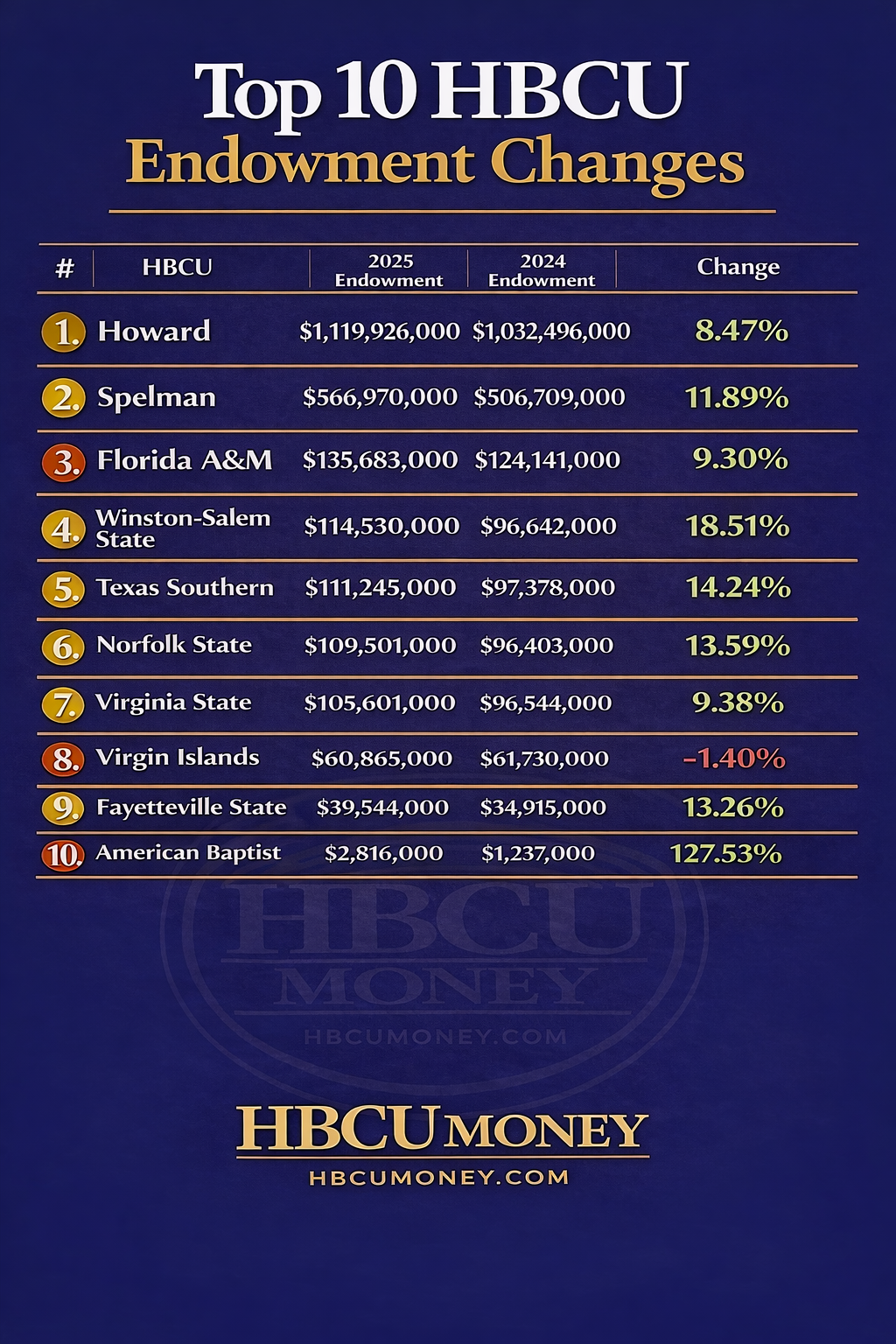
A year after Howard University became the first HBCU to break the $1 billion endowment value mark, four other HBCUs have reached the $100 million mark. It is a complicated celebration when the NACUBO report shows 89 PWIs who have at least $2 billion in endowment value. A few notable HBCUs who reported last year like Morehouse College, North Carolina A&T and Meharry Medical College who have been regular NACUBO participants, are all absent from this year’s list. An HBCU favorite, the University of Virgin Islands returned after an absence in 2024. The reality on the ground with the looming crisis in admissions is for most HBCUs, $500 million is the endowment floor and only two HBCUs (Howard and Spelman) are above that mark. With not as many students graduating K-12, that means HBCUs who are heavily reliant on tuition revenue will see acute strains in the coming decade. It is not a matter of if, but when. Strong endowments are often the only thing that can see institutions through times of stress. That currently includes political stress that all colleges and universities are facing as it relates to state and federal funding. The lack of urgency among HBCU alumni continues to be concerning. Many HBCU alumni think their institution is in better financial shape than it is with no real landscape of higher education economics and the factors that create vulnerability. Using HBCU Alumni Associations and Chapters as more aggressive investment vehicles that can benefit an HBCU’s foundation and endowment are paramount to long-term stability. But this means seeing them as more than social clubs. HBCUs like all African American institutions are in perilous times and continued reliance on lottery philanthropy that may or may not come from non-alumni driven philanthropy (see Mackenzie Scott, Michael Bloomberg, etc.) is as dangerous as hoping to pay your bills every month with scratch off lottery tickets.
“This year’s report shows how important well-managed endowments are to colleges and universities,” said Kara D. Freeman, NACUBO President and CEO. “Endowments help fuel innovation and serve as a stable foundation for institutions. Because of challenges in the economy, some institutions relied more heavily on their endowments—but that additional spending benefited students, faculty, staff, research, operations, and more. Endowments make college possible and more affordable, and contribute to better lives for all.”
NACUBO HIGHLIGHTS:
Top 10 HBCU Endowment Total – $2.4 billion*
Top 10 PWI Endowment Total – $340.0 billion
Number of PWIs Above $2 billion – 89
Number of PWIs Above $1 billion – 169
Number of HBCUs Above $1 billion – 1
Number of HBCUs Above $100 million – 4*
678 colleges, universities, and education-related foundations completed NACUBO’s FY25 survey and those institutions hold $953.7 billion of endowment assets with an average endowment of $1.4 billion and median endowment of $259.9 million.
HBCUs comprised 1.4 percent of NACUBO’s reporting institutions and 0.3 percent of the reporting endowment assets.
PWI endowments (32) with endowments over $5 billion hold 57.4 percent of the $953.7 billion in endowment assets.
**The change in market value does NOT represent the rate of return for the institution’s investments. Rather, the change in the market value of an endowment from FY24 to FY25 reflects the net impact of: 1) withdrawals to fund institutional operations and capital expenses; 2) the payment of endowment management and investment fees; 3) additions from donor gifts and other contributions; and 4) investment gains or losses.
SOURCE: NACUBO
Take a look at how an endowment works. Not only scholarships to reduce the student debt burden but research, recruiting talented faculty & students, faculty salaries, and a host of other things can be paid for through a strong endowment. It ultimately is the lifeblood of a college or university to ensure its success generation after generation.
The most difficult thing in life is to know yourself. — Thales
By any reasonable historical standard, Warren Buffett’s rejection by Benjamin Graham is more than a quaint anecdote; it is a powerful parable about institutional loyalty and long-term economic strategy. Graham, the father of value investing, turned away the future Oracle of Omaha not because Buffett was unqualified—far from it—but because he had a principle. Graham hired exclusively European American Jews at a time when Wall Street’s doors were locked tight against them. It was his quiet resistance to systemic exclusion and a way to build a parallel institution that could compete and thrive. Graham wasn’t interested in assimilation; he was focused on insulation, independence, and empowerment. The same cannot be said about the leadership structure of Historically Black Colleges and Universities (HBCUs), particularly their business schools.
A decade has passed since a comprehensive review was last undertaken on the leadership of HBCU business schools. One would hope that the intervening years would have ushered in a renaissance of internal cultivation—an era where HBCU alumni, steeped in the culture, history, and mission of these institutions, took the reins of their business schools. That hope remains, for the most part, unrealized. Instead, many HBCU B-schools continue to be led by individuals who are not products of these institutions, and in many cases, are fundamentally disconnected from the unique economic and cultural needs of the African American community.
The appointment of deans and senior faculty from predominantly white institutions (PWIs) is often lauded as a move toward “excellence” or “best practices.” The coded language of meritocracy is a familiar refrain—best person for the job, regardless of background. But this belief, as commonly practiced within HBCUs, is a convenient myth. It sidesteps the structural disadvantages HBCU graduates face in academia and business, and reinforces a dependency on external validation and leadership.
The consequence? A business education ecosystem within HBCUs that remains divorced from the very communities these schools are intended to serve. There is no pipeline, no incubator of internal talent, no clear strategy to empower HBCU alumni to lead, govern, and shape the next generation of Black business leadership.
Institutional Amnesia
In failing to privilege their own alumni in leadership selection, HBCU B-schools suffer from what might be called institutional amnesia. There is little effort to study and replicate the success of institutions that have prioritized internal development. Jewish, Catholic, and even Mormon institutions have all built robust networks by leveraging internal cultural capital and aligning institutional leadership with community objectives. HBCUs, by contrast, often appear to suffer from an inferiority complex that manifests in a relentless pursuit of PWI credentials as a proxy for excellence.
Even when HBCU alumni are in the pipeline, they are frequently passed over in favor of candidates whose resumes boast affiliations with Ivy League or flagship public institutions. The irony is rich and troubling: HBCUs, which claim to be dedicated to the uplift of African Americans, routinely reject their own in favor of the very systems that have historically excluded them.
The Data Tells the Story
Of the 85 accredited HBCU business schools and departments (based on the latest available data), fewer than 20% are led by HBCU alumni. Of that number, fewer than half have received their undergraduate and graduate education at an HBCU, further diluting the institutional knowledge that could be reinvested back into the system.
By contrast, 75% of business school deans and department chairs at Ivy League universities hold at least one degree from an Ivy League institution. This underscores the importance these institutions place on continuity, network loyalty, and internal cultural capital.
Lack of a Succession Strategy
The dearth of HBCU alumni in leadership roles is not merely a matter of optics—it is a strategic failure. The absence of a deliberate succession plan, where institutions identify, mentor, and elevate their own talent, weakens the intellectual and operational spine of HBCU B-schools. When young Black scholars and students do not see themselves reflected in positions of power within their own institutions, the implicit message is that their ascent must take place elsewhere.
Anecdotes abound of promising scholars who, having been educated and initially employed at HBCUs, eventually decamp to PWIs for better pay, prestige, or professional development. When those same scholars become leaders elsewhere, their institutional loyalty rarely circles back. The brain drain becomes self-perpetuating.
Cultural Incongruence and Strategic Drift
Leadership from outside HBCUs is not inherently problematic. However, leadership that does not understand or prioritize the mission-specific challenges and opportunities of HBCUs can lead to strategic drift. The market-driven nature of business education already pushes HBCUs to chase prestige metrics that are often defined by PWI standards—AACSB accreditation, international rankings, publication quotas. Yet these metrics seldom align with the needs of the African American community.
Who is building a curriculum around cooperative economics? Who is training students to start, fund, and grow businesses in historically Black neighborhoods? Who is leading research on Black entrepreneurship, Black banking, and financial exclusion? These priorities require not just academic competence but cultural commitment—something often missing in leadership that has not been formed within HBCUs.
The Cost of Outsourcing Leadership
The preference for external hires is also an expensive habit. Recruitment searches for deans can cost upwards of $250,000 when executive search firms are engaged. The revolving door of short-term leadership appointments, another consequence of weak institutional loyalty, creates instability in fundraising, student recruitment, and faculty morale.
Moreover, the indirect costs are enormous. When leadership lacks vision rooted in the mission of HBCUs, partnerships are misaligned, fundraising strategies are tone-deaf, and entrepreneurial ecosystems are underdeveloped. Business schools are economic engines, and the failure to connect them authentically to the community they serve is a missed opportunity of staggering proportions.
What Would Graham Do?
The story of Benjamin Graham and Warren Buffett is not merely about individual relationships; it is a case study in institutional integrity. Graham’s commitment to his community was not performative. It was strategic, values-driven, and unapologetically intentional. He understood that talent alone was insufficient. It had to be nurtured, protected, and positioned within the community’s own institutions.
African American leaders in education, particularly those responsible for HBCUs, must ask themselves: what kind of ecosystem are we building? Do we merely seek validation from the same institutions that denied us access for generations? Or are we committed to the difficult, often thankless work of institution-building?
The answer may well determine the fate of HBCUs in the 21st century.
A Call to Action
First, HBCU business schools must create formal succession pipelines for leadership from within their own alumni networks. This includes mentoring programs, leadership fellowships, and internal promotion tracks that incentivize long-term engagement.
Second, boards of trustees and presidential leadership must reexamine hiring criteria. Cultural alignment and mission understanding must be weighted as heavily as academic credentials.
Third, HBCUs should begin benchmarking themselves not against Harvard or Wharton but against institutions that have successfully used internal leadership to drive community outcomes. The benchmarks for success must be redefined to reflect mission, not mimicry.
Finally, alumni must hold their institutions accountable. Donations should come with expectations for institutional integrity. If alumni are good enough to fund these schools, they are certainly good enough to lead them.
HBCU B-schools sit at the intersection of education, economics, and cultural preservation. Their leadership must reflect that complexity. The time for apologetic hiring practices and external validation is over. It is time for HBCUs to know themselves—and to trust themselves enough to lead from within.
“Note: These data are based on colleges, universities, affiliated foundations, and related nonprofit organizations that volunteered to participate in NACUBO’s endowment study series.” – NACUBO
Howard University has finally done it. They have become the first HBCU to cross the $1 billion endowment mark. An indelible mark that is now the benchmark for potential to survive the coming admissions cliff that U.S. colleges and universities will face as demographics have acutely shifted from the number of students going to college and the number of colleges who will be able to withstand a downturn. HBCUs (like many smaller colleges and universities) are disproportionately reliant on tuition revenues and government funding to keep the doors open and lights on. The factors are a myriad from low African American wealth to limited investment models for their endowments. The latter being something of a chicken and egg situation whereby when you have less you are more conservative with your investment strategy, but this also leads to minimal returns. Without heavy alumni giving to ensure consistent endowment capital it is hard for HBCUs to take more investment risk.
The PWI-HBCU NACUBO Top 10 Endowment Gap for 2024 stands at $129.2 to $1, which is an increase from 2023’s $128.7 to $1.*
HIGHLIGHTS:
Top 10 HBCU Endowment Total – $2.6 billion*
Top 10 PWI Endowment Total – $336.0 billion
Number of PWIs Above $2 billion – 78
Number of PWIs Above $1 billion – 148
Number of HBCUs Above $1 billion – 1
Number of HBCUs Above $100 million – 8
669 colleges, universities, and education-related foundations completed NACUBO’s FY24 survey and those institutions hold $884.3 billion of endowment assets with an average endowment of $1.3 billion and median endowment of $244.4 million.
HBCUs comprised 1.5 percent of NACUBO’s reporting institutions and 0.3 percent of the reporting endowment assets.
PWI endowments (30) with endowments over $5 billion hold 58.5 percent of the $884.3 billion in endowment assets.
All values are in millions ($000)**
Previous year in parentheses for Endowment Value Per Full-Time Student
**The change in market value does NOT represent the rate of return for the institution’s investments. Rather, the change in the market value of an endowment from FY23 to FY24 reflects the net impact of: 1) withdrawals to fund institutional operations and capital expenses; 2) the payment of endowment management and investment fees; 3) additions from donor gifts and other contributions; and 4) investment gains or losses.
SOURCE: NACUBO
Take a look at how an endowment works. Not only scholarships to reduce the student debt burden but research, recruiting talented faculty & students, faculty salaries, and a host of other things can be paid for through a strong endowment. It ultimately is the lifeblood of a college or university to ensure its success generation after generation.
It is no secret that the world is moving towards a stronger reliance on renewable energy*, but there is a swath of the country that is moving extremely slow to embrace it. That swath is dominated by HBCU/PBI states who still dominantly prefer a traditional energy mix. The move towards renewable energy though is inevitable. This is both for environmental and economic reasons. To the latter, there is a massive investment and entrepreneurship opportunity available to HBCUpreneurs who want to help grow and cultivate the space in their respective states. American Association of Blacks In Energy (AABE) President Ralph Cleveland shared the following thoughts, “We will not meet the demands of energy transformation and climate change without Black institutions. This partnership reinforces the critical role HBCUs play in shaping the face of energy talent, development, and design. Not only do we need to create pathways to the C-Suite but we also need to activate our rich networks for a more inclusive energy ecosystem.” While we agree HBCUs need to create pathways to the C-Suite, we also believe the easiest and most economically empowering path there is to have HBCUs and HBCUpreneurs be the vanguard in creating renewable energy startups as highlighted in The Green Program’s ”19 Black Leaders on the Forefront of Clean Energy’ article. The power in energy like everything else is ultimately in the ownership.
HBCU Money took data from Yale Climate Connections and drilled down to the states that have HBCUs and PBIs located in them to see how the states where African America and its institutions are and will be impacted by the current energy mix in their state and also to highlight the opportunities that lay ahead as well. “Important note: The map shows electricity production within each state’s borders. Many states and utility companies exchange electricity with other states. So this data may not reflect the energy that is actually consumed — as opposed to generated — within each state.”
Why is nuclear not considered a renewable? National Grid states, “Nuclear fuels, such as the element uranium, are not considered renewable as they are a finite material mined from the ground and can only be found in certain locations.”
HIGHLIGHTS:
The average HBCU/PBI state has renewable energy of 12% average and 9% median, respectively.
Wind supplies the highest average renewable energy at 5% overall and hydropower supplies the highest median energy at 3% overall.
Oklahoma, the overall leader, is also the leader in wind energy with 41% of its energy coming from wind.
New York is the hydropower leader among HBCU/PBI states with 23% of its energy mix coming from water.
California is the solar power leader among HBCU/PBI states with 19% of its energy mix coming from the sun.
Only 6 of the 23 states have a double digit renewable energy source in their energy mix. Oklahoma, California, New York, Texas, Tennessee, Illinois.
“Note: These data are based on colleges, universities, affiliated foundations, and related nonprofit organizations that volunteered to participate in NACUBO’s endowment study series.” – NACUBO
With a looming enrollment crisis for all America’s colleges and universities, we are at a time where endowments are not only going to matter more they are going to matter the most. The building of endowments, cutting of some overweight athletic expenses that allow you to invest more, aggressive fundraising efforts, joint investing with other HBCUs, everything should be on the table. This is an arms race for survival. We have been at alert level red for awhile but apparently the sound of the siren has been broken. Now it is fixed and it is blaring. HBCU endowments are a key and integral component to African American wealth building both individually and institutionally. Their importance to African America’s economic survivability, sustainability, and empowerment cannot be overstated enough. That HBCU endowments continue to be that is a matter of conversation about who at HBCUs should be benefitting and prioritized most by our endowments.
HBCU endowment analysis from 2023 will not reflect that Spelman College kicked off 2024 with HBCUs largest ever donation and the first ever nine figure donation with its $100 million donation from Ronda Stryker and William Johnston. We will see how much of the $100 million makes it into Spelman’s actual endowment coffers this time next year, but even without it Spelman leads all HBCUs in NACUBO’s new category of endowment value per full-time equivalent (FTE) student with $197,713 per Spelmanite versus Florida A&M University’s worrisome $6,044 endowment value per full-time equivalent student. This arguably is a more accurate of how healthy a college or university’s endowment is performing to some degree which we covered in ‘Without Hyperactive Alumni, HBCUs Will Bear The Brunt Of The Building Tsunami Of College Closures And The End Of Their Blackness’. Only Spelman College and Meharry Medical College have endowment value per FTE above $100,000. The national average is $174,499 among all college and universities and median is $47,287. HBCUs reporting have an average of $63,861 and median of $19,256.
On the good news from 2023 is Morgan State University and Virginia State University breaking into the $100 million endowment club as only the ninth and tenth HBCUs to do so. It is assumed that Tuskegee University (not reported) based on their FY 2018 Fact Book also has an endowment above $100 million. This means that roughly 10 percent of the remaining HBCUs have endowments above $100 million. Unfortunately, the gap between that group and those below is staggering with there being questions of a larger percentage of HBCUs potentially having no endowment as a possibility. Lastly, unless Spelman comes through with another jaw-dropping donation (it is certainly possible), then at some point in 2024 Howard University’s endowment will cross the $1 billion mark making it the first HBCU to do so.
The PWI-HBCU NACUBO Top 10 Endowment Gap for 2023 stands at $128.7 to $1, which is an increase from 2022’s $127.5 to $1.*
HIGHLIGHTS:
Top 10 HBCU Endowment Total – $2.2 billion
Top 10 PWI Endowment Total – $321.6 billion
Number of PWIs Above $2 billion – 74
Number of PWIs Above $1 billion – 139
Number of HBCUs Above $1 billion – 0
Number of HBCUs Above $100 million – 9
688 colleges, universities, and education-related foundations completed NACUBO’s FY23 survey and those institutions hold $839 billion of endowment assets with an average endowment of $1.2 billion and median endowment of $209.1 million.
HBCUs comprised 1.4 percent of NACUBO’s reporting institutions and 0.3 percent of the reporting endowment assets.
PWI endowments (30) with endowments over $5 billion hold 58 percent of the $839 billion in endowment assets.
*Due to Hampton University and Morehouse College not participating this year significantly altered the Top 10 HBCUs endowment combined total. Therefore, HBCU Money took the editorial liberty of calculating the PWI-HBCU endowment gap based on 2022’s HBCU endowment total of $2.5 billion.
**The change in market value does NOT represent the rate of return for the institution’s investments. Rather, the change in the market value of an endowment from FY21 to FY22 reflects the net impact of: 1) withdrawals to fund institutional operations and capital expenses; 2) the payment of endowment management and investment fees; 3) additions from donor gifts and other contributions; and 4) investment gains or losses.
SOURCE: NACUBO
Take a look at how an endowment works. Not only scholarships to reduce the student debt burden but research, recruiting talented faculty & students, faculty salaries, and a host of other things can be paid for through a strong endowment. It ultimately is the lifeblood of a college or university to ensure its success generation after generation.





 HBCU Money