Category Archives: Moneyball

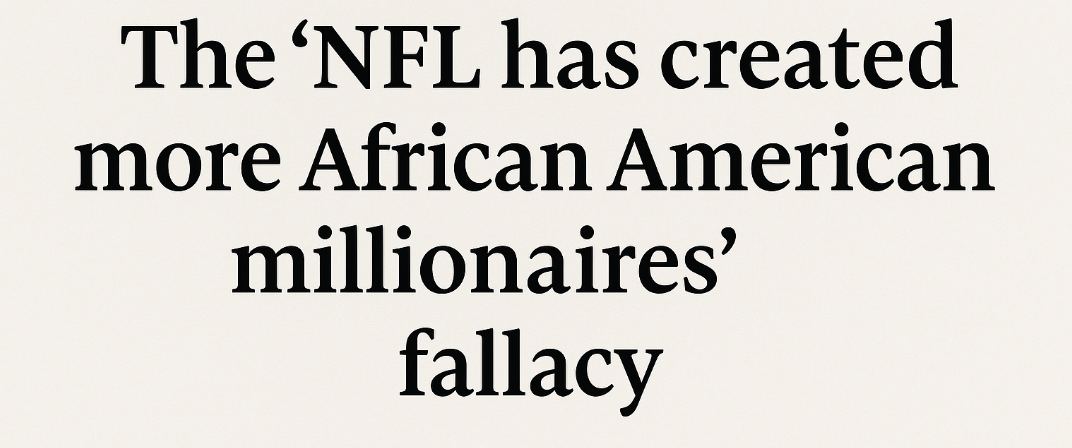
The Gridiron Mirage: Debunking the NFL as the Engine of African American Wealth

“A lot of enslaved people actually made money, but they had no power.” – William Rhoden

In the annals of American mythology, few institutions occupy as outsized a symbolic role in African American economic advancement as the National Football League. It is a league awash in spectacle and saturated with the rhetoric of opportunity. “The NFL has made more African American millionaires than any other institution,” say its defenders. This refrain—recited with patriotic pride or cynical resignation—has come to function as a social truism, a talisman held up to justify the nation’s meager investments in structural equity. But like most myths, its repetition does not make it true.

This article contends that this notion is not only false but insidious. It misrepresents the scale and structure of wealth in the African American community, diverts attention from more potent engines of generational prosperity, and masks the extractive and precarious nature of professional sports as a vehicle for wealth creation. The NFL is not a wealth escalator; it is, at best, a short-lived income spurt machine for a statistical elite, and at worst, a cultural and physical treadmill leading back to zero.

Gridiron Arithmetic: The Numbers Game

The first fallacy is numerical. As of the 2023 season, there were approximately 1,696 active NFL players spread across 32 teams. Around 58% of these players identified as African American, or roughly 984 athletes. Even when one accounts for the extended rosters, practice squads, and recent retirees still living off their earnings, the figure remains marginal—perhaps a few thousand men across multiple generations.

Contrast this with sectors such as healthcare, education, government, and business. The National Black MBA Association alone counts tens of thousands of members, many of whom have built sustainable wealth through entrepreneurship, investment, or corporate ascendancy. African American doctors number over 50,000. Black-owned businesses, according to the U.S. Census Bureau, exceed 140,000 with paid employees, and millions more operate as sole proprietorships.

The American Bar Association reports over 50,000 African American attorneys. Even the public sector, often decried as slow or bureaucratic, employs hundreds of thousands of Black professionals across local, state, and federal levels. These occupations, while lacking the glamour of a touchdown, generate far more stable, scalable, and generationally transferrable wealth.

Income vs. Wealth: The Shaky Foundations of NFL Riches

To understand the illusion, one must disentangle income from wealth. Wealth is not what one earns; it is what one owns. It is the portfolio, the property, the equity stake, the passive income stream, and, perhaps most critically, the ability to transfer resources across generations. NFL players earn substantial salaries during their brief careers—an average of $2.7 million per year, though the median is closer to $860,000. But careers are short, averaging just 3.3 years.

This creates what economists call a “high burn rate, low accumulation” profile. Studies have found that 15% of NFL players file for bankruptcy within 12 years of retirement, despite millions in earnings. Others do not go bankrupt but live in quiet precarity, reduced to local celebrity gigs and motivational speaking to sustain a post-football identity. The 2022 National Bureau of Economic Research paper “Bankruptcy Rates among NFL Players with Short-Lived Income” confirms this vulnerability, showing how the lack of financial literacy, support systems, and institutional guidance leads to dissipation rather than accumulation.

Meanwhile, wealth in America is driven by ownership: of businesses, real estate, stocks, and institutions. The NFL offers none of these to the vast majority of its Black athletes. Ownership, it must be said, remains the exclusive domain of white billionaires. As of 2025, there are zero majority African American owners of NFL franchises. While the NBA has made token strides—see Michael Jordan’s brief tenure as majority owner of the Charlotte Hornets—the NFL remains rigid in its old-world capital structure.

The Plantation Paradigm: Extraction, Not Empowerment

It is hard to avoid the uncomfortable metaphor that the NFL structurally resembles a modern-day plantation. African American bodies fuel the labor force, endure the risks, suffer the injuries, and entertain the masses. White ownership, white commissioners, and white-centered media conglomerates reap the institutional profits. The league generates $18 billion in annual revenue. The average team is valued at $5 billion. And yet, the athletes, even at the apex of their earning power, remain labor, not capital.

This is not a critique of sports per se. Athletics can inspire and galvanize. But the mythologizing of football as a viable strategy for racial uplift is akin to mistaking a single rainstorm for an irrigation system. The commodification of Black excellence in a space so structurally white in ownership and control cannot plausibly be the foundation for true economic emancipation.

This is made all the more clear by examining the fates of even the most successful. Players like Vince Young, who signed a $26 million contract and ended up broke, or Warren Sapp, who earned $82 million only to file for bankruptcy, are cautionary tales. Exceptions like LeBron James, who has parlayed his brand into equity ownerships and venture capital, are held up as archetypes. But these are aberrations, not templates. And they are not NFL stories.

The Opportunity Cost of Myth-Making

Perhaps the greatest harm of the “NFL creates millionaires” myth is opportunity cost. It distorts the allocation of attention, aspiration, and investment within the African American community. While youth in other demographics are taught to pursue STEM, financial literacy, or entrepreneurship, too many African American boys are sold a lottery ticket disguised as a profession. A 2021 study by the Journal of Black Studies found that African American adolescent males are 40 times more likely to aspire to a professional sports career than to become an engineer or entrepreneur.

This has ramifications far beyond the individual. It weakens pipelines to industries that are scalable, recession-resistant, and foundational to intergenerational wealth. No serious community-wide wealth can be built on the shoulders of 53-man rosters. Nor can economic independence arise from dependency on one of the most exploitative and physically damaging professions in modern labor.

There are also societal consequences. The overrepresentation of African Americans in professional sports distorts public perception. It fosters the narrative that “Black people are doing fine” because a few are seen in Super Bowl commercials or luxury car ads. It becomes a justification for denying systemic reform, funding cutbacks to HBCUs, or underinvestment in majority-Black schools. “Why do they need help?” ask the indifferent. “They have the NFL.”

Institutional Power vs Individual Stardom

In the game of wealth, institutions win. The NFL is an institution—one whose structure benefits its owners and media affiliates. The real wealth in sports lies not in being a player but in being an owner, a broadcaster, a media rights holder, or a licensed merchandiser. It lies in being Robert Kraft, not the running back who suffers a concussion under his ownership.

African American wealth building must shift its focus toward institutions that compound, aggregate, and replicate power. HBCUs, Black-owned banks, cooperative land trusts, investment syndicates, media companies, and technology accelerators are more viable pathways to collective advancement than any draft pick. Consider that a single Black-owned private equity fund managing $500 million will produce more Black millionaires than five decades of NFL careers.

In fact, historical analogues suggest that professional exclusion led to the construction of powerful Black institutions. During segregation, African Americans built hospitals, universities, bus lines, and newspapers. These were incubators of both economic and cultural power. In today’s integrationist fantasy, too many of these have been sacrificed in favor of proximity to elite white institutions—like the NFL—that will never relinquish true control.

The Global Lens: Transnational Wealth Thinking

Moreover, the fixation on domestic sports ignores the global economic realignment. The world’s fastest-growing wealth markets are in Africa, Asia, and Latin America. Forward-thinking African Americans should be exporting services, partnering with Pan-African institutions, and investing in sovereign wealth opportunities. Yet, the “NFL as savior” narrative keeps too many tethered to a narrow, provincial idea of success.

The NFL does not build factories. It does not fund innovation. It does not seed capital. It does not provide passive income. It does not own land, develop cities, or engage in infrastructure. It sells tickets. It sells ads. It breaks bodies. It builds billion-dollar stadiums on taxpayer subsidies and pays its workers less than hedge fund interns.

Real wealth is built through scale and succession. The Black farmer who owns 1,000 acres and passes it down is more transformative than the Pro Bowler whose children inherit post-career medical bills and reality show royalties.

Toward a New Narrative: Wealth Without Injury

African American communities need new wealth myths—ones grounded in fact, finance, and future orientation. The idea that the NFL is a pinnacle of Black achievement should be retired. In its place must come narratives about investment clubs, fintech startups, regenerative agriculture, urban development, and cooperative real estate ventures.

Educational institutions and cultural gatekeepers have a responsibility here. Public school counselors, pastors, and media platforms should deglamorize the sports-to-riches narrative and illuminate more durable paths. Foundations and philanthropies should invest not in football camps, but in coding bootcamps, maker spaces, and entrepreneurship labs.

Policy must evolve, too. Tax incentives should reward community ownership and capital retention. States should support Black-owned banks the way they support stadium construction. Reparations conversations should be about equity stakes, not honorary jerseys.

The NFL is not evil. It is, however, a business. And like all businesses, it is designed to maximize returns for its investors—not to solve racial inequality. The sooner we disabuse ourselves of the myth that it is a wealth escalator, the sooner we can begin the real work of building wealth—wealth that endures beyond the roar of the crowd, the flicker of the lights, or the brevity of a three-season career.

Trading Helmets for Holdings

In conclusion, the NFL is a distraction, not a development strategy. It is a parade, not a pipeline. It is a pageant of athletic excellence exploited for institutional enrichment. And it is a cultural sedative—one that soothes legitimate anger over systemic inequality with the spectacle of a few lucky gladiators.

The real revolution will not be televised on Monday Night Football. It will be written in balance sheets, ownership ledgers, and multi-generational trusts. African Americans must trade the helmet for holdings, the franchise tag for franchise ownership, and the myth of athletic salvation for the measured, compound reality of institutional power.

That is not as thrilling as a fourth-quarter comeback. But it is the only way to win the long game.

From Showtime to Shutout: What the Lakers Sale Says About Black Ownership in Sports

“Wealth is created in ownership. If you don’t own, you’re always at someone else’s mercy.” – Robert F. Smith

June 2025’s record-shattering $10 billion sale of the Los Angeles Lakers to Guggenheim Partners chief Mark Walter confirmed what many already suspected: franchise values are rocketing into the financial stratosphere. Yet the deal also spotlighted a harsher truth. After nearly a half-century of hard-court brilliance and gridiron dominance, African Americans are still largely locked out of true ownership power. This article examines why—tracing the structural barriers that keep Black wealth on the playing field instead of in the owner’s suite, and outlining the institutional reforms needed to change the score.

From the Field to the Boardroom: Still a One-Way Street

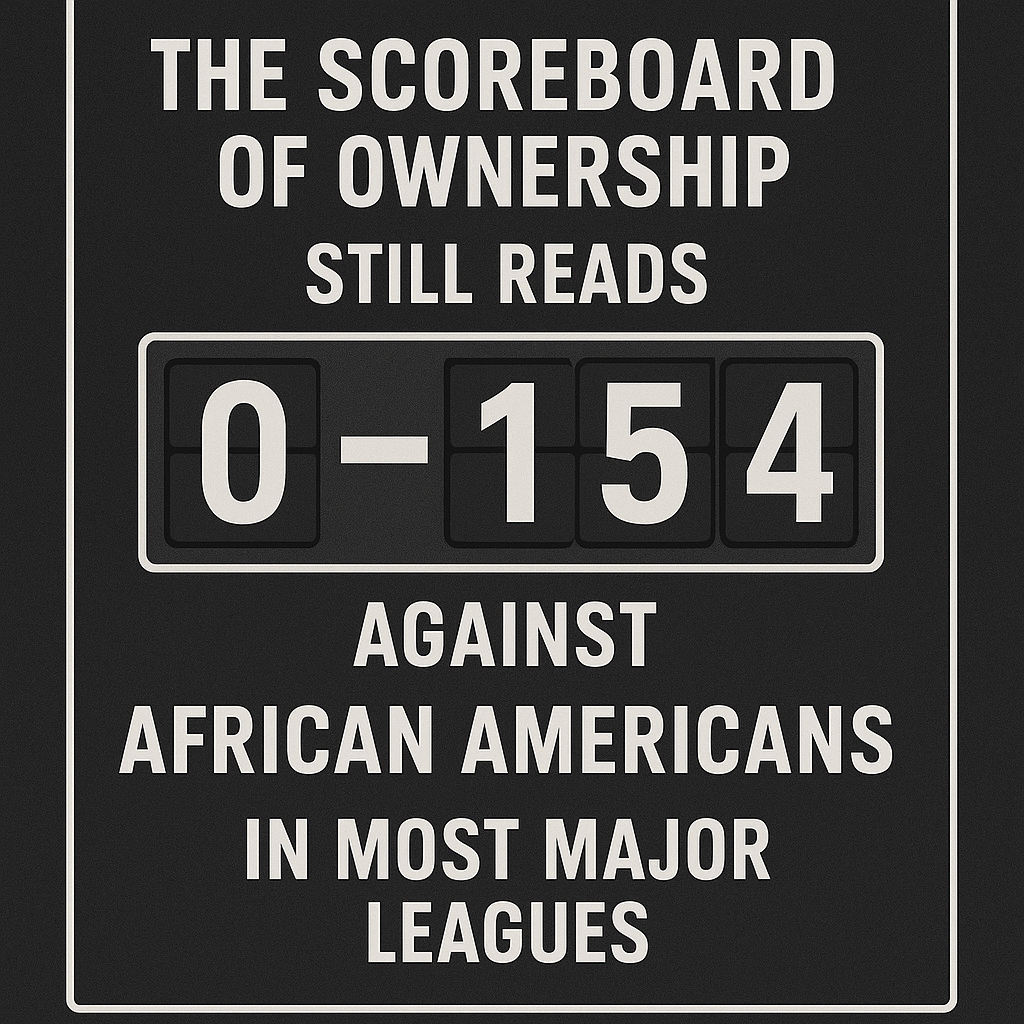
African Americans make up roughly 70–75 percent of NBA players and about 60–65 percent of NFL rosters. In the WNBA, the share is even higher. Yet across 154 combined franchises in the NBA, NFL, MLB, and NHL:

  • Zero teams are majority-owned by African Americans in the NFL, MLB, or NHL.
  • Only one historic example (Robert L. Johnson’s Charlotte Bobcats/Hornets) and one recent example (Michael Jordan, 2010–2023) exist in the NBA.

Three forces keep that door shut:

  1. Intergenerational-Wealth Deficit – Most Black athletes are first-generation millionaires, while many current owners are third- or fourth-generation billionaires.
  2. Limited Collective Capital Vehicles – Black-controlled banks and investment firms are few and undercapitalized relative to mainstream counterparts.
  3. Opaque League Gatekeeping – Franchise valuations above $4 billion and insider-driven vetting processes deter new entrants without deep networks.

The Robert L. Johnson Breakthrough—And the Mirage of Progress

On December 18, 2002, BET founder Robert L. Johnson secured the NBA’s Charlotte expansion franchise for $300 million, becoming the first African American majority owner of a modern U.S. pro team. The milestone was historic, but it proved fragile. Lacking a pipeline of Black institutional capital—no HBCU endowment co-investors, no African American businesses or firms operating as minority owners—Johnson operated alone. By 2010 he sold controlling interest to Michael Jordan, whose own 2023 exit returned the league to its status quo: African American talent on the court, minimal African American equity off it. Symbolic breakthroughs absent institutional follow-through do not create sustainable inclusion.

The LeBron Conundrum: Cultural Power Without Governance Leverage

Billion-dollar athlete-entrepreneur LeBron James epitomizes the new Black business titan—owning film studios, apparel lines, and minority stakes in Fenway Sports Group. Yet even LeBron, arguably the most financially astute athlete of his generation, cannot write a solo check for a majority share of an NBA or NFL team. Average franchise prices now exceed $4 billion in the NBA and $6.5 billion in the NFL.

LeBron’s estimated net worth, while staggering at $1.2 billion, pales in comparison to the financial firepower wielded by new Lakers controlling owner Mark Walter, who is worth an estimated $5.5 to $6 billion personally—and controls access to far greater institutional capital. As CEO of Guggenheim Partners, Walter leads a global financial firm with over $345 billion in assets under management (AUM), according to the firm’s own reporting.

That institutional reach gives Walter an unparalleled advantage: the ability to deploy capital at scale, with leverage, and over long time horizons. His 2012 acquisition of the Los Angeles Dodgers for $2 billion was just the beginning. Now, his control over the Lakers reflects how ownership is secured not by personal wealth alone—but by deep institutional infrastructure.

The gap is not merely one of celebrity or business acumen—it is one of capital architecture. LeBron’s wealth is largely rooted in earned income and venture-backed enterprises, while Walter’s access to Guggenheim’s multi-hundred-billion-dollar asset base enables him to execute major acquisitions swiftly and without co-investors.

Until African Americans gain collective control of similar institutional investment vehicles—through private equity firms, pension-managed funds, or bank-led syndicates—Black excellence in sports will continue to be celebrated on the court, but denied authority in the boardroom.

Building a Syndicate That Can Actually Write a Check

If African Americans are to move from the highlight reel to the cap table, the capital stack must shift from aspirational community pooling to institutional syndication—driven by organizations already designed to deploy large checks and assume complex risk. Pragmatism, not idealism, is the order of the day.

Capital SourceAsset BaseRealistic Deployment Rationale
Black-Owned Banks (18 nationwide)$6.4 billion in assetsFDIC-insured balance sheets, access to low-cost deposits—including the growing wave of Fortune 500 “diversity deposits”—can underwrite debt facilities or pledge Tier 1 capital to a buyout fund.
Black Investment & Private-Equity Firms (e.g., Ariel, Vista, Fairview, RLJ)$70–90 billion AUM (collectively)Deep GP/LP relationships with public pensions and foundations; experienced at assembling $100–$500 million special-purpose vehicles (SPVs) around a single asset.
HBCU Endowments (102 institutions)≈ $5 billion totalAsk for 0.5–1 percent commitments per school—$25–50 million system-wide—providing research access, internships, and brand equity rather than acting as anchors.
Athlete Sidecar FundVariableStructure a managed feeder that lets players co-invest passively (no tithes or self-directing). Capital is professionally deployed—removing behavioral risk.
Corporate & Public PensionsTrillionsMany plans reserve 5–10 percent for “emerging managers.” A Black-led sports-ownership PE fund fits this mandate.

1. Banks as Capital Bridges
Black-owned banks can’t buy teams outright, but they can warehouse capital and extend critical financial infrastructure. By leveraging corporate “diversity deposits” and issuing credit facilities, they can become crucial intermediaries that keep transaction fees and governance influence in Black hands.

2. Investment Firms as Syndicate Architects
Black-led PE firms already understand the terrain. By structuring a flagship $400–$600 million sports-focused fund, they can attract institutional LPs and scale their acquisitions from minority WNBA stakes to majority control in emerging or undervalued leagues.

3. HBCUs as Modest Strategic LPs
HBCUs should not be burdened with anchoring such funds. Instead, they can contribute symbolic capital, student talent pipelines, and academic value. For example, a 1 percent commitment from Howard or Spelman tied to naming rights or internship guarantees would align mission with opportunity.

4. Athletes & African American Families as Co-Investors, Not Donors
A feeder fund with low buy-ins and lock-up periods allows them to invest with institutional support. This protects them from high-risk self-management and ensures alignment with professional fund managers.

5. Execution Timeline

  • 2026–2028: Assemble GP team, secure $150 million from banks and PE partners, with layered support from HBCUs and athlete and African American businesses co-investors.
  • 2028–2032: Close a $500 million Fund I and acquire equity in two WNBA teams and a controlling NWSL stake bundled with real estate.
  • 2032–2037: Launch Fund II at $1 billion, targeting a controlling interest in an MLS or NBA franchise.
  • 2040: Own a major-league asset with governance representation from African American banks, investment firms, and HBCU partners—creating long-term cash flows and intergenerational wealth held by Black institutions.

Media Rights and the Power Gap

Owning teams is only half the battle. The NBA’s next domestic media deal could top $75 billion, and yet no Black-owned network will participate directly in those revenues. Streaming platforms, RSNs, data-analytics firms, and betting partnerships—all profit off Black athletic performance. Until African American institutions enter the media-rights supply chain, the revenue fountainhead remains out of reach.

Cultural Iconography, Financial Dispossession

Hip-hop tracks blare in arenas, sneaker culture drives merchandise sales, and social-media highlights fuel league engagement—but licensing profits flow to predominantly white ownership groups. Careers end; ownership dynasties do not. The average NFL tenure is 3.3 years; Robert Kraft has owned the Patriots for 31 years. Equity compounds; salaries evaporate.

From the Boardroom, Not the Ball Court: Where Owners Really Make Their Money

A glaring misconception is that sports fortunes begin with sports talent. In practice, franchise control stems from non-sports industries:

OwnerTeam(s)Primary Wealth Source
Steve BallmerLA ClippersMicrosoft stock
Stan KroenkeRams, Nuggets, ArsenalReal estate / Walmart marital fortune
Robert KraftPatriotsPaper & packaging
Mark CubanMavericksBroadcast.com tech exit
Joe TsaiNets, LibertyAlibaba IPO
Josh HarrisCommanders, 76ersApollo Global Mgmt. (private equity)

None earned money playing pro sports; all deployed patient, appreciating, often tax-advantaged capital to buy franchises. In contrast, athlete income is earned, highly taxed, and front-loaded. A $200 million NBA contract, after taxes, agents, and lifestyle inflation, seldom equals the liquidity needed for a $6 billion NFL acquisition.

African Americans dominate labor yet rely on labor income to pursue ownership—an uphill climb when the ownership class uses diversified portfolios, inheritance, and leverage. The gap is not just financial; it’s structural.

A Blueprint Forward

African American banks, PE firms, and institutional investors must build syndicates that mirror the strategies of the existing ownership class—while rooting the returns inside Black institutions.

  • 2026–2030 – Launch a $500 million Fund I with contributions from banks, investment firms, HBCUs, and athletes.
  • 2030–2035 – Acquire multiple minority and controlling stakes in undervalued leagues.
  • 2035–2045 – Expand into media-rights, merchandising, and facilities ownership.
  • 2045–2050 – Control a major-league asset and use it to empower future generations via scholarships, pensions, research grants, and equity reinvestment.

Owning the Game—or Owning What Funds the Game?

The persistent call for African American ownership in major league sports raises a deeper question: Should African Americans even prioritize owning sports franchises, when we remain almost entirely absent from the very industries—technology, finance, energy, real estate—that generate the wealth used to buy these teams in the first place?

Mark Walter didn’t become the Lakers’ majority owner through basketball. He did it through Guggenheim Partners—a financial firm managing $345 billion in assets. Steve Ballmer bought the Clippers not from years of courtside ambition, but from cashing out Microsoft stock. Owners dominate sports not because of athletic brilliance, but because they own pipelines, patents, trading desks, and land—the assets that make sports ownership a byproduct, not a goal.

For African Americans, the concern isn’t just that they don’t own the team. It’s that they don’t own the banks that financed the team, the media companies that broadcast the games, or the tech platforms monetizing fan engagement. It is a misallocation of focus to aim for the outcome—sports ownership—without first entering the industries that produce ownership-level capital.

There’s no harm in wanting a seat in the owner’s box. But the more strategic question is: why not aim to own the entire ecosystem? The scoreboard. The stadium real estate. The ticketing software. The AI that tracks player stats. The advertising networks.

Athletes made sports cool. Billionaires made sports profitable. African America must ask whether it wants symbolic entry into an elite club—or whether it wants to control the industries that fund the club.

The real power isn’t just in the arena. It’s in what surrounds it. And until African Americans own those arenas—of finance, data, infrastructure, and media—they will always be positioned to play the game, but not define it.

Final Whistle

The scoreboard of ownership still reads 0-154 against African Americans in most major leagues. Talent fills highlight reels; equity fills trust funds. The route to flipping that score will not be paved by bigger contracts or more MVP trophies. It will be built through African American banks mobilizing capital, investment firms leading syndicates, and HBCU institutions gaining board seats—not just honorary jerseys.

Athletes have inspired generations. Now, institutions must finance generations.

The next dynasty to celebrate should not just hoist a trophy—it should hold a deed.

Disclaimer: This article was assisted by ChatGPT.

Would The Ivy League Athletic Model Work For HBCUs?

“Challenges make you discover things about yourself that you never really knew.” — Cicely Tyson

When you encounter most HBCU alumni regarding their athletic programs they all desire to be a football powerhouse. They believe that this will lead to a land of riches and honey. At the core of this delusion though is that the wealth gap between P5 athletics boosters and HBCU boosters larger than the wealth gap between is greater than the southern most tip of Florida to upstate New York. Phil Knight, University of Oregon booster and Nike owner, has a net worth of $35 billion. Oprah Winfrey is the wealthiest African American HBCU alumni with a net worth of $3 billion and the last we checked does not act as a booster to her alma mater. Meanwhile, Phil Knight in 2012 alone built the University of Oregon football team a facility to the tune of almost $70 million – and got the state legislature to amend a law to make the building legal since it ran afoul of code. But many HBCU alumni believe that if we get the “talent” to come “home” it will level the playing field. It will not. It is exhausting even explaining that the wealthy of many major athletic programs has more to do with the PWI developing and graduating entrepreneurs like Phil Knight who go on to create multibillion firms and therefore have millions to give back than whatever latest 18 year old recruit they have snagged. For greater context, Phil Knight’s building donation is almost 4X Prairie View A&M University’s athletic budget, the highest among all HBCUs.

In our last SWAC/MEAC Financial Review, the two conferences combined for a loss of over $160 million in 2019-2020 if you took away their subsidies (and even with subsidies the two conferences were in the red). These $150 million in subsidies largely coming in the form of student loan fees which for most HBCUs means students packing on student loans for the sake of athletics. Something infuriating when you consider over 90 percent of HBCU students finish with student loan debt versus less than half that amount at Top 50 endowed schools, many who play DIII football or have no football program at all. That is $150 million in subsidies that could be going to scholarships, research, investments, and so many more things that produce an actual return on investment is an understatement. The idea though that HBCUs could try an athletic model that does not aspire to be P5 (no major television contracts are coming either) seems to be lost on all HBCU athletic leadership and alumni. But what if instead of focusing on the P5 schools, we instead focused on the Ivy League’s athletic model.

The Ivy League athletic model is characterized by its emphasis on academic excellence, limited athletic scholarships, and a focus on holistic student development. As historically Black colleges and universities (HBCUs) contemplate their athletic strategies, the potential adaptation of the Ivy League model raises important questions, especially concerning financial resources, alumni support, and institutional missions. Here’s a closer look at several key factors:

Financial Context: Endowments and Alumni Giving

HBCU Endowments: HBCUs generally have lower endowments compared to their Ivy League counterparts. For example, the average endowment for an HBCU is around $100 million, while top Ivy League schools like Harvard have endowments exceeding $50 billion. This significant disparity in financial resources impacts the ability of HBCUs to fund athletic programs and support student-athlete scholarships.

Ivy League Endowments: The Ivy League’s strong financial standing allows for extensive investments in athletics, facilities, and academic resources. Schools like Yale and Princeton have endowments of over $25 billion, which provide them with a substantial financial cushion to support a holistic student-athlete experience.

Alumni Giving Rates: HBCUs face challenges with alumni giving. For instance, HBCUs have an average alumni giving rate of about 15-20%, whereas Ivy League schools boast rates often exceeding 50%. This higher giving rate in the Ivy League reflects a stronger tradition of alumni engagement and philanthropic support, which is critical for sustaining athletic and academic programs.

Research Budgets and Institutional Support

HBCU Research Budgets: Research funding at HBCUs is generally lower than that of Ivy League institutions. While some HBCUs, like Howard University, receive substantial federal research grants, many others struggle to secure consistent funding. For instance, HBCUs collectively received approximately $1.5 billion in research funding in 2019, a fraction of what Ivy League schools secure annually.

Ivy League Research Funding: In contrast, Ivy League institutions benefit from robust research budgets, with individual schools like Johns Hopkins receiving over $2 billion in annual research funding. This financial backing enhances their ability to integrate athletics with academic resources, providing student-athletes with more comprehensive support.

Holistic Development and Community Engagement

The Ivy League model emphasizes the development of well-rounded individuals. HBCUs share a similar mission of producing leaders who are socially conscious and community-oriented. Adopting the Ivy model’s focus on holistic development could resonate well with HBCUs’ core values. This approach can enhance student engagement and create a strong support system for athletes.

Influence of Ivy League Billionaires

The presence of wealthy alumni, often referred to as “Ivy League billionaires,” contributes significantly to the financial health of Ivy institutions. Notable alumni from Ivy League schools frequently engage in philanthropy, enhancing the schools’ resources for academics and athletics. HBCUs lack a comparable number of affluent alumni, which affects their fundraising potential and overall financial sustainability.

Potential Challenges and Considerations

Implementing the Ivy League model in HBCUs presents both opportunities and challenges:

  • Funding Limitations: The financial constraints of HBCUs compared to Ivy League schools necessitate a tailored approach. Without significant endowment and alumni support, fully adopting a no-athletic-scholarship model could limit HBCUs’ competitiveness in attracting top athletic talent.
  • Cultural Fit: The cultural and historical contexts of HBCUs differ significantly from those of Ivy League schools. Any model adopted must align with the unique missions and student populations of HBCUs.

While the Ivy League athletic model offers valuable insights into promoting academic achievement and holistic development, its application in HBCUs would require careful adaptation. Financial disparities in endowments, alumni giving, and research funding pose significant challenges. However, by focusing on the integration of academic and athletic excellence while fostering community engagement and support, HBCUs can create a unique model that reflects their values and enhances student success both on and off the field.

In the end, HBCUs have to accept the realities on the ground. We have tried chasing the golden ticket of athletics only to find out time and time again it is fool’s gold. It is not the thing that will alter the financial realities of our institutions. If anything it may be the thing that causes their failure as a looming admissions’ crisis is looming across all of American higher education and without a lot of dry powder on hand many institutions will easily go the way of the Dodo bird. It is time to think differently, think acutely, and chart a path that maybe uncomfortable or not what we originally imagined but will ensure the existence, sustainability, and success for future HBCU generations.

Disclosure: This was written with the assistance of ChatGPT.