Category Archives: Investing

Black (Fictional) Wealth: What If Martin & Gina Had Invested Their $4,000 Tax Refund In 1995?

Truth is so hard to tell, it sometimes needs fiction to make it plausible. – Francis Bacon
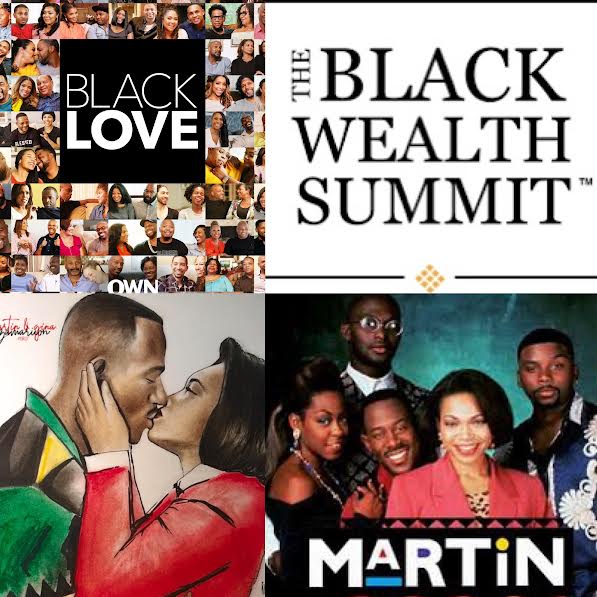
Heathcliff and Claire. George and Weezy. Carl and Harriette. Florida and James. Philip and Vivian. Martin and Gina. The African American fictional couples over the years who have exuded the importance of the African American family and Black love. From working class to high-income earners one thing has remained consistent. None seemingly were ever investors. The one African American fictional character that was a stockbroker was Living Single’s Kyle Barker and yet even in that show with Khadijah James (Queen Latifah) running what seemed to be a successful magazine and media company, the finances of the characters always seemed to come off as strained – save for Kyle and Maxine. The world of African American fictional characters reflects African America’s attitude towards money in real life. A central belief that the only way you make a lot of money is to have a high paying job. Money working for you through investments then and now is a concept that mightily struggles to take root among African American capital both individually and institutionally in our community. 

One thing that was or is rarely discussed in African American fictional shows is money and if it is discussed it is almost always discussed from a consumption and/or struggle vantage point – we all still have trauma from when Florida made James return that money. In real life, African America’s relationship with tax refunds has historically been used as an unrealized forced savings account. Many in African America not realizing that they are not getting money from the government, but are getting their money back from the government. Tax refunds are almost always a sign that an individual or household has paid too much in taxes throughout the year. Again, you are not getting money from the government, you are getting back your money that you overpaid to the government. This is why many refer to it as a forced savings account.

On April 6, 1995 aired Season 3 Episode 22 titled “C.R.E.A.M.” of Martin. It shows Martin and Gina as they are planning for their upcoming wedding. While paying their bills Martin sees a letter from the IRS and like any normal person begins to panic. Because seriously, who gets good news from the IRS? But instead of it being problematic, it turns out that an IRS error has allowed for Martin to receive a $4,000 tax refund. In the excitement, one would think that Martin and Gina just received a check of generational wealth as Martin exclaims, “We PAID! We PAID!” Immediately, Martin’s response is to find ways to spend the money noting that he should go out and buy them a satellite dish, a laser disc player, and himself a new wardrobe. Gina on the other hand actually reigns him in and suggest they actually invest the money. One thing that is glossed over in the exuberance was Gina’s earlier statement that they actually have all their bills paid this month suggesting that Martin and Gina’s finances are perhaps not on the most stable footing. It is likely that they were living check to check if not by some accounts living in the red.

To be clear, their refund was absolutely no small amount given that according to the U.S. Census, African American median household income in 1995 was $22,393. It would be equivalent to receiving almost $10,000 in 2023 terms where African American median household income is currently $46,400. African American homeownership rate during 1995 was the second lowest of any year over the past 30 years at 42.2 percent (see above). Whether or not Martin and Gina should have bought a home in 1995 is questionable given that they lived in Detroit, Michigan and the city 18 years later in 2013 would declare bankruptcy and by all accounts is still mightily struggling to recover for a myriad of reasons. 2013’s bankruptcy would also be in the shadows of the toxic dust from 2008’s Great Recession. According to NOVA AI, the median home price in Detroit in 1995 was $53,300, but by the end of 2022 median home values had only increased to $75,000 according to Realtor.com versus the rest of the country’s median home price in 1995 was $133,900 and at the end of 2022 home values were $479,500. A paltry 41 percent return over almost 30 years in Detroit versus 258 percent return for U.S. housing as a whole over the same period. This is only in nominal returns, but in real returns inflation has increased 92 percent over that same period according to OfficialData.org meaning real housing values in Detroit have actually been negative from 1995 to 2022. Martin and Gina would have needed to move into other asset classes that would be higher on the risk/return ladder (see below). In other words, they would need to either invest in stocks or start a business.

Just west of them headquartered in Seattle, Washington was the not quite a decade old tech company named Microsoft Company that went public in 1986. Had Martin and Gina invested their $4,000 in Microsoft that investment today would be worth approximately $306,000 or a return of 7,548.9 percent. Yes, you absolutely read that correctly. Instead, Martin and Gina invested in the most riskiest of endeavors and a cliche investment among African Americans – a restaurant. “The National Restaurant Association estimates a 20% success rate for all restaurants. About 60% of restaurants fail in their first year of operation, and 80% fail within 5 years of opening.” The comedic tragedy played out as expected according to Fandom.com, “Martin and Gina bite off more than they can chew when they invest all their money in a restaurant, (named Marty Mart’s Meatloaf & Waffles), that becomes more popular than they anticipated. The problem is that neither one of them knows how to run a restaurant or manage the finances, AND they take on Stan as a partner, which leads to lots of hilarious situations along the way.” Alternatively are stocks, owning a piece of a business without having to run a business and is definitely not as risky as starting your own business and especially if that business is a restaurant. Unfortunately, even as recently as 2020 only 34 percent of African American households owned stock versus over 60 percent of European American households. It is likely that it was even less in 1995 during Martin and Gina’s courtship. But it also begs the question, what are the expectations of African America’s fictional worlds? Should they do more to convey wealth building and investing that would help uplift our community?

Many would argue that A Different World (and The Cosby Show) had an immense impact on many African American children and families of the 80s and early 90s on attending HBCUs due to the fictional HBCU, Hillman College. There is a much higher hurdle to overcome as it relates to African Americans and money. Education is an accepted value deeply engrained in our community while investing not so much. However, many would also argue popular culture’s ability to influence behavior is a powerful tool and one worthy of strategic thought in community and institutional development. Fiction has a way of making us believe the impossible is possible. That we can travel the stars one day, be an African American doctor and lawyer couple, and so much more. It may also be the very thing necessary to ingratiate a different set of financial values into our community. Fiction allows us to change the paradigm of possibilities after all. Maybe, just maybe Tommy did not have a job – but he did have a portfolio of assets that provided him an income and the folks down at his “job” were fellow investors in an investment club.

“How To Start An Investment Club” by Better Investing click here.

African Americans Own $570.3 Billion Of America’s Stock Market Value – It Should Be $6 Trillion

“Investing should be more like watching paint dry or watching grass grow. If you want excitement, take $800 and go to Las Vegas.” – Paul Samuelson

A big number means absolutely nothing without context. Saying someone has a lot or a little of something does not tell you much of anything without a control variable to compare it to. This is absolutely one of the most troublesome things in conversation with many in African America where a number is presented like African America’s $1.5 trillion in buying power without asking – is that what is should be? How does it compare on a per person basis with other groups? What percentage of the overall buying power is it? It is in fact only 8 percent of America’s buying power while African America constitutes 12 percent of the U.S. population. Arguably then, African America’s buying power should be closer to $2.1 trillion or 40 percent greater than it is. When it comes to financial numbers we tend to personalize them thinking about if we (an individual) personally had that amount of money as opposed that amount of money spread across 40 million people or the budget necessary to run an entire institution versus a household. Again, context is not only important but imperative to understand what a number means and what it is actually telling you.

In 2020, the total equity market value of the U.S. stock market was $40.7 trillion according to Siblis Research. We asked Nova AI how much of the stock market is actually owned by African Americans, “A 2020 report by The Center for Economic and Policy Research, Black Americans held approximately 1.4% of the total value of U.S. listed public companies.” That amount equals out to the aforementioned $570.3 billion and at first glance it sounds like a tremendous amount, but further analysis says otherwise. First, it is a value that is equal to only 1.4 percent of the total equity market value. Secondly, if African America owned a representative amount of the total equity market value in correlation to our population (12 percent) it would be worth $6.1 trillion or almost 11 times the current ownership value. Lastly, how much would that workout per African American? The $570.3 billion equals out to $12,160 per African American while the $6.1 trillion would work $129,990 per African American. That is every African American man, woman, and child. For a household of four, it is the difference between a family having stock ownership value of less than $50,000 per household versus almost $600,000 per household.

The impact of such a difference is almost hard to truly imagine and/or quantify. Homeownership would skyrocket through 50 percent for the first time in African America’s history without question. African American student loan debt would plummet. HBCU endowments would skyrocket. African American banks, businesses, and nonprofits would flourish in ways not seen since the early 1900s. Access to mental and physical health would be a norm instead of a dogfight. Life expectancy would increase substantially. African American poverty would see significant drops. Marriage for African American would likely see a boom. The list goes on and on. A family with $600,000 in equity market value conservatively would produce $24,000 annually (4 percent yield) in dividend income for the household which is taxed at a lower rate than earned income (your job) and therefore would have African American households keeping more of their money. It would also establish a multigenerational emergency fund for an African American household. Something that seems almost unheard for the vast majority of us.

Headwinds for African American families to invest continue to be mountainous. African American median income is lowest among all groups and those African Americans who do find themselves with middle and high incomes tend to find themselves providing for immediate and extended families at a much higher rate than our European American counterparts. In 401(K)’s this shows up as European Americans contribute almost $300 a month while African Americans are just over $200. It may not sound like a huge difference, but when coupled over decades and compounding returns it can have a substantial impact on wealth building. There is also the severe lag in taxable investment accounts for African Americans. The majority of African American investors participate in the stock market strictly through their 401(K) and perhaps a IRA – both of which have annual contribution limits on them. Taxable investment accounts have unlimited contributions, easier to borrow against, more investment options, and easier to access in case of emergency, but according to a FINRA Foundation report, “Among African American respondents, 22 percent reported having a taxable investment account in 2012. The number rose to 26 percent in 2018 (see above).” In comparison, European and Asian American taxable accounts were at 35 and 41 percent, respectively. The latter two groups with higher median incomes, higher investment contributions, and as one sees significantly more taxable investment accounts make it a no wonder why their equity market value is significant head and shoulders above ours.

The answer while not a perfect one lies in group (small scale) and institutional (large scale) investing (ex. Investment Club: Definition, Advantages, How To Start One). Some downsides to group investing is finding likeminded people, consistent participation, employment volatility, less liquidity in case of an emergency. Upsides are more capital to scale investments with and generate greater returns, access to investments quicker allowing for compounding to take place longer, less individual risk, For instance, there is Black-owned real estate investment firm that offers mortgage notes at 20 percent annually, but the minimum is $5,000 to purchase a note. Saving $5,000 in a year is hard for a lot of households and if they can save that much they certainly do not want to lock it up in a note. With group investing perhaps with five people, then each is only responsible for $1,000 or just over $80 a month. Now your $1,000 is earning 20 percent when otherwise it would not be because of the minimum.

Institutional investing is arguably where the answer truly lies. African American institutions like our banks and credit unions, businesses, nonprofits, HBCU alumni associations and chapters, D9 organizations, HBCU endowments, and more do very little institutional investing. Instead, like many African American households most African American institutions hold the majority of their capital in cash and non-interest bearing accounts. The idea of our institutions being institutional investors even if they owned nothing more than vanilla ETFs (exchange-traded funds) like the SPY ETF (S&P 500) which is one of the safest entrees into the stock market investing seems like inventing fire for many African American institutions. Had any African American institution invested just $10,000 in the market in 2008 and held through 2021 that value would have increased over 400% to almost $43,000. Instead, most institutions like our households sat in cash and saw their $10,000 decline in value due to inflation and almost zero interest rates in savings accounts. The Divine 9 for instance has approximately 4 million members, if they could get 15 percent of that membership to give an extra $10 a year that would be $6 million per year able to invest in the stock market allowing the Divine 9 to be a substantive institutional investor and obviously on a scale that probably none of them could wield on their own without stress. That so many African American institutions have limited exposure to the stock market or none at all is arguably by far the greatest constraint on how much of the stock market’s value African America owns.

African America too often is looking to solve institutional problems with individual solutions. Workarounds, imagination, and institutional solutions are what is required if we are going to address much of the systemic mountains before us.

Ariel Capital’s 2021 Black Investor Survey: African America Is Closing The Engagement Gap But The Capital Gap Is Widening

“It was a wild year in many respects, but the stock market turned in a solid performance in 2021. Except for a few brief sell-offs, the S&P 500 gained 26.9% for the year. The Dow Jones Industrial Average (DJIA) gained 18.7% in 2021, while the Nasdaq Composite gained 21.4%.” – Forbes

Ariel Capital’s 2021 Black Investor Survey* continues to be a mixed bag of optimism and pessimism. Despite the increased engagement of investing among 401K plans, African Americans now only trail their European American counterparts by 20 basis points which is the closest it has ever been there is still significant struggle in the amount of capital invested. “For Black Americans, disparities grow every month; while they save $393 overall per month, whites are saving 76 percent more, at $693 per month. Even Black Americans who earn more than $100,000 a year consistently save or invest considerably less than their white counterparts at the same income level.” There are a number of factors at play, none more pronounced that with a community so impoverished that the likelihood that African Americans have to pull back on how much they invest even when their income is equal to their European American counterparts is typically attributable to how much African Americans are likely to have to help friends and family financially.

KEY HIGHLIGHTS:

  • More than twice as many Black 401(k) plan participants (12% vs. 5%) borrowed money from their retirement accounts.
  • Almost twice as many Black Americans (18% vs. 10%) dipped into an emergency fund.
  • And 9% of Black Americans (vs. 4% of white Americans) say they asked their family or friends for financial support in 2020, while 18% of Black Americans and 13% of white Americans acknowledged giving financial support to family and friends last year.
  • White 401(k) plan participants invest 26 percent more per month toward their retirement accounts than Black 401(k) plan participants ($291 vs. $231).

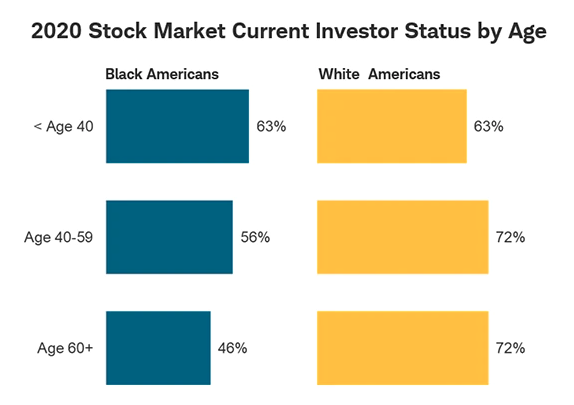
The conundrum that faces a great deal of African America is age. While the number of African Americans under 40 (see below) are participating on par with their European American counterparts, the hidden complexity there is older African Americans are not. This means that inheritances by the older demographics will continue to bolster younger European Americans and burden younger African Americans as the latter is more likely again to be burdened by immediate and extended financial issues even as they age. Carrie Schwab-Pomerantz, President of Charles Schwab Foundation, “notes that while 51% of white Americans say they have inherited wealth, just 23% of Black Americans have.” Once again, HBCUs have a critical role to play.

Getting African Americans to engage investing as early as possible in the 18-22 range is vital. This is because a primary way that younger African Americans as they age can buffer against the family burden is to have more money sooner and that is most easily accomplished through teenage/young adult investing. An added hedge to that is in IRAs where they can serve as an insurance policy of sorts given an investor is not supposed to access them until 59 1/2. Although we know we are more likely to due to our and our families’ financial situations. The problem of course is that we are not participating in IRAs (see below) anywhere near at the clip our counterparts are.

HBCUs and their alumni could be helping students open up Roth IRAs in particular. A 22-year old HBCU graduate with $6,000 in their IRA by graduation that never adds another penny and gets normal market returns would have almost $225,000 by age 60. This can be achieved by ensuring that any student participating in on-campus work study would automatically have a Roth IRA account opened for them, alumni could offer matching funds or just supporting funds into their accounts, etc. Again, the earlier they are invested the better. Should they achieve that $6,000 mark by age 20 and add nothing else it bolsters that $225,000 up to $271,000. This is the profound impact of earlier is more when it comes to compound investing.

For the full survey and analysis click here.

*About the survey

The online survey was conducted in December 2020 by Helical Research among 2,104 Americans age 18 and older with $50,000 or more household income in 2019. The margin of error for the total survey sample is two percentage points.

Bun B Advises African America To Get A Larger Worldview When It Comes To Wealth

”Investing should be more like watching paint dry or watching grass grow. If you want excitement, take $800 and go to Las Vegas.” – Paul Samuelson

The Walton Family, most notably known as the “owners” or dominant shareholders of Wal-Mart. As of March 31, 2022 they are worth an estimated $234.2 billion or 20 percent of African America’s $1.1 trillion buying power.

In an interview with Brandon Hightower, who is better known as B High and a journalist in Atlanta, on his YouTube channel BHighTV, Bernard Freeman, better known as hip-hop legend Bun B, lays down an immense amount of financial wisdom that he has accumulated over the years. Primarily speaking to up and coming hip-hop artists, the conversation could apply to any room in African America. According to an economic study done by McKinsey, African America continues to be the poorest racial group in America with a median net worth of only $24,000 and yet its financial behavior according to Mr. Freeman reflects anything but that.

Mr. Freeman immediately addresses the issue of ownership versus labor that many may have overlooked in the conversation. Asked about how to navigate the issues of artist feeling like they are being robbed by their labels Freeman says, “Don’t sign to a label. I mean that’s just it. Don’t sign to a label and take the slow road.” When pressed by Hightower of people not wanting to take the slow road, Freeman counters with, “Take the fast and get robbed then. Do you want to be famous or do you want to be rich? Because there is a likeliness that you might not be able to be both in this game. At a certain point you have to decide, do you want to be seen and known and look like you got bread and have everybody assume you got bread? Or do you really want to have bread and have people just assume you broke and not really getting it?” The slow road being an independent label that you own and own the masters and all rights to your music or going with a major label who owns the rights to everything you produce in exchange for a small royalty. Do you want to be the owner or do you want to be the labor? This is a question that is consistently overlooked in our community and institutions. HBCUs love to discuss how many of their students have gotten jobs, but when is the last time you saw an HBCU produce an entrepreneurship report detailing how many of their students started companies, hired other HBCU graduates, brought jobs to their community, wealth creation, and overall economic impact in the community? You do not because we do not have a focus there. Our community too often prides itself on finding a “good” job. Despite this push, our unemployment rate always remains twice the national average. Why? Because there is not nearly enough ownership within the community and therefore the ability to dictate employment, wages, and wealth in our community are always at the hands of others.

After a brief exchange on how the African American community seems to not believe that you can be famous and not be rich and be rich and not be famous, Mr. Freeman ask Mr. Hightower if he knows what the Walton Family (pictured above) looks like to which the latter replies no idea. The irony that members of the Walton family could walk into many Wal-Marts around the country and not be recognized, while controlling one of the world’s largest corporations and being one of the wealthiest families on Earth is not to be lost in this age of social media influencer and the like that more and more see as a path to riches. Again, associating being known with being financially successful. And while a few people listed on the Bloomberg Billionaires’ Index maybe well known, such as Bill Gates, Elon Musk, Mark Zuckerberg, 99 percent of that list could walk into many households and be absolutely unknown. However, one thing they all have in common? 100 percent of them are owners.

Mr. Freeman then says in response to Mr. Hightower asking how do we get kids to see beyond the drug dealers, ballplayers, and rap stars, “You have to give them a broader worldview so they can see what real money look like. Because I tell young people all the time everybody that you looking on TV and on the internet that’s rich, with the exception of a hand full of people, maybe ten people, somebody pay them.” He even goes on to discuss Shaquille O’Neal, who he believes either is close to or already a billionaire, but also states that a large portion of O’Neal’s wealth comes from people paying him, but who they themselves were already billionaires and O’Neal had no idea what they looked like before getting paid by them. We often hear of athlete’s salaries, but rarely if ever think about what the owner’s of these teams make. The NFL for instance, which is one of the worst paying professional sports leagues for players based on salaries and career expectancy, is also the most profitable sports league for owners. It is no coincidence that those two things go hand in hand. As of this article, Deshaun Watson, quarterback for the Cleveland Browns, recently signed to become the highest paid player in NFL history at 5 years, $230 million or $46 million per year. Compare that with Jerry Jones, owner of the Dallas Cowboys, who last year took home $280.4 million or six times what Deshaun Watson’s contract is. Even more so, Jerry Jones does not have to take one hit owning the team, can own it longer than any player can play, and then can pass it onto his children (as of this article the Dallas Cowboys are valued at $6.5 billion according to Forbes). Deshaun Watson can claim none of those things. Again, labor versus ownership.

This is not to say that Mr. Freeman is against having fun and enjoying your money as he points out discussing the trend of people who count money on the internet as a form of showing off. But he also follows it with, “Jay-Z is getting richer and richer and he is wearing less and less s**t that looks rich. And you keep going into these rooms with these people trying to look like money. No, you have to sound like money, think like money.” He points out that you will do little to impress Jeff Bezos or Warren Buffett walking into a meeting with them wearing a $4-5 million watch, number 2 and 5 on Bloomberg’s Billionaire Index and worth a combined $400 billion or 36 percent of African America’s buying power. One could argue that you may even turn them off by spending so lavishly. Spending $5 million on a watch versus leveraging that $5 million into $25 million worth of real estate and $2.5 million in annual income from that real estate looks like someone who is not really interested in building generational wealth. Especially for African America when every single dollar is going to count for families, communities, and institutions. In 2019, African Americans accounted for 13.2 percent of the population, but a heartbreaking 23.8 percent of poverty according to the U.S. Census.

“Wealthy does not have to prove to anybody that they are wealthy”, says Mr. Freeman in closing out the show’s segment. And to that point, the lack of wealth in our community and institutions continues to induce behavior that screams of lack. Unfortunately, wealth is not going to be generated by a job or even by starting a business per se. Wealth and power is generated by the building of an institutional ecosystem that is connected and circulates intellectual, social, economic, and political capital within it. African American banks having enough deposits to lend to an HBCU who wants to build a new research facility. An African American venture capital fund setting up and office at an HBCU to fund the next great idea in renewable energy. An HBCU alumni association putting money into an African American community to help ensure the K-12 system is providing the best education with the latest technology. Then all of those moments working together in unison. That is when we will see wealth and then power become not a scarcity in our community but a norm.

To watch the full interview segment, click below or go to http://www.bhightv.com.

Ariel Capital’s 2020 Black Investor Survey: African America’s Continued Fight To Close The Investment Gap

“On March 23, 2020, the S&P 500 fell 2.9%. In all, the index dropped nearly 34% in about a month, wiping out three years’ worth of gains for the market. It all led to a 76.1% surge for the S&P 500 and a shocking return to record heights. This run looks to be one of the, if not the, best 365-day stretches for the S&P 500 since before World War II. Based on month-end figures, the last time the S&P 500 rose this much in a 12-month stretch was in 1936, according to Howard Silverblatt, senior index analyst at S&P Dow Jones Indices.” – CBS News

Ariel Capital released their 2020 Black Investor Survey and the results show that there is reason to be pessimistic today, but potentially optimistic for tomorrow. The survey focuses on middle class African American and European American households earning over $50K in 2019. Some key financial points outside of this survey that should be taken into context though are poverty for African American stands at 21.2 percent versus 9.0 percent for European Americans. This high rate of poverty for African Americans means that middle class African Americans, as noted in the survey, are more likely to have high levels of assistance to family and friends which provides a damper on higher investing capabilities. These high levels of poverty are highly reflective of the median wealth gap between African and European Americas, $24,100 versus $188,200, respectively. African America continues to suffer from weak institution building and therefore the ability for its economic and financial ecosystem to strengthen continues to be suffocated. Firms like Ariel Capital and other African American financial institutions need more investment and support from other African American institutions, like HBCUs, in order to scale and create more employment, wealth, and economic opportunities beyond the grassroots level.

KEY HIGHLIGHTS:

  • The deep-rooted gap in stock market participation between the groups persists, with 55% of Black Americans and 71% of white Americans reporting stock market investments.
  • 63% of Black Americans under the age of 40 now participate in the stock market, equal to their white counterparts.
  • Ownership rates of 401(k) plans are now similar between Black and white Americans (53% vs. 55%).
  • White 401(k) plan participants put 26% more per month toward their retirement accounts than Black 401(k) plan participants ($291 vs. $231).
  • Black Americans are less likely than white Americans to own almost every kind of financial vehicle, with the exception of whole life insurance, which is favored in the Black community.
  • They are also less likely than white Americans to have written wills, financial plans, or retirement plans.
  • For Black Americans, disparities grow every month; while they save $393 per month, white Americans are saving 76% more ($693 per month).
  • Black Americans are also far less likely to have inherited (23% vs. 51%) or expect to inherit wealth (15% vs. 35%).
  • Black Americans are less likely to work with financial advisors (21% vs. 45% of whites).
  • Student loan delay or deferral was reported as being three times more common among Black Americans (16%) than whites (5%).
  • More than twice as many Black 401(k) participants (12% vs. 5%) borrowed money from their retirement accounts.
  • Almost twice as many Black Americans (18% vs. 10%) dipped into an emergency fund.
  • And 9% of Black Americans (vs. 4% of white Americans) say they asked their family or friends for financial support in 2020, while 18% of Black Americans and 13% of white Americans acknowledged giving financial support to family and friends last year.
  • Among Black Americans, 10% discussed the stock market with their families growing up, while 37% discuss the stock market with their families now (compared to 23% and 36%, respectively, for white Americans).
The chart above tracks the participation in the stock market through individual stocks, mutual funds, or ETFS. For African and European Americans, 2020 is an all-time low of participation since tracking began in January 1998. However, the gap of participation has closed from 24 percentage points in 1998 to 16 percentage points in 2020. Primarily due to the all-time low of European America’s participation falling by 10 percentage points and African America’s falling by only 2 percentage points. The closest the gap has been was in 2001 and 2002 when it was 10 percentage points and in 2002 saw African America break through 70 percentage points the only time in the survey’s history when we reached 74 percent.

HBCUs can play a significant role in closing the investment gap by introducing students to HBCU alumni who have gone on to become investors and financial advisors – thus circulating both intellectual and financial capital within the HBCU ecosystem. Even more so, they can assist in ensuring students set up investment accounts like a Roth IRA during their freshmen year and throughout matriculation. The earlier students are engaged in investing the more compounding can work for them over their lifetime which in turn makes for wealthier alumni, larger future donations, stronger African American communities, and more value proposition for HBCUs to promote within the African American community.