I’ve always been a poet. My dad went to Lincoln University with Gil-Scott Heron, so I came out of the womb listening to Gil-Scott Heron. – Malcolm Jamal-Warner
Dear Malcolm,
I will never forget where I was when the alert came on my phone. I was sitting in the woods for work. We were having a retreat of sorts in the Santa Fe National Forest for the morning. The cellphone service was spotty at best and most of the time my service said SOS. But every now and then I would get one bar and notifications would come pouring in. Around late morning early noon an alert from the Associated Press came in that you had passed and my entire insides collapsed. I had to find every way I could to hold it together. The disbelief helped. That cannot be right, but of course it coming from the Associated Press made it almost impossible for it to be an error. Yet, I hoped it was. My mind raced to find composure. I certainly could not shout out what I just saw on my phone. It would not make sense to anyone around me. While I am sure there are some around my age that work with me I cannot readily think of who. Even moreso, I am the only African American in my organization. It would not make sense to anyone to break down in tears at that moment. To have to explain why you are crying over a celebrity, but in a space of African Americans we know you were never that even if you were that.
It is complicated at times to understand cousins and play siblings AKA “Brother/Sister from another Mother” to those outside of our community. These connections are deep and I do mean DEEP. There are cousins who I have not spoken to in years who could call me right now and I would get on the first plane smoking to go defend them in whatever capacity they needed. They just need say the word. You became that to so many of us. A cousin and/or brother from another mother. You were an eclectic soul and that meant the world to me. You explored the world and your curiousities without feeling bound. Something I so deeply value in my own life. To explore your interests without worry of what anyone would think and say. Many wish they could live life without those restrictions and you did it effortlessly. You never “Sold Out” or went “Hollywood” on us. You were always willing to speak up and speak about the African American community in a manner that felt real and felt true. I appreciated that despite your own admitted struggles of feeling like enough you overflowed the cups of so many African American boys and girls who grew up with you.
Since you left us I kept thinking about how to describe you to the world as I saw you. You were a regular Brotha who was EXCEPTIONAL. That is all I keep thinking as I grapple with the tears of knowing another Brotha being gone far too soon. I took for granted that we would see you in our older years. That you would continue to impart your wisdom of how you saw the world and just the shining example of being an African American man, son, brother, husband, father, and all the complex layers that come with the lives we live.
There is no need to discuss your accomplishments. We all know them. We all lived them with you. I told a friend today you were someone who I wished I could meet one day and share ideas for our community and knew you would understand. They would be ideas you would love and embrace and support. For me, there are so few that I believe I could have those conversations with in the world and deeply saddens me that now there is one less person in this world I feel I can realte to and who would understand me. It took a lot to hold it together the rest of that day. Until I get home and sit with the stages of grief that it feels like the entirety of African America is trying to find the words for day after day right now. I think about your daughter and wife. How you really were the regular guy just enjoying a family vacation. The regular guy who loved being a father and put her flower in your fitted cap as you left us your final message. It still feels like one of the worst dreams I have ever had. For a community that needs good Brothas and often feels like we have too few this is a blow that I am uncertain we will ever an answer for anytime soon – if ever. I could go on, but there is no need. All I can do, all any of us can do from today forward is think of you, reminisce of you, and try each day to carry just a little of the light you showed to the world in our own way.
“Happiness is not a matter of intensity but of balance, order, rhythm and harmony.” – Thomas Merton
Social, economic, and civic are the three pillar institutions of any and every society. The framework of those three pillars varies from society to society. As with any three legged chair those pillars/legs must be kept in balance or the chair will tip over inevitably. The only alternative to the chair tipping over is person on it exerting an inordinate amount of energy to compensate for the unbalanced legs, but eventually even then the person tires and the chair falls, the person is hurt, and injury ensues to both chair and person. Had the stool’s engineers remained focused and prioritized balance and sustainability then the person and chair could exist in analogous perpetuity. Both sharing the energy to maintain the person’s weight across the stool and the stool’s support of the person.
How do we see the unbalance of much of global society today? To be clear, I say much because many Indigenous communities who have been untouched by the majority of society still live in balanced societies. They do not consume too much social where they do not attend to the economic needs (like fishing or hunting) of their people or too little time attending to the governance of their community. No, they spend a balanced time with all three pillars and therefore their societies have survived and sustained for millennia. Whereas, much of the 8 billion people who call Earth home suffer from an exerted system that leaves no room for sustainable balance for many of our communities existence.
Take a look at pre-pandemic work before remote/hybrid work was considered viable and even post-pandemic where a culture war is waging to force many back to the office. There are but seven days in a week or 168 hours. Of the 168 hours if we subtract a proper 8 hours of sleep nightly, then there are 112 hours left. The work week is 40 hours a week across 5 days. One would think that would leave a whole 72 hours for social and civic engagement. But because we work in offices and not from home or hybrid work consumes far more than 40 hours. For most people, work consumes about 3 hours before with getting ready and travel and 2 hours after returning home. That is to say work consumes around 13 hours of our day or 65 hours per week leaving only 47 hours for social and civic activities. A chair blatantly out of balance.
In a balanced society, none of the three pillars should consume more than 37 1/3 hours of our week. It is fundamentally not hard to see why we know our coworkers better than we know our neighbors or why we see a lack of interaction between parents and education institutions. Who has the time? Our economic pillar has become overweighted. Many will read this as we need to become underweight economically, but this just rebalances the strain. That is not at all the answer. Balance, balance, balance is. If we want citizens to be more active, engaged, and responsible for the other pillars of society we have to rebalance the pool of time available for them to do so. But how do we get the pillar of economics to trim itself in such a way that returns balance? How do you get anyone or anything to voluntarily rescind its power?
In our current system you get paid to work in our economic institutions. That is the only means of survival. Social and civic engagement is almost always voluntary – even when you are an employee of a social and civic institution. Or at least that is what many would say the pay suggests. The bank does not pay their financial analysts to go spend a day tutoring math kids. The school system does not pay their teachers to go sit on an educational committee at city hall. The government does not pay its politicians to do the janitorial work so a parent that cleans the building they work in can attend their kid’s science fair. You are only “paid” to do the job you are assigned and not to do the work we all know to be necessary for the sustainability and success of the society.
Yet, the lack of balance we all know comes with a cost – or more harshly a consequence. The consequence of an unbalanced society is multifaceted and severe. As we continue to allow the economic pillar to overshadow the social and civic responsibilities of our communities, we witness rising mental health issues, disconnection from our neighbors, civic disengagement, and an overall erosion of the societal fabric. The symptoms are everywhere: increasing loneliness despite hyper-connectivity, declining voter turnout in democracies, labor strikes due to poor work-life balance, and a general sense of dissatisfaction with life. When a stool wobbles for too long, it is not a matter of if it will tip, but when.
What happens when a society’s citizens are overworked, unable to engage meaningfully in their communities, and detached from civic duties? We already see the consequences in our daily lives. The rise in stress-related illnesses, the decline in trust in public institutions, and the feeling of social alienation are direct results of the imbalance we have accepted as normal. A society that prioritizes economic productivity over social cohesion and civic responsibility is one that burns its candle at both ends, hurtling toward inevitable collapse.
So, what can be done? How do we bring balance back to the three pillars?
First, we must redefine value. Work is not the only valuable contribution a person can make. Time spent building relationships with neighbors, participating in local governance, and contributing to community well-being should be recognized as equally important to financial productivity. This means restructuring our economies to support a more equitable distribution of time. Policies such as universal basic income, reduced workweeks, and incentives for civic engagement could help shift societal norms and expectations.
Second, we must implement systemic changes that facilitate balance. Corporations and governments alike must recognize that a burned-out population is neither productive nor sustainable. Offering flexible work schedules, promoting hybrid work models, and integrating social and civic engagement into corporate responsibility initiatives can help rebalance the pillars. Schools, workplaces, and civic institutions should collaborate to create structures that allow for more holistic societal engagement.
Finally, we as individuals must shift our mindsets. Reclaiming balance requires a cultural shift in how we define success. Instead of glorifying overwork, we must celebrate active participation in all three pillars. This means making intentional choices to engage with our communities, advocate for systemic change, and demand policies that prioritize sustainability over mere efficiency.
A society in balance fosters well-being, innovation, and resilience. When social, economic, and civic pillars are given equal importance, communities thrive, economies sustain themselves without exploitation, and governance remains responsive to the needs of the people. The alternative is continued imbalance, a prolonged exertion that inevitably leads to collapse.
We have reached a critical juncture where we must decide: do we continue to endure the consequences of imbalance, or do we take intentional steps toward realigning the three pillars of society? The answer lies not just in grand policy shifts but in everyday decisions—how we work, how we engage, and how we prioritize our time. Balance is not just an ideal; it is a necessity for the long-term survival and prosperity of our communities. The choice is ours.
“The regeneration of Africa means that a new and unique civilization is soon to be added to the world.” — Dr. Edward Wilmot Blyden
In a world increasingly threatened by climate change, biodiversity loss, and global inequality, it is not only science that must rise to meet the moment—it is institutions. The historic collaboration between Claflin University, a leading Historically Black College and University (HBCU) in Orangeburg, South Carolina, and Africa University in Zimbabwe is a testament to what the future of Pan-African higher education cooperation can and must look like.
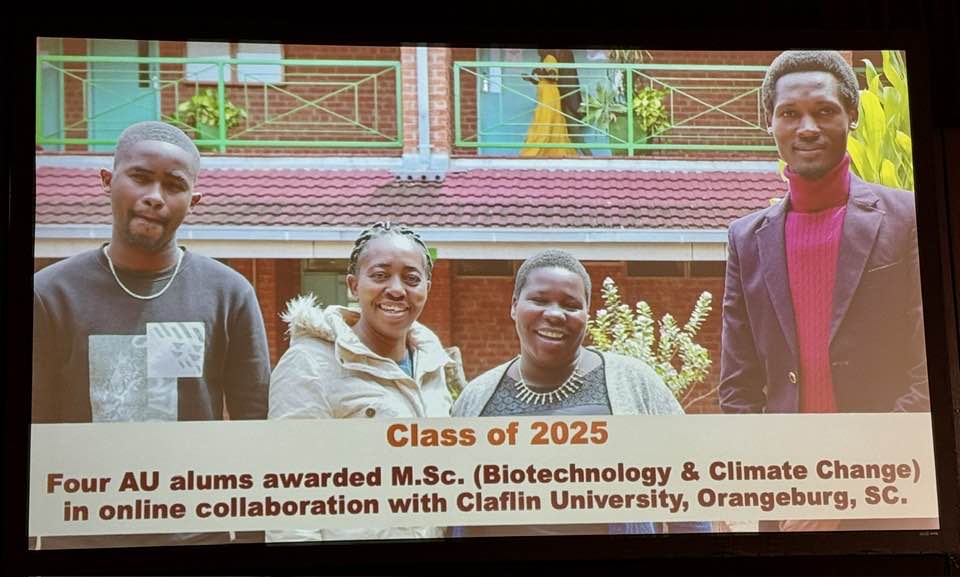
As seen in the powerful image of four smiling graduates—young scholars representing Africa University’s Class of 2025—this partnership is more than symbolic. These four AU alums were awarded Master of Science degrees in Biotechnology and Climate Change through an online program with Claflin University. It marks a significant step forward in bridging the gap between HBCUs and African universities, offering not just degrees, but transformation, elevation, and a realignment of institutional relationships across the African Diaspora.
Claflin University’s Dr. Gloria McCutcheon, a seasoned environmental scientist and scholar, alongside Africa University’s Dr. James Salley, deserves our deepest thanks and congratulations for stewarding this visionary effort. This is more than an academic exercise. It is an investment in Black global agency—an institutional architecture that boldly resists the neo-colonial fragmentation of Black intellect and instead forges knowledge capital across oceans.
The Institutional Revolution: Why It Matters
Historically, relationships between HBCUs and African universities have been underdeveloped. While shared historical and cultural lineages run deep, formal cooperation in research, degree programs, and faculty development has often been episodic and underfunded. This is due in part to a lack of intercontinental policy alignment, but also due to the structural underinvestment in both HBCUs and African institutions of higher learning.
Yet this partnership challenges that stagnation. By aligning their academic missions, Africa University and Claflin University are modeling a future where Black institutions on both sides of the Atlantic are no longer rivals for Western validation, but co-creators of global excellence.
Biotechnology and climate change are not only timely fields—they are strategic. These disciplines shape the future of agriculture, health, water, and energy. As climate change disproportionately affects the Global South, it is imperative that scientists and researchers from Africa and the African Diaspora lead in developing regionally grounded and globally relevant solutions. The MS program is designed with this in mind, empowering graduates with the tools to confront challenges that affect their communities directly.
This is the praxis of Black institutional sovereignty. It is not merely symbolic, it is materially transformational.
Online Education as Pan-African Infrastructure
One of the most remarkable elements of this partnership is its fully online format. In doing so, it sidesteps the exorbitant costs and restrictive visa policies that often inhibit African students from accessing U.S.-based graduate education. Rather than uprooting scholars from their communities and obligations, this model allows them to remain embedded in the ecosystems they intend to serve.
It is also a vital counterpoint to the often exploitative model of international student tuition dependency seen at many Predominantly White Institutions (PWIs). Instead of recruiting African students primarily as revenue sources, this partnership honors them as scholars and change-makers—collaborators in knowledge production, not customers.
This is especially crucial as online education technologies mature and expand access. The future of African Diaspora cooperation must be hybrid and tech-savvy, using every digital tool available to scale education, connect institutions, and reinforce the sovereignty of Black intellectual spaces.
Claflin’s leadership in this area signals what is possible for other HBCUs. Morehouse School of Medicine has already begun integrating global health partnerships, and Howard University has longstanding African studies initiatives. Yet this direct academic program collaboration between Claflin and Africa University sets a new precedent—one that should become a norm, not an exception.
The Bigger Picture: Climate, Biotechnology, and Black Sovereignty
The selection of Biotechnology and Climate Change as the focus of this master’s program is a strategic masterstroke. Climate adaptation, agricultural sustainability, and bio-innovation are the battlegrounds of the 21st century. From Nairobi to New Orleans, African-descended people are often the first to feel the tremors of ecological collapse. We are also, too often, the last to benefit from the technological revolutions responding to it.
By placing young African scholars at the cutting edge of these fields, Claflin and Africa University are not just preparing students for careers—they are preparing them to lead revolutions. Innovations in biotech can reshape everything from vaccine distribution to drought-resistant crops. Expertise in climate change can determine which communities survive sea-level rise, which economies can adapt to volatile weather, and which governments can formulate climate justice policies that center the most vulnerable.
This partnership builds knowledge that is simultaneously scientific and sovereign. It reflects a belief that Black students should not just study solutions crafted elsewhere, but invent their own. In a world that too often imposes external “development” frameworks on African nations and communities, this program declares: we are the architects of our own future.
A Framework for Expansion: What Comes Next?
One successful cohort is a seed. But the real question is how to scale this model.
Here are five recommendations:
Joint Endowments – HBCUs and African universities should pursue shared endowment vehicles that fund joint programs, scholarships, and research. Such funds would represent a new kind of transatlantic educational capital—independent, mission-driven, and Pan-African in structure.
Faculty Exchange Pipelines – Beyond student exchanges, institutions must prioritize reciprocal faculty exchange programs. African professors teaching at HBCUs (physically or virtually) and vice versa would broaden curricular offerings and deepen cultural fluency. HBCU Faculty Development Network is the perfect conduit to sponsor the programming infrastructure for such an exchange.
Shared Research Institutes – HBCUs and African universities could establish co-branded research institutes focusing on themes like climate change, food security, public health, and digital governance—topics where the Global Black experience offers unique insights.
Diasporic Accreditation Models – One major barrier is credential recognition. A Pan-African accreditation body could facilitate mutual recognition of degrees and allow smoother transitions for students moving between institutions in the Diaspora.
Government & Philanthropy Engagement – African governments and HBCU-aligned philanthropies must see this kind of partnership as strategic infrastructure. They must fund it accordingly. Every dollar spent here is a dollar spent on self-determination.
The Role of Leadership
Credit must be given where it is due. Dr. Gloria McCutcheon’s work at Claflin demonstrates what it means for faculty to move beyond the classroom and into institution-building. Her leadership not only provided the academic structure for the MS program but built the trust and collaborative framework that such international partnerships demand.
Likewise, Dr. James Salley’s leadership at Africa University—an institution that has long carried the banner of Pan-African Christian higher education—has been instrumental. AU was founded on the principle of serving Africa through excellence, and this collaboration expands that mission into the Diaspora.
This is what visionary leadership looks like: daring to connect what colonialism sought to divide.
The Image as Testament
Courtesy of Claflin University
The image that inspired this article—four young scholars, standing confidently in front of a brick building, adorned in the sunlight of new opportunity—represents more than a graduation. It is a visual declaration of Pan-African potential. Their smiles, their presence, their achievement—each affirms the power of institutions that choose cooperation over competition, legacy over ego, and elevation over exploitation.
They are not just Claflin graduates or Africa University alumni. They are trailblazers of a new academic order—one that transcends borders and builds Black excellence into the very structure of education itself.
Final Thoughts: Pan-African Pedagogy Is The Future
In a century defined by ecological upheaval, technological disruption, and renewed global competition, the African Diaspora cannot afford fragmented institutions. HBCUs and African universities must see each other as natural allies—extensions of a common historical, intellectual, and cultural struggle.
This Claflin-AU partnership is not just a program. It is a model of what is possible when Pan-African Diaspora institutions collaborate with purpose. It is a rejection of dependency and a commitment to capacity-building. It is the beginning of an educational ecosystem rooted in mutual respect, sovereign vision, and Pan-African commitment.
Let it grow. Let others follow. Let this be the future of Pan-African education—intercontinental, interdisciplinary, empowering, and unapologetically transformative.
Congratulations again to the Class of 2025. Your success is our collective success.
Life is a hard battle anyway. If we laugh and sing a little as we fight the good fight of freedom, it makes it all go easier. I will not allow my life’s light to be determined by the darkness around me. – Sojourner Truth
HBCU Money is officially a teenager. Usually the teenage years are a rough and tumultuous time and it is hard to see that being any differently for us. The current social and political climates that we are about to experience over the next four years will test our patience and fortitude. It is vital that HBCU Money stays a voice of focus, strategy, and guidance in the African American institutional space as it relates to economics, finance, and investment.
It is inherent that we continue to strengthen and build our African American institutional ecosystem. It is also vital that that ecosystem build bridges of connection with the African Diaspora institutional ecosystem. We must throw off the shackles of isolationism and island mentality that plagues us so deeply. Before we make decisions we must ask ourselves is there an African American institution that exist that serves that need or want. If it is not there, then we must discuss building it. Where is the HBCU that has an African American MBA that teaches us how to build and run businesses from our interest? Where is the HBCU that has a law school focused on African American agriculture and real estate? Where is the African American bank focused on export-import for African American businesses? Are we using our talents to enhance ourselves individually or are we using our talents to enhance our institutions that enhance the collective? These are just a few of the vital things we are missing in our financial infrastructure.
There is not much that needs to be said, but plenty that needs to be done.
It never ceases to amaze how easily appeased African America can be. We need 40 acres and instead allow ourselves to be given a pot with some dirt in it and are expected to act grateful. Ironically, often we do. “They gave us something” could be a whole mantra that we hear far too often when we need to show our communities that the mantra is “We fight not capitulate”. Time and time again PWIs show that they will put alligator and piranha filled moats around things like law schools, MBAs, and research to ensure that HBCUs never encroach on that institutional power. We get “agreements” that allow PWIs to pick and choose the best and brightest of our undergraduates for their graduate schools. The next Thurgood Marshall cannot come from one of our own HBCU law schools like the late justice but inevitably from a PWI law school where the molding of law and its purpose will be shaped how they see fit. Usually still to their benefit. The flagship HBCU in Mississippi cannot have a law school, it has an agreement. Imagine Ole Miss getting an “agreement” with something in Jackson State’s control. You cannot imagine it because it would never happen.
Historical and Structural Underrepresentation
Limited Legal Education Options for African Americans: Historically, African Americans were denied access to legal education at predominantly white institutions (PWIs) and were often left with no choice but to attend the few law schools established at Historically Black Colleges and Universities (HBCUs). Today, there are only six HBCU law schools:
Howard University School of Law
Southern University Law Center
Texas Southern University Thurgood Marshall School of Law
Florida A&M University College of Law
North Carolina Central University School of Law
University of the District of Columbia David A. Clarke School of Law
None in Mississippi: Despite Mississippi’s large African American population (nearly 40% of the state), there are no HBCU-affiliated law schools in the state. This lack forces African American students to compete for limited seats at existing law schools, often in environments that may not prioritize their unique needs or cultural experiences.
Historical Context of Discrimination in Mississippi Higher Education
Systemic Exclusion: For much of the 20th century, African Americans were excluded from attending predominantly white institutions (PWIs) in Mississippi. Segregation laws and practices relegated Black students to underfunded HBCUs, such as Jackson State University.
Funding Disparities: HBCUs in Mississippi have historically received significantly less funding than PWIs. This underfunding has limited their ability to expand academic offerings and infrastructure, including professional programs like law schools.
Ongoing Disparities
Resource Inequities: Mississippi’s higher education system continues to show disparities in funding and resources between HBCUs and PWIs. These inequities impact the quality of education and opportunities available to students at HBCUs.
Underrepresentation in Legal Education: African Americans remain underrepresented in Mississippi’s existing law schools, including the University of Mississippi School of Law and Mississippi College School of Law. These institutions do not adequately address the unique challenges faced by Black students and communities.
Pipeline Challenges: The lack of professional schools at HBCUs in Mississippi limits pathways for Black students to enter high-impact fields like law, perpetuating disparities in representation and leadership.
Historical Challenges at the University of Mississippi
Resistance to Integration: The admission of James Meredith in 1962 as the first African American student at Ole Miss was met with violent riots, requiring federal intervention. This historical event illustrates the extreme resistance to racial integration and set the tone for ongoing challenges faced by African American students.
Legacy of Segregation: The University of Mississippi, like many Southern institutions, has a deeply entrenched history of segregation that continues to influence campus culture and attitudes.
Ongoing Issues Faced by African American Students
Hostile Campus Environment: Many African American students at Ole Miss report feeling unwelcome or isolated due to a predominantly white student body and lingering racial tensions. Incidents of racism, such as vandalism of monuments and racist social media posts, contribute to a climate of hostility.
Symbolic Racism: The continued presence of Confederate symbols, including statues and the former use of Confederate imagery in campus traditions, reinforces a sense of exclusion for Black students. Efforts to remove or contextualize these symbols have been slow and controversial.
Underrepresentation: African American students are underrepresented at Ole Miss compared to the state’s demographics, limiting opportunities for meaningful diversity and inclusion.
Incidents of Racial Harassment: High-profile incidents, such as the noose placed around the statue of James Meredith in 2014, serve as stark reminders of ongoing racial animosity. These events create psychological distress and reinforce systemic barriers for Black students.
The African American brain drain into predominantly white institutions (PWIs) poses a significant challenge to the mission of historically Black colleges and universities (HBCUs) like Jackson State University (JSU). Establishing a law school at JSU would address this issue by offering a culturally affirming and accessible path for African American students to pursue legal education. This initiative would help retain talent, strengthen HBCU legacies, and diversify the legal profession.
Understanding African American Brain Drain
What is Brain Drain? Brain drain occurs when highly capable and motivated individuals, particularly African Americans, leave HBCUs to pursue educational and career opportunities at PWIs. This is often due to the lack of specialized or professional programs, such as law schools, at HBCUs.
Mississippi’s Context: Mississippi is home to several HBCUs, including Jackson State University, but none of these institutions offer legal education. As a result, aspiring African American lawyers in Mississippi are compelled to attend PWIs such as the University of Mississippi School of Law or Mississippi College School of Law, or leave the state entirely.
Impacts of Brain Drain
Cultural Isolation: African American students at PWIs often report feelings of isolation and marginalization due to a lack of diversity in faculty, curriculum, and campus culture. This can hinder their academic and professional development.
Loss of HBCU Legacy: When African American students leave HBCUs for PWIs, they miss the opportunity to benefit from the culturally affirming and supportive environments HBCUs provide. HBCUs foster a sense of community and empowerment that is particularly important in professional fields like law.
Weakened HBCU Influence: Brain drain diminishes the influence of HBCUs by limiting their ability to produce leaders in fields like law, where African Americans are already underrepresented. This affects the ability of HBCUs to contribute to societal change through their alumni.
The Role of PWIs in African American Brain Drain
Limited Inclusion: PWIs often fail to adequately support African American students. Issues such as implicit bias, underrepresentation among faculty, and a lack of focus on issues relevant to African American communities make these institutions less ideal for Black students.
Recruitment of Top Talent: Many PWIs actively recruit top African American talent, which they recognize as essential for promoting diversity. However, these efforts can inadvertently draw students away from HBCUs that would better align with their cultural and educational needs.
Mississippi became the last state to remove the Confederate battle flag from its state flag in 2020. The birthplace of Medgar Evers who was murdered in his driveway. It is the home of the Freedom Summer that saw three voting rights activists murdered that brought nationwide attention and shun a spotlight on the atrocities. The potential for the impact of a law school at Jackson State University and the creation of the seventh HBCU law school would be profound. African Americans constitute almost 15 percent of the US population and 40 percent of the Mississippi population, but less than 9 percent of Mississippi’s active lawyers are African American. An “agreement” with Ole Miss is highly unlikely to change that paradigm. This is a chance for an African American institution to not take the bull by the horns, but be the bull.
Amplifying the Civil Rights Legacy
Mississippi’s Legacy of Activism: The state has been at the center of the civil rights movement, with many battles fought for racial equality and justice. A JSU law school could build on this legacy, preparing lawyers to continue the fight against discrimination and inequality.
Empowering Marginalized Communities: By training lawyers from diverse backgrounds, the law school could directly address issues like voting rights, criminal justice reform, and educational equity—critical areas in a state still grappling with the effects of systemic racism.
The Role of JSU in Filling the Gap
Addressing Local Needs: A law school at JSU would directly address the absence of African American legal institutions in Mississippi, offering a local and affordable option for students who wish to study law in a supportive environment.
Culturally Relevant Curriculum: As an HBCU, JSU could design a curriculum that emphasizes the legal challenges faced by African American communities, such as systemic racism, criminal justice reform, and civil rights advocacy.
Building a Pipeline of Black Lawyers: By increasing access to legal education for African Americans, JSU could help diversify the legal profession and prepare graduates to address the specific legal needs of marginalized communities.
How a JSU Law School Can Address Brain Drain
Retaining Talent in Mississippi: Establishing a law school at JSU would give African American students in Mississippi the option to pursue legal education at an HBCU without leaving their state or community.
Culturally Relevant Education: A JSU law school could tailor its programs to address the legal challenges most relevant to African American communities, such as civil rights, voting rights, and criminal justice reform.
Strengthening HBCU Legacies: By offering a law program, JSU could enhance its reputation as a premier institution for African American education and leadership, attracting top talent to remain within the HBCU ecosystem.
The Need for an Inclusive Legal Education at JSU
Safe and Supportive Environment: An HBCU law school at Jackson State University would provide a nurturing environment for African American students, free from the racial hostility that has been reported at Ole Miss.
Focus on African American Legal Issues: A law school at JSU could emphasize areas of law that disproportionately impact Black communities, such as civil rights, voting rights, criminal justice reform, and housing law.
Addressing the Legacy of Exclusion: By creating a pathway to legal education specifically designed to empower marginalized groups, JSU could challenge the structural inequalities that have persisted in Mississippi’s higher education system.
Broader Benefits of a JSU Law School
Community Impact: Graduates of a JSU law school would be more likely to practice in underserved and predominantly African American communities, addressing legal deserts in Mississippi and beyond.
Representation in the Legal Profession: Increasing the number of African American lawyers trained at an HBCU would help diversify the legal profession and create more advocates for systemic change.
Economic and Cultural Reinvestment: Retaining African American students at JSU would help prevent the economic and cultural losses associated with brain drain, fostering stronger HBCU communities and alumni networks.
Mississippi’s lack of African American legal institutions highlights the urgency of a law school at JSU. Such a school would address historical exclusion, provide a platform for empowerment and justice, and meet the unique legal needs of African American communities. JSU’s law school could play a pivotal role in advancing social justice and transforming the legal profession.
The challenges African American students face at PWIs like the University of Mississippi further emphasize the need for supportive alternatives. A law school at Jackson State University would create an environment where Black legal scholars can thrive, challenging systemic inequities in higher education. By fostering a new generation of African American lawyers, JSU could significantly advance African America’s institutional empowerment, justice, and opportunity across Mississippi and beyond.
It is hard to imagine with the current social and political climate that has seen the Southern “attitude” towards African America emboldened that a partnership or agreement with the flagship institution of that attitude being anything more than cover for continued behavior and a means of a subversive quelling of African American institutional empowerment and independence. The Medgar Evers Law School at Jackson State University located in the capital of the state that is a symbol of power being named after Medgar Evers and a substance of power being a law school in the heart of Dixie. A heart that African America needs to be break.







 HBCU Money