Category Archives: Economics

Monetary Illiteracy In The Halls Of Power: When Grandstanding Replaces Governing

“It is the mark of an educated mind to be able to entertain a thought without accepting it.” — Aristotle

Each time Federal Reserve Chair Jerome Powell appears before Congress, particularly the House Financial Services Committee, a rare opportunity presents itself—one that could improve financial literacy at the highest levels of government and foster substantive dialogue on monetary policy’s profound impact on American households, businesses, and institutions. But that opportunity is almost always wasted.

Instead, the public is forced to endure yet another performance of political theater where elected officials, both Democrat and Republican, seem more concerned with going viral than going deep—more focused on five-minute gotchas than on fifty-year policy ramifications.

And for African America, whose economic institutions and family wealth face historic and systemic precarity, this continued dysfunction is not simply frustrating. It is dangerous.

The Purpose of Oversight or a Stage for Soundbites?

The Federal Reserve is arguably the most powerful economic institution in the world. Its chair, currently Jerome Powell, wields incredible influence over interest rates, inflation, labor markets, and the credit system. A hearing before Congress should be a time when policymakers probe deeply, ask sophisticated questions, and help inform the public through their own understanding.

Instead, what unfolds is often little more than ideological posturing. Members of Congress use their time to push personal or party agendas, cherry-pick statistics, or lob loaded questions with no intent of hearing the answer.

This isn’t oversight. It’s political performance art.

The House Financial Services Committee, charged with overseeing financial institutions, capital markets, and economic stability, must rise above this. Its role should be more than ceremonial. It should be educational—to itself and to the American people. But the overwhelming sense watching Powell’s recent testimonies is that most of the committee members lack even a basic understanding of how monetary policy functions, let alone how to interrogate it effectively.

Why It Matters for HBCUs and African American Economic Institutions

African America does not have the luxury of political and financial ignorance.

When inflation creeps higher, it isn’t just a line in a Bloomberg terminal. It is the difference between a Black student being able to afford books for the semester or choosing between groceries and tuition. It is a Black-owned small business having to lay off an employee because a loan’s interest rate jumped from 6% to 11%.

The lack of thoughtful interrogation of Powell’s monetary strategy reflects a more structural problem. There is a scarcity of African American economists in monetary policy circles. The Federal Reserve’s own ranks remain largely devoid of HBCU graduates, and few members of the House Financial Services Committee themselves come from economically marginalized backgrounds or have spent real time examining the consequences of macroeconomic policy on communities of color.

Yet these are the same communities most sensitive to interest rate swings, credit market freezes, or inflationary spikes.

And still, with this knowledge, Black America’s representatives—those on the committee and those adjacent—too often use their time during hearings for moral appeals or political slogans. But where is the policy meat? Where is the specificity? Where is the courage to press Powell on structural inequality in the Federal Reserve’s frameworks?

The Federal Reserve and the Myth of Neutrality

To be fair, the Federal Reserve, under Powell or any other chair, does not operate in a vacuum. But the institution often touts its political independence as a form of virtue. That independence, however, should not be mistaken for neutrality. The Fed’s policies have winners and losers.

From 2020 to 2022, the Fed’s monetary expansion saved financial markets—but also exploded asset prices, exacerbating wealth inequality. Homeowners gained equity. Renters fell behind. Banks consolidated more power while local lenders and community institutions—like Black banks—continued to struggle.

The committee could have questioned Powell on these outcomes. It could have demanded a racial wealth gap impact assessment of every major monetary policy decision. It could have interrogated how interest rate hikes disproportionately hurt historically marginalized borrowers. But those questions are never asked.

Instead, Powell is interrupted mid-sentence. Politicians talk over him. They make proclamations but ask no follow-ups. This behavior isn’t just disrespectful—it’s dangerous. And it’s a gross misuse of public time.

What HBCUs Can Teach Congress About Learning

At an HBCU, you learn that education is both a privilege and a weapon. It is something to be studied, sharpened, and used to build institutions. That approach—one rooted in discipline, humility, and preparation—is entirely missing from the House Financial Services Committee’s handling of monetary policy.

If a professor at Spelman or Howard or North Carolina A&T asked students to prepare a critique on central banking and one of those students responded with vague accusations or irrelevant political banter, they would be challenged to do better. Because rigor matters.

Imagine, instead, what would happen if HBCU economics departments had a seat at the table. Imagine if the committee regularly invited young scholars from Hampton, Morehouse, and FAMU to submit briefs or participate in Q&A sessions. Imagine a committee that used Powell’s visit as a chance to uplift new Black monetary scholars, who are often overlooked despite deep institutional knowledge.

There is no reason why an HBCU-trained economist should not be Chair of the Federal Reserve one day. But for that to happen, both access and expectation must change. We must expect more of Congress—and we must prepare ourselves to be in those seats.

The Price of Ignorance Is Paid in Communities Like Ours

Grandstanding doesn’t stabilize mortgage rates.

Political theater doesn’t ensure access to affordable credit.

Viral clips won’t help a Black farmer secure the funding needed to plant next season.

When the committee wastes its opportunity to genuinely understand and shape monetary policy, it abdicates responsibility for protecting those most vulnerable to economic volatility. Black communities cannot afford that negligence.

For instance, Powell was not questioned about how inflation-targeting might undervalue employment gains in Black communities. Nor was he asked whether the Fed’s models even consider racial employment disparities in real time. These are the kinds of questions that would surface if the committee viewed itself as learners—not performers.

A Call for Financial Statesmanship

What is needed in Congress is not just political courage but intellectual humility. An understanding that financial literacy is not just for constituents but must be a discipline practiced by lawmakers themselves.

The House Financial Services Committee could evolve into a place of high economic inquiry, a model of bipartisan dialogue around shared economic goals. But that will require members who read the footnotes of policy briefs, not just the headlines. Who consult experts across ideology. Who admit what they don’t know and ask better questions in return.

It also means creating a pipeline of informed staffers, many of whom should be HBCU-trained. Imagine a rotating fellowship where top students in finance and economics at Prairie View or Tuskegee serve one-year policy internships with members of Congress. Not only would this improve committee function, but it would democratize who gets to shape monetary discourse in the long run.

A Missed Opportunity That Cannot Keep Being Missed

Chair Powell is not infallible. His policies deserve scrutiny. But if the scrutiny is shallow, the Fed wins by default. Monetary policy deserves robust challenge—but that challenge must come with intellectual integrity, not political antics.

African American families, students, and business owners live with the real-world consequences of interest rate decisions every single day. They deserve elected officials who treat these hearings not as soundbite factories, but as classrooms—where hard questions are asked, where policies are dissected, and where the future is imagined more inclusively.

The Federal Reserve will always operate in the shadows unless Congress holds up a light. But to shine that light effectively, the House Financial Services Committee must first turn its cameras inward and ask whether it is performing or learning.

Because for communities like ours, the cost of their ignorance is far too high.

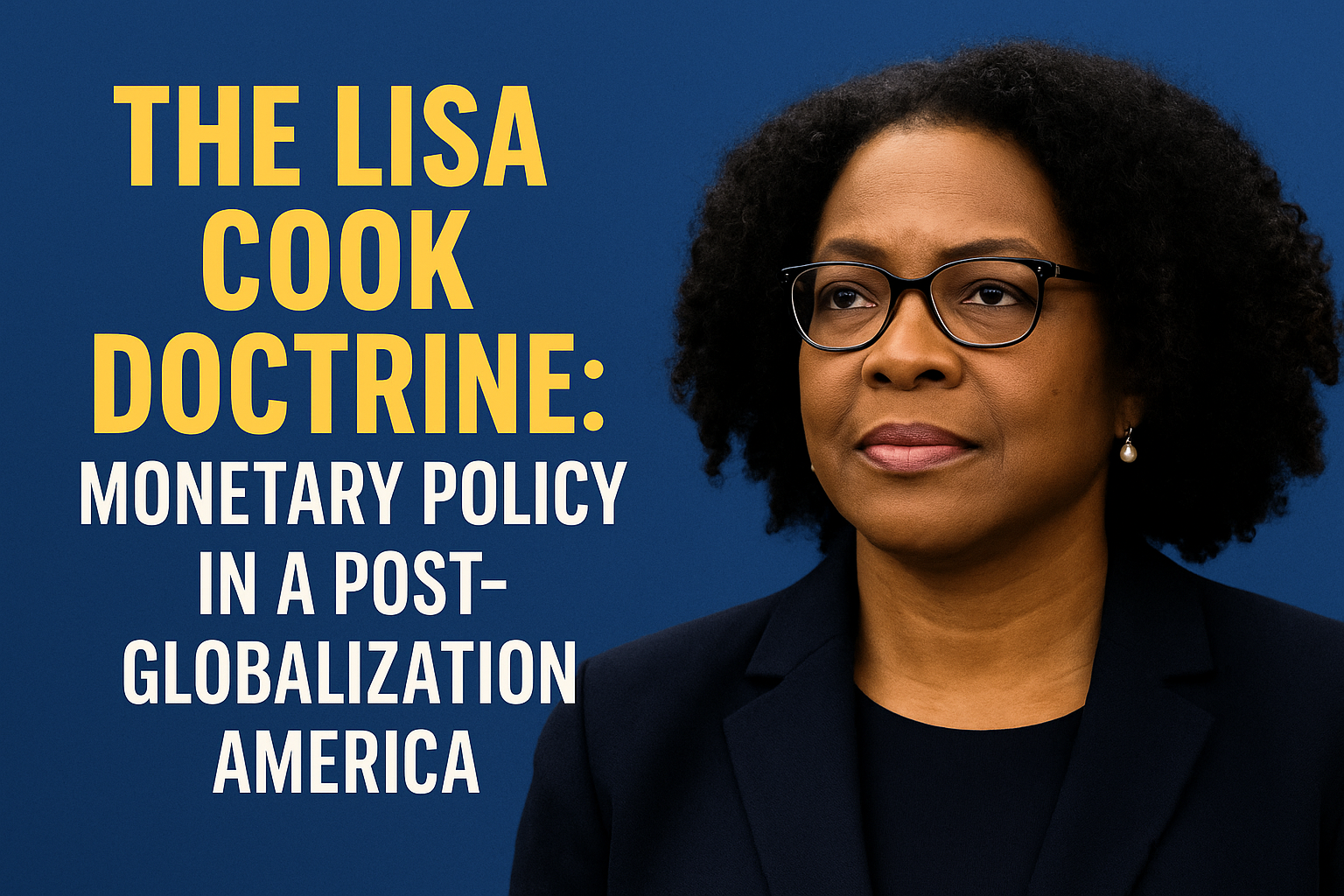
The Lisa Cook Doctrine: Monetary Policy In A Post-Globalization American

“Uncertainty is not an exception—it’s the economy’s new default. Our job isn’t to eliminate risk, but to build institutions resilient enough to thrive within it.” — Dr. Lisa D. Cook, Federal Reserve Governor & Spelman Alumna ’86

When Dr. Lisa D. Cook took the stage at the Council on Foreign Relations for the C. Peter McColough Series on International Economics, it was less a speech and more a declaration: the global economy is fragmenting, technology is compounding that fragmentation, and the Federal Reserve must remain nimble but principled in navigating this emerging disorder.

What makes Dr. Cook’s presence at the Federal Reserve so consequential is not simply her identity as the first African American woman to serve as a governor—though it is significant—but her lens. A lens forged not just through elite academic corridors, but one that dares to understand the edges of America’s economy—its marginalized labor markets, its precarious innovation system, and its uneven globalization. And if her remarks this week are any signal, Dr. Cook is actively shaping a monetary doctrine for this new epoch.

THE FEDERAL RESERVE AND ITS FRACTURED MANDATE

Dr. Cook reminded the audience that the Federal Reserve’s dual mandate—price stability and maximum employment—is being strained by new dynamics. Inflation, while down from pandemic-era peaks, remains stubbornly above target. Headline inflation is at 2.1 percent, core inflation at 2.5 percent—both still above the Fed’s 2 percent goal. On the employment side, job growth is steady, unemployment hovers at 4.2 percent, and labor force participation is not in freefall. But beneath these metrics lies disquiet.

That disquiet is coming from three fronts: trade protectionism, artificial intelligence, and long-term underinvestment in public innovation infrastructure.

In short, America’s economy is at a precipice—caught between inflation imported through tariffs and supply chain fragility, and deflationary pressures driven by automation and labor displacement.

Dr. Cook’s doctrine, it seems, is to hold the center.

TARIFFS: THE RETURN OF ECONOMIC NATIONALISM

Trade policy has re-entered the monetary discourse with a vengeance. For African American economists—and institutions like HBCUs that sit adjacent to both poor communities and international students from across the African diaspora—the discussion is no longer abstract. Dr. Cook underscored that tariffs, while politically popular, have a “nontrivial” inflationary effect.

Tariffs raise prices on imports, which businesses pass to consumers. But more importantly, they alter inflation expectations. And when inflation expectations become “unanchored,” monetary policy loses its credibility—and its traction.

This is not merely an economic concern, but a philosophical one. If the U.S. economy turns inward and abandons international trade cooperation, the financial consequences will not be equally shared. Institutions and people on the margins—like HBCUs, which rely on price-sensitive budgets and internationally sourced equipment—will be among the first to feel the tightening grip.

AI AND THE PRODUCTIVITY PARADOX

Artificial intelligence was one of the few bright spots in Dr. Cook’s analysis. While it introduces short-term labor displacement, it holds medium- to long-term potential for productivity gains, cost containment, and even inflation moderation.

Dr. Cook estimates productivity boosts from AI could range from 1 to 18 percent over the next decade. But this range, she admits, reflects the economic unknowns of the Fourth Industrial Revolution. For African American institutions, the message is twofold: AI will not wait for us to be ready, and without intentional investment in AI literacy and infrastructure, the economic benefits will bypass our communities entirely.

More than that, Dr. Cook emphasized the importance of how AI gets adopted. “It’s not job loss,” she clarified. “It’s task replacement.” The nuance matters. Black workers and businesses must advocate for job redesign, not job removal. This requires an active policy partnership between labor, government, and educational institutions.

HBCUs, with their historical ability to adapt curricula to new economic paradigms, have a window here. The time to build AI research centers, ethics think tanks, and public-private tech fellowships is not tomorrow—it is now.

UNCERTAINTY IS THE NEW NORMAL

Dr. Cook invoked former Fed Chair Ben Bernanke’s guidance: in times of heightened uncertainty, policymakers must plan for multiple scenarios. In Fed speak, this means optionality. In HBCU speak, this means resilience.

The Federal Reserve is not in a rate-cutting mood. Nor is it eager to hike. It is watching. And waiting. And watching some more. “The current stance is balanced,” Dr. Cook affirmed. “But that balance could shift in either direction.”

For HBCU leadership—especially those managing endowments, student financial aid disbursements, or capital investment strategies—this moment requires uncommon dexterity. Inflation could reaccelerate. Or the economy could cool into a stagflationary trap. The key is planning for a 2 percent interest world and a 6 percent one.

INNOVATION: TWENTY YEARS TO FRUITION

Perhaps the most poignant segment of Dr. Cook’s remarks came not from inflation or tariffs or AI—but from her reflections on innovation and time.

“It can take twenty years or more,” she noted, “from the time a student conceives an idea to the point it becomes a product on the market.”

That is a sobering timeline. And it is why public investment in basic research, early-stage science, and academic freedom matters so much. The ecosystem that birthed Silicon Valley started with small government grants, eccentric professors, and graduate students with uncertain job prospects.

For HBCUs, the lesson is urgent: waiting for federal investment in Black innovation ecosystems is no longer tenable. Institutions must pool their resources, coordinate R&D pipelines, and build their own version of the National Science Foundation if need be.

Tuskegee University had its agricultural labs. Howard had its medical research. North Carolina A&T and Prairie View have their engineering corridors. But the next phase of Black institutional development must consolidate these assets into a coordinated force, backed by investment funds, intellectual property banks, and patent commercialization arms.

THE GLOBAL BACKDROP: COORDINATION WITHOUT UNITY

On the global stage, Dr. Cook walked a careful line. She acknowledged that while central banks maintain regular dialogue—through G-7, G-20, OECD platforms—there is no grand consensus. Different countries have different mandates. The European Central Bank is laser-focused on inflation. The Bank of Japan must navigate currency volatility. The People’s Bank of China has geopolitical motives laced through its monetary calculus.

The Federal Reserve cannot outsource its decisions to global peers. But it can learn from them.

For African American policy circles and HBCU economics departments, this is a call to global literacy. We must teach our students to read the central bank minutes from Frankfurt, London, and Accra as readily as they read those from Washington.


INSTITUTIONAL IMPLICATIONS FOR HBCUs

What, then, should HBCU presidents, CFOs, and policy offices take from Dr. Cook’s remarks?

  1. Protect Purchasing Power
    Inflation—especially if prolonged—can erode real endowment spending. HBCUs must explore inflation-hedged assets, indexed tuition strategies, and energy-efficient infrastructure.
  2. Reimagine Labor Pipelines
    AI and global trade will redefine job descriptions. HBCUs must preemptively build training programs, certification pathways, and innovation hubs aligned with the labor market of 2030—not 2010.
  3. Internalize Innovation
    If innovation takes 20 years, then we must stop relying on outside institutions to fund our intellectual property journey. We must build our own innovation endowments, grant programs, and incubators.
  4. Globalize Strategically
    As America turns inward, HBCUs must look outward—toward African economies, Caribbean partnerships, and Latin American markets. Diversifying donor bases, research collaborations, and student recruitment internationally is no longer luxury. It is imperative.
  5. Endowment Defense Against Rate Risk
    Whether rates rise or fall, HBCU financial managers must adopt more active duration management strategies and review fixed income allocations accordingly.

FINAL THOUGHT: THE JUDGMENT ECONOMY

Dr. Cook’s final words were a reminder that even in an era of algorithms and quantitative models, human judgment remains central.

The economy cannot be automated. And neither can policy. The strength of institutions, including the Federal Reserve, still rests on the character and clarity of its leaders.

For HBCUs and African American institutions broadly, Dr. Cook’s rise—and her vision—should be both inspiration and instruction. It is not enough to be present in the room. One must bring a philosophy. A framework. A doctrine.

The Lisa Cook Doctrine, if there is one, is clear: do not panic, do not stagnate, and never underestimate the power of intentional innovation guided by principled policy.

In an uncertain world, that kind of leadership is the rarest form of capital.

African America’s May 2025 Jobs Report – 6.0%

Overall Unemployment: 4.2%

African America: 6.0%

Latino America: 5.1%

European America: 3.8%

Asian America: 3.6%

Analysis: European Americans’ unemployment rate has remained steady for four straight months with virtually no change in unemployment rate. Asian Americans increased 60 basis points and Latino Americans decreased 10 basis points from April, respectively. African America’s unemployment rate decreased by 30 basis points from April. Unemployment rates across all groups seem to be leveling off despite 

AFRICAN AMERICAN EMPLOYMENT REVIEW

AFRICAN AMERICAN MEN: 

Unemployment Rate – 5.2%

Participation Rate – 68.5%

Employed – 9,869,000

Unemployed – 540,000

African American Men (AAM) saw a decrease in their unemployment rate by 40 basis points in May. The group had a noticeable decrease in their participation rate in May by 70 basis points. African American Men lost 48,000 jobs in May and saw their number of unemployed drop by 47,000.

AFRICAN AMERICAN WOMEN: 

Unemployment Rate – 6.2%

Participation Rate – 61.7%

Employed – 10,332,000

Unemployed – 684,000

African American Women saw an increase in their unemployment rate by 10 basis points in May. The group increased their participation rate in May by 50 basis points. African American Women added 72,000 jobs in May and saw their number of unemployed increase by 21,000.

AFRICAN AMERICAN TEENAGERS:

Unemployment Rate – 14.4%

Participation Rate – 27.9%

Employed – 641,000

Unemployed – 108,000

African American Teenagers unemployment rate decreased by 520 basis points. The group saw their participation rate decreased by 40 basis points in May. African American Teenagers added 31,000 jobs in May and saw their number of unemployed also decrease 41,000.

African American Men-Women Job Gap: African American Women currently have 463,000 more jobs than African American Men in May. This is an increase from 344,000 in April.

CONCLUSION: The overall economy added 139,000 jobs in May while African America added 56,000 jobs. From CNBC, “Nearly half the job growth came from health care, which added 62,000, even higher than its average gain of 44,000 over the past year. Leisure and hospitality contributed 48,000 while social assistance added 16,000. On the downside, government lost 22,000 jobs as efforts to cull the federal workforce by President Donald Trump and the Elon Musk-led Department of Government Efficiency began to show an impact.”

Source: Bureau of Labor Statistics

This Week in the Economy: May 26–30, 2025

Tracking Black Economic Stakes in America’s Economic Indicators and Central Bank Signals

Monday, May 26 – Memorial Day

No scheduled economic events
While markets rest, Black workers—especially in essential sectors—continue to labor under wage suppression. National holidays often illuminate persistent labor disparities where African Americans overrepresent in underpaid, underprotected service roles.


Tuesday, May 27

  • Minneapolis Fed President Neel Kashkari Speech (Tokyo, 4:00 AM & 8:00 PM ET)

Known for his dovish leanings, Kashkari may highlight global risks to U.S. growth. For African Americans, particularly those vulnerable to job cuts in an economic slowdown, his tone on future rate cuts is critical.

  • Durable-Goods Orders (Apr): -7.8% (Prev: +9.2%)

A sharp plunge signals weakening investment and manufacturing demand. This contraction could hit Black industrial workers and logistics employees, especially those in Southern and Midwestern states.

  • Durable-Goods Minus Transportation (Apr): Data Pending

A flat reading here would confirm broad weakness beyond aerospace and autos, hurting smaller suppliers and minority-owned industrial businesses.

  • Case-Shiller Home Price Index (Mar): Data Pending (Prev: +4.5%)

Rising home prices continue to push African Americans out of first-time homeownership, especially in major urban markets like Atlanta, D.C., and Charlotte, where HBCU alumni are concentrated.

  • Consumer Confidence (May): 86.0 (No Change)

Flat confidence underscores persistent economic anxiety. For Black households carrying higher debt loads and experiencing lower wealth levels, stagnation in sentiment suggests limited consumption growth and continued vulnerability.


Wednesday, May 28

  • Minneapolis Fed President Neel Kashkari Speech (Tokyo, 4:00 AM ET)

Expect continued remarks on global financial coordination. The impact of any global tightening or deflation trends could ripple into U.S. credit markets, disproportionately hurting communities already locked out of affordable loans.

  • FOMC Meeting Minutes (2:00 PM ET)

This will reveal how serious the Fed is about easing policy. Delay in rate cuts prolongs high borrowing costs, keeping homeownership and business investment out of reach for many African Americans and HBCUs.


Thursday, May 29

  • Initial Jobless Claims (May 24): 228,000 (Prev: 227,000)

Minimal movement masks deeper problems; Black unemployment remains higher than national averages, and layoffs still skew toward underrepresented groups in precarious industries.

  • GDP (Q1 First Revision): -0.3%

A contracting economy, even marginally, means slower hiring and investment. For African American workers and business owners already operating with less margin for error, the pressure will rise.

  • Richmond Fed President Tom Barkin Speech (8:30 AM ET)

Representing a region with many HBCUs and Black rural towns, Barkin’s remarks could preview whether the Fed sees these communities as economic priorities or statistical footnotes.

  • Pending Home Sales (Apr): -0.4% (Prev: +6.1%)

Slumping pending sales point to ongoing housing market stress. This especially harms African American families trying to transition from renters to owners amid high mortgage rates.

  • Chicago Fed President Austan Goolsbee Speech (10:40 AM ET)

Goolsbee’s economic pragmatism could bring a dose of realism on inequality. If he signals concern over underperformance in low-income markets, that could hint at future support for inclusive growth.

  • Fed Governor Adriana Kugler Speech (2:00 PM ET)

Kugler may touch on labor market disparities and wage equity. Her background in labor economics makes her one of the more likely Fed voices to mention economic stratification directly.

  • San Francisco Fed President Mary Daly Speech (4:00 PM ET)

Daly often discusses inclusion and systemic barriers—her speech could reinforce the need for policy tools that close gaps in employment, housing, and education for Black communities.

  • Dallas Fed President Lorie Logan Speech (8:25 PM ET)

Logan oversees a region with growing Black populations in cities like Dallas and Houston. Her take on regional growth and monetary policy could influence credit access and labor demand in these hubs.


Friday, May 30

  • Personal Income (Apr): +0.3% (Prev: +0.5%)

Income growth slowing means wage pressures are easing—a problem for African American households already earning less and struggling with rising living costs.

  • Consumer Spending (Apr): +0.2% (Prev: +0.7%)

Weaker spending growth reflects household caution. Black consumers, often with fewer financial safety nets, are pulling back out of necessity—not choice.

  • PCE Index & Core PCE (Apr): +0.1% | YoY PCE: 2.2%, Core: 2.6%

Inflation is slowing but still above target. High price persistence in areas like housing and food continues to affect African American families, who spend a larger share of income on essentials.

  • Advanced U.S. Trade Balance (Apr): Data Pending (Prev: -$163.2B)

A massive trade deficit signals continued reliance on imports. U.S.-based Black manufacturers and exporters remain sidelined by structural inequalities in scale, capital, and global market access.

  • Advanced Retail Inventories (Apr): Data Pending (Prev: -0.1%)

Inventory declines suggest caution among retailers, which could mean reduced orders for minority-owned suppliers and less hiring in warehouse/logistics sectors with strong Black labor representation.

  • Advanced Wholesale Inventories (Apr): Data Pending (Prev: +0.4%)

If inventories keep rising, distributors may slow purchasing cycles, tightening cash flow for small suppliers—particularly those without banking relationships or supplier diversity contracts.

  • Chicago Business Barometer (PMI, May): 45.5 (Prev: 44.6)

A sub-50 reading indicates contraction. For African American professionals and businesses in Midwest metro markets, sluggish growth can stall economic progress and widen existing gaps.

  • Consumer Sentiment (Final, May): 50.8

Still hovering at recessionary levels, sentiment continues to reflect fear. Among Black households facing persistent inflation and limited safety nets, pessimism may trigger more cautious economic behavior.

  • San Francisco Fed President Mary Daly Speech (4:45 PM ET)

Her final remarks of the week may reinforce the theme of inclusive recovery—or warn of economic divergence. Either way, Daly remains a Fed leader worth watching for HBCU communities and Black policymakers.


HBCU Money Insight:
This week’s economic data confirms what many in Black America already feel—stagnant wages, expensive goods, and unaffordable homes. Despite easing inflation, the lack of meaningful policy response to racial economic disparities remains glaring. As Fed voices speak from Tokyo to Texas, the African American economy remains in the shadows of the headlines.

This Week in the Economy: May 19–23, 2025

Centering the Black Economic Lens on Federal Reserve Movements and Economic Indicators


Monday, May 19

  • New York Fed President John Williams Speech (8:45 AM ET)

Williams’ comments on inflation and growth will be closely watched. As a key voice in rate-setting, any hawkish signals could delay relief for African American borrowers already paying higher credit premiums.

  • Fed Vice Chair Philip Jefferson Speech (8:45 AM ET)

Jefferson, the Fed’s first African American Vice Chair, may emphasize equitable employment and inclusive policy. His framing will matter for HBCUs and Black communities relying on federal support and labor stability.

  • U.S. Leading Economic Indicators (Apr): -0.9% (Prev: -0.7%)

A steeper decline signals weakening momentum. This typically translates into fewer job openings, reduced wage growth, and tighter lending—especially damaging for African American workers and businesses still lagging in recovery.


Tuesday, May 20

  • Richmond Fed President Tom Barkin Speech (9:00 AM ET)

Barkin’s region includes southern states with high African American populations. His insights could indicate whether regional policy and economic support are filtering down to underserved communities.

  • Boston Fed President Susan Collins at Fed Listens (9:30 AM ET)

One of the few women of color leading a Fed bank, Collins’ presence at Fed Listens may bring attention to community feedback. Expect mentions of wealth inequality, which remains sharpest for Black Americans.

  • St. Louis Fed President Alberto Musalem Speech (1:00 PM ET)

As a new voice in the Fed, Musalem’s outlook could influence policy leanings that shape access to capital—particularly relevant in Missouri and the Mississippi Delta region, home to several HBCUs and Black rural communities.

  • Fed Governor Adriana Kugler Speech (5:00 PM ET)

Kugler’s focus on inclusive employment metrics may touch on disparities in Black unemployment and wage stagnation, helping guide equitable macroeconomic planning.


Wednesday, May 21

  • Fed Listens Event: Barkin & Bowman (12:15 PM ET)

These sessions are critical opportunities to elevate Black institutional voices—including HBCUs, Black banks, and civil society groups. The listening format also reflects whether the Fed is serious about closing racial wealth gaps through policy.


Thursday, May 22

  • Initial Jobless Claims (May 17): 230,000 (Prev: 229,000)

Little movement here masks a troubling truth: Black unemployment remains higher than national averages, and layoffs in service sectors often disproportionately affect African American workers.

  • S&P Flash U.S. Services PMI (May): 50.8 (Same as Forecast)

Marginal growth in services is a mixed bag. Black-owned service businesses may benefit from stable demand, but credit costs and supply chain inflation continue to eat into profits.

  • S&P Flash U.S. Manufacturing PMI (May): 49.8 (Below Forecast)

Contracting manufacturing output threatens industrial jobs—especially for African Americans in urban centers with historic manufacturing legacies and ongoing economic vulnerability.

  • Existing Home Sales (Apr): 4.12M (Prev: 4.02M)

An uptick in sales signals improved market activity, but high interest rates still lock out many African Americans from homeownership, exacerbating wealth inequality.

  • New York Fed President John Williams Speech (2:00 PM ET)

Williams’ second appearance may reinforce key monetary themes. If inflation remains the top concern, interest rates are unlikely to fall—delaying housing and business growth in communities that need it most.


Friday, May 23

  • Kansas City Fed President Jeff Schmid Speech (9:35 AM ET)

The Kansas City district includes Black communities in the Midwest. A pro-growth message from Schmid could be welcomed news for those hit hardest by disinvestment and population loss.

  • New Home Sales (Apr): 700,000 (Forecast: 724,000)

Falling slightly short of expectations, new home sales remain sensitive to mortgage rates. Limited access to credit and developer capital continues to stall Black homeownership and real estate entrepreneurship.

  • Fed Governor Lisa Cook Speech (12:00 PM ET)

The only African American woman on the Fed Board, Cook consistently advocates for equitable economics. Her remarks will likely address systemic financial exclusion and how monetary tools can close racial wealth gaps.


Sunday, May 25

  • Fed Chair Jerome Powell Commencement Address (2:40 PM ET)

Though ceremonial, Powell’s remarks will be widely covered. If he speaks to opportunity and equity, HBCUs and Black institutions can press for tangible follow-through in monetary policy and research funding.


HBCU Money Insight:
This week offers a mix of sobering and symbolic moments. With inflation slowing but economic indicators weakening, the question remains whether the Fed can pivot without sidelining Black workers, entrepreneurs, and institutions. For HBCUs and Black policymakers, these events are an opportunity to press for policy that doesn’t just stabilize the economy—but transforms who it works for.