Tag Archives: hbcu philanthropy

When the Gift Isn’t the Power: Prairie View’s Historic Donations and the Quiet Reality of UTIMCO Control

“A gift can open a door, but only ownership lets you walk through it on your own terms.”
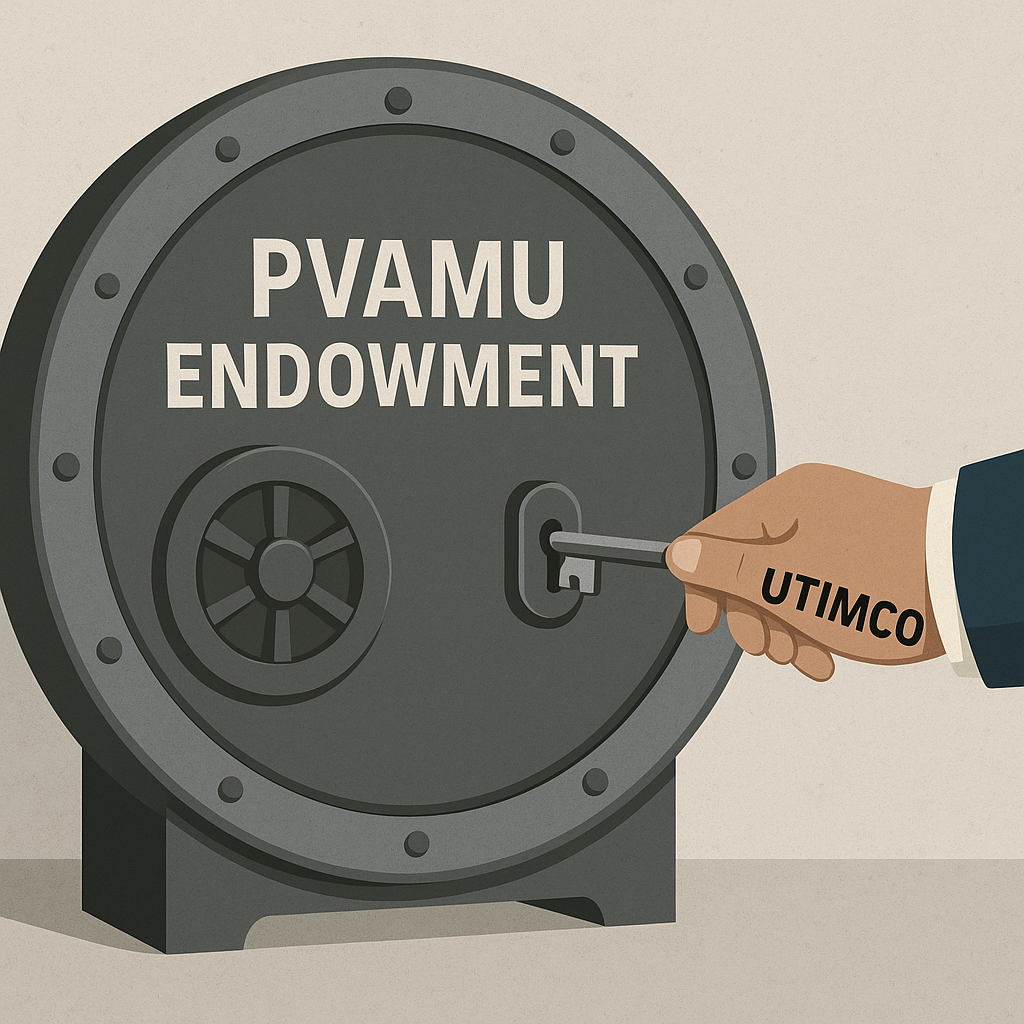
When Prairie View A&M University announced that it had received a historic $63 million unrestricted gift from philanthropist MacKenzie Scott, headlines celebrated the moment as a watershed for the institution, the Texas A&M University System, and the broader HBCU sector. It was framed as both a moral recognition of PVAMU’s legacy and a financial turning point that would catalyze new academic, cultural, and research frontiers.

And yet, behind the applause and the very real gratitude there remains a more sobering, structural reality: Prairie View does not actually control its capital. The university’s endowment, like that of all Texas A&M System schools, is controlled and managed by UTIMCO, the University of Texas/Texas A&M Investment Management Company. UTIMCO is one of the largest public endowment management entities in the United States, overseeing well over $70 billion in assets. It is powerful, sophisticated, and critically not directly accountable to Prairie View’s leadership or the African American community whose future PVAMU represents.

This is the overlooked truth in the philanthropic triumph narrative: historic gifts do not necessarily translate into historic power. And power, not simply capital, is the currency African American institutions have always lacked most in the American economic order. Prairie View A&M University’s situation is a case study in the difference.

This article explores:

  • Why Prairie View’s record-setting gift still leaves it structurally dependent
  • How UTIMCO’s control restricts the institution’s long-term sovereignty
  • What this tells us about HBCU philanthropy and institutional design
  • Why African American institutional power requires ownership, not just funding
  • What steps Prairie View, other public HBCUs, and African American philanthropists can take to change the paradigm

This is not about questioning the value or impact of MacKenzie Scott’s generosity. It is about ensuring that gifts to African American institutions actually translate into durable, compounding power not momentary uplift that still sits under someone else’s governance.

The Gift Was Unprecedented—But the Structure Wasn’t

MacKenzie Scott’s philanthropic investments in Prairie View were transformational by any measure. Unrestricted capital is rare. Unrestricted capital at that scale is almost unheard of for HBCUs. Prairie View announced bold plans: initiatives in student success, research expansion, recruitment of top scholars, and community-facing programs that would have immediate impact.

However, beneath these aspirational goals lies a structural constraint. As a member of the Texas A&M University System, Prairie View’s endowment assets are not independently managed. Instead, they are placed under UTIMCO stewardship.

This means:

  • Prairie View cannot choose its own investment strategy
  • Prairie View cannot decide its own risk profile
  • Prairie View cannot determine long-term reinvestment philosophies
  • Prairie View cannot directly leverage its endowment as collateral or strategic capital
  • Prairie View has limited input into how its own financial future is shaped

Prairie View is wealthy in name, but not in governance. This is the difference between having money and having power.

Why UTIMCO Control Matters

UTIMCO is a financial powerhouse. It runs an endowment strategy modeled on the “Yale model” of diversified, high-yield, alternative-asset heavy investing. Its size gives it access to premier private equity, hedge funds, venture capital, and global asset vehicles that smaller endowments could never reach. But Prairie View is not UTIMCO’s strategic priority. And Prairie View does not have representation proportionate to its needs, mission, or history on the governance side of the investment enterprise.

The problems with this arrangement are structural, not personal:

1. Prairie View’s capital becomes part of a system that does not share its cultural mission.

UTIMCO’s fiduciary responsibility is to the entire system—primarily UT Austin and Texas A&M University, the two flagship institutions with the largest political influence and endowment weight.

2. Prairie View does not benefit proportionately from its own growth.

When UTIMCO’s investments outperform, the rising tide lifts the entire system but Prairie View’s small allocation does not allow it to meaningfully influence direction or capture outsized opportunity.

3. Prairie View is locked out of using its endowment to build independent institutional leverage.

For example:

  • Launching Prairie View–controlled venture funds
  • Building independent real-estate portfolios
  • Creating sovereign partnerships with African universities
  • Developing major research parks or revenue-producing assets
  • Issuing bonds based on endowment performance
  • Using the endowment to create a Prairie View Development Corporation
  • Deposit into African American Owned Banks

These are the exact strategies that allow elite institutions to become global players. Without endowment control, Prairie View cannot follow the same playbook.

4. African American institutional power remains externally governed.

Even when philanthropy flows to us, governance does not.
This is the core dilemma.

The Limits of Public-Sector HBCU Philanthropy

Public HBCUs occupy an uncomfortable position in American philanthropy. They exist inside systems created by and for institutions that do not share their origin story, demographic composition, or cultural mission. As a result, public HBCUs rarely benefit from the full compounding power that large donations should create. A $63 million donation to a private HBCU with full endowment control is a generational shift. A $63 million donation to a public HBCU inside a state-controlled investment empire is uplift but not sovereignty. The structure, not the gift itself, limits the long-term multiplier effect.

The True Power of an Endowment Is Governance, Not Size

The most elite universities such as Harvard, Yale, Stanford understand that the endowment is not merely a pot of money. It is the engine of independence, the foundation of strategic risk-taking, and the vault that allows them to pursue multi-century planning horizons. Prairie View’s endowment, while larger than before, becomes one more line item inside a massive investment entity whose priorities were never designed around the empowerment of African American institutions.

This raises fundamental questions:

  • If Prairie View doubled or tripled its endowment, would it gain any more control?
  • If Prairie View received a $500 million gift tomorrow, would it govern that capital?
  • What does “wealth” mean if the institution cannot direct it?

These questions get at the heart of African American philanthropic strategy:
Power is not the receipt of capital it is the control of capital.

Why This Matters for African American Philanthropy

The African American community is entering a new era of giving. Donors both internal and external to the community are showing increased willingness to fund African American institutions, particularly HBCUs. But if those donations sit inside structures that we do not control, then the long-term compounding advantage is lost. Philanthropy that uplifts without empowering is charity. Philanthropy that transfers capital and governance is institution-building. Prairie View deserves the latter. All HBCUs deserve the latter. African America deserves the latter.

What Would It Look Like for Prairie View to Have Full Capital Control?

If Prairie View controlled its own endowment strategy, several catalytic changes could occur:

1. PVAMU could launch its own independent investment office.

This would allow:

  • Hiring Black fund managers
  • Building partnerships with African investment firms
  • Investing directly in Prairie View–based startups
  • Growing an internal investment culture among alumni and students

2. PVAMU could build a multibillion-dollar research and development ecosystem.

The endowment could seed:

  • A Prairie View Innovation Corridor
  • A Black-owned semiconductor research consortium
  • Autonomous vehicle labs
  • Agricultural technology incubators
  • An African Diaspora science and engineering exchange
  • A rural Texas innovation hub exporting expertise globally

3. PVAMU could pursue independent financial engineering strategies.

Including:

  • Issuing bonds based on endowment earnings
  • Creating a real estate trust
  • Launching a PVAMU-controlled venture fund
  • Building a revenue-producing hospital network
  • Constructing Prairie View–owned student housing developments

4. PVAMU could fundamentally reshape African American institutional futures.

With full investment autonomy, Prairie View could become:

  • A national model for Black endowment governance
  • A financial anchor for African American rural communities
  • A bridge between Texas and the global African Diaspora
  • A site of intergenerational wealth-creation for African American students
  • An institution that attracts not only students but developers, scientists, and investors

This is the scale of possibility currently constrained by UTIMCO governance.

What Needs to Change—A Philanthropic and Policy Framework

To transition from uplift to sovereignty, African American leaders, donors, and policymakers must pursue concrete reforms:

1. Public HBCUs must secure special provisions for independent endowment management.

This could include:

  • Carve-outs from state systems
  • Special legislative exemptions
  • Hybrid governance models where system oversight continues but investment control shifts with the ultimate goal of full sovereignty

2. Large donors should explicitly require endowment autonomy as part of major gifts.

Imagine if MacKenzie Scott had stipulated:

“This gift must be placed in a separately managed fund controlled solely by Prairie View A&M University and its own designated board of trustees.”

That single sentence would have changed the institution’s next 100 years.

3. Prairie View alumni must build parallel philanthropic capital pools.

This includes:

  • Alumni-controlled investment funds
  • Prairie View-specific donor-advised funds
  • Community investment vehicles
  • A Prairie View Cooperative Endowment Fund

These independent vehicles can partner with but not be controlled by state systems.

4. National African American institutions must lobby for HBCU endowment independence.

A single policy shift could alter the landscape for every public HBCU:

Public HBCUs must have governance authority over capital donated specifically to them.

A Moment of Truth for HBCU Philanthropy

Prairie View’s historic gift was a moment of celebration—but also a moment of clarity. If African American institutions cannot control the endowments gifted to them, then the path to sovereignty remains blocked.

The philanthropic sector must confront this truth:

We cannot build African American power without African American control of African American capital.

Prairie View A&M University has always carried a dual identity, an HBCU of national importance inside a system not built for it. The generosity of donors like MacKenzie Scott can change the scale of Prairie View’s work, but only structural reform can change the nature of Prairie View’s power. The next era of HBCU philanthropy cannot simply be about larger gifts. It must be about gifts that come with governance, strategy, and autonomy.

Because endowments don’t build institutions.
Endowment sovereignty does.

Disclaimer: This article was assisted by ChatGPT.

When the Numbers Don’t Add Up: Shannon Sharpe’s $10 Million Settlement (Offer) and Savannah State University’s $12 Million Endowment

“If we don’t support our own institutions, who will? Our future depends on it.” – Dr. Johnnetta B. Cole

In a society where celebrity controversy often overshadows institutional legacy, the recent $10 million legal settlement offer by Shannon Sharpe is notable not just for its allegations, but for what it inadvertently reveals about the chasm between Black celebrity wealth and the underfunded institutions that shape it.

Sharpe, an NFL Hall of Famer turned sports media luminary, is embroiled in a sexual assault lawsuit in April 2025 that has added fuel to the fodder over his public image for years. The allegations, dating back to 2021, accused him of sexual assault and misconduct. Though the terms of the settlement do not admit guilt, the figure—$10 million—is enough to reverberate well beyond the courtroom. Particularly for Savannah State University, Sharpe’s alma mater, whose entire endowment hovers just north of $12 million.

That a single lawsuit settlement could nearly eclipse the full financial endowment of a university—an institution that has educated generations of Black students since its founding in 1890—demands attention. It is more than legal coincidence; it is cultural commentary. Sharpe’s settlement and Savannah State’s endowment share more than proximity in value—they reflect a profound misalignment between individual Black success and collective Black institutional health.

Celebrity Capitalism vs. Institutional Capital

Sharpe’s alleged settlement offer arrives at a time when he is more visible than ever. From ESPN panels to viral podcast interviews, he has crafted a new media identity grounded in charisma, cultural commentary, and athletic credibility. He is a multimillionaire many times over, and for much of the public, a figure of Black excellence.

And yet, while the scandal has put his reputation into question, the institutional damage is more structural than sensational. Savannah State University, like most HBCUs, remains chronically underfunded. In Georgia, the flagship University of Georgia enjoys an endowment exceeding $1.8 billion. Savannah State’s $12 million looks less like a war chest than a coin jar.

This contrast is not unique. Harvard’s endowment, currently over $50 billion, generates more passive income in a single day than most HBCUs earn annually. Meanwhile, Black cultural, entertainment, and sports figures continue to accumulate individual wealth—largely without corresponding reinvestment in the institutions that launched their journeys.

In Sharpe’s case, it is particularly jarring. He has long spoken with pride about Savannah State, often positioning his ascent from a small HBCU to NFL stardom as proof of grit, talent, and perseverance. But the question remains: can Black America afford to celebrate individual ascent while its institutions struggle to survive?

Institutions as the Forgotten Priority

The logic of endowments is simple: they are long-term capital. Through careful management, they yield investment income that sustains a university’s operations—faculty salaries, scholarships, research grants, infrastructure. A $12 million endowment, assuming a 5% annual drawdown, provides just $600,000 per year. That’s not enough to fund a single major building renovation or hire a cohort of tenure-track faculty.

Yet for a fraction of what he has paid in legal settlements, Sharpe—or any number of successful HBCU alumni—could fundamentally change the trajectory of such institutions. This is not to single out Sharpe, but to highlight the imbalance. In an ideal world, the very wealth that is now being paid out in settlements would be instead building libraries, research labs, and scholarship funds.

This tension is particularly visible among athletes and entertainers. Black America’s most visible ambassadors often emerge from institutions that are themselves invisible in the national philanthropic conversation. According to UNCF, the combined endowments of all HBCUs total less than $5 billion. The Ivies, by contrast, hold over $200 billion in endowment assets.

Culture, Crisis, and the Limits of Individualism

Sharpe’s settlement speaks to more than a personal reckoning—it is a cultural moment. It raises questions about power, accountability, and how society arbitrates guilt and innocence outside the courtroom. But for the Black community, it should also prompt deeper reflection on how fame and fortune are managed—and how institutions are too often left behind.

There is a troubling pattern: institutions that produce Black talent are celebrated in name, while being abandoned in practice. Alumni homecomings become nostalgic affairs, rich in ritual but poor in revenue. HBCUs are used as cultural references in music and fashion, but rarely as investment priorities.

The result is that even as African Americans make gains in representation and cultural power, their institutions remain at risk of irrelevance or collapse. The stakes are not merely educational—they are existential. Without strong institutions, there can be no sustainable community power.

What a $10 Million Gift Would Mean

Imagine instead that $10 million were a donation, not a payout. At Savannah State, that amount would nearly double the endowment overnight. It could launch a center for Black media studies, a school of sports journalism, or fund full scholarships for dozens of students. It could digitize archives, attract talent, and fund study-abroad programs that broaden horizons.

Better yet, it could serve as a challenge grant—a call for other high-profile HBCU alumni to match it, dollar for dollar. Such a campaign could transform the entire financial landscape of HBCUs in a single generation.

There is precedent. Oprah Winfrey’s $13 million donation to Morehouse College, Robert F. Smith’s debt forgiveness gesture at Morehouse’s graduation, and Reed Hastings’ $120 million donation to Spelman, Morehouse, and UNCF during the racial reckoning of 2020 showed what’s possible. But sporadic generosity is not a strategy. What’s needed is a systemic culture of giving—an institutional ethos that reorients Black wealth toward Black infrastructure.

Moving from Scandal to Structure

Sharpe, like many public figures, is navigating a complex personal and professional moment. Settling a case of this magnitude inevitably invites scrutiny. But what comes next is more important. Can this moment be a catalyst—not just for personal reflection, but for public responsibility?

Celebrity scandals are ephemeral. Institutions, if cared for, are permanent. The opportunity now is for Sharpe—and others in similar positions—to pivot toward legacy-building. That means using their platforms not only to defend their names, but to elevate their alma maters. To protect not just brand equity, but intellectual capital. To trade spectacle for structure.

A Future Worth Investing In

Savannah State University is not just a school—it is a symbol of survival, intellect, and potential. Its alumni include judges, scientists, teachers, engineers, and businesspeople. It deserves more than to be a footnote in a celebrity controversy. It deserves capital, vision, and strategic philanthropy.

In the end, the numbers don’t lie. A $10 million lawsuit may capture headlines. But a $12 million endowment defines futures. The question is not what Shannon Sharpe did or didn’t do—but what he and others like him will do next.

If fame is fleeting and fortune unpredictable, then perhaps the wisest investment is the one that cannot be taken away: the institutions that built you.

12 Things Your HBCU Alumni Association/Chapter Needs To Do To Be Financially Successful

“Planning is bringing the future into the present so that you can do something about it now.” – Alan Lakein

Far too many HBCU Alumni Associations and Chapters have been asleep at the wheel for far too long financially. They have conducted themselves like a child who says they want to start a lemonade stand, but refuses to take the time to make a plan of acquiring lemons, sugar, water, and certainly not building a lemonade stand. There is more time spent playing with their friends and then seemingly complaining that their friends do not support their lemonade stand – that does not exist. It is enough to drive one mad. We have laid out twelve steps that HBCU alumni associations and chapters need to do to make themselves financially integral and sustainable for the future to meet the financial needs of both African America and the HBCUs they serve.

  1. Move banking accounts to African American owned banks and/or credit unions. It is utterly baffling that HBCUs and HBCU Alumni Associations/Chapters at this point still have not done this very elementary point of economic development given the acute presence of the #BankBlack movement over the past few years. Public HBCUs have more red tape by being state institutions and there are significant political dynamics at play there, but private HBCUs and HBCU alumni associations/chapters at private or public HBCUs at this point simply have no excuse.
  2. Invest in technology, especially financial technology. If HBCU Alumni Associations/Chapters want younger alumni involvement as they claim then they have to come into the 21st century – do you realize we are two decades into the 21st century and some HBCU foundations, alumni associations/chapters do not have a functioning web presence. This is where typically you would insert a mind blown emoji or gif. It is unfathomable and inexcusable at this point. HBCU Alumni Associations/Chapters need a web and social media presence independent of the mother institution for a myriad of reasons that should be readily apparent without great explanation. Alumni associations/chapters can work out an agreement with their schools to create work study that involves social media work and web development for those students who are interested and have the necessary skillset. Otherwise, spend the money and pay for a real web designer and social media manager – it is worth it. Financial technology – accepting payment by Venmo, CashApp, etc. should not be groundbreaking it should be standard. There are a plethora of financial technology available for nonprofit organizations. This should be the job of the treasurer at both the national and chapter levels to find technology that can improve the financial efficiency.
  3. Collect information on your members. Know your association/chapters strengths and weaknesses. If you plan on doing education outreach with your alumni association/chapter, it may help knowing who in the organization that has a background and connections in education. Need to put on an event? It may help to know the alumnus who worked in event planning or knows someone who does. Other information should be household income, level of education, home ownership, etc. The more information the better (we will explain the value of this in another point). But not knowing what assets you have is a dearth of proper planning and strategy.
  4. Write a business plan. If you do not know where you are going, any road will get you there. This opaque behavior is stressfully true with HBCU Alumni Associations/Chapters. We have an alumni association/chapter, now what? Having a written plan of what you want to accomplish, why, and how is paramount to any organization. HBCU Alumni Associations/Chapters are no different. The business plan should be reviewed and updated every 3-4 years to ensure that goals are on track . A review committee made up of internal and external members would be advised.
  5. Create a revenue and investment committee. These can be one committee or two committees, but it needs to exist. Beyond dues, how does the association/chapter plan to make money? Thinking of ways that revenue can be generated and those ideas presented to the association and chapter would be vital. Seriously, because have we not killed the annual golf tournament? Someone on this committee needs to have an investment background and if there is no one in the chapter with it, then invite a local financial adviser to sit on the committee in a volunteer role to help.
  6. Raise dues. There was just a collective gasp from everyone just now. However, creativity. Right now, most associations/chapters charge annual dues of $25-35 annually. Going to a monthly model of $5-10 can skyrocket annual dues revenue to $60-120 which is an increase of over 100 percent in dues revenue and it is an amount that few will miss. Implementing financial technology can allow this to be automated around alumni pay periods.
  7. Produce a newsletter and sale local advertising. Remember the roster of your membership and the data we talked about collecting. This is extremely valuable in putting together a media kit that you can use to sell local advertising in. Most alumni associations/chapters send out newsletters anyway. The ability to monetize that in the most optimal way requires being able to tell potential advertisers who they are reaching. Imagine being able to simply sell ten advertisements a year with twelve month commitments that each pay $50 per month. This is $6,000 in new annual revenue for the chapter from local businesses and relationship building.
  8. Hire a financial adviser. It can be the aforementioned one or a different one, but this also needs to be done. Associations/Chapters should be generating far more income than they do with the collective financial ability at their disposal. As an entity, your association/chapter can have a brokerage account that invest in stocks and bonds – not just sitting in a checking and savings account losing purchasing power. Ensure that the financial adviser is credible. There are even African American brokerage firms that can provide accounts and advising all under one roof. Again, we are not going to fundraise our way to institutional wealth. Our organizations’ money needs to be making money while it “sleeps” because money never sleeps.
  9. Purchase real estate. Now that you have a financial adviser, your chapter should also retain a real estate adviser to help build a rental property portfolio. Remember, we just created $6,000 in new annual revenue via the newsletter. You also raised dues from $25 to $60 and with the $35 surplus on a chapter of just twenty alumni that provides and extra $700 annually. In line with your investment income from your brokerage is also rental income. The association/chapter can focus on purchasing everything from single-family to commercial properties. If chapters purchased near their HBCU, it could help stem off any potential gentrification as many HBCUs are seeing, but in little position to do anything about. They could also purchase real estate locally where their chapter is located. This would provide the association/chapter another stream of revenue and diversified real estate holdings.
  10. Invest in African American small businesses. This could be done in conjunction with African American owned banks/credit unions. If a small business could not qualify for a SBA loan, then the chapter could work out a deal with the bank that would allow them to review the investment on the bank’s recommendation. The chapter would then either invest in the business with equity or provide a loan and act as a shadow lender. We know this is something desperately needed for many African American small businesses who are trying to grow and for some reason or another lack access to traditional financial products. Imagine a local African American kid comes to the bank with the next great social media company, but he needs $38,000 to get it going and does not qualify, but the bank says they have a program that may work to help him. The chapter invest the $38,000 for a 50 percent stake and acts as a passive investor while the kid builds his dream. Why $38,000? This is the amount Mark Zuckerberg and classmate Eduardo Saverin invested to get Facebook off the ground in 2004. A company now worth $840 billion and a 50 percent stake would be worth $420 billion – from a $38,000 investment. Not to mention the potential to secure jobs and internships for your HBCU’s students and alumni as the company grew.
  11. Endow internships at local organizations. HBCU alumni constantly complain about our students not having access to opportunity. Well, now with your new found financial wealth you can buy them access just like everyone else does for their community. The Museum of Natural Science in New York, Miami, Houston, etc. sure do appreciate that $100,000 donation your association/chapter gave them to hire a paid summer internship. The condition? That intern needs to come from your HBCU. Now, a student from your HBCU gets a paid summer internship, work experience in a field of their interest, and most importantly builds their professional network.
  12. Be transparent. Associations and chapters need to ensure that members feel like they know and understand what is going on. Part of this is improving the membership’s financial aptitude through financial literacy so that they understand the decisions being made on some level. Have a quarterly review of the financial portfolio and an annual audit. Trust is vital and for African American organizations that trust is built through transparency.

HBCU Alumni Associations & Chapters should be the symbol of group economics for African America. Instead, the actions have been more hat in hand with the rest of African American organizations who could, but do not leverage their capability. The infrastructure is there for HBCU Alumni Associations & Chapters to be financial forces if the proper financial strategy and plan is implemented. It is time to stop playing and start planning, there is a lemonade stand to build.

HBCU Medical Schools Lead Gifts Of $1 Million Or More To HBCUs in 2015

If you have something to give, give it now. – Mark Bezos

020214 hank aaron CC1

After only one donation of $1 million or more to HBCU in s 2013, in 2014 HBCUs landed an astounding nine, but the upward trend was not to continue. In 2015, HBCUs landed just four of the 530 donations that were of $1 million or more that found there way to American colleges and universities. That equates to 0.75 percent, while HBCUs constitute approximately three percent of the country’s higher education institutions. The nine donations in 2014 were a combined $20.5 million, while 2015’s foursome combined for $7 million.

Leading this year’s donors was Hammerin’ Hank Aaron with a donation of $3 million to the Morehouse School of Medicine. The baseball legend’s donation according to the press release by the school, “will be used to expand the Hugh Gloster Medical Education building and create the Billye Suber Aaron Student Pavilion.” However, the wealthiest donor among the group was billionaire Bill Gross, co-founder of the PIMCO investment firm with $1.5 trillion in assets under management, and his wife. Their donation was second among the group with a $2 million gift to Charles Drew University of Medicine & Science. HBCU medical schools are leaders within the HBCU research community constituting three of the top ten HBCU research institutions. These donations should only strengthen that resolve.

With African American owned banks seeing a huge engagement in 2016, it is possible that this may translate to institutional investments for HBCUs if the seeds of current sentiment are nurtured by leadership. This is an opportunity that HBCUs simply can not afford to miss, both financially and socially. Especially considering the higher education arms race for donors and the top four HWCU/PWI donations totaling $950 million in 2015. Building relationships with African American athletes and entertainers as donors as well as looking abroad in the African Diaspora would greatly increase the possibility of landing more of the eight and nine figure donations that are desperately needed.

The growth in the number of $1 million or more donations is a positive if it continues, but the amounts as well need to see dramatic increases as well for us to make sure our institutions are viable for generations to come.

1. Hank Aaron – $3 Million
Recipient: Morehouse School of Medicine
Source of Wealth: Transportation

2. William H. & Sue Gross – $2 Million
Recipient: Charles Drew University of Medicine & Science
Source of Wealth: Finance, Investments

3. Charles Barkley – $1 Million                                                                     Recipient: Morehouse College
Source of Wealth: Entertainment

4. Jimmie Edwards – $1 Million                                                                          Recipient: Dillard University
Source of Wealth: Chemicals

Source: The Center for Philanthropy

Nine Donations Of $1 Million Or More Find Their Way To HBCUs in 2014

Trammell_CrowPhoto

Never respect men merely for their riches, but rather for their philanthropy; we do not value the sun for its height, but for its use. – Gamaliel Bailey

There was thankfully almost no where to go but up after The Center for Philanthropy’s 2013 database reported HBCUs garnered only one $1 million or more donation out of the 559 to colleges and universities. However, with overall $1 million or more donations in 2014 to colleges and universities down 7.5 percent there was not much expectation that HBCUs would see a substantial increase from the previous year. Yet, a substantial increase there was as nine donations of $1 million or more found their way into HBCU hands out of the 517 to colleges and universities in 2014. This represents an increase from 0.2 percent to 1.7 percent of the overall donations year over year.

It is not all glitter and gold though. The gap between the top donations to HBCUs vs. HWCUs highlights both the institutional and household wealth gap that persist in this country. Combined, the nine donations totaled an impressive $20.5 million for HBCUs. Unfortunately if you take the top nine to HWCUs that number is $1.2 billion or 56 times greater. The gap between the largest donations is even bigger. Harvard University received a $350 million gift, while Paul Quinn College received a $4.4 million gift or an amount almost 80 times less. Transformative donors who can change the paradigm of an entire institution with one donation are much harder to come by for HBCUs. Transformative donations can be different amounts for different size institutions, but the definition lends itself to a minimum of $50 million and above for HBCUs. A figure that would double the bottom half of the top ten HBCU endowments and move the needle double digits on the upper half of the top ten HBCU endowments.

So what is holding back these transformative donations to HBCUs? A myriad of factors. Most transformative donors are titans of industry throughout America and the world. Their ownership in corporations and investments lends them the wealth to do such. African America’s disproportionate labor presence in the public sector where incomes are limited, lack of entrepreneurship, and lack of overall investment in our own institutions often aborts the ability for capital to circulate in African America. However, as more HBCUs are creating entrepreneurship centers on their campuses this could prove in the long-term a positive shift. In the short term, there has to be more emphasis on securing donations from the likes of African American celebrities willing to both give seven figure donations and lend their public capital to the institutions in the way of attracting more donors. That is if HBCUs can throw off their issues of being donor image conscious.

The growth in the number of $1 million or more donations is a positive if it continues, but the amounts as well need to see dramatic increases as well for us to make sure our institutions are viable for generations to come.

1. Trammell S. Crow – $4.4 Million
Recipient: Paul Quinn College
Source of Wealth: Family wealth, Real estate

2. Alfred C. Liggins – $4 Million
Recipient: Howard University
Source of Wealth: Media and entertainment

3. Ada Cecilia Collins Anderson – $3 Million                                                  Recipient: Huston-Tillotson University
Source of Wealth: Insurance, Real estate

4. Anonymous – $2.1 Million                                                                          Recipient: Virginia Union University
Source of Wealth: N/A

5. Anonymous – $2 Million                                                                             Recipient: Stillman College
Source of Wealth: N/A

6. Steve and Anne Pajcic – $2 Million                                                        Recipient: Edward Waters College University
Source of Wealth: Law

7. Nicholas Perkins – $1 Million                                                                    Recipient: Fayetteville State University
Source of Wealth: Food and beverage

8. Josh Smith – $1 Million                                                                                Recipient: Central State University
Source of Wealth: Consulting

9. William R. & Norma B. Harvey – $1 Million                                                  Recipient: Talladega College
Source of Wealth: Education, Manufacturing

Source: The Center for Philanthropy