
Tag Archives: Economics

Mapping the Gap: The Geography of African American Banks and Credit Unions in 2025

African Americans navigating their financial lives are operating inside two fundamentally different types of institutions, and understanding that difference is not academic it is strategic. JPMorgan Chase, the largest bank in the United States with over $3.9 trillion in assets, is a publicly traded corporation owned by shareholders. Its mandate is profit. It can accept corporate deposits, underwrite municipal bonds, finance international trade, issue letters of credit that move goods across oceans, syndicate billion-dollar loans, and operate in 100 countries. When a city government needs to finance a new highway, when a developer needs to close on a $200 million mixed-use project, when a corporation needs to hedge currency risk across three continents — JPMorgan is in that room. Navy Federal Credit Union, the largest credit union in the United States with approximately $180 billion in assets, is a member-owned cooperative. Its mandate is service to its members, who must meet eligibility requirements tied to military affiliation. It offers mortgages, car loans, checking accounts, and credit cards often at better rates and lower fees than JPMorgan but it cannot write a commercial real estate construction loan for a developer, cannot underwrite a municipal bond for a city, cannot finance an export contract for a manufacturer shipping goods to West Africa, and has no presence in international capital markets. Navy Federal is a powerful institution for what it does. It simply does not do what JPMorgan does, and JPMorgan does not do what Navy Federal does at the community level. For African Americans, this distinction carries enormous consequence. A community with only credit unions has access to consumer financial products; mortgages, auto loans, personal savings but lacks the commercial banking infrastructure needed to finance business growth, real estate development, institutional deposits, and economic expansion. A community with only banks, and specifically only large national banks with no cultural accountability, has access to products but not necessarily to equitable underwriting, community reinvestment, or the trust that comes from shared ownership. The absence of an African American-owned bank in Ohio or Wisconsin is not just symbolic. It means no institution with a community mandate is positioned to finance the next African American developer, fund the next HBCU-adjacent business corridor, or serve as a depository for the growing institutional wealth of Black organizations in those states.

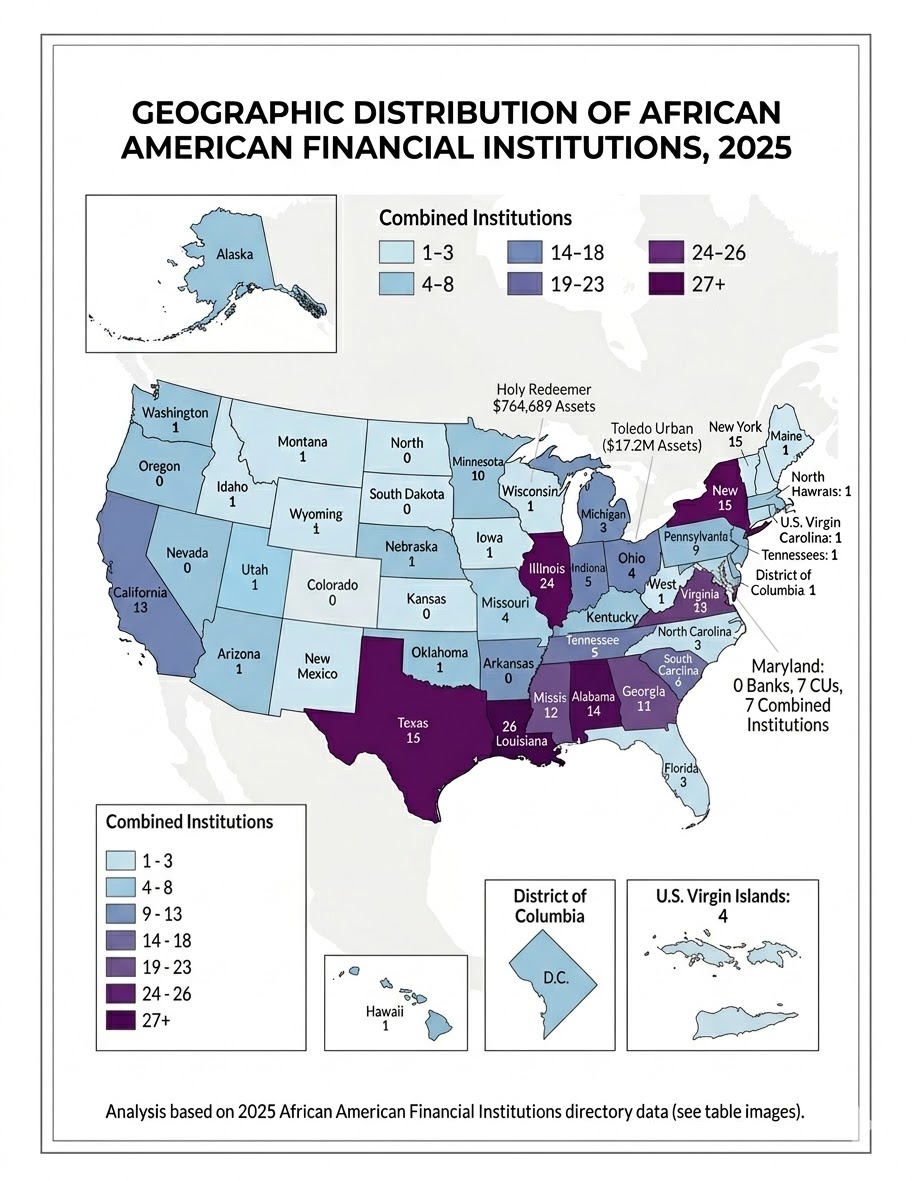
When the geography of African American banks and credit unions is examined together, a more complete — though still incomplete — picture of Black financial infrastructure emerges across the United States. The 2025 African American Owned Bank Directory covers 17 institutions across 15 states and territories. The 2025 NCUA data on African American credit unions adds 205 institutions across 29 states and territories, carrying $8.15 billion in assets and serving approximately 727,000 members. Combined, the two sectors represent over 220 institutions and more than $14.8 billion in assets operating across 31 states and territories. But geography, not just totals, is where the real story lives.

Thirteen states have both an African American-owned bank and at least one African American credit union: Alabama, the District of Columbia, Georgia, Illinois, Louisiana, Michigan, Mississippi, North Carolina, Oklahoma, Pennsylvania, South Carolina, Tennessee, and Texas. These are the states with the fullest financial ecosystem — where a community member can choose between a bank product and a credit union product from an institution with cultural roots in their community. Louisiana stands out, with one bank and 25 credit unions, the most of any state in the credit union count. Illinois follows with one bank and 23 credit unions.

Two states have African American banks but no African American credit unions in the NCUA data: Massachusetts, home to OneUnited Bank, and Utah, newly represented by Redemption Bank. These institutions serve their communities without the complementary infrastructure of a credit union network. Conversely, 16 states and territories have African American credit unions but no African American-owned bank: Arkansas, California, Connecticut, Delaware, Florida, Indiana, Maryland, Minnesota, Missouri, New Jersey, New York, Ohio, Virginia, the U.S. Virgin Islands, West Virginia, and Wisconsin.

The cases of Ohio and Wisconsin, discussed at length in the bank directory analysis, illustrate the limits of credit union coverage as a substitute for bank presence. Ohio has four African American credit unions with combined assets of approximately $18.3 million: Mahoning Valley in Youngstown, Mt. Zion Woodlawn in Cincinnati, Cleveland Church of Christ in Cleveland, and Toledo Urban in Toledo. Of these, Toledo Urban is the only institution of meaningful scale at $17.2 million in assets with 4,324 members. The other three are micro-institutions, each under $600,000 in assets and under 400 members. Wisconsin’s single credit union, Holy Redeemer Community of SE Wisconsin based in Milwaukee, holds just $764,689 in assets and serves 239 members. For a city where African Americans comprise roughly 39 percent of the population, that represents an institutional void that one small credit union cannot fill. Neither Ohio nor Wisconsin has an African American financial institution capable of writing a commercial real estate loan, funding a startup, or underwriting a mortgage for a first-generation homebuyer at any meaningful scale.

African American Financial Institutions by State, 2025

StateAfrican American BanksAfrican American Credit UnionsCombined Institutions
Alabama21214
Arkansas033
California011
Connecticut033
Delaware011
District of Columbia11011
Florida033
Georgia2911
Illinois12324
Indiana055
Louisiana12526
Maryland077
Massachusetts101
Michigan145
Minnesota022
Mississippi11112
Missouri044
New Jersey099
New York01515
North Carolina123
Ohio044
Oklahoma112
Pennsylvania189
South Carolina156
Tennessee156
Texas11415
Utah101
U.S. Virgin Islands044
Virginia01313
West Virginia011
Wisconsin011

Maryland presents a striking and instructive contrast. It has no African American-owned bank, a gap noted in the 2025 directory, yet it is the single largest state for African American credit union assets, hosting seven institutions with a combined $4.47 billion in assets. That figure is driven primarily by two institutions: Andrews Federal Credit Union in Suitland with $2.47 billion in assets and 142,076 members, and Municipal Employees Credit Union of Baltimore with $1.26 billion in assets and 98,358 members. Maryland’s credit union sector is, in asset terms, larger than the entire African American bank sector nationally. This is remarkable. It is also a reminder that credit unions and banks occupy different structural roles. Andrews Federal and MECU of Baltimore are large, sophisticated institutions with product offerings that approach commercial banking but they are member cooperatives, not banks, and their ownership structure, regulatory environment, and community lending mandates differ accordingly. Maryland’s absence from the bank directory is still a gap worth addressing, even with $4.47 billion in credit union assets in the state.

Virginia and Missouri follow a similar pattern to Maryland, albeit at smaller scale. Virginia has 13 African American credit unions with $471 million in assets but no African American-owned bank. Missouri has four credit unions with $481 million in assets, anchored by St. Louis Community Credit Union at $431.5 million, and also no bank. New York has 15 credit unions with $76 million in assets and no African American bank, a particularly stark figure given the size of New York’s African American population and its status as the financial capital of the country.

The states that are entirely absent from both the bank and credit union directories deserve attention. While the combined coverage of 31 states and territories is broader than either sector alone, large portions of the country remain without any African American-owned financial institution. States like Nevada, Arizona, Colorado, Washington, Oregon, and much of the Mountain West and Pacific Northwest have no representation in either directory. As African Americans continue to migrate to new metros — Las Vegas, Phoenix, Denver, Seattle — the absence of community-controlled financial institutions in those corridors becomes a growing concern.

The combined picture is this: African American banks and credit unions together hold approximately $14.8 billion in assets, serve over 700,000 credit union members and the deposit base of 17 banks, and operate across 31 states and territories. The credit union sector, at $8.15 billion in assets across 205 institutions, is actually slightly larger than the bank sector’s $6.72 billion across 17 institutions, a reflection of the credit union model’s greater accessibility and the longer runway some of these institutions have had to grow. But the two sectors are not interchangeable. Banks can hold commercial deposits, write business loans, issue letters of credit, and serve as the financial backbone of an entrepreneurial ecosystem in ways that most credit unions cannot. Credit unions, in turn, offer member ownership, lower fees, and community accountability that publicly or privately held banks may not. The African American community needs both, in every state where its population is substantial. Right now, it has neither in too many places that matter.

Sources: HBCU Money 2025 African American Owned Bank Directory; 2025 NCUA African American Credit Union Institutions data. Asset figures in U.S. dollars.

Disclaimer: This article was assisted by Claude (Anthropic).

African America’s August 2025 Jobs Report – 7.5%

Overall Unemployment: 4.1%

African America: 7.2%

Latino America: 5.3%

European America: 3.7%

Asian America: 3.6%

Analysis: European Americans’ unemployment rate was unchanged from July. Asian Americans decreased 30 basis points and Latino Americans increased 30 basis points from July, respectively. African America’s unemployment rate increased by 30 basis points from July.

AFRICAN AMERICAN EMPLOYMENT REVIEW

AFRICAN AMERICAN MEN: 

Unemployment Rate – 7.1%

Participation Rate – 69.8%

Employed – 9,893,000

Unemployed – 753,000

African American Men (AAM) saw a increase in their unemployment rate by 10 basis points in August. The group had an increase in their participation rate in August by 190 basis points, there highest participation rate in the past five months. African American Men gained 270,000 jobs in August and saw their number of unemployed increase by 30,000.

AFRICAN AMERICAN WOMEN: 

Unemployment Rate – 6.7%

Participation Rate – 61.4%

Employed – 10,260,000

Unemployed – 739,000

African American Women saw a increase in their unemployment rate by 40 basis points in August. The group increased their participation rate in August by 30 basis points. African American Women gained 13,000 jobs in August and saw their number of unemployed increase by 45,000.

AFRICAN AMERICAN TEENAGERS:

Unemployment Rate – 24.8%

Participation Rate – 29.3%

Employed – 590,000

Unemployed – 195,000

African American Teenagers unemployment rate increased by 310 basis points. The group saw their participation rate increased by 10 basis points in August. African American Teenagers lost 24,000 jobs in August and saw their number of unemployed also increase 25,000.

African American Men-Women Job Gap: African American Women currently have 367,000 more jobs than African American Men in August. This is an decrease from 624,000 in July.

CONCLUSION: The overall economy added 22,000 jobs in August while African America added 260,000 jobs. From Reuters,”The warning bell that rang in the labor market a month ago just got louder,” Olu Sonola, head of U.S. economic research at Fitch Ratings in New York, said in reference to the U.S. labor market. “A weaker-than-expected jobs report all but seals a 25-basis-point rate cut later this month.” Fed Chair Jerome Powell had already reinforced rate cut speculation with an unexpectedly dovish speech at last month’s Fed symposium in Jackson Hole.”

Source: Bureau of Labor Statistics

African America’s July 2025 Jobs Report – 7.2%

Overall Unemployment: 4.1%

African America: 7.2%

Latino America: 4.8%

European America: 3.7%

Asian America: 3.5%

Analysis: European Americans’ unemployment rate increased 10 basis points. Asian Americans increased 40 basis points and Latino Americans increased 20 basis points from June, respectively. African America’s unemployment rate increased by 40 basis points from June.

AFRICAN AMERICAN EMPLOYMENT REVIEW

AFRICAN AMERICAN MEN: 

Unemployment Rate – 7.0%

Participation Rate – 67.9%

Employed – 9,623,000

Unemployed – 723,000

African American Men (AAM) saw a increase in their unemployment rate by 10 basis points in July. The group had a precipitous drop in their participation rate in July by 90 basis points. African American Men lost 129,000 jobs in July and saw their number of unemployed increase by 2,000.

AFRICAN AMERICAN WOMEN: 

Unemployment Rate – 6.3%

Participation Rate – 61.1%

Employed – 10,247,000

Unemployed – 694,000

African American Women saw a increase in their unemployment rate by 50 basis points in July. The group increased their participation rate in July by 20 basis points. African American Women lost 1,000 jobs in July and saw their number of unemployed increase by 60,000.

AFRICAN AMERICAN TEENAGERS:

Unemployment Rate – 21.7%

Participation Rate – 29.2%

Employed – 614,000

Unemployed – 170,000

African American Teenagers unemployment rate increased by 250 basis points. The group saw their participation rate decreased by 80 basis points in July. African American Teenagers added 37,000 jobs in July and saw their number of unemployed also increase 15,000.

African American Men-Women Job Gap: African American Women currently have 624,000 more jobs than African American Men in July. This is an increase from 496,000 in June.

CONCLUSION: The overall economy added 73,000 jobs in July while African America lost 166,000 jobs. From CNBC, “This is a gamechanger jobs report,” said Heather Long, chief economist at Navy Federal Credit Union. “The labor market is deteriorating quickly.” The weak report, including the dramatic revisions, could provide incentive for the Federal Reserve to lower interest rates when it next meets in September. Following the report, futures traders raised the odds of a cut at the meeting to 75.5%, up from 40% on Thursday, according to CME Group data.”

Source: Bureau of Labor Statistics

African America’s June 2025 Jobs Report – 6.8%

Overall Unemployment: 4.1%

African America: 6.8%

Latino America: 4.8%

European America: 3.6%

Asian America: 3.5%

Analysis: European Americans’ unemployment rate has remained steady for four straight months with virtually no change in unemployment rate. Asian Americans decreased 10 basis points and Latino Americans decreased 30 basis points from May, respectively. African America’s unemployment rate increased by 80 basis points from May.

AFRICAN AMERICAN EMPLOYMENT REVIEW

AFRICAN AMERICAN MEN: 

Unemployment Rate – 6.9%

Participation Rate – 68.8%

Employed – 9,752,000

Unemployed – 721,000

African American Men (AAM) saw a increase in their unemployment rate by 170 basis points in June. The group had a mild rebound in their participation rate in June by 30 basis points. African American Men lost 117,000 jobs in June and saw their number of unemployed increase by 181,000.

AFRICAN AMERICAN WOMEN: 

Unemployment Rate – 5.8%

Participation Rate – 60.9%

Employed – 10,248,000

Unemployed – 634,000

African American Women saw a decrease in their unemployment rate by 40 basis points in June. The group decreased their participation rate in June by 80 basis points. African American Women lost 84,000 jobs in June and saw their number of unemployed decrease by 50,000.

AFRICAN AMERICAN TEENAGERS:

Unemployment Rate – 19.2%

Participation Rate – 30.0%

Employed – 651,000

Unemployed – 155,000

African American Teenagers unemployment rate increased by 480 basis points. The group saw their participation rate increased by 210 basis points in June. African American Teenagers added 10,000 jobs in May and saw their number of unemployed also decrease 41,000.

African American Men-Women Job Gap: African American Women currently have 496,000 more jobs than African American Men in June. This is an increase from 463,000 in May.

CONCLUSION: The overall economy added 147,000 jobs in June while African America lost 193,000 jobs. From CNN, “It is becoming harder for Americans to find work: The average duration of unemployment rose from 21.8 weeks to 23 weeks, and the share of unemployed workers who have been out of a job for 27 weeks or longer rose to 23.3%, edging closer to a three-year high. Trump’s tariffs — and the dizzying back and forth on implementing them and pausing them — has caused many businesses to stall major decision-making or spending, including hiring.”

Source: Bureau of Labor Statistics

HBCU Money’s 2024 African American Owned Bank Directory

All banks are listed by state. In order to be listed in our directory the bank must have at least 51 percent African American ownership. You can click on the bank name to go directly to their website.

KEY FINDINGS:

  • 14 of the 18 African American Owned Banks saw increases in assets from 2023.
  • African American Owned Banks (AAOBs) are in 16 states and territories. Key states absent are Maryland, Missouri, New York, and Virginia.
  • Adelphi Bank (OH) is the most recent African American Owned Bank started in 2023. Prior to that no African American owned bank had been started in 23 years.
  • Alabama and Georgia each have two AAOBs.
  • African American Owned Banks have approximately $6.4 billion of America’s $23.6 trillion bank assets (see below) or 0.027 percent. The apex of African American owned bank assets was in 1926 when AAOBs held 0.2 percent of America’s bank assets or 10 times the percentage they hold today.
  • African American Owned Banks comprise 12 percent of Minority-Owned Banks (151), but only control 1.75 percent of FDIC designated Minority-Owned Bank Assets.
  • 2024 Median AAOBs Assets: $191,590,000 ($168,701,000)
  • 2024 Average AAOBs Assets: $355,448,000 ($326,097,000)
  • TOTAL AFRICAN AMERICAN OWNED BANK ASSETS 2024: $6,398,070,000 ($5,867,738,000)

ALABAMA

ALAMERICA BANK

Location: Birmingham, Alabama

Founded: January 28, 2000

FDIC Region: Atlanta

Assets: $17,741,000

Asset Change (2023): UP 2.7%

COMMONWEALTH NATIONAL BANK

Location: Mobile, Alabama

Founded: February 19, 1976

FDIC Region: Atlanta

Assets: $66,375,000

Asset Change (2023): DOWN 0.8%

DISTRICT OF COLUMBIA

INDUSTRIAL BANK

Location: Washington, DC

Founded: August 18, 1934

FDIC Region: New York

Assets: $755,175,000

Asset Change (2023): UP 2.2%

GEORGIA

CARVER STATE BANK

Location: Savannah, Georgia

Founded: January 1, 1927

FDIC Region: Atlanta

Assets: $106,700,000

Asset Change (2023): UP 30.3%

CITIZENS TRUST BANK

Location: Atlanta, Georgia

Founded: June 18, 1921

FDIC Region: Atlanta

Assets: $793,469,000

Asset Change (2023): UP 7.0%

ILLINOIS

GN BANK

Location: Chicago, Illinois

Founded: January 01, 1934

FDIC Region: Chicago

Assets: $64,685,000

Asset Change (2023): UP 1.2%

LOUISIANA

LIBERTY BANK & TRUST COMPANY

Location: New Orleans, Louisiana

Founded: November 16, 1972

FDIC Region: Dallas

Assets: $1,076,349,000

Asset Change (2023): UP 2.6%

MASSACHUSETTS

ONEUNITED BANK

Location: Boston, Massachusetts

Founded: August 02, 1982

FDIC Region: New York

Assets: $756,367,000

Asset Change (2023): UP 0.1%

MICHIGAN

FIRST INDEPENDENCE BANK

Location: Detroit, Michigan

Founded: May 14, 1970

FDIC Region: Chicago

Assets: $644,122,000

Asset Change (2023): UP 6.1%

MISSISSIPPI

GRAND BANK FOR SAVINGS, FSB

Location: Hattiesburg, Mississippi

Founded: January 1, 1968

FDIC Region: Dallas

Assets: $252,934,000

Asset Change (2023): UP 57.0%

NORTH CAROLINA

MECHANICS & FARMERS BANK

Location: Durham, North Carolina

Founded: March 01, 1908

FDIC Region: Atlanta

Assets: $498,118,000

Asset Change (2023): UP 15.9% 

OHIO

ADELPHI BANK

Location: Columbus, Ohio

Founded: January 18, 2023

FDIC Region: Chicago

Assets: $68,154,000

Asset Change (2023): UP 55.1%

OKLAHOMA

FIRST SECURITY BANK & TRUST

Location: Oklahoma City, Oklahoma

Founded: April 06, 1951

FDIC Region: Dallas

Assets: $174,740,000

Asset Change (2023): UP 46.4%

PENNSYLVANIA

UNITED BANK OF PHILADELPHIA

Location: Philadelphia, Pennsylvania

Founded: March 23, 1992

FDIC Region: New York

Assets: $53,275,000

Asset Change (2023): DOWN 4.4%

SOUTH CAROLINA

OPTUS BANK

Location: Columbia, South Carolina

Founded: March 26, 1999

FDIC Region: Atlanta

Assets: $662,589,000

Asset Change (2023): UP 26.2%

TENNESSEE

CITIZENS SAVINGS B&T COMPANY

Location: Nashville, Tennessee

Founded: January 4, 1904

FDIC Region: Dallas

Assets: $181,740,000

Asset Change (2023): UP 3.1%

TEXAS

UNITY NB OF HOUSTON

Location: Houston, Texas

Founded: August 01, 1985

FDIC Region: Dallas

Assets: $201,440,000

Asset Change (2023): DOWN 3.6%

WISCONSIN

COLUMBIA SAVINGS & LOAN ASSOCIATION 

Location: Milwaukee, Wisconsin

Founded: January 1, 1924

FDIC Region: Chicago

Assets: $24,097,000

Asset Change (2023): DOWN 12.0%

SOURCE: FDIC