Tag Archives: african american marriage

Schools For Husbands and Wives: Preparing African American Couples for Partnership and Institutional Power

“The family is the nucleus of civilization.” — Will Durant
When news broke from Senegal that so-called “schools for husbands” were being used to lower maternal and newborn mortality rates, the headlines focused on the novelty of men being taught to wash dishes, attend prenatal visits, and support women’s healthcare. Yet beneath the surface, Senegal’s program is not just about chores or even just about health, it is about reshaping cultural norms so that households operate as functional units rather than fractured spaces of authority and neglect. In a country where patriarchal structures often keep women from making life-saving decisions without a man’s permission, Senegal’s government and community leaders recognized that sustainable change had to address the power imbalance between men and women.

This insight carries an important lesson for African America. The African American family is facing a structural crisis. Only 38 percent of African American children grow up in two-parent households compared to 78 percent of white children, and the numbers are even more stark when considering households of generational stability, wealth accumulation, and transmission of institutional knowledge. The decline of the two-parent household in African America has had profound consequences not just for children, but for adults who often enter adulthood without ever having witnessed sustained partnership between equals.

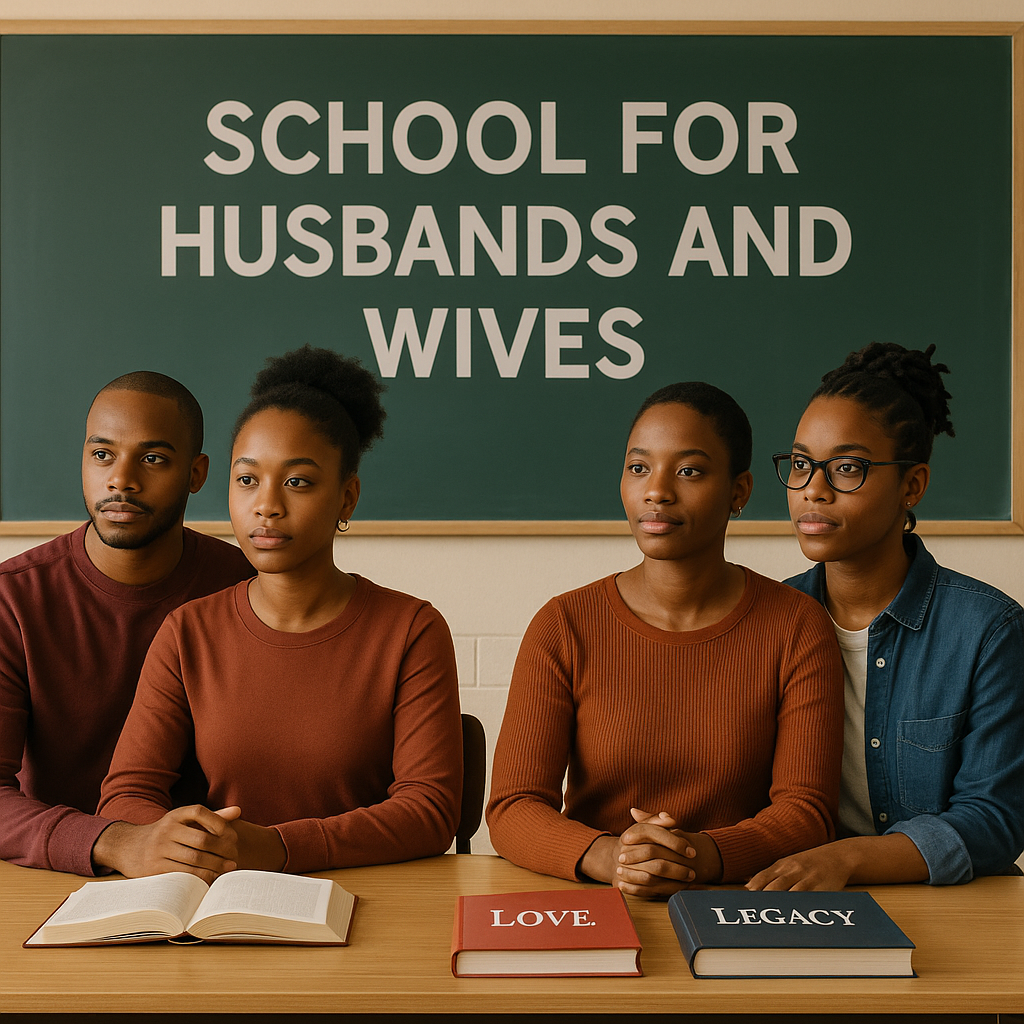
What if African America had its own version of Senegal’s schools expanded to include both husbands and wives, and designed for straight couples and LGBTQ couples alike? A “School for Husbands and Wives” could become a powerful cultural and institutional lever, equipping African Americans with the skills, expectations, and frameworks to build households that are not only emotionally healthy but also institutionally productive.

Why African America Needs Schools for Husbands and Wives

African Americans live in a paradox: on the one hand, they are among the most religiously active groups in the country, with churches historically serving as community hubs. On the other hand, African American households are disproportionately fragmented. The reasons are historical and structural—slavery destroyed family continuity, Jim Crow restricted marriage rights, mass incarceration and discriminatory welfare policies tore apart families, and modern labor and housing policies continue to erode family stability.

The consequence is that too many African Americans enter relationships without having observed healthy models of partnership. This absence manifests itself in multiple ways:

  • Gender distrust: Many African American men and women view each other as competitors rather than partners, shaped by economic inequality and media stereotypes.
  • Power imbalances: Without clarity on roles, relationships often collapse under stress: financial, emotional, or social.
  • Institutional gaps: Families are the basic units of institutions. When African American families are weak, African American institutions remain undercapitalized and undercoordinated.

This reality is not confined to heterosexual couples. LGBTQ African Americans, who face both external discrimination and internal cultural tension, often have even fewer family blueprints to draw upon. Whether in straight or queer relationships, the challenge remains: how do two people form a sustainable partnership when their models are fragmented, mistrust abounds, and institutional frameworks are weak?

A School for Husbands and Wives would take on this challenge directly, teaching the mechanics of partnership in the same way Senegal’s program teaches men the mechanics of maternal health support. But instead of focusing solely on chores or permissions, the African American model would expand to include economics, conflict resolution, institution building, and cultural grounding.

The Senegalese Model: A Starting Point

Senegal’s schools for husbands use respected community figures like imams, former soldiers, and elders to teach men about women’s rights, maternal health, and shared responsibilities. The success lies in reframing: chores are not humiliating, they are acts of love; women’s health decisions are not threats, they are family investments; shared authority is not weakness, it is strength.

For African Americans, a School for Husbands and Wives could use a similar approach: respected voices drawn from the community like professors, entrepreneurs, cultural leaders, and married couples who have sustained long-term partnerships would teach relationship and family skills as community investments. The aim would be to destigmatize conversations about partnership and create new models where none exist.

Curriculum for Partnership

What would a School for Husbands and Wives look like in African America?

  1. Economics of Partnership
    • Teaching couples how to pool resources effectively, manage debt, invest in assets, and prioritize institutional wealth over individual consumption.
    • Lessons on real estate, life insurance, trusts, and estate planning—so that households become wealth anchors, not debt traps.
  2. Conflict Resolution and Communication
    • Many couples replicate cycles of mistrust they observed growing up. Training in conflict resolution, active listening, and equitable compromise would be central.
    • Both straight and LGBTQ couples would benefit from structured conversations on navigating cultural stigma, managing extended family expectations, and sustaining emotional intimacy.
  3. Household Labor Distribution
    • Senegal emphasizes men helping with chores to reduce women’s burdens. In African America, the conversation must extend further: both partners share responsibility for cooking, cleaning, parenting, and professional ambitions.
    • The school would also address how unpaid labor at home directly connects to economic outcomes, productivity, and career success for both partners.
  4. Cultural and Historical Grounding
    • African American couples would be taught the history of the African American family as an institution under assault—from slavery to mass incarceration.
    • By understanding the intentionality of these assaults, couples would better grasp the importance of intentional partnership as resistance.
  5. Parenting as Institutional Strategy
    • Children should be raised not just with love, but with strategy: to become contributors to African American institutional wealth and culture.
    • Parents would learn to combine elements of “tiger” and “gentle” parenting—discipline and nurture balanced toward the goal of institutional power.

Straight and LGBTQ Couples Together

Too often, discussions of African American family structure exclude LGBTQ couples, reinforcing division where there should be solidarity. A School for Husbands and Wives would explicitly include both straight and LGBTQ couples, recognizing that the core challenges of partnership communication, trust, economic strategy, cultural grounding are universal.

In fact, LGBTQ couples often demonstrate resilience in building intentional families under hostile conditions, a skillset that all African Americans can learn from. By including diverse couple models, the school would normalize different family structures while emphasizing the shared goal: strong, functioning partnerships that build institutions.

Institutional Implications

African American institutions such as HBCUs, banks, businesses, nonprofits are only as strong as the families that sustain them. Wealth is built in households before it is transferred to institutions. If African American households remain fragmented, then institutions will remain weak.

A School for Husbands and Wives could therefore be sponsored or housed by HBCUs, serving both as a community program and as a research lab. Partnerships with African American financial institutions could integrate financial literacy into the curriculum. Faith institutions, cultural centers, and civic organizations could all play roles in teaching and sustaining graduates of the program.

The benefits would ripple:

  • Higher marriage stability rates among African Americans.
  • Greater pooling of household income, increasing wealth accumulation.
  • Stronger parenting, producing children with higher educational attainment and cultural grounding.
  • Increased institutional giving and investment, as families with stability contribute more to churches, HBCUs, and community organizations.

Policy and Public Health Dimensions

A School for Husbands and Wives should not be seen only as a cultural innovation, but also as a public health and policy strategy. The lack of stable households directly correlates with higher rates of poverty, incarceration, and health disparities. Policymakers could frame such schools as preventative investments, much like job training or nutrition programs.

Public funding, alongside philanthropic investment from African American institutions, could help establish pilot programs in cities with large African American populations. These schools could even be tied to existing healthcare infrastructure such as community health clinics so that relationship education is linked to wellness checkups, parenting support, and financial literacy programs.

If Senegal can link male training to maternal survival, African America can link couple training to family survival.

Lessons from Senegal’s Caution

Senegal’s experience shows that change is incremental and contested. Some men embrace new roles; others resist. Likewise, in African America, not everyone will accept the idea of formal schools for partnership. Some will argue that love is natural and cannot be taught. Others will resist LGBTQ inclusion. Some will see the program as unnecessary “therapy culture.”

But institutions are built through intentionality, not accident. Just as one studies law to become a lawyer or finance to become a banker, so too must African Americans study partnership if they are to build families that function as institutional engines.

A Vision Forward

Imagine a future where every African American couple, before or after marriage, participates in a School for Husbands and Wives. They leave not only with a deeper love for each other but with tools for building wealth, resolving conflict, and raising children with purpose. They learn to see themselves as not just individuals, but as co-founders of a household institution.

The Senegalese model shows us that cultural change is possible when men are trained to view equality as strength. African America can expand that vision: training both husbands and wives, straight and queer, to view partnership as the foundation of institutional survival.

Just as Senegal’s schools for husbands aim to save lives, African America’s schools for husbands and wives would aim to save legacies.ve legacies.

The Lack Of Marriage Is Holding Back African American Wealth – And How HBCUs Can Help

“Paradise is one’s own place, One’s own people, One’s own world, Knowing and known. Perhaps even Loving and loved.” – Octavia Butler

The declining marriage rates among African Americans are increasingly recognized as a significant factor holding back wealth accumulation within the community. This trend has profound implications for economic stability and intergenerational wealth transfer. Understanding the connection between marriage and wealth, along with relevant statistics, sheds light on this critical issue.

Married couples generally experience greater financial stability than single individuals. According to the U.S. Census Bureau, married couples tend to have higher median household incomes. In 2021, the median household income for married couples was approximately $100,000, compared to about $60,000 for single-parent households, which disproportionately include African American families.

Research has shown that marriage contributes significantly to wealth accumulation. A study by the Institute for Family Studies found that households headed by married couples have about three to four times the wealth of those headed by single individuals. Specifically, Black married couples had a median net worth of $131,000 in 2019, compared to only $29,000 for Black single individuals. This disparity highlights the financial advantages of marriage in building wealth.

From an economic development perspective, marriage plays a crucial role in the transfer of wealth between generations. Households with married parents are better positioned to pass down assets. A report from the Federal Reserve in 2019 indicated that only 45% of Black households had any wealth to pass on, compared to 70% of white households. The lack of marriage in the African American community limits opportunities for families to create and sustain intergenerational wealth.

It also has acute impact on social development within the African American community. Marriage can provide emotional and social stability, which is vital for sound financial decision-making. Couples often collaborate on budgeting, saving, and investing, leading to better financial outcomes. According to a Pew Research Center study, married couples are more likely to engage in long-term financial planning, further enhancing their wealth-building capacity.

The decline in marriage rates among African Americans is linked to systemic issues, including economic inequality, high incarceration rates, and historical trauma. The National Center for Family & Marriage Research reports that the marriage rate for African Americans has dropped significantly over the past few decades, from 60% in the 1960s to just 29% in 2021. Addressing these systemic barriers is essential for promoting stable relationships and supporting marriage as a pathway to wealth.

Cultural perceptions around marriage also play a role. While many African Americans value family and community, there may be less emphasis on traditional marriage structures. However, promoting awareness of the economic benefits of marriage within the community could encourage individuals to consider its advantages for wealth accumulation and stability.

Ways HBCUs Can Help Promote Black Marriage

HBCUs can play a pivotal role in promoting marriage within the African American community by implementing several strategies:

  • Educational Programs: HBCUs can offer workshops and seminars focused on relationship skills, financial literacy, and the benefits of marriage. By educating students on effective communication, conflict resolution, and financial planning, these programs can foster healthier relationships.
  • Mentorship and Counseling: Establishing mentorship programs that connect students with African American married couples can provide positive role models. Counseling services that focus on relationship dynamics and conflict resolution can also support students in building strong partnerships.
  • Community Engagement: HBCUs can organize community events that celebrate marriage and family life, encouraging students to engage with positive narratives around marriage. These events can include discussions, panels, and social activities that promote the value of committed relationships.
  • Collaborative Research: HBCUs can engage in research initiatives that explore the factors influencing marriage rates in the African American community. Understanding these dynamics can inform policies and programs aimed at supporting healthy relationships.
  • Scholarships and Incentives: Creating scholarship programs for students who participate in marriage enrichment programs can incentivize students to invest in their relationships while also promoting the value of African American marriage within the community.
  • Marriage Endowments: HBCU alumni can partner with the UNCF and Thurgood Marshall Fund to create an endowment that provides head start capital for African American marriages among their alumni. This head start capital can be disbursed at once or over a set number of years ensuring that couples get off to a financially stable start.

The decline in marriage rates among African Americans poses significant challenges to wealth accumulation and economic stability. By addressing the underlying issues and promoting the benefits of marriage, HBCUs can play a crucial role in fostering healthy relationships within the community. Implementing educational programs, mentorship opportunities, and community engagement initiatives can help strengthen marriage as a pathway to wealth and empower future generations to build a more financially secure future.

There is no African American community without the African American family and there is no African American family without African American marriage. At the very center of anything we discuss must be the institutional stabilization of the African American family and therefore African American marriages and partnerships. Right now the foundation of community and institution building is in crisis with no real way to stem the tide of the crisis. Building in more institutional support services for mental, physical, and nutritional health are just a few of the things needed along with financial stability programs would go a long way to the stability of African American marriage and partnerships. Generational wealth or generational poverty is on the line and great sacrifice must be made if we want the former and not more of the latter.

Stanford-born Marriage Pact: Can HBCUs Copy & Paste This To Increase African American Marriage?

“Black love is a radical act.” – Audre Lorde

A few years ago, HBCU Money did a report highlighting which HBCU states had the highest African American marriage rates. In the piece, HBCU LOVE: Top Ten HBCU States With Highest African American Marriage Rate, Virginia led with 34 percent African American marriage rate. The national average African American marriage rate is 29.7 percent which seven HBCU states exceeded. It is no small leap to say that HBCUs play a vital role in these high marriage rates given their role in helping African Americans have a space dedicated to themselves and cultural pride that feeds into a desire for an African American partner. Not something as likely for African Americans who attend PWIs where so few options are available that it may make it quite difficult to match with or find an African American partner among so few options. It also is significant that HBCUs provide for the bulk of African American professionals in all fields and leading to cultural pride, economic stability, and alignment of values while learning to appreciate the diversity of African America which ultimately play a major role in leading to African American marriage.

Unfortunately, African American marriage rates are still struggling. Finding marriage or a life partner is culturally challenged where young women are stressed to focus on their books and young men are stressed to focus on the plethora of young women where on many HBCU campuses the women to men ratio is considerably unbalanced. This is a result of a myriad of social factors not least among them high school graduation rates among African American boys continues to struggle and those who do graduate have far too few who are actually college ready even if they are accepted. It also does not help that so many young women and men are coming from single parent households, the Office of Juvenile Justice and Delinquency Prevention reports only “four in ten Black children” live with two parents. This means that the majority of women and men on HBCU campuses know marriage only through a theoretical lens and to say little of what has shaped their views on marriage, partnership, and the institution that is African American (healthy) love. For African America that desperately needs more marriage for a myriad of reasons and HBCUs being one of the most optimal African American spaces (for those HBCUs who still care to be such) the question is how can that seedling be grown into a full blown redwood. Enter “The HBCU Marriage Pact”, a blend of HBCU pride, computer science blended together and you end up with HBCU Computer Love – “To share in my computer world, I no longer need a strategy, thanks to modern technology”. Copy and pasted from Stanford University’s Marriage Pact.

Leanne Italie of the Associated Press writes, “The Marriage Pact, an annual matching ritual that has become popular on nearly 90 college campuses around the U.S., has turned that dusty cliche into fun. And a few couples have found lasting love. Nearly half a million students have participated since the pact first rolled out at Stanford University in 2017. Born of an economics project by two students there, the pact involves an algorithm that rates matches based on such statements as “I prefer politically incorrect humor” and “I pride myself on telling hard truths.” Unlike dating apps and services, each student gets just one name, a percentage on the quality of the match and an email address to reach out.” Liam McGregor, creator of Stanford’s Marriage Pact, explained to Ms. Italie that, “Rather than dwell on physical beauty and personal stats like height and hair color, the Marriage Pact focuses its 50-question survey on core values. Communication styles and conflict resolution.” This is what significantly sets it apart from dating apps that allows for the distraction of aesthetics that often mislead our assessment of actual compatibility.

For this to work at HBCUs though it cannot be an exactly Copy & Paste without nuance. African Americans are caught in a vortex between not being able to afford to get married and not being able to afford not too. A large driver of closing the wealth gap is getting African American marriage rates up in order to scale capital and resources among African American families and into African American institutions. While the development of the HBCU Marriage Pact would go a long way it must also come with addressing some of the unique barriers that many African Americans face in building healthy relationships and this is where HBCUs and HBCU alumni associations can come in. Funding an African American Marriage Development Program. In the program students can learn about the history of African American marriage, healthy communication, receive therapy, learn household financial planning, etiquette, and other tools to increase the probability of a sustainable and productive marriage. For an added bonus, those who get married through the HBCU Marriage Pact would also be eligible to receive a financial grant to assist in funding the newlywed couple’s emergency fund in hopes of also mitigating some of the early financial pressures that African American couples face.

HBCUs themselves could coordinate consortium research around the HMP to conduct a longitudinal study to see the HMP’s potential impact. It has a myriad of interdisciplinary components that could be researched from education, economics, health, and many more. Quite an amazing prospect that we could be both putting into action a solvable problem and being the institutions that conduct the research around its theory.

The foundation of all Black institutions is the foundation of the African American family and it is in peril because African Americas are not pairing with each other for a myriad of reasons. But if we are to ensure there are African Americans tomorrow who want to attend HBCUs, then today and immediately we must engage of the work to incentivize and strategize for more of it to happen. The more African American couples who are also HBCU alumni deepens the empowerment and strength of both institutions continuing to be the institutions of our community and not gentrified or diluted like so many of our institutions have lay burden to or under attack by this very moment.

4 WAYS TO STRENGTHEN AN HBCU MARRIAGE PACT:

  • If they choose to sign up for the pact, then they must complete wholistic development of therapy, financial literacy, parenting classes, and more that would show they have the proper aptitude to be someone’s partner.
  • Developing HBCU marriage chapters in cities. This would allow HBCU couples to meet and network with each other to build and develop community.
  • Offer continuing education workshops in best marriage and family practices so that HBCU couples can continue to learn about best practices for community and family building.
  • Create an endowment that gives a financial reward marriage capped at the 10 year anniversary mark. $1,000 in year 1, $2,000 in year 2, so on and so forth up to year 10 when the couple receive $10,000. A combined $55,000 over ten years that would go into financially strengthening the burgeoning family.

HBCU LOVE: Top Ten HBCU States With Highest African American Marriage Rate

Why is HBCU Money talking about marriage? We thought this was a site about money. Well, there are many economists and community developers that agree that one of the most fundamental ingredients to wealth building is marriage. It allows for scaling of capital towards savings and investment, reduction of expenses, and an ability to provide familial stability. Unfortunately, like our median income and wealth, there is no group less likely to actually get married than African Americans. The hurdles to African American marriage are deep and complicated and the solutions to them potentially even more deep and complicated. All that said, anything that leads to higher marriage rates between African Americans can only add to the community’s ability to actually stabilize and empower itself socially, economically, and politically. We of course acknowledge that marriages come in all forms, but the most important form is a healthy, happy, and loving marriage.

National African American Marriage Rate – 29.7%

  1. Virginia – 34.0%
  2. Maryland – 33.2%
  3. Delaware & Texas – 32.8%
  4. Florida & North Carolina – 31.3%
  5. Georgia – 30.9%
  6. Oklahoma – 30.0%
  7. Arkansas – 29.8%
  8. California – 29.7%
  9. Alabama & South Carolina – 29.4%
  10. Mississippi – 28.9%

The question then becomes how can HBCUs, their alumni, and other support organizations encourage more marriage among African Americans at HBCUs? This becomes vital for HBCU’s future because it could be suggested that a couple who both went to HBCUs would be more likely to send their child to an HBCU. Whereas a couple with only one HBCU parent present or no HBCU parents present is far less likely. To encourage coupling as part of an HBCU’s development strategy would by no means be simple given the ratio of women to men on HBCU campuses these days. Simply put, there are not enough men for women to choose from in the heterosexual relationships. And unless more data is collected on LGBTQ HBCU students, there may not be a viable quantity there for them either. This is why it would be important if this was to be considered that a network of HBCU development offices strategize together and increase the probability of matchmaking.

Tracking the statistics on HBCU marriage and family would also be immensely valuable information. An opportunity that certainly presents itself for further research by Hampton University’s National Center on African American Marriage and Parenting. Very little data is actually known on HBCU marriages and families.

Ultimately, HBCUs and their alumni though who can encourage more marriage among HBCU students/graduates must do so through ensuring those relationships are healthy. This means that there must be more mental and physical health development, financial literacy, and relationship etiquette taught. With seven of the ten HBCU states exceeding the national average for African American marriage the ingredients are certainly there for this seed to grow, but it indeed must be watered if we truly plan to see more marriage and healthier marriage which we know can also be one of the key tenets to community formation and building.

Source: U.S. Census