Tag Archives: African American institutional power

When the Gift Isn’t the Power: Prairie View’s Historic Donations and the Quiet Reality of UTIMCO Control

“A gift can open a door, but only ownership lets you walk through it on your own terms.”

When Prairie View A&M University announced that it had received a historic $63 million unrestricted gift from philanthropist MacKenzie Scott, headlines celebrated the moment as a watershed for the institution, the Texas A&M University System, and the broader HBCU sector. It was framed as both a moral recognition of PVAMU’s legacy and a financial turning point that would catalyze new academic, cultural, and research frontiers.

And yet, behind the applause and the very real gratitude there remains a more sobering, structural reality: Prairie View does not actually control its capital. The university’s endowment, like that of all Texas A&M System schools, is controlled and managed by UTIMCO, the University of Texas/Texas A&M Investment Management Company. UTIMCO is one of the largest public endowment management entities in the United States, overseeing well over $70 billion in assets. It is powerful, sophisticated, and critically not directly accountable to Prairie View’s leadership or the African American community whose future PVAMU represents.

This is the overlooked truth in the philanthropic triumph narrative: historic gifts do not necessarily translate into historic power. And power, not simply capital, is the currency African American institutions have always lacked most in the American economic order. Prairie View A&M University’s situation is a case study in the difference.

This article explores:

  • Why Prairie View’s record-setting gift still leaves it structurally dependent
  • How UTIMCO’s control restricts the institution’s long-term sovereignty
  • What this tells us about HBCU philanthropy and institutional design
  • Why African American institutional power requires ownership, not just funding
  • What steps Prairie View, other public HBCUs, and African American philanthropists can take to change the paradigm

This is not about questioning the value or impact of MacKenzie Scott’s generosity. It is about ensuring that gifts to African American institutions actually translate into durable, compounding power not momentary uplift that still sits under someone else’s governance.

The Gift Was Unprecedented—But the Structure Wasn’t

MacKenzie Scott’s philanthropic investments in Prairie View were transformational by any measure. Unrestricted capital is rare. Unrestricted capital at that scale is almost unheard of for HBCUs. Prairie View announced bold plans: initiatives in student success, research expansion, recruitment of top scholars, and community-facing programs that would have immediate impact.

However, beneath these aspirational goals lies a structural constraint. As a member of the Texas A&M University System, Prairie View’s endowment assets are not independently managed. Instead, they are placed under UTIMCO stewardship.

This means:

  • Prairie View cannot choose its own investment strategy
  • Prairie View cannot decide its own risk profile
  • Prairie View cannot determine long-term reinvestment philosophies
  • Prairie View cannot directly leverage its endowment as collateral or strategic capital
  • Prairie View has limited input into how its own financial future is shaped

Prairie View is wealthy in name, but not in governance. This is the difference between having money and having power.

Why UTIMCO Control Matters

UTIMCO is a financial powerhouse. It runs an endowment strategy modeled on the “Yale model” of diversified, high-yield, alternative-asset heavy investing. Its size gives it access to premier private equity, hedge funds, venture capital, and global asset vehicles that smaller endowments could never reach. But Prairie View is not UTIMCO’s strategic priority. And Prairie View does not have representation proportionate to its needs, mission, or history on the governance side of the investment enterprise.

The problems with this arrangement are structural, not personal:

1. Prairie View’s capital becomes part of a system that does not share its cultural mission.

UTIMCO’s fiduciary responsibility is to the entire system—primarily UT Austin and Texas A&M University, the two flagship institutions with the largest political influence and endowment weight.

2. Prairie View does not benefit proportionately from its own growth.

When UTIMCO’s investments outperform, the rising tide lifts the entire system but Prairie View’s small allocation does not allow it to meaningfully influence direction or capture outsized opportunity.

3. Prairie View is locked out of using its endowment to build independent institutional leverage.

For example:

  • Launching Prairie View–controlled venture funds
  • Building independent real-estate portfolios
  • Creating sovereign partnerships with African universities
  • Developing major research parks or revenue-producing assets
  • Issuing bonds based on endowment performance
  • Using the endowment to create a Prairie View Development Corporation
  • Deposit into African American Owned Banks

These are the exact strategies that allow elite institutions to become global players. Without endowment control, Prairie View cannot follow the same playbook.

4. African American institutional power remains externally governed.

Even when philanthropy flows to us, governance does not.
This is the core dilemma.

The Limits of Public-Sector HBCU Philanthropy

Public HBCUs occupy an uncomfortable position in American philanthropy. They exist inside systems created by and for institutions that do not share their origin story, demographic composition, or cultural mission. As a result, public HBCUs rarely benefit from the full compounding power that large donations should create. A $63 million donation to a private HBCU with full endowment control is a generational shift. A $63 million donation to a public HBCU inside a state-controlled investment empire is uplift but not sovereignty. The structure, not the gift itself, limits the long-term multiplier effect.

The True Power of an Endowment Is Governance, Not Size

The most elite universities such as Harvard, Yale, Stanford understand that the endowment is not merely a pot of money. It is the engine of independence, the foundation of strategic risk-taking, and the vault that allows them to pursue multi-century planning horizons. Prairie View’s endowment, while larger than before, becomes one more line item inside a massive investment entity whose priorities were never designed around the empowerment of African American institutions.

This raises fundamental questions:

  • If Prairie View doubled or tripled its endowment, would it gain any more control?
  • If Prairie View received a $500 million gift tomorrow, would it govern that capital?
  • What does “wealth” mean if the institution cannot direct it?

These questions get at the heart of African American philanthropic strategy:
Power is not the receipt of capital it is the control of capital.

Why This Matters for African American Philanthropy

The African American community is entering a new era of giving. Donors both internal and external to the community are showing increased willingness to fund African American institutions, particularly HBCUs. But if those donations sit inside structures that we do not control, then the long-term compounding advantage is lost. Philanthropy that uplifts without empowering is charity. Philanthropy that transfers capital and governance is institution-building. Prairie View deserves the latter. All HBCUs deserve the latter. African America deserves the latter.

What Would It Look Like for Prairie View to Have Full Capital Control?

If Prairie View controlled its own endowment strategy, several catalytic changes could occur:

1. PVAMU could launch its own independent investment office.

This would allow:

  • Hiring Black fund managers
  • Building partnerships with African investment firms
  • Investing directly in Prairie View–based startups
  • Growing an internal investment culture among alumni and students

2. PVAMU could build a multibillion-dollar research and development ecosystem.

The endowment could seed:

  • A Prairie View Innovation Corridor
  • A Black-owned semiconductor research consortium
  • Autonomous vehicle labs
  • Agricultural technology incubators
  • An African Diaspora science and engineering exchange
  • A rural Texas innovation hub exporting expertise globally

3. PVAMU could pursue independent financial engineering strategies.

Including:

  • Issuing bonds based on endowment earnings
  • Creating a real estate trust
  • Launching a PVAMU-controlled venture fund
  • Building a revenue-producing hospital network
  • Constructing Prairie View–owned student housing developments

4. PVAMU could fundamentally reshape African American institutional futures.

With full investment autonomy, Prairie View could become:

  • A national model for Black endowment governance
  • A financial anchor for African American rural communities
  • A bridge between Texas and the global African Diaspora
  • A site of intergenerational wealth-creation for African American students
  • An institution that attracts not only students but developers, scientists, and investors

This is the scale of possibility currently constrained by UTIMCO governance.

What Needs to Change—A Philanthropic and Policy Framework

To transition from uplift to sovereignty, African American leaders, donors, and policymakers must pursue concrete reforms:

1. Public HBCUs must secure special provisions for independent endowment management.

This could include:

  • Carve-outs from state systems
  • Special legislative exemptions
  • Hybrid governance models where system oversight continues but investment control shifts with the ultimate goal of full sovereignty

2. Large donors should explicitly require endowment autonomy as part of major gifts.

Imagine if MacKenzie Scott had stipulated:

“This gift must be placed in a separately managed fund controlled solely by Prairie View A&M University and its own designated board of trustees.”

That single sentence would have changed the institution’s next 100 years.

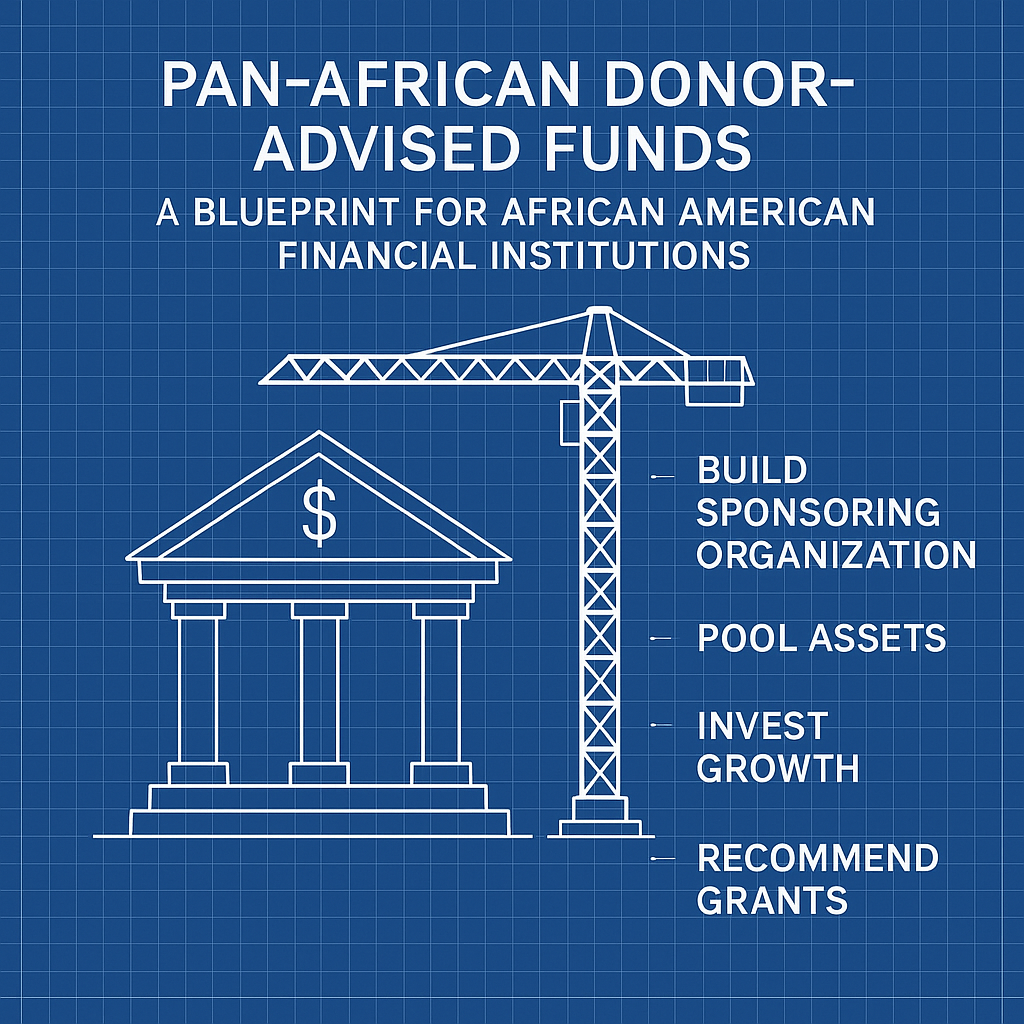
3. Prairie View alumni must build parallel philanthropic capital pools.

This includes:

  • Alumni-controlled investment funds
  • Prairie View-specific donor-advised funds
  • Community investment vehicles
  • A Prairie View Cooperative Endowment Fund

These independent vehicles can partner with but not be controlled by state systems.

4. National African American institutions must lobby for HBCU endowment independence.

A single policy shift could alter the landscape for every public HBCU:

Public HBCUs must have governance authority over capital donated specifically to them.

A Moment of Truth for HBCU Philanthropy

Prairie View’s historic gift was a moment of celebration—but also a moment of clarity. If African American institutions cannot control the endowments gifted to them, then the path to sovereignty remains blocked.

The philanthropic sector must confront this truth:

We cannot build African American power without African American control of African American capital.

Prairie View A&M University has always carried a dual identity, an HBCU of national importance inside a system not built for it. The generosity of donors like MacKenzie Scott can change the scale of Prairie View’s work, but only structural reform can change the nature of Prairie View’s power. The next era of HBCU philanthropy cannot simply be about larger gifts. It must be about gifts that come with governance, strategy, and autonomy.

Because endowments don’t build institutions.
Endowment sovereignty does.

Disclaimer: This article was assisted by ChatGPT.

Why African American Institutions Must Stop Chasing Donations and Start Building Endowments: The Investment Income Crisis in Black Philanthropy

“Philanthropy reflects not just generosity, but power. When African American foundations hold millions while their counterparts hold billions, the capacity to shape society is written in the balance sheets.” – HBCU Money Editorial Board

In the nonprofit and philanthropic world, financial statements tell a story much deeper than annual fundraising drives or program headlines. For African American institutions in particular, the real question of institutional power is not how much money comes in each year, but how much money is working on their behalf every day through investment income. The gap between African American legacy institutions and the nation’s major philanthropic foundations makes this truth impossible to ignore.

When most people evaluate nonprofits, they look at annual revenue: how much an institution raised in donations, how much it earned from programs, how much it reported on the IRS Form 990. By this metric, many organizations appear healthy. The King Center in Atlanta, for instance, reported $9.1 million in revenue in 2022, and the Malcolm X & Dr. Betty Shabazz Center reported $1.4 million in the same year. Even the Medgar & Myrlie Evers Institute, operating at a much smaller scale, posted $107,000 in revenue in 2023. Yet revenue alone is a deceptive indicator. It measures activity, not stability. Donations can be fickle. Program revenue can evaporate in downturns. Grants can dry up with shifts in political winds. A true measure of institutional health is whether an organization can generate its own independent cash flow — investment income.

The numbers reveal just how stark the divide is. The King Center, the strongest among African American legacy nonprofits, earned $788,000 in investment income in 2022. That represented nearly 9 percent of its total revenue, cushioning its operations with reliable, asset-driven support. By contrast, the Shabazz Center earned just $1,500 in investment income, and the Evers Institute earned nothing at all. Both remain almost entirely dependent on yearly contributions and program dollars. When compared to America’s powerhouse philanthropic institutions, the difference borders on staggering. The Ford Foundation generated $1.2 billion in investment income in 2022 — over 1,500 times what the King Center earned. The Rockefeller Foundation earned $120 million. The Walton Family Foundation, tied to the heirs of Walmart, brought in $240 million. The Bloomberg Family Foundation, anchored by the billionaire media mogul, generated $344 million. In this world, investment income is not supplemental; it is the engine. It underwrites operations, absorbs shocks, and ensures that missions continue even in the absence of donor enthusiasm. Investment portfolios are endowments of power, spinning off influence year after year.

This also clarifies why net income, the difference between revenue and expenses, is often misunderstood as a sign of strength. The King Center ran a $1.28 million surplus in 2022, while the Ford Foundation ran a $520 million deficit. Which institution is stronger? The answer is obvious: Ford. It can afford to run half a billion dollars in the red precisely because it has tens of billions in assets generating massive returns. Its deficit is a choice, not a crisis. By contrast, the Medgar Evers Institute’s deficit of just $25,000 in 2023 threatens its very survival because it has no investment base to fall back on. Net income measures short-term breathing room; investment income measures long-term power.

The contrast becomes sharper when examining the Steward Family Foundation, tied to David Steward, the wealthiest African American man. In 2023, the foundation reported $12.5 million in revenue and $857,000 in surplus, but just $29,000 in investment income. It holds only $22,000 in assets. Despite extraordinary personal wealth, the foundation is structured as a pass-through, distributing annual gifts rather than building a permanent, income-generating endowment. The Steward paradox highlights a broader challenge: African American wealth, even when achieved at extraordinary levels, has not consistently been institutionalized into enduring investment vehicles capable of generating influence across generations.

The implications of this reality are profound. Institutions without investment income are vulnerable to political tides, donor fatigue, and economic downturns. Their missions — whether preserving the legacy of Martin Luther King Jr., Malcolm X, or Medgar Evers — rest precariously on year-to-year survival. By contrast, the Ford or Rockefeller foundations can guarantee their voices in the public square for centuries. This imbalance in institutional financing means African American causes remain at the mercy of others’ benevolence while rival institutions are powered by their own wealth.

If investment income is the true measure of power, then African American institutions must pursue one clear priority: endowments. Not just annual fundraising, not just program grants, but the deliberate accumulation of assets whose returns will underwrite their missions indefinitely. Imagine if the King Center’s $788,000 in annual investment income could be multiplied tenfold or a hundredfold. Imagine if the Shabazz Center or the Medgar Evers Institute could fund their programming entirely from endowment returns. Imagine if the Steward Family Foundation transformed from a pass-through into a billion-dollar perpetual institution. This is the difference between surviving and shaping the future.

Investment income is the institutional equivalent of compound interest in personal finance. It rewards patience, discipline, and foresight. It separates organizations that merely exist from those that endure. For African American institutions, the lesson is clear: to secure legacies, to project influence, and to build power, they must shift their focus from short-term fundraising to long-term asset building. Only then can African American institutions stand as peers to Ford, Rockefeller, Walton, and Bloomberg — not just in name, but in financial reality.

Disclaimer: This article was assisted by ChatGPT.

The “Real World” Myth: How Sending African American Children to PWIs Undermines African American Institutional Power

“When you control a man’s thinking you do not have to worry about his actions. He will find his ‘proper place’ and will stay in it. You do not need to send him to the back door. He will go without being told; in fact, if there is no back door, he will cut one for his special benefit.”
Carter G. Woodson, The Mis-Education of the Negro

For generations, African American families have been told a myth that has become so pervasive it often passes without challenge: the idea that sending their children to predominantly white institutions (PWIs) of higher education better prepares them for the “real world.” On its surface, the reasoning sounds practical. Parents believe that if their child learns how to navigate white spaces, acquires the habits and codes of those spaces, and builds networks with white peers, they will be more successful in corporate America and society at large. It is a calculation born of centuries of survival in a society structured against African Americans.

But this calculation, when examined deeply, does not hold up to scrutiny. Instead of preparing African American students for the “real world,” the widespread preference for PWIs undermines the institutional power of African Americans and deprives HBCUs of the very human and financial capital they need to thrive.

The “real world” itself is not a fixed entity. It is not a monolith that African Americans must prepare to join on white terms. The real world is what a group of people make it. White Americans have defined their world and fortified it through their institutions such as universities, banks, hospitals, corporations, and foundations. Asian Americans, Jewish Americans, and other groups have done similarly, leveraging their educational and economic institutions to shape their reality. Yet, African America, too often, has internalized the belief that its institutions are insufficient, opting instead to send its brightest students and most valuable tuition dollars into the coffers of PWIs.

This is not simply a matter of personal choice. It is a collective decision with collective consequences. The more African American families buy into the “real world” myth, the weaker HBCUs become, and the less capable African America is of shaping its own real world.

The PWI Path and Its Assumptions

African American parents who choose PWIs for their children often do so with good intentions. They want their children to access elite resources, prestigious networks, and the perceived stamp of approval that comes with a degree from a PWI. They assume that because the U.S. labor market is majority white, exposure to that environment early on is critical to future success.

But these assumptions reveal several contradictions. White students do not consider attending an HBCU to balance their cultural experiences. They do not think, “I’ve had too much whiteness; I need a more balanced education.” Instead, they progress from a PWI undergraduate degree to a PWI graduate school, then into PWI-dominated corporate and institutional spaces. Their cultural immersion is never questioned, because their institutions define normalcy.

Meanwhile, African Americans alone have been conditioned to believe that too much African American immersion is dangerous, insular, or unrepresentative of the “real world.” The irony is sharp: a student may attend an HBCU, which is itself a diverse universe of African American culture, class, geography, and ideology, and still be told they have not had enough “exposure.” Yet a white student who grows up in an all-white town, attends an all-white PWI, and joins all-white firms is never told they lack “diversity of experience.”

This asymmetry is not accidental. It is a reflection of who controls institutional narratives in America. African Americans who absorb the “real world” myth are effectively outsourcing their children’s futures to white institutions, all while their own institutions wither from neglect.

The Diversity Within HBCUs

Another overlooked dimension of this myth is the assumption that HBCUs are homogeneous, insular spaces. This could not be further from the truth. The African American experience itself is vast. It includes children of Caribbean immigrants, descendants of enslaved Africans, first-generation college students from rural Mississippi, affluent families from Washington, D.C., African students from Nigeria and Ghana, Afro-Latinx students from Puerto Rico and the Dominican Republic, and more.

To attend an HBCU is not to encounter “less” diversity; it is to engage with the broad spectrum of the African Diaspora in concentrated form. These institutions are living laboratories of cultural exchange, intellectual competition, and class interaction.

By contrast, a PWI often provides African American students with only a sliver of diversity: they are frequently tokenized, expected to represent their entire race, and shuffled into diversity programming that centers their marginalization. Their peers may never learn about African American life beyond stereotypes, because the institution itself was never designed to illuminate African American experiences.

Thus, the African American student at an HBCU receives not just an education, but an immersion in African American pluralism is a preparation for engaging the world on African American terms. The PWI student, meanwhile, often internalizes the idea that their presence is conditional, exceptional, or peripheral.

Institutional Power and the Capital Flight from HBCUs

Every African American student who chooses a PWI over an HBCU represents more than an individual choice. It is the redirection of tuition dollars, alumni loyalty, and future endowment contributions away from African American institutions.

Imagine if even half of the African American students currently enrolled at PWIs redirected themselves to HBCUs. The financial impact would be transformative. Endowments would grow, faculty recruitment would expand, research capacity would increase, and the prestige of HBCUs would rise proportionally. These gains would compound over decades, creating a feedback loop of institutional strength.

Instead, what we have is a leakage of capital and talent into institutions that do not prioritize African American empowerment. PWIs benefit from African American enrollment statistics, which they parade as evidence of diversity, while offering little in terms of institutional reciprocity. They gain the reputational boost, while HBCUs lose the enrollment and financial stability they desperately need.

The result is predictable: HBCUs remain underfunded, under-endowed, and under-appreciated, not because they lack quality, but because too many African American families believe the myth that their children will be better off elsewhere.

The Real World Is What We Make It

The central flaw in the “real world” argument is the assumption that African Americans must adapt to a world built by others rather than shape their own. The real world is not an objective standard but it is the result of group will, institutional building, and cultural reinforcement.

White Americans shaped their “real world” through the sustained investment in Harvard, Yale, Princeton, and thousands of other institutions that center their history, culture, and power. Jewish Americans created their “real world” through a network of universities, foundations, and cultural centers that prioritize their collective survival. Asian Americans are building their own “real world” through business networks, educational pipelines, and capital flows that stretch across the Pacific.

If African Americans accept the premise that their children must be trained in white institutions to succeed, they have already conceded that they cannot or will not shape their own real world. They have abandoned the project of institutional power in favor of individual adaptation. This is not preparation; it is surrender.

Psychological Implications: Internalizing Inferiority

Beyond the economic impact, the myth has deep psychological consequences. African American students raised on the belief that HBCUs are not “the real world” internalize a subtle but corrosive idea: that their own culture is insufficient. They may carry degrees from elite PWIs, but the cost is often an alienation from African American institutional life.

The psychological message is clear—white spaces are the pinnacle of preparation, while African American spaces are something to escape. This creates a generational feedback loop where each successive cohort of African American parents pushes harder for PWIs, believing they are giving their children an advantage, while in reality they are weakening the very institutions that could make African America self-sufficient.

It also distorts identity. An African American child who grows up believing they must leave their community to succeed will often view their success as individual rather than collective. They may become comfortable being the “only one in the room,” rather than building the rooms where African Americans are not tokens but owners.

The Comparative Case: No Other Group Thinks This Way

No other racial or ethnic group in America sends its children away from its own institutions to gain “real world” experience. White families do not think Harvard students lack preparation because they have spent too much time around other white students. Jewish families do not believe their children need to avoid Jewish institutions to be competitive. Chinese Americans do not view Chinese language schools or cultural institutions as a liability to their children’s preparation.

It is only African Americans who accept this self-defeating logic. This uniqueness underscores the lingering effects of centuries of racial conditioning. From slavery to Jim Crow to modern structural racism, African Americans have been taught that their own institutions are inferior. The “real world” myth is simply the modernized version of this lesson.

By contrast, when other groups send their children to institutions, they do so with the understanding that these institutions will strengthen their cultural identity while equipping them to engage broader society on their own terms. For African Americans, the task must be the same: build HBCUs into the kind of institutions that define, rather than defer to, the real world.

Rethinking the “Preparation” Narrative

If the goal of higher education is preparation, then the question is: preparation for what? For African Americans, preparation should not simply mean being employable in someone else’s institution. It should mean being capable of building, leading, and sustaining African American institutions.

An HBCU graduate is not less prepared for corporate America than a PWI graduate; in many cases, they are more resilient, more culturally grounded, and more aware of systemic barriers. The difference is that the HBCU graduate, if supported by their community, is positioned to reinvest in African American institutional life.

The narrative that PWIs uniquely prepare African Americans for the “real world” ignores the fact that many HBCU alumni have gone on to excel in every imaginable field from politics, science, business, culture while also strengthening the institutions of African America. The preparation HBCUs offer is not narrow; it is holistic, rooted in both academic rigor and cultural affirmation.

A Call to Reclaim Institutional Power

For African Americans to continue believing in the “real world” myth is to ensure that the next century looks much like the last: individual success stories amid collective institutional weakness. To break this cycle, African American families must reorient their thinking.

Sending a child to an HBCU is not a limitation; it is an investment in collective power. It is a statement that African Americans will not only participate in the real world but will define it. It is a recognition that every tuition dollar, every alumni donation, and every student enrollment strengthens the institutional backbone of African America.

The time has come to retire the myth once and for all. The real world is not something African Americans must be prepared for by others. It is something African Americans must build for themselves, through the strengthening of HBCUs and the rejection of narratives that undermine them.

Until that shift happens, African America will remain trapped in a paradox: sending its children to PWIs in search of preparation, only to find that the institutions that could truly empower them are being starved of the very resources they need.

The “real world” is not out there waiting. It is in our hands to create.

 Disclaimer: This article was assisted by ChatGPT.

The Political Assault on Lisa D. Cook: Why the Fed’s Only HBCU Alum Faces an Outsized Storm

“You can not win a war that you will not acknowledge you are in, and African America refuses to acknowledge it is in a war and therefore has not built the institutional defense necessary to win.” – William A. Foster, IV

The latest calls for Federal Reserve Governor Lisa D. Cook to resign reveal less about her alleged financial entanglements and more about the precarious place of African American excellence in America’s institutional hierarchy. Cook, an alum of Spelman College—the jewel of the Atlanta University Center—sits as the only Historically Black College and University graduate in the Federal Reserve’s history. Her very presence at the central bank represents a seismic shift in the composition of economic policymaking. It also explains why she has become a lightning rod for partisan attacks.

On August 20, 2025, Donald Trump posted on Truth Social: “Cook must resign, now!!!!” The demand followed remarks from Bill Pulte, the Trump-appointed Director of the Federal Housing Finance Agency, who urged the Department of Justice to probe Cook’s role in allegedly questionable mortgages. What might otherwise be dismissed as yet another skirmish in Washington’s perpetual political warfare assumes broader significance when one considers who Cook is, what she represents, and what she symbolizes to African American institutions.

Lisa Cook’s rise to the Federal Reserve Board of Governors in May 2022 marked a watershed moment. For over a century, the Fed had been populated by a homogenous cadre of policymakers—almost exclusively White men with Ivy League or equivalent pedigrees. Cook, a Black woman educated at Spelman College, Oxford, and the University of California, Berkeley, carved a path through both racial and gendered barriers that have long defined the economics profession. Her scholarship is well known in academic circles: her pioneering work on the relationship between racial violence and African American innovation remains a cornerstone of economic history. By quantifying how lynching and Jim Crow violence curtailed patent activity by African Americans, she exposed a structural mechanism by which systemic racism suppressed not just Black lives but also Black wealth creation. At the Fed, she carried this analytical rigor into debates on labor markets, innovation, and most recently, the economic implications of artificial intelligence. For African America, her appointment was not just symbolic. It was strategic. HBCU graduates have long been overrepresented in producing the nation’s Black professionals—doctors, lawyers, judges, engineers. But in macroeconomic governance, their footprint has been virtually nonexistent. Cook’s ascension offered a foothold in one of the world’s most powerful institutions, where decisions reverberate across global markets, shape credit availability, and indirectly determine whether African American households can access affordable mortgages, student loans, and capital for small businesses.

The ferocity of the attacks against Cook cannot be divorced from her identity. The allegations hinge on supposed mortgage irregularities, amplified by Pulte and weaponized by Trump. Yet, even before these accusations, Cook faced resistance. Her Senate confirmation was one of the narrowest in Fed history, with Republicans uniformly opposed and some explicitly questioning her “fitness” for monetary policy on the grounds that her academic research leaned too heavily into racial economics. This rhetorical sleight-of-hand—dismissing racialized economic analysis as political—is a familiar tactic. It seeks to delegitimize the very work that challenges the dominant narrative. Cook’s critics often sidestep her publications in American Economic Review or her leadership within the American Economic Association, preferring instead to cast her as a “diversity appointment.” The current calls for her resignation escalate this narrative. To remove Cook under a cloud of controversy would not just eliminate a Fed governor. It would roll back the fragile gains of HBCU institutional representation in elite economic policymaking. It would signal, once again, that African American advancement is conditional, fragile, and always subject to reversal.

It is important to situate these attacks in a wider political economy. Trump’s demand is not only about Cook. It is about control of the Federal Reserve itself. The central bank has become increasingly politicized in recent years, with Republicans casting inflation and interest rate policy as partisan issues. To force out Cook would not only weaken President Biden’s appointees but also demoralize constituencies who view her as a critical voice for equity in macroeconomic policy. The Fed has traditionally projected itself as a technocratic, apolitical institution. Yet this veneer has cracked. Appointments are now battlefield contests. Cook’s vulnerability demonstrates that while America’s institutions have formally opened their doors to HBCU graduates, they have not yet fortified protections against political weaponization. This dynamic mirrors a historical pattern. African Americans who rise into positions of structural authority—whether judges, regulators, or corporate executives—often find themselves targets of disproportionate scrutiny. The goal is not merely to unseat them but to delegitimize the institutions that empowered them.

HBCUs stand uniquely implicated in this episode. Spelman College, Cook’s alma mater, is one of the leading producers of Black women in economics and STEM. Yet, despite their track record, HBCUs remain underfunded relative to predominantly White institutions. Cook’s ascent to the Fed was a triumph for the HBCU ecosystem, proof that institutional excellence could translate into influence at the very highest levels. That triumph is now under attack. If Cook were to resign or be forced out under pressure, it would reverberate across HBCUs. It would reinforce perceptions that HBCU alumni, even at their most accomplished, remain vulnerable to political takedowns. For African American students pursuing economics at Howard, Morehouse, or North Carolina A&T, the message would be chilling: success does not guarantee security. From an institutional development standpoint, the HBCU community must interpret this not as an isolated incident but as a case study in institutional fragility. Without strong networks of advocacy, media response, and financial backing, HBCU alumni who enter elite spaces will continue to stand exposed.

Cook’s potential ouster matters beyond symbolism. At a time when the Federal Reserve is grappling with questions of inflation persistence, labor market dynamics, and the disruptive potential of artificial intelligence, her perspective is invaluable. She has consistently foregrounded the idea that innovation is not distributed equally and that policy must account for structural barriers to participation. In her July 2025 speech at the National Bureau of Economic Research, Cook warned that generative AI could entrench inequality if its benefits accrued only to a narrow segment of firms and workers. This perspective matters because it forces the Fed to grapple with the distributional consequences of macroeconomic shifts, not just aggregate averages. Her departure would narrow the intellectual diversity of the Fed at precisely the moment it most needs heterodox insights.

What then must be the response of African American institutions—HBCUs, banks, think tanks, chambers of commerce? Silence cannot be an option. Cook’s defense should not be left to partisan politicians alone. Instead, a coordinated institutional defense is required, one that frames this attack not just as an assault on an individual but as an assault on African American institutional legitimacy. African American-owned banks could highlight the importance of a Fed governor who understands the structural barriers to credit access in Black communities. HBCU presidents could jointly issue statements defending the integrity of their alumna and reminding the public of their role in producing top-tier economists. Think tanks could produce rapid-response analyses showing the economic costs of underrepresentation in monetary policy. The lesson is clear: individual success must be buttressed by institutional power. Without that scaffolding, every Lisa Cook who rises will remain vulnerable to political storms.

Ultimately, the attack on Lisa Cook exemplifies America’s struggle with inclusion at the highest levels of institutional power. It is not enough to allow “firsts” to break through. True inclusion requires protecting them from disproportionate scrutiny, ensuring that they can govern with the same presumption of competence afforded to their peers. For African America, Cook’s ordeal is a reminder that victories in representation must be consolidated by institutional strategy. HBCUs cannot rest on symbolic triumphs; they must translate them into sustained influence, advocacy, and resilience. Otherwise, every gain risks being undone at the first sign of political backlash.

Lisa D. Cook stands at a crossroads. Her presence at the Federal Reserve is not simply about her credentials, which are unimpeachable. It is about what she represents: the intellectual capacity of HBCUs, the resilience of African American scholarship, and the potential for inclusive economic governance. The calls for her resignation are not neutral. They are part of a larger contest over who gets to shape America’s financial architecture. If African American institutions fail to rally, Cook may become another cautionary tale of progress reversed. But if they respond with clarity and force, this moment could mark the beginning of a new era—one in which HBCU alumni are not just present in elite institutions but are protected by a scaffolding of institutional power equal to the challenges they face. Her fate, in many ways, is a referendum on whether African America can defend its foothold in the commanding heights of global economic governance.

Disclaimer: This article was assisted by ChatGPT.