Bun B Advises African America To Get A Larger Worldview When It Comes To Wealth

”Investing should be more like watching paint dry or watching grass grow. If you want excitement, take $800 and go to Las Vegas.” – Paul Samuelson

The Walton Family, most notably known as the “owners” or dominant shareholders of Wal-Mart. As of March 31, 2022 they are worth an estimated $234.2 billion or 20 percent of African America’s $1.1 trillion buying power.

In an interview with Brandon Hightower, who is better known as B High and a journalist in Atlanta, on his YouTube channel BHighTV, Bernard Freeman, better known as hip-hop legend Bun B, lays down an immense amount of financial wisdom that he has accumulated over the years. Primarily speaking to up and coming hip-hop artists, the conversation could apply to any room in African America. According to an economic study done by McKinsey, African America continues to be the poorest racial group in America with a median net worth of only $24,000 and yet its financial behavior according to Mr. Freeman reflects anything but that.

Mr. Freeman immediately addresses the issue of ownership versus labor that many may have overlooked in the conversation. Asked about how to navigate the issues of artist feeling like they are being robbed by their labels Freeman says, “Don’t sign to a label. I mean that’s just it. Don’t sign to a label and take the slow road.” When pressed by Hightower of people not wanting to take the slow road, Freeman counters with, “Take the fast and get robbed then. Do you want to be famous or do you want to be rich? Because there is a likeliness that you might not be able to be both in this game. At a certain point you have to decide, do you want to be seen and known and look like you got bread and have everybody assume you got bread? Or do you really want to have bread and have people just assume you broke and not really getting it?” The slow road being an independent label that you own and own the masters and all rights to your music or going with a major label who owns the rights to everything you produce in exchange for a small royalty. Do you want to be the owner or do you want to be the labor? This is a question that is consistently overlooked in our community and institutions. HBCUs love to discuss how many of their students have gotten jobs, but when is the last time you saw an HBCU produce an entrepreneurship report detailing how many of their students started companies, hired other HBCU graduates, brought jobs to their community, wealth creation, and overall economic impact in the community? You do not because we do not have a focus there. Our community too often prides itself on finding a “good” job. Despite this push, our unemployment rate always remains twice the national average. Why? Because there is not nearly enough ownership within the community and therefore the ability to dictate employment, wages, and wealth in our community are always at the hands of others.

After a brief exchange on how the African American community seems to not believe that you can be famous and not be rich and be rich and not be famous, Mr. Freeman ask Mr. Hightower if he knows what the Walton Family (pictured above) looks like to which the latter replies no idea. The irony that members of the Walton family could walk into many Wal-Marts around the country and not be recognized, while controlling one of the world’s largest corporations and being one of the wealthiest families on Earth is not to be lost in this age of social media influencer and the like that more and more see as a path to riches. Again, associating being known with being financially successful. And while a few people listed on the Bloomberg Billionaires’ Index maybe well known, such as Bill Gates, Elon Musk, Mark Zuckerberg, 99 percent of that list could walk into many households and be absolutely unknown. However, one thing they all have in common? 100 percent of them are owners.

Mr. Freeman then says in response to Mr. Hightower asking how do we get kids to see beyond the drug dealers, ballplayers, and rap stars, “You have to give them a broader worldview so they can see what real money look like. Because I tell young people all the time everybody that you looking on TV and on the internet that’s rich, with the exception of a hand full of people, maybe ten people, somebody pay them.” He even goes on to discuss Shaquille O’Neal, who he believes either is close to or already a billionaire, but also states that a large portion of O’Neal’s wealth comes from people paying him, but who they themselves were already billionaires and O’Neal had no idea what they looked like before getting paid by them. We often hear of athlete’s salaries, but rarely if ever think about what the owner’s of these teams make. The NFL for instance, which is one of the worst paying professional sports leagues for players based on salaries and career expectancy, is also the most profitable sports league for owners. It is no coincidence that those two things go hand in hand. As of this article, Deshaun Watson, quarterback for the Cleveland Browns, recently signed to become the highest paid player in NFL history at 5 years, $230 million or $46 million per year. Compare that with Jerry Jones, owner of the Dallas Cowboys, who last year took home $280.4 million or six times what Deshaun Watson’s contract is. Even more so, Jerry Jones does not have to take one hit owning the team, can own it longer than any player can play, and then can pass it onto his children (as of this article the Dallas Cowboys are valued at $6.5 billion according to Forbes). Deshaun Watson can claim none of those things. Again, labor versus ownership.

This is not to say that Mr. Freeman is against having fun and enjoying your money as he points out discussing the trend of people who count money on the internet as a form of showing off. But he also follows it with, “Jay-Z is getting richer and richer and he is wearing less and less s**t that looks rich. And you keep going into these rooms with these people trying to look like money. No, you have to sound like money, think like money.” He points out that you will do little to impress Jeff Bezos or Warren Buffett walking into a meeting with them wearing a $4-5 million watch, number 2 and 5 on Bloomberg’s Billionaire Index and worth a combined $400 billion or 36 percent of African America’s buying power. One could argue that you may even turn them off by spending so lavishly. Spending $5 million on a watch versus leveraging that $5 million into $25 million worth of real estate and $2.5 million in annual income from that real estate looks like someone who is not really interested in building generational wealth. Especially for African America when every single dollar is going to count for families, communities, and institutions. In 2019, African Americans accounted for 13.2 percent of the population, but a heartbreaking 23.8 percent of poverty according to the U.S. Census.

“Wealthy does not have to prove to anybody that they are wealthy”, says Mr. Freeman in closing out the show’s segment. And to that point, the lack of wealth in our community and institutions continues to induce behavior that screams of lack. Unfortunately, wealth is not going to be generated by a job or even by starting a business per se. Wealth and power is generated by the building of an institutional ecosystem that is connected and circulates intellectual, social, economic, and political capital within it. African American banks having enough deposits to lend to an HBCU who wants to build a new research facility. An African American venture capital fund setting up and office at an HBCU to fund the next great idea in renewable energy. An HBCU alumni association putting money into an African American community to help ensure the K-12 system is providing the best education with the latest technology. Then all of those moments working together in unison. That is when we will see wealth and then power become not a scarcity in our community but a norm.

To watch the full interview segment, click below or go to http://www.bhightv.com.

HBCU Money’s 2021 Top 10 HBCU Endowments

If there was a short analysis of the 2021 HBCU endowment list it would be this – still not enough. Despite record breaking donations toward HBCUs from Mackenzie Scott and others in 2020-2021, the PWI-HBCU endowment gap among the Top 10 PWIs and HBCUs continues to balloon, a gap that stands at a staggering $121 to $1. This despite a 35 percent increase by the Top 10 HBCU endowments from last year. Simply put, winning the philanthropic “lottery” is not enough and it never will be when it comes to closing the endowment gap. The rabbit never beats the tortoise to put it another way. HBCUs must find a way to find consistent capital infusions over time as opposed to lighting quick one-offs.

The HBCU donor pool is simply too small and too poor (relatively speaking) to close the endowment gap. Without increasing the percentage of African Americans college students who go to HBCUs from 10 percent to 25-30 percent, it does not bode well for HBCUs to be able to close the endowment gap through traditional means. HBCUs and their alumni are going to have to be more creative and must be so expeditiously. While this is the most HBCU endowments we have ever reported with $100 million or greater, increasing from five in 2020 to seven in 2021, PWIs saw an 25 percent increase in the number of endowments over $2 billion going from 55 to 69 and an equally 25 percent rise in the number of endowments over $1 billion going from 114 to 142. This while HBCUs are still waiting for their first billion dollar endowment.

To that point, the race between Howard and Spelman is tightening. Last year’s $334 million lead that Howard held over Spelman has shrunk to $265 million. At one point it seemed a foregone conclusion that Howard would reach the milestone first (The Race To The First Billion Dollar HBCU Endowment: Can Anyone Catch Howard?), that is no longer the case. Howard’s public relations over the past year have not been favorable and while many people say all press is good press – not when you are an African American institution. With Hampton and North Carolina A&T’s departure from the MEAC, no HBCU conference (CIAA, GCAC, MEAC, SIAC, SWAC) is dominating the Top 10 and the list is split 50/50 between private and public HBCUs as well. Arguably this is the most diverse Top 10 HBCU endowment list since we first began publishing, but one thing remains feverishly consistent and that is there is a lot of work to be done to ensure HBCU endowments and therefore the institutions of HBCUs are sustainable and thriving.

HIGHLIGHTS:

  • Top 10 HBCU Endowment Total – $2.7 billion
  • Top 10 PWI Endowment Total – $328.7 billion
  • Number of PWIs Above $2 billion – 69
  • Number of PWIs Above $1 billion – 142
  • HBCU Median – $97.8 million (33.7%)
  • NACUBO Median – $200.4 million (25.8%)
  • HBCU Average – $203.8 million (53.6%)
  • NACUBO Average – $1.2 billion (35.2%)

All values are in millions ($000)*

1. Howard University – $795,203 (11.6%)

2. Spelman College – $530,399 (40.3%)

3.  Hampton University – $379,992 (35.4%)

4.  Morehouse College – $278,073 (77.0%)

5.  Meharry Medical College – $186,943 (19.3%)

6. North Carolina A&T State University  – $157,336 (113.2%)

7. Florida A&M University – $118,635 (24.4%)

8. Morgan State University$97,783 (162.9%)

9. Tennessee State University – $91,120 (33.2%)

10. The University of the Virgin Islands – $82,863 (23.9%)

OTHERS REPORTING:

*The change in market value does NOT represent the rate of return for the institution’s investments. Rather, the change in the market value of an endowment from FY20 to FY21 reflects the net impact of:
1) withdrawals to fund institutional operations and capital expenses;
2) the payment of endowment management and investment fees;
3) additions from donor gifts and other contributions; and
4) investment gains or losses.

SOURCE: NACUBO

Take a look at how an endowment works. Not only scholarships to reduce the student debt burden but research, recruiting talented faculty & students, faculty salaries, and a host of other things can be paid for through a strong endowment. It ultimately is the lifeblood of a college or university to ensure its success generation after generation.

Ariel Capital’s 2020 Black Investor Survey: African America’s Continued Fight To Close The Investment Gap

“On March 23, 2020, the S&P 500 fell 2.9%. In all, the index dropped nearly 34% in about a month, wiping out three years’ worth of gains for the market. It all led to a 76.1% surge for the S&P 500 and a shocking return to record heights. This run looks to be one of the, if not the, best 365-day stretches for the S&P 500 since before World War II. Based on month-end figures, the last time the S&P 500 rose this much in a 12-month stretch was in 1936, according to Howard Silverblatt, senior index analyst at S&P Dow Jones Indices.” – CBS News

Ariel Capital released their 2020 Black Investor Survey and the results show that there is reason to be pessimistic today, but potentially optimistic for tomorrow. The survey focuses on middle class African American and European American households earning over $50K in 2019. Some key financial points outside of this survey that should be taken into context though are poverty for African American stands at 21.2 percent versus 9.0 percent for European Americans. This high rate of poverty for African Americans means that middle class African Americans, as noted in the survey, are more likely to have high levels of assistance to family and friends which provides a damper on higher investing capabilities. These high levels of poverty are highly reflective of the median wealth gap between African and European Americas, $24,100 versus $188,200, respectively. African America continues to suffer from weak institution building and therefore the ability for its economic and financial ecosystem to strengthen continues to be suffocated. Firms like Ariel Capital and other African American financial institutions need more investment and support from other African American institutions, like HBCUs, in order to scale and create more employment, wealth, and economic opportunities beyond the grassroots level.

KEY HIGHLIGHTS:

  • The deep-rooted gap in stock market participation between the groups persists, with 55% of Black Americans and 71% of white Americans reporting stock market investments.
  • 63% of Black Americans under the age of 40 now participate in the stock market, equal to their white counterparts.
  • Ownership rates of 401(k) plans are now similar between Black and white Americans (53% vs. 55%).
  • White 401(k) plan participants put 26% more per month toward their retirement accounts than Black 401(k) plan participants ($291 vs. $231).
  • Black Americans are less likely than white Americans to own almost every kind of financial vehicle, with the exception of whole life insurance, which is favored in the Black community.
  • They are also less likely than white Americans to have written wills, financial plans, or retirement plans.
  • For Black Americans, disparities grow every month; while they save $393 per month, white Americans are saving 76% more ($693 per month).
  • Black Americans are also far less likely to have inherited (23% vs. 51%) or expect to inherit wealth (15% vs. 35%).
  • Black Americans are less likely to work with financial advisors (21% vs. 45% of whites).
  • Student loan delay or deferral was reported as being three times more common among Black Americans (16%) than whites (5%).
  • More than twice as many Black 401(k) participants (12% vs. 5%) borrowed money from their retirement accounts.
  • Almost twice as many Black Americans (18% vs. 10%) dipped into an emergency fund.
  • And 9% of Black Americans (vs. 4% of white Americans) say they asked their family or friends for financial support in 2020, while 18% of Black Americans and 13% of white Americans acknowledged giving financial support to family and friends last year.
  • Among Black Americans, 10% discussed the stock market with their families growing up, while 37% discuss the stock market with their families now (compared to 23% and 36%, respectively, for white Americans).
The chart above tracks the participation in the stock market through individual stocks, mutual funds, or ETFS. For African and European Americans, 2020 is an all-time low of participation since tracking began in January 1998. However, the gap of participation has closed from 24 percentage points in 1998 to 16 percentage points in 2020. Primarily due to the all-time low of European America’s participation falling by 10 percentage points and African America’s falling by only 2 percentage points. The closest the gap has been was in 2001 and 2002 when it was 10 percentage points and in 2002 saw African America break through 70 percentage points the only time in the survey’s history when we reached 74 percent.

HBCUs can play a significant role in closing the investment gap by introducing students to HBCU alumni who have gone on to become investors and financial advisors – thus circulating both intellectual and financial capital within the HBCU ecosystem. Even more so, they can assist in ensuring students set up investment accounts like a Roth IRA during their freshmen year and throughout matriculation. The earlier students are engaged in investing the more compounding can work for them over their lifetime which in turn makes for wealthier alumni, larger future donations, stronger African American communities, and more value proposition for HBCUs to promote within the African American community.

African American Poverty Rates Per HBCU State

HBCUs and strategic PBIs comprise 23 states in the Unites States along with the Virgin Islands and Washington D.C. HBCU Money decided to take a look into the African American poverty rates and overall poverty rates for each state where an HBCU operates. Included are states of California (Charles Drew University), Illinois (Chicago State University), New York (Medgar Evers College), and Massachusetts (Roxbury Community College) which are also states with significant African American populations. The results of these states show a median poverty rate of 34.6 percent for African Americans versus 20.3 percent overall which are show in parentheses per state. There are seven HBCU states where the African American poverty rate is 2X the general population.

Alabama – 40.1% (24.6%)

Arkansas – 35.9% (22.5%)

California – 28.6% (18.1%)

Delaware – 28.0% (18.5%)

Florida – 31.7% (20.3%)

Georgia – 30.9% (21.0%)

Illinois – 37.5% (17.0%)

Kentucky – 34.6% (22.4%)

Louisiana – 47.1% (28.0%)

Maryland – 19.5% (12.0%)

Massachusetts – 24.0% (13.5%)

Michigan – 41.2% (19.7%)

Mississippi – 42.5% (26.9%)

Missouri – 37.6% (18.6%)

New York – 30.8% (19.7%)

North Carolina – 32.3% (21.2%)

Ohio – 42.1% (20.1%)

Oklahoma – 40.2% (21.5%)

Pennsylvania – 32.7% (17.0%)

South Carolina – 36.7% (22.6%)

Tennessee – 37.0% (21.2%)

Texas – 26.4% (20.9%)

Virginia – 28.3% (14.0%)

Understanding the African American poverty rates is vital for HBCUs and alumni because it means many of our resources for students may need to be targeted toward the unique climb that many African American families face as they send students coming from impoverished backgrounds to college. Things such as travel to and from school during breaks, proper funding for nutrition beyond meal planning, adequate clothing and technology, and stronger life planning resources. The latter being significant because for many of these students they will be creating the foundation for their family. How do you do what nobody in your family has ever done? How do we help the families so that they do not overburden the student? While no formal evidence is know, there is anecdotal evidence that suggest a significant amount of HBCU students are likely sending portions of their financial aid or refunds home to help family members. This notion is supported by research from Thomas Shapiro in his book, “The Hidden Cost of Being African American”, where his research shows that African Americans pass money backwards generationally more than any other group.

Beyond just our students though, HBCU alumni should be creating mediums to help HBCUs be in a position to create social capital in our communities. Imagine for a moment, (Insert Your HBCU) Community Center – funded by HBCU alumni – that serves as a place for K-12 students and their families to receive community resources. This can be a place that provides internships for HBCU social work students, interdisciplinary research opportunities, and again an opportunity to position HBCUs as part of the community leadership and endear themselves in African American communities so that as children are aging HBCUs are at the forefront of their mind. For HBCUs this can be an opportunity that allows for the encouragement of more tangible giving projects for alumni and hopefully creating another means to increase alumni giving.

It must be taken into account that building wealth and reducing poverty are not the same thing, but they certainly dance with each other. Our families, communities, and institutions are often digging themselves out of significant holes that contribute to a lot of other issues we see ailing us. The first step for HBCUs, as one set of institutions part of a greater African American institutional ecosystem, is that we must understand there is a problem and look for ways that HBCUs can work with other African American institutions as well as work within our lane of community development in addressing African American poverty.

Source: U.S. Census Bureau

Can NFTs Help HBCUs Close The Endowment Gap?

Black people lived right by the railroad tracks, and the train would shake their houses at night. I would hear it as a boy, and I thought: I’m gonna make a song that sounds like that. – Little Richards

The individual, familial, community, and institutional wealth gaps between African America and all other groups continues to widen. Despite the consequential donations from Mackenzie Scott and Michael Bloomberg in 2020 to HBCUs it is simply not enough consistently and overwhelming enough to put out the fire. That fire being the HWCU-HBCU endowment gap, which is over $100 to $1 – and widening. Ironically, African America is often standing there with a water hose in their hand watching their house burn while waiting on their neighbor to bring a bucket of water over and help. Why do we say African America has the water hose? By HBCU Money estimates, African America’s tuition revenue value to all colleges is worth $60 billion annually – only $6 billion of that goes makes it way to HBCUs. There are 100 plus HBCUs, but only two have institutional banking relationships with African American owned banks. In other words, there are things that if we just looked inwardly there would be substantive change happening. Instead, we continue to wait for the “lottery” of other’s grace to befall upon us. And to that point, one of the greatest financial opportunities of our lifetime maybe falling upon us to use a resource within our institutions – our creativity.

It is no secret that African American creativity drives American culture. African American creativity has and is often exploited to the social and financial benefit of other groups. There maybe no greater example of that than hip-hop (and the music industry in general) where African American musicians created a genre of music that is now global in reach, but very little of it is actually owned by African Americans. Enter, the internet. Enter, NFTs. The internet is not flat nor is it democratized – after all even on the internet all of the mediums like Amazon, Facebook, Alphabet, Twitter, Square, etc. none are owned by African Americans. However, there is an increasing amount of decentralization that seems to be taking root in pockets of the World Wide Web where opportunities can be staked out. For instance, had an HBCU endowment in July 2011 purchased 5,000 bitcoins which at the time were $13.91 for a total of $69,550, then that HBCU today would have a value of $330 million today. To the best of our knowledge, there are no HBCUs holding bitcoin or any other cryptocurrencies in their portfolio. And while there is still plenty of time to add cryptocurrencies to the portfolio, there is also a new opportunity that one could easily argue is the equivalent of buying cryptocurrencies ten years ago. The NFT.

NFTs or non-fungible tokens are “Non-fungible” more or less means that it’s unique and can not be replaced with something else. For example, a bitcoin is fungible — trade one for another bitcoin, and you’ll have exactly the same thing. A one-of-a-kind trading card, however, is non-fungible. If you traded it for a different card, you’d have something completely different.”, says Mitchell Clark from The Verge. NFTs also work off the Ethereum blockchain, Ethereum being a cryptocurrency and blockchains are a digital distributed, decentralized, public ledger that exists across a network. So what can be a NFT? Again, Mitchell Clark from The Verge, “NFTs can really be anything digital (such as drawings, music, your brain downloaded and turned into an AI), but a lot of the current excitement is around using the tech to sell digital art.” NFTs are already showing their potential. A 14-year old girl made over $1 million from selling 8,000 NFTs according to Business Insider. The most expensive NFT sold to date went for $69 million at Christie’s. An amount that would still be greater than any donation ever given to an HBCU. Now imagine unlocking the creativity that exist on HBCU campuses with students, faculty, and staff.

This could ultimately be a win-win for everyone involved if setup properly. HBCUs can provide the space, hardware, infrastructure, and other support needed while students, faculty, and staff can provide the immense creative capital that we know. Unlocking African America creativity on campuses could quite literally means tens if not hundreds of billions into African American families, communities, and HBCUs. The incentive for HBCUs to invest in this infrastructure is simple. Financially more stable graduates, improved retention rates, potentially higher alumni donor rates, and a new stream of income for endowments.

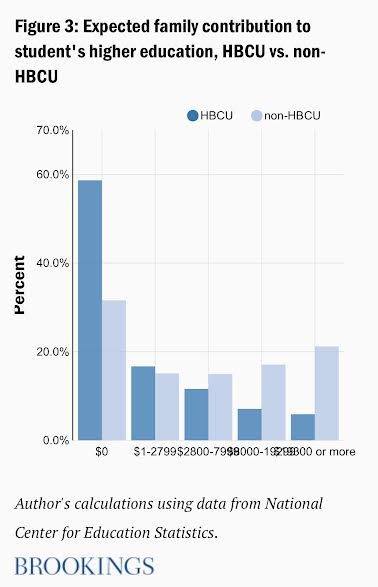
Students could see themselves earning enough to reduce or eliminate student borrowing costs. An immense hinderance to HBCU graduates creating generational wealth for themselves and their family. This barrier to wealth also is something that it could be argued contributes to poor alumni donor giving at HBCUs. HBCU donations of significance often come from older HBCU alumni who tend to wait and give a large donation either at the end of life or through their estate once they have passed on. HBCU students on a whole as reflecting in HBCU Pell Grant numbers are coming from far more low-income backgrounds their PWI counterparts. Brookings reports that almost 60% of HBCU students expect $0 in family contributions (graph below) to their education as opposed to less than one-third for non-HBCU students. On the other end less than 6 percent of HBCU students expect their family to contribute at least $19,300 to their education versus over 20 percent of non-HBCU students. This means that despite HBCUs on average costing significantly less than their PWI counterparts, HBCU students are still more likely to graduate with student loan debt and significant student loan debt loads. The most recent HBCU Money report showing that 86 percent of HBCU graduates finish with debt and a median of over $34,000 in student loan debt versus 40 percent and $24,000 in student loan debt for those coming from Top 50 endowed colleges and universities.

For HBCUs, the previous mentioned is great for their long-term sustainability, but in this case there is a huge financial reward to be had by HBCU endowments today. By providing the infrastructure, helping ensure the intellectual property rights, and more – HBCUs can create financial partnerships with students, faculty, and staff. This means that in the same way there is NIL (name, image, likeness) happening in collegiate sports, HBCUs too could use these partnerships as a means to recruit more African American faculty who often cringe at the pay rates at HBCUs. It also means that if a student, faculty, or staff produces an NFT for example that sells for $100,000, then potentially on a 50-50 split that the HBCU’s endowment just increased by $50,000. There is also the opportunity to have a foray into the entrepreneurship that is already taking root in the NFT as well as the supporting properties that will support it as an industry and asset class. As we mentioned, intellectual property attorneys in this new age will become even more valuable. There are currently six HBCU law schools who could create a focus on both IP and on digital IP in particular and those schools would be rewarded handsomely by being at the forefront of the curve. Simply put, there is just too much opportunity and money that has yet to even scratch the surface of value for HBCUs to not get involved in NFTs.

The acute importance of closing the endowment gap must be at the forefront of HBCU alumni conversations if our institutions are to be sustained into the next Millenia. It must be if we are to take serious the closing of the individual and institutional wealth gaps for African America. More importantly if HBCUs are to move beyond simply surviving and into empowered institutions that are truly able to serve the social, economic, and political interest of African America and the Diaspora, then having the institutional wealth and endowments necessary to do so is paramount. Climbing this mountain will be no easy task, but we can simply look at the wealth that has been created by our labor and our creativity as an enduring possibility of possibility. This time we must be the ownership of that creativity and protect its ownership at all costs.