Note: These data are based on colleges, universities, affiliated foundations, and related nonprofit organizations that volunteered to participate in NACUBO’s endowment study series.
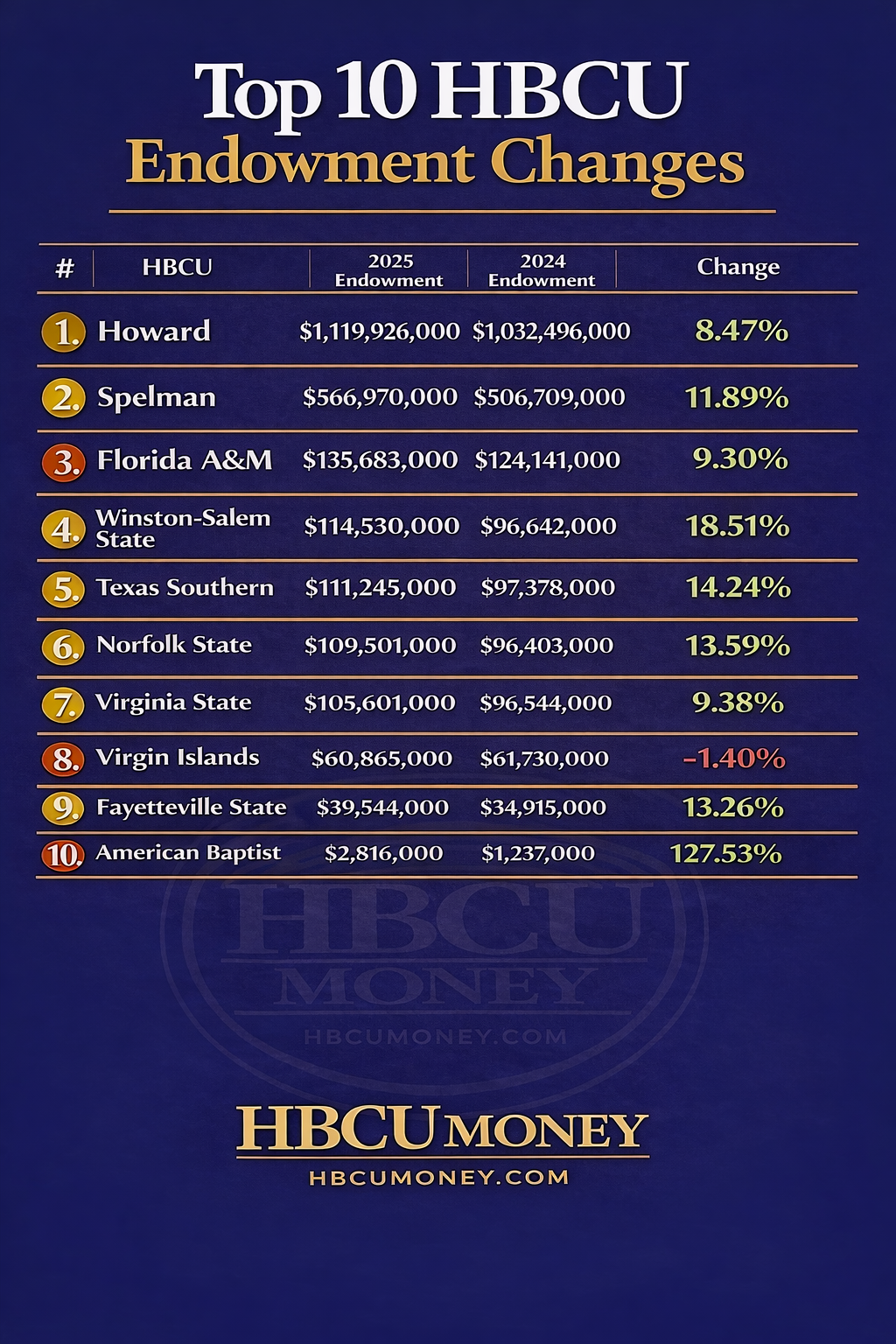
A year after Howard University became the first HBCU to break the $1 billion endowment value mark, four other HBCUs have reached the $100 million mark. It is a complicated celebration when the NACUBO report shows 89 PWIs who have at least $2 billion in endowment value. A few notable HBCUs who reported last year like Morehouse College, North Carolina A&T and Meharry Medical College who have been regular NACUBO participants, are all absent from this year’s list. An HBCU favorite, the University of Virgin Islands returned after an absence in 2024. The reality on the ground with the looming crisis in admissions is for most HBCUs, $500 million is the endowment floor and only two HBCUs (Howard and Spelman) are above that mark. With not as many students graduating K-12, that means HBCUs who are heavily reliant on tuition revenue will see acute strains in the coming decade. It is not a matter of if, but when. Strong endowments are often the only thing that can see institutions through times of stress. That currently includes political stress that all colleges and universities are facing as it relates to state and federal funding. The lack of urgency among HBCU alumni continues to be concerning. Many HBCU alumni think their institution is in better financial shape than it is with no real landscape of higher education economics and the factors that create vulnerability. Using HBCU Alumni Associations and Chapters as more aggressive investment vehicles that can benefit an HBCU’s foundation and endowment are paramount to long-term stability. But this means seeing them as more than social clubs. HBCUs like all African American institutions are in perilous times and continued reliance on lottery philanthropy that may or may not come from non-alumni driven philanthropy (see Mackenzie Scott, Michael Bloomberg, etc.) is as dangerous as hoping to pay your bills every month with scratch off lottery tickets.
“This year’s report shows how important well-managed endowments are to colleges and universities,” said Kara D. Freeman, NACUBO President and CEO. “Endowments help fuel innovation and serve as a stable foundation for institutions. Because of challenges in the economy, some institutions relied more heavily on their endowments—but that additional spending benefited students, faculty, staff, research, operations, and more. Endowments make college possible and more affordable, and contribute to better lives for all.”
NACUBO HIGHLIGHTS:
Top 10 HBCU Endowment Total – $2.4 billion*
Top 10 PWI Endowment Total – $340.0 billion
Number of PWIs Above $2 billion – 89
Number of PWIs Above $1 billion – 169
Number of HBCUs Above $1 billion – 1
Number of HBCUs Above $100 million – 4*
678 colleges, universities, and education-related foundations completed NACUBO’s FY25 survey and those institutions hold $953.7 billion of endowment assets with an average endowment of $1.4 billion and median endowment of $259.9 million.
HBCUs comprised 1.4 percent of NACUBO’s reporting institutions and 0.3 percent of the reporting endowment assets.
PWI endowments (32) with endowments over $5 billion hold 57.4 percent of the $953.7 billion in endowment assets.
**The change in market value does NOT represent the rate of return for the institution’s investments. Rather, the change in the market value of an endowment from FY24 to FY25 reflects the net impact of: 1) withdrawals to fund institutional operations and capital expenses; 2) the payment of endowment management and investment fees; 3) additions from donor gifts and other contributions; and 4) investment gains or losses.
SOURCE: NACUBO
Take a look at how an endowment works. Not only scholarships to reduce the student debt burden but research, recruiting talented faculty & students, faculty salaries, and a host of other things can be paid for through a strong endowment. It ultimately is the lifeblood of a college or university to ensure its success generation after generation.
Love is or it ain’t. Thin love ain’t love at all. – Toni Morrison, Beloved
When Pittsburgh Steelers wide receiver DK Metcalf proposed to Grammy-nominated singer Normani in March 2025, everyone saw the romance. But few understood the deeper significance. Three years earlier, Russell Wilson and Ciara had orchestrated the introduction at a party where Ciara made sure Normani attended. “They was playing cupid, but it worked,” Normani later said. “If you could trust a couple [to set you up], that would be the couple.”
Four months later in July 2025, when NBA star Donovan Mitchell proposed to singer Coco Jones, the Wilsons were once again celebrating behind the scenes. Russell had helped plan the proposal, working with luxury event planners to create the perfect moment.
Two high-profile engagements. One couple quietly orchestrating connections. But this isn’t just celebrity matchmaking—it’s something more profound. Russell and Ciara Wilson are modeling what intentional Black love looks like, and the ripple effects could fundamentally reshape African American institutional capacity at a moment when our community desperately needs it.
What makes the Wilsons’ matchmaking significant isn’t the celebrity of the couples they bring together—it’s the deliberateness of it. They’re not hoping love happens. They’re creating the conditions for it. They’re investing three years of relationship before an engagement. They’re using their social capital to bridge different professional spheres, connecting successful Black professionals across industries who might never meet organically despite moving in similar circles.
This kind of intentionality around Black love has historical resonance. During the segregation era and Jim Crow, when every institution worked to keep Black families separated and destabilized, our communities survived by being deliberate about connection. Churches served as matchmakers. Family networks facilitated introductions. HBCUs became spaces where Black professionals met their future spouses. The community understood that strong marriages weren’t just about individual happiness—they were about survival and institutional building.
The data reveals something striking: marriage rates for Black adults were higher than for white adults in every U.S. Census from 1890 to 1940—the height of overt racism and segregation. Even in 1960, the marriage rate for Black adults was 61%, and two-thirds of Black children lived in two-parent households. Today, only 31% of Black Americans are married, and half have never been married at all.
What changed wasn’t racism—that existed then and persists now. What changed was the infrastructure of intentionality around Black love. The systems that deliberately brought people together, that supported young marriages, that made partnership formation a community priority—those eroded while the obstacles remained.
Understanding what the Wilsons are doing requires understanding what Black families have survived—and what continues to threaten our ability to build generational wealth and institutional power through stable partnerships.
The historical attacks on Black family formation were systematic and devastating. During segregation, redlining prevented Black families from buying homes in appreciating neighborhoods, which meant that even when Black couples married and saved, their wealth accumulated at a fraction of the rate of white families. Housing policies created by the federal government in the 1930s explicitly designated Black neighborhoods as too risky for mortgage lending, forcing Black families into predatory contracts that often ended in eviction.
But perhaps no threat has been more insidious than the systematic devaluation of Black women as romantic partners. Research consistently shows that Black women face unique marginalization in the dating market. Studies reveal that Black women receive the lowest desirability ratings on dating platforms from men of all races, with one 2014 OKCupid analysis finding Black women rated as “least attractive” compared to women of other races. These aren’t just numbers—they reflect deep-seated stereotypes that paint Black women as too masculine, too strong, too independent, too angry to be desirable partners.
The roots of these stereotypes trace directly to slavery, when Black femininity was deliberately contrasted against white femininity to justify Black women’s oppression and exploitation. When Black women assertively advocate for themselves, society—including some Black men—uses labels like “loud,” “angry,” and “emasculating” to question their worthiness for romantic relationships. The myth persists despite Black women’s clear desire for marriage and partnership.
This devaluation creates a devastating cycle. Black men face their own pressures and internalized racism, sometimes leading them to view relationships outside the Black community as aspirational—an “upgrade” that signals status and success. The data bears this out: among Black newlyweds with bachelor’s degrees, men are more than twice as likely as women to marry outside their race (30% versus 13%). Some Black men internalize colorism and Eurocentric beauty standards, further narrowing the pool of Black women they consider desirable partners.
When successful Black men choose partners outside the community without understanding the implications, they dilute the very networks and institutional capacity the Black community needs to build generational power. They reduce the already constrained supply of partners for Black women who, despite facing the most challenging dating environment of any demographic, remain the group most committed to intra-racial partnership. This isn’t about policing individual choice—it’s about recognizing that individual choices, aggregated across thousands of successful Black professionals, have community-level consequences for institutional sustainability.
When the Great Migration brought millions of Black families north seeking better opportunities, they found wages increasing but housing wealth eroding. Segregated housing markets meant Black families paid higher rents for deteriorating properties while watching their neighborhoods decline in value. The very act of Black families moving into a neighborhood triggered white flight, which collapsed property values. Homes that should have been vehicles for wealth accumulation became wealth traps.
Then came the deliberate destruction. The Tulsa Race Massacre of 1921 obliterated what was known as “Black Wall Street”—a thriving district where Black families owned land, operated businesses, and built wealth estimated at over $200 million in today’s dollars. Hundreds died, thousands were left homeless, and laws were passed to prevent survivors from rebuilding. This wasn’t unique. Chicago saw approximately 1,000 Black homes and businesses burned during the Red Summer of 1919. Across the country, thriving Black communities were systematically destroyed through racial violence that governments failed to prevent and often actively supported.
The wealth that did accumulate often couldn’t be transferred. Without access to estate planning services and facing discriminatory legal systems, many Black families lost property through “heirs property” designations that left land ownership unclear and prevented descendants from accessing the wealth their grandparents had built.
Today’s threats are more subtle but no less destructive. Mass incarceration has removed hundreds of thousands of Black men from their communities, destroying the gender balance needed for relationship formation. The student debt crisis hits Black families hardest—Black graduates owe an average of $25,000 more than their white peers—making the economic foundation for marriage more precarious. The wealth gap means young Black couples can’t fall back on family wealth during rough patches the way white couples can. Geographic dispersion means young Black professionals leave the high-marriage-rate states where HBCU ecosystems once facilitated connections, moving to cities where they’re isolated from institutional support networks.
But perhaps most damaging is the loss of cultural infrastructure around Black love. The deliberate community matchmaking of previous generations has largely disappeared. The social pressure and support for marriage has weakened. Dating apps have replaced friend introductions, optimizing for superficial attraction rather than shared values and compatible life goals. Young Black professionals, especially those who’ve left HBCU networks, often lack access to communities of Black peers navigating similar life stages.
The Wilsons understand something crucial: strong Black marriages aren’t just about personal fulfillment. They’re about building institutional capacity. When they facilitate a marriage between DK Metcalf and Normani, they’re not just creating a happy couple—they’re multiplying resources that could flow to Black institutions.
Consider the mathematics of it. Married couples don’t just have double the income of single individuals—they accumulate wealth exponentially faster. Black married couples have a median net worth of $131,000 compared to just $29,000 for single Black individuals. This isn’t because marriage magically creates money. It’s because marriage allows for coordinated financial strategy, shared expenses, combined networks, and the ability to take risks one income couldn’t support.
But the real multiplier effect extends beyond individual household wealth. Strong Black marriages create:
Coordinated Philanthropic Power: A married couple decides together where to direct resources. They create family foundations. They develop multi-year giving strategies to institutions they both value. They leverage their combined networks to recruit other donors. They become major benefactors rather than occasional contributors.
Intergenerational Institutional Commitment: Children from stable two-parent households inherit not just wealth but institutional loyalty. A child whose parents both attended HBCUs, both support Black cultural institutions, both invest in Black businesses—that child grows up with institutional commitment encoded in their identity. They become the next generation of supporters, leaders, and advocates.
Professional Network Effects: When two successful Black professionals marry, their networks merge. Different industries intersect, creating unexpected opportunities. Professional connections multiply. These network overlaps create opportunities for institutional partnerships, corporate sponsorships, business ventures, and talent pipelines that wouldn’t exist otherwise.
Resilience and Risk-Taking: Married couples can take risks single individuals cannot. They can invest in Black startups, fund untested ventures, support experimental programs, and make long-term commitments to institutions precisely because they have a partner sharing the risk. This risk-taking capacity is essential for institutional innovation and growth.
Cultural Modeling and Social Capital: Visible successful Black marriages change cultural narratives. They make marriage aspirational. They demonstrate what’s possible. They create social pressure in the positive sense—the expectation that successful Black professionals will find partners, build families, and invest in community. This cultural shift has compound effects across generations.
The geographic data supports this institutional impact. Seven of the top ten states with highest Black marriage rates—Virginia (34.0%), Maryland (33.2%), Texas and Delaware (32.8%), Florida and North Carolina (31.3%), and Georgia (30.9%)—are HBCU states. These states have thriving Black middle classes, strong African American institutions, and robust professional networks. The marriage rates aren’t coincidental—they’re evidence of how institutional ecosystems and family stability reinforce each other.
What the Wilsons are doing works because they understand marriage formation as network building. They’re not running a dating service. They’re curating a community of successful Black professionals who share values, understand each other’s pressures, and can build partnerships that transcend individual achievement.
Research shows people are still most likely to meet long-term partners through friends, family, or work rather than dating apps. The Wilsons are leveraging this truth at scale. Every couple they help create becomes a new node in an expanding network. Metcalf and Normani will introduce their single friends to each other. Mitchell and Jones will facilitate connections within their circles. The Wilsons’ nine-year marriage serves as the model and proof of concept.
This creates self-reinforcing cycles. Strong marriages produce stable families. Those families invest in institutions. Those institutions create spaces where the next generation forms relationships. Those relationships produce more strong marriages. The cycle builds momentum.
This is how communities accumulate power—not through individual success stories but through interconnected networks of families committed to collective advancement. During segregation, Black communities maintained this infrastructure deliberately because they had to. We knew that isolated success meant nothing if it couldn’t be transferred to the next generation or scaled across the community.
The Wilsons are reviving this model for the contemporary moment, when Black professionals are more economically successful than ever but often isolated from the institutional networks that would allow that success to compound.
Imagine if what the Wilsons are doing at the celebrity level was replicated across every tier of Black professional achievement. Imagine if young Black doctors, lawyers, engineers, educators, entrepreneurs were part of deliberate matchmaking networks that facilitated connections based on shared values and institutional commitment.
The compound effects would be staggering:
Economic Impact: Thousands of additional stable Black marriages would translate to billions in accumulated wealth. That wealth, properly channeled, could recapitalize Black institutions that have operated on shoestring budgets for generations. HBCUs could build endowments rivaling elite white institutions. Black hospitals could expand. Community development financial institutions could scale their lending. Black cultural institutions could thrive rather than merely survive.
Political Power: Married couples are more likely to vote, more likely to engage in civic life, more likely to serve on boards and run for office. A generation of politically engaged Black couples could fundamentally shift electoral dynamics and policy priorities in states with large Black populations.
Professional Advancement: The network effects of thousands of strategic Black marriages would create unprecedented opportunities for collaboration. Black entrepreneurs would have access to capital through their spouses’ networks. Black professionals would have insider information about opportunities through their partners’ connections. The “old boys network” that has excluded Black professionals for generations could be matched by networks of Black couples leveraging their combined social capital.
Cultural Renaissance: Stable Black families create the conditions for cultural production. Artists need economic security to take creative risks. Writers need time to develop their craft. Musicians need resources to experiment. When Black creative professionals have partners who can provide economic stability, the entire community benefits from their artistic output.
Institutional Sustainability: Perhaps most critically, networks of strong Black marriages ensure institutional continuity. When couples commit to supporting institutions together, those institutions can plan decades into the future. They can launch ambitious programs knowing they have committed donors. They can weather economic downturns because their supporter base is stable. They can dream bigger because their foundation is stronger.
But recognizing what’s possible raises uncomfortable questions about what’s missing. If the Wilsons can facilitate life-changing connections within celebrity circles, why doesn’t similar infrastructure exist for the thousands of Black professionals outside those circles? If marriage rates for Black adults were higher during Jim Crow than today, what infrastructure did we lose—and how do we rebuild it?
These questions don’t have simple answers, but they demand serious consideration:
How do we recreate the deliberate matchmaking infrastructure that sustained Black communities during segregation, adapted for contemporary circumstances? Church networks and family connections can’t carry the full weight when young Black professionals are geographically dispersed and disconnected from traditional institutions.
What would institutional investment in Black relationship formation look like? HBCUs, Black Greek organizations, professional associations, cultural institutions—these entities have the trust and access to facilitate connections. But do they recognize this as part of their mission? Do they allocate resources to it? Do they measure success by families formed, not just events hosted?
How do we address the structural barriers that make marriage economically precarious for young Black professionals? Student debt, wage gaps, wealth inequality, housing costs—these aren’t relationship problems, but they make relationship formation dramatically harder for Black Americans than for white Americans with similar educational attainment.
What role does media and culture play in shaping expectations around Black love? When the dominant narratives about Black relationships emphasize dysfunction and failure, when successful Black marriages are invisible, when young Black people grow up without models of healthy partnerships—this creates self-fulfilling prophecies that perpetuate the marriage gap.
How do we balance individual freedom and choice with community needs for strong families and institutions? Nobody should be pressured into marriage. But if the community loses the infrastructure that facilitates healthy relationship formation, individual freedom becomes isolation by default.
The Wilsons have shown what’s possible. Their intentional matchmaking, their sustained investment in couples’ success, their willingness to leverage their social capital for others’ benefit—this is the model. But celebrity circles can only accommodate so many couples. The question is how to scale this intentionality across the Black professional class.
The answer must be institutional, because only institutions can sustain infrastructure across generations. Individual matchmakers burn out. Informal networks fragment. But institutions—if properly designed and resourced—can maintain systems indefinitely.
What might institutional investment in Black love infrastructure look like?
HBCU Alumni Networks as Matchmaking Ecosystems: Alumni associations in major cities could host quarterly events specifically designed to facilitate connections among young Black professionals. Not awkward singles mixers, but sophisticated networking events, community service projects, cultural experiences where relationships form organically among people with shared backgrounds and values. Success could be measured not just by attendance but by marriages facilitated and families formed.
Black Professional Associations as Relationship Hubs: Organizations for Black lawyers, doctors, engineers, educators, entrepreneurs could recognize relationship facilitation as core to their mission. When successful Black professionals marry, their combined professional power benefits the entire community. These associations could create structured mentorship that pairs young professionals not just for career guidance but for life partnership modeling.
Technology Platforms Designed for Black Love: Dating apps optimize for engagement and superficial attraction. What if technology was designed specifically to facilitate meaningful connections among Black professionals committed to community building? Platforms that prioritize shared values, institutional loyalty, life goals, and cultural understanding over swipe-right dynamics.
Financial Incentives for Family Formation: What if institutions offered tangible support for young Black couples? Grants for couples pursuing marriage counseling. Low-interest loans for home purchases for alumni couples. Scholarships for children of HBCU alumni couples. These investments would pay dividends in institutional loyalty that compounds across generations.
Cultural Campaigns Celebrating Black Love: Media campaigns showcasing successful Black marriages, particularly among professionals committed to community advancement. Not aspirational fantasy but realistic portrayals of how successful couples navigate challenges, support each other’s growth, and invest in institutions. Make Black love visible, aspirational, and achievable.
Research Infrastructure: We lack basic data on what makes Black marriages successful. Which combinations of backgrounds, values, and life circumstances predict long-term partnership success? What interventions effectively support young Black couples through early marriage challenges? Hampton University’s National Center on African American Marriage and Parenting represents a start, but we need comprehensive research infrastructure that can inform evidence-based programming.
The answers won’t come from any single intervention but from a ecosystem of institutional support that makes Black love not just possible but probable. That makes stable marriages not just aspirational but expected. That makes family formation not just personal but communal.
Russell and Ciara Wilson didn’t set out to solve the Black marriage crisis or to transform African American institutional capacity. They’re simply two people who understand the value of healthy relationships and want to share that blessing with their friends.
But their efforts reveal what’s missing and what’s possible. They show that when influential people commit to facilitating connections within Black professional circles, life-changing partnerships form. They demonstrate that intentionality around Black love produces results that individual effort alone cannot achieve. They prove that building strong Black marriages is institution-building at its most fundamental level.
The viral social media pleas asking the Wilsons to expand their matchmaking aren’t just jokes. They reflect a genuine hunger for what the Wilsons provide—thoughtful facilitation of connections among Black professionals who share values and aspirations. They reveal the absence of infrastructure that our grandparents’ generation took for granted because it was built into the fabric of Black community life.
The declining marriage rate among African Americans isn’t inevitable. It’s the result of infrastructure collapse that can be reversed through deliberate institutional investment. The opportunity is to recognize that facilitating Black love isn’t tangential to institutional missions—it’s foundational to building the networks of stable families that will sustain Black institutions for generations.
Seven of the ten states with highest Black marriage rates are HBCU states, which means the foundation still exists. The communities are still present. The institutions still stand. What’s needed is leadership willing to acknowledge that the work of building Black institutional power begins with building Black families. That the work of building Black families requires intentional infrastructure. That the work of building that infrastructure is everyone’s responsibility who claims commitment to Black advancement.
The Wilsons are showing us what’s possible when two people commit to intentionally building Black love within their circles of influence. The question for the rest of us—for institutions, for leaders, for anyone with social capital and community commitment—is whether we’ll do the same within our own spheres. Whether we’ll recognize matchmaking as institution-building. Whether we’ll invest in the infrastructure that makes Black love not just possible but inevitable.
The fire is there. The Wilsons are fanning the flames. The question is whether the rest of us will add fuel until it becomes a blaze that lights the way for generations to come.
Disclaimer: This article was assisted by ClaudeAI.
A single twig breaks, but the bundle of twigs is strong. – Tecumseh
The tradition of giving runs deep in African American communities. From the mutual aid societies formed during enslavement to the church collections that funded the Civil Rights Movement, Black Americans have always understood that our collective survival depends on our willingness to invest in one another. Yet somewhere between necessity and aspiration, we’ve lost the language to teach our children that philanthropy isn’t charity—it’s power.
Teaching African American children ages 5-18 about philanthropy means doing more than dropping coins in a collection plate. It means helping them understand that strategic giving builds the institutions that will protect, educate, and employ them throughout their lives. It means showing them that every dollar they contribute to Black-led organizations is a vote for their own future.
Starting Early: Philanthropy for Elementary Ages (5-10)
Young children understand fairness instinctively. They know when something isn’t right, and they want to help fix it. This natural empathy creates the perfect foundation for introducing philanthropic concepts.
Begin with concrete examples from African American history. Tell them about the Free African Society, founded in 1787 by Richard Allen and Absalom Jones, which provided mutual aid to Black Philadelphians. Explain how enslaved people pooled resources to purchase freedom for family members. These aren’t abstract concepts they’re survival strategies that became institutional frameworks.
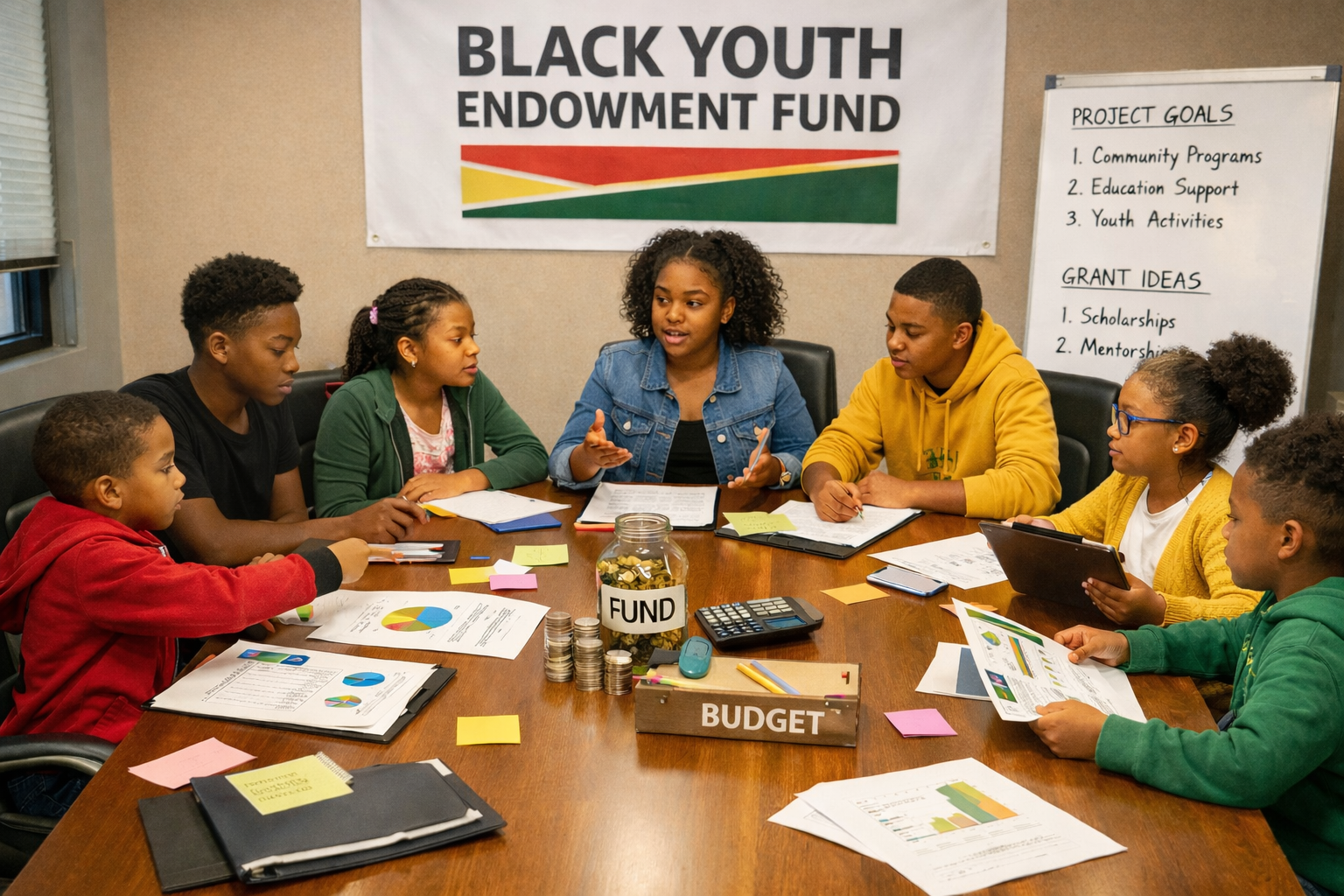
Create a family giving jar where children can contribute a portion of their allowance or gift money. Let them research and choose a Black-led organization to support quarterly. This could be a local youth program, a historical preservation society, or an HBCU scholarship fund. The key is giving them agency in the decision-making process. When children see their small contributions combine with others to create meaningful impact, they begin to understand collective power.
Use storytelling to illustrate how institutions are built. Talk about how HBCUs were created because white institutions excluded Black students. Explain how Mary McLeod Bethune started a school with $1.50 and turned it into Bethune-Cookman University. Show them that great institutions often begin with small, consistent contributions from people who understood the long game.
Middle School: Understanding Institutional Building (11-13)
By middle school, children can grasp more sophisticated concepts about how money moves and how power is built. This is when we introduce them to the difference between charity and institutional philanthropy.
Charity addresses immediate needs—feeding the hungry, clothing the poor. Institutional philanthropy builds the structures that create long-term change: schools, hospitals, community development corporations, legal defense funds, policy organizations. Both matter, but only institutional philanthropy shifts power dynamics.
Teach them about the NAACP Legal Defense Fund, established in 1940. Explain how sustained philanthropic support allowed lawyers like Thurgood Marshall to develop the legal strategy that led to Brown v. Board of Education. This wasn’t a one-time donation it was years of investment that transformed American society.
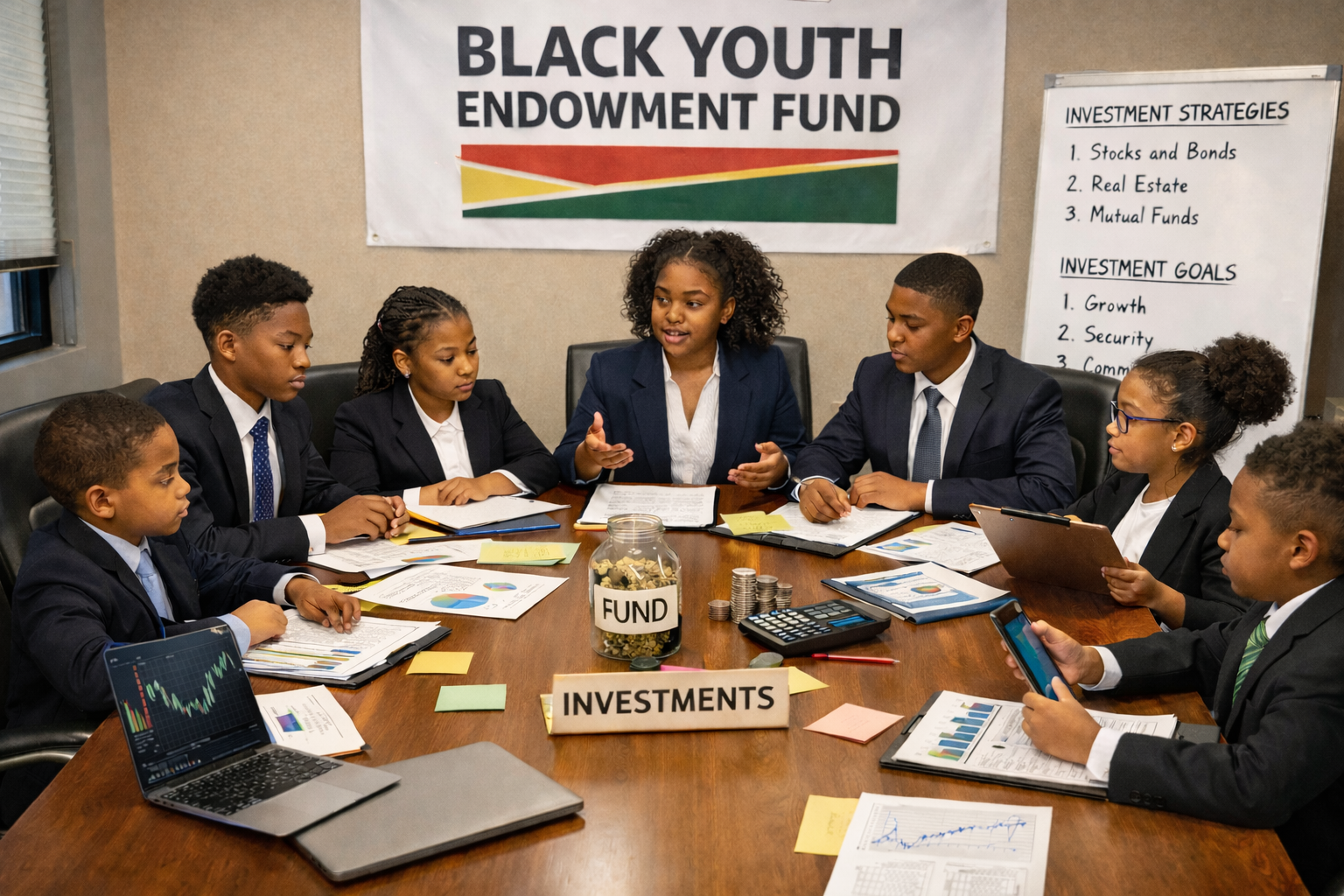
Introduce the concept of endowments and investment income. Too many African American organizations operate in perpetual crisis mode, chasing donations year after year. Show students the difference between an organization with a $100,000 annual budget that must be fundraised every twelve months and an organization with a $2 million endowment generating $80,000 annually in investment income. The second organization can focus on mission instead of survival.
Start a philanthropy club at school or in your community. Let students identify a need in their community and develop a giving circle to address it. They should practice everything: setting fundraising goals, researching organizations, making collective decisions, tracking impact, and understanding how their contributions grow through consistent giving. This hands-on experience transforms abstract concepts into practical skills.
High School: Strategic Power Building (14-18)
High school students are ready to understand philanthropy as a tool for social, economic, and political empowerment. They can analyze power structures and recognize how institutional support or the lack thereof shapes outcomes in Black communities.
Teach them to read institutional budgets and annual reports. Show them how to evaluate whether an organization has sufficient reserves, how much goes to programs versus overhead, and whether they’re building long-term sustainability. This financial literacy is essential for effective philanthropy.
Explore the concept of investment income in depth. Many students don’t realize that major institutions—universities, museums, hospitals—operate primarily on endowment income, not annual fundraising. Harvard’s endowment generated approximately $2.3 billion in investment income in recent years. Imagine if HBCUs collectively had similar resources. Explain that building Black institutional power requires moving beyond the donation mentality to an investment mindset.
Discuss how philanthropy intersects with political power. Show them how think tanks, policy organizations, and advocacy groups are funded. Explain that when Black communities don’t adequately fund our own policy organizations, others define the agenda affecting our lives. The Tea Party movement and its affiliated organizations received hundreds of millions in philanthropic support that reshaped American politics. What might be possible if African American communities invested similarly in organizations advancing our interests?
Examine collective philanthropy models. Traditional philanthropy often centers wealthy donors making large gifts. But collective giving where many people contribute smaller amounts has always been the African American philanthropic model. From church building funds to contemporary giving circles, we’ve understood that our strength lies in numbers. Today’s technology makes collective philanthropy more powerful than ever. A thousand people giving $100 monthly creates $1.2 million annually enough to endow a scholarship, support a community organization, or launch a new initiative.
Encourage students to start giving now, even if it’s $5 monthly to an organization they believe in. The habit matters more than the amount. A teenager who gives $10 monthly from age 16 to 66 contributes $6,000 in direct donations, but if that money is invested and earns average returns, it represents tens of thousands in institutional support.
Teaching African American youth about philanthropy means helping them understand its components and how they work together to build institutional power.
Educational Institutions: HBCUs, independent schools, scholarship funds, and educational support organizations create pathways to opportunity and preserve cultural knowledge. Sustained philanthropic support allows these institutions to build endowments, improve facilities, and attract top faculty and students.
Economic Development: Community development corporations, Black-owned business incubators, affordable housing organizations, and loan funds build wealth and economic stability. These institutions require patient capital and sustained support to create generational impact.
Legal and Policy Organizations: Civil rights organizations, legal defense funds, policy think tanks, and advocacy groups shape the rules that govern society. Inadequate funding in this sector means Black interests remain underrepresented in policy formation.
Cultural Institutions: Museums, historical societies, arts organizations, and media companies preserve our stories and shape narratives. Control over our cultural narrative requires institutional infrastructure that only sustained philanthropy can build.
Health and Social Services: Community health centers, mental health organizations, and social service providers address immediate needs while building the institutional capacity to serve Black communities long-term.
Each component requires different funding strategies. Some need operating support, others need capital for buildings or technology, many need endowment building. Teaching youth to think strategically about where and how they give helps them maximize impact.
The most important lesson we can teach African American children about philanthropy is that it’s not optional it’s essential. Every community that has built institutional power has done so through sustained, strategic philanthropy. Jewish communities support Jewish institutions. Asian American communities support Asian American institutions. African American communities must do the same.
Start conversations early. Make giving a family practice. Teach children to evaluate organizations critically. Help them understand that building Black institutional power is a marathon, not a sprint. Show them that their contributions, combined with others, create the schools, organizations, and institutions that will serve generations to come.
This isn’t about guilt or obligation. It’s about power, self-determination, and legacy. When we teach our children that philanthropy is institution-building, we give them tools to shape their own future rather than waiting for others to determine it for them.
The question isn’t whether African American communities can afford to invest in our institutions. The question is whether we can afford not to.
We went from bartering to dollars. We can go from capitalism to whatever may come next. But without institutional ownership of the institutions that control the circulation of the medium, without the institutional ownership that protects our economic interest, and without the institutional ownership that reduces financial risk in our community, then power and empowerment will always be reduced to the fantasy of freedom we tell ourselves with raised fists. – William A. Foster, IV
There is a financial story unfolding across the historically Black college and university landscape that is not receiving nearly enough attention. It is not a story about endowments, donor campaigns, or legislative funding fights — though it touches all of those. It is a story about credit unions: small, member-owned financial institutions that were once tethered to HBCUs as a gateway to financial inclusion for Black students, faculty, and alumni. One by one, they are disappearing. And the speed with which they have vanished over the past five years should alarm anyone who has spent even a passing moment thinking about African American wealth-building.
In 2020, HBCU Money published a comprehensive directory of all eleven HBCU-based credit unions in the country. The list was not long to begin with. Eleven institutions, spread across the nation, collectively holding $88.7 million in total assets and serving roughly 14,953 members. Those numbers were already modest bordering on fragile but they represented something tangible: a constellation of Black-controlled financial institutions with deep roots in the communities they served.
Today, that number has dropped to six.
Five HBCU-based credit unions have either closed or been acquired since that 2020 snapshot. Howard University Employees Federal Credit Union in Washington, D.C., which held $10.1 million in assets making it the fourth-largest in the group is no longer operational as an independent institution. Savannah State Teachers Federal Credit Union in Georgia, Tennessee State University’s credit union, and Shaw University’s federal credit union in Raleigh, North Carolina, the smallest of the group at just $400,000 in assets, have all ceased to exist as independent entities.
And then there is Prairie View A&M University Federal Credit Union, a case study in how these institutions disappear not with a clean closure, but with an acquisition that raises questions nobody seems willing to ask out loud. Prairie View FCU, which held $3.7 million in assets as of 2020, was absorbed by Cy-Fair Federal Credit Union, the credit union tied to Cypress-Fairbanks Independent School District in the Houston suburbs. Prairie View FCU now operates as a division of Cy-Fair FCU, retaining its name and its single location at the foot of the PVAMU campus but operating entirely under Cy-Fair’s infrastructure, branding, and control. The Cy-Fair FCU website frames the arrangement in the warmest possible terms celebrating PVFCU’s “remarkable 85-year history” and its founding in 1937 by sixteen pioneers who created a financial institution to serve employees of what was then Texas’s first state-supported college for African Americans. The language is reverent. The reality is that an 85-year-old Black institution, one built by and for a Black community, is now a subsidiary of a school district credit union. This in and of itself should be acutely embarrassing to the HBCU community. A school district lording over a higher education institution community’s financial interest.
The choice of Cy-Fair FCU as the acquiring institution deserves scrutiny. Cypress-Fairbanks ISD is the third-largest school district in Texas, but its relationship with its Black community has been, to put it charitably, troubled. In 2020, the district was forced to confront documented racial disparities in its own student discipline where African American students made up 18.5 percent of enrollment but accounted for 38.7 percent of suspensions in the 2018-19 school year. The district commissioned an equity audit, and the results confirmed what critics had long alleged: districtwide discrepancies in academics, discipline, and staff representation along racial lines. White students consistently outperformed Black peers on standardized tests and graduated at higher rates, while the teaching staff remained overwhelmingly white — 66 percent white in 2019-20, even as the student body had become far more diverse.
The situation reached a national flashpoint in January 2022 when Cy-Fair ISD trustee Scott Henry, who had won his seat on a platform centered on opposing critical race theory, made remarks at a board work session that were widely condemned as racist. Henry openly questioned the value of hiring more Black teachers, pointing to Houston ISD’s higher percentage of Black educators and linking it to that district’s dropout rate — a claim that multiple studies and education researchers have thoroughly debunked. Harris County Judge Lina Hidalgo, then Houston Mayor Sylvester Turner, the NAACP, and the ACLU of Texas all called for his resignation. Henry was fired from his position at software company Splunk but, because he was elected, could not be removed from the board by his colleagues. His remarks, and the social media trail of racially charged posts that preceded them, painted a portrait of the ideological environment within Cy-Fair ISD’s governance.
It is into this environment that Prairie View FCU, an institution founded specifically to serve a historically Black university community was folded. The Cy-Fair FCU website does not dwell on any of this context. It offers a “Panther Card” debit card that channels a portion of spending back to PVAMU athletics, and it lists enhanced services like video banking and remote deposit. These are not trivial upgrades for an institution that previously lacked basic digital banking capabilities. But the upgrades come at a cost: Prairie View FCU’s independence, its board, and its autonomy as a Black-controlled financial institution are gone. What remains is a branding exercise — a name on a building, a division page on someone else’s website.
Five institutions, gone in roughly four years. What remains is a smaller, more concentrated group of survivors. According to 2025 data from the National Credit Union Administration, the six remaining HBCU-based credit unions now hold a combined $76.8 million in total assets and serve 11,588 members. Southern Teachers & Parents Federal Credit Union in Baton Rouge, Louisiana, leads the group at $28.9 million in assets. Florida A&M University Federal Credit Union in Tallahassee follows closely at $28.5 million. Virginia State University Federal Credit Union in South Chesterfield, Virginia, has seen meaningful growth, reaching $13.3 million in assets, a 54.4 percent increase since 2016. Councill Credit Union at Alabama A&M in Normal, Alabama, clocks in at $2.5 million, though it has lost roughly 28 percent of its assets over the same period. Arkansas A&M College Federal Credit Union in Pine Bluff holds $1.9 million, and Xavier University’s Credit Union in New Orleans, one of the smallest surviving institutions, manages $1.7 million.
The trajectory is not encouraging. Even among the survivors, total membership has declined by more than seven percent since 2016, dropping from 12,467 members to 11,588. The average assets per member across the group have risen — from $5,189 to $5,611 — but that figure is almost entirely a function of assets outpacing a shrinking membership base, not a sign of organic financial health or deepening engagement. These are institutions hemorrhaging members even as they struggle to grow. And that hemorrhaging did not catch everyone off guard. Back in February 2012, HBCU Money published a detailed proposal outlining a path forward for these credit unions — not as isolated, single-branch institutions stumbling through each academic year, but as a unified financial force. The concept was straightforward in theory: consolidate the eleven HBCU-based credit unions into a single national institution, or at the very least forge a formal alliance that would pool resources, share technology infrastructure, and create economies of scale.
The 2012 proposal painted a picture of what that consolidated institution could look like. With access to the combined workforce of HBCUs — roughly 180,000 full and part-time employees — along with approximately 400,000 students, over a million alumni, the endowments of more than a hundred institutions, and the financial ecosystems of the communities surrounding each campus, a unified HBCU credit union would have been one of the most significant African American-controlled financial institutions in the country. It would have had the scale to offer affordable mortgages, student loans, small business financing, and a suite of services that, individually, none of these credit unions could ever dream of providing.
That merger never materialized. The alliance was never formed. And the consequences of that inaction are now playing out in real time as institutions that might have been strengthened by consolidation instead fold into obscurity. The reasons for the failure are familiar and deeply structural. HBCU administrations have historically been risk-averse when it comes to financial innovation, partly because of the precarious funding environments many of these schools operate in, and partly because of a broader cultural reluctance to prioritize financial infrastructure as a strategic institutional asset. The credit unions themselves lacked the technological sophistication and institutional support needed to compete in a rapidly evolving financial services landscape. Many of them did not have functional websites, mobile apps, or even basic debit card programs, amenities that any modern financial institution would consider non-negotiable. As the 2020 directory noted, the most glaring deficiency was a lack of FinTech investment. Without it, these credit unions were structurally incapable of retaining members whose financial needs matured beyond what a single-branch, limited-service institution could offer.
To understand just how far behind HBCU-based credit unions have fallen, it helps to look at what a university-based credit union can become when it is given the institutional support, technological investment, and long-term strategic commitment to grow. Michigan State University Federal Credit Union — MSUFCU — is that example. And the comparison is, frankly, staggering. MSUFCU, headquartered in East Lansing, Michigan, is the largest university-based credit union in the world. Founded in 1937 by eight faculty and staff members — its earliest records were kept in a desk drawer, it has grown into a financial powerhouse that, as of 2025, serves over 367,000 members and holds $8.26 billion in assets. It operates out of more than 30 branches across Michigan, has expanded into the Chicago metropolitan area, and employs over 1,300 people. It is not just a credit union; it is a regional financial institution by any standard measure.
Put that number next to the combined assets of every African American credit union in the country including the six remaining HBCU-based credit unions and the disparity becomes almost difficult to articulate. The six surviving HBCU-based credit unions hold, collectively, $76.8 million in assets. MSUFCU holds $8.26 billion. That means a single predominantly white university credit union holds more than 107 times the combined assets of every HBCU-based credit union still in existence. MSUFCU’s assets are not just larger than the combined total of HBCU credit unions they exceed the total assets of virtually all African American credit unions in the country. The gap is not a crack. It is a canyon.
MSUFCU did not arrive at this scale through magic or accident. It grew because Michigan State University invested in it. It grew because the institution was given the runway to expand its membership base from employees to students to alumni and to build out the technological and physical infrastructure that a modern credit union requires. It grew because it had the institutional backing to pursue mergers and acquisitions, absorbing smaller credit unions and even banks as it expanded its geographic footprint. Every strategic move MSUFCU has made over the past several decades — the branch expansions, the technology partnerships, the acquisition of McHenry Savings Bank and Algonquin State Bank in the Chicago area — reflects a long-term institutional vision that HBCU-based credit unions have never had the support or the organizational will to pursue. The contrast is not merely about money. It is about institutional commitment. It is about whether a university sees its credit union as a strategic asset, a vehicle for building generational wealth among its community or as an afterthought, a small office on the edge of campus that serves a fraction of the student body and operates with minimal oversight and fewer resources.
The 2025 NCUA data on the six surviving HBCU-based credit unions tells a story of incremental progress layered on top of structural decline. Virginia State University Federal Credit Union is the clearest success story in the group, growing its assets by 54.4 percent since 2016 from $8.6 million to $13.3 million and increasing its assets per member by 87.1 percent, from $3,742 to $7,001. Florida A&M University Federal Credit Union has also seen solid growth, with total assets rising 41.3 percent to $28.5 million, and membership expanding by 16.5 percent to 3,918 members. But these gains are exceptions, not the rule. Southern Teachers & Parents Federal Credit Union in Baton Rouge, the largest in the group, has grown its assets by only 2 percent since 2016, and its membership has fallen by 15.6 percent, dropping from 5,124 members to 4,326. It is holding steady on assets while quietly bleeding its membership base. Councill Credit Union at Alabama A&M has seen its assets shrink by nearly 28 percent since 2016, and its membership has fallen by over 30 percent. Arkansas A&M College Federal Credit Union has lost 22.7 percent of its assets. Xavier University’s credit union has contracted by 36.3 percent in assets and lost 5 percent of its membership. Across the group, the median asset change since 2016 is negative 10.3 percent. The median membership change is negative 10.3 percent as well. For every Virginia State that is growing, there are two or three institutions quietly shrinking toward irrelevance.
The average assets per member across all six institutions now stands at $5,611, up from $5,189 in 2016. That is a 12.5 percent increase — a number that sounds encouraging until you consider that MSUFCU’s assets per member, calculated from its $8.26 billion in assets and 367,000 members, comes to approximately $22,500. HBCU credit union members hold, on average, roughly one-quarter of the per-member asset value that an MSU credit union member does. The wealth-building capacity of these institutions is simply not comparable.
The collapse of five HBCU-based credit unions between 2020 and 2025 is not an isolated event. It is a symptom of a larger pattern in African American financial infrastructure one in which institutions that could, in theory, serve as engines of wealth circulation and community investment instead wither from neglect, underfunding, and a failure of institutional imagination. The 2012 proposal for a consolidated HBCU credit union was not a radical idea. It was a practical one. Credit union mergers are common across the industry. MSUFCU itself has pursued multiple mergers and acquisitions as a core part of its growth strategy. The tools, the regulatory framework, and the precedent all exist. What has been missing is the will on the part of HBCU administrations, alumni networks, and the broader African American institutional ecosystem to treat financial infrastructure with the same urgency that is applied to endowment campaigns or facility renovations.
The #BankBlack movement that surged during the social justice awakening of 2020 brought renewed attention to African American financial institutions, including credit unions. But attention without structural investment is temporary. The members who were inspired to open accounts at HBCU credit unions during that period appear, in many cases, to have drifted away once the cultural moment passed, a pattern visible in the continued membership declines across the group.
If the remaining six HBCU-based credit unions are to survive and if the broader ecosystem of African American credit unions is to grow rather than contract the conversation must shift from nostalgia to strategy. That means revisiting the merger and alliance models that were proposed over a decade ago. It means demanding that HBCUs treat their credit unions as institutional priorities, not afterthoughts. It means investing in the technological infrastructure that members now expect as a baseline. And it means reckoning honestly with the fact that, while MSUFCU serves as an aspirational model, it did not build $8.26 billion in assets overnight. It built them over nearly ninety years of sustained, intentional institutional support.
The clock is not on HBCU credit unions’ side. The five that have already closed will not reopen. But the six that remain still hold something valuable: a foothold. The question is whether the institutions and communities they serve will invest in preserving it or whether the quiet collapse will simply continue, one credit union at a time, until there are none left to save.
Disclaimer: This article was assisted by ClaudeAI.
The drums of Africa still beat in my heart. They will not let me rest while there is a single Negro boy or girl without a chance to prove his worth. – Mary McLeod Bethune
Every day, thousands of HBCU alumni stand in front of classrooms across America, shaping young minds and breaking cycles of poverty through education. These teachers carry forward the legacy of their alma maters, often working in the nation’s most underfunded schools with the fewest resources. Yet too often, they do so without the support of the very communities that benefited from similar dedication during their own educational journeys.
The numbers tell a powerful story. As of this writing, 1,690 HBCU alumni are actively seeking support on DonorsChoose, the popular crowdfunding platform for classroom projects. These aren’t outliers. They represent a significant cross-section of HBCU graduates who chose the noble, challenging profession of teaching. What’s more striking is where they teach and the conditions they face: 1,661 of them work in historically underfunded schools. That’s 98% of HBCU alumni teachers on the platform working in institutions starved of adequate resources.
The funding gap these teachers navigate is staggering. Of the 1,690 HBCU alumni teachers, 1,202 have projects with zero donations. They’ve submitted requests for books, supplies, technology, and basic classroom materials, and they’re waiting for someone to care enough to help. Additionally, 182 have never received funding for any project they’ve ever posted. These are educators who have repeatedly asked for support and been met with silence. Perhaps most telling: 1,555 teach in schools where more than half of students come from low-income households, the same communities many HBCUs were founded to serve.
HBCU alumni entering the teaching profession isn’t coincidental; it’s part of a rich tradition. Historically Black Colleges and Universities were established with a mission to educate those who had been systematically excluded from higher education. Many HBCUs began as teacher training institutions, recognizing that education would be the key to Black advancement and self-determination. Schools like Bennett College, Miles College, Tuskegee University, and Wiley University produced generations of teachers who returned to their communities to educate the next generation.
This tradition continues today. HBCU graduates are more likely than their peers from other institutions to teach in high-need schools, to work with predominantly African American student populations, and to stay in the profession despite its challenges. They bring cultural competence, high expectations, and a deep understanding of the systemic barriers their students face. They are, in many ways, continuing the work their institutions started: creating pathways to opportunity through education.
Yet the schools where they teach are chronically underfunded. Decades of inequitable school funding formulas, property tax-based education systems, and discriminatory resource allocation have created a two-tiered education system. HBCU alumni teachers often find themselves purchasing classroom supplies out of pocket, fundraising for basic necessities, and making impossible choices about which students get access to which resources.
There’s a moral imperative for HBCU alumni, families, organizations, and associations to support their fellow graduates who have chosen teaching. These educators are extending the mission of HBCUs into K-12 classrooms. When an HBCU alumna teaching third grade needs books for her classroom library, she’s doing the work of literacy development that HBCUs have championed for over a century. When an HBCU alumnus teaching high school chemistry needs lab equipment, he’s preparing the next generation of STEM professionals, many of whom will attend HBCUs themselves.
Supporting HBCU alumni teachers is also an investment in community wealth-building. Education remains one of the most reliable paths to economic mobility. The students these teachers serve are disproportionately Black and brown children from low-income families. Quality education, with adequate resources, can break cycles of poverty. When we fund a classroom project for an HBCU graduate teaching in Detroit, Atlanta, or rural Mississippi, we’re investing in future engineers, doctors, teachers, and leaders.
Moreover, there’s a pragmatic networking advantage. The HBCU community is uniquely positioned to support its own. Alumni associations already have infrastructure for giving. Fraternities and sororities have national reach and local chapters. HBCU families understand the value of these institutions and want to see their impact multiplied. By channeling even a fraction of philanthropic dollars toward HBCU alumni teachers, these networks can create measurable change in thousands of classrooms.
Supporting HBCU alumni teachers doesn’t require massive institutional change or million-dollar commitments, though those would certainly help. It starts with awareness and intentionality. There are concrete steps HBCU communities can take, starting with funding classroom projects on DonorsChoose. The platform makes it easy to search for HBCU alumni teachers. Alumni associations can create giving campaigns around Homecoming, Founders’ Day, or Giving Tuesday specifically to fund projects by graduates. A $50 donation can purchase books for a classroom library. A $200 donation can buy tablets for student learning. A $500 donation can transform a science lab. Individual alumni can adopt a teacher from their alma mater and commit to funding their projects annually.
Beyond direct funding, HBCU communities can create mentorship and professional development opportunities. Many HBCU alumni teachers work in isolation, without access to the kind of collegial support and professional growth opportunities their non-HBCU peers enjoy. Alumni associations can host virtual meetups, share teaching resources, or create affinity groups for teachers by subject area or grade level. Greek organizations can leverage their networks to connect teachers across cities and states. Experienced educators can mentor early-career teachers, helping them navigate challenges and avoid burnout.
Amplifying voices and celebrating work matters too. Social media campaigns highlighting HBCU alumni teachers, their innovative classroom practices, and their students’ achievements can build awareness and attract support. Alumni magazines can feature teacher profiles. Homecoming events can honor outstanding educators. This recognition matters not just for morale but for retention. Teaching is hard, underpaid work, and feeling seen and valued by one’s community makes a difference.
Perhaps most importantly, HBCU communities should support organizations that support teachers systemically. The Black Teacher Collaborative, an HBCU-founded and led organization, exemplifies this approach. Founded by educators from HBCUs, the Collaborative works to increase the number of Black teachers, improve their working conditions, and elevate their leadership in education policy. Supporting organizations like the Black Teacher Collaborative multiplies impact. They provide professional development, advocacy, research, and community-building that individual donations to classroom projects cannot. They work systemically to address the conditions that force teachers to crowdfund for basic supplies.
The Black Teacher Collaborative’s team brings deep expertise in teacher preparation, retention, and advocacy. They understand the unique challenges HBCU graduates face in the teaching profession and the unique assets they bring. Supporting such organizations isn’t charity; it’s strategic investment in educational equity and teacher empowerment.
While individual and organizational philanthropy is crucial, the root problem is systemic underfunding of public schools, particularly those serving low-income students and African American students. HBCU alumni, with their networks and influence, can advocate for equitable school funding formulas, increased teacher salaries, and policies that support rather than burden classroom teachers. Alumni associations and Greek organizations can engage in collective advocacy, using their political capital to push for the structural changes that would make teacher crowdfunding unnecessary.
Creating sustained support for HBCU alumni teachers requires more than one-off donations or awareness campaigns. It requires building a culture where supporting educators is seen as central to the HBCU mission, not peripheral to it. Alumni associations can integrate teacher support into their annual giving programs. Greek organizations can make teacher appreciation a national initiative. HBCU families can include teachers in their philanthropic planning.
This culture shift starts with storytelling. When alumni share why they support teachers, they inspire others. When teachers share how support has transformed their classrooms, they make the impact tangible. When students whose lives have been changed speak up, they close the loop. These stories, shared widely and often, create momentum. It also requires accountability. Alumni associations and organizations should set goals: How many teacher projects will we fund this year? How many teachers will we mentor? How much will we donate to organizations like the Black Teacher Collaborative? Tracking progress and reporting results keeps teacher support visible and valued.
Supporting HBCU alumni teachers is about more than helping individuals; it’s about sustaining a tradition and building a movement. HBCUs have always been about uplift, not just of individuals but of entire communities. When we support teachers, we honor that legacy. We ensure that the next generation has access to educators who see their brilliance, understand their context, and refuse to let resource scarcity limit their potential.
The 1,690 HBCU alumni on DonorsChoose represent thousands more working in schools across the country. They are the inheritors of a tradition that goes back to the founding of HBCUs themselves. They deserve our support, our celebration, and our partnership. The question is not whether we can afford to support them but whether we can afford not to.
The call to action is clear: HBCU alumni, log onto DonorsChoose and fund a project. HBCU families, talk to your children about the importance of supporting educators. HBCU organizations, make teacher support a strategic priority. Greek letter organizations, mobilize your networks for collective impact. And everyone, support HBCU-founded organizations like the Black Teacher Collaborative that are working for systemic change.
Our alumni teachers are out there every day, doing the work HBCUs prepared them to do. It’s time we showed up for them the way they show up for their students. It’s time we invested in those who are investing in our future. It’s time we gave back to those who give so much.
Disclaimer: This article was assisted by ClaudeAI.






 HBCU Money