When the missionaries came to Africa they had the Bible and we had the land. They said ‘Let us pray.’ We closed our eyes. When we opened them we had the Bible and they had the land. – Desmond Tutu
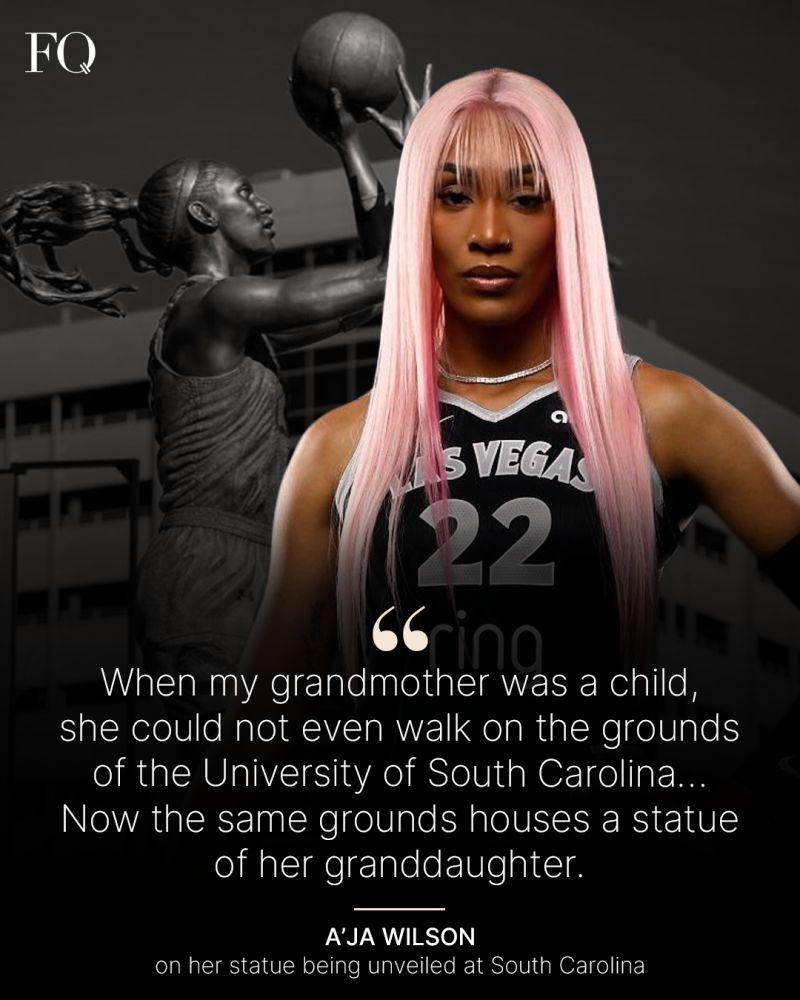
The image is powerful: A’ja Wilson, WNBA superstar and Olympic gold medalist, immortalized in bronze on the grounds of the University of South Carolina. Wilson herself captured the poignancy of the moment in a quote that went viral: “When my grandmother was a child, she could not even walk on the grounds of the University of South Carolina… Now the same grounds houses a statue of her granddaughter.”
It’s the kind of story that gets shared across social media, celebrated in sports columns, and held up as evidence of how far we’ve come as a nation. But is it? Is this progress, or is this something else entirely? Is this the culmination of the civil rights movement, or is it the very thing that movement warned us about—the integration of individuals while the institutions built to serve the community crumble?
There’s another story here, one that rarely gets told in the celebratory press releases and ESPN features. It’s a story about institutional theft, strategic underfunding, and the systematic gutting of Black educational institutions that continues to this day. Because while A’ja Wilson’s grandmother couldn’t walk on USC’s campus due to segregation, the institution that would have educated her, South Carolina State University has been financially starved for generations to help build the very programs that now celebrate diversity milestones.
Before we dive deeper into the numbers, we must ask a fundamental question: Who determines what progress looks like for the African American community? This question cuts to the heart of the paradox surrounding A’ja Wilson’s statue and the underfunding of HBCUs. African America has long suffered from a destructive pincer movement between two ideological forces, both claiming to know what’s best for Black communities, neither actually serving those communities’ interests. On one side sits conservative ideology, committed to choking resources from Black institutions through “fiscal responsibility” rhetoric and states’ rights arguments that echo the same justifications used to maintain segregation. This path leads to institutions like South Carolina State University being denied half a billion dollars while legislatures claim budgets are tight and everyone must sacrifice equally ignoring that the sacrifices are never equal.
On the other side sits liberal ideology that views the disappearance of distinctly African American institutions not as a tragedy but as the ultimate goal. In this worldview, true progress means Black students dispersed throughout predominantly white institutions, Black neighborhoods giving way to “diverse” communities, and HBCUs eventually becoming obsolete historical footnotes and relics of a segregated past we’ve happily moved beyond. Both roads lead to the same destination: the destruction of Black institutional power, Black economic infrastructure, and Black self-determination. One just has sugar on top.
The conservative approach is at least honest in its hostility. Budget cuts, funding formulas that disadvantage HBCUs, and legislative indifference make their intentions clear. But the liberal approach is perhaps more insidious because it wraps institutional decimation in the language of progress, integration, and opportunity. It celebrates the statue while ignoring the $500 million debt. It applauds diversity in predominantly white spaces while shrugging at the decline of Black spaces. This false choice between resource starvation and institutional disappearance has been forced upon African American communities for six decades. Meanwhile, no one asked whether the Jewish community should close Yeshiva University to prove they’ve integrated. No one suggests that Catholic universities are relics of discrimination that should fade away. No one celebrates the closing of women’s colleges as a victory for gender equality. Yet HBCUs are expected to gracefully accept their decline as the price of progress. And when they struggle due to systematic underfunding, that struggle is presented as evidence that they’re no longer necessary rather than proof that they’ve been deliberately undermined.
Real progress would mean African American communities having the power to determine their own institutional futures. It would mean robust, well-funded HBCUs and access to all institutions. It would mean integration as addition, not subtraction and expanding opportunities without destroying the institutions that served the community when no one else would.
According to Forbes reporting, South Carolina State University has been underfunded by nearly $500 million over the years. This isn’t an accident or an oversight it’s a pattern repeated across the nation. Much of that funding that should have gone to SC State was instead redirected to predominantly white institutions like USC, enabling them to build state-of-the-art facilities, offer competitive scholarships, and recruit top talent like A’ja Wilson. The results speak for themselves: USC now boasts a $1.1 billion endowment as of 2025, while South Carolina State struggles with just $17.2 million. That’s not a typo—USC’s endowment is more than 60 times larger than the institution that was created specifically to serve Black students when USC wouldn’t admit them. Let that sink in for a moment. The money that could have made SC State a powerhouse institution offering world-class facilities, attracting premier faculty, and providing transformational opportunities for thousands of Black students was instead funneled to USC. And now we’re supposed to celebrate that USC has become diverse enough to recruit and celebrate Black athletes while the institution that was built specifically to serve Black students struggles with inadequate funding, aging infrastructure, and an endowment that wouldn’t cover the cost of a single building on USC’s campus. This is not progress. This is resource extraction disguised as inclusion.
The cruel irony of school integration is rarely discussed in polite company. Yes, it was necessary. Yes, it broke down legal barriers that should never have existed. But it also created an economic hemorrhaging from Black institutions that has never been addressed or remedied. Today, less than 10% of African American tuition revenue flows into Historically Black Colleges and Universities. Read that statistic again. Despite making up over 13% of the U.S. population and a significant portion of college students, the institutions built specifically to serve the Black community receive less than a tenth of the tuition dollars spent by Black families on higher education. Where does the other 90% go? Largely to predominantly white institutions that, for decades or even centuries, excluded Black students entirely. Institutions that built their endowments, their reputations, and their infrastructure without ever having to serve Black communities—until it became politically and economically advantageous to do so.
The financial disparity tells only part of the story. HBCUs have experienced a devastating brain drain over the past six decades, a loss of intellectual capital, leadership talent, and institutional knowledge that would be considered catastrophic in any other context. The nation’s brightest Black students, who once had little choice but to attend HBCUs, now have the option to attend any institution. On its face, this seems like unqualified good news. But when those predominantly white institutions actively recruit Black talent while simultaneously supporting state funding mechanisms that starve HBCUs, the result is predictable: HBCUs lose both the students and the resources, creating a vicious cycle of decline.
This brain drain extends beyond students. Faculty members, seeing better funding and facilities elsewhere, often make the rational choice to leave. Donors, wanting to support institutions perceived as prestigious or on the rise, redirect their giving. Athletes, artists, and future leaders choose schools with newer facilities and bigger budgets. And with each departure, the HBCU left behind grows weaker, making it harder to compete for the next generation of talent. The students who remain at HBCUs often from lower-income backgrounds, first-generation college students, or those specifically committed to the HBCU mission deserve the same quality of education and resources as their peers at heavily-funded state flagships. Instead, they attend institutions forced to do more with less, year after year, generation after generation.
State governments have become expert at justifying HBCU underfunding through seemingly neutral “funding formulas” based on enrollment numbers, research output, and facility utilization. This is where conservative fiscal ideology and liberal integrationist ideology converge into a unified assault on Black institutional sustainability. These formulas ignore the historical context that created the disparities in the first place. How can an HBCU compete on research output when it’s been denied the laboratory facilities, equipment, and graduate programs that enable such research? How can it boost enrollment when prospective students see crumbling buildings next to a predominantly white institution’s gleaming new science complex—built partially with funds diverted from the HBCU’s budget? How can it improve facility utilization when it doesn’t have the capital to build new facilities in the first place?
Conservative legislators champion these “neutral” formulas as fiscally responsible governance, conveniently ignoring that the formulas are designed to perpetuate historical inequity while providing political cover for continued discrimination. Meanwhile, liberal voices remain largely silent about these formulas because they don’t fundamentally object to HBCU decline, they’ve happily accepted the premise that integration means these institutions should eventually fade away. Arguably, many liberals quietly support conservatives as a means to an end of their agenda. The result is the same regardless of which party controls the statehouse: HBCUs lose funding, infrastructure deteriorates, and the institutional capacity of the Black community diminishes. The conservative approach does it through direct budget cuts and “objective” formulas. The liberal approach does it through purposeful neglect and celebrating individual success stories at PWIs as proof that separate institutions are no longer needed. Both roads, sugar-coated or not, lead to the same hell.
South Carolina State University’s $500 million funding gap didn’t happen overnight. It’s the accumulated result of decades of choices—choices to prioritize USC over SC State, to invest in predominantly white institutions while allowing the HBCU to make do with aging infrastructure and limited resources. The numbers tell a devastating story. As of June 2024, the University of South Carolina’s endowment reached $1.044 billion, a figure that crossed the billion-dollar threshold for the first time in the institution’s history. By October 2025, it had grown to $1.1 billion with a 12.8% return that exceeded median returns for similar institutions. This massive war chest funds scholarships, faculty recruitment, research initiatives, and state-of-the-art facilities. Meanwhile, South Carolina State University’s endowment stood at approximately $17.2 million as of 2023. Let that disparity sink in: $1.1 billion versus $17.2 million. USC’s endowment is more than 60 times larger than SC State’s. USC can establish endowed faculty chairs for $1.5 million, name entire departments for $3 million, and fund comprehensive scholarship programs all from investment returns alone. SC State struggles to fund basic operations.
This isn’t coincidence. This is the direct result of systematic resource allocation that has funneled state support, donor dollars, and institutional advantages to USC while SC State has been left to survive on scraps. When the state underfunds SC State by $500 million over the years and redirects those resources to USC, this is the inevitable outcome: one institution accumulates generational wealth while the other fights for survival. USC used this enormous financial advantage to build a basketball program capable of recruiting a generational talent like A’ja Wilson. It constructed state-of-the-art training facilities, hired top-tier coaches with competitive salaries, and created an environment where champions could be developed. The USC Foundations managed portfolio supports permanent, invested funds that ensure long-term financial stability, the kind of stability that allows an institution to compete for the best students, faculty, and athletes. All admirable goals except when achieved partially through funds that should have gone to the state’s HBCU, and when celebrated as “progress” while the disparity grows ever wider.
To SC State’s credit, it is fighting back. The university raised over $6 million in the 2024-25 fiscal year and achieved a 15.2% alumni giving rate as of July 2025, a remarkable achievement given the economic challenges many HBCU alumni face. But even record-breaking fundraising cannot overcome a 60-to-1 endowment disadvantage created by generations of state-sanctioned discrimination. This isn’t ancient history. Forbes reported on this ongoing underfunding in recent years, documenting a pattern of systematic disinvestment that continues today. While we celebrate milestones like statues on integrated campuses and billion-dollar endowments at predominantly white institutions, the institutions that educated Black students when no one else would continue to be starved of resources, their endowments a fraction of what they should be, their futures perpetually uncertain.
True progress would be A’ja Wilson’s statue at USC and South Carolina State University receiving its full $500 million in owed funding (plus interest). Progress would be that less-than-10% of Black tuition dollars flowing to HBCUs becoming 70%, 80%, or 90%. Progress would be state legislatures across the nation acknowledging decades of discriminatory funding and implementing genuine remedies, not just apologies. Progress would look like HBCUs having facilities that rival their state flagship counterparts. It would mean competitive faculty salaries that stop the brain drain. It would mean endowments built through equitable state funding and private investment that reflect the institutions’ importance to American education. Instead, we get symbolic victories while the infrastructure crumbles. We celebrate individual Black excellence at predominantly white institutions while the institutions built to serve Black communities struggle to keep the lights on.
Acknowledging this reality doesn’t require diminishing A’ja Wilson’s achievements. She is an extraordinary athlete and role model who has earned every accolade. The issue isn’t her success or where she chose to attend college, the issue is a system that presents her individual achievement as collective progress while systematically defunding Black institutions and using integration as justification for that defunding. Fixing this requires several concrete steps. State legislatures must conduct honest audits of HBCU funding over the past 60 years and develop remediation plans to address documented underfunding. South Carolina owes SC State $500 million and that debt should be acknowledged and paid. This isn’t charity; it’s restitution for documented, systematic discrimination. Endowment equity must be addressed directly. When USC holds $1.1 billion while SC State holds $17.2 million—a 60-to-1 disparity—that gap didn’t emerge from market forces or donor preferences alone. It resulted from decades of state policy that enriched one institution while impoverishing the other. South Carolina should establish a dedicated endowment equalization fund, potentially matching private donations to SC State dollar-for-dollar until the disparity is meaningfully reduced.
Federal policy (one day) must address the structural disadvantages HBCUs face in funding formulas, perhaps through direct appropriations that account for historical discrimination. The current system perpetuates inequality under the guise of neutrality. Alumni of all institutions, but particularly successful HBCU graduates at predominantly white institutions, must direct resources back to HBCUs to help stop the financial bleeding. Every major gift to a PWI with a billion-dollar endowment is a choice not to support an HBCU fighting to survive. And perhaps most importantly, we must change the narrative. We must stop treating the closure or decline of HBCUs as inevitable or even acceptable. These institutions represent irreplaceable cultural and educational resources that deserve investment, not managed decline. A $17.2 million endowment for an institution serving thousands of students is a scandal that should generate the same outrage as crumbling infrastructure or contaminated water supplies.
A’ja Wilson’s grandmother couldn’t walk on USC’s campus as a child. That was wrong, and it’s right that those barriers no longer exist. But her grandmother could have attended South Carolina State University, an institution that has been systematically underfunded for generations, partially to build up institutions like USC. That underfunding continues today, as true now as it was decades ago. So when we celebrate the statue, what exactly are we celebrating? The opening of doors, or the closing of others? Individual achievement, or institutional destruction?
The question of whose version of progress we accept matters deeply. The conservative approach would deny South Carolina State its $500 million and call it fiscal responsibility. The liberal approach celebrates the statue as proof we’ve moved beyond needing institutions like SC State. Both ideologies, whether through resource starvation or purposeful neglect disguised as integration, arrive at the same endpoint: weakened Black institutions and diminished Black institutional power. But there’s a third path, one that rejects this false choice entirely. It’s a vision of progress defined by and for the African American community—one that says we can have A’ja Wilson’s statue at USC and a fully-funded South Carolina State University with facilities that rival any institution in the nation. One that recognizes robust HBCUs as evidence of progress, not obstacles to it.
We can hold all these truths simultaneously. We can celebrate individual achievements while demanding that the institutions built to serve Black students receive the funding and support they deserve. We can acknowledge barriers broken while refusing to accept that the gutting of Black institutions is an acceptable price for that change whether that gutting comes from conservative budget cuts or liberal narratives that view HBCU decline as inevitable evolution. Until we do, stories like A’ja Wilson’s statue will remain bittersweet moments of individual triumph shadowed by institutional injustice, symbols that raise more questions than they answer about what progress actually means and who gets to define it. And the power to define what progress means will remain in the hands of those who have never had to worry about the survival of their own institutions.
The question isn’t whether A’ja Wilson deserves her statue. She absolutely does. The question is whether South Carolina State University deserves its $500 million. It absolutely does, too. And until that debt is paid, we haven’t truly addressed what integration cost or what real progress requires. More importantly, until African American communities have the power to define progress for themselves to build and sustain their own institutions without being forced to choose between resource starvation and institutional disappearance we’re still living with the consequences of other people’s definitions, other people’s choices, and other people’s versions of what our future should look like. Both roads of conservative resource choking and liberal institutional disappearance lead to the same hell. One just comes with celebration, statues, and sugar on top. Real progress would mean building a new road entirely.
Disclaimer: This article was assisted by ClaudeAI.