Category Archives: Philanthropy

Giving Back to Those Who Give: How HBCU Communities Can Support Their Alumni Teachers

The drums of Africa still beat in my heart. They will not let me rest while there is a single Negro boy or girl without a chance to prove his worth. – Mary McLeod Bethune

Every day, thousands of HBCU alumni stand in front of classrooms across America, shaping young minds and breaking cycles of poverty through education. These teachers carry forward the legacy of their alma maters, often working in the nation’s most underfunded schools with the fewest resources. Yet too often, they do so without the support of the very communities that benefited from similar dedication during their own educational journeys.

The numbers tell a powerful story. As of this writing, 1,690 HBCU alumni are actively seeking support on DonorsChoose, the popular crowdfunding platform for classroom projects. These aren’t outliers. They represent a significant cross-section of HBCU graduates who chose the noble, challenging profession of teaching. What’s more striking is where they teach and the conditions they face: 1,661 of them work in historically underfunded schools. That’s 98% of HBCU alumni teachers on the platform working in institutions starved of adequate resources.

The funding gap these teachers navigate is staggering. Of the 1,690 HBCU alumni teachers, 1,202 have projects with zero donations. They’ve submitted requests for books, supplies, technology, and basic classroom materials, and they’re waiting for someone to care enough to help. Additionally, 182 have never received funding for any project they’ve ever posted. These are educators who have repeatedly asked for support and been met with silence. Perhaps most telling: 1,555 teach in schools where more than half of students come from low-income households, the same communities many HBCUs were founded to serve.

HBCU alumni entering the teaching profession isn’t coincidental; it’s part of a rich tradition. Historically Black Colleges and Universities were established with a mission to educate those who had been systematically excluded from higher education. Many HBCUs began as teacher training institutions, recognizing that education would be the key to Black advancement and self-determination. Schools like Bennett College, Miles College, Tuskegee University, and Wiley University produced generations of teachers who returned to their communities to educate the next generation.

This tradition continues today. HBCU graduates are more likely than their peers from other institutions to teach in high-need schools, to work with predominantly African American student populations, and to stay in the profession despite its challenges. They bring cultural competence, high expectations, and a deep understanding of the systemic barriers their students face. They are, in many ways, continuing the work their institutions started: creating pathways to opportunity through education.

Yet the schools where they teach are chronically underfunded. Decades of inequitable school funding formulas, property tax-based education systems, and discriminatory resource allocation have created a two-tiered education system. HBCU alumni teachers often find themselves purchasing classroom supplies out of pocket, fundraising for basic necessities, and making impossible choices about which students get access to which resources.

There’s a moral imperative for HBCU alumni, families, organizations, and associations to support their fellow graduates who have chosen teaching. These educators are extending the mission of HBCUs into K-12 classrooms. When an HBCU alumna teaching third grade needs books for her classroom library, she’s doing the work of literacy development that HBCUs have championed for over a century. When an HBCU alumnus teaching high school chemistry needs lab equipment, he’s preparing the next generation of STEM professionals, many of whom will attend HBCUs themselves.

Supporting HBCU alumni teachers is also an investment in community wealth-building. Education remains one of the most reliable paths to economic mobility. The students these teachers serve are disproportionately Black and brown children from low-income families. Quality education, with adequate resources, can break cycles of poverty. When we fund a classroom project for an HBCU graduate teaching in Detroit, Atlanta, or rural Mississippi, we’re investing in future engineers, doctors, teachers, and leaders.

Moreover, there’s a pragmatic networking advantage. The HBCU community is uniquely positioned to support its own. Alumni associations already have infrastructure for giving. Fraternities and sororities have national reach and local chapters. HBCU families understand the value of these institutions and want to see their impact multiplied. By channeling even a fraction of philanthropic dollars toward HBCU alumni teachers, these networks can create measurable change in thousands of classrooms.

Supporting HBCU alumni teachers doesn’t require massive institutional change or million-dollar commitments, though those would certainly help. It starts with awareness and intentionality. There are concrete steps HBCU communities can take, starting with funding classroom projects on DonorsChoose. The platform makes it easy to search for HBCU alumni teachers. Alumni associations can create giving campaigns around Homecoming, Founders’ Day, or Giving Tuesday specifically to fund projects by graduates. A $50 donation can purchase books for a classroom library. A $200 donation can buy tablets for student learning. A $500 donation can transform a science lab. Individual alumni can adopt a teacher from their alma mater and commit to funding their projects annually.

Beyond direct funding, HBCU communities can create mentorship and professional development opportunities. Many HBCU alumni teachers work in isolation, without access to the kind of collegial support and professional growth opportunities their non-HBCU peers enjoy. Alumni associations can host virtual meetups, share teaching resources, or create affinity groups for teachers by subject area or grade level. Greek organizations can leverage their networks to connect teachers across cities and states. Experienced educators can mentor early-career teachers, helping them navigate challenges and avoid burnout.

Amplifying voices and celebrating work matters too. Social media campaigns highlighting HBCU alumni teachers, their innovative classroom practices, and their students’ achievements can build awareness and attract support. Alumni magazines can feature teacher profiles. Homecoming events can honor outstanding educators. This recognition matters not just for morale but for retention. Teaching is hard, underpaid work, and feeling seen and valued by one’s community makes a difference.

Perhaps most importantly, HBCU communities should support organizations that support teachers systemically. The Black Teacher Collaborative, an HBCU-founded and led organization, exemplifies this approach. Founded by educators from HBCUs, the Collaborative works to increase the number of Black teachers, improve their working conditions, and elevate their leadership in education policy. Supporting organizations like the Black Teacher Collaborative multiplies impact. They provide professional development, advocacy, research, and community-building that individual donations to classroom projects cannot. They work systemically to address the conditions that force teachers to crowdfund for basic supplies.

The Black Teacher Collaborative’s team brings deep expertise in teacher preparation, retention, and advocacy. They understand the unique challenges HBCU graduates face in the teaching profession and the unique assets they bring. Supporting such organizations isn’t charity; it’s strategic investment in educational equity and teacher empowerment.

While individual and organizational philanthropy is crucial, the root problem is systemic underfunding of public schools, particularly those serving low-income students and African American students. HBCU alumni, with their networks and influence, can advocate for equitable school funding formulas, increased teacher salaries, and policies that support rather than burden classroom teachers. Alumni associations and Greek organizations can engage in collective advocacy, using their political capital to push for the structural changes that would make teacher crowdfunding unnecessary.

Creating sustained support for HBCU alumni teachers requires more than one-off donations or awareness campaigns. It requires building a culture where supporting educators is seen as central to the HBCU mission, not peripheral to it. Alumni associations can integrate teacher support into their annual giving programs. Greek organizations can make teacher appreciation a national initiative. HBCU families can include teachers in their philanthropic planning.

This culture shift starts with storytelling. When alumni share why they support teachers, they inspire others. When teachers share how support has transformed their classrooms, they make the impact tangible. When students whose lives have been changed speak up, they close the loop. These stories, shared widely and often, create momentum. It also requires accountability. Alumni associations and organizations should set goals: How many teacher projects will we fund this year? How many teachers will we mentor? How much will we donate to organizations like the Black Teacher Collaborative? Tracking progress and reporting results keeps teacher support visible and valued.

Supporting HBCU alumni teachers is about more than helping individuals; it’s about sustaining a tradition and building a movement. HBCUs have always been about uplift, not just of individuals but of entire communities. When we support teachers, we honor that legacy. We ensure that the next generation has access to educators who see their brilliance, understand their context, and refuse to let resource scarcity limit their potential.

The 1,690 HBCU alumni on DonorsChoose represent thousands more working in schools across the country. They are the inheritors of a tradition that goes back to the founding of HBCUs themselves. They deserve our support, our celebration, and our partnership. The question is not whether we can afford to support them but whether we can afford not to.

The call to action is clear: HBCU alumni, log onto DonorsChoose and fund a project. HBCU families, talk to your children about the importance of supporting educators. HBCU organizations, make teacher support a strategic priority. Greek letter organizations, mobilize your networks for collective impact. And everyone, support HBCU-founded organizations like the Black Teacher Collaborative that are working for systemic change.

Our alumni teachers are out there every day, doing the work HBCUs prepared them to do. It’s time we showed up for them the way they show up for their students. It’s time we invested in those who are investing in our future. It’s time we gave back to those who give so much.

Disclaimer: This article was assisted by ClaudeAI.
$50,000 From TI to Morris Brown: The Math of Good Intentions and the Silence of Black Entertainment Wealth

“Generosity without scale is sympathy dressed as strategy.”

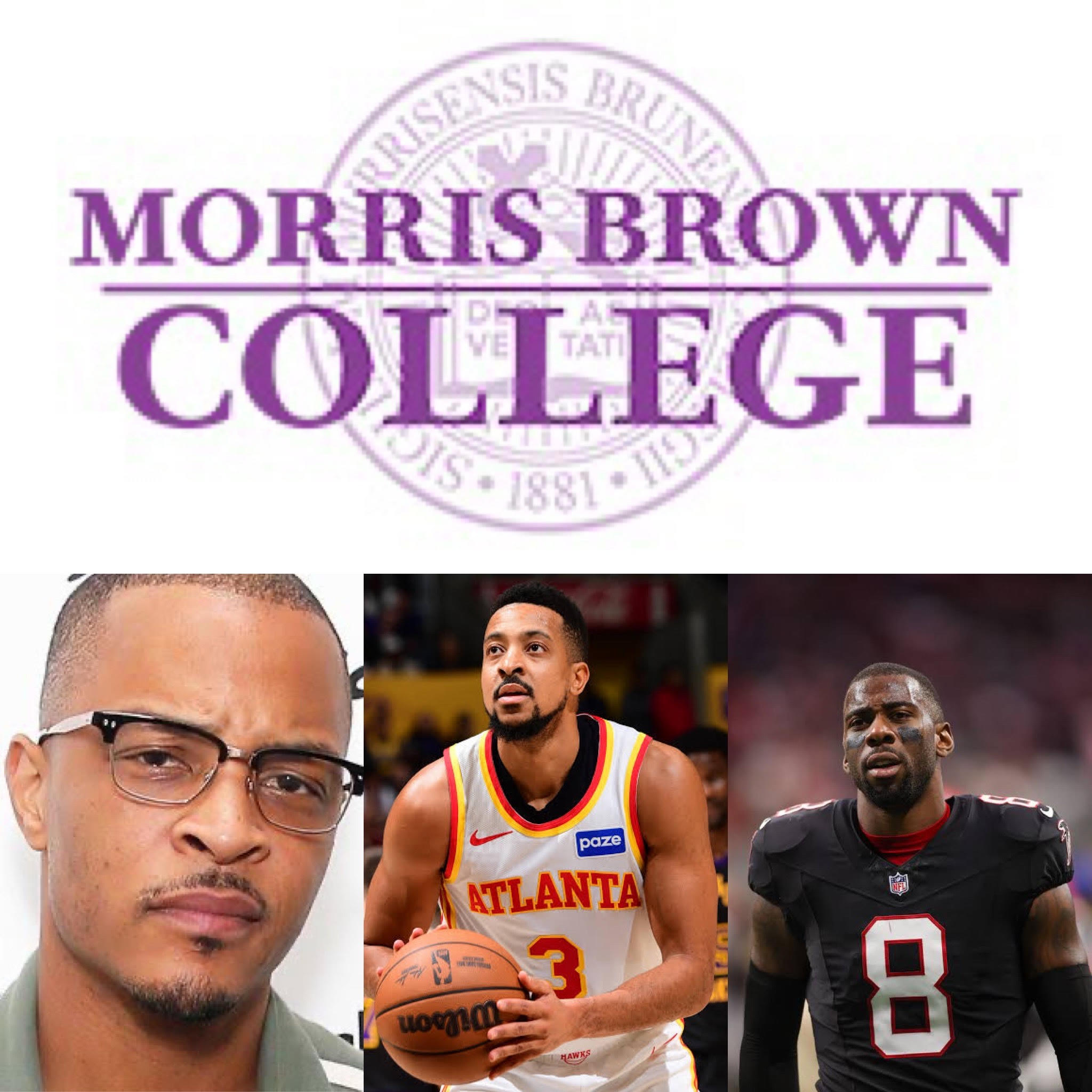
Morris Brown College, one of the oldest and most historically significant HBCUs in the country, recently made headlines when it announced $810,000 in combined donations — a $700,000 federal grant secured by Georgia Rep. Nikema Williams for emergency security infrastructure, a $60,000 contribution from the Sixth District of the AME Church, and a $50,000 personal donation from Grammy-winning Atlanta rapper TI. The timing was not incidental. Morris Brown had just been targeted with a violent racist threat sent via email to its students, the latest in a string of bomb threats and hate-driven communications that have terrorized HBCUs across the country over the past several years. In that context, every dollar matters. And TI’s willingness to write a check when the institution was under duress says something real about his character.

But character and capacity are two different things. And when we separate the two, the conversation about Black entertainment wealth and HBCU philanthropy becomes one that African America has been too reluctant to have.

A $50,000 donation to an HBCU that needs millions — preferably $10 million and above — to endow itself against continued financial stress is, by any honest institutional accounting, a gesture. It is not nothing. It is not ungrateful to say so. But let us look at what $50,000 actually produces when placed into an endowment. At a standard 5% endowment withdrawal rate, the industry benchmark used by universities from Harvard to Howard, a $50,000 contribution generates $2,500 per year or just over $200 per month in spendable income. That is assuming the donation is placed entirely into the endowment, that it is not drawn down immediately to cover operating costs, and that it compounds without interruption. $2,500 annually. That is the long-term institutional return on a $50,000 gift. It does not hire a single staff member. It does not fund a scholarship for more than a handful of semesters. It does not move the needle on the kind of structural financial distress that has kept institutions like Morris Brown on life support for decades.

For context, Morris Brown College lost its accreditation in 2002 publicly attributed to financial mismanagement, though it is worth saying plainly that what outside critics label mismanagement at African American institutions is frequently the predictable consequence of chronic resource deprivation, not a failure of aptitude. When an institution has operated for decades without the capital infrastructure that wealthier universities take for granted, the systems that sustain accreditation are not luxuries it can afford to build. Morris Brown did not regain its accreditation until 2022, twenty years of institutional limbo during which enrollment cratered to roughly 20 students. It has spent the years since clawing its way back, rebuilding systems, restoring credibility, and fighting to reopen its doors to students who had no other option. This is not a school that needs a symbolic gesture. It is a school that needs a war chest. The difference between $50,000 and $10 million is not simply a matter of degree. It is a difference in kind. One is a contribution. The other is a lifeline.

Here is where the conversation becomes difficult and where most people stop having it. The moment someone questions the size of a donation from a public figure, the response is predictable. “Well, he did not have to give anything.” “Who else is stepping up?” “At least he did something.” All of those statements are technically true. And all of them function as a wall that prevents any honest interrogation of whether the donation was calibrated to the actual need of the institution. This is the trap of philanthropic shame. It weaponizes gratitude against accountability. It makes any critique of giving patterns feel ungrateful, even when the critique is not about the donor’s character but about the structural mismatch between the scale of Black entertainment wealth and the scale of Black institutional need.

The reason to be cautious in criticizing TI specifically is not complicated either. There is always the possibility that a $50,000 donation is the first installment that the donor intends to return, to escalate, to commit over time. Philanthropic shame, if deployed too early and too harshly, can kill that possibility before it develops. No one wants to be the reason a donor who was testing the waters never comes back. So we extend the benefit of the doubt. We say thank you. And we move on to the next crisis. But extending the benefit of the doubt indefinitely is not generosity. It is passivity. And passivity is the reason HBCUs remain structurally underfunded while the entertainers and athletes who come from those communities spend their wealth in ways that have nothing to do with institutional survival.

This is the part of the conversation that makes people uncomfortable, so it needs to be said plainly. Rap music, the dominant cultural product of Black entertainment, has spent decades glorifying consumption. The cars, the clubs, the jewelry, the real estate purchased not as investment but as exhibition. The lyrics are not subtle. The messaging is not buried. It is the core aesthetic of an industry that has produced generational wealth for a small number of people while simultaneously shaping the financial identity of an entire generation of young Black men. TI himself has built a career in part on that aesthetic. His catalog includes some of the most commercially successful hip-hop of the last two decades. His business ventures span multiple industries. His net worth, by most estimates, puts him in a category where a $50,000 donation to an HBCU or African American nonprofit is not a sacrifice it is a rounding error. This is not an attack on TI. It is an observation about proportion. When someone whose public brand is built on wealth flexes in the direction of philanthropy, the question is not whether the donation is welcome. It is whether the donation reflects an understanding of what HBCUs actually need to survive. And $50,000, against the backdrop of the consumption narrative that built his brand, reads less like a philanthropic commitment and more like a line item, something that allows the story to be told without fundamentally changing the financial equation.

The case of Sean “Diddy” Combs and his reported $1 million pledge to Howard University is instructive here, though for different reasons. That pledge which Howard likely never received, and which, given subsequent events surrounding Combs, would have likely needed to be returned regardless illustrates a structural problem in how Black entertainers engage with HBCU philanthropy: the difference between a pledge and a donation. A pledge is a promise. It requires follow-through, and in many cases it does not arrive. Howard University, one of the most visible and well-connected HBCUs in the country, has publicly acknowledged the gap between pledges made by high-profile donors and funds actually received. When someone of Diddy’s financial standing pledges $1 million instead of simply writing the check, it raises the question of whether the gesture was ever truly about the institution or about the optics of appearing philanthropic. The distinction matters enormously for HBCUs. A pledge that never materializes does not pay tuition. It does not fund scholarships. It does not stabilize an endowment. It creates a false sense of security, a headline that suggests the institution has been supported when, in financial reality, nothing has changed.

TI is not alone in his absence from serious HBCU philanthropy, and that is the larger indictment. The Black entertainment and sports ecosystem has produced an unprecedented concentration of individual wealth in African American history. Athletes earning eight and nine figures annually. Musicians whose streaming catalogs generate passive income indefinitely. Actors, producers, brand ambassadors, a class of Black wealth that did not exist at this scale a generation ago. And the wealth is not abstract or distant. It is landing right in Atlanta — the same city where Morris Brown sits. Nickeil Alexander-Walker signed a four-year, $62 million contract with the Atlanta Hawks in July 2025. CJ McCollum, earning roughly $30.67 million in the final year of a $64 million contract, was traded to that same Hawks roster in January 2026. Kyle Pitts, the former fourth overall NFL draft pick, is entering free agency after completing a four-year, $32.9 million rookie contract with the Atlanta Falcons, playing his fifth-year option at $10.878 million. These are three athletes whose combined contractual wealth over recent years exceeds $190 million — all in Atlanta, all in the same city as a historically significant HBCU that just received $50,000 in a moment of crisis. The proximity is not coincidental. It is the point. The wealth is here. The need is here. The question is whether the two will ever meet on terms that actually matter to institutional survival. And yet, when we look at the philanthropic landscape of HBCUs, the contributions from this class of earners remain episodic, reactive, and structurally insufficient. The giving tends to arrive in moments of crisis, a threat, a tragedy, a headline that makes inaction look bad. It rarely arrives as a proactive, strategic commitment to institutional endowment building. It rarely arrives at the scale that would actually change the trajectory of a school’s financial health. This is not a coincidence. It is a pattern. And the pattern reveals something important about how Black entertainment and athletic wealth understands or fails to understand its relationship to Black institutional survival.

Morris Brown’s situation is a case study in reactive giving. The school was under threat. TI donated. The AME Church donated. A federal grant arrived. The headlines wrote themselves: “$810,000 in donations to Morris Brown.” On the surface, it looks like the system worked. The institution was in danger, and resources materialized. But this is crisis philanthropy, giving triggered by emergency, not guided by long-term institutional strategy. Crisis philanthropy keeps institutions alive in the short term while doing almost nothing to build the endowment depth, operational resilience, and financial sovereignty that would prevent the next crisis from being existential. For HBCUs to move beyond survival mode, the philanthropic relationship with Black entertainment wealth must shift from reactive to proactive. That means donors of consequence such as athletes, musicians, actors, entrepreneurs must begin thinking about HBCU giving not as a charitable impulse but as an institutional investment. It means committing at levels that actually move endowment needles. It means giving consistently, not just when a camera is on. It means understanding that $50,000 is appreciated, but $5 million is transformational, and $50 million is generational.

Morris Brown College needs what every structurally underfunded HBCU needs: a minimum $10 million endowment contribution to begin building genuine financial insulation. At a 5% withdrawal rate, a $10 million endowment produces $500,000 annually enough to fund several scholarships, support basic operational stability, and begin the slow process of institutional self-sufficiency. A $50 million endowment produces $2.5 million annually. That is the threshold at which an HBCU stops being vulnerable to every external shock and starts functioning as a durable institution. TI’s $50,000 is welcome. It is not unwanted, and it is not nothing. But it is not the answer to Morris Brown’s structural problem. Neither is any single donation from any single entertainer. The answer requires a collective commitment, a decision by the Black entertainers and athletes who have benefited most from the cultural and educational ecosystems that HBCUs helped build, to invest back into those ecosystems at a scale that matches the crisis.

The question is no longer whether anyone will criticize a $50,000 gift. The question is whether the class of people who can afford to give $5 million will ever decide that HBCUs are worth that investment not in a moment of crisis, but as a permanent fixture of their financial and philanthropic identity. Morris Brown College survived the threat. It received donations. But survival is not the same as strength. And until Black entertainment wealth decides to fund strength not just survival, HBCUs like Morris Brown will continue to depend on the next headline to remind donors that they still exist.


Disclaimer: This article was assisted by ClaudeAI.
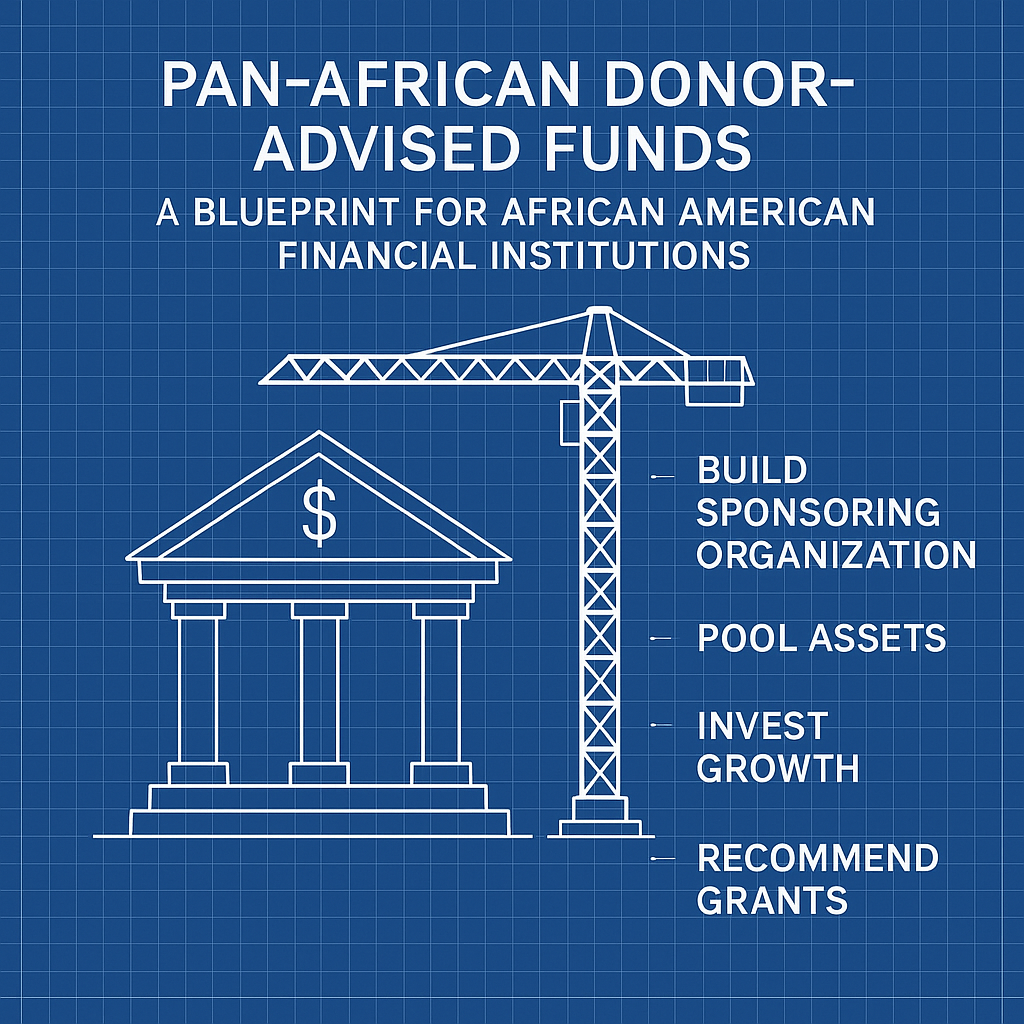
Pan-African Donor-Advised Funds: A Blueprint For African American Financial Institutions

“To be a poor man is hard, but to be a poor race in a land of dollars is the very bottom of hardships.” — W.E.B. Du Bois

Philanthropy, at its best, is not only about generosity but also about power. For African America and the broader African Diaspora, philanthropy has too often been reduced to the goodwill of outsider corporations, foundations, and billionaires whose dollars arrive with priorities and strings attached. If African American financial institutions are to play a central role in reshaping the destiny of our people, they must learn to wield the tools of modern philanthropy at scale. Chief among these tools is the donor-advised fund.

A donor-advised fund, or DAF, is a charitable giving vehicle hosted by a sponsoring public charity. Donors contribute assets such as cash, securities, or real estate, receive an immediate tax deduction, and then recommend grants to nonprofit organizations over time. These funds are often described as “charitable investment accounts,” because once assets are placed inside them they can be invested for tax-free growth, providing donors the flexibility to make grants years or even decades later. Unlike private foundations, DAFs do not carry heavy administrative costs, reporting requirements, or annual payout mandates. That combination of flexibility, efficiency, and tax benefit has made them the fastest-growing vehicle in philanthropy, with more than $229 billion in assets managed in the United States by 2022.

The technical mechanics are straightforward, but the implications for African American institutional power are profound. When majority institutions host DAFs, they not only manage the assets and collect the fees but also strengthen their institutional position in the broader philanthropic ecosystem. If African American banks, credit unions, and HBCUs were to host their own DAF platforms, they would retain both the capital and the influence. They would also ensure that those assets circulate internally, building the capacity of Black institutions rather than reinforcing external ones.

The Pan-African case for donor-advised funds grows out of both history and strategy. The African Diaspora is scattered across North America, the Caribbean, South America, Europe, and Africa. Despite cultural variations, there is a shared experience of enslavement, colonization, and systemic exclusion that has left us fragmented and underdeveloped institutionally. A Pan-African DAF would allow African America’s wealth to pool with Diasporic wealth, creating a philanthropic capital base that could fund initiatives from Harlem to Havana, from Lagos to London. Imagine a Spelman alumna in Atlanta, a banker in Kingston, and a tech entrepreneur in Nairobi all contributing to the same Pan-African DAF. The fund’s assets grow through coordinated investment, and the grants sustain HBCUs, African universities, Diaspora think tanks, hospitals, and cooperative businesses. Philanthropy would move beyond sporadic generosity into a coordinated, long-term Diasporic strategy.

African American financial institutions are uniquely positioned to lead in building these vehicles. Black-owned banks could create DAF platforms, allowing depositors and wealthier clients to establish accounts, with the bank managing the assets and directing grants into curated pools of African American and Diaspora institutions. HBCUs could build DAFs under their endowment arms, offering alumni the chance to contribute not just to individual schools but to collective vehicles that support Black higher education broadly. Credit unions, already rooted in cooperative traditions, could create member-based DAFs that channel contributions into scholarships, healthcare clinics, or Diaspora research projects. A Pan-African exchange could even emerge, allowing African American donors to support African institutions and African donors to support African American initiatives, breaking down silos and creating reciprocity.

The impact on philanthropy would be transformative. Pooling resources through Pan-African DAFs would reduce fragmentation and administrative waste. A single DAF with $1 billion in assets could deploy $50 million in annual grants while continuing to grow its capital base. Instead of thousands of scattered donations, these funds would strategically target long-term capacity-building institutions like universities, hospitals, and think tanks. They would also allow families to pass advisory privileges to children and grandchildren, embedding intergenerational philanthropy into family legacies. By linking U.S. tax benefits with Diaspora impact, Pan-African DAFs would connect global Black institutions across borders in ways never before achieved.

More than philanthropy, DAFs are about institutional power. Hosting our own funds would allow African America to retain capital that otherwise circulates through majority institutions. The act of managing billions in philanthropic assets would increase the legitimacy, visibility, and bargaining power of African American banks and credit unions in the national financial system. Control over DAFs also allows agenda-setting: funding HBCU graduate schools, African healthcare systems, Diaspora media, or land ownership initiatives. With sufficient scale, Pan-African DAFs would fund the think tanks, advocacy networks, and policy shops that shape legislation and strategy across the Diaspora. They would also strengthen interdependence between Black banks, universities, and cooperatives, weaving a tighter institutional ecosystem. And globally, they would reframe African American philanthropy as not merely domestic but as a force shaping development across Africa, the Caribbean, and beyond.

Mainstream philanthropic firms offer lessons. Fidelity Charitable, Schwab Charitable, and Vanguard Charitable collectively manage tens of billions in DAF assets, attracting donors with ease of use, professional management, and trusted brands. But they also embody the critique that DAFs can warehouse wealth indefinitely, giving donors immediate tax deductions without ensuring timely disbursement to communities. A Pan-African DAF must avoid this trap by committing to clear disbursement expectations, perhaps requiring annual grantmaking of 7 to 10 percent of assets. It must also invest in building trust and branding. Fidelity and Schwab are household names; African American financial institutions must cultivate similar reputations for professionalism, security, and vision if they are to attract donors at scale.

The roadmap to implementation is straightforward. Institutions must establish DAFs under existing nonprofit or financial arms with full compliance to IRS rules. They must develop Pan-African investment strategies that allocate assets into African American-owned funds, African sovereign bonds, and Diasporic infrastructure projects. They need technology platforms that allow donors to open accounts, contribute assets, recommend grants, and track impact with ease. Partnerships with vetted institutions across the Diaspora are essential, ensuring that grants reach trusted universities, hospitals, and cooperatives. Above all, a compelling public narrative must frame participation in Pan-African DAFs as not just philanthropy but as an act of liberation and institution building. Families should be encouraged to use DAFs to teach the next generation about philanthropy and responsibility, embedding giving as a permanent part of Diasporic culture.

The vision for the future is clear. By 2045, African American banks could be managing $100 billion in Pan-African DAFs, with $7–10 billion flowing annually into HBCUs, African universities, hospitals, and think tanks. Fee revenues from managing these assets would sustain our financial institutions, while the grants would expand the capacity of Diasporic institutions. The Pan-African DAF could become one of the most powerful philanthropic vehicles in the world, rivaling Gates, Ford, and Rockefeller. But unlike those entities, it would not be rooted in charity; it would be rooted in sovereignty. It would represent a Diaspora using philanthropy to build freedom, not dependency.

Donor-advised funds are not new, but their potential for African American and Pan-African institutions has yet to be realized. For too long, our wealth has flowed outward, strengthening others’ institutions while leaving ours fragile. By developing Pan-African DAFs, African American banks, credit unions, and HBCUs can capture that wealth, grow it, and deploy it across the Diaspora to increase our power. This is not simply about philanthropy; it is about sovereignty, agenda-setting, and survival. The next century will not be decided by who receives charity but by who controls the institutions that give it.

Disclaimer: This article was assisted by ChatGPT

You Want a Bigger HBCU Endowment? Graduate Students in Four Years—and HBCU Alumni Must Make That Happen

The four-year graduation rate is often presented as a benign statistic tucked inside higher education reports, but for institutions serving African America, it is not benign at all. It is the lever on which long-term wealth, institutional survival, and multigenerational stability subtly depend. Wealthy universities treat the four-year graduation rate not as an outcome but as an engineered product, backed by endowment might, operational discipline, and capital-rich ecosystems. Their students finish on time because the institution ensures they are shielded from interruption. Meanwhile, HBCUs navigate a different reality: the same students who possess the intellectual capacity to thrive are too often delayed not by academics but by the economic turbulence that disproportionately defines their journey. It is here between the idea of talent and the machinery of capital that the four-year graduation rate becomes a revealing measure of African America’s structural position in the American economic hierarchy.

A delayed degree carries a cost structure that compounds aggressively. Extra semesters are not simply tuition bills; they are opportunity-cost accelerants. A student who graduates at 22 enters the workforce two to three years ahead of a peer who reaches the finish line at 24 or 25. Those early earnings fund retirement accounts earlier, compound longer, support earlier homeownership, and create the financial runway that future philanthropy relies upon. For African American students who statistically begin college with fewer financial reserves and exit with higher student debt those lost years are wealth years. They represent not only diminished individual prosperity but the slowed creation of a donor class that HBCUs and other African American institutions depend on to build endowment strength and institutional sovereignty.

Endowments, which serve as the economic lungs of a university, breathe differently depending on how quickly their alumni progress into stable earning years. A university that graduates students in four years rather than six gains an alumni base that stabilizes earlier, saves earlier, invests earlier, and gives earlier. A philanthropic ecosystem is essentially a long-term consequence of time management: the more years an alumnus spends debt-free and employed, the more predictable their giving pattern becomes. Elite institutions leverage this fact elegantly. HBCUs, despite producing extraordinary alumni under significantly harsher financial conditions, remain constrained by the delayed timelines imposed by student financial fragility.

Financial fragility is a central explanatory variable in the HBCU graduation gap. It is not uncommon for a student to miss a semester because of a $300 balance or a transportation breakdown that derails their schedule. In the broader American economic system, such modest shocks rarely jeopardize a wealthy student’s trajectory. But within the HBCU ecosystem, they represent the sharp edges of institutional undercapitalization meeting the exposed nerves of household vulnerability. The four-year graduation rate is therefore not simply a metric of academic navigation but a map of where the Black household economy intersects with American higher education’s structural inequities.

This makes alumni involvement not a sentimental tradition but an economic necessity. Alumni can narrow the financial fragility gap more efficiently than any other stakeholder group. Microgrant funds, even modestly capitalized, are capable of eliminating the most common disruptions that extend time-to-degree. A $250 emergency grant can protect $25,000 in long-term student debt. A $500 intervention can guard a student’s four-year trajectory and thus preserve two additional years of post-graduation earnings that ultimately benefit both the graduate and the institution’s future endowment. Alumni-funded tutoring, advising enhancements, STEM support programmes, and paid internships create artificial endowment-like effects: stabilizing student progression even when the institutional endowment itself is undersized.

Yet HBCU alumni cannot focus solely on the university years if the goal is a structurally higher four-year graduation rate. The process begins far earlier within K–12 systems that shape academic readiness long before students set foot on campus. The elite institutions that boast 85–95 percent on-time graduation rates are drawing from K–12 ecosystems with intense capital saturation: high-quality teachers, advanced coursework, stable households, well-funded enrichment programmes, and neighborhoods that function as multipliers of academic preparedness. HBCU alumni have an opportunity to influence this pipeline through investments that are often modest in individual scope but transformational in aggregate impact. Funding reading centres, coding clubs, college-prep academies, robotics labs, literacy coaches, and after-school tutoring programmes plants the seeds of future four-year graduates years before college entry.

Indeed, a strong K–12 foundation reduces the need for remedial coursework, accelerates major declaration, strengthens performance in gateway courses like calculus and biology, and diminishes the likelihood that students need extra semesters to satisfy graduation requirements. When alumni support dual-enrollment initiatives, sponsor early-college programmes, or build partnerships between HBCUs and local school districts, they enlarge the pool of college-ready students whose likelihood of completing on time is structurally higher. In this sense, investing in K–12 is not philanthropy it is pre-endowment development.

The economic implications of strengthening both ends of the education pipeline are enormous. A 20–30 percentage-point improvement in four-year completion rates across the HBCU ecosystem would reduce student loan debt burdens by billions, accelerate African American household wealth accumulation, raise the number of alumni earning six-figure incomes before age 30, and increase the philanthropic participation rate across Black institutions. Over decades, such shifts ripple outward: stronger alumni lead to stronger HBCUs, which lead to stronger civic, cultural, and economic institutions in African American communities, which themselves create more stable families, more prepared K–12 students, and more future college graduates. The system feeds itself when time is efficiently managed.

In the HBCU Money worldview, where institutional power is the only reliable safeguard against structural marginalization, time-to-degree represents one of the clearest and most overlooked levers of collective economic advancement. In a Financial Times context, the four-year graduation rate appears as a liquidity indicator—showing how quickly an institution converts educational investment into economic output. In The Economist’s framing, it reveals the mismatched capital structures between wealthy universities and historically underfunded ones, and how those mismatches reproduce inequality in slow, quiet, compounding increments.

For African America, the conclusion is unmistakable. The four-year graduation rate is not merely a statistic. It is a wealth mechanism. It is an endowment accelerator. It is an institutional survival tool. And it is a community-level economic strategy that begins in kindergarten and culminates with a diploma. If HBCU alumni wish to see their institutions strengthen, their communities accumulate wealth, and their young people enter the economy with maximum velocity, then they must make both K–12 investment and four-year graduation obsession-level priorities. Institutions rise with the financial stability of their graduates. Ensuring those graduates complete degrees on time is one of the most effective—and least discussed—strategies available for building African American institutional power across generations.

A Tale of Two Virginias:

A revealing contrast in American higher education can be observed by examining two institutions that sit just 120 miles apart: Virginia State University (VSU) and the University of Virginia (UVA). NACUBO estimates VSU’s endowment at approximately $100 million for around 5,000 students, producing an endowment-per-student of roughly $20,000. According to U.S. News, VSU graduates 27% of its students in four years. UVA, one of the most heavily capitalized public universities in the world, possesses an endowment of roughly $10.2 billion for about 25,000 students, an endowment-per-student of approximately $410,000, more than twenty times the capital density VSU can deploy. Its four-year graduation rate stands at 92%.

The gulf between the two institutions reflects not a difference in student talent but a difference in institutional resource density and shock absorption capacity. A VSU student must personally carry far more academic and financial fragility. A single $300 expense can knock them off their semester plan. A delayed prerequisite can add a year to their degree. Limited advising bandwidth means problems are often discovered only after they have already extended time-to-degree. UVA faces the same categories of issues, but its endowment, staffing, and operating budgets act as buffers absorbing shocks before they disrupt academic progress.

Endowment-per-student, therefore, is not merely a balance-sheet statistic; it is a proxy for how much risk the institution can carry on behalf of its students. UVA carries most of the risk. VSU students carry most of their own. UVA’s 92% four-year graduation rate is a reflection of institutional cushioning. VSU’s 27% rate reflects its absence.

Yet to understand the true economic cost of the graduation gap, it is useful to model what would happen if VSU improved its four-year graduation rate—first to a plausible mid-term target such as 50%, and then to a UVA-like 90%. Both scenarios dramatically change the trajectory of the institution.

Assume that VSU today produces roughly 1,350 graduates every four years (based on a 27% rate). If it increased its four-year graduation rate to 50%, VSU would instead graduate 2,500 students every four years, an increase of 1,150 additional on-time graduates, each entering the workforce two years earlier, with lower student debt, earlier retirement contributions, earlier homeownership, and earlier philanthropic capacity. Even if only a modest fraction of these additional graduates contributed $50–$150 annually to VSU’s endowment, the compounding effect across 20 years would be substantial. Under conservative assumptions with basic donor participation growth and average returns of 7% VSU’s endowment could plausibly grow from $100 million to $155–$170 million over two decades, powered largely by the increased velocity and increased number of earning alumni.

Now consider the UVA-like scenario. A four-year graduation rate of 90% at VSU would mean roughly 4,500 on-time graduates every four years or over three times the current output. This scale of early, debt-lighter graduates would fundamentally transform VSU’s financial ecosystem. Even minimal alumni participation say, 12–15% giving $100–$200 annually would translate into millions in annual recurring contributions. Over two decades, with investment returns compounding, VSU’s endowment could grow not to $150 million but potentially to $300–$400 million, depending on participation rates and gift sizes. That would triple the institution’s financial capacity without a single major donor campaign, capital campaign, or extraordinary windfall. The key variable is simply graduation velocity.

This comparison illustrates a broader truth: endowment growth is not just a function of investment strategy but of how quickly a university converts students into earning alumni. A student who graduates at 22 gives for 40–50 years. A student who graduates at 25 gives for 30–35 years. A student who drops out does not give at all. VSU’s current 27% four-year graduation rate is not merely an academic statistic—it is an endowment drag factor. UVA’s 92% rate is an endowment accelerant.

The financial distance between the two universities appears vast, but it is governed by a formula that HBCUs can influence: more on-time graduates → more early earners → more consistent donors → more endowment growth → more institutional cushioning → more on-time graduates. VSU today sits at the fragile end of this cycle. A graduation-rate increase to 50% would move it into a position of stability. A leap to 90% would place it into an entirely different institutional category—one where it begins to accumulate capital in the same compounding manner that allows institutions like UVA to weather downturns, attract top faculty, and protect students from the shocks that so often derail academic momentum.

VSU cannot replicate UVA’s wealth in the short term. But by increasing on-time graduation, it can replicate the mechanism through which wealthy universities become wealthier. And that mechanism—graduation velocity—is one of the few levers fully within reach of alumni, leadership, and institutional partners.

Here are four strategic, high-impact actions HBCU alumni associations or chapters can take to directly raise four-year graduation rates and strengthen institutional wealth:

1. Create a Permanent Emergency Microgrant Fund (The “$300 Fund”)

Most delays in graduation arise from small financial shocks:
balances under $500, transportation failures, book costs, or housing gaps.

Alumni chapters can formalize a permanent, locally governed microgrant fund offering rapid-response support (48–72 hours).

A chapter raising just $25,000 per year can prevent dozens of delays, each shielding students from additional semesters of debt and protecting the institution’s future alumni giving pipeline.

This is low-cost, high-yield institutional intervention.

2. Fund Paid Internships and Alumni-Mentored Work Opportunities

Students who work long hours off campus are more likely to fall behind academically, switch majors repeatedly, or extend enrollment.

Alumni chapters can create paid internships, stipends, or alumni-hosted part-time roles tied directly to students’ majors.

Each position:

  • reduces the student’s financial burden
  • keeps them academically aligned
  • accelerates pathways to stable post-graduate employment

This lifts graduation rates and increases alumni earnings—expanding the future donor base.

3. Build K–12 Pipelines in Local Cities That Feed Directly Into HBCUs

Four-year graduation begins long before freshman year.

Alumni chapters can adopt 2–3 local schools and support:

  • literacy acceleration programs
  • SAT/ACT prep
  • dual enrollment partnerships
  • STEM and robotics clubs
  • early-college summer institutes hosted by their own HBCUs

Better-prepared students require fewer remedial courses, retain majors longer, and graduate on schedule, raising institutional performance and future endowment sustainability.

This is pre-investment in the future alumni base.

4. Pay for Summer Courses After Freshmen Year to Build Early Credit Momentum

After their first year, many students fall off the four-year pace due to light credit loads, failed gateway courses, or sequencing issues that a single summer class could easily correct. Yet for many HBCU students, summer tuition—often just one or two courses—is financially out of reach.

Alumni chapters can establish a Freshman Summer Acceleration Grant to pay for up to two summer course immediately after freshman year, allowing students to:

close early credit gaps,

retake or accelerate critical prerequisites,

reduce future semester overloads,

create a credit cushion for unexpected disruptions,

stay aligned with four-year degree maps.

A small investment of summer tuition produces an outsized institutional return: students enter sophomore year on pace, avoid bottlenecks in upper-level coursework, and dramatically increase their likelihood of graduating in four years. This is an early-stage compounding effect—protecting momentum before delays become expensive and permanent.

Disclaimer: This article was assisted by ChatGPT.

Have HBCUs Given Up On Recruiting African American Students?

“Change will not come if we wait for some other person or some other time. We are the ones we’ve been waiting for. We are the change that we seek.” – Barack Obama

It almost seems like an absurd question to ask, but…

in 2025, the idea that Historically Black Colleges and Universities (HBCUs) are no longer focused on recruiting African American students is not as far-fetched as it sounds. It’s a question whispered in alumni boardrooms, discussed in quiet conversations among concerned parents, and pondered in the minds of young Black students as they decide where to apply. While HBCUs remain vital institutions for the Black community, the numbers and decisions behind closed doors suggest that a shift is underway—one that demands scrutiny, reflection, and action.

In the decades since desegregation opened the doors of Predominantly White Institutions (PWIs) to Black students, the role and mission of HBCUs have been evolving. According to data from the Pew Research Center, Black student enrollment at HBCUs increased by just 15% from 1976 to 2022. Meanwhile, enrollment of students from other racial and ethnic groups rose by a staggering 117% during the same period. In 1976, Black students made up 85% of HBCU enrollment. By 2022, that number had dropped to 76%. That means nearly one in four HBCU students today is not Black. At at least five HBCUs, such as Bluefield State University, Lincoln University (MO), and West Virginia State University, White students now comprise the majority. While some view this as a testament to progress and inclusion, others see it as a troubling signal that the core mission of HBCUs, educating and empowering African American students, their families, and ultimately the social, economic, and political interest of African America, may be slipping.

Nowhere is this shift more alarming than in the enrollment of Black male students. In 1976, Black men made up 38% of students at HBCUs. By 2022, that number had fallen to just 26%. The decline is not only concerning it is an existential threat to the cultural and academic ecosystem of HBCUs, which once produced the very architects of Black political, business, and religious life. Many HBCUs now boast majority-female student bodies, a testament to the resilience and commitment of Black girls, but also a glaring reflection of systemic failure to support Black boys in education from kindergarten through college. The disappearance of Black young men from HBCU campuses must be seen for what it is: a crisis.

Some of the explanations are economic. Many HBCUs struggle with limited financial resources. According to HBCU Money’s 2024 endowment rankings, only one HBCU, Howard University, has an endowment exceeding $1 billion. Most HBCUs operate with endowments below $100 million, leaving them vulnerable to financial pressures that force them to make difficult choices. In that context, expanding recruitment to non-Black students may seem like a pragmatic strategy to increase tuition revenue, especially when those students are attracted by athletic scholarships in sports like soccer, baseball, and tennis—sports where African American participation is historically underrepresented. But when HBCUs prioritize this kind of recruitment while failing to maintain deep engagement with the Black communities that birthed them, they risk trading mission for margin.

The situation has also been shaped by the recruitment arms race. PWIs now actively recruit top Black students with full-ride scholarships, aggressive outreach, and promises of diversity and inclusion. For many Black high schoolers, a name-brand PWI with a large endowment and impressive campus facilities appears more appealing and more financially accessible than an underfunded HBCU. This has contributed to an image crisis for many HBCUs. Once the first choice for Black excellence, some HBCUs are increasingly viewed as a second-tier option, even among Black students themselves. This perception isn’t entirely fair, but it’s not without basis. Fewer in-person recruitment visits, fewer marketing campaigns that center Black identity, and an overreliance on digital outreach have all contributed to HBCUs becoming less visible in the spaces that matter most.

And yet, 2023 may have marked an inflection point. When the U.S. Supreme Court struck down race-conscious admissions at PWIs, many Black students and families began rethinking their college plans. In the aftermath of the ruling, applications to HBCUs surged. According to Inside Higher Ed, institutions such as Howard University, Florida A&M University, and North Carolina A&T reported double-digit increases in applications in 2024. These students, disillusioned by the erasure of diversity efforts at mainstream universities, began looking again to HBCUs as spaces where their identities were affirmed, not tolerated. This renewed interest is an opportunity, but also a test. Will HBCUs meet the moment?

To do so, recruitment must become intentional again not just broad-based or reactive. The recruitment of African American students, especially Black male students, needs to return to being a top institutional priority. That means more than sending emails or relying on the Common Black College Application. It means going into Black neighborhoods, hosting HBCU nights at community centers and churches, building relationships with high school counselors, and creating early K-8 pipeline programs. It means building community and cultural trust. The reality is, many Black high school students no longer have any personal connection to an HBCU. They may not know an alum. They may never have stepped on a campus. For HBCUs to thrive, they must reintroduce themselves.

And this is where alumni become vital. HBCU alumni are among the most loyal in the nation, but they are too often treated only as sources of homecoming participants. In truth, they are the best ambassadors. Empowering alumni to lead recruitment efforts, fund scholarships, and bring HBCU visibility to their local schools is an untapped strategy with enormous potential. HBCUs must support this with resources and coordination, not just hope.

The work also includes tackling affordability. More than 70% of HBCU students are Pell Grant eligible, compared to just 39% of students nationally. That means HBCUs disproportionately serve low-income, first-generation college students. For these students, even small gaps in aid can become barriers. Innovations like the reduced tuition and work-study model at Paul Quinn College show that reimagining cost structures is possible. Institutions that find ways to lower costs, provide housing and food support, and prioritize need-based aid will be the ones that retain and graduate more Black students.

At a deeper level, this conversation is not just about numbers. It’s about identity. The cultural mission of HBCUs cannot be outsourced. HBCUs are sacred institutions, repositories of Black intellectualism, resistance, and imagination. When they drift too far from that mission, they risk becoming something entirely different. Diversity should be additive, not dilutive. To serve the world, HBCUs must first continue serving the people who built them.

This doesn’t mean rejecting change. It means anchoring change in purpose. HBCUs can welcome diversity without losing their soul. But to do so, they must recommit to the hard, intentional work of finding and lifting up Black students not just those with 4.0 GPAs and high SAT scores, but also the creative thinkers, the late bloomers, the future leaders hiding in overlooked ZIP codes. These students may not be polished when they arrive, but neither were the trailblazers who founded these institutions. We owe them the same belief.

In the end, the question “Have HBCUs given up on recruiting African American students?” is not an accusation it is a call. A call to reignite the radical vision that gave birth to these schools in the first place. A call to remember that every Black student recruited to an HBCU is a declaration of faith in Black futures. A call to stop letting budget constraints dictate who gets to belong in spaces we built. And a call to Black America to advocate, to donate, to volunteer, and to remind our youth that these institutions are not relics of the past. They are sanctuaries for tomorrow. A fort of many that protects the social, economic, and political interest of African America.

In the words of Zora Neale Hurston, “There are years that ask questions and years that answer.” This year, the question has been asked. What comes next is up to all of us.


Sidebar Feature: Black Male Enrollment Crisis

  • In 2022, only 26% of HBCU students were Black men.
  • Compare that to 38% in 1976.
  • Solutions include mentorship pipelines, mental health support, re-entry programs for formerly incarcerated youth, and dedicated Black male scholarships.

HBCU Money Action Items: How You Can Help (K-8 Focused)

1. The HBCU Express: Mobile Campus Experience

Transform a retired school bus into a rolling HBCU ambassador painted in your school’s colors, filled with college memorabilia, yearbooks, and screens showing campus life. Drive it to elementary schools during lunch or after school, let kids climb aboard, sit in “college seats,” and take photos. Make it an event kids talk about for weeks.

Bonus: Offer free rides to campus tours for families.

2. Saturday HBCU Youth Academies (On-Campus or Virtual)

Host monthly Saturday programs where K-8 students take classes taught by alumni and current students—coding, dance, robotics, creative writing, step team, debate. For chapters near campus, hold sessions in campus facilities with meals in the dining hall. For distant chapters (like a New York chapter for a Virginia HBCU), run virtual sessions where kids still see campus backgrounds, hear from current students, and feel connected to the institution. Hybrid models work too—virtual learning followed by an annual in-person campus visit.

3. HBCU Summer Day Camp Scholarships & Sponsorships

If the HBCU already runs summer day camps for ages 8-14, alumni chapters can fund full or partial scholarships so more K-8 students from underserved communities can attend for free. Chapters can also sponsor transportation (charter buses from their city to campus), provide camp supplies, fund field trips, or endow specific camp programs (STEM lab, arts workshop, sports clinic). For distant chapters, sponsor a group of local kids to travel to campus for the week-long experience—cover registration, travel, and meals. This removes financial barriers and gets more Black children on campus during formative years.

4. Adopt-a-School Family Weekends

Alumni chapters “adopt” local elementary or middle schools and sponsor quarterly weekend campus visits for groups of families with K-8 children. Time visits around campus events—football or basketball games, step shows, concert series, or even quiet weekends when students are just hanging out on the yard. Provide transportation, cover game tickets or event admission, and assign each family a paid student tour guide who walks them through dorms, the student center, dining halls, and academic buildings.

Let kids eat campus food, sit in lecture halls, and watch college students in their natural environment. Parents see the affordability, safety, and culture while kids fall in love with the energy. End with a family cookout or pizza party where alumni share their stories and parents ask real questions about financial aid, academics, and campus life. You’re selling the parents on the investment and indoctrinating the kids with belonging. Make it so memorable that families go home and tell everyone about “their weekend at the HBCU.”

5. HBCU Junior Homecoming

Create a “Little Yard Fest” during homecoming week specifically for K-8 students—kid-friendly step show performances, band practice visits, meet-and-greets with the mascot, face painting in school colors, and a mini parade. Let children experience the joy, pride, and cultural richness of HBCU homecoming. Give every child a “Future Class of 20XX” t-shirt. When homecoming becomes their childhood memory, attending becomes their teenage dream.

6. Community-Based Tutoring & Enrichment Centers

Alumni chapters establish free after-school and weekend tutoring programs in their local communities—at libraries, community centers, churches, or alumni members’ offices. Offer homework help, test prep, reading circles, and subject-specific support led by alumni volunteers. Decorate spaces with HBCU banners, pennants, and imagery. Kids get academic support while being surrounded by HBCU pride. Current college students can join virtually to provide tutoring, creating direct peer connections across distances.

7. HBCU Family Culture Days at Museums & Theaters

Partner with local museums, science centers, theaters, or cultural institutions to sponsor “HBCU Family Days” where alumni associations buy out tickets so parents and guardians can bring their K-8 children for free. Brand it visibly with school colors, have alumni volunteers greet families wearing HBCU gear, distribute information packets about the school, and create photo opportunities. Follow up with invitations to visit campus. It positions the HBCU as an institution invested in Black family enrichment and intellectual development.

8. Live Virtual Campus Walks & Class Sit-Ins

Alumni chapters coordinate with student organizations (SGA, fraternities, sororities, academic clubs) to host live virtual campus tours where current students walk K-8 children through campus via smartphone or camera—showing dorms, the yard, dining halls, the library, labs, and student hangout spots. Go beyond static tours: arrange for interested students to virtually “sit in” on actual college classes, club meetings, or rehearsals. Let them see what college life really looks like in real-time. Schedule Q&A sessions where kids can ask current students anything. This works for any chapter regardless of geographic distance and makes the campus feel accessible and alive.


The goal: Make HBCU campuses feel like second homes before kids even reach high school. When college decisions come, they won’t be choosing the unknown—they’ll be coming home.

Disclaimer: This article was assisted by ChatGPT and ClaudeAI.