Category Archives: Banking & Credit Unions

The Debt That Could Bind Us: Why African American Banks Must Engage African Debt Markets to Strengthen Diaspora Sovereignty

“Control of credit is control of destiny. Until Our institutions decide where Our capital sleeps and wakes, Our freedom will remain on loan.” – William A. Foster, IV

The African diaspora’s greatest unrealized financial potential may lie not in Wall Street, but in the vast and growing debt markets of Africa. Across the continent, nations are negotiating, restructuring, and reimagining how they fund development. At the same time, African American banks and financial institutions, small but strategically positioned in the global Black economic architecture, stand largely on the sidelines. This disconnection is more than a missed investment opportunity; it is a failure of transnational financial imagination. If the descendants of Africa in America wish to secure true sovereignty, interconnectivity, and global influence, engaging African debt markets is not optional it is imperative.

Africa’s debt profile is as complex as it is misunderstood. Many Western narratives frame African debt in crisis terms, yet that view ignores the sophistication of African capital markets and the diversity of creditors. The continent’s public debt stood around $1.8 trillion by 2025, but much of this borrowing has gone toward infrastructure and industrial expansion. The key shift in recent years has been away from traditional multilateral lenders toward bilateral and market-based finance particularly through Chinese, Gulf, and private bond markets. Countries like Kenya, Ghana, Nigeria, and Ethiopia have issued Eurobonds in recent years, often at higher interest rates due to perceptions of risk rather than fundamental insolvency. Others, such as Zambia, have undergone restructuring efforts designed to rebalance repayment with growth. In each case, Africa’s economic story remains one of ambition constrained by external debt conditions, a pattern reminiscent of the post-Reconstruction era Black South, when capital starvation and dependency on non-Black lenders limited autonomy and intergenerational power. That parallel matters deeply for African Americans. The same global financial order that restricts African nations’ fiscal independence also limits the growth of African American financial institutions. The tools that could change both realities already exist within the diaspora: capital pools, credit analysis expertise, and shared strategic interest in sovereignty.

African American banks—roughly 18 federally insured institutions as of 2025—control an estimated $6.4 billion in combined assets. While that is a fraction of what one mid-sized regional white-owned bank manages, these institutions hold a symbolic and strategic power far greater than their balance sheets suggest. They remain the custodians of community trust, the anchors of small-business lending in historically neglected markets, and potential conduits for international financial collaboration. Historically, African American banks were created to fill a void left by exclusionary financial systems. But in the 21st century, their mission can evolve beyond domestic community lending toward global financial participation. The African debt market, currently dominated by Western institutions that extract value through high interest and credit rating manipulation, offers a natural arena for African American engagement. If Black banks can collectively participate through bond purchases, underwriting partnerships, or diaspora-focused sovereign funds they could help shift Africa’s dependence from Western and Asian creditors toward diaspora-based capital flows. This would not only stabilize African economies, but also create transnational linkages that reinforce both African and African American economic self-determination.

Consider the power of mutual indebtedness as a political tool. When nations or institutions lend to each other, they form durable relationships governed by trust, negotiation, and shared interest. For too long, the African diaspora’s relationship with Africa has been philanthropic or cultural rather than financial. That model, however well-intentioned, is structurally disempowering and it reinforces dependency rather than partnership. Debt, properly structured, reverses that dynamic. If African American financial institutions were to purchase or underwrite African sovereign and municipal debt, they would create financial obligations that tether African states to diaspora capital, not to exploit but to interdepend. This is the foundation of modern sovereignty: the ability to borrow and invest within your own cultural and political network rather than through intermediaries who extract value and dictate terms. Imagine, for instance, a syndicated loan or bond issuance where a consortium of African American banks, credit unions, and philanthropic financial arms partner with African development banks or ministries of finance. The terms could prioritize developmental outcomes like affordable housing, small business lending, renewable energy while generating steady returns. The instruments could even be marketed domestically as “Diaspora Sovereign Bonds,” accessible through digital platforms. The impact would be twofold: African American banks would diversify their portfolios and tap into emerging market yields, while African governments would gain access to capital free from neocolonial conditions.

Historically Black Colleges and Universities (HBCUs) stand at the crossroads of intellect, finance, and heritage. Their institutional capacity, academic talent, and alumni networks make them natural architects for a new financial relationship between the African diaspora and the African continent. Yet this potential comes with risk, particularly for public HBCUs, whose visibility and state dependency could make them targets of political and financial backlash. If a public HBCU were to openly participate in or advocate for engagement with African debt markets, it would likely face scrutiny from state legislatures, regulatory bodies, and entrenched financial interests. Such activity would be perceived by non–African American–owned banks and state-level policymakers as a challenge to existing capital hierarchies. The idea of Black public institutions developing transnational financial alliances outside traditional Western frameworks threatens not only market control but ideological narratives about where and how Black institutions should operate. To navigate this terrain, public HBCUs must be strategic, creative, and stealth in execution. Their participation in African financial engagement cannot be loud; it must be layered. They can do so through consortia, research collaborations, and investment partnerships that quietly build expertise and influence without triggering overt resistance. For example, an HBCU economics department could conduct African sovereign credit research under a global development initiative, while a business school could host “emerging market” investment programs that include African debt instruments without explicitly branding them as Pan-African.

Private HBCUs, freer from state oversight, can play a more overt role forming partnerships with African banks, hosting diaspora finance summits, and seeding funds dedicated to Africa-centered investments. But public institutions must operate with a subtler hand, leveraging think tanks, foundations, and alumni networks to pursue the same ends through indirect channels. Creativity will be their shield. Collaboration with African American–owned banks, credit unions, or diaspora investment funds can serve as intermediary structures allowing HBCUs to channel research, expertise, and even capital participation without placing the institutions themselves in direct political crossfire.

Both public and private HBCUs must also activate and empower their alumni associations as extensions of institutional sovereignty. Alumni associations exist in a different legal and political space and they are often registered as independent nonprofits, free from the direct control of state governments or university boards. This autonomy allows them to operate where the universities cannot. Through alumni associations, HBCUs can channel capital, intelligence, and partnerships in ways that stay outside the reach of regulators or political gatekeepers. Alumni bodies can create joint funds, invest in African debt instruments, or collaborate with African banks and diaspora enterprises. The understanding between HBCUs and their alumni networks must be clear and disciplined: the institution provides intellectual and structural guidance; the alumni associations execute the capital movement. This relationship becomes a discreet circulatory system of sovereignty with universities generating the vision and expertise, alumni executing the financial maneuvers that advance that vision.

HBCUs can further support this ecosystem by funneling institutional capital and intellectual property toward their alumni associations in strategic, deniable ways. Research centers can license data or consulting services to alumni-managed firms. Endowments can allocate small funds to “external collaborations” that, in practice, seed diaspora initiatives. Career and alumni offices can quietly match graduates in finance and development with African institutions seeking diaspora partners. These are small, legal, but potent acts of quiet nation-building. The success of this strategy depends on discipline, secrecy, and shared purpose. HBCUs, particularly the public ones, must move as institutions that understand the historical realities of Black advancement: every act of power must be both visionary and shielded. Alumni associations, meanwhile, must operate as the agile extensions of these universities, taking calculated risks on behalf of the larger mission. If executed carefully, this dual structure of HBCUs as the intellectual architects and alumni associations as the financial executors creates a protected channel for diaspora wealth creation. It allows public institutions to avoid political exposure while still advancing the collective objective: redirecting Black capital toward Africa and reestablishing a financial circuit of trust, obligation, and empowerment across the diaspora. In this model, the public HBCU becomes the hidden engineer, the private HBCU the visible vanguard, and the alumni network the financial hand. Together, they form an ecosystem of quiet innovation and a movement that builds transnational Black sovereignty not through protest or proclamation, but through precise and deliberate financial design.

Skeptics might argue that African American banks lack the scale or technical capacity to engage in sovereign lending. This concern, while not unfounded, can be addressed through collaboration. No single Black institution must go it alone. The path forward lies in consortium models of pooling resources, sharing risk, and leveraging collective bargaining power. Diaspora bond funds could be structured as partnerships between African American banks, HBCU endowments, and African development finance institutions such as the African Development Bank (AfDB) or Africa Export-Import Bank (Afreximbank). These organizations already have experience managing sovereign risk and would benefit from diaspora participation, which strengthens their political legitimacy. Furthermore, technology has lowered the cost of entry into complex financial markets. Digital banking, blockchain-based identity verification, and fintech partnerships can allow diaspora institutions to participate in cross-border finance with greater transparency and speed. The real obstacle, therefore, is not capacity it is vision. The diaspora’s capital remains trapped within Western financial systems that reward liquidity but punish sovereignty. Redirecting even a fraction of that capital toward Africa would shift the balance of global economic power in subtle but profound ways.

Sovereignty in the modern world is measured as much in capital access as in military or political power. Nations that cannot borrow on fair terms cannot build on fair terms. The same is true for communities. African Americans, long denied fair access to capital, should understand this truth intimately. The African debt question, then, is not a distant geopolitical matter it is a mirror. If African American banks and financial institutions continue to operate solely within the parameters of domestic credit markets, their growth will remain capped by a system designed to contain them. But if they extend their vision outward to the African continent, to Caribbean nations, to the global diaspora then they create new asset classes, new partnerships, and new pathways to power. Moreover, engagement with African debt markets enhances geopolitical influence. It positions African American institutions as interlocutors between Africa and global finance, enabling a collective voice on credit ratings, debt restructuring, and investment policy. That is the kind of influence that cannot be achieved through philanthropy or symbolism it is built through transactions, treaties, and trust.

Other diasporas have already proven this model works. Jewish, Indian, and Chinese global networks have long used financial interconnectivity as a tool of sovereignty. Israel’s government issues bonds directly to diaspora investors through the Development Corporation for Israel—a program that has raised over $46 billion since 1951. The Indian diaspora contributes billions annually in remittances and investments that underpin India’s foreign reserves. The African diaspora, by contrast, remains financially fragmented despite its vast size and income. With over 140 million people of African descent living outside Africa, the potential for coordinated capital deployment is immense. Even modest participation of say, $10 billion annually in diaspora-held African bonds would change the global conversation around African finance and diaspora economics. This scale of engagement requires trust, transparency, and accountability. African nations must commit to governance reforms and anti-corruption measures that assure diaspora investors of integrity. Likewise, African American institutions must build financial literacy and confidence around African markets, overcoming decades of Western media narratives portraying the continent as unstable or uninvestable.

The long-term vision is a self-sustaining ecosystem of diaspora credit: African American and Caribbean banks pool capital to buy or underwrite African debt; HBCUs model sovereign risk, publish credit analyses, and design diaspora finance curricula; African governments and regional banks issue diaspora-oriented financial instruments; fintech platforms connect diaspora investors directly to African projects; and cultural finance diplomacy transforms diaspora engagement into official national strategy. The ecosystem would allow wealth to circulate within the global African community rather than being siphoned outward through exploitative intermediaries. Over time, such networks could support not only debt financing but also equity investment, venture capital, and trade finance all under the umbrella of Black sovereignty economics.

At its core, this initiative is not merely about money. It is about the reconfiguration of power. The African diaspora cannot achieve full sovereignty while its economic lifeblood flows through institutions indifferent or hostile to its future. Engaging African debt markets transforms the diaspora from spectators of African development into its co-architects. It also transforms Africa from a borrower of last resort to a partner of first resort within its global family. For African American banks, this is the logical next chapter. The institutions that once shielded Black wealth from domestic exclusion now have the opportunity to project that wealth into international inclusion. It is a matter of strategic foresight aligning moral mission with financial opportunity. As the world edges toward a multipolar order where the U.S., China, and regional blocs vie for influence, the African diaspora must define its own sphere of power not through slogans but through balance sheets. A sovereign people must have sovereign finance.

Toward a Diaspora Credit Ecosystem

The long-term vision is a self-sustaining ecosystem of diaspora credit:

  1. Diaspora Banks & Funds: African American and Caribbean banks pool capital to buy or underwrite African debt.
  2. HBCU Research Hubs: HBCUs model sovereign risk, publish credit analyses, and design diaspora finance curricula.
  3. African Institutions: African governments and regional banks issue diaspora-oriented financial instruments.
  4. Fintech Platforms: Secure, regulated digital systems connect diaspora investors directly to African projects.
  5. Cultural Finance Diplomacy: Diaspora engagement becomes part of national policy—similar to how nations court foreign direct investment today.

The ecosystem would allow wealth to circulate within the global African community rather than being siphoned outward through exploitative intermediaries. Over time, such networks could support not only debt financing but also equity investment, venture capital, and trade finance all under the umbrella of Black sovereignty economics.

In 1900, at the First Pan-African Conference in London, W.E.B. Du Bois declared, “The problem of the twentieth century is the problem of the color line.” A century later, that color line has become a credit line. It is drawn not only across borders but across ledgers between who lends and who borrows, who owns and who owes. The African American bank and the African treasury are not distant cousins; they are parts of one economic body severed by history and waiting to be reconnected by will. Engaging African debt markets is not charity it is strategy. It is the financial expression of unity long preached but rarely practiced. The next stage of the African world’s freedom struggle will not be won merely in the streets or in the schools. It will be won in the boardrooms where capital chooses its direction. If African American finance chooses Africa, both sides of the Atlantic will rise together not as debtors and creditors, but as partners in sovereignty.

Disclaimer: This article was assisted by ChatGPT.

More Than A Decade Later: New York’s Carver Bank Has Not Returned To African American Ownership

At close of market May 16th, 2025 Carver Federal Savings Bank (Ticker: CARV) stock price was $1.37 and had a market capitalization of $7 million.

In the heart of Harlem, a modest stone building bears a powerful legacy. Carver Federal Savings Bank, founded in 1948 to serve African Americans shut out of the financial system, once stood as a proud monument of Black economic independence. But more than a decade after a series of financial interventions shifted its ownership structure, Carver remains out of African American hands—raising questions about the future of Black-owned banking in America’s largest city.

For much of the 20th century, Carver Federal Savings Bank wasn’t just a bank—it was a symbol. Born in the crucible of racial segregation, the bank was named after George Washington Carver, a gesture toward economic empowerment and self-reliance in an era when African Americans couldn’t freely access mortgages, capital, or commercial loans. Carver stood apart as one of the few banks chartered to serve underserved Black communities with full-service financial products, not just basic deposit services. By the 2000s, Carver had grown into the largest Black-operated bank in the United States, holding nearly $800 million in assets and a footprint that extended across New York City. But the financial crisis of 2008 brought a devastating blow to community banks nationwide. Carver was no exception.

In 2011, to prevent collapse, Carver accepted a $55 million recapitalization led by Goldman Sachs, Morgan Stanley, Citigroup, and Prudential Financial. The deal saved the institution from immediate failure but came with a price: Black ownership was diluted, and eventually disappeared altogether. “It was like watching a cultural landmark sold off piece by piece,” says Alfred Edmond Jr., senior vice president at Black Enterprise. The investors involved in the bailout argued that their capital preserved an essential community institution. Without it, Carver may have followed the path of other Black banks that shuttered in the wake of the crisis. Yet critics argue that Wall Street’s “rescue” functioned more as a quiet takeover.

As of 2024, Carver is publicly traded under the ticker symbol CARV on the NASDAQ. But its board of directors and major shareholders no longer reflect the community it was founded to serve. African American representation remains, but it is symbolic at best—not controlling. This is not merely symbolic loss. According to a 2023 Federal Reserve report, only 16 Black-owned banks remain in the United States—down from more than 50 in the 1990s. Black-owned banks hold less than 0.01% of America’s banking assets, despite African Americans comprising over 13% of the population. These institutions face outsized scrutiny, undercapitalization, and, more recently, cultural erasure. “Carver’s transformation reflects a broader systemic problem,” says Mehrsa Baradaran, professor of law and author of The Color of Money: Black Banks and the Racial Wealth Gap. “These banks are often asked to solve problems created by centuries of exclusion without the capital or autonomy to do so.”

In the wake of the George Floyd protests in 2020, corporate America made a wave of public commitments to racial equity. JPMorgan Chase pledged $30 billion. Bank of America committed $1 billion. A smaller yet symbolically important gesture came in the form of investments into Black-owned banks, often through special deposit programs or equity infusions. Carver, still labeled as a Minority Depository Institution (MDI), became the recipient of some of this renewed attention. Goldman Sachs’s One Million Black Women initiative included community bank support. JPMorgan made technical assistance available. But none of these efforts changed the fact that the bank was no longer under Black control. “The irony is that companies are promoting racial equity while owning and profiting from a once-Black institution,” says Nicole C. Elam, president and CEO of the National Bankers Association. “There’s no accountability mechanism to ensure community control is returned.” Despite all the attention, Carver’s stock remains volatile, trading below $4 per share for much of 2024. Its market capitalization hovers under $20 million—hardly a prize for large investors. And yet, efforts to return control to Black investors or the community have stalled.

At first glance, the logic is simple. If Black community leaders or financial institutions want Carver back, why not just buy it? The answer, as usual, lies in a thicket of regulatory burdens, capital constraints, and systemic inequities. First, buying back a publicly traded bank is not cheap. Not only must investors pay for the shares, they must also meet stringent capital adequacy standards, undergo intense scrutiny from the Office of the Comptroller of the Currency (OCC) and the FDIC, and develop a viable turnaround plan. That requires not only money, but financial expertise and a willing group of institutional backers. Second, Black institutional capital remains relatively shallow. The combined assets of all Black banks in America are less than those of a mid-sized regional bank. Few HBCU endowments top $1 billion. Black venture capital and private equity firms are growing but still under-resourced. “If you don’t control the capital, you don’t control the bank,” says John Rogers Jr., founder of Ariel Investments. “And Black America still doesn’t have control of the capital.”

Some believe that the pandemic-era racial reckoning presented a missed opportunity. Corporate America was writing big checks. Foundations were searching for credible ways to support Black wealth-building. Influential Black philanthropists like Robert F. Smith and Mellody Hobson were encouraging long-term investments. With the right coordination, a capital stack combining philanthropy, mission-oriented investment, and community contributions could have reestablished Black control of Carver. But that coordination never materialized. “Institution building takes vision and orchestration. We had the moment. What we didn’t have was the mechanism,” says William Michael Cunningham, an economist and banking analyst. “Everyone wanted to help, but no one wanted to lead.”

New York’s political leadership has been largely silent on the issue. Harlem’s representation in the city council and state legislature rarely mentions Carver publicly. Even as the Adams administration touts equity initiatives and minority small business support, it has not made a coordinated effort to support community banking or institutional ownership transfer. Compare this to other minority community examples. In Chicago, the city has created a $100 million Community Wealth Fund to help finance minority entrepreneurs and institutions. In Atlanta, the Russell Center for Innovation and Entrepreneurship works closely with regional banks and city government to support Black business ecosystems. “New York talks a good game,” says Inez Barron, a former city councilmember. “But when it comes to economic infrastructure, the silence is deafening.”

The erosion of Black control of Carver has not gone unnoticed by its depositors. Harlem residents and small business owners say they still bank with Carver out of loyalty—but many no longer see it as their bank. “The staff are still great. The service is personal. But it doesn’t feel like we own it anymore,” says Celeste Washington, who owns a beauty salon two blocks from the 125th Street branch. “It feels like a museum of what Black finance used to be.” Others are more cynical. “It’s the same bank name, same building, but a different master,” says a former Carver employee who requested anonymity. “The soul’s been sold.”

Despite the challenges, some financial architects are working to engineer a return to community control. One idea gaining traction is a cooperative buyback. Using a vehicle similar to a special purpose acquisition company (SPAC), a collective of Black investors, philanthropists, and mission-driven capitalists could pool resources to buy out majority shareholders. A parallel idea involves transferring shares to a nonprofit trust governed by Harlem residents and business leaders. Others are pushing for a broader transformation of Black institutional capital. “We need to stop thinking of banks as only banks,” says economist Darrick Hamilton. “Think of them as economic platforms—distribution points for housing finance, entrepreneurship, education loans, and job creation. That’s what Carver could be again.” A Black-owned financial institution, particularly in a city as rich and diverse as New York, could be pivotal in building a community-centered economic ecosystem—from affordable housing cooperatives to small business lending networks to cultural real estate ownership.

Observers say that Black colleges and universities, especially those in the northeast like Howard University, Lincoln University (PA), and Morgan State, could play a strategic role. These institutions, along with Black philanthropic funds and pension boards, could pool endowment dollars to create an acquisition consortium. Even a modest $50 million fund could provide enough leverage to reclaim majority control and reorient Carver toward mission-driven service. “Imagine if Carver became the lead underwriter of mortgages for Black college alumni in major cities,” says Anthony Jackson, a Black banking consultant. “Or the back-end servicer of student loan refinancing for HBCU graduates. That kind of synergy could multiply.” The projected ROI on such a move isn’t trivial. Assuming a 10% annual return over 30 years, a $50 million investment grows to more than $872 million—more than the combined assets of most Black-owned banks today. It’s a long-term play—but one that offers strategic cultural, economic, and financial returns.

Carver’s story is still being written. It could continue as a bank preserved in name only, a hollowed-out shell of its former self. Or, with vision, coordination, and capital, it could return to its original purpose: not merely to serve Black communities, but to be owned by them. What’s at stake is more than a bank. It’s about ownership, power, and whether the symbols of Black advancement can be reclaimed—or will remain curated artifacts of a more ambitious past.

Disclaimer: This article was assisted by ChatGPT.

HBCU Money’s 2024 African American Owned Bank Directory

All banks are listed by state. In order to be listed in our directory the bank must have at least 51 percent African American ownership. You can click on the bank name to go directly to their website.

KEY FINDINGS:

  • 14 of the 18 African American Owned Banks saw increases in assets from 2023.
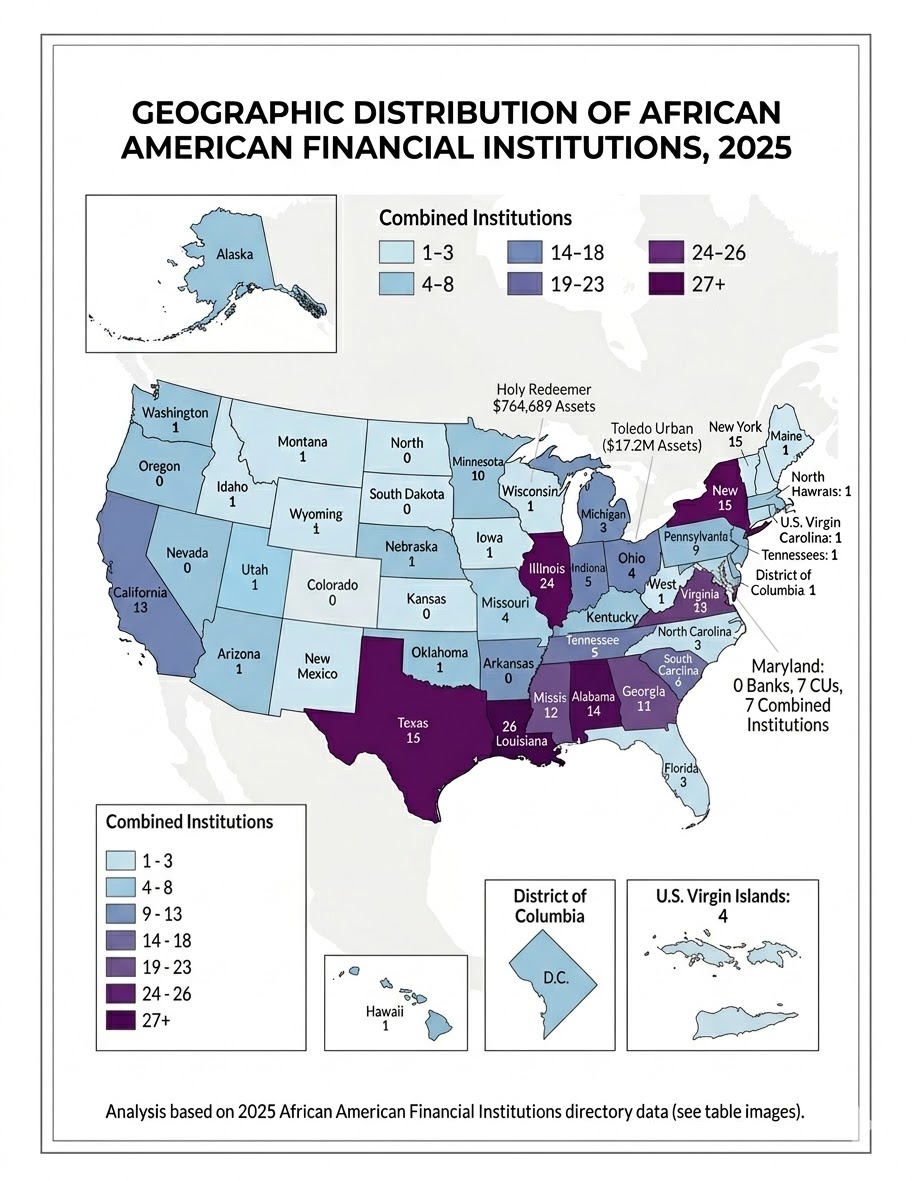
  • African American Owned Banks (AAOBs) are in 16 states and territories. Key states absent are Maryland, Missouri, New York, and Virginia.
  • Adelphi Bank (OH) is the most recent African American Owned Bank started in 2023. Prior to that no African American owned bank had been started in 23 years.
  • Alabama and Georgia each have two AAOBs.
  • African American Owned Banks have approximately $6.4 billion of America’s $23.6 trillion bank assets (see below) or 0.027 percent. The apex of African American owned bank assets was in 1926 when AAOBs held 0.2 percent of America’s bank assets or 10 times the percentage they hold today.
  • African American Owned Banks comprise 12 percent of Minority-Owned Banks (151), but only control 1.75 percent of FDIC designated Minority-Owned Bank Assets.
  • 2024 Median AAOBs Assets: $191,590,000 ($168,701,000)
  • 2024 Average AAOBs Assets: $355,448,000 ($326,097,000)
  • TOTAL AFRICAN AMERICAN OWNED BANK ASSETS 2024: $6,398,070,000 ($5,867,738,000)

ALABAMA

ALAMERICA BANK

Location: Birmingham, Alabama

Founded: January 28, 2000

FDIC Region: Atlanta

Assets: $17,741,000

Asset Change (2023): UP 2.7%

COMMONWEALTH NATIONAL BANK

Location: Mobile, Alabama

Founded: February 19, 1976

FDIC Region: Atlanta

Assets: $66,375,000

Asset Change (2023): DOWN 0.8%

DISTRICT OF COLUMBIA

INDUSTRIAL BANK

Location: Washington, DC

Founded: August 18, 1934

FDIC Region: New York

Assets: $755,175,000

Asset Change (2023): UP 2.2%

GEORGIA

CARVER STATE BANK

Location: Savannah, Georgia

Founded: January 1, 1927

FDIC Region: Atlanta

Assets: $106,700,000

Asset Change (2023): UP 30.3%

CITIZENS TRUST BANK

Location: Atlanta, Georgia

Founded: June 18, 1921

FDIC Region: Atlanta

Assets: $793,469,000

Asset Change (2023): UP 7.0%

ILLINOIS

GN BANK

Location: Chicago, Illinois

Founded: January 01, 1934

FDIC Region: Chicago

Assets: $64,685,000

Asset Change (2023): UP 1.2%

LOUISIANA

LIBERTY BANK & TRUST COMPANY

Location: New Orleans, Louisiana

Founded: November 16, 1972

FDIC Region: Dallas

Assets: $1,076,349,000

Asset Change (2023): UP 2.6%

MASSACHUSETTS

ONEUNITED BANK

Location: Boston, Massachusetts

Founded: August 02, 1982

FDIC Region: New York

Assets: $756,367,000

Asset Change (2023): UP 0.1%

MICHIGAN

FIRST INDEPENDENCE BANK

Location: Detroit, Michigan

Founded: May 14, 1970

FDIC Region: Chicago

Assets: $644,122,000

Asset Change (2023): UP 6.1%

MISSISSIPPI

GRAND BANK FOR SAVINGS, FSB

Location: Hattiesburg, Mississippi

Founded: January 1, 1968

FDIC Region: Dallas

Assets: $252,934,000

Asset Change (2023): UP 57.0%

NORTH CAROLINA

MECHANICS & FARMERS BANK

Location: Durham, North Carolina

Founded: March 01, 1908

FDIC Region: Atlanta

Assets: $498,118,000

Asset Change (2023): UP 15.9% 

OHIO

ADELPHI BANK

Location: Columbus, Ohio

Founded: January 18, 2023

FDIC Region: Chicago

Assets: $68,154,000

Asset Change (2023): UP 55.1%

OKLAHOMA

FIRST SECURITY BANK & TRUST

Location: Oklahoma City, Oklahoma

Founded: April 06, 1951

FDIC Region: Dallas

Assets: $174,740,000

Asset Change (2023): UP 46.4%

PENNSYLVANIA

UNITED BANK OF PHILADELPHIA

Location: Philadelphia, Pennsylvania

Founded: March 23, 1992

FDIC Region: New York

Assets: $53,275,000

Asset Change (2023): DOWN 4.4%

SOUTH CAROLINA

OPTUS BANK

Location: Columbia, South Carolina

Founded: March 26, 1999

FDIC Region: Atlanta

Assets: $662,589,000

Asset Change (2023): UP 26.2%

TENNESSEE

CITIZENS SAVINGS B&T COMPANY

Location: Nashville, Tennessee

Founded: January 4, 1904

FDIC Region: Dallas

Assets: $181,740,000

Asset Change (2023): UP 3.1%

TEXAS

UNITY NB OF HOUSTON

Location: Houston, Texas

Founded: August 01, 1985

FDIC Region: Dallas

Assets: $201,440,000

Asset Change (2023): DOWN 3.6%

WISCONSIN

COLUMBIA SAVINGS & LOAN ASSOCIATION 

Location: Milwaukee, Wisconsin

Founded: January 1, 1924

FDIC Region: Chicago

Assets: $24,097,000

Asset Change (2023): DOWN 12.0%

SOURCE: FDIC

The Only African American Owned Bank In Texas Selects Morris Brown College Alum As Its Next CEO

Unity National Bank, headquartered in Houston, Texas, with $209 million in assets, is the eighth largest African American owned bank by assets. It is located just a stone’s throw away from Texas Southern University. Recently the bank named Pedro Bryant, a Morris Brown College alum, its new CEO and President. Unity National Bank has an immense opportunity to move up the rankings for African American banks with the right strategy. According to an Apartment List report in February 2024, San Antonio, Houston, Dallas, and Austin rank as the third, fourth, sixth, and seventh best cities in the US for African American professionals. Lendio also reports that Texas is home to over 400,000 African American owned businesses and almost 13,000 are employer firms. These ingredients mean that with Unity National Bank being the only African American owned bank in the state the runway for growth is theirs to capture. This also means a strengthening of ties between HBCUs and the African America private sector are that much stronger. The lack of cohesion between the two institutions (100 HBCUs and 16 African American owned banks) has largely been one of the key ingredients holding back the African American economy as intellectual and economic capital rarely circulates between HBCUs and the African American owned employer firms.

Unity National Bank’s Full Press Release:

2024’s Most Powerful Women in African American Owned Banks

Whatever glory belongs to the race for a development unprecedented in history for the given length of time, a full share belongs to the womanhood of the race. – Mary McLeod Bethune

African American Owned Banks (AAOBs) continue to decline, down to 16 since from 21 since we last highlighted African American Owned Banks’ Most Powerful Women in 2013. The decline of almost 25 percent of African American Owned Banks over the past decade has meant less and less opportunity across the board and for African American women that appears to be the case as well. As our institutions decrease, so then do our ability to create opportunities for our communities. African American women in AAOBs have seen an increase only in the board of directors with all other positions seeing a decline.

Even with that reality, the numbers in comparison to their counterparts is still much greater. The largest 50 banks which are all non-AAOBs have only 1 woman (2 percent) at the helm according to American Banker. African American women comprise almost 20 percent of African American Owned Banks CEO positions.

2024 Statistics (2013 Statistics)

3 CEOs/President (4 CEOs/Presidents)

1 CFO (2 CFOs)

10 Vice-Presidents (13 Vice-Presidents)

8 Board of Directors (7 Board of Directors)

We have done our best to find out just who are some of the amazing African American women serving as executives and directors at African American Owned Banks around the country. However, some banks do not have their management or board of directors listed so we are sure we missed a few talented women, but for now here is who we found and some of their stories.

*HBCU Alumnus

COMMONWEALTH NATIONAL BANK

Beverly Cooper, Board of Directors

Mrs. Cooper is co-founder of the voter education non-profit Stand Up Mobile: A Blueprint for US.  She retired after 15 years as President of The Christian Benevolent Funeral Home, Inc. a family- owned business for 96 years. 

CITIZENS TRUST BANK

Cynthia N. Day, President/Chief Executive Officer

In February 2012, she became the Chief Executive Officer, the first permanently named female CEO in the Company’s history. Under her leadership as Chief Executive Officer, the bank has reached many milestones including achieving its highest level of performance during its 100 year existence. Further, most recently, the Bank was ranked, by S&P Global, #28 out of the Top 200 Performing Banks in the Country in its asset band.

Iris D. Goodly, Senior Vice President/ Director of Client Services and Operations

LIBERTY BANK & TRUST COMPANY

Jaimmé Collins, General Counsel, EVP and SVP of Strategy

In addition to being General Counsel, Ms. Collins manages Liberty’s strategic initiatives, joint ventures, regulatory matters, and leads Liberty Community Development Corporation (Liberty’s real estate development affiliate) and Liberty Foundation, Inc. (Liberty’s nonprofit affiliate).

Ann Duplessis, SVP of Bank Administration

*Tammy Joseph, SVP of Internal Controls

*Rhonda McMillan, SVP & Chief Credit Officer (pictured bottom right)

ONEUNITED BANK

Teri Williams, President and Chief Operating Officer

Responsible for implementation of the Bank’s strategic initiatives, as well as the day-to-day operations of the bank. These operational areas include all retail branches, marketing, compliance, lending, information technology, customer support, legal, and human resources. Under her leadership, OneUnited Bank has consolidated the local names and product offerings of four (4) banks to create a powerful national brand supported by innovative products and services. She brings 30 years of financial services expertise from premier institutions such as Bank of America and American Express, where she was one of the youngest Vice Presidents.

Sherri Brewer, Senior Vice President, Chief Retail Officer

She has been in the banking industry for 30 years. She has held senior level positions in the areas of sales, operations and consumer lending. Her responsibilities include management of five retail branches as well as the online branch, the banks facilities, item processing operations and the call center. She also serves as the Security Officer for the Bank. She has successfully managed two system conversions and one item processing conversion during her tenure. Ms. Brewer has worked for Wells Fargo, Orange County Credit Union, Business Bank of California, and First City Federal Credit Union.

FIRST INDEPENDENCE BANK

Linda Forte, Board of Directors

MECHANICS & FARMERS BANK

Emma S. Allen, Board of Directors

Connie J. White, Board of Directors

ADELPHI BANK

Greta Russell, Board of Directors

Gabrielle Whittaker, SVP of Consumer Banking and Community Relations

UNITED BANK OF PHILADELPHIA

Marionette Y. Wilson, Secretary of the Board of Directors

Ms. Wilson joined the Board of Directors of United Bank of Philadelphia in 1992 as a founding director. She is now retired but was formerly the Co-Founder/Partner, John Frazier, Inc., Philadelphia, PA from 1981-2002.

*Evelyn F. Smalls, President and Chief Executive Officer (pictured bottom left)

Mrs. Smalls is President and Chief Executive Officer of United Bank of Philadelphia, a minority-owned and controlled, full service commercial bank. With over 30 years experience in banking and community development, Mrs. Smalls is responsible for the leadership and management of the Bank including setting the direction of the organization, communicating its vision and adapting the culture and operations to achieve success.

Prior to her appointment as President and Chief Executive Officer, Mrs. Smalls served as Senior Vice President for Regulatory Compliance and Community Reinvestment. Her leadership helped establish the Bank’s community reinvestment model that has achieved consecutive “Outstanding” ratings from the Federal Reserve and FDIC since the Bank’s inception.

Mrs. Smalls received her Bachelor’s degree in Business from North Carolina Central University. 

Brenda M. Hudson-Nelson, Executive Vice President & CFO

Mrs. Hudson-Nelson has served as United Bank of Philadelphia’s Executive Vice President and Chief Financial Officer for twenty-five years. Mrs. Hudson-Nelson has thirty-four years experience within the financial services industry. Mrs. Hudson-Nelson’s responsibilities include directing financial planning, implementing, and overseeing the Bank’s systems of internal controls, managing the Bank’s investment portfolio, and monitoring and managing the Bank’s sensitivity to interest rate risk. Ms. Hudson-Nelson ensures that the Bank’s Annual Report, SEC Reports and other Regulatory Reports are filed accurately and timely. 

She served as Treasurer on the Boards of Director for the South Street Dance Company, CHOICE, Big Brothers/Big Sisters of America, Big Brothers/Big Sisters of Mercer County, and for Prevention Point Philadelphia.

Dimitria Davenport, Vice President, Community Banking & Compliance

With over 20 years in the financial services industry, she has held key roles within Training, Consumer Banking, Retail Administration and Human Resources.  Dimitria has spent the last eighteen years of her career working diligently to carry out United Bank’s mission of financially empowering people and businesses in the greater Philadelphia region. 

Dimitria serves on several Boards: The Executive Committee of The African American Chamber of Commerce, The City Schools and The New Hope Community Development Corporation.

CITIZENS SAVINGS B&T COMPANY

*Dr. LaDonna Boyd, Board of Directors (pictured top left)

As the fifth-generation president/CEO of the R.H. Boyd Family of Companies in Nashville, Tennessee, she’s a powerhouse of innovation and creativity, transforming the business landscape while championing social causes close to her heart.

She earned her bachelor’s in economics and with a minor in French from Spelman College, followed by an MBA with a finance concentration from Tennessee State University. She completed her with a Doctorate in Education with a focus on organizational leadership from Pepperdine University. She further honed her skills by earning two certificates in from Harvard University’s Extension School in Digital Marketing Strategy and Artificial Intelligence in Business: Creating Value With Machine Learning.

*Joan Fleming, SVP of Residential Lending and Community Development (pictured top right)

She is an industry leader- finding ways to produce results through her expertise, commitment and relationships. Joan has a passion for delivering value and benefit to her clients with an enthusiastic and friendly attitude. It is her commitment to serve the underserved by being an advocate for affordable housing and financial literacy. Her “thinking outside the box” mentality allows her to develop programs to ensure everyone can build wealth through homeownership. 

UNITY NATIONAL BANK OF HOUSTON

*Sharon E. Murphy, Board of Directors