Tag Archives: wealth gap

Ariel Capital’s 2020 Black Investor Survey: African America’s Continued Fight To Close The Investment Gap

“On March 23, 2020, the S&P 500 fell 2.9%. In all, the index dropped nearly 34% in about a month, wiping out three years’ worth of gains for the market. It all led to a 76.1% surge for the S&P 500 and a shocking return to record heights. This run looks to be one of the, if not the, best 365-day stretches for the S&P 500 since before World War II. Based on month-end figures, the last time the S&P 500 rose this much in a 12-month stretch was in 1936, according to Howard Silverblatt, senior index analyst at S&P Dow Jones Indices.” – CBS News

Ariel Capital released their 2020 Black Investor Survey and the results show that there is reason to be pessimistic today, but potentially optimistic for tomorrow. The survey focuses on middle class African American and European American households earning over $50K in 2019. Some key financial points outside of this survey that should be taken into context though are poverty for African American stands at 21.2 percent versus 9.0 percent for European Americans. This high rate of poverty for African Americans means that middle class African Americans, as noted in the survey, are more likely to have high levels of assistance to family and friends which provides a damper on higher investing capabilities. These high levels of poverty are highly reflective of the median wealth gap between African and European Americas, $24,100 versus $188,200, respectively. African America continues to suffer from weak institution building and therefore the ability for its economic and financial ecosystem to strengthen continues to be suffocated. Firms like Ariel Capital and other African American financial institutions need more investment and support from other African American institutions, like HBCUs, in order to scale and create more employment, wealth, and economic opportunities beyond the grassroots level.

KEY HIGHLIGHTS:

  • The deep-rooted gap in stock market participation between the groups persists, with 55% of Black Americans and 71% of white Americans reporting stock market investments.
  • 63% of Black Americans under the age of 40 now participate in the stock market, equal to their white counterparts.
  • Ownership rates of 401(k) plans are now similar between Black and white Americans (53% vs. 55%).
  • White 401(k) plan participants put 26% more per month toward their retirement accounts than Black 401(k) plan participants ($291 vs. $231).
  • Black Americans are less likely than white Americans to own almost every kind of financial vehicle, with the exception of whole life insurance, which is favored in the Black community.
  • They are also less likely than white Americans to have written wills, financial plans, or retirement plans.
  • For Black Americans, disparities grow every month; while they save $393 per month, white Americans are saving 76% more ($693 per month).
  • Black Americans are also far less likely to have inherited (23% vs. 51%) or expect to inherit wealth (15% vs. 35%).
  • Black Americans are less likely to work with financial advisors (21% vs. 45% of whites).
  • Student loan delay or deferral was reported as being three times more common among Black Americans (16%) than whites (5%).
  • More than twice as many Black 401(k) participants (12% vs. 5%) borrowed money from their retirement accounts.
  • Almost twice as many Black Americans (18% vs. 10%) dipped into an emergency fund.
  • And 9% of Black Americans (vs. 4% of white Americans) say they asked their family or friends for financial support in 2020, while 18% of Black Americans and 13% of white Americans acknowledged giving financial support to family and friends last year.
  • Among Black Americans, 10% discussed the stock market with their families growing up, while 37% discuss the stock market with their families now (compared to 23% and 36%, respectively, for white Americans).
The chart above tracks the participation in the stock market through individual stocks, mutual funds, or ETFS. For African and European Americans, 2020 is an all-time low of participation since tracking began in January 1998. However, the gap of participation has closed from 24 percentage points in 1998 to 16 percentage points in 2020. Primarily due to the all-time low of European America’s participation falling by 10 percentage points and African America’s falling by only 2 percentage points. The closest the gap has been was in 2001 and 2002 when it was 10 percentage points and in 2002 saw African America break through 70 percentage points the only time in the survey’s history when we reached 74 percent.

HBCUs can play a significant role in closing the investment gap by introducing students to HBCU alumni who have gone on to become investors and financial advisors – thus circulating both intellectual and financial capital within the HBCU ecosystem. Even more so, they can assist in ensuring students set up investment accounts like a Roth IRA during their freshmen year and throughout matriculation. The earlier students are engaged in investing the more compounding can work for them over their lifetime which in turn makes for wealthier alumni, larger future donations, stronger African American communities, and more value proposition for HBCUs to promote within the African American community.

Can NFTs Help HBCUs Close The Endowment Gap?

Black people lived right by the railroad tracks, and the train would shake their houses at night. I would hear it as a boy, and I thought: I’m gonna make a song that sounds like that. – Little Richards

The individual, familial, community, and institutional wealth gaps between African America and all other groups continues to widen. Despite the consequential donations from Mackenzie Scott and Michael Bloomberg in 2020 to HBCUs it is simply not enough consistently and overwhelming enough to put out the fire. That fire being the HWCU-HBCU endowment gap, which is over $100 to $1 – and widening. Ironically, African America is often standing there with a water hose in their hand watching their house burn while waiting on their neighbor to bring a bucket of water over and help. Why do we say African America has the water hose? By HBCU Money estimates, African America’s tuition revenue value to all colleges is worth $60 billion annually – only $6 billion of that goes makes it way to HBCUs. There are 100 plus HBCUs, but only two have institutional banking relationships with African American owned banks. In other words, there are things that if we just looked inwardly there would be substantive change happening. Instead, we continue to wait for the “lottery” of other’s grace to befall upon us. And to that point, one of the greatest financial opportunities of our lifetime maybe falling upon us to use a resource within our institutions – our creativity.

It is no secret that African American creativity drives American culture. African American creativity has and is often exploited to the social and financial benefit of other groups. There maybe no greater example of that than hip-hop (and the music industry in general) where African American musicians created a genre of music that is now global in reach, but very little of it is actually owned by African Americans. Enter, the internet. Enter, NFTs. The internet is not flat nor is it democratized – after all even on the internet all of the mediums like Amazon, Facebook, Alphabet, Twitter, Square, etc. none are owned by African Americans. However, there is an increasing amount of decentralization that seems to be taking root in pockets of the World Wide Web where opportunities can be staked out. For instance, had an HBCU endowment in July 2011 purchased 5,000 bitcoins which at the time were $13.91 for a total of $69,550, then that HBCU today would have a value of $330 million today. To the best of our knowledge, there are no HBCUs holding bitcoin or any other cryptocurrencies in their portfolio. And while there is still plenty of time to add cryptocurrencies to the portfolio, there is also a new opportunity that one could easily argue is the equivalent of buying cryptocurrencies ten years ago. The NFT.

NFTs or non-fungible tokens are “Non-fungible” more or less means that it’s unique and can not be replaced with something else. For example, a bitcoin is fungible — trade one for another bitcoin, and you’ll have exactly the same thing. A one-of-a-kind trading card, however, is non-fungible. If you traded it for a different card, you’d have something completely different.”, says Mitchell Clark from The Verge. NFTs also work off the Ethereum blockchain, Ethereum being a cryptocurrency and blockchains are a digital distributed, decentralized, public ledger that exists across a network. So what can be a NFT? Again, Mitchell Clark from The Verge, “NFTs can really be anything digital (such as drawings, music, your brain downloaded and turned into an AI), but a lot of the current excitement is around using the tech to sell digital art.” NFTs are already showing their potential. A 14-year old girl made over $1 million from selling 8,000 NFTs according to Business Insider. The most expensive NFT sold to date went for $69 million at Christie’s. An amount that would still be greater than any donation ever given to an HBCU. Now imagine unlocking the creativity that exist on HBCU campuses with students, faculty, and staff.

This could ultimately be a win-win for everyone involved if setup properly. HBCUs can provide the space, hardware, infrastructure, and other support needed while students, faculty, and staff can provide the immense creative capital that we know. Unlocking African America creativity on campuses could quite literally means tens if not hundreds of billions into African American families, communities, and HBCUs. The incentive for HBCUs to invest in this infrastructure is simple. Financially more stable graduates, improved retention rates, potentially higher alumni donor rates, and a new stream of income for endowments.

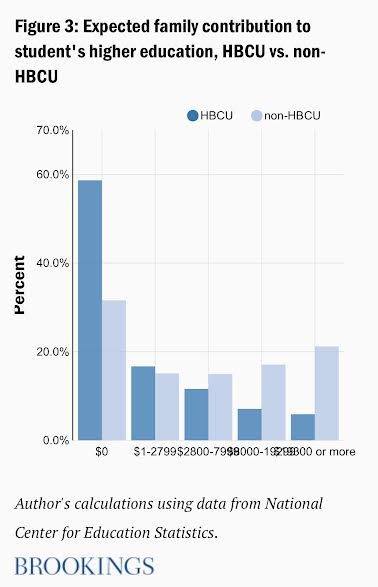
Students could see themselves earning enough to reduce or eliminate student borrowing costs. An immense hinderance to HBCU graduates creating generational wealth for themselves and their family. This barrier to wealth also is something that it could be argued contributes to poor alumni donor giving at HBCUs. HBCU donations of significance often come from older HBCU alumni who tend to wait and give a large donation either at the end of life or through their estate once they have passed on. HBCU students on a whole as reflecting in HBCU Pell Grant numbers are coming from far more low-income backgrounds their PWI counterparts. Brookings reports that almost 60% of HBCU students expect $0 in family contributions (graph below) to their education as opposed to less than one-third for non-HBCU students. On the other end less than 6 percent of HBCU students expect their family to contribute at least $19,300 to their education versus over 20 percent of non-HBCU students. This means that despite HBCUs on average costing significantly less than their PWI counterparts, HBCU students are still more likely to graduate with student loan debt and significant student loan debt loads. The most recent HBCU Money report showing that 86 percent of HBCU graduates finish with debt and a median of over $34,000 in student loan debt versus 40 percent and $24,000 in student loan debt for those coming from Top 50 endowed colleges and universities.

For HBCUs, the previous mentioned is great for their long-term sustainability, but in this case there is a huge financial reward to be had by HBCU endowments today. By providing the infrastructure, helping ensure the intellectual property rights, and more – HBCUs can create financial partnerships with students, faculty, and staff. This means that in the same way there is NIL (name, image, likeness) happening in collegiate sports, HBCUs too could use these partnerships as a means to recruit more African American faculty who often cringe at the pay rates at HBCUs. It also means that if a student, faculty, or staff produces an NFT for example that sells for $100,000, then potentially on a 50-50 split that the HBCU’s endowment just increased by $50,000. There is also the opportunity to have a foray into the entrepreneurship that is already taking root in the NFT as well as the supporting properties that will support it as an industry and asset class. As we mentioned, intellectual property attorneys in this new age will become even more valuable. There are currently six HBCU law schools who could create a focus on both IP and on digital IP in particular and those schools would be rewarded handsomely by being at the forefront of the curve. Simply put, there is just too much opportunity and money that has yet to even scratch the surface of value for HBCUs to not get involved in NFTs.

The acute importance of closing the endowment gap must be at the forefront of HBCU alumni conversations if our institutions are to be sustained into the next Millenia. It must be if we are to take serious the closing of the individual and institutional wealth gaps for African America. More importantly if HBCUs are to move beyond simply surviving and into empowered institutions that are truly able to serve the social, economic, and political interest of African America and the Diaspora, then having the institutional wealth and endowments necessary to do so is paramount. Climbing this mountain will be no easy task, but we can simply look at the wealth that has been created by our labor and our creativity as an enduring possibility of possibility. This time we must be the ownership of that creativity and protect its ownership at all costs.

Building Wealth In College: 6 Personal Financial Tips Before You Blow Your HBCU Refund

By William A. Foster, IV

“There are two types of (people) in this world; there are those with guns and the ones with butter. The guns; that’s the real estate, the stocks and bonds, artwork that appreciates with value. The “butta”; cars, clothes, jewelry that don’t mean shit after you buy it.” – Melvin (Baby Boy)

When I arrived at my HBCU many years ago, two decades ago now, it was true before, it was true then, and it is true now – you know on an HBCU campus when refund checks have been disbursed. New wardrobes show up and fashion shows commence across campus, “new” used cars show up with rims and sound systems, and in some cases trips to Jamaica for spring break are coordinated. A full range of African American consumerism is in full bloom. The problem of course is that majority of these refunds are part of a financial aid package that largely includes student loans. This means students are being handed thousands of dollars (with no financial aptitude) that will in their future life turn into tens of thousands of dollars of student loan debt to pay back. But Jamaica will be fun, right? Or in the words of the classic philosopher Riley Freeman (of the Boondocks) after blowing the food money their granddad left them “Now before you start hating, ask yourself – be honest, ain’t I clean though?”

The ripple effect is acute to put it kindly. HBCUs, although significantly cheaper, often find their students graduating with more student loan debt than their counterparts. A result of poor endowments, lack of family resources, and again, poor financial aptitude. Student loan debt, even more so than credit cards, maybe the easiest debt for a college student to obtain. It is also the cheapest unsecured debt that most of us will ever see or have access too in our lifetime – and there is the rub. There is good debt and bad debt. As simple as it can be put, good debt helps you acquire assets that generate income. Bad debt does not. Again, good debt, if used properly helps you acquire assets that can in turn pay off the debt and once paid off continue to pay you passive income. The best example of this I ever witnessed was a classmate of mine who had a part-time job while in school was using his refunds as down payments on rental properties buying one or two a year. By the time we graduated he owned 5-6 rental properties that were all cash flowing. Those rental properties will pay for the mortgages AND his student loans. Eventually leaving him with rental income and appreciation from the properties. Meaning when he takes that trip to Jamaica he could really afford it.

A few things to think about before we get into our tips. Upon graduation, do you expect for someone to give you $10,000 or more dollars? Upon graduation, how will you come up with the deposit for your first apartment? Upon graduation, will you have an emergency fund or savings of any sort? For most HBCU students, there is a resounding no to probably all of those questions, which is why refunds should be treated as close to an “inheritance” as most of us will ever see. If we are smart about it, this will give us the foundation to build transformative wealth.

The TIPS

TIP 1: Learn to say NO. Say no to yourself, to your friends, and for a lot of HBCU students – your family. The last part being the hardest for some. It is a poorly kept secret on a lot of HBCU campuses that a lot of students send portions of their refund checks  home to help their families. Unfortunately, their families are not likely to be helping them pay their student loans after graduation. Without learning to say no you are likely to succumb to your own consumer desires, friends or classmates peer pressure, and families dependency. Just like when flying, put your mask on first. In other words, make sure you establish your financial foundation before overextending yourself to help others. Financial security and stability should be a paramount concern. If you are unsure what that means, always ask yourself this question as you build wealth – if something happened and you could never work again – how long would you be financially okay?

TIP 2: Call a financial advisor and open a brokerage account. There is a misconception that that financial advisers are for the wealthy. This is simply not true. They are for whoever is willing to use them and the earlier you acquire one the more likely you are to make a long-term plan for wealth creation. Remember, you building wealth is in their best interest. If you need help finding a financial advisor, do your homework. There are vultures out there like in any occupation, but there are quality people in the profession as well. This is one time where Google is indeed your friend. A great place to also go – your HBCU’s business school. Just to understand what this has the potential for in the short-term. Imagine your refund is $2,000 a year and we will use the prior five year returns of the S&P 500. The returns on the $2,000 invested each August over the past five years would be worth $14,020 today. Which means the student would have increased their assets by 40 percent with a student loan interest rate that has been under 5 percent for over a decade. There are however downside risk and that should be explained to you by the financial advisor. If they do not explain this, fire them immediately and find a new one.

TIP 3: The financial advisor can help you with this one as well, but it is a specific type of account. Opening a Roth IRA. It is another type of brokerage account, but the difference is you will not have access to the money until you reach the ripe retirement age of 65. The beauty of this account though is you will never pay taxes on the money earned in it. Retirement is often something that African American are ghastly unprepared for financially. If you contributed $2,000 a year to the account during your five years in college and graduated at 22 you would have $10,000 in your account. If invested in the market, which has a historical annual return of 12 percent, and you simply contributed $50 a month going forward for the next 43 years that would give you at the age of 65 over $2 million tax-free.

TIP 4:  Open a CD ladder at your bank or credit union. Every year when you get your refund, go to your bank (preferably a Black Owned Bank) and open a certificate of deposit (CD). Your freshmen year get a four year CD, sophomore year get a three year CD, junior year a two year CD, and so on. Assuming you are getting a minimum of $2,000 in refunds per year and it takes you like many students these days five years to graduate, when you walk across the stage you will have $10,000 to start off in the world with. This will not have the same impact as the previous tip, but is more for those who are a bit more risk averse. While you may not increase your assets by 40 percent, there is also no chance of you losing any of the $10,000 either. If you are not familiar with CD ladders, call your bank, visit the library, Google, and of course as always – your HBCU’s business school.

TIP 5: Start a business. When I was in undergraduate, I wanted to open up a jazz club, but learned very quickly and harshly that nobody wants to lend to just a good idea. Banks, the SBA, and others expected you to have some skin in the captain also known as a down payment of capital. It is also unlikely that you will be able to call home and have family fund your amazing idea. Often times, your refund can serve as the seed capital for your business. Remember, Michael Dell founded Dell Computers in his dorm room. You do not need to be a business major to start a business. You need an idea. It certainly is prudent to visit your HBCU’s business school and ask for guidance on things like setting up the proper paperwork. While there, you may have recruit an accounting student as your CFO and a marketing major as your CMO. Some HBCUs actually house the region’s Small Business Center that is funded by the SBA and they have a lot of free resources at your disposal to help you get on your way.

TIP 6: Create a real estate partnership. Believe it or not, there is still a lot of valuable real estate that is available to be purchased in and around HBCUs. It also protects HBCU communities from gentrification that we have and are seeing around HBCUs like Howard, Texas Southern, Prairie View, and others. If you can find three other like-minded class mates who are all willing to contribute their refunds that would be $8,000 a year and $40,000 by the time of graduation which would give the group buying power of $200,000 worth of real estate. Be it a single-family, duplex, or other kind of rental property. Your refunds could be the start of a real estate empire that in turn would pay off all of you and your classmates student loans and build wealth over the years. Definitely do your homework on this one. Take a real estate class from a reputable place, speak with a local real estate investor who maybe open to mentoring, and of course see what resources your HBCU business school has on the topic.

In the end, whatever you choose to do with your refund, make sure it counts. Remember, this is still debt – whether it becomes good debt or bad debt is ultimately up to you. Getting more financially educated whether you receive a little refund, a big refund, or no refund is vitally important for all HBCU students and their futures.



The Greatest Financial Literacy Video Ever (According To Our Editor)

“A wise person should have money in their head, but not in their heart.” – Jonathan Swift

By William A. Foster, IV

Anyone who knows me and has talked to me about money has been sent this video. As a financier who has been asked for personal finance help by family and friends along with once upon a time being a former adjunct professor whose primary job was to teach a prism of subjects for incoming freshmen at a local community college throughout the course, one of those being financial literacy, finding this video was like stumbling upon treasure.

Dan Griffin, CPA, in one hour could honestly change your financial life if you listen, take notes, and put into action everything he discusses. I have watched more financial literacy videos than I can count and this is hands down the best. It is not smoke and mirrors, nor him trying to sign you up for anything, or any of the quite frankly pompousness that I tend to come across with this new era of financial literacy experts that have cropped up as a niche industry. Are there credible people out there trying to teach financial literacy? Absolutely. Is it getting harder and harder to figure who is genuine and who is a pimp turned pastor turned financial advisor? Definitely. Dan Griffin’s video is the most basic financial “meal” imaginable, meat and potatoes. His voice throughout is never too high or low, but simply steady. Moving from one subject on the financial menu to the next and explaining them in depth while giving you additional information to look up on your own. Quite frankly, I have yet to see anyone come remotely close to this one hour.

If the wealth gap is to be closed both individual and institutionally, then it starts with improving our basic financial literacy and that is what this video does. As a bonus, we have also added how you can legally get to a point where you are paying no federal taxes.

Jay-Z’s Billionaire Ascension Highlights The Black-White Billionaire Wealth Gap In America

“I want to inspire people. I want someone to look at me and say “Because of you I didn’t give up.” – Reginald F. Lewis

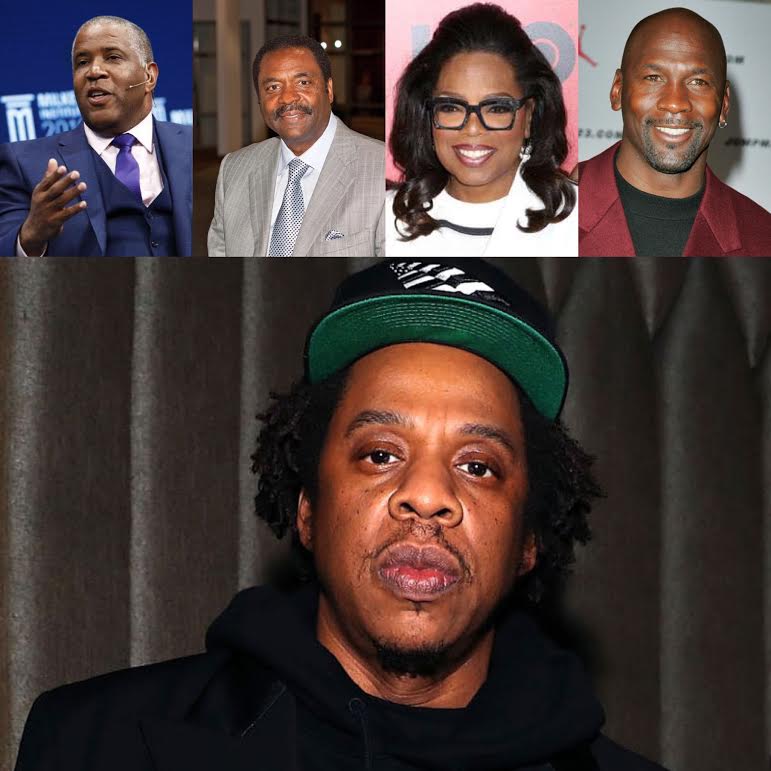
Forbes Magazine recently declared that Shawn Carter AKA Jay-Z AKA Hova officially has the net worth to enter billionaire status. We wonder if there will be a follow-up to 50 Cent’s I Get Money song that was remixed and called the Billionaire Remix or Forbes 1-2-3 where Jay-Z, Diddy, and 50 Cent who at the time were worth a combined $1 billion between the three of them. Now, Jay-Z can do the song all by himself. Unfortunately, while social media celebrated Mr. Carter’s new found billionaire status, it does open up an additional layer to the conversation on the racial wealth gap in America. Of course, no one who is a billionaire is going to garner sympathy from Main Street America, but the lack of African American billionaires certainly can be argued as a point of why there is continued institutional weakness among Main Street African America.

African Americans make up 15 percent of the American population, but of the Forbes 400 wealthiest Americans there are only three who make the cut – Mr. Carter is not one of those three. This amounts to less than 1 percent representation. According to the website, “The minimum net worth to join this exclusive club hit an all-time high of $2.1 billion while the average net worth for a Forbes 400 member rose half a billion to a record $7.2 billion.” The only three African Americans present on the Forbes 400 are Robert Smith, who recently made headlines by promising to pay off all of Morehouse’s 2019 class student loan debt. Then there is David Steward, a man who could walk into almost every room in African America and would not be recognized, but has made his $3 billion fortune through co-founding an information technology firm that is integrated in the highest levels of corporate and government. Lastly, Oprah Winfrey, who ironically is not even the wealthiest HBCU graduate but is the wealthiest African American HBCU graduate. It would take 60 African American billionaires with a net worth exceeding $2.1 billion to be representative according to our population’s percentage. Overall, there were 680 billionaires in the United States in 2018 and only four of those at the time were African American, Michael Jordan being the fourth who is also a recently minted billionaire and also is a case study in himself of just how astonishing the wealth gap is among African American and European American billionaires, but more on that later. The irony of representation for African Americans is that the United States in 2018 comprised almost 25 percent of the world’s billionaires despite being less than 5 percent of the global population according to Wealth-X.

In 2014, the median wealth for African America stood at $9,590 versus $130,800 for European Americans, according to the U.S. Census Bureau. This means that for every $1 that African Americans have European Americans have approximately $14. This in itself is an astonishing number until you examine the gap among the billionaire class. The five wealthiest European Americans (Bezos, Gates, Buffett, Zuckerberg, & Ellison) have a combined net worth of $427.7 billion versus $13.4 billion for our billionaire five of Smith, Steward, Winfrey, Jordan, and Carter. It is a ratio of the aforementioned having $31 to every $1 of the latter, which is almost 2.5 times greater than the overall gap. For the gap to be progressively worse as the wealth goes higher is in some ways astonishing and in a lot of ways expected because of how the wealth is being created. Re-enter, Michael Jordan.

There is the man who built Nike and the man who owns Nike and they are not the same. Very few will argue that had Michael Jeffrey Jordan not signed with Nike in 1984 the company, founded and majority owned by Phil Knight, probably never becomes more than a two-bit player behind the likes of Adidas, Reebok, and New Balance. Jordan was a paradigm shift. The financial gods aligned the stars in 1984 for Phil Knight with the signing of the man who would become arguably the greatest NBA player of all-time, the NBA’s continued meteoric rise in popularity, cable television, and ESPN. All of these ingredients came together to take Nike from a company that in 1984 was doing $867 million in revenue to the behemoth that it is 35 years later with revenues of $36.4 billion. An increase of 4200 percent over the time period. Jordan’s brand accounts for almost 10 percent of the company’s revenues today despite Jordan himself not having played in the NBA for almost 20 years. No other brand comes close to the singular importance that Jordan still holds for Nike, and therefore Phil Knight. Yet, Knight’s net worth is almost $34 billion, while Jordan’s is only $1.9 billion. Ultimately, Jordan who earns around $100 million annually from Nike or 3.2 percent of the Jordan brand revenues is simply well compensated labor, while Knight, the owner, truly reaps the fruits of His Airness.

Consequences of these gaps is not unnoticed institutionally within communities. Billionaires tend to be major donors to institutions like education, healthcare, and more philanthropically. These are areas of institutional infrastructure for African America that are severely under built and underfunded.  Never mind the investments they make in the order of private equity or venture capital that spawns new generations of wealth and influence, which tends to lead into immense political influence in the form of political contributions that shapes policies for hundreds of millions. Phil Knight has contributed well over $2 billion to his former alma maters, the University of Oregon and Stanford Graduate School of Business,  an amount equal to the value of all 100 plus HBCU endowments combined. He has so much influence that the state of Oregon has changed laws just to accommodate his giving to the University of Oregon.

Unfortunately, coming back to one of Jay-Z’s most prolific lyrics tells a lot of the issues facing African American wealth accumulation where he says “I’m not a businessman, I’m a business, man.” For many this line is interpreted as Mr. Carter braggadocios that he is bigger than just being Phil Knight, he is Nike – and he is right and that is where he is also wrong. Instead of controlling the company and brand, he is the company and brand. In other words, if he does not work, then he does not eat in a sense. Many of Mr. Carter’s businesses are built on their relationship to him. They are what is considered a lifestyle brand and he is the lifestyle brand you aspire to be. You drink his liquor or wear his clothes because this allows you to share in his coolness. For his business to continue to produce, then he himself must remain relevant. Three of the five African American billionaires have made their money via sports/entertainment and mainly off their own image, while four of the five European American billionaires have built their companies via technology and scaled those businesses to something that the entire world wants and needs. Even Mr. Buffett, who has largely made his money through investments and lords over companies like Geico, Wells Fargo, and many other companies is so integrated into people’s lives, often in ways they do not even realize on a day-to-day basis. Their companies and brands are far more well known to the world than the founders themselves. Governments buy Microsoft software. In fact, Microsoft Windows still accounts for use on almost 80 percent of the computers worldwide. They have created systemic companies, while our billionaires have created mostly popularity brands and as we know popularity eventually fades as new generations arise. The fact that Mr. Carter has remained relevant this long is a testament to him for sure (and his wife), but not something anyone should assume can last a lifetime. There is also the reality that even if it does, he can not pass his social capital along to his children, but Jeff Bezos’ children can and will most likely inherit Amazon even if they choose to not run it.

The situation is also not isolated to African America. Worldwide, the sons and daughters of Africa are battling the same fate. Asia is experiencing a meteoric rise in their billionaire class and now trails only Europe/US with the Diaspora with the most billionaires. Africa, one of the world’s fastest growing economies, has less than 2 percent of the world’s billionaires but contains over 15 percent of the world’s population – mainly, due to Asian and European interest continuing to siphon the continent of resources and burden it with predatory debt to their own interest and benefit. Simply put, we are not going to sing, dance, or chase balls in closing the wealth or power gap overall or the gap in the pantheons of the two. We are going to have to build institutions that wield wealth and power on a mass scale not just in small silos. Mr. Carter and Jamie Dimon are financially worth roughly the same, but Mr. Dimon is the CEO/Chairman of J.P. Morgan bank that controls almost $3 trillion in assets. An amount that is 600 times all African American owned banks combined. Mr. Dimon is not a business, man. He is “just” a businessman.

A multilayered cake is what the wealth gap entails like so many other issues that African America is looking for solutions to as a community. This data ultimately just gives us another layer to examine to help level the playing field. Mr. Carter’s billionaire status while admirable also should raise pertinent strategic questions for the community in its economic development. How is African American wealth being created? Is it scalable? Is it replicable? Are we seeing the wealth circulated back within the our community’s institutions? The reality of what it means that the gap at the apex of wealth is so pronounced must be examined and what it can tell us is still to be determined, but we do know that while men lie, women lie, numbers do not.