
Tag Archives: HBCUs

HBCUs Can Fill the Void: How America’s Retreat from Polar Research Creates an Unprecedented Opportunity for Black Academic Leadership

“When I’m asked about the relevance to Black people of what I do, I take that as an affront. It presupposes that Black people have never been involved in exploring the heavens, but this is not so. Ancient African empires – Mali, Songhai, Egypt – had scientists, astronomers. The fact is that space and its resources belong to us, not to any one group.” – Mae Jemison

The United States government’s recent decision to withdraw its only research vessel from Antarctica represents more than a logistical setback for American science it signals a historic opportunity for Historically Black Colleges and Universities to claim leadership in one of the world’s most critical research frontiers.

When scientists like Alison Murray learned their Antarctic diving research would be indefinitely postponed due to the vessel withdrawal, it exposed a troubling reality: America is ceding scientific leadership in polar regions at precisely the moment when climate research has become existentially urgent. Yet within this crisis lies an opening that forward-thinking HBCU leaders and initiatives like the proposed HBCU Exploration Institute (HEI) should seize immediately.

The withdrawal of U.S. research capabilities from Antarctica isn’t happening in isolation. It reflects broader federal retreat from exploratory science across multiple domains from deep-sea mapping to atmospheric research to space exploration. As scientists told The Washington Post, building a replacement vessel could take years, leaving a generation of young researchers without access to critical field sites and diminishing American influence on a continent where geopolitical and scientific stakes are rising rapidly.

Currently, only a handful of nations operate dedicated Antarctic vessels capable of navigating the continent’s treacherous ice-choked waters. As America pulls back, countries including China, Russia, and even smaller nations are expanding their polar research fleets and infrastructure. This isn’t merely about scientific prestige it’s about who shapes climate policy, who controls access to research sites, who sets international standards for environmental stewardship, and ultimately, who benefits from discoveries made in these frontier regions.

For HBCUs, this federal abandonment creates a three-fold opportunity: to fill genuine research gaps with immediate societal value, to establish institutional leadership in high-stakes scientific domains, and to fundamentally reframe the narrative about who leads exploration and discovery in the 21st century.

The HBCU Exploration Institute concept outlined in its founding business plan isn’t simply about participating in exploration it’s about transforming who controls the means of discovery. The proposed organization would operate research vessels, aircraft, field stations, and space payloads governed and staffed by HBCU talent, creating a parallel infrastructure to traditional federal research systems. This model offers several strategic advantages in the current moment. First, HBCUs can move with greater institutional agility than large federal bureaucracies. While government agencies debate budget allocations and political appointees shift priorities with each administration, a Pan-African, HBCU-led exploration organization could secure diverse funding streams—from philanthropic foundations to international partnerships to corporate sponsors—that insulate research from political winds.

HBCUs bring essential perspectives to exploration science that mainstream institutions have historically marginalized. The concept of “exploration power” examining whose data is gathered, who gathers it, and who benefits is central to HEI’s mission. This isn’t abstract ethics; it’s practical strategy. Research conducted in partnership with African and Caribbean institutions, for example, can build diplomatic relationships and shared intellectual property frameworks that strengthen both African American and African Diaspora scientific capacity. The HBCU network represents untapped human capital. Talented Black students and faculty have faced persistent barriers to entry in traditional exploration fields, from oceanography to aerospace. An HBCU-led initiative could create direct pipelines from undergraduate research to polar expeditions to faculty positions, bypassing gatekeeping mechanisms that have kept exploration science predominantly white and economically privileged.

Perhaps most significantly, launching an HBCU exploration initiative at this moment positions these institutions as leaders not just in American higher education, but within the global African diaspora’s intellectual ecosystem. African and Caribbean nations are rapidly expanding their own scientific capabilities. The African Union Space Agency, launched in recent years, coordinates satellite programs and space research across the continent. Caribbean nations are investing in climate resilience research essential to their survival. Yet many of these institutions lack the infrastructure, funding, and international partnerships that even modestly-resourced American HBCUs can access.

An HBCU Exploration Institute operating polar icebreakers, conducting deep-sea research, and launching satellite payloads wouldn’t just advance American science it would establish HBCUs as anchor institutions for Pan-African scientific collaboration. Imagine Howard University leading joint oceanographic research with the University of Ghana, or Spelman College coordinating atmospheric monitoring stations across the Caribbean. The reputational gains would be transformative. This matters for recruitment, fundraising, and influence. Prospective students choosing between HBCUs v. PWIs would see real HBCU ships, real HBCU expeditions, and real HBCU career pathways into exploration science. Donors and foundations seeking to support climate research and diversity initiatives simultaneously would find a natural home. And HBCU presidents would have new platforms for thought leadership on issues from climate power to space policy to scientific diplomacy.

Here’s an uncomfortable truth: this initiative will only succeed if HBCU alumni associations mobilize with the same intensity, pride, and financial commitment they bring to homecoming football games and basketball tournaments. Every fall, HBCU alumni pour millions into athletics for season tickets, tailgate sponsorships, facility upgrades, coaching staff salaries. Alumni associations organize elaborate events, coordinate donor campaigns, and celebrate athletic achievements with genuine institutional pride. The Battle of the Real HU generates more alumni engagement and media attention than most academic programs receive in a decade. That energy, that organizational capacity, that willingness to invest must now be redirected toward exploration science with the same fervor.

Imagine if Howard University’s alumni association launched a “Name a Research Station” campaign with the same production value as a homecoming concert. Picture Spelman graduates organizing Antarctic expedition watch parties with the same enthusiasm as NCAA tournament viewing events. Envision FAMU’s National Alumni Association creating an “Explorers Circle” giving society that receives the same social prestige as premium athletic booster clubs. This isn’t criticism of HBCU athletics culture it’s a call to expand that culture to encompass scientific exploration. The infrastructure already exists. Alumni associations know how to run capital campaigns, coordinate reunion giving, leverage social networks, and create moments of collective pride. These skills transfer directly to funding research vessels and field stations.

The proposed HBCU Exploration Institute requires $102 million over three years. That sounds daunting until you consider that HBCU athletic programs collectively generate hundreds of millions annually, most of it from student fees. A coordinated campaign across major HBCU alumni networks—Howard, Spelman, Morehouse, Hampton, Tuskegee, FAMU, North Carolina A&T, Southern, Jackson State, Prairie View A&M—could realistically raise $25-30 million in year one if alumni leadership treats this with athletic-level urgency. Some institutions have already demonstrated this model. When North Carolina A&T needed to upgrade its engineering facilities, alumni responded with major gifts because they understood engineering excellence as core to institutional identity. Spelman’s alumni have funded science facilities and research programs. But these efforts have remained institution-specific and episodic. What’s needed now is collective, sustained mobilization.

Alumni associations must take several concrete actions immediately. First, every major HBCU alumni organization should establish an Exploration Science Committee with the same organizational status as athletic support committees. These groups would coordinate giving campaigns, identify potential major donors from alumni ranks, and create visibility for exploration research. Second, alumni homecoming and reunion events must begin celebrating scientific exploration with the same pageantry as athletics. Feature returning researchers presenting expedition findings. Honor alumni working in climate science, oceanography, and aerospace with the same recognition as athletic hall of fame inductees. Create traditions around scientific achievement that become part of institutional identity.

Third, alumni networks must leverage their professional positions to open doors. HBCU graduates work throughout corporate America, foundation leadership, and government agencies. An organized alumni effort could secure corporate sponsorships, foundation meetings, and federal partnership discussions that individual institutions struggle to access. When Hampton alumni at NASA advocate for HBCU partnerships, or Spelman graduates at the Mellon Foundation champion exploration science grants, institutional barriers dissolve. Fourth, alumni giving must be restructured to prioritize exploration infrastructure. Many alumni give to scholarship funds or general operating budgets, which is valuable but doesn’t build transformative capacity. Alumni associations should create specific endowments for vessel operations, expedition funding, and fellowship programs—tangible assets that generate sustained visibility and research output.

The cultural shift required is significant but not unprecedented. HBCU alumni already understand institutional pride, collective identity, and the power of coordinated action. They’ve built that culture around athletics because athletics has been positioned as central to HBCU identity and excellence. Exploration science must now be positioned the same way. This means changing the narrative from “HBCUs need better STEM programs” to “HBCUs will lead humanity’s next era of discovery.” It means alumni bragging about their school’s Antarctic expedition with the same pride they show for conference championships. It means young alumni seeing paths to exploration careers at their alma maters, not just at mainstream institutions.

The financial model becomes achievable when viewed through this lens. If each of the top 20 HBCU alumni associations committed to raising just $5 million over three years for exploration science—less than many spend on athletic facility upgrades—the startup capital is secured. Add foundation grants and federal partnerships, and the budget is covered. But more than money, alumni provide legitimacy, momentum, and accountability. When alumni demand progress on exploration science initiatives with the same intensity they demand winning seasons, institutional leadership responds. When alumni celebrate research expeditions with the same enthusiasm as rivalry games, prospective students take notice. When alumni networks coordinate giving and advocacy, transformation becomes possible.

The HEI business plan proposes a $102 million startup budget over three years to acquire vessels, establish field stations, fund expeditions, and build fellowship programs. That’s substantial, but it’s also achievable given current philanthropic interest in both climate research and HBCU development. The Bezos Earth Fund has committed billions to climate research. The Mellon Foundation has prioritized HBCU infrastructure investment. NASA and NOAA, despite federal constraints, actively seek diverse institutional partnerships. A well-organized HBCU consortium could secure multi-year commitments from these sources, particularly by framing the initiative as addressing federal research gaps.

The immediate focus should be marine research, where the vessel shortage is acute. Acquiring or leasing even one ocean-capable research ship—potentially a refitted commercial vessel—would allow HBCUs to begin Antarctic and Arctic research within two years rather than waiting for federal capacity to rebuild. Partnering with international research programs could offset operational costs while building the diplomatic relationships that strengthen HBCU global standing. Field stations in strategic locations like the Gulf Coast, Alaska, Ghana, the U.S. Virgin Islands would serve multiple functions: research platforms, student training sites, and hubs for international collaboration. These don’t require massive funding; even modest facilities become transformative when they provide HBCU students access to environments and equipment unavailable on their home campuses.

The fellowship and expedition programs are equally critical. Summer research academies focusing on polar, marine, and aerospace exploration would create immediate visibility and impact. Graduate fellowships with guaranteed expedition participation would attract top-tier students who might otherwise choose mainstream programs. Faculty sabbaticals at international field sites would bring research capacity and publications that elevate institutional rankings.

Predictable objections will emerge: HBCUs lack the expertise, the infrastructure, the established research networks. But these arguments mistake historical exclusion for inherent incapacity. HBCUs have produced astronauts, oceanographers, and polar scientists they’ve simply done so while their parent institutions received minimal support for exploration science infrastructure. Moreover, the proposed model explicitly builds on existing strengths. Many HBCUs have robust Earth science, environmental science, and physics programs that lack only field research opportunities. The institute wouldn’t create scientific capacity from nothing; it would provide the ships, stations, and funding to activate capacity that already exists but remains underutilized. The real risk isn’t that HBCUs might fail at exploration science it’s that by not trying, they’ll watch other institutions and nations claim leadership in domains that will define 21st-century research prestige and funding.

Federal withdrawal from Antarctic research won’t reverse quickly. Budget constraints, political dysfunction, and competing priorities mean the vessel gap could persist for a decade or more. That timeline perfectly matches the HEI five-year development plan, which envisions operational vessels and field stations by year three and landmark research publications by year four. HBCUs face a choice. They can wait for federal capacity to rebuild, competing for scarce berths on research vessels if and when they return to service. Or they can recognize this moment as the opportunity it is: a chance to build independent exploration infrastructure, establish diaspora research leadership, and fundamentally shift the narrative about who belongs in humanity’s most ambitious scientific endeavors.

But this choice isn’t just for presidents and administrators it’s for the millions of HBCU alumni whose collective power remains largely untapped for scientific advancement. The same alumni networks that fill stadiums, fund athletic scholarships, and travel across the country for homecoming games must now channel that organizational capacity toward building research fleets and exploration programs. The motto proposed for the HBCU Exploration Institute is “To Discover, To Lead, To Belong.” That sequence matters. Discovery creates the intellectual foundation. Leadership transforms institutions and influences policy. But belonging establishing permanent presence in exploration science requires infrastructure, commitment, and the willingness to act when opportunities emerge.

America’s retreat from Antarctica isn’t just a setback for researchers like Alison Murray. It’s an invitation for institutions that have been systematically excluded from exploration science to step forward and claim the leadership role they’ve always been capable of holding. The question is whether HBCU leaders and, crucially, whether HBCU alumni will recognize this moment and seize it before it passes. The energy, pride, and resources are already there mobilized. Now they must be redirected toward putting HBCU names on research vessels sailing to Antarctica, field stations conducting climate research, and satellite payloads orbiting Earth. That’s a legacy worth more than any championship trophy.

The Lost Generation: How Gen X Inherited the Collapse of Black Institutions

“We were sold the idea that the institutions that our great-grandparents built after enslavement, the institutitons that their blood, sweat, tears, and far too often their lives were sacrificed for no longer mattered. The institutions that protected our grandparents and parents no longer mattered. That we had no obligation, no duty to uphold them, strengthen them, defend them – and it may ultimately be our downfall.” – William A. Foster, IV

African America’s Generation X came of age in the shadow of promises made but never fulfilled. Born after the civil-rights movement and the legislative victories of the 1960s, they were told they were heirs to a new world of possibility. Yet for most, the landscape they entered was not one of expanding opportunity but of institutional decline. Gen X did not inherit the wealth of their White peers, nor did they inherit the institutional foundations that could have shielded them from the widening chasm of inequality. Instead, they became the “lost generation” of African America—not because they lacked talent or will, but because they were asked to build lives in the absence of functioning institutions.

The story is one of numbers as much as narratives. At mid-century, African Americans could point to over 134 banks, more than 500 hospitals, and a dense ecosystem of schools, businesses, and mutual-aid societies that created scaffolding for resilience. By the time Gen X came of age in the 1980s and 1990s, the majority of those institutions had collapsed. Today, fewer than 20 African American banks remain. The hospitals, once numbering in the hundreds, have shrunk to just one. The erasure of these structures left Gen X to navigate adulthood without the community-owned institutions that had once provided both opportunity and insulation.

This institutional decline coincided with the hardening of social and economic divides. African American median household wealth remains below $20,000, compared to more than $180,000 for White households. Home-ownership rates hover around 44 percent, far below the 73 percent enjoyed by Whites. Poverty, unemployment, and health disparities disproportionately fell on African American Gen X families, erasing many of the gains their parents’ generation had fought for. In health, the loss of African American hospitals meant fewer spaces for culturally competent care and fewer pathways for African American doctors, nurses, and administrators to train and serve their communities. In finance, the disappearance of banks meant fewer loans for businesses and homes, ensuring that the dollar cycled out of the community faster than it could ever build generational stability.

By the 1980s, when many Gen Xers were entering high school, even the educational system that had once cultivated excellence for African American children was being dismantled. A century earlier, African American boarding schools—descendants of Reconstruction-era self-help institutions—had trained teachers, scientists, craftsmen, and entrepreneurs. Schools such as Piney Woods, Laurinburg, and Pine Forge stood as examples of self-contained learning environments that instilled discipline and race pride. By 2014, only four remained. Their decline, chronicled in The Final Four: African American Boarding Schools on the Verge of Extinction, symbolized the erosion of intellectual infrastructure that once undergirded the Black middle class. These schools had produced generations of college-ready youth who often went on to HBCUs and then into the professions. When they withered, so did a crucial pipeline.

Their demise reflected not a lack of academic excellence but the disintegration of a supportive ecosystem. As integration policies shifted resources away from Black-controlled schools, and as affluent African American families pursued suburban acceptance, the boarding schools were left with dwindling endowments and shrinking enrollments. Their survival required a collective sense of purpose that the Gen X era—steeped in the illusion of individual advancement—could no longer muster. The extinction of these schools mirrored the broader trajectory of African American institutions: erasure through neglect, assimilation, and the seductive myth that success could be purely personal.

The same cultural dissonance emerged in the world of entertainment and higher education. On television, Gen X watched A Different World, a fictional HBCU experience that inspired a generation but also unintentionally reflected a pivot. The series’ most memorable duo, Dwayne Wayne and Ron Johnson, captured the promise and pitfalls of the Gen X mindset. As HBCU Money’s essay Dwayne Wayne & Ron Johnson Dropped the Ball: HBCUpreneurship observed, the show chronicled two brilliant young men who graduated not to build companies or institutions, but to take jobs inside someone else’s. Their story became emblematic of a generation encouraged to chase credentials rather than ownership.

Gen X was the first to be told that integration was complete, that they could “make it” anywhere. But what they were rarely told was that making it individually often meant abandoning the collective scaffolding their grandparents had built. The very concept of the HBCU as a launch pad for entrepreneurship faded into nostalgia. Dwayne and Ron’s missed opportunity was not fictional; it mirrored the real-world drift of African American college graduates into corporate dependency, even as those corporations benefited from their creativity without reinvesting in African American communities.

The consequences were measurable. While White entrepreneurial ecosystems flourished in the 1990s with the rise of venture capital and tech startups, African American business formation lagged far behind. Few HBCUs established business incubators, angel networks, or venture funds that could capture their graduates’ ingenuity. Gen X, trained to seek jobs rather than ownership, lacked both the financing structures and the cultural reinforcement to build enduring enterprises. The very generation that watched the digital revolution unfold found itself on the consumer end rather than the ownership end of that transformation.

In this sense, the decline of African American institutions was not merely physical but philosophical. The idea that collective power could yield freedom gave way to the belief that individual success was freedom itself. This ideological shift—fed by television, politics, and the allure of assimilation—eroded the cooperative ethos that once sustained Black Wall Streets and mutual-aid societies. Where earlier generations might have pooled resources to open a bank, Gen X was taught to seek a mortgage from Wells Fargo. Where their ancestors founded hospitals like Provident and Homer G. Phillips, Gen X looked to be admitted to the best White medical schools rather than to revive their own.

The paradox of Gen X is that they were told they had arrived at a moment of inclusion—seen in the growth of African American representation in politics, sports, entertainment, and corporate America—while the ground beneath them was collapsing. Symbolic milestones such as the first African American CEOs of Fortune 500 companies or the growing ranks of African American elected officials did not offset the fact that the ecosystem of African American hospitals, banks, and businesses was being erased. Gen X bore the brunt of this contradiction: celebrated for individual achievement while collectively stripped of institutional power.

The American economy of the 1980s and 1990s was primed for wealth building. Deregulation, real-estate booms, and the rise of the stock market created enormous opportunities for asset accumulation. Yet African American Gen Xers, lacking access to capital and institutional mentorship, were largely excluded. The few who broke through—whether in entertainment or professional fields—were exceptional precisely because the system offered so little support. They became proof of possibility for a generation starved of infrastructure, even as their fame obscured the underlying erosion.

By the early 2000s, as Gen X entered its peak earning years, the effects of institutional loss were unmistakable. The community’s wealth gap widened even as educational attainment rose. African American college-graduation rates climbed, but the payoff was smaller salaries, heavier debt, and less wealth accumulation. Without community-controlled banks or credit unions, they faced higher borrowing costs. Without business investment networks, they relied on personal savings to launch ventures, limiting scale and sustainability. Without hospitals and schools owned by the community, the circulation of dollars—once measured in weeks—shrank to hours.

The collapse of the boarding schools and the failure of HBCUpreneurship are not side stories; they are the connective tissue of this larger decline. Each represented a node of self-determination that could have anchored Gen X’s ascent. When those nodes vanished, Gen X’s trajectory became fragmented—brilliant individuals floating in isolation, disconnected from the institutional gravity that sustains a people. The lesson from the Final Four and from Dwayne Wayne and Ron Johnson is that without institutional continuity, culture becomes performance, not power.

The irony is that Gen X still carried the memory of what once was. Many were raised by grandparents who remembered owning land, operating local businesses, or attending all-Black schools where teachers lived in their neighborhoods. They inherited stories of collective pride, but not the structures that produced it. And because their own formative years coincided with mass media’s rise, those stories were often drowned out by consumer culture’s narrative of individual aspiration. Success became synonymous with escaping one’s community rather than empowering it.

That shift in imagination may be Gen X’s greatest tragedy. A people’s future is determined as much by what they believe is possible as by what they own. When the imagination of ownership fades, dependency becomes normalized. African America’s Gen X did not choose dependency; they adapted to a system that rewarded proximity to White institutions while punishing independent Black ones. Government contracts, corporate partnerships, and philanthropic grants replaced the cooperative economics of earlier eras. The result was a generation of professionals with unprecedented credentials but limited leverage.

Still, within this loss lies instruction. Gen X’s struggle clarifies that talent alone does not equal power. Communities achieve permanence only when they own the institutions that convert talent into infrastructure. The hospitals, banks, and boarding schools were not merely service providers—they were instruments of sovereignty. Their disappearance left African America reliant on external validation and vulnerable to the volatility of goodwill.

Oprah Winfrey, Michael Jordan, and Barack Obama stand as icons of Gen X achievement, but their presence cannot replace the 500 hospitals or 100 banks that once supported African American communities. Institutions are what allow success to scale beyond the individual. Without them, every victory is fleeting, every gain precarious. The Gen X dream of being “the first” often became a cycle of isolation: the first in the boardroom, the first on the cover, the first to arrive—but rarely the architect of a system that ensured there would be a second.

As Millennials and Gen Z inherit the debris of that collapse, they confront the same choice: to celebrate representation or to rebuild capacity. The wealth and power gaps remain staggering. African Americans are still nearly twice as likely to live in poverty and hold only about four percent of America’s small-business assets despite comprising thirteen percent of its population. The absence of institutions guarantees these outcomes; their reconstruction could begin to reverse them.

Rebuilding will require the mindset Gen X was never taught—to treat institutions as the truest form of freedom. That means HBCUs creating venture capital funds that invest in their graduates. It means restoring the legacy of African American boarding schools as incubators of discipline and intellect. It means reviving credit unions and community banks that finance local ownership. It means rediscovering that the measure of progress is not how many individuals cross the threshold of another people’s institutions, but how many institutions one’s own people can build and sustain.

Gen X stands, then, as both victim and warning: the generation that inherited the death of African American institutions and the collapse of mobility. Their story illustrates that the survival of a people rests not on individual ascent but on collective infrastructure. Without it, the next generation risks becoming lost as well. The lost generation’s greatest gift may be its clarity—the understanding that brilliance without ownership is bondage, and that no degree, celebrity, or salary can substitute for a hospital, a bank, a school, or a business owned in the name of one’s community.

Disclaimer: This article was assisted by ChatGPT.

Can Military Strategy Save HBCUs? “The Estimate of the Situation” Approach

Strike an enemy once and for all. Let him cease to exist as a tribe or he will live to fly in your throat again. – Shaka Zulu, Advice to King Dingiswayo on the treatment of the defeated Ndwanwes

The Battle for the Black Mind

At the beginning of the 20th century, African American higher education was a mission of survival. By the end of the century, it had become a struggle for relevance. Today, the nation’s Historically Black Colleges and Universities (HBCUs) face a different kind of warfare—one not waged on battlefields but in boardrooms, budget hearings, and data dashboards. Declining endowments, limited research funding, a shrinking pool of Black male students, and encroachment by Predominantly White Institutions (PWIs) on their traditional demographic base has left many HBCUs strategically adrift.

But what if the remedy lies not in education reform think tanks or philanthropic patchwork, but in the unlikeliest of quarters—military strategy?

In the art of war, commanders engage in a disciplined process known as the “Estimate of the Situation.” Codified in U.S. military doctrine, this method assesses terrain, adversaries, capabilities, and courses of action before deciding how to marshal forces to achieve objectives. It is a doctrine of clarity, decisiveness, and ruthless prioritization—traits HBCUs, long forced into reactive postures, desperately need. If deployed correctly, it may offer a blueprint for survival and supremacy.

Terrain and Threat Assessment

The educational terrain for HBCUs is marked by systemic deprivation. While the Ivies and flagship publics boast endowments in the billions—Harvard’s at over $50 billion and the University of Texas System’s UTIMCO fund at $66 billion—only a handful of HBCUs cross the $100 million threshold. In 2024, Howard University led with a $908 million endowment, trailed by Spelman College ($569 million) and Hampton University ($379 million). By contrast, many HBCUs hover in the single-digit millions, dependent on volatile tuition revenue and susceptible to enrollment shocks.

Their adversaries are both external and internal. PWIs, emboldened by racial reckoning post-George Floyd, have launched aggressive DEI (Diversity, Equity, and Inclusion) marketing campaigns targeting high-achieving Black students, faculty, and even entire academic programs traditionally incubated within HBCUs. These institutions are mimicking HBCU cultural strengths while wielding superior infrastructure, funding, and media amplification.

Internally, decades of underfunding by state legislatures, inconsistent leadership pipelines, and fractured alumni giving have made coordination among HBCUs difficult. Public HBCUs often answer to politically hostile boards or governors who see their growth as optional, not imperative. In some Southern states, Black institutions are funded at levels far below their white counterparts, even while serving disproportionately more first-generation and low-income students.

The question then is: what does victory look like?

Mission Analysis: Existential or Expansionist?

In military parlance, the mission must be clear: is it to survive or to dominate? Too many HBCUs adopt a minimalist, survivalist mindset—hoping to keep doors open, retain accreditation, and attract enough enrollment to balance the books. But such passivity is tantamount to strategic surrender. If the mission is redefined as expansionist—growing endowments, poaching research talent, building technology hubs, or acquiring other institutions—then a different posture is required. One of preemption, consolidation, and power projection.

The underlying assumption should be this: the war for Black minds will intensify in the next decade as the U.S. becomes more diverse and the global competition for brainpower increases. If HBCUs do not act like insurgent militaries—nimbly, strategically, and with unified doctrine—they risk being romantic relics rather than revolutionary institutions.

Center of Gravity: The Black Intellectual Capital Base

In military strategy, the “center of gravity” is the source of an entity’s strength. For HBCUs, that center is their unparalleled social trust within the African American community and their historical mandate to serve as the custodians of Black intellectual capital.

Every great military power identifies its core asset. Rome had its legions. Britain its navy. The Soviet Union its armored divisions. For HBCUs, it is their alumni networks, faculty thought leadership, and cultural currency. But this center is fragile—threatened by underinvestment and neglect.

HBCUs should protect and project this strength. This means doubling down on producing future Black PhDs, engineers, doctors, and diplomats not as an accidental byproduct, but as a stated national security imperative for Black America. It also means developing internal think tanks and war colleges of their own—places where institutional planning, scenario modeling, and leadership development are continuous and sophisticated.

Logistics and Lines of Communication: The Endowment as Supply Chain

No army survives without logistics. In the higher education battlefield, the logistics trail is the endowment. It funds scholarships, shields against state austerity, allows for faculty recruitment, and finances long-term infrastructure. Currently, the Black educational front is malnourished.

A military-style “Operation Supply Line” could change this. Instead of chasing microgrants from corporations and philanthropies, a war doctrine would focus on concentrated, large-scale capital campaigns to create state-level or regional endowment federations.

Imagine, for example, if North Carolina’s five public HBCUs—North Carolina A&T, Fayetteville State, Elizabeth City State, Winston-Salem State, and North Carolina Central—pooled assets and donor bases into a centralized fund similar to UTIMCO. This would enable sophisticated portfolio strategies, risk mitigation, and scale advantages. Donors could give once, and see those funds managed professionally and distributed strategically.

The same could apply to private HBCUs, with alliances organized around geographic or academic complementarities. But like military alliances, these federations must be underpinned by mutual accountability and binding mission coherence.

Command Structure and Unity of Effort

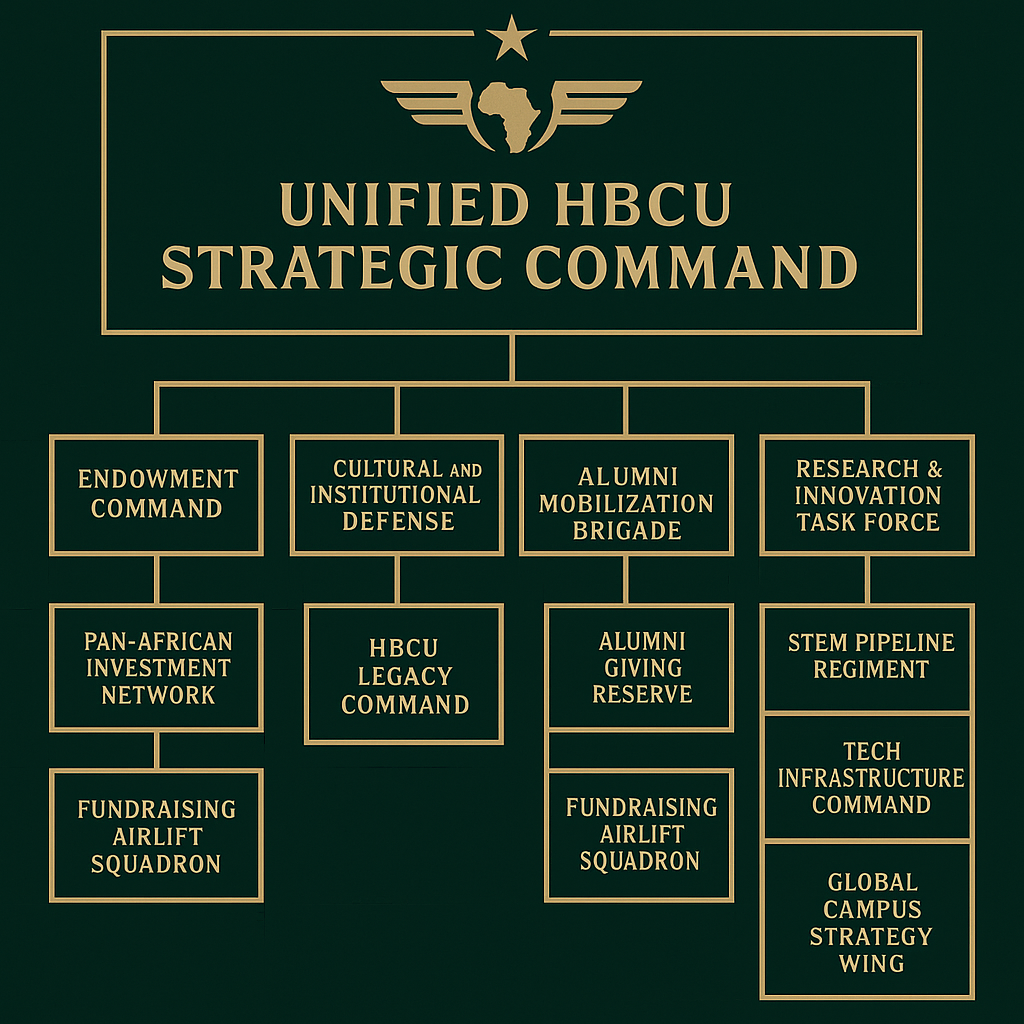
Another hallmark of successful military strategy is clarity of command. At present, the HBCU landscape resembles a coalition of militias—each acting autonomously, sometimes duplicating efforts or even competing for the same resources. This is operationally inefficient.

There is precedent for unity. During World War II, Allied forces coordinated through joint command centers and mission directives despite national differences. HBCUs must do the same, perhaps through the reimagining of the Thurgood Marshall College Fund and UNCF as strategic command centers with teeth—not just fundraising conduits but institutions empowered to set joint priorities, coordinate lobbying efforts, and deploy institutional reinforcements to weaker allies.

This would mean acting less like separate colleges and more like battalions of a unified liberation force. Leadership exchanges, shared procurement, collaborative curriculum design, and a universal strategic plan should all be part of the doctrine.

War Games: Scenario Planning for a Disruptive Future

In military planning, exercises and simulations are key to testing preparedness. HBCUs need war games of their own—scenarios that model enrollment collapse, cyberattacks, political defunding, or rival university encroachments.

How would an HBCU survive if its primary state funding was cut 30% overnight? What if a prominent PWI began offering free tuition to Black students within its region? Could it recruit, retrain, and digitally educate at scale in response?

Scenario planning should not be theoretical. HBCUs could embed these exercises into board retreats, trustee meetings, and presidential onboarding. Just as generals must war-game an invasion, university leaders must anticipate disruption and know their mobilization plans.

Counteroffensive: Reclaiming the Intellectual Offensive

Finally, no military campaign is complete without a counteroffensive. HBCUs must stop playing defense. They should reclaim the offensive by launching campaigns that define what Black excellence is—not as an assimilationist ideal, but as an autonomous civilization-building agenda.

This could include opening campuses abroad in Africa and the Caribbean, creating a Black Fulbright equivalent to rotate scholars through HBCU-led global programs, or establishing “colonies of influence” in major American cities through cultural centers and satellite campuses.

The ultimate strategic goal is deterrence: to make it clear to the philanthropic sector, the corporate elite, and rival institutions that HBCUs are not simply cultural landmarks but geopolitical actors in the knowledge economy. Their preservation, therefore, is not charity—it is strategic alignment with the future.

Final Estimate: Can Military Strategy Save HBCUs?

The Estimate of the Situation is a cold, analytical process. It recognizes no nostalgia, entertains no sentimentality. It demands clarity, precision, and ruthless self-appraisal. For HBCUs, the time for reactive strategies and wistful memory is over. What is required is a war doctrine.

The adversaries are organized. The battlefield is asymmetric. And time is not on the side of the disorganized.

Yet, there is hope. Unlike in war, HBCUs do not need to annihilate their enemies. They need only to out-strategize them. With the right command structure, pooled resources, rigorous planning, and cultural clarity, they can turn the tide.

As Shaka Zulu warned: to spare a weakened enemy is to invite a future war. For HBCUs, the weakened enemy is irrelevance—and they must strike now to ensure it never flies at their throat again.


The “Real World” Myth: How Sending African American Children to PWIs Undermines African American Institutional Power

“When you control a man’s thinking you do not have to worry about his actions. He will find his ‘proper place’ and will stay in it. You do not need to send him to the back door. He will go without being told; in fact, if there is no back door, he will cut one for his special benefit.”
Carter G. Woodson, The Mis-Education of the Negro

For generations, African American families have been told a myth that has become so pervasive it often passes without challenge: the idea that sending their children to predominantly white institutions (PWIs) of higher education better prepares them for the “real world.” On its surface, the reasoning sounds practical. Parents believe that if their child learns how to navigate white spaces, acquires the habits and codes of those spaces, and builds networks with white peers, they will be more successful in corporate America and society at large. It is a calculation born of centuries of survival in a society structured against African Americans.

But this calculation, when examined deeply, does not hold up to scrutiny. Instead of preparing African American students for the “real world,” the widespread preference for PWIs undermines the institutional power of African Americans and deprives HBCUs of the very human and financial capital they need to thrive.

The “real world” itself is not a fixed entity. It is not a monolith that African Americans must prepare to join on white terms. The real world is what a group of people make it. White Americans have defined their world and fortified it through their institutions such as universities, banks, hospitals, corporations, and foundations. Asian Americans, Jewish Americans, and other groups have done similarly, leveraging their educational and economic institutions to shape their reality. Yet, African America, too often, has internalized the belief that its institutions are insufficient, opting instead to send its brightest students and most valuable tuition dollars into the coffers of PWIs.

This is not simply a matter of personal choice. It is a collective decision with collective consequences. The more African American families buy into the “real world” myth, the weaker HBCUs become, and the less capable African America is of shaping its own real world.

The PWI Path and Its Assumptions

African American parents who choose PWIs for their children often do so with good intentions. They want their children to access elite resources, prestigious networks, and the perceived stamp of approval that comes with a degree from a PWI. They assume that because the U.S. labor market is majority white, exposure to that environment early on is critical to future success.

But these assumptions reveal several contradictions. White students do not consider attending an HBCU to balance their cultural experiences. They do not think, “I’ve had too much whiteness; I need a more balanced education.” Instead, they progress from a PWI undergraduate degree to a PWI graduate school, then into PWI-dominated corporate and institutional spaces. Their cultural immersion is never questioned, because their institutions define normalcy.

Meanwhile, African Americans alone have been conditioned to believe that too much African American immersion is dangerous, insular, or unrepresentative of the “real world.” The irony is sharp: a student may attend an HBCU, which is itself a diverse universe of African American culture, class, geography, and ideology, and still be told they have not had enough “exposure.” Yet a white student who grows up in an all-white town, attends an all-white PWI, and joins all-white firms is never told they lack “diversity of experience.”

This asymmetry is not accidental. It is a reflection of who controls institutional narratives in America. African Americans who absorb the “real world” myth are effectively outsourcing their children’s futures to white institutions, all while their own institutions wither from neglect.

The Diversity Within HBCUs

Another overlooked dimension of this myth is the assumption that HBCUs are homogeneous, insular spaces. This could not be further from the truth. The African American experience itself is vast. It includes children of Caribbean immigrants, descendants of enslaved Africans, first-generation college students from rural Mississippi, affluent families from Washington, D.C., African students from Nigeria and Ghana, Afro-Latinx students from Puerto Rico and the Dominican Republic, and more.

To attend an HBCU is not to encounter “less” diversity; it is to engage with the broad spectrum of the African Diaspora in concentrated form. These institutions are living laboratories of cultural exchange, intellectual competition, and class interaction.

By contrast, a PWI often provides African American students with only a sliver of diversity: they are frequently tokenized, expected to represent their entire race, and shuffled into diversity programming that centers their marginalization. Their peers may never learn about African American life beyond stereotypes, because the institution itself was never designed to illuminate African American experiences.

Thus, the African American student at an HBCU receives not just an education, but an immersion in African American pluralism is a preparation for engaging the world on African American terms. The PWI student, meanwhile, often internalizes the idea that their presence is conditional, exceptional, or peripheral.

Institutional Power and the Capital Flight from HBCUs

Every African American student who chooses a PWI over an HBCU represents more than an individual choice. It is the redirection of tuition dollars, alumni loyalty, and future endowment contributions away from African American institutions.

Imagine if even half of the African American students currently enrolled at PWIs redirected themselves to HBCUs. The financial impact would be transformative. Endowments would grow, faculty recruitment would expand, research capacity would increase, and the prestige of HBCUs would rise proportionally. These gains would compound over decades, creating a feedback loop of institutional strength.

Instead, what we have is a leakage of capital and talent into institutions that do not prioritize African American empowerment. PWIs benefit from African American enrollment statistics, which they parade as evidence of diversity, while offering little in terms of institutional reciprocity. They gain the reputational boost, while HBCUs lose the enrollment and financial stability they desperately need.

The result is predictable: HBCUs remain underfunded, under-endowed, and under-appreciated, not because they lack quality, but because too many African American families believe the myth that their children will be better off elsewhere.

The Real World Is What We Make It

The central flaw in the “real world” argument is the assumption that African Americans must adapt to a world built by others rather than shape their own. The real world is not an objective standard but it is the result of group will, institutional building, and cultural reinforcement.

White Americans shaped their “real world” through the sustained investment in Harvard, Yale, Princeton, and thousands of other institutions that center their history, culture, and power. Jewish Americans created their “real world” through a network of universities, foundations, and cultural centers that prioritize their collective survival. Asian Americans are building their own “real world” through business networks, educational pipelines, and capital flows that stretch across the Pacific.

If African Americans accept the premise that their children must be trained in white institutions to succeed, they have already conceded that they cannot or will not shape their own real world. They have abandoned the project of institutional power in favor of individual adaptation. This is not preparation; it is surrender.

Psychological Implications: Internalizing Inferiority

Beyond the economic impact, the myth has deep psychological consequences. African American students raised on the belief that HBCUs are not “the real world” internalize a subtle but corrosive idea: that their own culture is insufficient. They may carry degrees from elite PWIs, but the cost is often an alienation from African American institutional life.

The psychological message is clear—white spaces are the pinnacle of preparation, while African American spaces are something to escape. This creates a generational feedback loop where each successive cohort of African American parents pushes harder for PWIs, believing they are giving their children an advantage, while in reality they are weakening the very institutions that could make African America self-sufficient.

It also distorts identity. An African American child who grows up believing they must leave their community to succeed will often view their success as individual rather than collective. They may become comfortable being the “only one in the room,” rather than building the rooms where African Americans are not tokens but owners.

The Comparative Case: No Other Group Thinks This Way

No other racial or ethnic group in America sends its children away from its own institutions to gain “real world” experience. White families do not think Harvard students lack preparation because they have spent too much time around other white students. Jewish families do not believe their children need to avoid Jewish institutions to be competitive. Chinese Americans do not view Chinese language schools or cultural institutions as a liability to their children’s preparation.

It is only African Americans who accept this self-defeating logic. This uniqueness underscores the lingering effects of centuries of racial conditioning. From slavery to Jim Crow to modern structural racism, African Americans have been taught that their own institutions are inferior. The “real world” myth is simply the modernized version of this lesson.

By contrast, when other groups send their children to institutions, they do so with the understanding that these institutions will strengthen their cultural identity while equipping them to engage broader society on their own terms. For African Americans, the task must be the same: build HBCUs into the kind of institutions that define, rather than defer to, the real world.

Rethinking the “Preparation” Narrative

If the goal of higher education is preparation, then the question is: preparation for what? For African Americans, preparation should not simply mean being employable in someone else’s institution. It should mean being capable of building, leading, and sustaining African American institutions.

An HBCU graduate is not less prepared for corporate America than a PWI graduate; in many cases, they are more resilient, more culturally grounded, and more aware of systemic barriers. The difference is that the HBCU graduate, if supported by their community, is positioned to reinvest in African American institutional life.

The narrative that PWIs uniquely prepare African Americans for the “real world” ignores the fact that many HBCU alumni have gone on to excel in every imaginable field from politics, science, business, culture while also strengthening the institutions of African America. The preparation HBCUs offer is not narrow; it is holistic, rooted in both academic rigor and cultural affirmation.

A Call to Reclaim Institutional Power

For African Americans to continue believing in the “real world” myth is to ensure that the next century looks much like the last: individual success stories amid collective institutional weakness. To break this cycle, African American families must reorient their thinking.

Sending a child to an HBCU is not a limitation; it is an investment in collective power. It is a statement that African Americans will not only participate in the real world but will define it. It is a recognition that every tuition dollar, every alumni donation, and every student enrollment strengthens the institutional backbone of African America.

The time has come to retire the myth once and for all. The real world is not something African Americans must be prepared for by others. It is something African Americans must build for themselves, through the strengthening of HBCUs and the rejection of narratives that undermine them.

Until that shift happens, African America will remain trapped in a paradox: sending its children to PWIs in search of preparation, only to find that the institutions that could truly empower them are being starved of the very resources they need.

The “real world” is not out there waiting. It is in our hands to create.

 Disclaimer: This article was assisted by ChatGPT.

Student Loans and Tax Credits: A Creative Plan to Solve the Student Loan Crisis

“A hunch is creativity trying to tell you something.” – Frank Capra

Once upon a time in the bustling town of Gradsville, there lived a recent college graduate named Tim. Armed with a shiny diploma and a mountain of student loans, Tim was ready to take on the world, or so he thought. After months of job hunting, he finally landed a gig at a local coffee shop, where he expertly crafted lattes while dreaming of his future as a high-powered executive.

One fateful morning, as he was frothing milk, Tim received an email from his loan servicer. The subject line read: “Your Student Loan Repayment Starts Now!” His heart raced. He opened the email, and there it was: a number so big it could compete with the national debt. Tim squinted at the screen, convinced it was a prank. “This must be a mistake!” he muttered, spilling a little espresso on his apron.

Determined to tackle the situation, he decided to devise a plan. Tim figured if he couldn’t pay his loans, he might as well make the most of his situation. So, he took his trusty old bicycle, painted it bright pink, and outfitted it with a sign reading, “Will Work for Student Loan Payments!” He rode around town, ringing a tiny bell and offering to do odd jobs for anyone willing to pay him in cash.

At first, the townsfolk were amused. Mrs. Jenkins, the elderly lady down the street, hired him to weed her garden. Tim spent hours pulling weeds, but when he presented her with the bill, she handed him a cookie instead. “This is for the effort, dear,” she said sweetly.

Undeterred, Tim pressed on. He mowed lawns, walked dogs, and even became a local celebrity for his “Bicycle Karaoke” sessions, where he belted out off-key renditions of pop songs while pedaling through the park. “I will survive!” he sang, as people threw coins into his basket.

But as the days turned into weeks, Tim realized he was raking in more laughs than cash. One evening, after a particularly exhausting day, he collapsed on his couch, exhausted and broke. Just then, his phone buzzed. It was an alert from his loan servicer: “Your payment is due tomorrow!”

In a moment of desperation, Tim decided to get creative. He hosted a “Loan Repayment Comedy Show” at the coffee shop, charging admission and promising a night of laughter. The townsfolk packed the place, eager to see the local hero make fun of his financial woes. Tim took the stage, and with each joke, he poked fun at his debt, his job, and even his pink bicycle.

By the end of the night, he had raised enough money to make his first payment. The crowd cheered, and Tim realized something important: while student loans were a burden, laughter was the best way to lighten the load.

With a new plan in mind, he turned his bike into a mobile comedy machine, spreading joy and occasionally collecting spare change. And just like that, Tim learned that sometimes, the best way to deal with life’s challenges is to find humor in them—even if it involves a pink bicycle and a lot of bad singing!

In a landscape where the burden of student debt looms over millions of Americans, I offer a glimmer of hope with an innovative proposal. Tax Credits. The creative use of tax credits can be designed to alleviate the financial strain of student loans. 

The cost of higher education continues to soar. As of 2025 higher education costs are nearly $35,000 per year for private institutions and over $10,000 for public universities. Over 45 million borrowers now collectively owe over $1.7 trillion in student debt. This staggering figure has become a significant hurdle for graduates entering the workforce, hindering their ability to invest in homes, start businesses, and contribute to local economies.

What exactly is the problem?

The student loan crisis has reached critical levels. According to the Federal Reserve, approximately one in five borrowers is in default or delinquency, while the average monthly payment for federal student loans hovers around $400. For many, this payment is a substantial chunk of their income, especially for young professionals just starting their careers. The implications extend beyond individual borrowers; they ripple through the economy, stifling growth and innovation. We are currently bordering on student loans reaching levels where they pose systemic risk to the entire system.

The proposed solution is tax credits for individuals and institutions.

To address this escalating issue, a two-pronged solution is proposed: tax credits for individuals repaying student loans and tax credits for institutions that implement aggressive debt reduction initiatives.

1.  Tax Credits for Individuals: This initiative would provide borrowers with a tax credit for every dollar they pay toward their student loans. Currently only student loan interest is tax deductible up to $2,500 per year. Under this new proposal full student loan payments become tax deductible. For example, someone with a $400 a month student loan payment will pay $4,800 in a full tax year. That $4,800 becomes a tax credit that can be used to lower their income tax burden. This would not only ease the financial burden but also encourage timely repayments, ultimately reducing the total outstanding debt. 


2. Additional Tax Credits for Individual payments to the loans of others. Under this new tax provision taxpayers who actively make student loan payments on behalf of other student loan holders can also receive a dollar-for-dollar tax credit.

3. Tax Credits for Private Entities: By aligning private institutional interests with the economic well-being of the public, private institutions would be motivated to contribute to the solution of student loan debt. Imagine Apple or JP Morgan deciding to allocate several billion a year to paying student loans of private citizens in exchange for tax credits. If the top 200 companies in the S&P 500 committed $1 billion each year to paying student loans it would mean that over a 10 year stretch nearly all student loans can be eliminated. Imagine a highly educated populace without the burden of student loan debt.

There are major benefits across the board.

This solution has the potential to benefit various stakeholders, including the wealthy, corporations, higher education institutions and local and state economies.

Wealthy individuals could see tax deductions that encourage more investment into the broader economy with the new capital. Simultaneously they also can benefit from a more educated workforce that drives productivity and innovation into the future.

Corporations would gain from a more skilled labor pool without the financial burden of student debt hindering employees’ productivity. Companies could also leverage tax credits to invest in employee education programs, enhancing workforce skills while reducing tax liabilities.

Higher Education Institutions benefit through potential students and current students now knowing that they can comfortably pursue educational goals without the fear of post graduate debt crippling their ability to perform in the labor force.

Local and state economies would see a revival as graduates with reduced debt would have more disposable income to spend on housing, goods, and services. This consumption can lead to job creation and increased tax revenues, offsetting some of the initial losses from the tax credits.

Like most policy shifts there will be opposition.

Despite its potential benefits, this proposal would likely face opposition from several parties. Conservative fiscal policymakers may argue that tax credits could lead to significant revenue losses for the federal government, exacerbating the national debt.  From a social standpoint there is bound to be criticisms of unfairness from individuals that did not attend college. Additionally, some economists may present a potential moral hazard in the form of people focusing too much on education and delaying real world labor pursuit. This has the potential to slow the proliferation of qualified labor into the workforce.

Estimating Revenue Loss for the Federal Government

Implementing such a tax credit system is not without its costs. Estimates suggest that the federal government could lose approximately $20 billion annually in tax revenue if the credits are widely adopted. This figure reflects both the individual tax relief provided to individuals and the institutional incentives for corporations. While this loss could raise concerns about funding for other critical programs, proponents will likely argue that the long-term economic benefits of a more educated populace and a healthy economy would outweigh the initial financial drawbacks.

In conclusion, the proposal for tax credits aimed at alleviating the student loan crisis presents a promising solution to a pressing problem. By aligning the interests of individuals, corporations, and the economy, this approach could pave the way for a brighter future, where education is an investment rather than a burden. As the conversation around student debt continues, it is crucial to explore innovative solutions that can lead to systemic change.