Unity National Bank, headquartered in Houston, Texas, with $209 million in assets, is the eighth largest African American owned bank by assets. It is located just a stone’s throw away from Texas Southern University. Recently the bank named Pedro Bryant, a Morris Brown College alum, its new CEO and President. Unity National Bank has an immense opportunity to move up the rankings for African American banks with the right strategy. According to an Apartment List report in February 2024, San Antonio, Houston, Dallas, and Austin rank as the third, fourth, sixth, and seventh best cities in the US for African American professionals. Lendio also reports that Texas is home to over 400,000 African American owned businesses and almost 13,000 are employer firms. These ingredients mean that with Unity National Bank being the only African American owned bank in the state the runway for growth is theirs to capture. This also means a strengthening of ties between HBCUs and the African America private sector are that much stronger. The lack of cohesion between the two institutions (100 HBCUs and 16 African American owned banks) has largely been one of the key ingredients holding back the African American economy as intellectual and economic capital rarely circulates between HBCUs and the African American owned employer firms.
Negro banks, as a rule, have failed because the people, taught that their own pioneers in business cannot function in this sphere, withdrew their deposits. – Dr. Carter G. Woodson
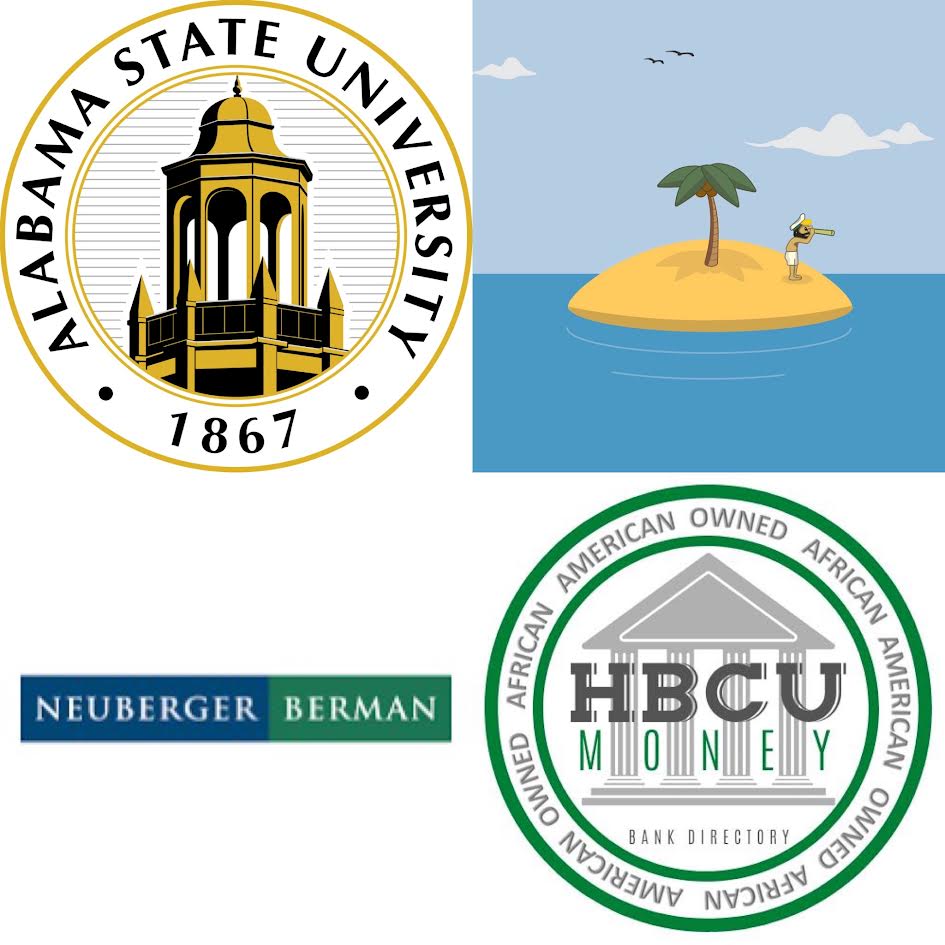
What is an ecosystem? How do you develop an ecosystem? Can we develop an African American ecosystem? It seems to be a question that a room full of African American institutional leadership have little understanding of based on the institutional decisions that are continuously made. In their academic paper entitled Economic Ecosystems, Philip E. Auerswald and Lokesh M. Dani, “An ecosystem is defined as a dynamically stable network of interconnected firms and institutions within bounded geographical space. It is proposed that representing regional economic networks as ‘ecosystems’ provides analytical structure and depth to theories of the sources of regional advantage, the role of entrepreneurs in regional development, and the determinants of resilience in regional economic systems.” The most vital part of that definition being interconnected firms and institutions. African American institutions in general at every turn fail to understand this concept and HBCUs are no exception. This is especially true of HBCUs choice of banks and now Alabama State University’s recent decision to forego a plethora of African American Owned Investment and Asset Management firms and hand $125 million to another European American owned investment firm. African American capital once again reinforcing European America’s financial ecosystem – not ours.
It is almost a redundant story at this point. African American institutions all operating on their own island and failing to interconnect and intertwine with each other. African America from individual to institutions all do what is best for themselves individually and not what is best for the collective and certainly not what connects and strengthens the collective. See Hampton University and North Carolina A&T State University decisions to leave an HBCU conference for a PWI one. To that vein is why over 90 percent of African America’s $100 billion in annual tuition revenue goes into PWIs and not HBCUs/PBIs. HBCUs provide very little means of an example for the community to follow. Instead, HBCUs are a glaring headlight of just how poorly African American institutions perform in strategically integrating themselves within the African American ecosystem, especially economically. There are no reports on HBCUs engagement with the African American private sector because HBCUs do not seemingly see that as important. How many of HBCU graduates work for African American owned companies? How much HBCU athletic sponsorship dollars come from African American owned companies/partnerships? How much of the HBCU endowment is invested in African American firms? These are basic questions that any leadership of an HBCU should be able to answer. Unfortunately as Jarrett Carter, Sr., founder of HBCU Digest, once eloquently put it, “Many HBCUs are just trying to be PWI-adjacent.”
Is $125 million a lot of money? Context matters. To any individual, most would agree $125 million is significant. To institutions, it varies on size, scope, and goals. For African American Financial Institutions, almost down to even the largest of our firms having an $125 million account would see their bottom line acutely move. Providing perspective on the landscape, Pension and Investments reports, “The global asset management industry showed some signs of recovery in 2023, with total assets under management (AUM) rising 12% year-over-year to nearly $120 trillion, according to research by Boston Consulting Group.” For African American Asset Managers, “The largest Black-owned asset managers are responsible for more than $253 billion in assets, according to FIN Searches data. Vista Equity Partners is the largest Black-owned firm in the industry, with the private equity manager handling $103.8 billion in assets.” African American Owned Asset Managers only account for 0.2 percent of the global AUM. By contrast, the Top 10 non-Black asset managers have $22 trillion assets under management which accounts for almost 20 percent of global AUM.
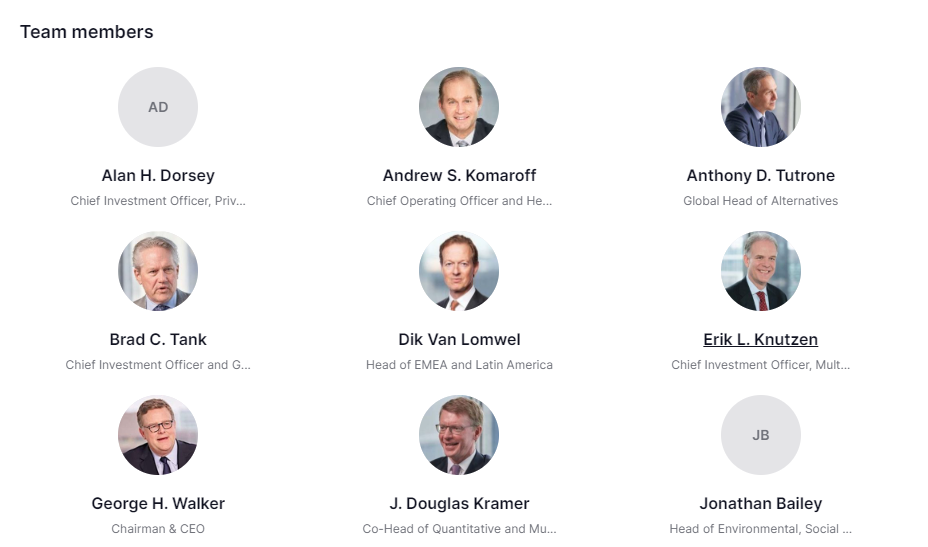
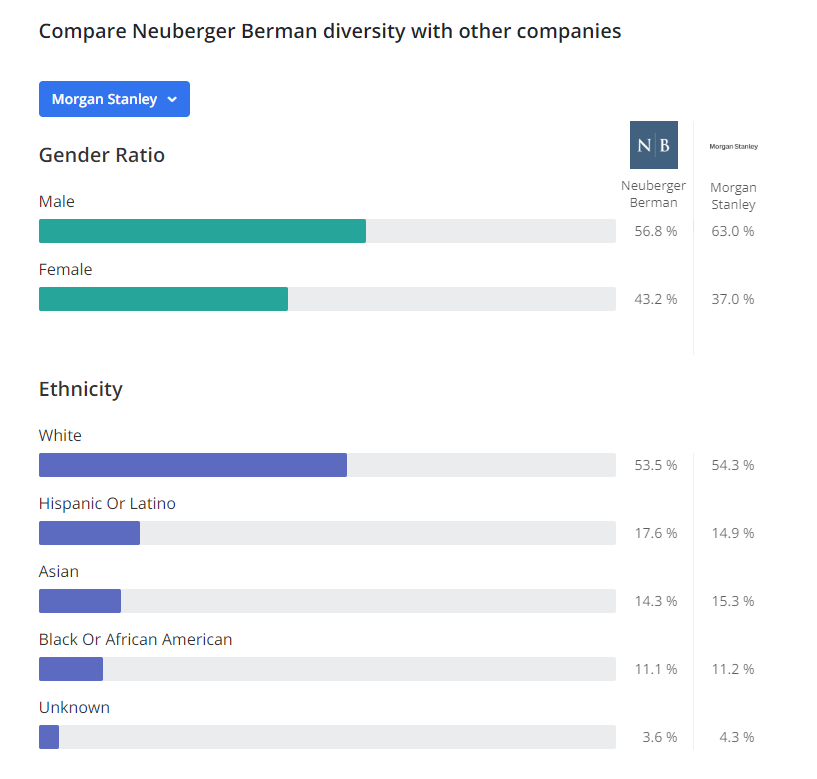
The asset management firm that Alabama State University chose according to World Benchmarking Alliance, “Neuberger Berman is a private employee-owned investment management firm (leadership pictured above) headquartered in New York, USA. It was founded in 1939 and has offices in 39 cities across 26 countries. The firm manages equities, fixed income, private equity and hedge fund portfolios for global institutional investors, advisors and high-net-worth individuals. It managed USD 460 billion of assets (under management) in 2021 and employed 2,647 staff in 2022.” This means that Alabama State University’s $125 million is equal to 0.02 percent of assets under management for Neuberger Berman. A drop in the bucket. The entirety of assets at African American Owned Asset Management firms is only 55 percent of Neuberger Berman assets under management. Alabama State University’s $125 million would have lifted the ENTIRE African American Owned Asset Management’s AUM by 0.05 percent. A move that would have strengthened the African American economic and financial ecosystem.
African America as a community talks about the circulation of the dollar or our lack thereof constantly, but what is virtually never talked about is the circulation of the African American institutional dollar being the largest part of that conversation. It is a fairly accepted statistic that the African American dollar does not stay in the African American community for a day, while other communities see their dollar stay in their communities for weeks and in the case of the Asian American community for almost a month. We often think of the circulation of our dollar like everything else, on an island or as an individual. An individual going and buying food from even an expensive African American owned restaurant is $100-200, but an HBCU building a new building means the opportunity for a new loan worth tens of millions for an African American owned bank, it means tens of millions for an African American owned construction company, so on and so forth. Instead, Bethune-Cookman University borrows from a notorious predatory lender to the African American community in Wells Fargo and almost finds itself losing those buildings due to foreclosure.
HBCU alumni know little about the state of finances or the movement of the money at their alma maters. HBCU administrators either willfully withholding the information or inept themselves of the importance of the information and providing it. Both are problematic. The notion that HBCUs cannot find African American investment firms is a painful thought knowing that a Google search would bring up the HBCU Money African American Owned Bank Directory at the very least. The likelihood is more in line with what Mr. Carter said in that a good deal of HBCU leadership simply wants to be like their PWI counterparts is far more likely. This would explain the debacle “donation” accepted by Florida A&M University’s president recently where a simple Google search would have avoided such embarrassment. Instead, Alabama State University’s Neuberger Berman relationship and a plethora of others instances (a decade ago when we reported “Spelman College & Regions Bank – A Failure To Disclose”) is that likely they are simply mimicking PWI actions and unwittingly reinforcing the PWI/European American ecosystem to say the least. Unfortunately, that mimicking reinforces another community’s economic and financial ecosystems not ours and why you may never see OneUnited Field at any HBCU’s athletic facility. Because we are holding out for J.P. Morgan, Bank of America, or Wells Fargo to show us the same love they show PWIs. Not acknowledging those are not our community’s banks.
If HBCUs are simply going to behave as PWI-adjacent institutions, then it is hard to argue with why over 90 percent of African Americans who go to college are not choosing HBCUs. For many it becomes a question of why get a knockoff when they can get the real thing. After all their ice is colder. HBCUs, HBCU alumni associations, and HBCU support organizations as a whole are not making decisions related to African American institutions ecosystem’s interests and interconnectivity and that is most glaring in the poor institutional decisions we are making in regards to our institutional finances and endowments.
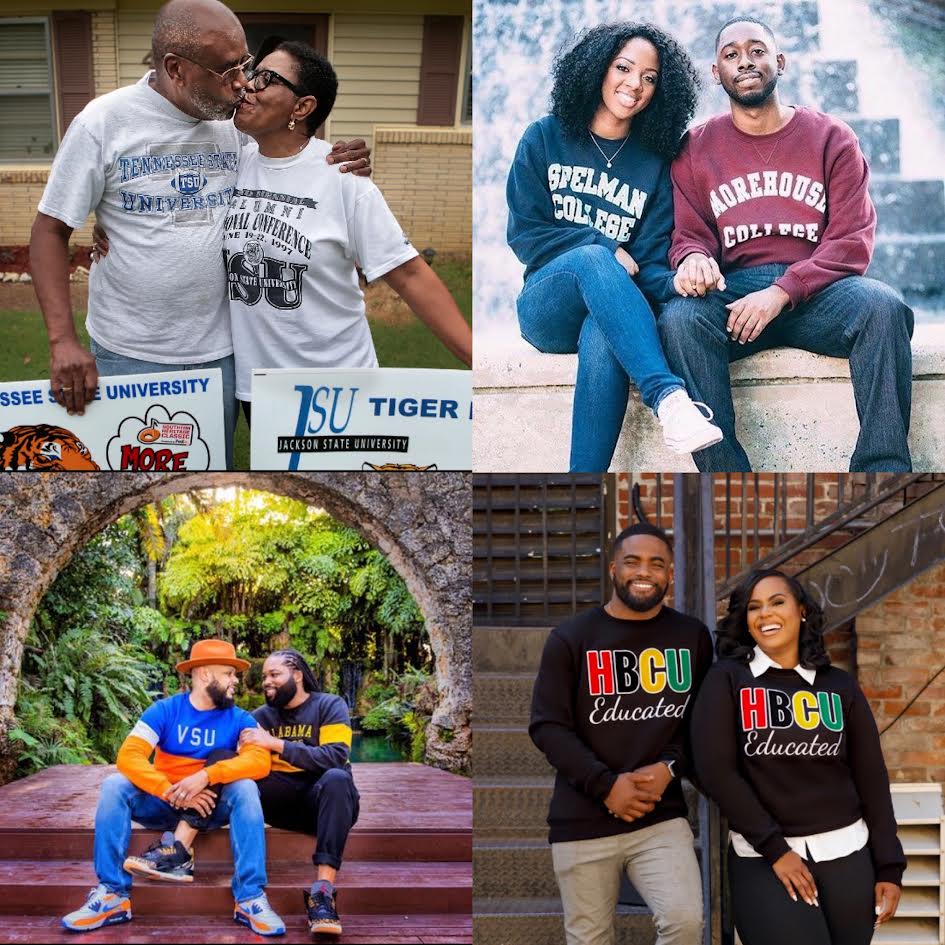
A few years ago, HBCU Money did a report highlighting which HBCU states had the highest African American marriage rates. In the piece, HBCU LOVE: Top Ten HBCU States With Highest African American Marriage Rate, Virginia led with 34 percent African American marriage rate. The national average African American marriage rate is 29.7 percent which seven HBCU states exceeded. It is no small leap to say that HBCUs play a vital role in these high marriage rates given their role in helping African Americans have a space dedicated to themselves and cultural pride that feeds into a desire for an African American partner. Not something as likely for African Americans who attend PWIs where so few options are available that it may make it quite difficult to match with or find an African American partner among so few options. It also is significant that HBCUs provide for the bulk of African American professionals in all fields and leading to cultural pride, economic stability, and alignment of values while learning to appreciate the diversity of African America which ultimately play a major role in leading to African American marriage.
Unfortunately, African American marriage rates are still struggling. Finding marriage or a life partner is culturally challenged where young women are stressed to focus on their books and young men are stressed to focus on the plethora of young women where on many HBCU campuses the women to men ratio is considerably unbalanced. This is a result of a myriad of social factors not least among them high school graduation rates among African American boys continues to struggle and those who do graduate have far too few who are actually college ready even if they are accepted. It also does not help that so many young women and men are coming from single parent households, the Office of Juvenile Justice and Delinquency Prevention reports only “four in ten Black children” live with two parents. This means that the majority of women and men on HBCU campuses know marriage only through a theoretical lens and to say little of what has shaped their views on marriage, partnership, and the institution that is African American (healthy) love. For African America that desperately needs more marriage for a myriad of reasons and HBCUs being one of the most optimal African American spaces (for those HBCUs who still care to be such) the question is how can that seedling be grown into a full blown redwood. Enter “The HBCU Marriage Pact”, a blend of HBCU pride, computer science blended together and you end up with HBCU Computer Love – “To share in my computer world, I no longer need a strategy, thanks to modern technology”. Copy and pasted from Stanford University’s Marriage Pact.
Leanne Italie of the Associated Press writes, “The Marriage Pact, an annual matching ritual that has become popular on nearly 90 college campuses around the U.S., has turned that dusty cliche into fun. And a few couples have found lasting love. Nearly half a million students have participated since the pact first rolled out at Stanford University in 2017. Born of an economics project by two students there, the pact involves an algorithm that rates matches based on such statements as “I prefer politically incorrect humor” and “I pride myself on telling hard truths.” Unlike dating apps and services, each student gets just one name, a percentage on the quality of the match and an email address to reach out.” Liam McGregor, creator of Stanford’s Marriage Pact, explained to Ms. Italie that, “Rather than dwell on physical beauty and personal stats like height and hair color, the Marriage Pact focuses its 50-question survey on core values. Communication styles and conflict resolution.” This is what significantly sets it apart from dating apps that allows for the distraction of aesthetics that often mislead our assessment of actual compatibility.
For this to work at HBCUs though it cannot be an exactly Copy & Paste without nuance. African Americans are caught in a vortex between not being able to afford to get married and not being able to afford not too. A large driver of closing the wealth gap is getting African American marriage rates up in order to scale capital and resources among African American families and into African American institutions. While the development of the HBCU Marriage Pact would go a long way it must also come with addressing some of the unique barriers that many African Americans face in building healthy relationships and this is where HBCUs and HBCU alumni associations can come in. Funding an African American Marriage Development Program. In the program students can learn about the history of African American marriage, healthy communication, receive therapy, learn household financial planning, etiquette, and other tools to increase the probability of a sustainable and productive marriage. For an added bonus, those who get married through the HBCU Marriage Pact would also be eligible to receive a financial grant to assist in funding the newlywed couple’s emergency fund in hopes of also mitigating some of the early financial pressures that African American couples face.
HBCUs themselves could coordinate consortium research around the HMP to conduct a longitudinal study to see the HMP’s potential impact. It has a myriad of interdisciplinary components that could be researched from education, economics, health, and many more. Quite an amazing prospect that we could be both putting into action a solvable problem and being the institutions that conduct the research around its theory.
The foundation of all Black institutions is the foundation of the African American family and it is in peril because African Americas are not pairing with each other for a myriad of reasons. But if we are to ensure there are African Americans tomorrow who want to attend HBCUs, then today and immediately we must engage of the work to incentivize and strategize for more of it to happen. The more African American couples who are also HBCU alumni deepens the empowerment and strength of both institutions continuing to be the institutions of our community and not gentrified or diluted like so many of our institutions have lay burden to or under attack by this very moment.
4 WAYS TO STRENGTHEN AN HBCU MARRIAGE PACT:
If they choose to sign up for the pact, then they must complete wholistic development of therapy, financial literacy, parenting classes, and more that would show they have the proper aptitude to be someone’s partner.
Developing HBCU marriage chapters in cities. This would allow HBCU couples to meet and network with each other to build and develop community.
Offer continuing education workshops in best marriage and family practices so that HBCU couples can continue to learn about best practices for community and family building.
Create an endowment that gives a financial reward marriage capped at the 10 year anniversary mark. $1,000 in year 1, $2,000 in year 2, so on and so forth up to year 10 when the couple receive $10,000. A combined $55,000 over ten years that would go into financially strengthening the burgeoning family.
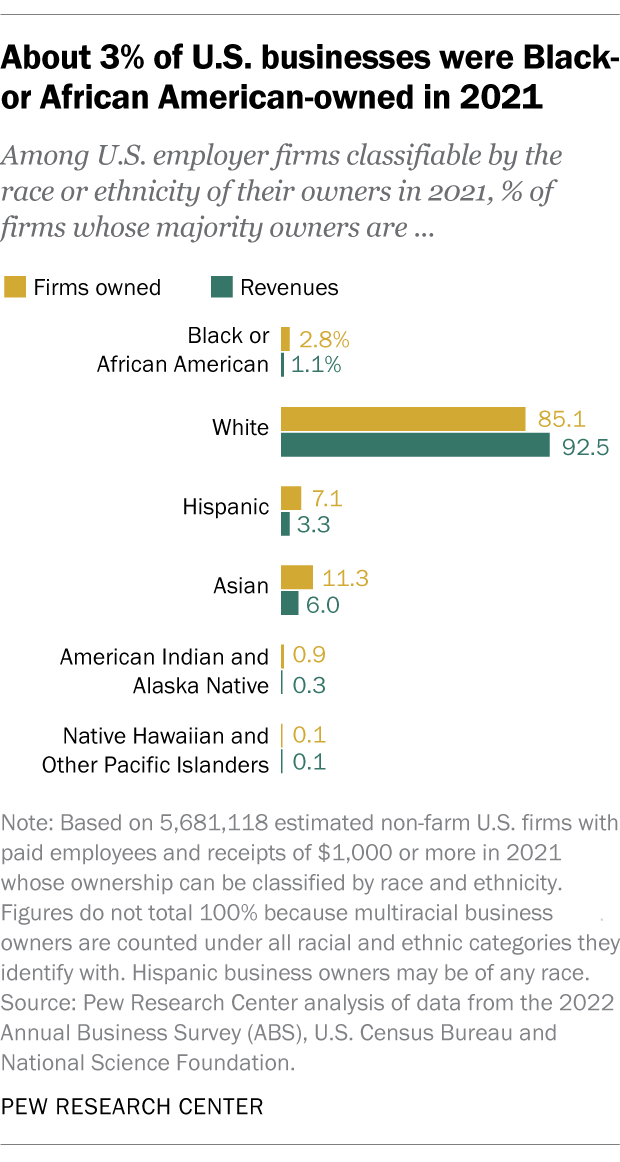
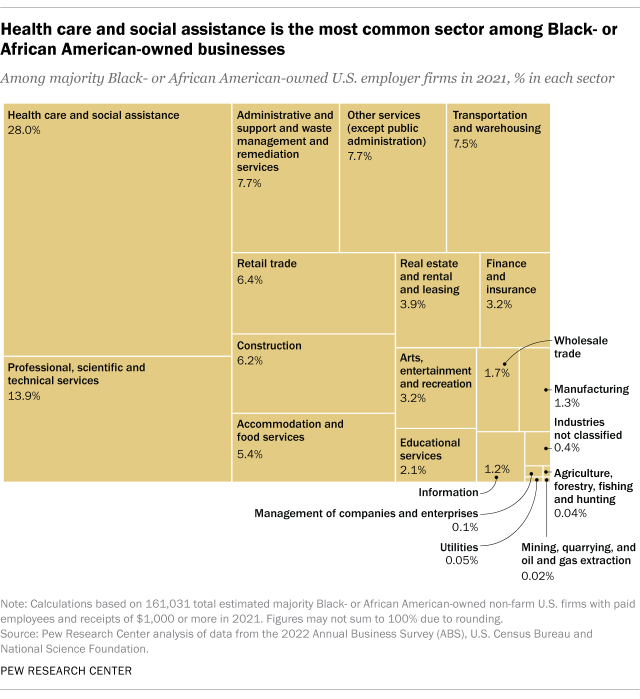
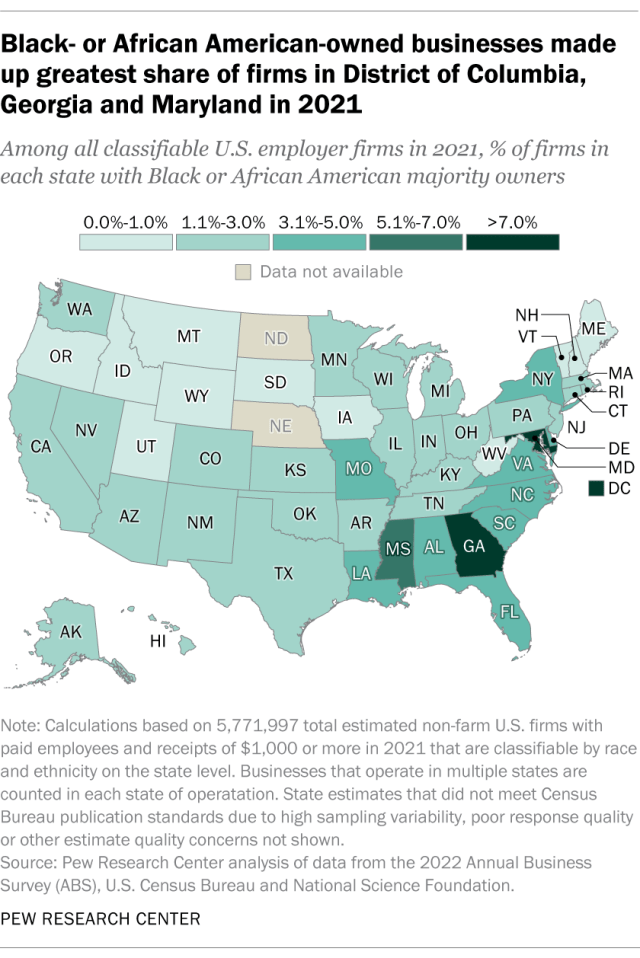
Pew Research Center highlights a look at the 161,031 U.S. firms with majority African American ownership as of 2021. Below are a few of the highlighted graphs that Pew Research showed in their report with HBCU Money commentary.
According to the SBA there were approximately 3.2 million African American-owned businesses as of 2018, but that is just the top layer. When you dig into the numbers by the Census of how many of those 3.2 million African American-owned businesses actually have paid employees and receipts exceeding $1,000 that number plummets to the previously mentioned 161,031 or only 5 percent of total African American-owned businesses.
African American businesses are highly concentrated in health care and social assistance. Businesses that often have low scale potential and high risk often times due their clients being predominantly African American and higher probability of being uninsured. Where are the African American-owned energy companies? Manufacturing companies? Multinational firms? These are the questions that need to be asked, considered, and discussed by HBCU business schools and African American organizations like the HBCU Chamber of Commerce.
It is no surprise that the highest concentration of African American-owned businesses are in locations with higher African American density populations and high concentrations of HBCUs. HBCUs and HBCU alumni unfortunately are not doing enough to create investment infrastructure to ensure the businesses are able to go into less explored and more profitable areas as the aforementioned graph highlighted.
For the full Pew Research Center report click here.
“There is a place in God’s sun for the youth “farthest down” who has the vision, the determination, and the courage to reach it.” – Mary McLeod Bethune
It is no secret that desegregation crippled just about every African American owned institution from neighborhoods to businesses to HBCUs – and many would argue the foundational institutions of Black marriage and African American families themselves. African American institutional ownership was faced with having to compete for human capital of the very people whose interest they were built to serve and the institutional ownership that all other non-European American groups envy. In turn, our institutions experienced a mass exodus as African Americans believed that the grass was truly greener and ice colder on the Eurocentric side. Fast forward to today, many African Americans believe they live in a pseudo-meritocracy, a dystopian like post-racial world where even having African American institutions of our own is somehow un-American and participating in our own institutional spaces is a sign of being the “not quite good enough negro” as many of us attempt to impress the European American gaze. This despite other demographics firmly having their own such as Notre Dame for the European Catholics, Brandeis being a secular European Jewish institution, and of course Harvard the flagship WASP institution, so on and so on. Never mind that the majority of the HWCU/PWIs that tout “diversity” often have less than 5 percent African Americans on their campus – and the majority are often there only to play sports.
Case in point, the University of Texas who is one of the most profitable athletic program in the country has a less than 5 percent African American population on its campus. The numbers are even starker when it comes to African American males who make up less than 2 percent of overall campus population, but comprise around 70 percent of the football and basketball teams. HWCU/PWIs have shown one thing to be true, and that is they want the best and brightest of our young women and the fastest and strongest of our young men. HBCUs have been unable to compete due to misperception of inclusion and the reality of the resource/wealth gap between our communities that desegregation and the GI Bill largely caused. Many HBCUs go decades before they can raise enough funding for new facilities or scholarships. Harvard’s endowment in one year can lose more money than the amount all 100 plus HBCUs have combined and still be one of the largest higher education endowments in the world.
In an environment where higher education is getting more and more expensive, African American students who come from the group with the lowest median net worth and income in the country often make college choices based on financial needs more than most. The result, continued exodus and plummeting of African Americans choosing HBCUs due to the lack of scholarship and aid available and the ever present belief that white is right and better.. Currently, less than 10 percent of African American going to college are choosing HBCUs over HWCU/PWIs. A detriment to alumni sizes, social networks, donations, and most dire – HBCU endowments. Just increasing the 10 percent to 25 percent could stave off many of the financial woes facing HBCUs and start to bring circulation of intellectual and financial capital into African American institutions. So how can HBCUs recruit in “Woodcrest”? How do you recruit African Americans who have become immersed in non-Black communities to HBCUs? How do you recruit African Americans who are in African American communities that are impoverished and are only looking to get out? How do you recruit middle class and affluent African American families who have the financial resources African American institutions so desperately need? How do you get African Americans to care more about African American institutionalism than we do African American individualism?
Two of America’s most beloved animated characters of the past 20 years are Huey and Riley Freeman voiced by the regal and benevolent Regina King. The Boondocks first premiered in comic form in 1997 and by 2005 would find their way to television and into our hearts. Huey, the tormented revolutionary and his younger brother Riley, the wanna be thug/hustler and athlete who shows glimpses of artistic genius. Their grandfather, voiced by the late great John Witherspoon, has moved them to a predominantly European American suburb away from the Southside of Chicago’s predominantly African American community at the most formative time in their life. Grandpa Freeman is also part of the Civil Rights generation and is a friend of Dr. Martin Luther King, Jr.’s as it turned out in an episode called ‘The Return of the King’. A controversial episode, but poignant of what happens when children, in this case Riley, are removed from cultural immersion of our own community. Riley has no idea who Dr. Martin Luther King Jr. is and often refers to him as “Morgan Freeman King” in the episode. The irony should not be lost on the Morgan Freeman dig who himself believes Black History Month and being identified as African American is an insult. In another episode, this one more focused on Huey, entitled A Huey Freeman Christmas, Huey convinced his European American teacher to let him write and direct the Christmas play. Naturally, Huey being who he is makes Jesus Black and makes a very Afrocentric production that was ultimately seen by no one as parents of Huey’s European American classmates boycotted the play since their kids were not in it, appalled by its Afrocentricity, and ultimately had the teacher fired for being “irresponsible” highlighting how European Americans will put down one of their own to maintain institutional power. The school was named the J. Edgar Hoover Elementary after all, named for the notorious FBI who infiltrated, spied upon, and sought the destruction of everyone from Dr. Martin Luther King, Jr., Malcolm X, Black Panthers, and every other African American individual and institution he even remotely viewed as a threat to the European American institutional power structure.
Riley ignorant of his cultural identity, Huey militantly attempting to push his Afrocentricity into an Eurocentric institutional space, and Grandad feeling as if he has “made it” because he is able to eat cheese with The Man. This is the family you have to convince that an African American institution and space is the best place to be. There also is the influence of the community on Huey and Riley. Tom DuBois who is married to a European American woman, Uncle Ruckus who rails against all things Black – while being the darkest character on the show, Tom’s daughter Jazmine whom you are never quite sure how she identifies and that probably is the point, and countless others who throughout the show push against anything and everything that would empower African American institutionalism at all turns. In fact, there is no exposure or presence of any Black institutions on the show. The Boondocks one could argue was actually the forerunner to Blackish, but that is another article for another time. With so much pushing against Huey or Riley choosing an HBCU and their grandfather allowing them to attend an HBCU, how do we overcome such an obstacle? Is it possible? Is it even worth the energy?
The answer of course is – it is complicated. How do you win a war most of your population does not know it is in? Another part is turning every other cheek to be included and a proverbial peace that means its erasure? Those that do know they are in a war are fighting with antiquated strategies, equipment, and/or resources? HBCUs have limited resources and manpower to dedicate to recruiting. HBCUs one advantage is being an African American space, an African American institution dedicated to African American empowerment, or at least they were. Many HBCUs see making recruitment of African Americans a secondary objective in favor of more ethnic diversity – ignoring African American and Diaspora diversity as they attempt to parrot their PWI counterparts, declines in African American faculty and research geared towards African American interests becoming ever more pervasive – institutional gentrification by our own hands. In other words, many HBCUs are trying to become a watered down version of a PWI. This makes their case for recruiting even harder because of the aforementioned issues of limited resources and manpower. If a college student is going to choose a PWI versus an HBCU posing as a PWI knockoff, then usually they will go with the one who is the real thing so to speak. For those HBCUs trying to hold the line it is rough. They have to convince an African American population that does not want to live in or build African American communities, bank with African American banks, and see their ancestry as starting at slavery more than they see it internationalized with the Diaspora as Malcolm X and so many other Pan-Africanist have desperately tried to connect to little avail. That being educated by African Americans in an African American space as something valuable, worthwhile, and imperative to the African American community’s empowerment. A small task it is not.
How do we even get to students like Huey and Riley? Their geography is world’s away from any African American institution, their socialization will largely save for trips back to Chicago sparingly be within the confines of European American institutions and spaces, education will be firmly European American with a likelihood of an European American perspective on diversity being from European American majority ideology, and certainly it would be remiss to say that neither of their possible love interest are African American girls. Jazmine, the daughter of Tom and Sara DuBois, who is biracial and fits the cultural aptitude that often comes with those who have African American fathers and European American mothers where the mother drives the cultural nourishment and almost certainly are reared with an anti-Afrocentric value system. Riley’s probable love interest that is Cindy McPhearson, an European American girl, who shares a lot of the same interest and often similar toxic behaviors as Riley. One could argue they make even more sense should it play out than Huey and Jazmine from a qualitative level. All which was described, virtually none of it sits within an African American space or possibility. Yet, these are exactly the African American students you could argue we are in large part trying to recruit to HBCUs. This is the group that you need more than any other if you want to increase the African American rate choosing HBCUs to increase from 10 percent to 25 percent.
If African Americans are going to continue to not be proactive in the development of African American communities and empowerment of African American marriage and families then this entire conversation maybe for naught within a few generations as we will have self-gentrified ourselves out of existence. The question of how we get our talents and resources to prioritize the building of new African American institutions, supporting of existing African American institutions, and the empowering of all of our African American institutions is the central question for our survivability and furthermore our success as a people.