Tag Archives: endowments

Balancing the Ledger: A Comprehensive Analysis of Athletics vs. Research Spending (MEAC/SWAC vs. SEC/Big 10)

“Since new developments are the products of a creative mind, we must therefore stimulate and encourage that type of mind in every way possible.” – George Washington Carver

In the financially stratified ecosystem of American higher education, institutions are increasingly confronted with a binary tension: to invest in athletic visibility or academic viability. For universities across the NCAA spectrum, especially those in the MEAC and SWAC conferences compared to their counterparts in the SEC and Big Ten, this decision is less about preference and more about resource constraints and strategic direction. Yet, data reveals a persistent imbalance in how these priorities manifest, and more critically, the long-term costs of these choices.

Conference Dynamics: Institutional Identity and Capital Exposure

The MEAC and SWAC are defined by institutions that are predominantly Historically Black Colleges and Universities (HBCUs). These universities have traditionally operated under capital scarcity, navigating chronic underfunding while serving as incubators of social mobility for African American communities. Their mission, often grounded in equity and community uplift, limits their ability to generate large commercial revenues through athletics. This is not due to a lack of talent or audience, but because media deals, booster contributions, and government funding disproportionately favor PWI institutions.

By contrast, the SEC and Big Ten represent the economic elite of collegiate athletics and academia. With flagship state universities at their helm, these conferences are buttressed by multi-billion-dollar endowments, large donor bases, and lucrative broadcast contracts. Their budgets allow for investments in both athletics and research without having to cannibalize one to fund the other. In essence, they play the game with more capital and fewer trade-offs.

Athletics Budgets: Symbolism vs. Strategy

MEAC and SWAC institutions report average athletics expenditures between $11 million and $12 million annually. Notable programs like North Carolina A&T and Prairie View A&M may hover slightly higher, but Mississippi Valley State and others operate on budgets as low as $3.9 million. These figures pale in comparison to SEC schools like Alabama or Texas A&M, where athletic spending exceeds $150 million. The Big Ten’s Ohio State leads all with $215 million dedicated to athletics alone.

While athletic programs at HBCUs serve as cultural centers and enrollment drivers, their limited revenue-generating capacity renders them economically unsustainable without substantial subsidization. Many are forced to divert institutional funds, raise student fees, or solicit local donations just to keep programs afloat. In contrast, SEC and Big Ten programs function as media properties, brand engines, and financial assets, often contributing revenue back to their academic institutions.

Athletics at HBCUs carry significant intangible value, cultural pride, alumni engagement, community identity, but these cannot substitute for financial sustainability. The opportunity cost of maintaining expensive athletic programs without equivalent return on investment demands strategic scrutiny.

Research Spending: The Forgotten Core

Where the real divergence occurs is in research investment. MEAC and SWAC research expenditures are overwhelmingly modest. With the exceptions of Howard University ($122 million) and Florida A&M ($41 million), most institutions sit between $2 million and $25 million in annual research activity. These figures reflect decades of underinvestment and insufficient infrastructure, not a lack of capacity or talent.

Meanwhile, SEC and Big Ten institutions routinely surpass $500 million in annual research outlays. Schools like Michigan ($1.67 billion), Wisconsin ($1.36 billion), and Penn State ($996 million) operate on a scale comparable to government agencies and national labs. They attract large NIH, NSF, and Department of Defense grants. They lead clinical trials, generate patents, and build interdisciplinary research parks.

This disparity is not simply numerical; it is strategic. Research drives federal grants, patents, corporate partnerships, and endowment growth. It also attracts high-performing faculty and students, serving as the foundation of institutional longevity and economic influence.

The Ratio That Tells the Future
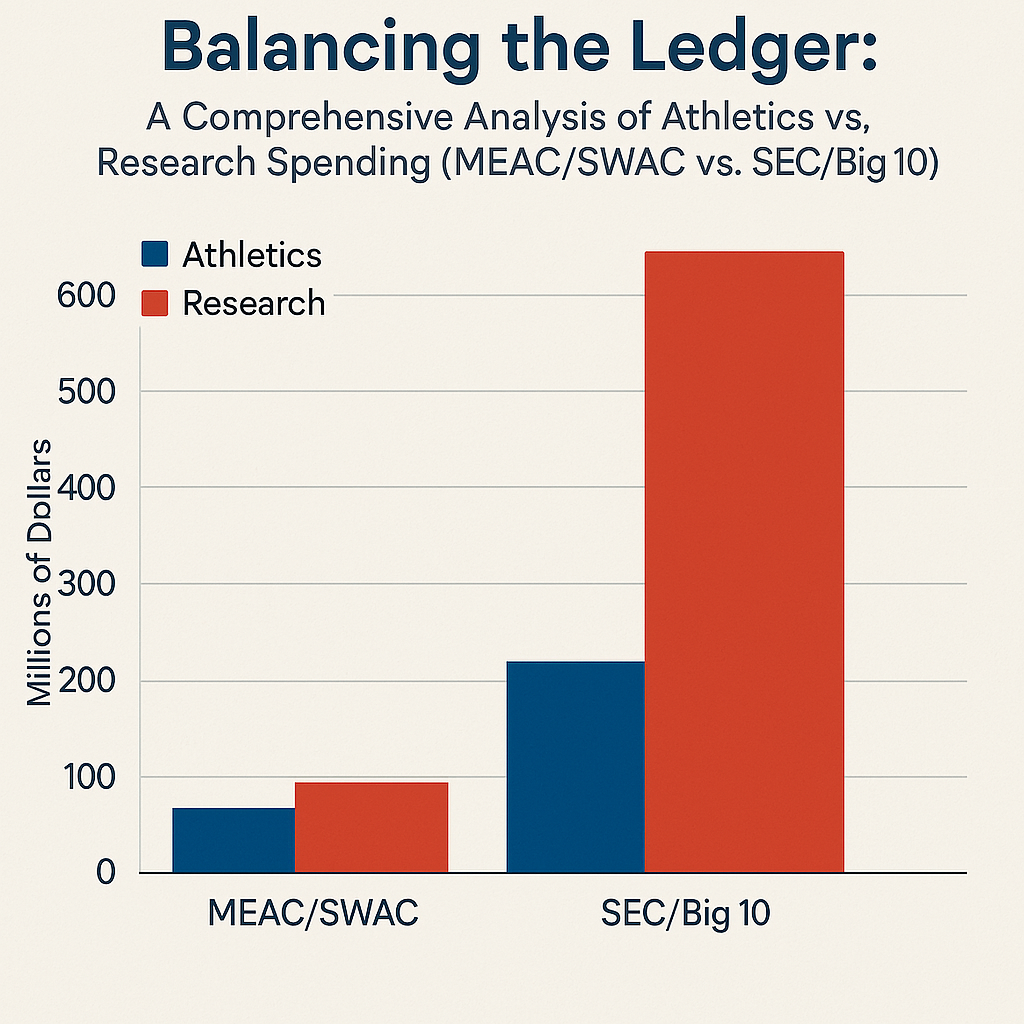
The athletics-to-research spending ratio offers a lens into institutional philosophy:

  • Norfolk State: 2:1 athletics to research
  • Jackson State: 0.7:1
  • Mississippi Valley State: 6:1
  • Alabama: 0.15:1
  • Michigan: 0.11:1
  • Wisconsin: 0.11:1

While SEC and Big Ten schools spend more on athletics than HBCUs, they also spend exponentially more on research. The imbalance within HBCUs is a reflection not of poor prioritization, but of systemic capital deprivation. These ratios also underscore how HBCUs are often forced to choose between visibility and viability, between entertainment and innovation, because they lack the financial bandwidth to pursue both.

Research as Revenue: Commercialization and the Innovation Economy

University research is not merely an academic endeavor it is a gateway to commercialization. Inventions born in labs often become patents. Patents become licensing agreements. Licensing revenue, in turn, flows back into the institution. The University of Florida’s development and commercialization of Gatorade yielded more than $280 million over time. Stanford’s involvement in launching Google and Hewlett-Packard has helped fuel its $36 billion endowment. Wisconsin’s WARF fund manages $4 billion in research-derived assets.

This model is not just aspirational; it is replicable. But replication requires infrastructure, policy, and intention.

Building the Infrastructure: A Two-Track Strategy for HBCUs

Campus Infrastructure

  1. Strengthen Technology Transfer Offices (TTOs): These serve as the conversion points from research to revenue. TTOs are responsible for managing patents, evaluating commercial potential, and negotiating licensing agreements.
  2. Invest in Innovation Facilities: Makerspaces, incubators, wet labs, and data science centers can all be built in underused buildings or retrofitted spaces.
  3. Embed Commercialization in Curriculum: Courses in IP law, venture creation, product development, and ethics should be available to both undergraduates and graduate students.
  4. Create Campus Accelerators: Provide seed funding, pitch competitions, and alumni mentorship. These accelerators can be industry-specific (e.g., AgTech at Tuskegee, FinTech at Howard).
  5. Celebrate Wins: Every patent, startup, or licensing deal should be internally recognized and externally marketed. Visibility breeds validation and investment.

Capital Infrastructure

  1. Black-Owned Banks: Offer startup lines of credit and financial education embedded in innovation ecosystems. These institutions can also hold endowment funds or manage cash flow from royalty revenues.
  2. Diaspora Sovereign Wealth Funds: Channel African and Caribbean capital into HBCU startups and joint ventures. Funds like Nigeria’s NSIA or Pan-African VC firms could provide growth capital.
  3. HBCU Venture & Endowment Funds: Seeded by Black VC firms, family offices, and institutional investors. These funds can create co-investment syndicates for promising faculty or student ventures.
  4. Donor-Advised Funds (DAFs): Enable alumni to contribute to IP pipelines through tax-efficient giving. DAFs could also be matched by corporate sponsors or philanthropic partners.

Building Strategic Partnerships for Scale

HBCUs need not operate in silos. Strategic collaboration can accelerate commercialization and R&D outcomes:

  • Inter-HBCU R&D Collaboratives: Morgan State and FAMU could co-sponsor patent consortiums.
  • Cross-registration commercialization programs with PWIs like Johns Hopkins or Emory.
  • Statewide HBCU innovation districts tied to workforce pipelines and rural development.

From the Lab to the Ledger: Case Studies in ROI

  1. University of Florida – Gatorade: In the 1960s, UF researchers developed a hydration drink to help football players endure Florida’s brutal heat. The result, Gatorade, has yielded over $280 million in licensing revenue. These funds helped UF build research infrastructure, attract top scientists, and grow its endowment.
  2. Stanford University – Silicon Valley: Stanford was not always wealthy. Its proximity to innovation and its open policies toward student and faculty entrepreneurship led to the creation of Google, Cisco, and more. Today, Stanford’s alumni-founded companies generate trillions in global market value.
  3. University of Wisconsin – WARF: Established in 1925, the Wisconsin Alumni Research Foundation has monetized research in Vitamin D, stem cells, and imaging. With over $4 billion in assets, WARF reinvests in faculty, students, and commercialization pipelines.
  4. MIT – Ecosystem Builders: MIT’s Deshpande Center and The Engine Fund act as innovation pipelines that commercialize tough tech. MIT startups have created over 4.6 million jobs globally.

What HBCUs Must Avoid: Dependency Without Ownership

Too often, HBCUs have served as intellectual suppliers while other institutions and corporations reap the financial rewards. Faculty develop ideas, only for those patents to be captured by universities with larger TTOs. Students build prototypes, only to license them under incubators unaffiliated with their home campus.

To shift this paradigm, ownership must be embedded from the start. That means building institutional IP portfolios and teaching students the economics of invention.

A Circular Ecosystem Rooted in Culture and Capital

StakeholderRole in the Pipeline
Black-Owned BanksStartup capital, credit access, and embedded finance literacy
Diaspora Wealth FundsStrategic investment, global partnerships, and joint IP deals
African American NPOsStakeholder investors, endowment builders, and R&D supporters
Black Media & AlumniNarrative shaping, promotional power, and advocacy
HBCU TTOs & LeadershipPatent management, research development, and startup formation

Final Calculations: Wealth Is Institutional, Not Individual

The data from MEAC, SWAC, SEC, and Big Ten schools paints a vivid picture of the financial landscape of higher education. While SEC and Big Ten schools show that it is possible to be excellent in both athletics and academics, MEAC and SWAC institutions face tougher choices due to structural inequalities and historical underfunding.

As conversations around equity, student success, and public accountability continue, this kind of comparative data is essential. Whether aiming for a championship or a Nobel Prize, universities must remember that their ultimate mission is to educate, innovate, and uplift communities.

University research isn’t just about publications and academic prestige it’s a launchpad for innovation, economic growth, and financial sustainability. When strategically supported, it becomes a core driver of commercialization, entrepreneurship, and long-term prosperity through patents and endowment growth.

Many HBCUs and smaller institutions already are incubators of brilliance but they’ve been left out of the research-to-wealth pipeline due to underfunding and limited infrastructure. With targeted investments and smart policy, they can flip the script and become not just engines of education, but engines of innovation and wealth creation.

Disclaimer: This article was assisted by ChatGPT.
It’s Complicated: The 2019-2020 HBCU Graduate Student Loan Debt Report

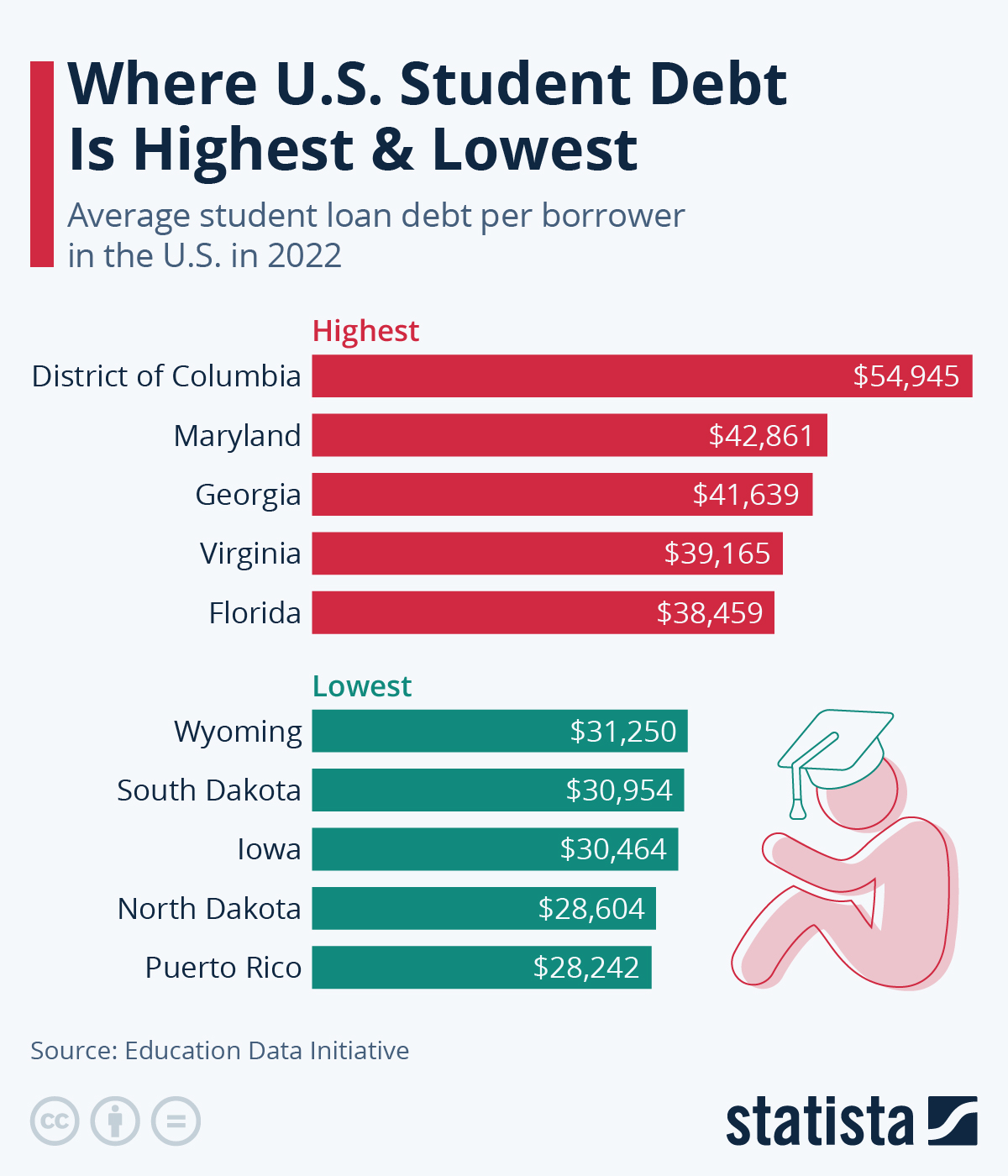
Chart: Where U.S. Student Debt Is Highest & Lowest | Statista

The most recent student loan data is an extremely hard gauge to use given its lag time. This data is the latest data available by ICAS, but also is pre-COVID and pre-George Floyd. The latter in that situation potentially produced a significant increase in student loan debt by students as many sought to help themselves and their families through financial aid refunds. COVID exposed African America’s acute financial fragility through poor health insurance, jobs with high exposure to COVID risk, and more. To the latter, in the post-George Floyd that also occurred where hundreds of millions poured into HBCU coffers led by MacKenzie Scott in levels never seen before and COVID relief funding through the CARES Act to colleges and universities witnessed HBCUs providing an immense amount of financial relief to its students to try and stem the debt tide.

HBCU graduates actually have some good news in that their median debt dropped approximately 8 percent from our last report while their PWI counterparts at major endowed institutions remained virtually unchanged. The bad news is that the percentage of HBCU graduates with debt remains unchanged while their PWI counterparts at major endowed institutions graduating with debt dropped almost 20 percent. This expands the gap of HBCU/PWI students graduating with debt from a previous 46 percentage points difference to now 52 percentage points in this latest report.

Numbers in parentheses shows the comparative results from the universities of the 30 largest endowments:

Median Total Debt of HBCU Graduates – $31,422 ($24,479)

Proportion of HBCU Graduates with debt – 85% (33%)

Median Private Debt of HBCU Graduates – $17,386 ($44,622)

Proportion of HBCU Graduates with private debt – 7% (5%)

Source: The Institute for College Access & Success

Looking at the numbers even further shows that HBCU Graduates debt is almost 30 percent higher than their PWI major endowed counterparts. This despite HBCUs being significantly cheaper, HBCU Graduates suffer from a student body that acutely comes from families that lack family assets and stability to assist. It is highlighted in the private debt component where PWI counterparts have significantly higher amounts of private debt. Potentially speaking to the borrowing power of those PWI families beyond federal financial aid.

It may be a few years before updated data from within the COVID era is available, but basic extrapolation suggest that even with the donations received after George Floyd and the CARES Act that HBCUs simply still lack the endowments to make up for the acute lack of African American household wealth combined with less than 10 percent of African Americans choosing HBCUs. The latter means that HBCUs operate with smaller alumni pools. These smaller pools means a smaller nominal giving of the alumni who do give and a significantly smaller probability that the HBCU can create a percentage of alumni who go onto become wealthy donors.

In the end, HBCU alumni who care about this must make available scholarship to a wider net of HBCU students while in school. Focusing on creating scholarship that is available to every student who is academically eligible and giving less emphasis to GPA. The large majority of any HBCU graduation class has GPAs between 2.0 and 3.0 and are the ones most likely to be left out of having any ability to decrease their student loan burdens making them almost never to be in a position to become donors.

By expanding eligibility requirements, scholarships can provide financial relief to those who need it most—students who are often balancing academics with work, family responsibilities, and other challenges. Many of these students demonstrate resilience, dedication, and a commitment to completing their education, yet traditional scholarship models disproportionately favor high achievers with GPAs above 3.5. While academic excellence should be celebrated, financial aid should not solely be reserved for the top percentage of students.

A broader approach to scholarships will help create a stronger alumni network in the long run, as more graduates will leave school with reduced debt, making them more likely to support their alma mater financially and contribute to future scholarship funds.

Previous HBCU Graduate Student Loan Reports

The 2016-2017 HBCU Graduate Student Loan Report

Good News/Bad News: Percentage Of HBCU Graduates With Debt Drops But Debt Loads Increase

90 Percent of HBCU Graduates Have Student Loan Debt


Would The Ivy League Athletic Model Work For HBCUs?

“Challenges make you discover things about yourself that you never really knew.” — Cicely Tyson

When you encounter most HBCU alumni regarding their athletic programs they all desire to be a football powerhouse. They believe that this will lead to a land of riches and honey. At the core of this delusion though is that the wealth gap between P5 athletics boosters and HBCU boosters larger than the wealth gap between is greater than the southern most tip of Florida to upstate New York. Phil Knight, University of Oregon booster and Nike owner, has a net worth of $35 billion. Oprah Winfrey is the wealthiest African American HBCU alumni with a net worth of $3 billion and the last we checked does not act as a booster to her alma mater. Meanwhile, Phil Knight in 2012 alone built the University of Oregon football team a facility to the tune of almost $70 million – and got the state legislature to amend a law to make the building legal since it ran afoul of code. But many HBCU alumni believe that if we get the “talent” to come “home” it will level the playing field. It will not. It is exhausting even explaining that the wealthy of many major athletic programs has more to do with the PWI developing and graduating entrepreneurs like Phil Knight who go on to create multibillion firms and therefore have millions to give back than whatever latest 18 year old recruit they have snagged. For greater context, Phil Knight’s building donation is almost 4X Prairie View A&M University’s athletic budget, the highest among all HBCUs.

In our last SWAC/MEAC Financial Review, the two conferences combined for a loss of over $160 million in 2019-2020 if you took away their subsidies (and even with subsidies the two conferences were in the red). These $150 million in subsidies largely coming in the form of student loan fees which for most HBCUs means students packing on student loans for the sake of athletics. Something infuriating when you consider over 90 percent of HBCU students finish with student loan debt versus less than half that amount at Top 50 endowed schools, many who play DIII football or have no football program at all. That is $150 million in subsidies that could be going to scholarships, research, investments, and so many more things that produce an actual return on investment is an understatement. The idea though that HBCUs could try an athletic model that does not aspire to be P5 (no major television contracts are coming either) seems to be lost on all HBCU athletic leadership and alumni. But what if instead of focusing on the P5 schools, we instead focused on the Ivy League’s athletic model.

The Ivy League athletic model is characterized by its emphasis on academic excellence, limited athletic scholarships, and a focus on holistic student development. As historically Black colleges and universities (HBCUs) contemplate their athletic strategies, the potential adaptation of the Ivy League model raises important questions, especially concerning financial resources, alumni support, and institutional missions. Here’s a closer look at several key factors:

Financial Context: Endowments and Alumni Giving

HBCU Endowments: HBCUs generally have lower endowments compared to their Ivy League counterparts. For example, the average endowment for an HBCU is around $100 million, while top Ivy League schools like Harvard have endowments exceeding $50 billion. This significant disparity in financial resources impacts the ability of HBCUs to fund athletic programs and support student-athlete scholarships.

Ivy League Endowments: The Ivy League’s strong financial standing allows for extensive investments in athletics, facilities, and academic resources. Schools like Yale and Princeton have endowments of over $25 billion, which provide them with a substantial financial cushion to support a holistic student-athlete experience.

Alumni Giving Rates: HBCUs face challenges with alumni giving. For instance, HBCUs have an average alumni giving rate of about 15-20%, whereas Ivy League schools boast rates often exceeding 50%. This higher giving rate in the Ivy League reflects a stronger tradition of alumni engagement and philanthropic support, which is critical for sustaining athletic and academic programs.

Research Budgets and Institutional Support

HBCU Research Budgets: Research funding at HBCUs is generally lower than that of Ivy League institutions. While some HBCUs, like Howard University, receive substantial federal research grants, many others struggle to secure consistent funding. For instance, HBCUs collectively received approximately $1.5 billion in research funding in 2019, a fraction of what Ivy League schools secure annually.

Ivy League Research Funding: In contrast, Ivy League institutions benefit from robust research budgets, with individual schools like Johns Hopkins receiving over $2 billion in annual research funding. This financial backing enhances their ability to integrate athletics with academic resources, providing student-athletes with more comprehensive support.

Holistic Development and Community Engagement

The Ivy League model emphasizes the development of well-rounded individuals. HBCUs share a similar mission of producing leaders who are socially conscious and community-oriented. Adopting the Ivy model’s focus on holistic development could resonate well with HBCUs’ core values. This approach can enhance student engagement and create a strong support system for athletes.

Influence of Ivy League Billionaires

The presence of wealthy alumni, often referred to as “Ivy League billionaires,” contributes significantly to the financial health of Ivy institutions. Notable alumni from Ivy League schools frequently engage in philanthropy, enhancing the schools’ resources for academics and athletics. HBCUs lack a comparable number of affluent alumni, which affects their fundraising potential and overall financial sustainability.

Potential Challenges and Considerations

Implementing the Ivy League model in HBCUs presents both opportunities and challenges:

  • Funding Limitations: The financial constraints of HBCUs compared to Ivy League schools necessitate a tailored approach. Without significant endowment and alumni support, fully adopting a no-athletic-scholarship model could limit HBCUs’ competitiveness in attracting top athletic talent.
  • Cultural Fit: The cultural and historical contexts of HBCUs differ significantly from those of Ivy League schools. Any model adopted must align with the unique missions and student populations of HBCUs.

While the Ivy League athletic model offers valuable insights into promoting academic achievement and holistic development, its application in HBCUs would require careful adaptation. Financial disparities in endowments, alumni giving, and research funding pose significant challenges. However, by focusing on the integration of academic and athletic excellence while fostering community engagement and support, HBCUs can create a unique model that reflects their values and enhances student success both on and off the field.

In the end, HBCUs have to accept the realities on the ground. We have tried chasing the golden ticket of athletics only to find out time and time again it is fool’s gold. It is not the thing that will alter the financial realities of our institutions. If anything it may be the thing that causes their failure as a looming admissions’ crisis is looming across all of American higher education and without a lot of dry powder on hand many institutions will easily go the way of the Dodo bird. It is time to think differently, think acutely, and chart a path that maybe uncomfortable or not what we originally imagined but will ensure the existence, sustainability, and success for future HBCU generations.

Disclosure: This was written with the assistance of ChatGPT.

HBCU Money’s 2023 Top 10 HBCU Endowments

Note: These data are based on colleges, universities, affiliated foundations, and related nonprofit organizations that volunteered to participate in NACUBO’s endowment study series.” – NACUBO

With a looming enrollment crisis for all America’s colleges and universities, we are at a time where endowments are not only going to matter more they are going to matter the most. The building of endowments, cutting of some overweight athletic expenses that allow you to invest more, aggressive fundraising efforts, joint investing with other HBCUs, everything should be on the table. This is an arms race for survival. We have been at alert level red for awhile but apparently the sound of the siren has been broken. Now it is fixed and it is blaring. HBCU endowments are a key and integral component to African American wealth building both individually and institutionally. Their importance to African America’s economic survivability, sustainability, and empowerment cannot be overstated enough. That HBCU endowments continue to be that is a matter of conversation about who at HBCUs should be benefitting and prioritized most by our endowments.

HBCU endowment analysis from 2023 will not reflect that Spelman College kicked off 2024 with HBCUs largest ever donation and the first ever nine figure donation with its $100 million donation from Ronda Stryker and William Johnston. We will see how much of the $100 million makes it into Spelman’s actual endowment coffers this time next year, but even without it Spelman leads all HBCUs in NACUBO’s new category of endowment value per full-time equivalent (FTE) student with $197,713 per Spelmanite versus Florida A&M University’s worrisome $6,044 endowment value per full-time equivalent student. This arguably is a more accurate of how healthy a college or university’s endowment is performing to some degree which we covered in ‘Without Hyperactive Alumni, HBCUs Will Bear The Brunt Of The Building Tsunami Of College Closures And The End Of Their Blackness’. Only Spelman College and Meharry Medical College have endowment value per FTE above $100,000. The national average is $174,499 among all college and universities and median is $47,287. HBCUs reporting have an average of $63,861 and median of $19,256.

On the good news from 2023 is Morgan State University and Virginia State University breaking into the $100 million endowment club as only the ninth and tenth HBCUs to do so. It is assumed that Tuskegee University (not reported) based on their FY 2018 Fact Book also has an endowment above $100 million. This means that roughly 10 percent of the remaining HBCUs have endowments above $100 million. Unfortunately, the gap between that group and those below is staggering with there being questions of a larger percentage of HBCUs potentially having no endowment as a possibility. Lastly, unless Spelman comes through with another jaw-dropping donation (it is certainly possible), then at some point in 2024 Howard University’s endowment will cross the $1 billion mark making it the first HBCU to do so.

The PWI-HBCU NACUBO Top 10 Endowment Gap for 2023 stands at $128.7 to $1, which is an increase from 2022’s $127.5 to $1.*

HIGHLIGHTS:

  • Top 10 HBCU Endowment Total – $2.2 billion
  • Top 10 PWI Endowment Total – $321.6 billion
  • Number of PWIs Above $2 billion – 74
  • Number of PWIs Above $1 billion – 139
  • Number of HBCUs Above $1 billion – 0
  • Number of HBCUs Above $100 million – 9
  • 688 colleges, universities, and education-related foundations completed NACUBO’s FY23 survey and those institutions hold $839 billion of endowment assets with an average endowment of $1.2 billion and median endowment of $209.1 million.
  • HBCUs comprised 1.4 percent of NACUBO’s reporting institutions and 0.3 percent of the reporting endowment assets.
  • PWI endowments (30) with endowments over $5 billion hold 58 percent of the $839 billion in endowment assets.

All values are in millions ($000)**

1. Howard University – $926,633 (7.4%)

Endowment Value Per Full-Time Student – $81,341

2. Spelman College – $474,907 (3.4%)

Endowment Value Per Full-Time Student – $197,713

3.  Meharry Medical College – $179,287 (6.0%)

Endowment Value Per Full-Time Student – $165,394

4. North Carolina A&T State University  – $164,720 (0.1%)

Endowment Value Per Full-Time Student – N/A

5. Florida A&M University – $113,378 (1.7%)

Endowment Value Per Full-Time Student – $6,044

6. Morgan State University – $101,037 (12.9%)

Endowment Value Per Full-Time Student – N/A

7. Virginia State University – $100,935 (45.1%)

Endowment Value Per Full-Time Student – $22,903

8. Norfolk State University – $83,525 (17.4%)

Endowment Value Per Full-Time Student – $16,149

9. Fayetteville State University – $31,280 (-2.2%)

Endowment Value Per Full-Time Student – $5,479

10. Kentucky State University – $20,238 (6.3%)

Endowment Value Per Full-Time Student – $15,861

*Due to Hampton University and Morehouse College not participating this year significantly altered the Top 10 HBCUs endowment combined total. Therefore, HBCU Money took the editorial liberty of calculating the PWI-HBCU endowment gap based on 2022’s HBCU endowment total of $2.5 billion.

**The change in market value does NOT represent the rate of return for the institution’s investments. Rather, the change in the market value of an endowment from FY21 to FY22 reflects the net impact of:
1) withdrawals to fund institutional operations and capital expenses;
2) the payment of endowment management and investment fees;
3) additions from donor gifts and other contributions; and
4) investment gains or losses.

SOURCE: NACUBO

Take a look at how an endowment works. Not only scholarships to reduce the student debt burden but research, recruiting talented faculty & students, faculty salaries, and a host of other things can be paid for through a strong endowment. It ultimately is the lifeblood of a college or university to ensure its success generation after generation.

Tone Deaf: Harvard Launches A $100 Million Endowment To Itself To Study Its Ties To Slavery – An Amount Greater Than 99 Percent Of HBCU Endowments

“Every year, our white intruders become more greedy, exacting, oppressive, and overbearing. Every year, contentions spring up between them and our people, and when blood is shed, we have to make atonement, whether right or wrong, at the cost of the lives of our greatest chiefs and the yielding up of large tracts of our lands.” – Tecumseh

There are two families in the same neighborhood. The Johnsons and the Smiths. They both have the intention of building magnificent homes for their families. Homes they intend to pass down generation after generation. The Smiths have the Johnsons work for them and build their home, hold them hostage in fact on their land while they do so, and after their home is finally finished and pristine allow them to leave and go off and build their own – at least that is what the Johnsons think. As the Johnsons work diligently to build their home, they often awake many mornings to see their work burned to the ground, members of their family kidnapped in the middle of the night never to be seen again, and yet they persist in building their home. They often end up having to buy low quality materials from the Smiths at arguably predatory prices and even after purchasing these materials may awaken to see those same materials stolen or damaged, and yet they persist in building their home. Sometimes they catch the Smiths in the act of harm, but more times than not it is as if they are ghosts in the night. To make matters even more complicated, sometimes the Smiths will invite the Johnsons over for days at a time and allow them to sleep in their attic. The Johnsons often naively believing that the Smiths are wanting to commune with them often failing to see that every moment they spend entertaining and staying at the Smiths is a lost day they could be building their home. And while the Smiths enjoy being entertained by the Johnsons and having them sleep in their attic they are well aware only one of them has a home for their family. A place that is theirs. This reality has given the Smiths control of the neighborhood at every social, economic, and political turn. The Johnsons know that without their home being finished they will never be able to have a place to call home, but fewer and fewer of the family wants to continue building the home. Instead, they find themselves more and more settling for sleeping in the Smiths attic, cooking their food, and entertaining them and while they seem “free” to go and come as they wish, somehow they are right back where they started and their entire ability to exist is dependent on the Smiths. 

The greatest magicians in history know that the key to any successful magic trick is the sleight of hand. To have one’s audience focused on what they believe is happening while actually something out of their focus is instead happening. Harvard University is the nation’s largest non-system endowment at approximately $50 billion. It is an amount that is well over 15 times the size of ALL HBCU endowments combined. To put in perspective just how insulting the $100 million endowment Harvard created for itself is, if it were an HBCU endowment, then it would rank number eight among the 2022 HBCU Money Top 10 HBCU Endowment list. It could easily double the size of all HBCU endowments with roughly 5 percent of its endowment. To add to the harshness of that reality, the gap between the top ten PWI endowments and top ten HBCU endowments has skyrocketed over the past the past decade from $103 to $1 in 2013 to a staggering $128 to $1 in 2022, there is absolutely no movement to atone for what slavery, Jim Crow, and segregation did to HBCUs and African American institutions. Simply put, write the check – but we know they will not. 

For all of the frustration African America has with European American conservatives across the South, their European American liberal counterparts offer little more than lip service to right history’s wrongs, especially on the institutional level. And even when they “attempt” to do so they always do it in a way that leaves that them just as institutionally empowered and us just as institutionally dependent. A recent example of this is European American owned banks like J.P. Morgan and others “investing” in African American owned banks in the wake of the George Floyd protests. These banks did not simply write a repertory check to African American owned banks and step back so the African American owned banks had the autonomy to build with it as they saw fit. No, they “invested” and ensured that they receive the public relations bump for doing so while also ensuring that they are able to profit from anything they put into African American owned banks. Never is it, we know we owe you for the damages done and that we have disproportionate wealth and resources because of the history of slavery and Jim Crow. It is instead, a flashpoint like George Floyd’s death that European American institutions maneuver to look more inclusive by letting a few of us in their house to sleep in the attic, cook their food, wash their clothes, entertain them, all the while knowing that we still will have no home. 

Harvard could have easily paid five to ten HBCUs between $10-20 million each to conduct the same research. Both accomplishing its goal of studying its ties and actually helping the financial coffers of HBCUs. This would have given a precedent for other PWIs who could then do the same with the same result. Assuming there are other PWIs that want to broach that subject of their own history. Harvard could have also picked up the mantle and took the vanguard on an effort to have itself and the rest of the top 25 largest endowments in the country redistribute $6 billion into HBCUs with those PWIs paying proportional to the size of their endowment. America’s largest twenty five endowments combine for $454.6 billion which works out to $151 to $1 for all HBCU endowments combined. A $6 billion infusion from those twenty five endowments would equate only 1.3 percent of their total. A percentage that is still less than the representation of HBCUs (3 percent) of the U.S. higher education institutions. 

Instead, Harvard pats itself on the back with an accounting trick and says to the world and primarily to African America that it is serious about what who knows. This initiative got an immense social bump within African America when the now former president of Prairie View A&M University, Dr. Ruth Simmons, in one of her last events on the campus hosted the outgoing president of Harvard University and creator of the slavery initative, Dr. Lawrence Bacow. The Pan-African historian Dr. John Henrik Clarke would say we (African American institutions and leadership) are doing ceremony without substance. Harvard acknowledging or not acknowledging their ties to slavery does nothing for the social, economic, or political capital of HBCUs and African American institutions. Yet, we give them space in our spaces and credit for something that we already knew – that PWIs have exorbitant resources pools in large part because African America was choked for centuries from being able to build themselves into competitive institutions – and that is as true today in 2023 as it was in 1823 and 1923.

The whole of African America’s education problem does not solely lie with HBCUs, but starts from early childhood through graduate school. An African American child can not go from birth through graduate school in the African American educational pipeline. Other communities most certainly can and do. We have yet to see the profound problem with our educational dependency and as such have done nothing to formulate a strategy let alone act on one. We see Harvard and its peers lure us into a false sense of individual inclusion while continuing to starve our institutions. It is one of the greatest long games to ensure that a group of people have no institutional representation of their own nor control of that which is fed into their minds. Harvard University should pay if they truly believe in righting history’s wrongs and we would owe them no thank you or gratitude for doing so. Ultimately and without waver we must not be distracted by their shiny illusion of inclusion, but remember that is our duty and responsibility to continue to empower and build upon that which our foreparents started and ensure that our people have a home.