Tag Archives: black owned banks

Cultural Triumph, Institutional Fragility, Financial Violence: Uncle Nearest and the Case for Black-Owned Banks

“Financial violence has always been America’s quietest weapon and when African America builds without its own banks, it builds on sand.” – HBCU Money

The announcement that Farm Credit Mid-America, a Kentucky cooperative lender, had placed Uncle Nearest and its affiliated companies under federal receivership has shaken both the whiskey industry and African American business circles. The suit, seeking repayment of more than $108 million in loans, highlights not only the fragility of high-growth consumer brands but also a longstanding structural reality: the absence of large, African American-owned financial institutions that could have acted as lender, partner, and safeguard. At its height, Uncle Nearest was not just a spirits company. It had become a cultural symbol, a multimillion-dollar brand built on the rediscovered story of Nathan “Nearest” Green, the enslaved man who taught Jack Daniel to distill. But symbols are poor substitutes for capital. When the credit cycle turns and lenders impose stricter terms, symbols do not pay creditors, nor do they provide the liquidity needed to weather missteps. Uncle Nearest’s fate is therefore not only a corporate matter but a macro-lesson in institutional gaps that continue to undermine African American economic power. And it is inseparable from a longer history of European Americans wielding financial violence to weaken or erase African American institutions.

Farm Credit Mid-America’s complaint is straightforward in legal framing but heavy in consequence. It alleges default on revolving and term loans, misuse of proceeds—including purchase of a Martha’s Vineyard property outside agreed-upon terms—and inflated valuations of whiskey barrel inventories pledged as collateral. The cooperative insists the company failed to provide accurate financial reporting and violated covenants on net worth and liquidity. For the court, these alleged breaches justified appointing a receiver to oversee Uncle Nearest’s assets. For the wider market, the case raises questions about how one of the fastest-growing American whiskey brands could become so overextended in such a short time. But to view this only through the narrow lens of corporate mismanagement is to miss the structural point. Uncle Nearest turned to Farm Credit Mid-America precisely because African America has no equivalent institution at scale. The problem is not just a troubled borrower but a financial architecture in which African Americans must seek credit from institutions historically aligned against them.

European Americans have long recognized that domination requires more than guns and laws—it requires control of finance. Throughout American history, financial violence has been deployed to cripple African American economic advancement. The Freedman’s Savings Bank collapse in 1874 wiped out the life savings of formerly enslaved depositors, and the federal government refused to fully compensate them, teaching African Americans early that their deposits could be sacrificed without recourse. In the 20th century, European American banks and the federal government codified racial exclusion through redlining maps, systematically denying mortgages in Black neighborhoods. This was not neutral finance; it was engineered financial violence, preventing African Americans from entering the homeownership wealth pipeline. The burning of Greenwood in Tulsa in 1921, often remembered as a physical massacre, was also a financial one. Banks, insurance companies, and credit lines were destroyed alongside homes and businesses. Without access to capital, Greenwood could never fully rebuild. In more recent times, financial violence has taken the form of predatory lending. Subprime mortgage products were disproportionately pushed onto African American homeowners before the 2008 financial crisis, wiping out a generation of household wealth. European American-controlled finance profits from African American participation in the economy while denying equal access to capital formation. Uncle Nearest’s entanglement with Farm Credit Mid-America is not an anomaly but a continuation. When European American-controlled institutions are the gatekeepers of capital, they wield the power not only to finance but also to foreclose, to empower but also to erase.

The Uncle Nearest saga is a case study in how celebrated success stories often obscure fragile foundations. For nearly a decade, business media and cultural outlets heralded the brand as a triumph of African American entrepreneurship. The company claimed exponential growth, distribution in all 50 states, and a flagship distillery that drew tourists. Yet financial statements were rarely disclosed, and profitability was never the focus. The enthusiasm reflected a broader dynamic: African American brands often become cultural darlings before they become financially resilient. Without deep ties to institutional lenders within their own community, they must rely on external credit relationships that can sour quickly. When this happens, the story moves from triumph to turmoil in a matter of months.

At the core of this episode lies a more sobering truth. African American households control nearly $1.7 trillion in annual spending power, but African American-owned financial institutions hold less than 0.5% of U.S. banking assets. The top African American-owned bank has under $1 billion in assets; Farm Credit Mid-America, the plaintiff in the Uncle Nearest case, controls more than $25 billion. This mismatch leaves African American entrepreneurs, even those with national brands, dependent on institutions whose strategic priorities do not necessarily align with sustaining African American economic power. When defaults arise, the lender’s duty is to recover capital—not to protect the cultural or institutional significance of the borrower. European American-controlled finance, then, becomes not merely a neutral system but an instrument of selective gatekeeping. It funds African American brands when profitable, then withdraws and seizes control when convenient, replicating patterns of dispossession stretching back centuries.

Receivership is not always terminal. In many instances, companies emerge leaner and restructured. A skilled receiver may stabilize operations, preserve brand value, and even attract new capital. But for Uncle Nearest, the optics are punishing. A brand that marketed authenticity, resilience, and cultural restoration is now under external control. From an institutional perspective, the more important lesson is this: receivership often transfers control of assets from founders to outsiders. In this case, the intellectual property, inventory, and brand narrative of Uncle Nearest may ultimately end up in the hands of a major spirits conglomerate. The cultural capital painstakingly built could be monetized by global firms with no obligation to the communities that celebrated the brand’s rise.

This is hardly a new pattern. African American economic history is dotted with enterprises that gained cultural significance but lacked the institutional scaffolding to survive financial storms. From insurance firms in the early 20th century to radio stations in the late 20th century, the cycle repeats: individual success, rapid expansion, external borrowing, crisis, foreclosure, and eventual transfer of ownership. The absence of African American-controlled capital at scale explains why these cycles recur. Wealth is preserved and multiplied not through consumption but through financial intermediation like banks, insurers, investment funds, and cooperatives. Without these, individual businesses operate in a structurally hostile financial environment, an environment designed and maintained by European American interests.

The Uncle Nearest case illustrates several lessons that extend beyond whiskey or even consumer goods. Growth without institutional capital is fragile; rapid expansion must be supported by lenders whose incentives align with the borrower’s long-term survival. Transparency is essential; overstated inventory, inflated collateral, or vague reporting create vulnerabilities. Community lenders could impose discipline while understanding cultural context. Symbols cannot substitute for structures; a brand can inspire, but only institutions preserve value across generations. And perhaps most importantly, financial violence must be anticipated. Entrepreneurs cannot treat European American-controlled capital as neutral. It must be engaged with caution, hedged against, and ultimately replaced by African American-owned capital.

If African American entrepreneurs are to avoid similar fates, the ecosystem must address the capital gap at its root. That means building financial institutions with assets measured not in millions but in tens of billions. Institutional investments by profitable African American owned corporations and high net-worth African Americans of existing African American banks could create scale and efficiency. Other institutional investment vehicles such as real estate investment trusts, private credit funds, and venture platforms controlled by African American institutions could channel capital into businesses without reliance on external lenders. Partnership with HBCUs could pool university endowments, serving as anchor investors for community-controlled funds. These strategies require not just capital but governance discipline. Failed experiments in the past show that poorly managed institutions can collapse under their own weight. The challenge is to combine professional financial management with community accountability.

Internationally, minority communities have built financial ecosystems as buffers against exclusion. In South Korea, family-owned conglomerates leveraged domestic banks to grow global brands like Samsung and Hyundai. In Israel, tight networks of banks, state funding, and venture capital built the foundation for a high-tech economy. African American institutions remain far from achieving comparable coordination. Philanthropic donations, though celebrated, often flow into consumption or temporary relief rather than capital formation. Until African American institutions master the art of financial intermediation, the cycle of celebrated rise and sudden vulnerability will continue.

Uncle Nearest’s predicament carries symbolic weight precisely because the brand itself was constructed around reclaiming lost African American contributions. Nathan “Nearest” Green’s story gave the company authenticity, and Fawn Weaver’s stewardship turned it into a case study of cultural entrepreneurship. But culture without capital is precarious. If the brand is ultimately sold or absorbed into a global portfolio, the irony will be stark: once again, the African American contribution will be remembered, but the financial returns will flow elsewhere. This pattern mirrors the broader reality of African American culture in America—ubiquitous in influence, marginal in ownership.

What would a different outcome look like? Imagine a scenario where an African American-owned financial cooperative, with $20 billion in assets, had been Uncle Nearest’s primary lender. When financial stress emerged, restructuring discussions would occur within the community, balancing creditor protection with brand preservation. A workout plan could have extended maturities, injected bridge capital, and preserved ownership. Instead, the present outcome will likely see the brand either auctioned, restructured under external oversight, or sold into a larger portfolio. The story of Uncle Nearest will remain in museums and marketing campaigns, but the financial rewards will slip away—just as European American institutions have ensured through financial violence for generations.

The Uncle Nearest receivership is not just a cautionary tale about aggressive borrowing or mismanagement. It is a systemic reminder of what happens when cultural triumphs outpace institutional capacity, and when European American-controlled finance holds the decisive power. Financial violence has been the consistent tool used to limit African American progress—from denying mortgages, to burning banks, to predatory subprime lending. Today it manifests in legal filings, receiverships, and foreclosures that strip ownership while preserving value for others. Until African American communities control financial institutions of sufficient scale, stories like this will recur: brilliant brands, celebrated entrepreneurs, cultural resonance—and eventual loss of ownership when credit turns cold. Only when African America builds banks, insurers, funds, and cooperatives at scale will financial violence cease to be an inevitability and become a relic of the past.

The call to action is clear. This moment must not be treated as another sad headline in the long story of African American dispossession. It must be the spark for a generational project to build the financial scaffolding that has been systematically denied. African American investors, entrepreneurs, and institutions cannot wait for European American finance to treat them fairly; fairness has never been the logic of capital. They must pool resources, scaling banks, capitalize funds, and demand that philanthropy move beyond symbolic gifts toward endowments and capital vehicles that last. The future of African American business depends not on individual brilliance or cultural resonance but on the quiet, disciplined construction of financial power. If Uncle Nearest becomes a turning point, it will not be because of whiskey. It will be because African America finally decided that financial violence would no longer be its inheritance, and that institutional capital, built and controlled internally, would be its defense.

Disclaimer: This article was assisted by ChatGPT.

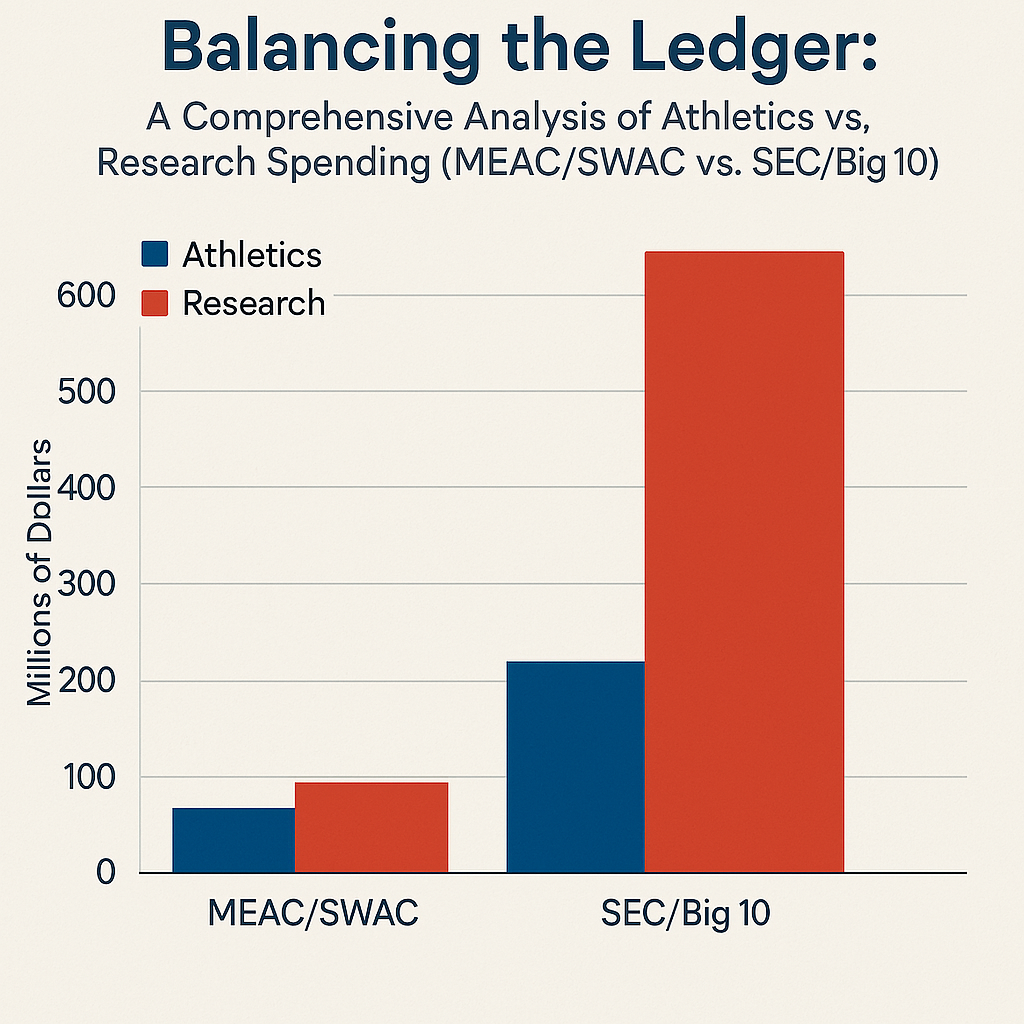
Balancing the Ledger: A Comprehensive Analysis of Athletics vs. Research Spending (MEAC/SWAC vs. SEC/Big 10)

“Since new developments are the products of a creative mind, we must therefore stimulate and encourage that type of mind in every way possible.” – George Washington Carver

In the financially stratified ecosystem of American higher education, institutions are increasingly confronted with a binary tension: to invest in athletic visibility or academic viability. For universities across the NCAA spectrum, especially those in the MEAC and SWAC conferences compared to their counterparts in the SEC and Big Ten, this decision is less about preference and more about resource constraints and strategic direction. Yet, data reveals a persistent imbalance in how these priorities manifest, and more critically, the long-term costs of these choices.

Conference Dynamics: Institutional Identity and Capital Exposure

The MEAC and SWAC are defined by institutions that are predominantly Historically Black Colleges and Universities (HBCUs). These universities have traditionally operated under capital scarcity, navigating chronic underfunding while serving as incubators of social mobility for African American communities. Their mission, often grounded in equity and community uplift, limits their ability to generate large commercial revenues through athletics. This is not due to a lack of talent or audience, but because media deals, booster contributions, and government funding disproportionately favor PWI institutions.

By contrast, the SEC and Big Ten represent the economic elite of collegiate athletics and academia. With flagship state universities at their helm, these conferences are buttressed by multi-billion-dollar endowments, large donor bases, and lucrative broadcast contracts. Their budgets allow for investments in both athletics and research without having to cannibalize one to fund the other. In essence, they play the game with more capital and fewer trade-offs.

Athletics Budgets: Symbolism vs. Strategy

MEAC and SWAC institutions report average athletics expenditures between $11 million and $12 million annually. Notable programs like North Carolina A&T and Prairie View A&M may hover slightly higher, but Mississippi Valley State and others operate on budgets as low as $3.9 million. These figures pale in comparison to SEC schools like Alabama or Texas A&M, where athletic spending exceeds $150 million. The Big Ten’s Ohio State leads all with $215 million dedicated to athletics alone.

While athletic programs at HBCUs serve as cultural centers and enrollment drivers, their limited revenue-generating capacity renders them economically unsustainable without substantial subsidization. Many are forced to divert institutional funds, raise student fees, or solicit local donations just to keep programs afloat. In contrast, SEC and Big Ten programs function as media properties, brand engines, and financial assets, often contributing revenue back to their academic institutions.

Athletics at HBCUs carry significant intangible value, cultural pride, alumni engagement, community identity, but these cannot substitute for financial sustainability. The opportunity cost of maintaining expensive athletic programs without equivalent return on investment demands strategic scrutiny.

Research Spending: The Forgotten Core

Where the real divergence occurs is in research investment. MEAC and SWAC research expenditures are overwhelmingly modest. With the exceptions of Howard University ($122 million) and Florida A&M ($41 million), most institutions sit between $2 million and $25 million in annual research activity. These figures reflect decades of underinvestment and insufficient infrastructure, not a lack of capacity or talent.

Meanwhile, SEC and Big Ten institutions routinely surpass $500 million in annual research outlays. Schools like Michigan ($1.67 billion), Wisconsin ($1.36 billion), and Penn State ($996 million) operate on a scale comparable to government agencies and national labs. They attract large NIH, NSF, and Department of Defense grants. They lead clinical trials, generate patents, and build interdisciplinary research parks.

This disparity is not simply numerical; it is strategic. Research drives federal grants, patents, corporate partnerships, and endowment growth. It also attracts high-performing faculty and students, serving as the foundation of institutional longevity and economic influence.

The Ratio That Tells the Future

The athletics-to-research spending ratio offers a lens into institutional philosophy:

  • Norfolk State: 2:1 athletics to research
  • Jackson State: 0.7:1
  • Mississippi Valley State: 6:1
  • Alabama: 0.15:1
  • Michigan: 0.11:1
  • Wisconsin: 0.11:1

While SEC and Big Ten schools spend more on athletics than HBCUs, they also spend exponentially more on research. The imbalance within HBCUs is a reflection not of poor prioritization, but of systemic capital deprivation. These ratios also underscore how HBCUs are often forced to choose between visibility and viability, between entertainment and innovation, because they lack the financial bandwidth to pursue both.

Research as Revenue: Commercialization and the Innovation Economy

University research is not merely an academic endeavor it is a gateway to commercialization. Inventions born in labs often become patents. Patents become licensing agreements. Licensing revenue, in turn, flows back into the institution. The University of Florida’s development and commercialization of Gatorade yielded more than $280 million over time. Stanford’s involvement in launching Google and Hewlett-Packard has helped fuel its $36 billion endowment. Wisconsin’s WARF fund manages $4 billion in research-derived assets.

This model is not just aspirational; it is replicable. But replication requires infrastructure, policy, and intention.

Building the Infrastructure: A Two-Track Strategy for HBCUs

Campus Infrastructure

  1. Strengthen Technology Transfer Offices (TTOs): These serve as the conversion points from research to revenue. TTOs are responsible for managing patents, evaluating commercial potential, and negotiating licensing agreements.
  2. Invest in Innovation Facilities: Makerspaces, incubators, wet labs, and data science centers can all be built in underused buildings or retrofitted spaces.
  3. Embed Commercialization in Curriculum: Courses in IP law, venture creation, product development, and ethics should be available to both undergraduates and graduate students.
  4. Create Campus Accelerators: Provide seed funding, pitch competitions, and alumni mentorship. These accelerators can be industry-specific (e.g., AgTech at Tuskegee, FinTech at Howard).
  5. Celebrate Wins: Every patent, startup, or licensing deal should be internally recognized and externally marketed. Visibility breeds validation and investment.

Capital Infrastructure

  1. Black-Owned Banks: Offer startup lines of credit and financial education embedded in innovation ecosystems. These institutions can also hold endowment funds or manage cash flow from royalty revenues.
  2. Diaspora Sovereign Wealth Funds: Channel African and Caribbean capital into HBCU startups and joint ventures. Funds like Nigeria’s NSIA or Pan-African VC firms could provide growth capital.
  3. HBCU Venture & Endowment Funds: Seeded by Black VC firms, family offices, and institutional investors. These funds can create co-investment syndicates for promising faculty or student ventures.
  4. Donor-Advised Funds (DAFs): Enable alumni to contribute to IP pipelines through tax-efficient giving. DAFs could also be matched by corporate sponsors or philanthropic partners.

Building Strategic Partnerships for Scale

HBCUs need not operate in silos. Strategic collaboration can accelerate commercialization and R&D outcomes:

  • Inter-HBCU R&D Collaboratives: Morgan State and FAMU could co-sponsor patent consortiums.
  • Cross-registration commercialization programs with PWIs like Johns Hopkins or Emory.
  • Statewide HBCU innovation districts tied to workforce pipelines and rural development.

From the Lab to the Ledger: Case Studies in ROI

  1. University of Florida – Gatorade: In the 1960s, UF researchers developed a hydration drink to help football players endure Florida’s brutal heat. The result, Gatorade, has yielded over $280 million in licensing revenue. These funds helped UF build research infrastructure, attract top scientists, and grow its endowment.
  2. Stanford University – Silicon Valley: Stanford was not always wealthy. Its proximity to innovation and its open policies toward student and faculty entrepreneurship led to the creation of Google, Cisco, and more. Today, Stanford’s alumni-founded companies generate trillions in global market value.
  3. University of Wisconsin – WARF: Established in 1925, the Wisconsin Alumni Research Foundation has monetized research in Vitamin D, stem cells, and imaging. With over $4 billion in assets, WARF reinvests in faculty, students, and commercialization pipelines.
  4. MIT – Ecosystem Builders: MIT’s Deshpande Center and The Engine Fund act as innovation pipelines that commercialize tough tech. MIT startups have created over 4.6 million jobs globally.

What HBCUs Must Avoid: Dependency Without Ownership

Too often, HBCUs have served as intellectual suppliers while other institutions and corporations reap the financial rewards. Faculty develop ideas, only for those patents to be captured by universities with larger TTOs. Students build prototypes, only to license them under incubators unaffiliated with their home campus.

To shift this paradigm, ownership must be embedded from the start. That means building institutional IP portfolios and teaching students the economics of invention.

A Circular Ecosystem Rooted in Culture and Capital

StakeholderRole in the Pipeline
Black-Owned BanksStartup capital, credit access, and embedded finance literacy
Diaspora Wealth FundsStrategic investment, global partnerships, and joint IP deals
African American NPOsStakeholder investors, endowment builders, and R&D supporters
Black Media & AlumniNarrative shaping, promotional power, and advocacy
HBCU TTOs & LeadershipPatent management, research development, and startup formation

Final Calculations: Wealth Is Institutional, Not Individual

The data from MEAC, SWAC, SEC, and Big Ten schools paints a vivid picture of the financial landscape of higher education. While SEC and Big Ten schools show that it is possible to be excellent in both athletics and academics, MEAC and SWAC institutions face tougher choices due to structural inequalities and historical underfunding.

As conversations around equity, student success, and public accountability continue, this kind of comparative data is essential. Whether aiming for a championship or a Nobel Prize, universities must remember that their ultimate mission is to educate, innovate, and uplift communities.

University research isn’t just about publications and academic prestige it’s a launchpad for innovation, economic growth, and financial sustainability. When strategically supported, it becomes a core driver of commercialization, entrepreneurship, and long-term prosperity through patents and endowment growth.

Many HBCUs and smaller institutions already are incubators of brilliance but they’ve been left out of the research-to-wealth pipeline due to underfunding and limited infrastructure. With targeted investments and smart policy, they can flip the script and become not just engines of education, but engines of innovation and wealth creation.

Disclaimer: This article was assisted by ChatGPT.

The Only African American Owned Bank In Texas Selects Morris Brown College Alum As Its Next CEO

Unity National Bank, headquartered in Houston, Texas, with $209 million in assets, is the eighth largest African American owned bank by assets. It is located just a stone’s throw away from Texas Southern University. Recently the bank named Pedro Bryant, a Morris Brown College alum, its new CEO and President. Unity National Bank has an immense opportunity to move up the rankings for African American banks with the right strategy. According to an Apartment List report in February 2024, San Antonio, Houston, Dallas, and Austin rank as the third, fourth, sixth, and seventh best cities in the US for African American professionals. Lendio also reports that Texas is home to over 400,000 African American owned businesses and almost 13,000 are employer firms. These ingredients mean that with Unity National Bank being the only African American owned bank in the state the runway for growth is theirs to capture. This also means a strengthening of ties between HBCUs and the African America private sector are that much stronger. The lack of cohesion between the two institutions (100 HBCUs and 16 African American owned banks) has largely been one of the key ingredients holding back the African American economy as intellectual and economic capital rarely circulates between HBCUs and the African American owned employer firms.

Unity National Bank’s Full Press Release:

Island Mentality: Alabama State University’s $125 Million Decision Highlights HBCUs’ Continued Failure To Connect With The African American Financial Sector

Negro banks, as a rule, have failed because the people, taught that their own pioneers in business cannot function in this sphere, withdrew their deposits. – Dr. Carter G. Woodson

What is an ecosystem? How do you develop an ecosystem? Can we develop an African American ecosystem? It seems to be a question that a room full of African American institutional leadership have little understanding of based on the institutional decisions that are continuously made. In their academic paper entitled Economic Ecosystems, Philip E. Auerswald and Lokesh M. Dani, “An ecosystem is defined as a dynamically stable network of interconnected firms and institutions within bounded geographical space. It is proposed that representing regional economic networks as ‘ecosystems’ provides analytical structure and depth to theories of the sources of regional advantage, the role of entrepreneurs in regional development, and the determinants of resilience in regional economic systems.” The most vital part of that definition being interconnected firms and institutions. African American institutions in general at every turn fail to understand this concept and HBCUs are no exception. This is especially true of HBCUs choice of banks and now Alabama State University’s recent decision to forego a plethora of African American Owned Investment and Asset Management firms and hand $125 million to another European American owned investment firm. African American capital once again reinforcing European America’s financial ecosystem – not ours.

It is almost a redundant story at this point. African American institutions all operating on their own island and failing to interconnect and intertwine with each other. African America from individual to institutions all do what is best for themselves individually and not what is best for the collective and certainly not what connects and strengthens the collective. See Hampton University and North Carolina A&T State University decisions to leave an HBCU conference for a PWI one. To that vein is why over 90 percent of African America’s $100 billion in annual tuition revenue goes into PWIs and not HBCUs/PBIs. HBCUs provide very little means of an example for the community to follow. Instead, HBCUs are a glaring headlight of just how poorly African American institutions perform in strategically integrating themselves within the African American ecosystem, especially economically. There are no reports on HBCUs engagement with the African American private sector because HBCUs do not seemingly see that as important. How many of HBCU graduates work for African American owned companies? How much HBCU athletic sponsorship dollars come from African American owned companies/partnerships? How much of the HBCU endowment is invested in African American firms? These are basic questions that any leadership of an HBCU should be able to answer. Unfortunately as Jarrett Carter, Sr., founder of HBCU Digest, once eloquently put it, “Many HBCUs are just trying to be PWI-adjacent.”

Is $125 million a lot of money? Context matters. To any individual, most would agree $125 million is significant. To institutions, it varies on size, scope, and goals. For African American Financial Institutions, almost down to even the largest of our firms having an $125 million account would see their bottom line acutely move. Providing perspective on the landscape, Pension and Investments reports, “The global asset management industry showed some signs of recovery in 2023, with total assets under management (AUM) rising 12% year-over-year to nearly $120 trillion, according to research by Boston Consulting Group.” For African American Asset Managers, “The largest Black-owned asset managers are responsible for more than $253 billion in assets, according to FIN Searches data. Vista Equity Partners is the largest Black-owned firm in the industry, with the private equity manager handling $103.8 billion in assets.” African American Owned Asset Managers only account for 0.2 percent of the global AUM. By contrast, the Top 10 non-Black asset managers have $22 trillion assets under management which accounts for almost 20 percent of global AUM.

The asset management firm that Alabama State University chose according to World Benchmarking Alliance, “Neuberger Berman is a private employee-owned investment management firm (leadership pictured above) headquartered in New York, USA. It was founded in 1939 and has offices in 39 cities across 26 countries. The firm manages equities, fixed income, private equity and hedge fund portfolios for global institutional investors, advisors and high-net-worth individuals. It managed USD 460 billion of assets (under management) in 2021 and employed 2,647 staff in 2022.” This means that Alabama State University’s $125 million is equal to 0.02 percent of assets under management for Neuberger Berman. A drop in the bucket. The entirety of assets at African American Owned Asset Management firms is only 55 percent of Neuberger Berman assets under management. Alabama State University’s $125 million would have lifted the ENTIRE African American Owned Asset Management’s AUM by 0.05 percent. A move that would have strengthened the African American economic and financial ecosystem.

African America as a community talks about the circulation of the dollar or our lack thereof constantly, but what is virtually never talked about is the circulation of the African American institutional dollar being the largest part of that conversation. It is a fairly accepted statistic that the African American dollar does not stay in the African American community for a day, while other communities see their dollar stay in their communities for weeks and in the case of the Asian American community for almost a month. We often think of the circulation of our dollar like everything else, on an island or as an individual. An individual going and buying food from even an expensive African American owned restaurant is $100-200, but an HBCU building a new building means the opportunity for a new loan worth tens of millions for an African American owned bank, it means tens of millions for an African American owned construction company, so on and so forth. Instead, Bethune-Cookman University borrows from a notorious predatory lender to the African American community in Wells Fargo and almost finds itself losing those buildings due to foreclosure.

HBCU alumni know little about the state of finances or the movement of the money at their alma maters. HBCU administrators either willfully withholding the information or inept themselves of the importance of the information and providing it. Both are problematic. The notion that HBCUs cannot find African American investment firms is a painful thought knowing that a Google search would bring up the HBCU Money African American Owned Bank Directory at the very least. The likelihood is more in line with what Mr. Carter said in that a good deal of HBCU leadership simply wants to be like their PWI counterparts is far more likely. This would explain the debacle “donation” accepted by Florida A&M University’s president recently where a simple Google search would have avoided such embarrassment. Instead, Alabama State University’s Neuberger Berman relationship and a plethora of others instances (a decade ago when we reported “Spelman College & Regions Bank – A Failure To Disclose”) is that likely they are simply mimicking PWI actions and unwittingly reinforcing the PWI/European American ecosystem to say the least. Unfortunately, that mimicking reinforces another community’s economic and financial ecosystems not ours and why you may never see OneUnited Field at any HBCU’s athletic facility. Because we are holding out for J.P. Morgan, Bank of America, or Wells Fargo to show us the same love they show PWIs. Not acknowledging those are not our community’s banks.

If HBCUs are simply going to behave as PWI-adjacent institutions, then it is hard to argue with why over 90 percent of African Americans who go to college are not choosing HBCUs. For many it becomes a question of why get a knockoff when they can get the real thing. After all their ice is colder. HBCUs, HBCU alumni associations, and HBCU support organizations as a whole are not making decisions related to African American institutions ecosystem’s interests and interconnectivity and that is most glaring in the poor institutional decisions we are making in regards to our institutional finances and endowments.

Why Do HBCUs Not Bank With Black Banks?

It could all be so simple But you‘d rather make it hard, loving you is like a battle and we both end up with scars. – Lauryn Hill

Something that should be so simple, HBCUs and other African American organizations, businesses, and other African American institutions have made not just a battle but sometimes it feels like a war. That battle, getting African American institutions to bank with the African American banking system with banks and/or credit unions owned and controlled by – African Americans. It is economic development 101 for other groups, but for African America it is seemingly Calculus III. Based on HBCU Money’s internal research on the matter only two, a PBI and HBCU, are believed to bank with a Black-owned bank. That means that just like the over 90 percent of African Americans who go to college not choosing HBCUs, well over 90 percent of HBCUs do not bank with a Black-owned bank. And in both cases, neither (AAOBs or HBCUs) are able to fulfill their potential as they would with the patronage and investment of those they were built to serve.

We asked the AI app Nova for their take on why HBCUs do not bank with African American owned banks and here was its answer: “There are a few reasons why many HBCUs may not bank with Black-owned banks. One reason is that larger, more established banks often offer more resources and services that HBCUs may need, such as investment services or customized financial solutions. Additionally, some HBCUs may feel more comfortable with larger, more established banks that have a long history of working with educational institutions. However, there has been a growing movement encouraging HBCUs to support Black-owned banks and businesses as a way to promote economic empowerment within the Black community. Many Black-owned banks have a strong commitment to supporting HBCUs, and may offer specialized products and services tailored to their needs.”

Despite AI being quite learned in its contribution to this. There are as they say – levels to this. Not least among them is the plight of public HBCUs lacking autonomy. It would take a massive student and alumni uprising in order to get a public HBCUs moved to an African American owned bank. Ultimately, public HBCUs are controlled by a board or if they are in a system, then a system’s board. In either case, the state’s flagship PWIs carrying the most financial weight and tend to be determinate of how all public universities in the state will behave and most certainly likely where they will bank. And while it is complicated to wrangle the institutional banking of public HBCUs into African American owned banks, their proxy organizations like alumni associations and foundations that serve them should not have anywhere near the issue of banking Black. Then there are the private HBCUs who have far more autonomy with their banking decisions and yet it seems potentially only one private HBCU actually banks Black. It is almost befuddling in the case of the Alabama and Georgia HBCUs not to bank Black. They both have two African American Owned Banks in headquartered in their states. Morehouse specifically just a few years ago had one of their alumni bring back African American owned banking to Oklahoma when alumnus Kevin Perry purchased controlling interest in First Security Bank & Trust. In fact, 14 of the 15 states and territories where there are African American owned banks have HBCUs/PBIs in them with Wisconsin being the lone exception.

African America’s flagship HBCU, Howard University, two years ago entered into a partnership with PNC Bank to create the PNC National Center for Entrepreneurship housed at Howard University. PNC’s Foundation providing Howard University with a rather obtuse $3.4 million a year grant for five years. PNC Bank is based in Pittsburgh,PA, its executive team in 2022 commanded $81 million in compensation, and the bank has assets over $550 billion – an amount that is over 100 times the size of all 16 remaining African American Owned Banks’ assets combined. We think Marcus Garvey just rolled over in his grave. Meanwhile, right in Howard University’s backyard is Industrial Bank, an African American Owned Bank with $723 million in assets, meaning PNC Bank has over 760 times the amount of assets of Industrial. There is in fact only one African American Owned Bank that has over $1 billion in assets, Liberty Bank & Trust in Louisiana.

That HBCU presidents and AAOB CEOs do not have closer relationships simply speaks to the island mentality that African American institutions as a whole have. Although our community loves to parrot the harsh reality of an African American dollar that does not circulate in our community’s even 6 hours while “the average lifespan of the dollar is approximately 28 days in Asian communities, 19 days in Jewish communities, 17 days in white communities”, according to a piece by the FAMUAN (see how we are circulating HBCU media capital). This has done nothing to make HBCU administrators understand that the circulation of the African American institutional dollar is far more impactful than the African American consumer collar. Despite as recently as 2017, there were four African American Owned Banks with HBCU alumni as CEOs. It is also not just on HBCUs, but AAOBs should be doing a better job of heavily pursuing those HBCUs that do have the autonomy to decide where they bank and forging deep relationships with them at multiple levels.

By forging that relationship HBCUs and AAOBs can multiply the probability of opportunities and profitability. That way when an HBCU alum creates the next Google, SpaceX, FedEx, or other Fortune 500 company, then they will already know the importance of banking with an AAOB and hiring HBCU alumni. It will be understood because the intentionality of our ecosystem’s success will be modeled and molded and as a result our community is empowered with success a rule and not the outlier it operates in now as so many of us continue to try and build a nation as an island instead of forging together.