
“No people will save themselves until they know themselves and are willing to make sacrifices on behalf of themselves.” — John Henrik Clarke
In November 1962, more than one hundred African American civil rights, religious, business, and labor leaders gathered at Columbia University’s Arden House to found the American Negro Leadership Conference on Africa, co-chaired by A. Philip Randolph and Martin Luther King Jr., with Roy Wilkins, Whitney Young, James Farmer, and Dorothy Height among its founders. The conference brought together African-American civil rights, religious, business, and labor leaders to discuss “The Role of the American Negro Community in U.S. Policy Toward Africa.” Business leaders were in the room. Newly independent African governments were asking, directly, how black America intended to engage. Nigeria’s ambassador to the UN, newly arrived in New York, invited ANLCA’s leaders to discuss how Africans felt about U.S. policy and wanted black Americans to think more precisely about their role. What emerged from that opening was solidarity in the framework of resolutions, declarations, moral testimony against apartheid and colonialism. What never emerged was capital. No investment vehicle. No banking partnership. No coordinated channel through which the balance sheets sitting inside black-owned insurance companies, HBCU endowments, and fraternal and sororal organizations of that era could be directed toward equity stakes in the economies ANLCA’s own leadership was courting. The organization, formed in late 1961, aimed to represent African-American opinion on African issues and influence U.S. policy toward Africa, but its effectiveness was later explained mainly in terms of organisational deficiencies and financial problems. By 1968, six years after its founding, ANLCA had gone out of business, done in by the very financial infrastructure it never built. The correct instinct that African American institutions had a stake in African economic sovereignty was there from the beginning. The institutional architecture to act on it was not. It defaulted to the register it knew (political and moral advocacy) and never built the economic counterpart. That gap between political solidarity and financial infrastructure is the story of African American engagement with Africa Core, told and retold across more than sixty years, and it is being told again right now, in real time, on the floor of the Nigerian Exchange.
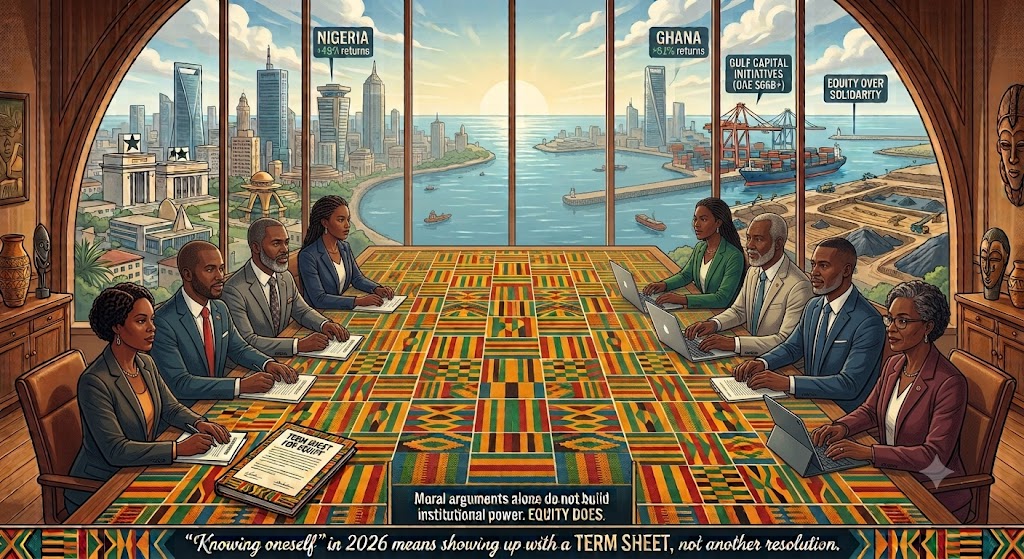
Nigeria’s stock market closed the first half of 2026 as one of the best-performing equity markets in the world, outpacing nearly every major exchange except South Korea’s, with the benchmark index delivering returns north of 45 percent in local terms and roughly 47 to 67 percent in dollar terms depending on the measurement window. Ghana’s exchange did even better. Kenya and Tunisia also ranked among the world’s top performers. The drivers were not speculative: banking recapitalization, currency stabilization, improving foreign exchange liquidity, and stronger corporate earnings across financial services, industrial goods, and telecommunications. This is not a bubble story. It is a structural repricing of Africa Core as an investment destination, and the capital moving in to claim it is not, for the most part, African American capital. It is Gulf capital, and it is moving with striking speed and specificity.
The United Arab Emirates alone has announced tens of billions of dollars in greenfield foreign direct investment across the continent since 2017, with Egypt receiving over $66 billion, Mauritania $34 billion, South Africa $24 billion, and smaller but still substantial commitments to Morocco, Tunisia, and Somaliland. This is not philanthropy or cultural affinity. It is a sovereign wealth strategy: ports, minerals, agricultural land, telecommunications infrastructure, and military basing rights, pursued with the kind of coordinated, state-backed patience that treats decades as the unit of planning rather than news cycles. The UAE is not alone. China’s Belt and Road financing in Africa Core has operated on a similar time horizon for two decades. What both share is institutional coordination: sovereign funds, state banks, and diplomatic infrastructure moving in concert toward a defined strategic objective. Neither government felt compelled to issue a resolution of solidarity first. They wired capital and negotiated equity.
This is the pattern ANLCA set and the pattern African American institutional engagement with Africa Core has largely repeated since: the moral register comes first, fluently, and the institutional register; ownership, equity, board seats, depository structures arrives late, if at all, and usually as an afterthought to the solidarity statement rather than its point. It is not that the moral argument is wrong. Apartheid was wrong to oppose, colonialism was wrong to indulge, and the resolutions ANLCA passed were not empty gestures. But moral clarity and institutional power are different currencies, and African American engagement with Africa Core has tended to spend the one it already had in abundance while never accumulating the other. A resolution of solidarity does not purchase a stake in a bank. A pledge of ethnic kinship does not seat anyone on the board of a telecommunications concession. The Gulf states and Beijing have never made this mistake, because they were never tempted to: their African strategies were designed from the outset as instruments of ownership and leverage, not as expressions of affinity. African American institutions, operating from a genuine and historically earned solidarity with Africa Core, have too often mistaken the expression of that solidarity for the exercise of power.
HBCU Money’s Annual Wealth Report has documented the domestic version of this same reflex for years: capital that could compound within African American institutions instead leaks outward, whether to mainstream white-owned lenders, to tuition paid to non-HBCU institutions, or to philanthropy that never returns as equity. Philanthropy itself is instructive here; it is the domestic cousin of the moral-argument-over-institutional-argument pattern, a mode of engagement that feels like generosity and functions like leakage, because it moves capital out of the ecosystem without building an ownership claim inside it. The Africa Core opportunity is the same leakage problem at continental scale, except the clock is now visibly running, priced daily in Lagos and Accra, and the instinct to respond with a statement of affinity rather than a term sheet is exactly the instinct that hollowed out ANLCA by 1968.
This is where the argument must resist a comfortable but incomplete framing. It would be easy to describe this moment as a moral failure or a squandered kinship, a broken promise to the motherland and stop there. That framing, however emotionally resonant, is itself part of the problem, because it keeps the conversation inside the register that has already failed to produce institutional power for sixty years. Institutions do not act on sentiment; they act on mandate, structure, and incentive. The Gulf states are not investing in Africa Core because they feel a particular way about it. They are investing because sovereign wealth funds exist whose explicit mandate is long-horizon strategic acquisition, because state development banks exist to underwrite the political risk that private capital alone will not absorb, and because diplomatic infrastructure exists to convert investment into standing influence. African American institutions have never built the equivalent apparatus, not because the will was absent — ANLCA proved the will was substantial even in 1962 — but because the capital base was historically too fragmented, too undercapitalized, and too oriented toward domestic survival and political advocacy to fund continental strategy. That is a structural condition, not a character flaw, and it is a condition that can now change: HBCU endowments have grown, Black-owned banks are consolidating and strengthening their balance sheets, and a first generation of African American-led private equity and venture capital has reached a scale where continental allocation is at least conceivable. The question the institutional ecosystem must now answer is whether that capacity will be organized as an ownership strategy this time, or once again channeled into the more familiar work of issuing statements.
The urgency is not rhetorical. Every year the Africa Core rally continues without African American institutional participation is a year in which ownership stakes in banks, in telecommunications carriers, in ports, in the exchanges themselves are being allocated to other claimants at valuations that will not remain this favorable. The economist’s version of this argument matters more than the moral one for the audience that actually controls capital allocation: entering an asset class after a multi-decade sovereign wealth campaign has already secured the strategic positions means entering as a minority co-investor in someone else’s strategy, not as a principal in one’s own. The Dangote Cement IPO discussions, the growing depth of Nigerian and Ghanaian capital markets, the African Development Bank’s expanding project pipeline, these are not permanent features of the landscape. They are a window, and windows in capital markets close. Solidarity does not hold a window open. Equity does.
What would African American institutional participation actually require, structurally, rather than sentimentally? First, a dedicated investment vehicle and not a fund improvised by a single HBCU endowment acting alone, which lacks both the scale and the risk tolerance for cross-border exposure, but a pooled vehicle drawing on multiple HBCU endowments, African American-owned banks and credit unions, and Black-led institutional investors, structured explicitly for Africa Core equity and infrastructure exposure. HBCU Money has previously floated the concept of an African Depository Receipt structure; instruments that would allow African American enterprises and investors to hold and trade positions on African exchanges such as the Johannesburg Stock Exchange, the Nigerian Exchange, and the Ghana Securities Exchange with the same ease as holding a domestic security. That is a twenty-year project, not a headline initiative, and it will not be built by any single actor. It requires coordination among finance departments at institutions like Tuskegee, Hampton, and Fisk; the balance sheets of Black-owned banks and credit unions tracked in HBCU Money’s own directory; and the diplomatic relationships that HBCU Politics has argued need standing rather than episodic form which was the very standing form ANLCA never built before it dissolved.
Second, talent concentration matters here as much as it does domestically. The African American institutions best positioned to understand Africa Core capital markets, economics and finance faculty, MBA programs, international affairs departments are scattered across dozens of HBCUs with no coordinating research function. A continental investment strategy requires the kind of standing analytical capacity that mainstream investment banks maintain for every region in which they deploy capital: current data on regulatory environments, currency risk, political stability, and sector-specific opportunity. Institutions such as Tougaloo, Alcorn State, and Delaware State are not typically named in conversations about international finance, but their economics and international studies programs are exactly where this analytical capacity should be built and credentialed, both because it distributes opportunity beyond the usual flagship institutions and because a coordinated research function spread across multiple campuses is more durable than one housed in a single office that can be defunded in a budget cycle.
Third, strategic coordination requires an actual counterpart on the African side, and this is where HBCU Politics’ geopolitical framing becomes directly operational rather than abstract. African finance ministries and central banks are already negotiating with Gulf sovereign wealth funds and Chinese state banks; they are not naive about what those counterparts want in exchange for capital, and they will not be moved by a fresh round of resolutions expressing kinship. African American institutions entering this landscape need to be legible as a coordinated counterpart with a defined mandate; capital in exchange for equity, talent exchange, and standing partnership, not capital in exchange for extractive access alone, and not solidarity offered in place of capital at all. This is precisely the distinction the “third power” framing has tried to establish: the African diaspora is not simply a sentimental constituency to be courted by both Washington and Beijing, but a potential third actor with its own capital and its own terms, if and only if that capital is organized into something that can actually negotiate rather than something that can only declare.
None of this happens through admiration of the Nigerian rally from a distance, and none of it happens through episodic, individually initiated investment by wealthy African Americans acting alone, however well-intentioned. Individual capital, deployed without institutional coordination, replicates exactly the fragmentation problem HBCU Money has documented domestically: it produces isolated success stories rather than compounding institutional capacity. The Gulf states did not build their African footprint through the enthusiasm of individual sheikhs. They built it through sovereign funds, state banks, and standing diplomatic infrastructure acting as a single, patient, coordinated actor. That is the model that must be matched, not the individual investor model that African American capital has too often defaulted to, and not the advocacy-conference model that ANLCA proved, at real cost, does not convert into ownership on its own.
John Henrik Clarke, writing on the question of whether African peoples could save themselves, offered a standard that applies with equal force to this moment: no people will save themselves until they know themselves and are willing to make sacrifices on behalf of themselves. Knowing oneself, in this context, means recognizing which register a given moment calls for. Africa Core in 2026 is not asking African American institutions for another resolution. It is pricing equity, daily, on an exchange floor, and it will allocate that equity to whoever shows up with a term sheet rather than a communiqué. The parable that opened this piece was not a story about 1962. It is a story about right now — moral clarity mistaken for institutional strategy, and a closing window. The only variable still undetermined is whether this generation of African American institutional leadership builds the ownership vehicle before the opportunity is fully spoken for, or whether it convenes once more to say, correctly and insufficiently, that it stands in solidarity.
Disclaimer: This article was assisted by ClaudeAI.

