Tag Archives: african american wealth

Give Black App: A Digital Gatekeeper For African American Philanthropy & Institutional Capital

“We must invest in ourselves. Without our own institutions, we will always be at the mercy of others.” – Mary McLeod Bethune

In the long arc of African American economic life, a recurring pattern emerges: the institutions most critical to our survival are consistently starved of capital, while the broader society thrives off of our labor, culture, and creativity. From Reconstruction-era mutual aid societies to the undercapitalized HBCUs of today, the struggle has never been whether African Americans are generous, but whether that generosity is systematically directed into institutions that can build durable power.

The Give Black App, founded by David C. Hughes, Alexus Hall, and Fran Harris, positions itself at this inflection point. It is not simply an app but a digital strategy—one attempting to reshape the flow of African American philanthropy and donations by curating, centralizing, and amplifying support for Black-led institutions.

The Context of Underfunding

African American nonprofits receive disproportionately less funding compared to their White counterparts. A 2020 Bridgespan study found that unrestricted net assets of White-led nonprofits were 76% larger than those of Black-led nonprofits, while revenues were 24% higher. These disparities compound over time. For HBCUs, the story is even starker: the endowments of all 100+ HBCUs combined is less than 1/10th of Harvard University’s alone.

Despite African America’s estimated $1.8 trillion in annual buying power, only a fraction is captured by its own institutions. Much of African American giving remains individual-to-individual or church-centered, providing immediate relief but not the kind of long-term institutional scaffolding needed to compete with White or global capital. Platforms like Give Black attempt to redirect that generosity into a framework where dollars reinforce permanence.

Building the Infrastructure of Giving

Give Black’s strength lies in infrastructure, a word often overlooked in philanthropy. The app operates as a digital gatekeeper, cataloguing Black-led nonprofits and enabling donors—whether individuals, alumni associations, or grassroots organizations—to find and fund them with ease.

This may seem simple, but its implications are profound. In an environment where discoverability is one of the greatest barriers for Black-led organizations, Give Black centralizes attention. For the countless nonprofits that lack robust marketing budgets, development officers, or national visibility, the app provides a seat at the table they would otherwise be denied.

The team itself reflects intentional design. Hughes, a Morehouse and Prairie View alumnus, carries the academic gravitas to engage institutions; Hall, with a background in cybersecurity and software sales, grounds the platform’s technical operations; Harris, a lifelong advocate of Black love and economic empowerment, provides the cultural grounding and marketing voice. Alongside them stand directors rooted in community engagement, finance, athletics, and science. Together, they represent a cross-section of African American life that mirrors the very community the app seeks to serve.

Philanthropy Meets Technology

Unlike GoFundMe or Benevity, which serve broad audiences, Give Black narrows its focus: African American-led institutions. This specificity is both its greatest strength and its potential vulnerability. By making African American philanthropy visible and trackable, the app attempts to normalize institutional giving within the community itself.

African American donors, long used to personal giving—funeral funds, tuition help, emergency assistance—are now asked to see their dollars not just as charity but as investment. An app that allows for transparency, accountability, and impact measurement may finally bridge the gap between intent and sustained institutional support.

Technology also democratizes giving. Younger generations, accustomed to digital wallets and mobile donations, are unlikely to write checks or mail contributions. By existing where they already transact, Give Black normalizes philanthropy as part of daily life. With proper marketing, it could serve as a digital equivalent of the collection plate—except one that sends dollars to Black think tanks, schools, health clinics, and endowment foundations rather than solely to Sunday offerings.

The Role of Fran Harris

Much of the initial confusion about Give Black’s leadership arises from Fran Harris’s name. She openly jokes about it—she is not the Fran Harris who was a WNBA champion or Shark Tank winner, though many assume otherwise. Instead, she distinguishes herself as someone whose “entire life has been about Black love and economic empowerment.”

That distinction matters. Whereas celebrity often drives visibility in African American philanthropy, Harris positions herself not as a star but as a steward of a broader vision. Her work focuses on the storytelling and cultural marketing needed to align African American giving with institutional capital. In a sense, her humor in addressing the name confusion underscores the seriousness of her actual role: grounding the app’s message in authenticity rather than celebrity.

The Gaps in the Strategy

Despite its promise, Give Black faces hurdles. First, fundraising expertise at the highest level appears limited within the core team. Major philanthropy is an industry of its own, requiring seasoned development officers capable of cultivating seven- and eight-figure gifts. Without this, Give Black risks becoming a platform for small-dollar giving—important, but insufficient for closing institutional capital gaps.

Second, technological depth must match ambition. While Hall’s cybersecurity background provides operational credibility, scaling a fintech-style platform requires CTO-level leadership. Issues of compliance, data integrity, and user trust are not optional—they are the foundation of sustainability.

Third, policy and compliance matter. Donations intersect with financial regulations, nonprofit law, and IRS oversight. To become the definitive gateway for Black giving, Give Black must not only build a sleek front end but also a back-end architecture that can withstand regulatory scrutiny and instill donor confidence.

Where the Opportunities Lie

The greatest opportunities for Give Black lie in institutional self-reliance.

One clear pathway is through alumni networks. HBCU alumni giving rates remain in the single digits, compared to 20–30% at elite PWIs. If Give Black positioned itself as the official conduit for alumni donations, it could help double or triple those rates over time. That alone would shift millions into endowments and operating budgets across the HBCU ecosystem.

Another opportunity lies in membership-based organizations—from professional networks to civic associations. Instead of dues going solely toward programming, portions could be funneled into long-term institutional giving through Give Black, creating a culture of collective philanthropy.

The Pan-African Diaspora represents yet another opening. African and Caribbean communities abroad are increasingly connected digitally. Give Black could expand to become a Pan-African philanthropic bridge, enabling solidarity between African Americans and global Black communities. Diaspora donors, often seeking trustworthy channels for giving, could find in Give Black a centralized, transparent platform.

Finally, the most transformative opportunity is to integrate endowment-building features directly into the app. Too much African American giving is trapped in the cycle of operating expenses. By redirecting portions of donations into permanent capital funds, Give Black could help institutions create reserves that outlast political climates and economic downturns.

Lessons from History

The urgency of Give Black’s mission must be seen against history. During the early 20th century, White-controlled philanthropy dictated the survival of many HBCUs. Institutions like Hampton and Tuskegee often relied on Northern industrialists whose donations came with ideological strings attached. The absence of African American-controlled philanthropic infrastructure meant dependency—and dependency always meant vulnerability.

Today, African American institutions still operate under the shadow of that dependency. Foundation funding remains racially skewed, and government support is often politically weaponized. Give Black, by offering a decentralized and community-driven alternative, challenges that cycle.

But history also warns: movements that lack discipline or scale are easily absorbed or ignored. Just as the Negro Leagues produced baseball talent but lacked the capital to maintain independence, so too can African American philanthropy generate excitement but fail to sustain institutional life if it is not channeled strategically.

The Verdict

Give Black App is not merely a digital donation tool. It is a test case: can African America leverage technology to redirect its wealth into its own institutions? The team’s composition, heavy in HBCU roots, marketing authenticity, and community engagement, suggests it understands both the stakes and the culture.

Still, the app must avoid the trap of becoming a feel-good project without measurable institutional outcomes. Its long-term success will be determined by whether it can:

  1. Secure partnerships with HBCUs, alumni associations, and membership-based organizations.
  2. Develop deep fundraising and compliance infrastructure.
  3. Normalize institutional giving across African American households.

If it does, Give Black could evolve into a cornerstone of African American institutional development—a kind of digital Freedman’s Bureau, redistributing not charity but power.

For African America, the stakes could not be higher. In an era where White nonprofits sit on multibillion-dollar endowments, while Black nonprofits scrape for survival, the question is not whether we are generous. It is whether our generosity is building the kind of institutions that ensure survival for centuries, not just survival for today.

Give Black, if scaled with vision and discipline, may finally provide the infrastructure to answer that question with a resounding yes.

When the Numbers Don’t Add Up: Shannon Sharpe’s $10 Million Settlement (Offer) and Savannah State University’s $12 Million Endowment

“If we don’t support our own institutions, who will? Our future depends on it.” – Dr. Johnnetta B. Cole

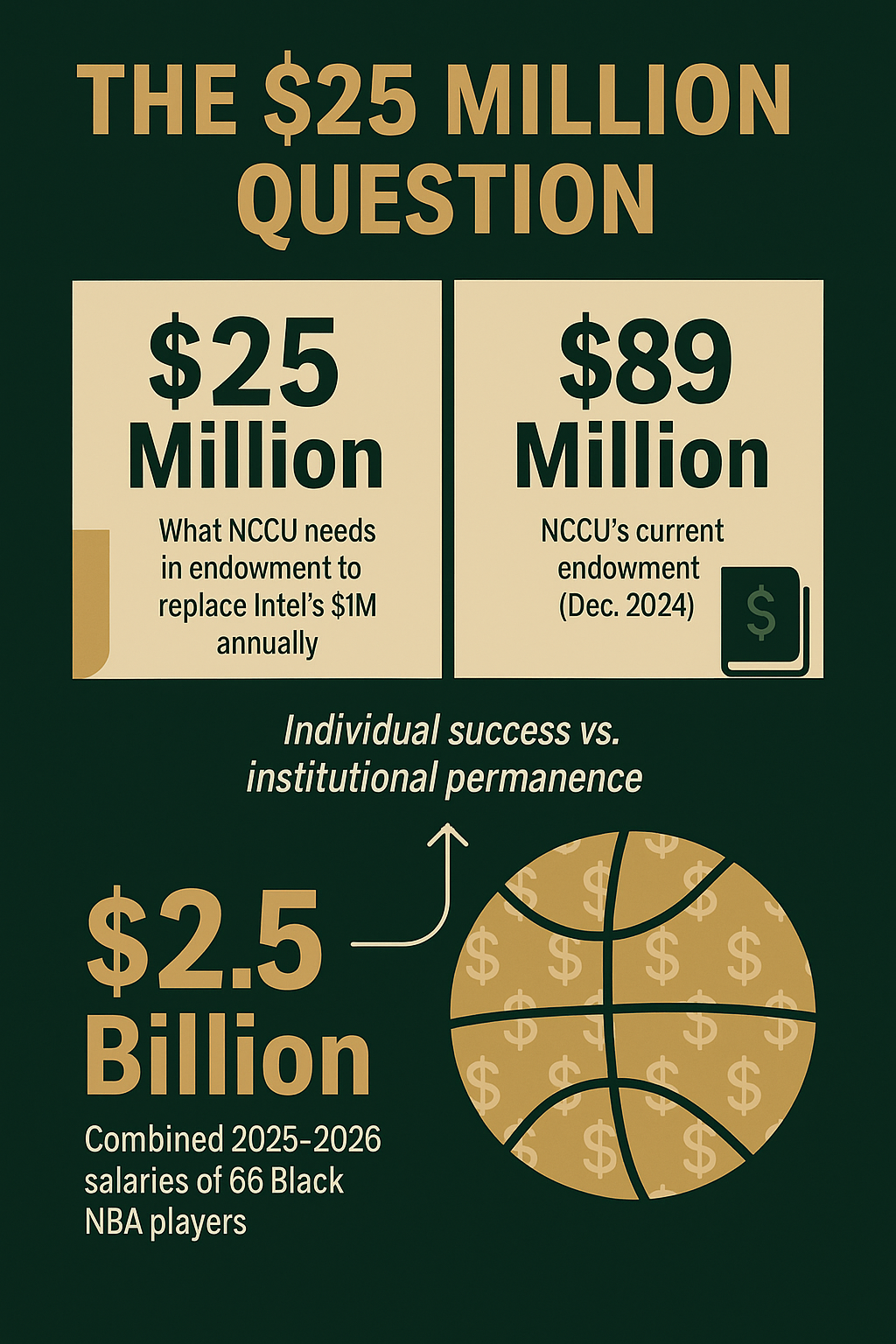
In a society where celebrity controversy often overshadows institutional legacy, the recent $10 million legal settlement offer by Shannon Sharpe is notable not just for its allegations, but for what it inadvertently reveals about the chasm between Black celebrity wealth and the underfunded institutions that shape it.

Sharpe, an NFL Hall of Famer turned sports media luminary, is embroiled in a sexual assault lawsuit in April 2025 that has added fuel to the fodder over his public image for years. The allegations, dating back to 2021, accused him of sexual assault and misconduct. Though the terms of the settlement do not admit guilt, the figure—$10 million—is enough to reverberate well beyond the courtroom. Particularly for Savannah State University, Sharpe’s alma mater, whose entire endowment hovers just north of $12 million.

That a single lawsuit settlement could nearly eclipse the full financial endowment of a university—an institution that has educated generations of Black students since its founding in 1890—demands attention. It is more than legal coincidence; it is cultural commentary. Sharpe’s settlement and Savannah State’s endowment share more than proximity in value—they reflect a profound misalignment between individual Black success and collective Black institutional health.

Celebrity Capitalism vs. Institutional Capital

Sharpe’s alleged settlement offer arrives at a time when he is more visible than ever. From ESPN panels to viral podcast interviews, he has crafted a new media identity grounded in charisma, cultural commentary, and athletic credibility. He is a multimillionaire many times over, and for much of the public, a figure of Black excellence.

And yet, while the scandal has put his reputation into question, the institutional damage is more structural than sensational. Savannah State University, like most HBCUs, remains chronically underfunded. In Georgia, the flagship University of Georgia enjoys an endowment exceeding $1.8 billion. Savannah State’s $12 million looks less like a war chest than a coin jar.

This contrast is not unique. Harvard’s endowment, currently over $50 billion, generates more passive income in a single day than most HBCUs earn annually. Meanwhile, Black cultural, entertainment, and sports figures continue to accumulate individual wealth—largely without corresponding reinvestment in the institutions that launched their journeys.

In Sharpe’s case, it is particularly jarring. He has long spoken with pride about Savannah State, often positioning his ascent from a small HBCU to NFL stardom as proof of grit, talent, and perseverance. But the question remains: can Black America afford to celebrate individual ascent while its institutions struggle to survive?

Institutions as the Forgotten Priority

The logic of endowments is simple: they are long-term capital. Through careful management, they yield investment income that sustains a university’s operations—faculty salaries, scholarships, research grants, infrastructure. A $12 million endowment, assuming a 5% annual drawdown, provides just $600,000 per year. That’s not enough to fund a single major building renovation or hire a cohort of tenure-track faculty.

Yet for a fraction of what he has paid in legal settlements, Sharpe—or any number of successful HBCU alumni—could fundamentally change the trajectory of such institutions. This is not to single out Sharpe, but to highlight the imbalance. In an ideal world, the very wealth that is now being paid out in settlements would be instead building libraries, research labs, and scholarship funds.

This tension is particularly visible among athletes and entertainers. Black America’s most visible ambassadors often emerge from institutions that are themselves invisible in the national philanthropic conversation. According to UNCF, the combined endowments of all HBCUs total less than $5 billion. The Ivies, by contrast, hold over $200 billion in endowment assets.

Culture, Crisis, and the Limits of Individualism

Sharpe’s settlement speaks to more than a personal reckoning—it is a cultural moment. It raises questions about power, accountability, and how society arbitrates guilt and innocence outside the courtroom. But for the Black community, it should also prompt deeper reflection on how fame and fortune are managed—and how institutions are too often left behind.

There is a troubling pattern: institutions that produce Black talent are celebrated in name, while being abandoned in practice. Alumni homecomings become nostalgic affairs, rich in ritual but poor in revenue. HBCUs are used as cultural references in music and fashion, but rarely as investment priorities.

The result is that even as African Americans make gains in representation and cultural power, their institutions remain at risk of irrelevance or collapse. The stakes are not merely educational—they are existential. Without strong institutions, there can be no sustainable community power.

What a $10 Million Gift Would Mean

Imagine instead that $10 million were a donation, not a payout. At Savannah State, that amount would nearly double the endowment overnight. It could launch a center for Black media studies, a school of sports journalism, or fund full scholarships for dozens of students. It could digitize archives, attract talent, and fund study-abroad programs that broaden horizons.

Better yet, it could serve as a challenge grant—a call for other high-profile HBCU alumni to match it, dollar for dollar. Such a campaign could transform the entire financial landscape of HBCUs in a single generation.

There is precedent. Oprah Winfrey’s $13 million donation to Morehouse College, Robert F. Smith’s debt forgiveness gesture at Morehouse’s graduation, and Reed Hastings’ $120 million donation to Spelman, Morehouse, and UNCF during the racial reckoning of 2020 showed what’s possible. But sporadic generosity is not a strategy. What’s needed is a systemic culture of giving—an institutional ethos that reorients Black wealth toward Black infrastructure.

Moving from Scandal to Structure

Sharpe, like many public figures, is navigating a complex personal and professional moment. Settling a case of this magnitude inevitably invites scrutiny. But what comes next is more important. Can this moment be a catalyst—not just for personal reflection, but for public responsibility?

Celebrity scandals are ephemeral. Institutions, if cared for, are permanent. The opportunity now is for Sharpe—and others in similar positions—to pivot toward legacy-building. That means using their platforms not only to defend their names, but to elevate their alma maters. To protect not just brand equity, but intellectual capital. To trade spectacle for structure.

A Future Worth Investing In

Savannah State University is not just a school—it is a symbol of survival, intellect, and potential. Its alumni include judges, scientists, teachers, engineers, and businesspeople. It deserves more than to be a footnote in a celebrity controversy. It deserves capital, vision, and strategic philanthropy.

In the end, the numbers don’t lie. A $10 million lawsuit may capture headlines. But a $12 million endowment defines futures. The question is not what Shannon Sharpe did or didn’t do—but what he and others like him will do next.

If fame is fleeting and fortune unpredictable, then perhaps the wisest investment is the one that cannot be taken away: the institutions that built you.

2023’s African America Household Portfolio Creeps Towards $7 Trillion In Assets

At the end of 2023, African America had asset values totaling $6.54 trillion and liability values totaling $1.55 trillion. This is an increase of $330 billion and $40 billion, respectively. Below is a breakdown of that wealth by assets and liabilities as reported by the Federal Reserve’s Distribution of Household Wealth data. African American assets amounted to 4% of U.S. Household and African American liabilities amounted to 8.3% of U.S. Household liabilities. This is a 100 basis points decline in assets from 2022 and 50 basis points decline in liabilities from 2022.

HBCU Money took a look at what exactly the African American asset portfolio entailed. African Americans are highly concentrated in two main areas, real estate and retirement accounts (pensions and 401K), respectively. These two groups comprise over 70 percent of African American assets versus only 43 percent for European Americans. Corporate equities/mutual funds and private business ownership comprise a staggering 35.3 percent of European American assets versus only 9.2 percent for African Americans, these two categories also representing African America’s lowest asset holdings.

Examining where African America puts its money and theorizing why can give us insight into strategies that can help in closing both household and institutional wealth gaps.

ASSETS

Real estate – $2.24 trillion

Definition: Real estate is defined as the land and any permanent structures, like a home, or improvements attached to the land, whether natural or man-made.

% of African America’s Assets – 34.3%

% of U.S. Household Real Estate Assets – 5.0%

4.2% increase from 2022

Consumer durable goods – $570 billion (3.6% increase from 2022)

Definition: Consumer durables, also known as durable goods, are a category of consumer goods that do not wear out quickly and therefore do not have to be purchased frequently. They are part of core retail sales data and are considered durable because they last for at least three years, as the U.S. Department of Commerce defines. Examples include large and small appliances, consumer electronics, furniture, and furnishings.

% of African America’s Assets – 8.7%

% of U.S. Household Assets – 7.2%

3.6% increase from 2022

Corporate equities and mutual fund shares – $270 billion

Definition: A stock, also known as equity, is a security that represents the ownership of a fraction of the issuing corporation. Units of stock are called “shares” which entitles the owner to a proportion of the corporation’s assets and profits equal to how much stock they own. A mutual fund is a pooled collection of assets that invests in stocks, bonds, and other securities.

% of African America’s Assets – 4.3%

% of U.S. Household Assets – 0.7%

17.4% increase from 2022

Defined benefit pension entitlements – $1.66 trillion

Definition: Defined-benefit plans provide eligible employees with guaranteed income for life when they retire. Employers guarantee a specific retirement benefit amount for each participant based on factors such as the employee’s salary and years of service.

% of African America’s Assets – 25.4%

% of U.S. Household Assets – 9.5%

3.1% increase from 2022

Defined contribution pension entitlements – $730 billion

Definition: Defined-contribution plans are funded primarily by the employee. The most common type of defined-contribution plan is a 401(k). Participants can elect to defer a portion of their gross salary via a pre-tax payroll deduction. The company may match the contribution if it chooses, up to a limit it sets.

% of African America’s Assets – 11.2%

% of U.S. Household Assets – 5.6%

21.7% increase from 2022

Private businesses – $330 billion

Definition: A private company is a firm held under private ownership. Private companies may issue stock and have shareholders, but their shares do not trade on public exchanges and are not issued through an initial public offering (IPO). As a result, private firms do not need to meet the Securities and Exchange Commission’s (SEC) strict filing requirements for public companies.1 In general, the shares of these businesses are less liquid, and their valuations are more difficult to determine.

% of African America’s Assets – 5.0%

% of U.S. Household Assets – 2.1%

5.7% decrease from 2022

Other assets – $740 billion

Definition: Alternative investments can include private equity or venture capital, hedge funds, managed futures, art and antiques, commodities, and derivatives contracts.

% of African America’s Assets – 11.3%

% of U.S. Household Assets – 2.7%

2.8% increase from 2022

LIABILITIES

Home Mortgages – $770 billion

Definition: Debt secured by either a mortgage or deed of trust on real property, such as a house and land. Foreclosure and sale of the property is a remedy available to the lender. Mortgage debt is a debt that was voluntarily incurred by the owner of the property, either for purchase of the property or at a later point, such as with a home equity line of credit.

% of African America’s Liabilities – 50.3%

% of U.S. Household Liabilities – 6.0%

1.3% increase from 2022

Consumer Credit$710 billion

Definition: Consumer credit, or consumer debt, is personal debt taken on to purchase goods and services. Although any type of personal loan could be labeled consumer credit, the term is more often used to describe unsecured debt of smaller amounts. A credit card is one type of consumer credit in finance, but a mortgage is not considered consumer credit because it is backed with the property as collateral. 

% of African America’s Liabilities – 47.7%

% of U.S. Household Liabilities – 14.8%

4.2% increase from 2022

Other Liabilities – $30 billion

Definition: For most households, liabilities will include taxes due, bills that must be paid, rent or mortgage payments, loan interest and principal due, and so on. If you are pre-paid for performing work or a service, the work owed may also be construed as a liability.

% of African America’s Liabilities – 1.9%

% of U.S. Household Liabilities – 2.7%

0.0 nonchange from 2022

Source: Federal Reserve

2022’s African America Household Portfolio Just Over $6 Trillion In Assets

At the end of 2022, African America had asset values totaling $6.2 trillion and liability values totaling $1.5 trillion. Below is a breakdown of those by wealth component by assets and liabilities as reported by the Federal Reserve’s Distribution of Household Wealth data. African American assets amounted to 5% of U.S. Household assets and African American liabilities amounted to 8.8% of U.S. Household liabilities.

HBCU Money took a look at what exactly the African American asset portfolio entailed. African Americans are highly concentrated in two main areas, real estate and retirement accounts (pensions and 401K), respectively. These two groups comprise almost 70 percent of African American assets versus only 43 percent for European Americans. Corporate equities/mutual funds and private business ownership comprise a staggering 35.1 percent of European American assets versus only 9.6 percent for African Americans, these two categories also representing African America’s lowest asset holdings.

Examining where African America puts its money and theorizing why can give us insight into strategies that can help in closing both household and institutional wealth gaps.

ASSETS

Real estate – $2.15 trillion

Definition: Real estate is defined as the land and any permanent structures, like a home, or improvements attached to the land, whether natural or man-made.

% of African America’s Assets – 33.1%

% of U.S. Household Real Estate Assets – 6.1%

10 Year % Growth – 187%

Consumer durable goods – $550 billion

Definition: Consumer durables, also known as durable goods, are a category of consumer goods that do not wear out quickly and therefore do not have to be purchased frequently. They are part of core retail sales data and are considered durable because they last for at least three years, as the U.S. Department of Commerce defines. Examples include large and small appliances, consumer electronics, furniture, and furnishings.

% of African America’s Assets – 7.2%

% of U.S. Household Assets – 7.3%

10 Year % Growth – 81%

Corporate equities and mutual fund shares – $270 billion

Definition: A stock, also known as equity, is a security that represents the ownership of a fraction of the issuing corporation. Units of stock are called “shares” which entitles the owner to a proportion of the corporation’s assets and profits equal to how much stock they own. A mutual fund is a pooled collection of assets that invests in stocks, bonds, and other securities.

% of African America’s Assets – 4.9%

% of U.S. Household Assets – 1.1%

10 Year % Growth – 90%

Defined benefit pension entitlements – $1.57 trillion

Definition: Defined-benefit plans provide eligible employees with guaranteed income for life when they retire. Employers guarantee a specific retirement benefit amount for each participant based on factors such as the employee’s salary and years of service.

% of African America’s Assets – 24.7%

% of U.S. Household Assets – 10.5%

10 Year % Growth – 51%

Defined contribution pension entitlements – $600 billion

Definition: Defined-contribution plans are funded primarily by the employee. The most common type of defined-contribution plan is a 401(k). Participants can elect to defer a portion of their gross salary via a pre-tax payroll deduction. The company may match the contribution if it chooses, up to a limit it sets.

% of African America’s Assets – 11.8%

% of U.S. Household Assets – 8.0%

10 Year % Growth – 163%

Private businesses – $350 billion

Definition: A private company is a firm held under private ownership. Private companies may issue stock and have shareholders, but their shares do not trade on public exchanges and are not issued through an initial public offering (IPO). As a result, private firms do not need to meet the Securities and Exchange Commission’s (SEC) strict filing requirements for public companies.1 In general, the shares of these businesses are less liquid, and their valuations are more difficult to determine.

% of African America’s Assets – 4.7%

% of U.S. Household Assets – 2.2%

10 Year % Growth – 106%

Other assets – $700 billion

Definition: Alternative investments can include private equity or venture capital, hedge funds, managed futures, art and antiques, commodities, and derivatives contracts.

% of African America’s Assets – 13.6%

% of U.S. Household Assets – 4.2%

10 Year % Growth – 136%

LIABILITIES

Home Mortgages – $770 billion

Definition: Debt secured by either a mortgage or deed of trust on real property, such as a house and land. Foreclosure and sale of the property is a remedy available to the lender. Mortgage debt is a debt that was voluntarily incurred by the owner of the property, either for purchase of the property or at a later point, such as with a home equity line of credit.

% of African America’s Liabilities – 56.1%

% of U.S. Household Liabilities – 7.2%

10 Year % Growth – 53.3%

Consumer Credit$710 billion

Definition: Consumer credit, or consumer debt, is personal debt taken on to purchase goods and services. Although any type of personal loan could be labeled consumer credit, the term is more often used to describe unsecured debt of smaller amounts. A credit card is one type of consumer credit in finance, but a mortgage is not considered consumer credit because it is backed with the property as collateral. 

% of African America’s Liabilities – 42.1%

% of U.S. Household Liabilities – 14.1%

10 Year % Growth – 91.7%

Other Liabilities – $30 billion

Definition: For most households, liabilities will include taxes due, bills that must be paid, rent or mortgage payments, loan interest and principal due, and so on. If you are pre-paid for performing work or a service, the work owed may also be construed as a liability.

% of African America’s Liabilities – 1.8%

% of U.S. Household Liabilities – 2.8%

10 Year % Growth – 200%

Source: Federal Reserve

Building Wealth In College: 6 Personal Financial Tips Before You Blow Your HBCU Refund

By William A. Foster, IV

“There are two types of (people) in this world; there are those with guns and the ones with butter. The guns; that’s the real estate, the stocks and bonds, artwork that appreciates with value. The “butta”; cars, clothes, jewelry that don’t mean shit after you buy it.” – Melvin (Baby Boy)

When I arrived at my HBCU many years ago, two decades ago now, it was true before, it was true then, and it is true now – you know on an HBCU campus when refund checks have been disbursed. New wardrobes show up and fashion shows commence across campus, “new” used cars show up with rims and sound systems, and in some cases trips to Jamaica for spring break are coordinated. A full range of African American consumerism is in full bloom. The problem of course is that majority of these refunds are part of a financial aid package that largely includes student loans. This means students are being handed thousands of dollars (with no financial aptitude) that will in their future life turn into tens of thousands of dollars of student loan debt to pay back. But Jamaica will be fun, right? Or in the words of the classic philosopher Riley Freeman (of the Boondocks) after blowing the food money their granddad left them “Now before you start hating, ask yourself – be honest, ain’t I clean though?”

The ripple effect is acute to put it kindly. HBCUs, although significantly cheaper, often find their students graduating with more student loan debt than their counterparts. A result of poor endowments, lack of family resources, and again, poor financial aptitude. Student loan debt, even more so than credit cards, maybe the easiest debt for a college student to obtain. It is also the cheapest unsecured debt that most of us will ever see or have access too in our lifetime – and there is the rub. There is good debt and bad debt. As simple as it can be put, good debt helps you acquire assets that generate income. Bad debt does not. Again, good debt, if used properly helps you acquire assets that can in turn pay off the debt and once paid off continue to pay you passive income. The best example of this I ever witnessed was a classmate of mine who had a part-time job while in school was using his refunds as down payments on rental properties buying one or two a year. By the time we graduated he owned 5-6 rental properties that were all cash flowing. Those rental properties will pay for the mortgages AND his student loans. Eventually leaving him with rental income and appreciation from the properties. Meaning when he takes that trip to Jamaica he could really afford it.

A few things to think about before we get into our tips. Upon graduation, do you expect for someone to give you $10,000 or more dollars? Upon graduation, how will you come up with the deposit for your first apartment? Upon graduation, will you have an emergency fund or savings of any sort? For most HBCU students, there is a resounding no to probably all of those questions, which is why refunds should be treated as close to an “inheritance” as most of us will ever see. If we are smart about it, this will give us the foundation to build transformative wealth.

The TIPS

TIP 1: Learn to say NO. Say no to yourself, to your friends, and for a lot of HBCU students – your family. The last part being the hardest for some. It is a poorly kept secret on a lot of HBCU campuses that a lot of students send portions of their refund checks  home to help their families. Unfortunately, their families are not likely to be helping them pay their student loans after graduation. Without learning to say no you are likely to succumb to your own consumer desires, friends or classmates peer pressure, and families dependency. Just like when flying, put your mask on first. In other words, make sure you establish your financial foundation before overextending yourself to help others. Financial security and stability should be a paramount concern. If you are unsure what that means, always ask yourself this question as you build wealth – if something happened and you could never work again – how long would you be financially okay?

TIP 2: Call a financial advisor and open a brokerage account. There is a misconception that that financial advisers are for the wealthy. This is simply not true. They are for whoever is willing to use them and the earlier you acquire one the more likely you are to make a long-term plan for wealth creation. Remember, you building wealth is in their best interest. If you need help finding a financial advisor, do your homework. There are vultures out there like in any occupation, but there are quality people in the profession as well. This is one time where Google is indeed your friend. A great place to also go – your HBCU’s business school. Just to understand what this has the potential for in the short-term. Imagine your refund is $2,000 a year and we will use the prior five year returns of the S&P 500. The returns on the $2,000 invested each August over the past five years would be worth $14,020 today. Which means the student would have increased their assets by 40 percent with a student loan interest rate that has been under 5 percent for over a decade. There are however downside risk and that should be explained to you by the financial advisor. If they do not explain this, fire them immediately and find a new one.

TIP 3: The financial advisor can help you with this one as well, but it is a specific type of account. Opening a Roth IRA. It is another type of brokerage account, but the difference is you will not have access to the money until you reach the ripe retirement age of 65. The beauty of this account though is you will never pay taxes on the money earned in it. Retirement is often something that African American are ghastly unprepared for financially. If you contributed $2,000 a year to the account during your five years in college and graduated at 22 you would have $10,000 in your account. If invested in the market, which has a historical annual return of 12 percent, and you simply contributed $50 a month going forward for the next 43 years that would give you at the age of 65 over $2 million tax-free.

TIP 4:  Open a CD ladder at your bank or credit union. Every year when you get your refund, go to your bank (preferably a Black Owned Bank) and open a certificate of deposit (CD). Your freshmen year get a four year CD, sophomore year get a three year CD, junior year a two year CD, and so on. Assuming you are getting a minimum of $2,000 in refunds per year and it takes you like many students these days five years to graduate, when you walk across the stage you will have $10,000 to start off in the world with. This will not have the same impact as the previous tip, but is more for those who are a bit more risk averse. While you may not increase your assets by 40 percent, there is also no chance of you losing any of the $10,000 either. If you are not familiar with CD ladders, call your bank, visit the library, Google, and of course as always – your HBCU’s business school.

TIP 5: Start a business. When I was in undergraduate, I wanted to open up a jazz club, but learned very quickly and harshly that nobody wants to lend to just a good idea. Banks, the SBA, and others expected you to have some skin in the captain also known as a down payment of capital. It is also unlikely that you will be able to call home and have family fund your amazing idea. Often times, your refund can serve as the seed capital for your business. Remember, Michael Dell founded Dell Computers in his dorm room. You do not need to be a business major to start a business. You need an idea. It certainly is prudent to visit your HBCU’s business school and ask for guidance on things like setting up the proper paperwork. While there, you may have recruit an accounting student as your CFO and a marketing major as your CMO. Some HBCUs actually house the region’s Small Business Center that is funded by the SBA and they have a lot of free resources at your disposal to help you get on your way.

TIP 6: Create a real estate partnership. Believe it or not, there is still a lot of valuable real estate that is available to be purchased in and around HBCUs. It also protects HBCU communities from gentrification that we have and are seeing around HBCUs like Howard, Texas Southern, Prairie View, and others. If you can find three other like-minded class mates who are all willing to contribute their refunds that would be $8,000 a year and $40,000 by the time of graduation which would give the group buying power of $200,000 worth of real estate. Be it a single-family, duplex, or other kind of rental property. Your refunds could be the start of a real estate empire that in turn would pay off all of you and your classmates student loans and build wealth over the years. Definitely do your homework on this one. Take a real estate class from a reputable place, speak with a local real estate investor who maybe open to mentoring, and of course see what resources your HBCU business school has on the topic.

In the end, whatever you choose to do with your refund, make sure it counts. Remember, this is still debt – whether it becomes good debt or bad debt is ultimately up to you. Getting more financially educated whether you receive a little refund, a big refund, or no refund is vitally important for all HBCU students and their futures.