Monthly Archives: July 2025

Balancing the Ledger: A Comprehensive Analysis of Athletics vs. Research Spending (MEAC/SWAC vs. SEC/Big 10)

“Since new developments are the products of a creative mind, we must therefore stimulate and encourage that type of mind in every way possible.” – George Washington Carver

In the financially stratified ecosystem of American higher education, institutions are increasingly confronted with a binary tension: to invest in athletic visibility or academic viability. For universities across the NCAA spectrum, especially those in the MEAC and SWAC conferences compared to their counterparts in the SEC and Big Ten, this decision is less about preference and more about resource constraints and strategic direction. Yet, data reveals a persistent imbalance in how these priorities manifest, and more critically, the long-term costs of these choices.

Conference Dynamics: Institutional Identity and Capital Exposure

The MEAC and SWAC are defined by institutions that are predominantly Historically Black Colleges and Universities (HBCUs). These universities have traditionally operated under capital scarcity, navigating chronic underfunding while serving as incubators of social mobility for African American communities. Their mission, often grounded in equity and community uplift, limits their ability to generate large commercial revenues through athletics. This is not due to a lack of talent or audience, but because media deals, booster contributions, and government funding disproportionately favor PWI institutions.

By contrast, the SEC and Big Ten represent the economic elite of collegiate athletics and academia. With flagship state universities at their helm, these conferences are buttressed by multi-billion-dollar endowments, large donor bases, and lucrative broadcast contracts. Their budgets allow for investments in both athletics and research without having to cannibalize one to fund the other. In essence, they play the game with more capital and fewer trade-offs.

Athletics Budgets: Symbolism vs. Strategy

MEAC and SWAC institutions report average athletics expenditures between $11 million and $12 million annually. Notable programs like North Carolina A&T and Prairie View A&M may hover slightly higher, but Mississippi Valley State and others operate on budgets as low as $3.9 million. These figures pale in comparison to SEC schools like Alabama or Texas A&M, where athletic spending exceeds $150 million. The Big Ten’s Ohio State leads all with $215 million dedicated to athletics alone.

While athletic programs at HBCUs serve as cultural centers and enrollment drivers, their limited revenue-generating capacity renders them economically unsustainable without substantial subsidization. Many are forced to divert institutional funds, raise student fees, or solicit local donations just to keep programs afloat. In contrast, SEC and Big Ten programs function as media properties, brand engines, and financial assets, often contributing revenue back to their academic institutions.

Athletics at HBCUs carry significant intangible value, cultural pride, alumni engagement, community identity, but these cannot substitute for financial sustainability. The opportunity cost of maintaining expensive athletic programs without equivalent return on investment demands strategic scrutiny.

Research Spending: The Forgotten Core

Where the real divergence occurs is in research investment. MEAC and SWAC research expenditures are overwhelmingly modest. With the exceptions of Howard University ($122 million) and Florida A&M ($41 million), most institutions sit between $2 million and $25 million in annual research activity. These figures reflect decades of underinvestment and insufficient infrastructure, not a lack of capacity or talent.

Meanwhile, SEC and Big Ten institutions routinely surpass $500 million in annual research outlays. Schools like Michigan ($1.67 billion), Wisconsin ($1.36 billion), and Penn State ($996 million) operate on a scale comparable to government agencies and national labs. They attract large NIH, NSF, and Department of Defense grants. They lead clinical trials, generate patents, and build interdisciplinary research parks.

This disparity is not simply numerical; it is strategic. Research drives federal grants, patents, corporate partnerships, and endowment growth. It also attracts high-performing faculty and students, serving as the foundation of institutional longevity and economic influence.

The Ratio That Tells the Future
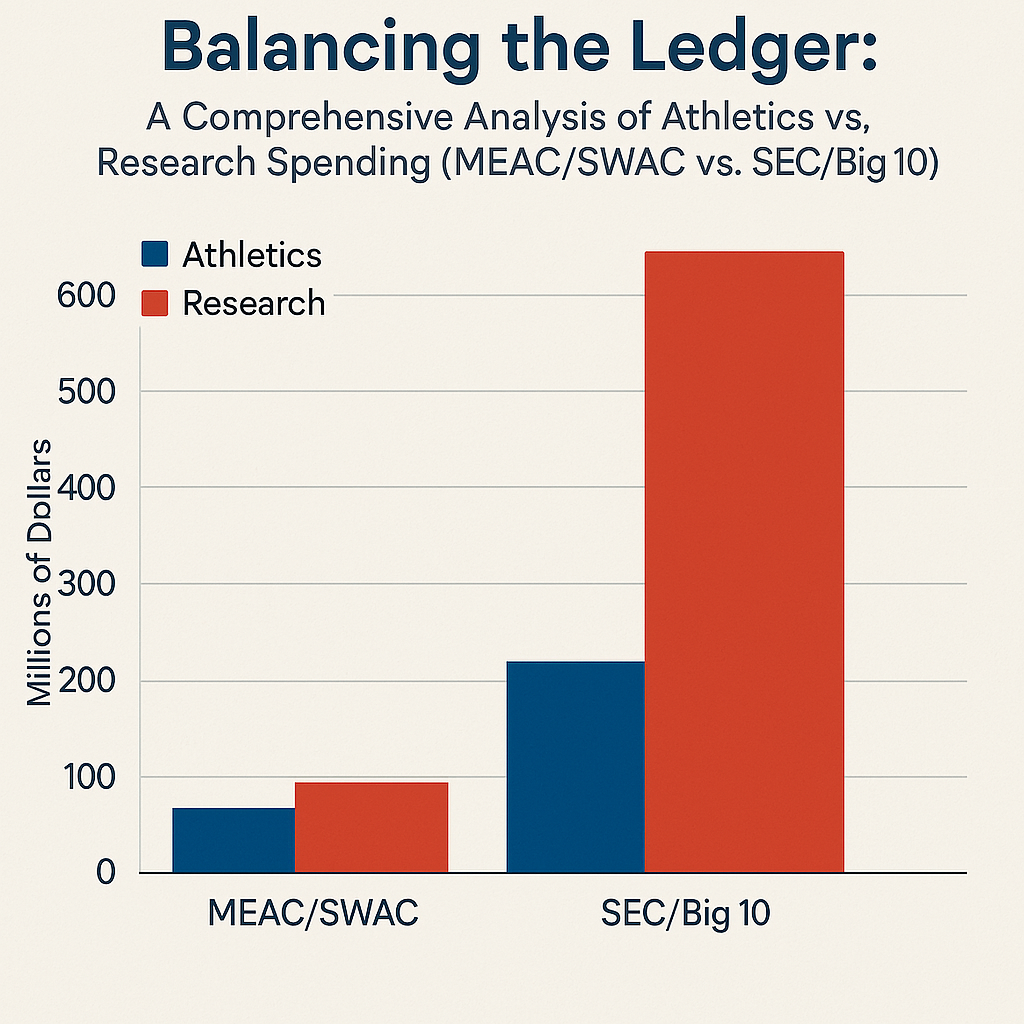
The athletics-to-research spending ratio offers a lens into institutional philosophy:

  • Norfolk State: 2:1 athletics to research
  • Jackson State: 0.7:1
  • Mississippi Valley State: 6:1
  • Alabama: 0.15:1
  • Michigan: 0.11:1
  • Wisconsin: 0.11:1

While SEC and Big Ten schools spend more on athletics than HBCUs, they also spend exponentially more on research. The imbalance within HBCUs is a reflection not of poor prioritization, but of systemic capital deprivation. These ratios also underscore how HBCUs are often forced to choose between visibility and viability, between entertainment and innovation, because they lack the financial bandwidth to pursue both.

Research as Revenue: Commercialization and the Innovation Economy

University research is not merely an academic endeavor it is a gateway to commercialization. Inventions born in labs often become patents. Patents become licensing agreements. Licensing revenue, in turn, flows back into the institution. The University of Florida’s development and commercialization of Gatorade yielded more than $280 million over time. Stanford’s involvement in launching Google and Hewlett-Packard has helped fuel its $36 billion endowment. Wisconsin’s WARF fund manages $4 billion in research-derived assets.

This model is not just aspirational; it is replicable. But replication requires infrastructure, policy, and intention.

Building the Infrastructure: A Two-Track Strategy for HBCUs

Campus Infrastructure

  1. Strengthen Technology Transfer Offices (TTOs): These serve as the conversion points from research to revenue. TTOs are responsible for managing patents, evaluating commercial potential, and negotiating licensing agreements.
  2. Invest in Innovation Facilities: Makerspaces, incubators, wet labs, and data science centers can all be built in underused buildings or retrofitted spaces.
  3. Embed Commercialization in Curriculum: Courses in IP law, venture creation, product development, and ethics should be available to both undergraduates and graduate students.
  4. Create Campus Accelerators: Provide seed funding, pitch competitions, and alumni mentorship. These accelerators can be industry-specific (e.g., AgTech at Tuskegee, FinTech at Howard).
  5. Celebrate Wins: Every patent, startup, or licensing deal should be internally recognized and externally marketed. Visibility breeds validation and investment.

Capital Infrastructure

  1. Black-Owned Banks: Offer startup lines of credit and financial education embedded in innovation ecosystems. These institutions can also hold endowment funds or manage cash flow from royalty revenues.
  2. Diaspora Sovereign Wealth Funds: Channel African and Caribbean capital into HBCU startups and joint ventures. Funds like Nigeria’s NSIA or Pan-African VC firms could provide growth capital.
  3. HBCU Venture & Endowment Funds: Seeded by Black VC firms, family offices, and institutional investors. These funds can create co-investment syndicates for promising faculty or student ventures.
  4. Donor-Advised Funds (DAFs): Enable alumni to contribute to IP pipelines through tax-efficient giving. DAFs could also be matched by corporate sponsors or philanthropic partners.

Building Strategic Partnerships for Scale

HBCUs need not operate in silos. Strategic collaboration can accelerate commercialization and R&D outcomes:

  • Inter-HBCU R&D Collaboratives: Morgan State and FAMU could co-sponsor patent consortiums.
  • Cross-registration commercialization programs with PWIs like Johns Hopkins or Emory.
  • Statewide HBCU innovation districts tied to workforce pipelines and rural development.

From the Lab to the Ledger: Case Studies in ROI

  1. University of Florida – Gatorade: In the 1960s, UF researchers developed a hydration drink to help football players endure Florida’s brutal heat. The result, Gatorade, has yielded over $280 million in licensing revenue. These funds helped UF build research infrastructure, attract top scientists, and grow its endowment.
  2. Stanford University – Silicon Valley: Stanford was not always wealthy. Its proximity to innovation and its open policies toward student and faculty entrepreneurship led to the creation of Google, Cisco, and more. Today, Stanford’s alumni-founded companies generate trillions in global market value.
  3. University of Wisconsin – WARF: Established in 1925, the Wisconsin Alumni Research Foundation has monetized research in Vitamin D, stem cells, and imaging. With over $4 billion in assets, WARF reinvests in faculty, students, and commercialization pipelines.
  4. MIT – Ecosystem Builders: MIT’s Deshpande Center and The Engine Fund act as innovation pipelines that commercialize tough tech. MIT startups have created over 4.6 million jobs globally.

What HBCUs Must Avoid: Dependency Without Ownership

Too often, HBCUs have served as intellectual suppliers while other institutions and corporations reap the financial rewards. Faculty develop ideas, only for those patents to be captured by universities with larger TTOs. Students build prototypes, only to license them under incubators unaffiliated with their home campus.

To shift this paradigm, ownership must be embedded from the start. That means building institutional IP portfolios and teaching students the economics of invention.

A Circular Ecosystem Rooted in Culture and Capital

StakeholderRole in the Pipeline
Black-Owned BanksStartup capital, credit access, and embedded finance literacy
Diaspora Wealth FundsStrategic investment, global partnerships, and joint IP deals
African American NPOsStakeholder investors, endowment builders, and R&D supporters
Black Media & AlumniNarrative shaping, promotional power, and advocacy
HBCU TTOs & LeadershipPatent management, research development, and startup formation

Final Calculations: Wealth Is Institutional, Not Individual

The data from MEAC, SWAC, SEC, and Big Ten schools paints a vivid picture of the financial landscape of higher education. While SEC and Big Ten schools show that it is possible to be excellent in both athletics and academics, MEAC and SWAC institutions face tougher choices due to structural inequalities and historical underfunding.

As conversations around equity, student success, and public accountability continue, this kind of comparative data is essential. Whether aiming for a championship or a Nobel Prize, universities must remember that their ultimate mission is to educate, innovate, and uplift communities.

University research isn’t just about publications and academic prestige it’s a launchpad for innovation, economic growth, and financial sustainability. When strategically supported, it becomes a core driver of commercialization, entrepreneurship, and long-term prosperity through patents and endowment growth.

Many HBCUs and smaller institutions already are incubators of brilliance but they’ve been left out of the research-to-wealth pipeline due to underfunding and limited infrastructure. With targeted investments and smart policy, they can flip the script and become not just engines of education, but engines of innovation and wealth creation.

Disclaimer: This article was assisted by ChatGPT.

A Letter To Malcolm

I’ve always been a poet. My dad went to Lincoln University with Gil-Scott Heron, so I came out of the womb listening to Gil-Scott Heron. – Malcolm Jamal-Warner

Dear Malcolm,

I will never forget where I was when the alert came on my phone. I was sitting in the woods for work. We were having a retreat of sorts in the Santa Fe National Forest for the morning. The cellphone service was spotty at best and most of the time my service said SOS. But every now and then I would get one bar and notifications would come pouring in. Around late morning early noon an alert from the Associated Press came in that you had passed and my entire insides collapsed. I had to find every way I could to hold it together. The disbelief helped. That cannot be right, but of course it coming from the Associated Press made it almost impossible for it to be an error. Yet, I hoped it was. My mind raced to find composure. I certainly could not shout out what I just saw on my phone. It would not make sense to anyone around me. While I am sure there are some around my age that work with me I cannot readily think of who. Even moreso, I am the only African American in my organization. It would not make sense to anyone to break down in tears at that moment. To have to explain why you are crying over a celebrity, but in a space of African Americans we know you were never that even if you were that.

It is complicated at times to understand cousins and play siblings AKA “Brother/Sister from another Mother” to those outside of our community. These connections are deep and I do mean DEEP. There are cousins who I have not spoken to in years who could call me right now and I would get on the first plane smoking to go defend them in whatever capacity they needed. They just need say the word. You became that to so many of us. A cousin and/or brother from another mother. You were an eclectic soul and that meant the world to me. You explored the world and your curiousities without feeling bound. Something I so deeply value in my own life. To explore your interests without worry of what anyone would think and say. Many wish they could live life without those restrictions and you did it effortlessly. You never “Sold Out” or went “Hollywood” on us. You were always willing to speak up and speak about the African American community in a manner that felt real and felt true. I appreciated that despite your own admitted struggles of feeling like enough you overflowed the cups of so many African American boys and girls who grew up with you.

Since you left us I kept thinking about how to describe you to the world as I saw you. You were a regular Brotha who was EXCEPTIONAL. That is all I keep thinking as I grapple with the tears of knowing another Brotha being gone far too soon. I took for granted that we would see you in our older years. That you would continue to impart your wisdom of how you saw the world and just the shining example of being an African American man, son, brother, husband, father, and all the complex layers that come with the lives we live.

There is no need to discuss your accomplishments. We all know them. We all lived them with you. I told a friend today you were someone who I wished I could meet one day and share ideas for our community and knew you would understand. They would be ideas you would love and embrace and support. For me, there are so few that I believe I could have those conversations with in the world and deeply saddens me that now there is one less person in this world I feel I can realte to and who would understand me. It took a lot to hold it together the rest of that day. Until I get home and sit with the stages of grief that it feels like the entirety of African America is trying to find the words for day after day right now. I think about your daughter and wife. How you really were the regular guy just enjoying a family vacation. The regular guy who loved being a father and put her flower in your fitted cap as you left us your final message. It still feels like one of the worst dreams I have ever had. For a community that needs good Brothas and often feels like we have too few this is a blow that I am uncertain we will ever an answer for anytime soon – if ever. I could go on, but there is no need. All I can do, all any of us can do from today forward is think of you, reminisce of you, and try each day to carry just a little of the light you showed to the world in our own way.

May the Ancestors welcome you home.

Your Cousin and Brother from Another Mother,

William

Powell’s Precarious Position: What HBCU Real Estate Investors Must Prepare For

“Real estate power does not wait on political peace—it plans around it.”HBCU Money

In commercial real estate, calm markets are often a prerequisite for aggressive growth. When volatility creeps in—especially from policy uncertainty—wise investors do not panic, but they do reposition. As rumors swirl that Federal Reserve Chair Jerome Powell may be removed from office before the end of his term, the CRE market is already baking in disruption. For HBCU alumni who invest in real estate, this moment demands attention, strategy, and foresight.

Although Powell’s official term runs through May 2026, and he can technically serve until 2028, market insiders are moving as if his exit could happen sooner—possibly under a second Trump administration. On July 17, GlobeSt.com reported that commercial real estate markets are increasingly factoring in political risk, with deal structures, loan pricing, and capital flows tightening ahead of any actual policy change.

For HBCU alumni who have spent years assembling rental portfolios, developing mixed-use properties, or backing Opportunity Zone projects near campuses, this isn’t abstract economic theory. This is cash flow, cap rates, and leverage dynamics in real time.

The Federal Reserve controls interest rates, liquidity, and lending standards—the lifeblood of commercial real estate. But the Chair also shapes expectations. Even the perception of instability at the Fed causes lenders to pull back and investors to reprice assets.

Jerome Powell has been seen as a steady hand, even when unpopular. His cautious rate policy—especially amid post-pandemic inflation—kept CRE markets from overheating or crashing. But if he’s ousted or disempowered, markets may expect more aggressive rate cuts under political pressure, a weakening dollar complicating international investment and supply chain costs, and a loss of institutional independence introducing a political lens into every Fed decision.

For HBCU alumni real estate investors, it means more volatile borrowing costs, reduced predictability in returns, and a need to re-evaluate how aggressively to pursue expansion or refinance.

Lenders are tightening up—and they are doing so before Powell is removed. That should concern anyone whose real estate model is sensitive to capital cost.

Bridge and construction loans are becoming harder to secure without pristine credit and higher equity injections. Cash-out refinances—especially for small portfolios—are being capped or delayed altogether. Development deals in low-income communities (where many HBCU graduates invest as a mission) are being scrutinized harder or shelved entirely.

As one investment banker told GlobeSt, “We’re seeing deals priced as if Powell’s out in six months, and we’re living in a very different rate environment.” It’s not a prediction—it’s a hedge. And HBCU alumni need to do the same.

If you’re invested in—or considering entering—any of the following CRE asset classes, Powell’s fate may shape your returns:

CRE SectorRisk From Fed Instability
MultifamilyRising rates hurt acquisitions and refinancing; rent growth may not keep up with cost of capital
RetailAlready under pressure from e-commerce; volatile rates shrink tenant pool and landlord leverage
HospitalityHeavily exposed to economic cycles; refinancing becomes challenging if Fed turmoil hits
Industrial/LogisticsGenerally stable, but price compression expected if Fed credibility drops
Development ProjectsMost vulnerable—cost of capital, input inflation, and credit availability all in flux

HBCU alumni often favor multifamily and mixed-use in urban corridors. That makes preparation even more critical.

Let’s be clear: instability in the Fed disproportionately hurts Black real estate investors.

Less institutional capital backing Black developers means higher reliance on bank debt. Lower net worth and liquidity reserves can make it harder to endure tightened credit cycles. Projects in historically Black neighborhoods—often underinvested already—face greater scrutiny from conservative lenders during uncertain times. And Black investors are more likely to reinvest locally, meaning pullbacks hit community wealth and revitalization efforts harder.

If you’re financing student housing near Howard, renovating a historic property near Southern, or redeveloping land near Fort Valley State, you may suddenly find banks “reassessing” your application—not because of your deal, but because of Washington.

HBCU alumni have a legacy of building through adversity. This moment demands no less. Key investor moves right now include:

Renegotiate your debt terms while rates are still predictable. If your loans mature in 2026 or 2027, the window to lock in current rates or secure extensions is closing. Powell’s tenure—and potential replacement—will shape forward rate curves. Beat the volatility while you still can.

Shift to fixed-rate debt. Adjustable-rate debt was cheap two years ago. Now it’s a ticking time bomb. Consider refinancing into fixed-rate debt, even at a slight premium, to gain stability and prevent future cash flow disruptions.

Expand your lender relationships. Do not depend on one or two institutions. Build ties with Black-owned banks, CDFIs, and credit unions aligned with HBCU values. These institutions may have more mission-aligned flexibility if traditional banks tighten up.

Build a liquidity cushion. Discipline now prevents desperation later. Liquidity is the real hedge during economic uncertainty—especially if tenants default, contractors raise costs, or refinance windows close.

Delay discretionary projects. This is the time to tighten pro formas, not push for maximum leverage. If a deal still pencils at 9% debt, proceed. If it only works at 6%, wait.

Pool capital. Use alumni associations and real estate clubs to form investment syndicates. One investor may get denied a $5M deal. Five alumni together might get approved for $25M. Leverage unity, scale, and relationships.

Crisis also presents acquisition opportunities. There will be distressed sellers needing to offload assets quickly, developers unable to complete projects, and landlords who can’t refinance expiring loans. HBCU alumni, especially those with capital or credit, should keep an eye out. Joint ventures among alumni can create scale and deploy capital when others retreat. Use this time to buy smart, not fast.

Beyond Powell himself, it’s the Fed’s credibility that gives investors confidence to commit capital to 10–30 year projects. If a new Chair appears beholden to political pressure, markets may price in new risks to long-term bonds, accelerate inflation fears, and depress asset values. That would slow not just your next project—but the next generation’s.

That is why HBCU alumni must take this seriously, not just as investors—but as stewards of intergenerational wealth.

HBCU institutions also have a role to play. They can create alumni investment syndicates that provide deal flow and capital. They can offer discounted land or property near campus to alumni developers. They can develop relationships with mission-driven lenders and introduce alumni projects for financing. And they can host economic briefings and real estate strategy sessions to keep their alumni sharp and agile in rapidly changing markets.

Colleges like Tuskegee, Texas Southern, and FAMU have alumni who are reshaping skylines. These institutions must recognize this as an extension of their impact—and protect it.

The Federal Reserve Chair is not a figurehead. Powell’s potential removal would represent a seismic shift in economic planning—especially for real estate. For HBCU alumni, many of whom have built their portfolios in the shadows of systemic exclusion, the message is clear: this is not a time to panic—but it is time to prepare.

Build alliances, lock in rates, stockpile liquidity, and be ready. The future of our neighborhoods, our campuses, and our financial independence will be shaped by how we respond to this moment.

And if the rest of the market goes quiet, remember: Black investors have never needed perfect conditions to build power—we’ve just needed a plan and each other.

Disclaimer: This article was assisted by ChatGPT.
Healthier Workers, Less Insurance Costs: Why Companies Should Bring Physical Education To The Workplace

“Health is not valued till sickness comes.” – Thomas Fuller

For most in the United States during the first 18 years of their life once they enter the K-12 system they are required to participate in physical activity for one hour a day. Once they leave the K-12 system, unless they voluntarily are an active person we see a precipitous decline in physical activity overall with each passing year and decade declining further and further. As life events happen like marriage, children, and others that decline is likely to become even more dramatic. This for many, while sitting at an office or working from home 8-10 hours a day.

How physical education in the workplace is becoming a strategic investment in health, morale, and the bottom line

In the early 20th century, a worker might find a gymnasium nestled inside a factory, next to the cafeteria or above the warehouse floor. Industrial giants like Ford Motor Company and Pullman believed that a healthy worker was a productive one. Then came the white-collar revolution, and fitness was outsourced to the private sphere. But as chronic disease rates climb and employer healthcare costs spiral upward, companies are again looking inward—this time to yoga mats and standing desks.

The reintroduction of physical education (PE) into the workplace is no mere wellness fad. In the age of burnout, sedentary jobs, and hypercompetitive talent wars, physical activity has evolved into a strategic imperative. Companies that once prized proximity to Ivy League MBAs now seek proximity to hiking trails, bike lanes, and boutique gyms. Remote work may have altered where we work, but it has not changed the fact that workers, like machines, require routine maintenance.

A new breed of employer, from start-ups to Fortune 500 firms, is making a case for fitness as a lever of cost control, employee retention, and morale. The evidence, increasingly, supports them.

The Quiet Crisis of Sedentarism

The modern office is a crucible of inactivity. According to the World Health Organization, physical inactivity is the fourth leading risk factor for global mortality, responsible for 3.2 million deaths annually. American workers, particularly in tech, finance, and administrative roles, sit for an average of 10 to 13 hours per day. A study by the CDC found that sedentary office jobs contribute significantly to obesity, cardiovascular disease, and Type 2 diabetes—all conditions with direct cost implications for employers.

Workplace-related healthcare costs in the United States are a quiet crisis. The U.S. spends more per employee on healthcare than any other developed country, with employer-sponsored health insurance accounting for over $1.3 trillion in annual expenditures. For companies that self-insure, the connection between employee health and the bottom line is brutally direct.

The economic rationale for workplace fitness programs thus begins with the simple arithmetic of prevention. A study by Harvard researchers found that medical costs fall by about $3.27 for every dollar spent on wellness programs. Moreover, companies report reduced absenteeism, improved productivity, and fewer disability claims.

From Gym Perk to Health Strategy

The workplace fitness revolution has quietly evolved beyond on-site gyms. While Silicon Valley once wooed engineers with climbing walls and nap pods, the new emphasis is on integrated wellness architecture—spaces and schedules designed to facilitate movement throughout the day.

“Fitness is no longer a perk; it’s a strategy,” says Dr. Lena Gupta, a workplace health consultant based in Washington, D.C. “We’ve moved from subsidized gym memberships to embedded physical literacy—movement as part of the workday, not something squeezed in before or after.”

The emerging gold standard includes standing meetings, ‘active breaks’, group workouts during lunch hours, and even walking audits of corporate campuses. Some firms are experimenting with “movement nudges”—AI-generated reminders to stretch, walk, or perform micro-exercises during long Zoom calls.

But the centerpiece of this strategy is structured physical education, inspired by traditional PE curriculums in schools. Think guided classes in mobility, resistance training, posture correction, cardiovascular endurance, and mindfulness, all tailored for adult bodies and office constraints.

A Return on Health Investment

For all the enthusiasm around morale and culture, it is the actuarial tables that are tipping decisions. Chronic diseases account for 90% of America’s $4.1 trillion in annual healthcare spending. Of these, many are lifestyle-driven—meaning, preventable.

Companies are discovering that workplace fitness programs can dramatically reduce the incidence and severity of these diseases. Johnson & Johnson, which has run one of the longest-standing corporate wellness programs in the U.S., reports annual savings of $225 per employee through reduced medical claims. Bank of America, which introduced PE-like programs as part of its health initiative, saw employee turnover drop by 25% over five years.

Critically, such programs also reduce presenteeism—the hidden cost of employees who are physically present but unwell or disengaged. According to a study by the Journal of Occupational and Environmental Medicine, productivity losses due to health-related issues are estimated to cost U.S. employers $225.8 billion annually.

The Morale Multiplier

Physical education at work does more than extend lifespans or reduce claims. It builds camaraderie. Shared movement is one of the few rituals that transcends hierarchy, industry, and age. A lunchtime yoga session or post-work cycling group allows interns to sweat beside executives. This flattens organizations and strengthens culture.

More importantly, it signals care. In a Gallup poll, employees who feel their employer is genuinely concerned for their well-being are 69% less likely to search for a new job. At a time when burnout is driving the Great Resignation and Gen Z expects holistic benefits, the presence of a PE program can differentiate employers in a fiercely competitive labor market.

“You don’t need bean bags and kombucha,” says Rashida Bellamy, head of HR at a mid-sized fintech firm in Chicago. “You need to show that you’re investing in health—physical, emotional, communal.”

Retention through Rejuvenation

It is no accident that companies with robust wellness cultures also tend to have high retention rates. A 2023 report by Deloitte found that 77% of employees are more likely to stay at a company that prioritizes their well-being. For millennials and Gen Z—who now comprise over half the workforce—flexibility, purpose, and health are inseparable.

PE programs also play a quiet role in institutional knowledge retention. When employees feel better physically, they are less likely to take long-term medical leave, retire early due to preventable illnesses, or disengage from developmental opportunities.

Consider this: a mid-level manager with 12 years of firm-specific knowledge leaves due to burnout-induced hypertension. Replacing her may cost upwards of 150% of her salary when factoring in lost productivity, recruitment fees, and onboarding time. If a $500-a-year investment in fitness classes could retain her, the cost-benefit ratio is impossible to ignore.

Barriers and Blind Spots

Despite their promise, workplace fitness programs face real challenges. The first is space. Not all companies have campuses or in-house gyms. Urban firms in high-rent buildings may find it difficult to dedicate square footage to wellness.

The second is participation. Programs often fail due to lack of buy-in. Employees feel guilty leaving their desk. Managers send mixed signals. Without top-down modeling, fitness initiatives wither.

Third, there’s the inclusion gap. Not all bodies, ages, or cultural backgrounds approach physical activity the same way. A CrossFit session at 6am may thrill a 29-year-old developer but alienate a 52-year-old accountant managing arthritis.

Smart companies address these challenges by being deliberate. Fitness should be normalized—not exceptionalized. It should be inclusive, adaptive, and aligned with performance, not just aesthetics. Firms like Salesforce, for instance, offer tiered wellness programs, from chair yoga and desk stretching to high-intensity bootcamps, each guided by professionals trained in adaptive movement.

From Fitness to Policy

The rise of workplace physical education is not purely a private trend. Public policy is beginning to take note. In the U.K., companies receive tax breaks for providing certain wellness benefits. In Germany, the government subsidizes up to €500 per employee for approved health-promoting workplace activities. In the U.S., wellness programs can be tied to health savings accounts (HSAs), with the potential for future tax incentives.

More provocatively, some economists are arguing that workplace fitness could become part of national health strategy. If chronic disease is a macroeconomic risk, then workplace movement is not just a human resources issue—it’s a matter of national competitiveness.

The Future of Corporate Kinesiology

The most forward-thinking firms now view workplace movement as part of corporate infrastructure. Just as Wi-Fi, lighting, and HVAC systems became essential, so too will movement pathways, fitness pods, and employee biometric monitoring. In the age of wearable tech, companies may eventually optimize workflows around energy cycles and physical rhythms.

Already, some start-ups are experimenting with “kinesiology-as-a-service”—subscription-based platforms that provide customized movement plans, daily challenges, and performance tracking for hybrid teams. Others are integrating wellness directly into task management tools, prompting users to stretch between emails or walk during calls.

In this vision, physical education is not a nostalgic return to high school gym. It is a reinvention of the workday itself—a dynamic, embodied, and biologically attuned experience.

Moving the Bottom Line

For all the metrics, charts, and ROI calculations, the case for physical education at work comes down to a simple truth: humans were not designed to sit 10 hours a day staring into blue light. The modern workplace must evolve—not only to optimize performance, but to safeguard the humanity of its workers.

In doing so, companies may rediscover something long forgotten in the drive for efficiency: that a healthier, happier employee is not a cost, but a compounding asset.

Benefits of Physical Education in the Workplace

  1. Enhanced Employee Health and Wellness
    Regular physical activity reduces the risk of chronic illnesses like obesity, diabetes, and heart disease. This leads to fewer medical claims, contributing to significant long-term savings on healthcare costs for employers.
  2. Lower Long-Term Healthcare Costs
    By promoting physical fitness, companies can reduce the frequency and severity of employee health issues. This not only lowers healthcare premiums but also decreases out-of-pocket expenses for employees, boosting their overall satisfaction and loyalty.
  3. Improved Productivity and Focus
    Exercise boosts cognitive function, energy levels, and alertness. Employees who engage in regular physical activity are better equipped to tackle their work with greater focus and efficiency.
  4. Higher Employee Morale
    Group fitness activities, wellness challenges, and company-sponsored health initiatives foster a sense of community and belonging. Employees who feel supported in their well-being are generally more positive, motivated, and satisfied with their workplace.
  5. Reduced Stress and Burnout
    Physical activity is a proven method for managing stress. Offering workplace fitness programs helps employees cope better with demanding workloads, resulting in improved mental health and a more resilient workforce.
  6. Improved Employee Retention
    Wellness programs, including physical education, demonstrate a company’s commitment to its employees’ well-being. Such initiatives are attractive to job seekers and help retain current staff by reinforcing a supportive and health-conscious work culture.
  7. Stronger Workplace Culture
    Fitness initiatives encourage teamwork and camaraderie, fostering stronger interpersonal relationships among employees. This contributes to a more cohesive and collaborative workplace environment.

How to Introduce Physical Education in the Workplace

  1. On-site Fitness Classes
    Offer yoga, pilates, Zumba, or aerobics classes during lunch breaks or after hours.
  2. Dedicated Fitness Spaces
    Provide gyms or multipurpose rooms equipped with fitness gear. Even small spaces with basic equipment can make a big difference.
  3. Wellness Challenges
    Organize step competitions, fitness challenges, or team-based activities. Provide rewards such as gift cards or extra vacation days to incentivize participation.
  4. Active Breaks
    Encourage employees to take short, active breaks during the day to stretch, walk, or do light exercises.
  5. Collaboration with Professionals
    Partner with trainers, therapists, or health coaches to offer tailored programs and guidance.
  6. Flexible Work Hours
    Allow employees to integrate physical activity into their schedules without feeling penalized for stepping away from their desks.
  7. Outdoor Activities and Events
    Plan outings like fun runs, team hikes, or charity sports events that combine fitness with social engagement.
  8. Fitness Subsidies
    Provide financial support for gym memberships or home fitness equipment to remove cost barriers for employees.

Challenges and Solutions

  1. Limited Resources
    • Solution: Start small with walking groups or virtual fitness programs, and grow the initiative as resources allow.
  2. Low Participation Rates
    • Solution: Offer diverse programs that cater to various fitness levels and interests. Create an inclusive environment and incentivize participation with rewards.
  3. Initial Costs
    • Solution: Frame the program as an investment that will yield long-term savings on healthcare and employee turnover. Over time, cost reductions in other areas can offset the upfront expenses.

The Long-Term Impact

Investing in workplace physical education yields far-reaching benefits. Companies can reduce healthcare costs by minimizing the risk of chronic illnesses, while higher employee morale contributes to a more motivated and engaged workforce. Employees who feel valued and supported are more likely to stay with the organization, reducing turnover and recruitment costs. By fostering a culture of health and well-being, companies not only enhance individual employee lives but also ensure the organization thrives.

If the State Won’t Pay, the Rich Must: The $27.5 Billion Endowment Public Broadcasting Now Requires

“In the absence of state support, those with capital must decide: will they merely enjoy the benefits of a stable society—or invest in the institutions that make it possible?”
Arielle Morgan, Senior Fellow, Institute for Civic Infrastructure

The withdrawal of $1.1 billion in federal funding from the Corporation for Public Broadcasting is not merely a fiscal adjustment—it is a structural dislocation. It marks the effective end of a decades-long social contract in which the U.S. government ensured the existence of a nationwide, non-commercial broadcasting ecosystem intended to serve the public interest. For PBS, NPR, and their hundreds of affiliate stations across the country, the clock is now ticking toward an uncertain future.

But if the U.S. government is no longer willing to fund public broadcasting, another powerful bloc may have to: the ultra-wealthy and the corporations that have long built brand equity on the back of public trust and public platforms. In other words, the very elite who most benefit from stability, reliable information, and a functioning democracy may now be expected to underwrite one of its most foundational institutions.

The price tag? $27.5 billion.

A Simple, Uncomfortable Equation

To replace $1.1 billion in federal funding with investment returns, the equation is straightforward. Using a conservative draw rate of 4%—commonly applied by universities and foundations to ensure long-term preservation of capital—an endowment of $27.5 billion would be required to generate that annual payout.

This is not a charity exercise. It is a capital strategy.

To reach this target, two basic donor models stand out:

  • 275 individuals contributing $100 million each
  • 2,750 individuals contributing $10 million each

These figures are within striking distance of the top echelon of American wealth. As of 2024, the United States had over 800 billionaires and more than 23,000 centi-millionaires (individuals with $100 million or more in net worth). Put bluntly, it would require only 1.2% of America’s centi-millionaires to secure the future of public broadcasting in perpetuity.

What’s at Stake for the Elite

There is a growing recognition—even among the ultra-wealthy—that civil society must be preserved, even if governments no longer have the capacity or political will to do so. The fragility of liberal democracy, demonstrated by political polarization, misinformation, and institutional distrust, poses long-term risks not only to the electorate but also to markets, capital flows, and reputational value.

Public broadcasting—independent, educational, and widely trusted—has long been a stabilizing force in this ecosystem. Its reach into rural towns, inner cities, and suburban households makes it a conduit for shared narratives and factual baselines. It is not exaggeration to say that NPR and PBS, through All Things Considered, NewsHour, Frontline, and Sesame Street, have helped preserve a measure of social cohesion in a deeply divided country.

For the ultra-wealthy, losing this infrastructure would not simply be a cultural loss. It would be a strategic risk.

Hence the question: if the state won’t fund it, why won’t they?

The Precedent Is There

Large-scale philanthropic endowments are nothing new. In the past two decades:

  • Michael Bloomberg has donated over $3.3 billion to his alma mater Johns Hopkins University.
  • MacKenzie Scott has given away over $16 billion since 2019.
  • The Gates Foundation operates with a $67 billion endowment and deploys billions annually to global health and education initiatives.
  • Ken Griffin recently contributed $300 million to Harvard University.

Yet public broadcasting—a sector with tangible civic impact—has rarely drawn the same scale of contribution. This may be due in part to its status as a federal recipient, which gave the impression of permanence and stability. That illusion has now evaporated.

What remains is the opportunity to build a truly private-public media model—one whose operating capital is drawn from private wealth but whose editorial independence is legally insulated from donor interference.

A Corporate Response to a Public Crisis

Philanthropists are not the only entities positioned to act. Corporations, particularly those with vested interests in news, content, or public trust, have a strategic imperative to help capitalise such an endowment. Among the most obvious candidates:

  • Technology firms such as Apple, Amazon, Google, and Meta, which dominate digital content distribution and advertising, but face persistent scrutiny over misinformation and platform responsibility.
  • Media conglomerates such as Comcast, Disney, and Paramount, whose own news divisions benefit from a well-informed public and a credible informational ecosystem.
  • Financial firms such as JPMorgan Chase, Goldman Sachs, and BlackRock, for whom geopolitical and social stability underpin long-term asset growth.

Indeed, a structured vehicle—such as a Public Broadcasting Endowment Corporation (PBEC)—could allow corporations to make long-term contributions that are tax-deductible, reputationally beneficial, and materially impactful. Their names need not appear on programming or editorial decisions; the return on investment would be brand credibility and a stronger civic framework.

Moreover, such a fund could become a flagship ESG initiative—aligning corporate interests with measurable civic outcomes.

Structuring the Capital Stack

A diversified funding approach would enhance resilience and buy-in. A potential framework:

Donor TypeTarget ContributionTotal
275 HNWIs @ $100M$27.5 billion100%
OR
1,000 HNWIs @ $10M$10 billion36%
100 Corporates @ $100M$10 billion36%
Broad-based campaign$7.5 billion28%
Total$27.5 billion100%

A broad-based campaign could also complement elite contributions. Imagine a national “Democracy Dividend” campaign: one million Americans pledging $1,000 annually for ten years. That alone would yield $10 billion—a testament to public commitment alongside private wealth.

From Pledge Drives to Private Equity

Public broadcasting has traditionally raised funds through grassroots donations and corporate underwriting. But this model is no longer viable on its own. What is required is a transition from pledge drives to portfolio management.

The envisioned endowment would be governed by a professional board and investment committee, structured similarly to major university endowments. Earnings would be deployed annually to:

  • Sustain local PBS and NPR affiliates, especially in underserved areas
  • Support original investigative journalism and children’s educational content
  • Fund innovation in digital and streaming public media
  • Preserve and digitize historic programming archives
  • Maintain emergency broadcast systems and rural information networks

Crucially, editorial integrity would be enshrined by legal charter—preventing donors or sponsors from influencing content.

Philanthropy as Infrastructure

Too often, philanthropy is reactive—applied to symptoms rather than systems. An endowment, by contrast, is structural. It is a recognition that certain institutions are too important to be left at the mercy of annual budgets, market swings, or election cycles.

The erosion of federal support for public broadcasting is a warning signal. The infrastructure of civic life—fact-based journalism, educational programming, and communal storytelling—requires capital insulation, not just ideological support.

This is not about saving Big Bird or Masterpiece Theatre. It is about fortifying one of the last remaining platforms where Americans—regardless of political identity or geography—encounter one another not as algorithms or enemies, but as citizens.

Will the Wealthy Step Up?

The government has walked away. The funding gap is real. But the wealth to close it is readily available.

If even a fraction of the world’s wealthiest individuals and corporations stepped forward with capital rather than condolences, the future of public broadcasting could shift from a question of survival to a model of strategic, sovereign independence.

In the end, it is not about whether we can raise $27.5 billion. It is whether the people most capable of doing so will finally recognise that their wealth is not a wall—but a bridge to a more stable, informed, and democratic society.

🎯 Key Facts

  • Total CPB federal subsidy rescinded: $1.1 billion
  • This funding supports both PBS and NPR, primarily by supporting local member stations.
  • Goal: Replace $1.1 billion per year in perpetuity through investment returns from an endowment.

📊 Endowment Calculation Assumptions

To generate $1.1 billion annually, the endowment must safely yield that amount without depleting principal.

ScenarioInvestment ReturnAnnual Draw RateRequired Endowment
Conservative5% return4% draw$27.5 billion
Moderate6% return4% draw$27.5 billion
Ambitious8% return5% draw$22 billion

Rule of Thumb:

  • Endowment needed = Annual Budget ÷ Draw Rate
  • So for $1.1 billion with a 4% draw:
    $1,100,000,000 ÷ 0.04 = $27.5 billion

🏛️ Comparisons to Similar Institutions

InstitutionEndowmentNotes
Harvard University$50.7B (2024)Largest university endowment
Bill & Melinda Gates Foundation$67B (2024)Largest U.S. philanthropic fund
NPRN/ADoes not have a large central endowment
Howard University$1B (2024)Largest HBCU endowment

🔄 Alternatives or Supplements

If not a full endowment, partial coverage models could include:

  • A $5B–$10B endowment paired with annual fundraising
  • Public-private consortiums involving universities, foundations, and philanthropists

💡 Final Recommendation

To fully replace the $1.1B annual CPB subsidy, a minimum $27.5 billion endowment would be needed under conservative investment assumptions.
This figure ensures long-term sustainability without needing annual appropriations or political reauthorization.

Disclaimer: This article was assisted by ChatGPT.