Monthly Archives: June 2025

Monetary Illiteracy In The Halls Of Power: When Grandstanding Replaces Governing

“It is the mark of an educated mind to be able to entertain a thought without accepting it.” — Aristotle

Each time Federal Reserve Chair Jerome Powell appears before Congress, particularly the House Financial Services Committee, a rare opportunity presents itself—one that could improve financial literacy at the highest levels of government and foster substantive dialogue on monetary policy’s profound impact on American households, businesses, and institutions. But that opportunity is almost always wasted.

Instead, the public is forced to endure yet another performance of political theater where elected officials, both Democrat and Republican, seem more concerned with going viral than going deep—more focused on five-minute gotchas than on fifty-year policy ramifications.

And for African America, whose economic institutions and family wealth face historic and systemic precarity, this continued dysfunction is not simply frustrating. It is dangerous.

The Purpose of Oversight or a Stage for Soundbites?

The Federal Reserve is arguably the most powerful economic institution in the world. Its chair, currently Jerome Powell, wields incredible influence over interest rates, inflation, labor markets, and the credit system. A hearing before Congress should be a time when policymakers probe deeply, ask sophisticated questions, and help inform the public through their own understanding.

Instead, what unfolds is often little more than ideological posturing. Members of Congress use their time to push personal or party agendas, cherry-pick statistics, or lob loaded questions with no intent of hearing the answer.

This isn’t oversight. It’s political performance art.

The House Financial Services Committee, charged with overseeing financial institutions, capital markets, and economic stability, must rise above this. Its role should be more than ceremonial. It should be educational—to itself and to the American people. But the overwhelming sense watching Powell’s recent testimonies is that most of the committee members lack even a basic understanding of how monetary policy functions, let alone how to interrogate it effectively.

Why It Matters for HBCUs and African American Economic Institutions

African America does not have the luxury of political and financial ignorance.

When inflation creeps higher, it isn’t just a line in a Bloomberg terminal. It is the difference between a Black student being able to afford books for the semester or choosing between groceries and tuition. It is a Black-owned small business having to lay off an employee because a loan’s interest rate jumped from 6% to 11%.

The lack of thoughtful interrogation of Powell’s monetary strategy reflects a more structural problem. There is a scarcity of African American economists in monetary policy circles. The Federal Reserve’s own ranks remain largely devoid of HBCU graduates, and few members of the House Financial Services Committee themselves come from economically marginalized backgrounds or have spent real time examining the consequences of macroeconomic policy on communities of color.

Yet these are the same communities most sensitive to interest rate swings, credit market freezes, or inflationary spikes.

And still, with this knowledge, Black America’s representatives—those on the committee and those adjacent—too often use their time during hearings for moral appeals or political slogans. But where is the policy meat? Where is the specificity? Where is the courage to press Powell on structural inequality in the Federal Reserve’s frameworks?

The Federal Reserve and the Myth of Neutrality

To be fair, the Federal Reserve, under Powell or any other chair, does not operate in a vacuum. But the institution often touts its political independence as a form of virtue. That independence, however, should not be mistaken for neutrality. The Fed’s policies have winners and losers.

From 2020 to 2022, the Fed’s monetary expansion saved financial markets—but also exploded asset prices, exacerbating wealth inequality. Homeowners gained equity. Renters fell behind. Banks consolidated more power while local lenders and community institutions—like Black banks—continued to struggle.

The committee could have questioned Powell on these outcomes. It could have demanded a racial wealth gap impact assessment of every major monetary policy decision. It could have interrogated how interest rate hikes disproportionately hurt historically marginalized borrowers. But those questions are never asked.

Instead, Powell is interrupted mid-sentence. Politicians talk over him. They make proclamations but ask no follow-ups. This behavior isn’t just disrespectful—it’s dangerous. And it’s a gross misuse of public time.

What HBCUs Can Teach Congress About Learning

At an HBCU, you learn that education is both a privilege and a weapon. It is something to be studied, sharpened, and used to build institutions. That approach—one rooted in discipline, humility, and preparation—is entirely missing from the House Financial Services Committee’s handling of monetary policy.

If a professor at Spelman or Howard or North Carolina A&T asked students to prepare a critique on central banking and one of those students responded with vague accusations or irrelevant political banter, they would be challenged to do better. Because rigor matters.

Imagine, instead, what would happen if HBCU economics departments had a seat at the table. Imagine if the committee regularly invited young scholars from Hampton, Morehouse, and FAMU to submit briefs or participate in Q&A sessions. Imagine a committee that used Powell’s visit as a chance to uplift new Black monetary scholars, who are often overlooked despite deep institutional knowledge.

There is no reason why an HBCU-trained economist should not be Chair of the Federal Reserve one day. But for that to happen, both access and expectation must change. We must expect more of Congress—and we must prepare ourselves to be in those seats.

The Price of Ignorance Is Paid in Communities Like Ours

Grandstanding doesn’t stabilize mortgage rates.

Political theater doesn’t ensure access to affordable credit.

Viral clips won’t help a Black farmer secure the funding needed to plant next season.

When the committee wastes its opportunity to genuinely understand and shape monetary policy, it abdicates responsibility for protecting those most vulnerable to economic volatility. Black communities cannot afford that negligence.

For instance, Powell was not questioned about how inflation-targeting might undervalue employment gains in Black communities. Nor was he asked whether the Fed’s models even consider racial employment disparities in real time. These are the kinds of questions that would surface if the committee viewed itself as learners—not performers.

A Call for Financial Statesmanship

What is needed in Congress is not just political courage but intellectual humility. An understanding that financial literacy is not just for constituents but must be a discipline practiced by lawmakers themselves.

The House Financial Services Committee could evolve into a place of high economic inquiry, a model of bipartisan dialogue around shared economic goals. But that will require members who read the footnotes of policy briefs, not just the headlines. Who consult experts across ideology. Who admit what they don’t know and ask better questions in return.

It also means creating a pipeline of informed staffers, many of whom should be HBCU-trained. Imagine a rotating fellowship where top students in finance and economics at Prairie View or Tuskegee serve one-year policy internships with members of Congress. Not only would this improve committee function, but it would democratize who gets to shape monetary discourse in the long run.

A Missed Opportunity That Cannot Keep Being Missed

Chair Powell is not infallible. His policies deserve scrutiny. But if the scrutiny is shallow, the Fed wins by default. Monetary policy deserves robust challenge—but that challenge must come with intellectual integrity, not political antics.

African American families, students, and business owners live with the real-world consequences of interest rate decisions every single day. They deserve elected officials who treat these hearings not as soundbite factories, but as classrooms—where hard questions are asked, where policies are dissected, and where the future is imagined more inclusively.

The Federal Reserve will always operate in the shadows unless Congress holds up a light. But to shine that light effectively, the House Financial Services Committee must first turn its cameras inward and ask whether it is performing or learning.

Because for communities like ours, the cost of their ignorance is far too high.

From Showtime to Shutout: What the Lakers Sale Says About Black Ownership in Sports

“Wealth is created in ownership. If you don’t own, you’re always at someone else’s mercy.” – Robert F. Smith

June 2025’s record-shattering $10 billion sale of the Los Angeles Lakers to Guggenheim Partners chief Mark Walter confirmed what many already suspected: franchise values are rocketing into the financial stratosphere. Yet the deal also spotlighted a harsher truth. After nearly a half-century of hard-court brilliance and gridiron dominance, African Americans are still largely locked out of true ownership power. This article examines why—tracing the structural barriers that keep Black wealth on the playing field instead of in the owner’s suite, and outlining the institutional reforms needed to change the score.

From the Field to the Boardroom: Still a One-Way Street

African Americans make up roughly 70–75 percent of NBA players and about 60–65 percent of NFL rosters. In the WNBA, the share is even higher. Yet across 154 combined franchises in the NBA, NFL, MLB, and NHL:

  • Zero teams are majority-owned by African Americans in the NFL, MLB, or NHL.
  • Only one historic example (Robert L. Johnson’s Charlotte Bobcats/Hornets) and one recent example (Michael Jordan, 2010–2023) exist in the NBA.

Three forces keep that door shut:

  1. Intergenerational-Wealth Deficit – Most Black athletes are first-generation millionaires, while many current owners are third- or fourth-generation billionaires.
  2. Limited Collective Capital Vehicles – Black-controlled banks and investment firms are few and undercapitalized relative to mainstream counterparts.
  3. Opaque League Gatekeeping – Franchise valuations above $4 billion and insider-driven vetting processes deter new entrants without deep networks.

The Robert L. Johnson Breakthrough—And the Mirage of Progress

On December 18, 2002, BET founder Robert L. Johnson secured the NBA’s Charlotte expansion franchise for $300 million, becoming the first African American majority owner of a modern U.S. pro team. The milestone was historic, but it proved fragile. Lacking a pipeline of Black institutional capital—no HBCU endowment co-investors, no African American businesses or firms operating as minority owners—Johnson operated alone. By 2010 he sold controlling interest to Michael Jordan, whose own 2023 exit returned the league to its status quo: African American talent on the court, minimal African American equity off it. Symbolic breakthroughs absent institutional follow-through do not create sustainable inclusion.

The LeBron Conundrum: Cultural Power Without Governance Leverage

Billion-dollar athlete-entrepreneur LeBron James epitomizes the new Black business titan—owning film studios, apparel lines, and minority stakes in Fenway Sports Group. Yet even LeBron, arguably the most financially astute athlete of his generation, cannot write a solo check for a majority share of an NBA or NFL team. Average franchise prices now exceed $4 billion in the NBA and $6.5 billion in the NFL.

LeBron’s estimated net worth, while staggering at $1.2 billion, pales in comparison to the financial firepower wielded by new Lakers controlling owner Mark Walter, who is worth an estimated $5.5 to $6 billion personally—and controls access to far greater institutional capital. As CEO of Guggenheim Partners, Walter leads a global financial firm with over $345 billion in assets under management (AUM), according to the firm’s own reporting.

That institutional reach gives Walter an unparalleled advantage: the ability to deploy capital at scale, with leverage, and over long time horizons. His 2012 acquisition of the Los Angeles Dodgers for $2 billion was just the beginning. Now, his control over the Lakers reflects how ownership is secured not by personal wealth alone—but by deep institutional infrastructure.

The gap is not merely one of celebrity or business acumen—it is one of capital architecture. LeBron’s wealth is largely rooted in earned income and venture-backed enterprises, while Walter’s access to Guggenheim’s multi-hundred-billion-dollar asset base enables him to execute major acquisitions swiftly and without co-investors.

Until African Americans gain collective control of similar institutional investment vehicles—through private equity firms, pension-managed funds, or bank-led syndicates—Black excellence in sports will continue to be celebrated on the court, but denied authority in the boardroom.

Building a Syndicate That Can Actually Write a Check

If African Americans are to move from the highlight reel to the cap table, the capital stack must shift from aspirational community pooling to institutional syndication—driven by organizations already designed to deploy large checks and assume complex risk. Pragmatism, not idealism, is the order of the day.

Capital SourceAsset BaseRealistic Deployment Rationale
Black-Owned Banks (18 nationwide)$6.4 billion in assetsFDIC-insured balance sheets, access to low-cost deposits—including the growing wave of Fortune 500 “diversity deposits”—can underwrite debt facilities or pledge Tier 1 capital to a buyout fund.
Black Investment & Private-Equity Firms (e.g., Ariel, Vista, Fairview, RLJ)$70–90 billion AUM (collectively)Deep GP/LP relationships with public pensions and foundations; experienced at assembling $100–$500 million special-purpose vehicles (SPVs) around a single asset.
HBCU Endowments (102 institutions)≈ $5 billion totalAsk for 0.5–1 percent commitments per school—$25–50 million system-wide—providing research access, internships, and brand equity rather than acting as anchors.
Athlete Sidecar FundVariableStructure a managed feeder that lets players co-invest passively (no tithes or self-directing). Capital is professionally deployed—removing behavioral risk.
Corporate & Public PensionsTrillionsMany plans reserve 5–10 percent for “emerging managers.” A Black-led sports-ownership PE fund fits this mandate.

1. Banks as Capital Bridges
Black-owned banks can’t buy teams outright, but they can warehouse capital and extend critical financial infrastructure. By leveraging corporate “diversity deposits” and issuing credit facilities, they can become crucial intermediaries that keep transaction fees and governance influence in Black hands.

2. Investment Firms as Syndicate Architects
Black-led PE firms already understand the terrain. By structuring a flagship $400–$600 million sports-focused fund, they can attract institutional LPs and scale their acquisitions from minority WNBA stakes to majority control in emerging or undervalued leagues.

3. HBCUs as Modest Strategic LPs
HBCUs should not be burdened with anchoring such funds. Instead, they can contribute symbolic capital, student talent pipelines, and academic value. For example, a 1 percent commitment from Howard or Spelman tied to naming rights or internship guarantees would align mission with opportunity.

4. Athletes & African American Families as Co-Investors, Not Donors
A feeder fund with low buy-ins and lock-up periods allows them to invest with institutional support. This protects them from high-risk self-management and ensures alignment with professional fund managers.

5. Execution Timeline

  • 2026–2028: Assemble GP team, secure $150 million from banks and PE partners, with layered support from HBCUs and athlete and African American businesses co-investors.
  • 2028–2032: Close a $500 million Fund I and acquire equity in two WNBA teams and a controlling NWSL stake bundled with real estate.
  • 2032–2037: Launch Fund II at $1 billion, targeting a controlling interest in an MLS or NBA franchise.
  • 2040: Own a major-league asset with governance representation from African American banks, investment firms, and HBCU partners—creating long-term cash flows and intergenerational wealth held by Black institutions.

Media Rights and the Power Gap

Owning teams is only half the battle. The NBA’s next domestic media deal could top $75 billion, and yet no Black-owned network will participate directly in those revenues. Streaming platforms, RSNs, data-analytics firms, and betting partnerships—all profit off Black athletic performance. Until African American institutions enter the media-rights supply chain, the revenue fountainhead remains out of reach.

Cultural Iconography, Financial Dispossession

Hip-hop tracks blare in arenas, sneaker culture drives merchandise sales, and social-media highlights fuel league engagement—but licensing profits flow to predominantly white ownership groups. Careers end; ownership dynasties do not. The average NFL tenure is 3.3 years; Robert Kraft has owned the Patriots for 31 years. Equity compounds; salaries evaporate.

From the Boardroom, Not the Ball Court: Where Owners Really Make Their Money

A glaring misconception is that sports fortunes begin with sports talent. In practice, franchise control stems from non-sports industries:

OwnerTeam(s)Primary Wealth Source
Steve BallmerLA ClippersMicrosoft stock
Stan KroenkeRams, Nuggets, ArsenalReal estate / Walmart marital fortune
Robert KraftPatriotsPaper & packaging
Mark CubanMavericksBroadcast.com tech exit
Joe TsaiNets, LibertyAlibaba IPO
Josh HarrisCommanders, 76ersApollo Global Mgmt. (private equity)

None earned money playing pro sports; all deployed patient, appreciating, often tax-advantaged capital to buy franchises. In contrast, athlete income is earned, highly taxed, and front-loaded. A $200 million NBA contract, after taxes, agents, and lifestyle inflation, seldom equals the liquidity needed for a $6 billion NFL acquisition.

African Americans dominate labor yet rely on labor income to pursue ownership—an uphill climb when the ownership class uses diversified portfolios, inheritance, and leverage. The gap is not just financial; it’s structural.

A Blueprint Forward

African American banks, PE firms, and institutional investors must build syndicates that mirror the strategies of the existing ownership class—while rooting the returns inside Black institutions.

  • 2026–2030 – Launch a $500 million Fund I with contributions from banks, investment firms, HBCUs, and athletes.
  • 2030–2035 – Acquire multiple minority and controlling stakes in undervalued leagues.
  • 2035–2045 – Expand into media-rights, merchandising, and facilities ownership.
  • 2045–2050 – Control a major-league asset and use it to empower future generations via scholarships, pensions, research grants, and equity reinvestment.

Owning the Game—or Owning What Funds the Game?

The persistent call for African American ownership in major league sports raises a deeper question: Should African Americans even prioritize owning sports franchises, when we remain almost entirely absent from the very industries—technology, finance, energy, real estate—that generate the wealth used to buy these teams in the first place?

Mark Walter didn’t become the Lakers’ majority owner through basketball. He did it through Guggenheim Partners—a financial firm managing $345 billion in assets. Steve Ballmer bought the Clippers not from years of courtside ambition, but from cashing out Microsoft stock. Owners dominate sports not because of athletic brilliance, but because they own pipelines, patents, trading desks, and land—the assets that make sports ownership a byproduct, not a goal.

For African Americans, the concern isn’t just that they don’t own the team. It’s that they don’t own the banks that financed the team, the media companies that broadcast the games, or the tech platforms monetizing fan engagement. It is a misallocation of focus to aim for the outcome—sports ownership—without first entering the industries that produce ownership-level capital.

There’s no harm in wanting a seat in the owner’s box. But the more strategic question is: why not aim to own the entire ecosystem? The scoreboard. The stadium real estate. The ticketing software. The AI that tracks player stats. The advertising networks.

Athletes made sports cool. Billionaires made sports profitable. African America must ask whether it wants symbolic entry into an elite club—or whether it wants to control the industries that fund the club.

The real power isn’t just in the arena. It’s in what surrounds it. And until African Americans own those arenas—of finance, data, infrastructure, and media—they will always be positioned to play the game, but not define it.

Final Whistle

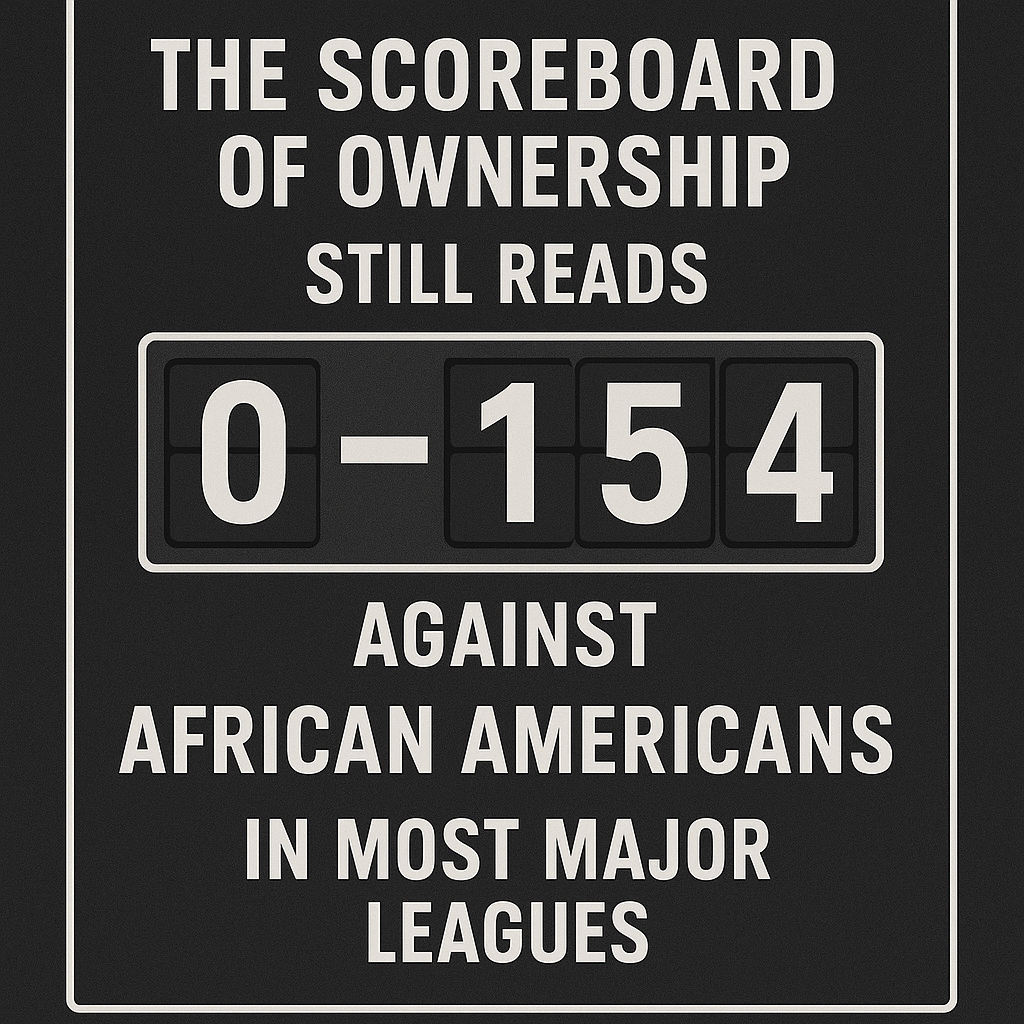
The scoreboard of ownership still reads 0-154 against African Americans in most major leagues. Talent fills highlight reels; equity fills trust funds. The route to flipping that score will not be paved by bigger contracts or more MVP trophies. It will be built through African American banks mobilizing capital, investment firms leading syndicates, and HBCU institutions gaining board seats—not just honorary jerseys.

Athletes have inspired generations. Now, institutions must finance generations.

The next dynasty to celebrate should not just hoist a trophy—it should hold a deed.

Disclaimer: This article was assisted by ChatGPT.

Has The Internet Become A Utility? No, But It Is Close

 Opportunity has power over all things. — Sophocles

I have constantly made the argument that just because you put someone on a nuclear submarine does not mean they will innately figure out how to pilot it. In fact, disaster is more likely to happen. Just giving someone access to information does not mean they will automatically know how to better themselves unless that portal is strictly designed to do so. However, the internet is filled with as much junk (if not more) than useful information. People will therefore gravitate to what they have learned to comprehend. There is the argument that having water in your home is better than not, but what if that water is more toxic than clean. The faucet becomes deadly, not helpful.

What is a utility? The dictionary defines a public utility as “a business enterprise, as a public-service corporation, performing an essential public service and regulated by the federal, state, or local government.”

Based on this definition, the internet does not quite fit the criteria of a public utility—at least, not yet. While the internet has certainly become an essential service in modern society, it lacks the same level of regulation and universal accessibility that defines traditional utilities like electricity, water, and gas. These utilities are tightly controlled to ensure consistency, affordability, and access for all, regardless of socioeconomic status. The internet, by contrast, is still largely managed by private corporations that set their own prices, establish service areas, and determine the quality of the connection users receive. This has led to disparities in access, with high-speed broadband readily available in affluent urban areas while rural and lower-income communities often struggle with slow or unreliable connections.

One of the biggest distinctions between the internet and traditional utilities is the role of regulation. Electricity and water services are heavily regulated because they are deemed necessary for survival and public welfare. In contrast, the internet operates in a more laissez-faire environment. While governments have attempted to introduce regulations such as net neutrality—intended to ensure equal access to all online content—these efforts have faced pushback from major telecommunications companies. The debate over whether the internet should be classified as a public utility is an ongoing one, with proponents arguing that universal access is a fundamental right in an increasingly digital world, while opponents fear overregulation could stifle innovation and increase costs.

Despite these challenges, the internet has become nearly indispensable in daily life. It is the backbone of modern communication, education, commerce, and entertainment. Job applications, telehealth services, remote work opportunities, and access to government resources all depend on a reliable internet connection. The COVID-19 pandemic underscored just how vital internet access is, as schools transitioned to online learning and businesses adopted work-from-home models. Those without reliable internet were left at a severe disadvantage, further exacerbating existing inequalities.

Another factor to consider is infrastructure. Traditional utilities operate on a centralized infrastructure model, where a single provider (often a government-regulated entity) manages distribution to all consumers. The internet, however, consists of a decentralized network of private providers, each controlling different segments of the infrastructure. While this decentralization has allowed for rapid innovation and expansion, it has also led to fragmentation, where service quality and pricing vary widely based on geographic location. In areas with limited competition, internet providers can charge high fees for subpar service, leaving consumers with little recourse.

Cost is another key element in the utility debate. Utilities like water and electricity are subject to price regulations to prevent excessive charges. The internet, however, remains largely unregulated in this regard, with broadband costs in the United States being some of the highest in the world. Many low-income households cannot afford high-speed internet, effectively locking them out of opportunities that require online access. This digital divide reinforces socioeconomic disparities, as those with consistent internet access gain educational and economic advantages over those who are disconnected.

Moreover, the quality of the internet experience is not uniform. Unlike water, which is expected to be safe to drink regardless of where you live, the internet experience varies widely based on available bandwidth, provider policies, and regional infrastructure. Some communities suffer from data caps, throttling, and unreliable service, while others enjoy ultra-fast fiber-optic connections. This inconsistency highlights another major difference between the internet and true public utilities.

If the internet were to become a public utility, significant changes would need to occur. Governments would have to step in to ensure equitable access, set fair pricing standards, and improve infrastructure in underserved areas. Public broadband initiatives, such as municipal networks, have already been proposed and implemented in some areas, offering lower-cost, high-speed options as an alternative to private ISPs. However, these efforts are often met with legal and political challenges, as existing providers fight to maintain their market dominance.

The argument that the internet should be classified as a utility stems from its necessity in modern life. Just as society determined that water, electricity, and gas are essential for a functioning household, the internet is increasingly seen as an essential service. Many believe that access to the digital world should not be a privilege but a right. However, until regulations catch up with this reality, the internet remains in a gray area—essential, but not yet universally protected and regulated like a true public utility.

To enhance the discussion on the internet’s status as a utility, it’s essential to examine the digital divide—the gap between those who have access to modern information and communication technologies and those who do not. Despite advancements in global connectivity, significant disparities persist both within the United States and worldwide.

Global Perspective

As of 2022, approximately 2.7 billion people, or one-third of the world’s population, remained without internet access. Additionally, 53% lacked access to high-speed broadband, limiting their ability to engage fully in the digital economy.

The divide is more pronounced between high-income and low-income countries. In high-income nations, internet usage stands at about 93%, whereas in low-income countries, only 27% of the population is online. This discrepancy highlights the infrastructural and economic challenges faced by developing regions in achieving digital parity.

Gender disparities also contribute to the global digital divide. Globally, 70% of men use the internet compared to 65% of women. Women account for a disproportionate share of the offline population, outnumbering male non-users by 17%. This gap underscores the need for targeted initiatives to promote digital inclusion among women.

United States Perspective

In the United States, while 95% of adults use the internet and 90% own a smartphone, only 80% have high-speed internet at home. This indicates that a significant portion of the population still lacks reliable broadband access, affecting their ability to participate fully in digital activities.

Income disparities significantly influence internet access. In 2019, 44% of adults in households earning below $30,000 annually did not have broadband services. This lack of access can hinder opportunities for education, employment, and access to essential services.

Educational attainment also plays a role in digital connectivity. Adults with higher education levels are more likely to have internet access, highlighting the intersection between education and digital inclusion.

Racial and ethnic disparities further exacerbate the digital divide. In 2021, 71% of White non-Hispanics used a PC or tablet, compared to 57% of African Americans and 54% of Hispanics. These differences can perpetuate existing inequalities in education and employment opportunities.

Implications

The digital divide has far-reaching consequences. Individuals without reliable internet access face challenges in job applications, accessing healthcare, and participating in educational opportunities. For instance, during the COVID-19 pandemic, students without home internet struggled with remote learning, exacerbating educational inequalities.

Addressing the digital divide is crucial for ensuring equitable access to information and opportunities. Potential solutions include investing in infrastructure to expand broadband access, implementing affordable internet programs, and enhancing digital literacy initiatives. Bridging this gap is essential for the internet to be considered a true utility, accessible and beneficial to all.

The digital divide—the gap between those with access to modern information and communication technologies and those without—profoundly affects various sectors, notably entrepreneurship and Historically Black Colleges and Universities (HBCUs).

Impact on Entrepreneurship

Entrepreneurs rely heavily on digital tools for marketing, sales, communication, and operations. Limited access to high-speed internet and digital technologies hampers business growth and innovation.

  • Rural Entrepreneurs: In the United States, rural small businesses face significant challenges due to inadequate broadband access. This deficiency restricts their ability to expand customer bases through online sales and reduces operational efficiencies. Research indicates that limited broadband access correlates with reduced business innovation in rural areas, as it impedes the adoption of cloud-based technologies essential for modern business operations.
  • Women Entrepreneurs in Developing Countries: The high cost of mobile data and unreliable internet connectivity disproportionately affect female entrepreneurs in developing nations. A survey across 96 countries revealed that 45% of women in business lack regular internet access due to expense and connectivity issues, hindering their capacity to market products, communicate with customers, and receive payments.
  • General Entrepreneurial Challenges: The digital divide limits access to digital finance, reducing diversified funding sources for disadvantaged groups. This constraint affects the ability to engage in open innovation processes, as individuals without access to information and communication technologies (ICT) cannot participate effectively in the digital economy.

Impact on HBCUs

Historically Black Colleges and Universities play a crucial role in providing higher education to African American communities. However, many HBCUs face challenges related to the digital divide.

  • Infrastructure Limitations: A significant number of HBCUs are located in areas with limited broadband access, often referred to as “broadband deserts.” This lack of high-speed internet hampers the institutions’ ability to offer digital learning resources and affects students’ educational experiences.
  • Funding and Resources: HBCUs have historically been underfunded, limiting their capacity to invest in necessary digital infrastructure and technology. This financial constraint exacerbates the digital divide, affecting the quality of education and the institutions’ competitiveness.
  • Digital Literacy and Inclusion: Despite these challenges, HBCUs are actively working to bridge the digital divide by fostering digital literacy and inclusivity. Initiatives include collaborative assignment designs and amplifying student voices to enhance digital learning experiences.

Efforts to Bridge the Gap

Addressing the digital divide requires concerted efforts from governments, private sectors, and educational institutions.

  • Investments in Infrastructure: Allocating funds to improve broadband infrastructure in underserved areas is crucial. For instance, federal agencies have directed significant financial support towards technology initiatives in HBCUs to enhance digital equity.
  • Public-Private Partnerships: Collaborations between corporations and educational institutions can lead to substantial improvements in digital infrastructure. Such partnerships aim to enhance technology access and digital literacy among students and the broader community.
  • Policy Initiatives: Governments can implement policies to reduce the cost of mobile data and internet services, making them more affordable for entrepreneurs and educational institutions. Such measures are vital in developing countries where the cost remains a significant barrier.

The digital divide significantly impacts entrepreneurship and HBCUs by limiting access to essential digital tools and resources. Addressing this issue is critical for fostering economic growth, innovation, and educational equity.

Ultimately, the question of whether the internet should become a utility comes down to societal priorities. If we agree that digital access is fundamental to education, employment, healthcare, and civic engagement, then steps must be taken to ensure it is available to all, regardless of income or location. This may mean rethinking current regulatory frameworks, expanding public broadband initiatives, or enforcing stricter oversight of internet service providers. Until then, the internet remains on the verge of utility status—vital, but not yet universally accessible or regulated in the way that other essential services are.

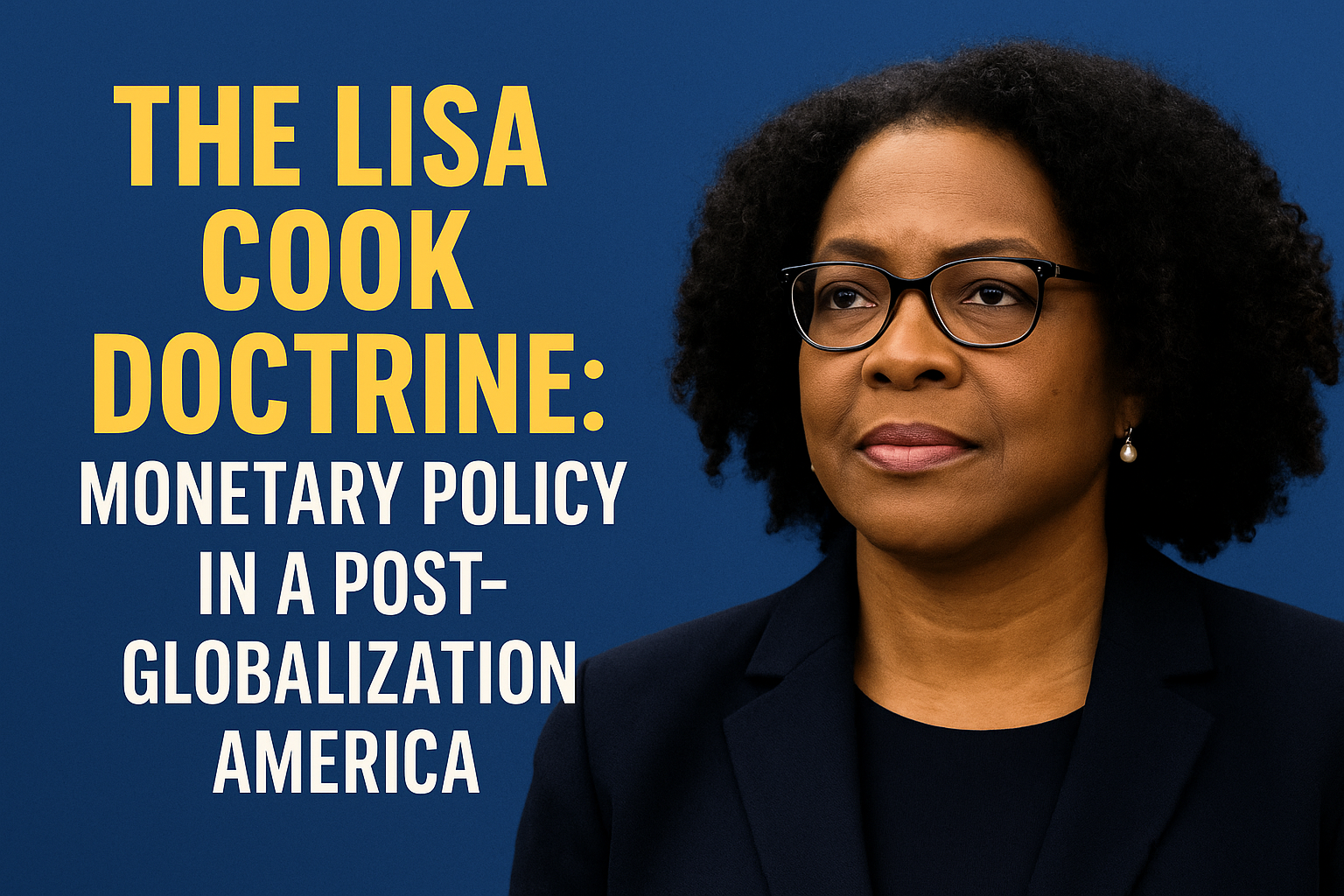
The Lisa Cook Doctrine: Monetary Policy In A Post-Globalization American

“Uncertainty is not an exception—it’s the economy’s new default. Our job isn’t to eliminate risk, but to build institutions resilient enough to thrive within it.” — Dr. Lisa D. Cook, Federal Reserve Governor & Spelman Alumna ’86

When Dr. Lisa D. Cook took the stage at the Council on Foreign Relations for the C. Peter McColough Series on International Economics, it was less a speech and more a declaration: the global economy is fragmenting, technology is compounding that fragmentation, and the Federal Reserve must remain nimble but principled in navigating this emerging disorder.

What makes Dr. Cook’s presence at the Federal Reserve so consequential is not simply her identity as the first African American woman to serve as a governor—though it is significant—but her lens. A lens forged not just through elite academic corridors, but one that dares to understand the edges of America’s economy—its marginalized labor markets, its precarious innovation system, and its uneven globalization. And if her remarks this week are any signal, Dr. Cook is actively shaping a monetary doctrine for this new epoch.

THE FEDERAL RESERVE AND ITS FRACTURED MANDATE

Dr. Cook reminded the audience that the Federal Reserve’s dual mandate—price stability and maximum employment—is being strained by new dynamics. Inflation, while down from pandemic-era peaks, remains stubbornly above target. Headline inflation is at 2.1 percent, core inflation at 2.5 percent—both still above the Fed’s 2 percent goal. On the employment side, job growth is steady, unemployment hovers at 4.2 percent, and labor force participation is not in freefall. But beneath these metrics lies disquiet.

That disquiet is coming from three fronts: trade protectionism, artificial intelligence, and long-term underinvestment in public innovation infrastructure.

In short, America’s economy is at a precipice—caught between inflation imported through tariffs and supply chain fragility, and deflationary pressures driven by automation and labor displacement.

Dr. Cook’s doctrine, it seems, is to hold the center.

TARIFFS: THE RETURN OF ECONOMIC NATIONALISM

Trade policy has re-entered the monetary discourse with a vengeance. For African American economists—and institutions like HBCUs that sit adjacent to both poor communities and international students from across the African diaspora—the discussion is no longer abstract. Dr. Cook underscored that tariffs, while politically popular, have a “nontrivial” inflationary effect.

Tariffs raise prices on imports, which businesses pass to consumers. But more importantly, they alter inflation expectations. And when inflation expectations become “unanchored,” monetary policy loses its credibility—and its traction.

This is not merely an economic concern, but a philosophical one. If the U.S. economy turns inward and abandons international trade cooperation, the financial consequences will not be equally shared. Institutions and people on the margins—like HBCUs, which rely on price-sensitive budgets and internationally sourced equipment—will be among the first to feel the tightening grip.

AI AND THE PRODUCTIVITY PARADOX

Artificial intelligence was one of the few bright spots in Dr. Cook’s analysis. While it introduces short-term labor displacement, it holds medium- to long-term potential for productivity gains, cost containment, and even inflation moderation.

Dr. Cook estimates productivity boosts from AI could range from 1 to 18 percent over the next decade. But this range, she admits, reflects the economic unknowns of the Fourth Industrial Revolution. For African American institutions, the message is twofold: AI will not wait for us to be ready, and without intentional investment in AI literacy and infrastructure, the economic benefits will bypass our communities entirely.

More than that, Dr. Cook emphasized the importance of how AI gets adopted. “It’s not job loss,” she clarified. “It’s task replacement.” The nuance matters. Black workers and businesses must advocate for job redesign, not job removal. This requires an active policy partnership between labor, government, and educational institutions.

HBCUs, with their historical ability to adapt curricula to new economic paradigms, have a window here. The time to build AI research centers, ethics think tanks, and public-private tech fellowships is not tomorrow—it is now.

UNCERTAINTY IS THE NEW NORMAL

Dr. Cook invoked former Fed Chair Ben Bernanke’s guidance: in times of heightened uncertainty, policymakers must plan for multiple scenarios. In Fed speak, this means optionality. In HBCU speak, this means resilience.

The Federal Reserve is not in a rate-cutting mood. Nor is it eager to hike. It is watching. And waiting. And watching some more. “The current stance is balanced,” Dr. Cook affirmed. “But that balance could shift in either direction.”

For HBCU leadership—especially those managing endowments, student financial aid disbursements, or capital investment strategies—this moment requires uncommon dexterity. Inflation could reaccelerate. Or the economy could cool into a stagflationary trap. The key is planning for a 2 percent interest world and a 6 percent one.

INNOVATION: TWENTY YEARS TO FRUITION

Perhaps the most poignant segment of Dr. Cook’s remarks came not from inflation or tariffs or AI—but from her reflections on innovation and time.

“It can take twenty years or more,” she noted, “from the time a student conceives an idea to the point it becomes a product on the market.”

That is a sobering timeline. And it is why public investment in basic research, early-stage science, and academic freedom matters so much. The ecosystem that birthed Silicon Valley started with small government grants, eccentric professors, and graduate students with uncertain job prospects.

For HBCUs, the lesson is urgent: waiting for federal investment in Black innovation ecosystems is no longer tenable. Institutions must pool their resources, coordinate R&D pipelines, and build their own version of the National Science Foundation if need be.

Tuskegee University had its agricultural labs. Howard had its medical research. North Carolina A&T and Prairie View have their engineering corridors. But the next phase of Black institutional development must consolidate these assets into a coordinated force, backed by investment funds, intellectual property banks, and patent commercialization arms.

THE GLOBAL BACKDROP: COORDINATION WITHOUT UNITY

On the global stage, Dr. Cook walked a careful line. She acknowledged that while central banks maintain regular dialogue—through G-7, G-20, OECD platforms—there is no grand consensus. Different countries have different mandates. The European Central Bank is laser-focused on inflation. The Bank of Japan must navigate currency volatility. The People’s Bank of China has geopolitical motives laced through its monetary calculus.

The Federal Reserve cannot outsource its decisions to global peers. But it can learn from them.

For African American policy circles and HBCU economics departments, this is a call to global literacy. We must teach our students to read the central bank minutes from Frankfurt, London, and Accra as readily as they read those from Washington.


INSTITUTIONAL IMPLICATIONS FOR HBCUs

What, then, should HBCU presidents, CFOs, and policy offices take from Dr. Cook’s remarks?

  1. Protect Purchasing Power
    Inflation—especially if prolonged—can erode real endowment spending. HBCUs must explore inflation-hedged assets, indexed tuition strategies, and energy-efficient infrastructure.
  2. Reimagine Labor Pipelines
    AI and global trade will redefine job descriptions. HBCUs must preemptively build training programs, certification pathways, and innovation hubs aligned with the labor market of 2030—not 2010.
  3. Internalize Innovation
    If innovation takes 20 years, then we must stop relying on outside institutions to fund our intellectual property journey. We must build our own innovation endowments, grant programs, and incubators.
  4. Globalize Strategically
    As America turns inward, HBCUs must look outward—toward African economies, Caribbean partnerships, and Latin American markets. Diversifying donor bases, research collaborations, and student recruitment internationally is no longer luxury. It is imperative.
  5. Endowment Defense Against Rate Risk
    Whether rates rise or fall, HBCU financial managers must adopt more active duration management strategies and review fixed income allocations accordingly.

FINAL THOUGHT: THE JUDGMENT ECONOMY

Dr. Cook’s final words were a reminder that even in an era of algorithms and quantitative models, human judgment remains central.

The economy cannot be automated. And neither can policy. The strength of institutions, including the Federal Reserve, still rests on the character and clarity of its leaders.

For HBCUs and African American institutions broadly, Dr. Cook’s rise—and her vision—should be both inspiration and instruction. It is not enough to be present in the room. One must bring a philosophy. A framework. A doctrine.

The Lisa Cook Doctrine, if there is one, is clear: do not panic, do not stagnate, and never underestimate the power of intentional innovation guided by principled policy.

In an uncertain world, that kind of leadership is the rarest form of capital.