
“Uncertainty is not an exception—it’s the economy’s new default. Our job isn’t to eliminate risk, but to build institutions resilient enough to thrive within it.” — Dr. Lisa D. Cook, Federal Reserve Governor & Spelman Alumna ’86
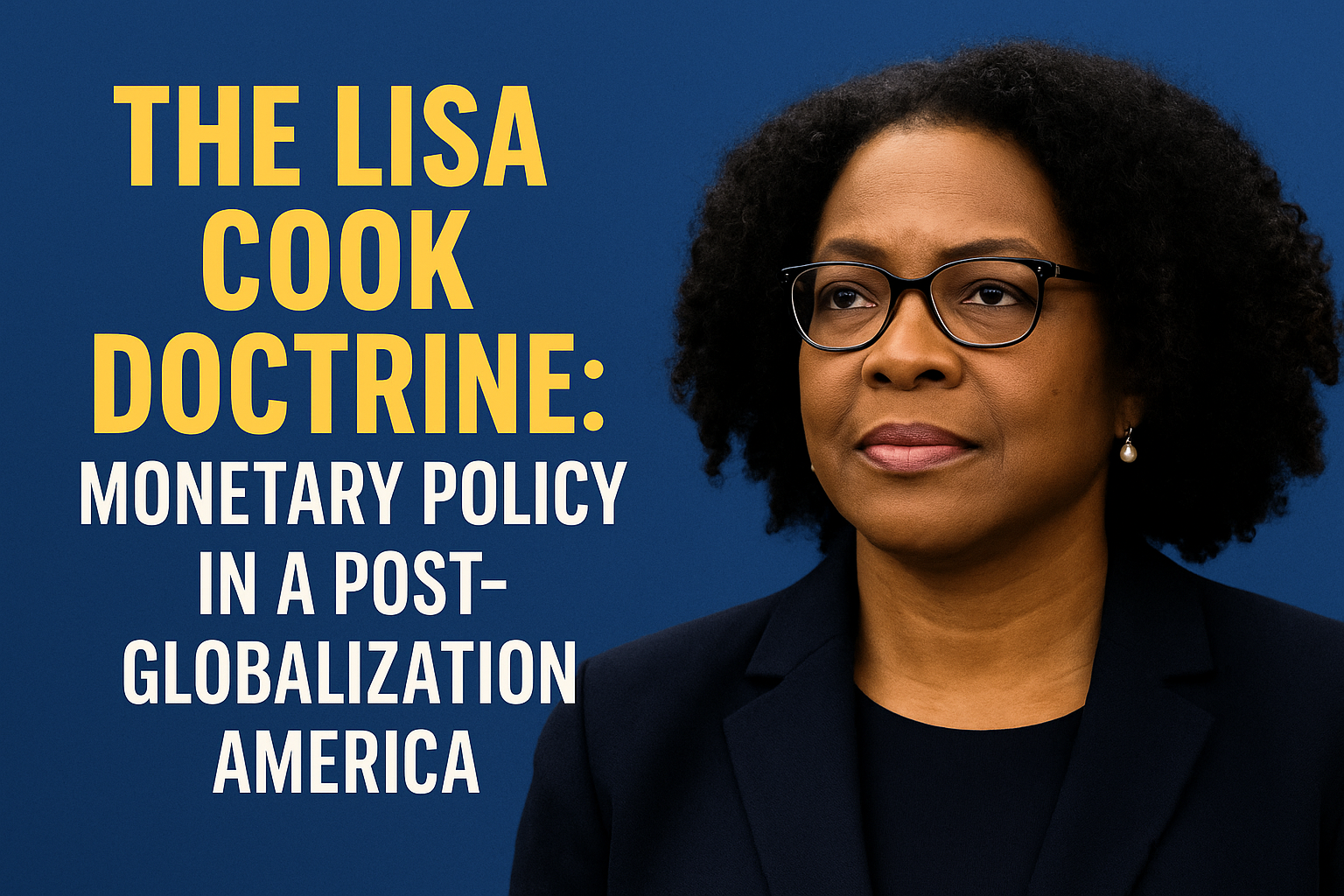
When Dr. Lisa D. Cook took the stage at the Council on Foreign Relations for the C. Peter McColough Series on International Economics, it was less a speech and more a declaration: the global economy is fragmenting, technology is compounding that fragmentation, and the Federal Reserve must remain nimble but principled in navigating this emerging disorder.
What makes Dr. Cook’s presence at the Federal Reserve so consequential is not simply her identity as the first African American woman to serve as a governor—though it is significant—but her lens. A lens forged not just through elite academic corridors, but one that dares to understand the edges of America’s economy—its marginalized labor markets, its precarious innovation system, and its uneven globalization. And if her remarks this week are any signal, Dr. Cook is actively shaping a monetary doctrine for this new epoch.
THE FEDERAL RESERVE AND ITS FRACTURED MANDATE
Dr. Cook reminded the audience that the Federal Reserve’s dual mandate—price stability and maximum employment—is being strained by new dynamics. Inflation, while down from pandemic-era peaks, remains stubbornly above target. Headline inflation is at 2.1 percent, core inflation at 2.5 percent—both still above the Fed’s 2 percent goal. On the employment side, job growth is steady, unemployment hovers at 4.2 percent, and labor force participation is not in freefall. But beneath these metrics lies disquiet.
That disquiet is coming from three fronts: trade protectionism, artificial intelligence, and long-term underinvestment in public innovation infrastructure.
In short, America’s economy is at a precipice—caught between inflation imported through tariffs and supply chain fragility, and deflationary pressures driven by automation and labor displacement.
Dr. Cook’s doctrine, it seems, is to hold the center.
TARIFFS: THE RETURN OF ECONOMIC NATIONALISM
Trade policy has re-entered the monetary discourse with a vengeance. For African American economists—and institutions like HBCUs that sit adjacent to both poor communities and international students from across the African diaspora—the discussion is no longer abstract. Dr. Cook underscored that tariffs, while politically popular, have a “nontrivial” inflationary effect.
Tariffs raise prices on imports, which businesses pass to consumers. But more importantly, they alter inflation expectations. And when inflation expectations become “unanchored,” monetary policy loses its credibility—and its traction.
This is not merely an economic concern, but a philosophical one. If the U.S. economy turns inward and abandons international trade cooperation, the financial consequences will not be equally shared. Institutions and people on the margins—like HBCUs, which rely on price-sensitive budgets and internationally sourced equipment—will be among the first to feel the tightening grip.
AI AND THE PRODUCTIVITY PARADOX
Artificial intelligence was one of the few bright spots in Dr. Cook’s analysis. While it introduces short-term labor displacement, it holds medium- to long-term potential for productivity gains, cost containment, and even inflation moderation.
Dr. Cook estimates productivity boosts from AI could range from 1 to 18 percent over the next decade. But this range, she admits, reflects the economic unknowns of the Fourth Industrial Revolution. For African American institutions, the message is twofold: AI will not wait for us to be ready, and without intentional investment in AI literacy and infrastructure, the economic benefits will bypass our communities entirely.
More than that, Dr. Cook emphasized the importance of how AI gets adopted. “It’s not job loss,” she clarified. “It’s task replacement.” The nuance matters. Black workers and businesses must advocate for job redesign, not job removal. This requires an active policy partnership between labor, government, and educational institutions.
HBCUs, with their historical ability to adapt curricula to new economic paradigms, have a window here. The time to build AI research centers, ethics think tanks, and public-private tech fellowships is not tomorrow—it is now.
UNCERTAINTY IS THE NEW NORMAL
Dr. Cook invoked former Fed Chair Ben Bernanke’s guidance: in times of heightened uncertainty, policymakers must plan for multiple scenarios. In Fed speak, this means optionality. In HBCU speak, this means resilience.
The Federal Reserve is not in a rate-cutting mood. Nor is it eager to hike. It is watching. And waiting. And watching some more. “The current stance is balanced,” Dr. Cook affirmed. “But that balance could shift in either direction.”
For HBCU leadership—especially those managing endowments, student financial aid disbursements, or capital investment strategies—this moment requires uncommon dexterity. Inflation could reaccelerate. Or the economy could cool into a stagflationary trap. The key is planning for a 2 percent interest world and a 6 percent one.
INNOVATION: TWENTY YEARS TO FRUITION
Perhaps the most poignant segment of Dr. Cook’s remarks came not from inflation or tariffs or AI—but from her reflections on innovation and time.
“It can take twenty years or more,” she noted, “from the time a student conceives an idea to the point it becomes a product on the market.”
That is a sobering timeline. And it is why public investment in basic research, early-stage science, and academic freedom matters so much. The ecosystem that birthed Silicon Valley started with small government grants, eccentric professors, and graduate students with uncertain job prospects.
For HBCUs, the lesson is urgent: waiting for federal investment in Black innovation ecosystems is no longer tenable. Institutions must pool their resources, coordinate R&D pipelines, and build their own version of the National Science Foundation if need be.
Tuskegee University had its agricultural labs. Howard had its medical research. North Carolina A&T and Prairie View have their engineering corridors. But the next phase of Black institutional development must consolidate these assets into a coordinated force, backed by investment funds, intellectual property banks, and patent commercialization arms.
THE GLOBAL BACKDROP: COORDINATION WITHOUT UNITY
On the global stage, Dr. Cook walked a careful line. She acknowledged that while central banks maintain regular dialogue—through G-7, G-20, OECD platforms—there is no grand consensus. Different countries have different mandates. The European Central Bank is laser-focused on inflation. The Bank of Japan must navigate currency volatility. The People’s Bank of China has geopolitical motives laced through its monetary calculus.
The Federal Reserve cannot outsource its decisions to global peers. But it can learn from them.
For African American policy circles and HBCU economics departments, this is a call to global literacy. We must teach our students to read the central bank minutes from Frankfurt, London, and Accra as readily as they read those from Washington.
INSTITUTIONAL IMPLICATIONS FOR HBCUs
What, then, should HBCU presidents, CFOs, and policy offices take from Dr. Cook’s remarks?
- Protect Purchasing Power
Inflation—especially if prolonged—can erode real endowment spending. HBCUs must explore inflation-hedged assets, indexed tuition strategies, and energy-efficient infrastructure. - Reimagine Labor Pipelines
AI and global trade will redefine job descriptions. HBCUs must preemptively build training programs, certification pathways, and innovation hubs aligned with the labor market of 2030—not 2010. - Internalize Innovation
If innovation takes 20 years, then we must stop relying on outside institutions to fund our intellectual property journey. We must build our own innovation endowments, grant programs, and incubators. - Globalize Strategically
As America turns inward, HBCUs must look outward—toward African economies, Caribbean partnerships, and Latin American markets. Diversifying donor bases, research collaborations, and student recruitment internationally is no longer luxury. It is imperative. - Endowment Defense Against Rate Risk
Whether rates rise or fall, HBCU financial managers must adopt more active duration management strategies and review fixed income allocations accordingly.
FINAL THOUGHT: THE JUDGMENT ECONOMY
Dr. Cook’s final words were a reminder that even in an era of algorithms and quantitative models, human judgment remains central.
The economy cannot be automated. And neither can policy. The strength of institutions, including the Federal Reserve, still rests on the character and clarity of its leaders.
For HBCUs and African American institutions broadly, Dr. Cook’s rise—and her vision—should be both inspiration and instruction. It is not enough to be present in the room. One must bring a philosophy. A framework. A doctrine.
The Lisa Cook Doctrine, if there is one, is clear: do not panic, do not stagnate, and never underestimate the power of intentional innovation guided by principled policy.
In an uncertain world, that kind of leadership is the rarest form of capital.


 HBCU Money
This Week in the Economy: May 19–23, 2025
Centering the Black Economic Lens on Federal Reserve Movements and Economic Indicators
Monday, May 19
Tuesday, May 20
Wednesday, May 21
Thursday, May 22
Friday, May 23
Sunday, May 25
HBCU Money Insight:
This week offers a mix of sobering and symbolic moments. With inflation slowing but economic indicators weakening, the question remains whether the Fed can pivot without sidelining Black workers, entrepreneurs, and institutions. For HBCUs and Black policymakers, these events are an opportunity to press for policy that doesn’t just stabilize the economy—but transforms who it works for.
Leave a comment
Posted in Economics
Tagged African American Homeownership Trends, Black Economic Policy 2025, Black Small Business Economic Outlook, Black Unemployment Statistics, economy, Fed Interest Rates Impact on Black Communities, federal reserve, Federal Reserve and Black Wealth, finance, HBCU Financial Commentary, Inclusive Economic Growth Fed Listens, inflation, interest rates, Lisa Cook Federal Reserve Speech, Philip Jefferson Economic Equity