Tag Archives: black owned

Circulating The HBCU Business Dollar: HBCU Money Partners With Proud Product For The HBCU Money Logo Tee

HBCU Money has partnered with Proud Product to sell its HBCU Money Logo Tee through the HBCU Grad online store, creating a powerful collaboration that promotes both HBCU pride and financial empowerment. This partnership is a strategic move that brings together two brands dedicated to uplifting Historically Black Colleges and Universities (HBCUs) and fostering economic growth within the Black community.

HBCU Money is known for its commitment to financial literacy, economic development, and wealth-building strategies specifically tailored for HBCU students, graduates, and supporters. By teaming up with Proud Product, a brand that celebrates HBCU culture and academic excellence through apparel, this collaboration expands the reach of HBCU Money’s mission.
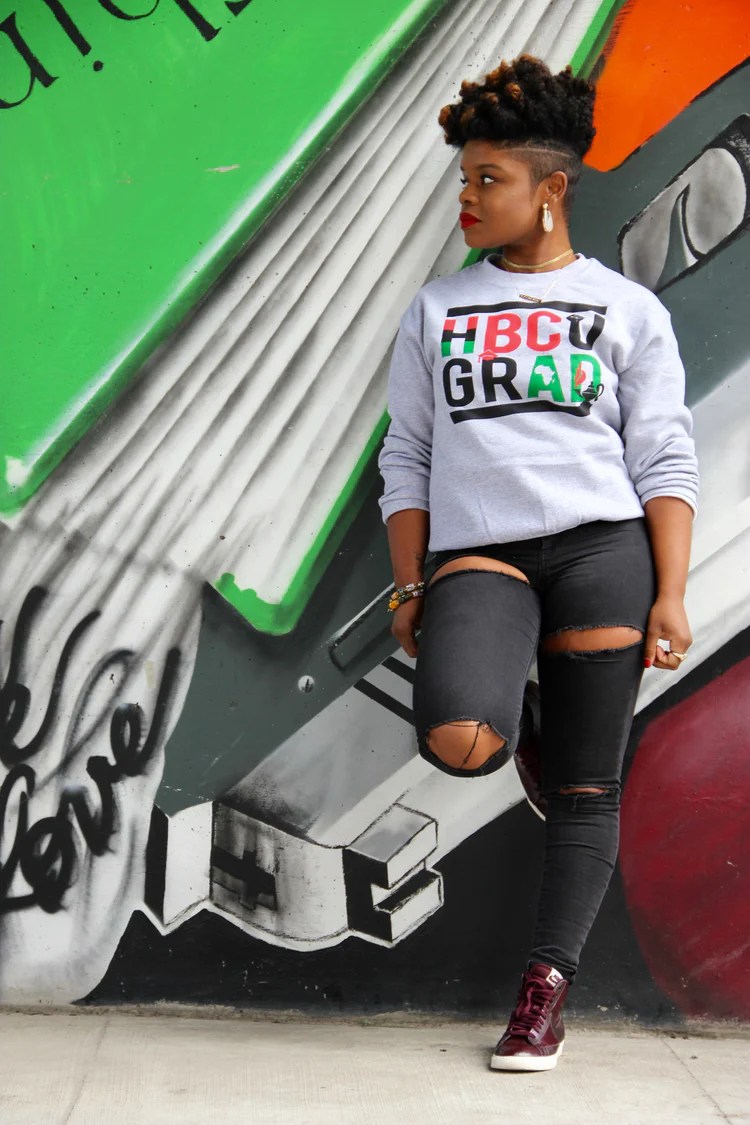
HBCU Grad’s Shopify-based platform provides an accessible and well-established marketplace for HBCU-themed merchandise, making it easier for supporters to purchase the HBCU Money Logo Tee. This partnership allows HBCU Money to leverage HBCU Grad’s e-commerce expertise and existing customer base while reinforcing a shared vision of empowering HBCU communities.

The HBCU Money Logo Tee, available in heather gray, is more than just a t-shirt—it represents a movement focused on financial awareness and economic independence. By purchasing this shirt through Proud Product, buyers are not only expressing their school spirit but also supporting two HBCU-owned brands that prioritize education, financial stability, and generational wealth.

This collaboration is an example of how HBCU-focused businesses can work together to amplify their impact. By joining forces, HBCU Money and Proud Product are strengthening the culture, supporting Black entrepreneurship, and promoting a message of financial empowerment—one t-shirt at a time.

HBCU Money™ Turns 13 Years Old

By William A. Foster, IV

Life is a hard battle anyway. If we laugh and sing a little as we fight the good fight of freedom, it makes it all go easier. I will not allow my life’s light to be determined by the darkness around me. – Sojourner Truth

HBCU Money is officially a teenager. Usually the teenage years are a rough and tumultuous time and it is hard to see that being any differently for us. The current social and political climates that we are about to experience over the next four years will test our patience and fortitude. It is vital that HBCU Money stays a voice of focus, strategy, and guidance in the African American institutional space as it relates to economics, finance, and investment.

It is inherent that we continue to strengthen and build our African American institutional ecosystem. It is also vital that that ecosystem build bridges of connection with the African Diaspora institutional ecosystem. We must throw off the shackles of isolationism and island mentality that plagues us so deeply. Before we make decisions we must ask ourselves is there an African American institution that exist that serves that need or want. If it is not there, then we must discuss building it. Where is the HBCU that has an African American MBA that teaches us how to build and run businesses from our interest? Where is the HBCU that has a law school focused on African American agriculture and real estate? Where is the African American bank focused on export-import for African American businesses? Are we using our talents to enhance ourselves individually or are we using our talents to enhance our institutions that enhance the collective? These are just a few of the vital things we are missing in our financial infrastructure.

There is not much that needs to be said, but plenty that needs to be done.

Pew Research Center Highlights Black-Owned Business Statistics

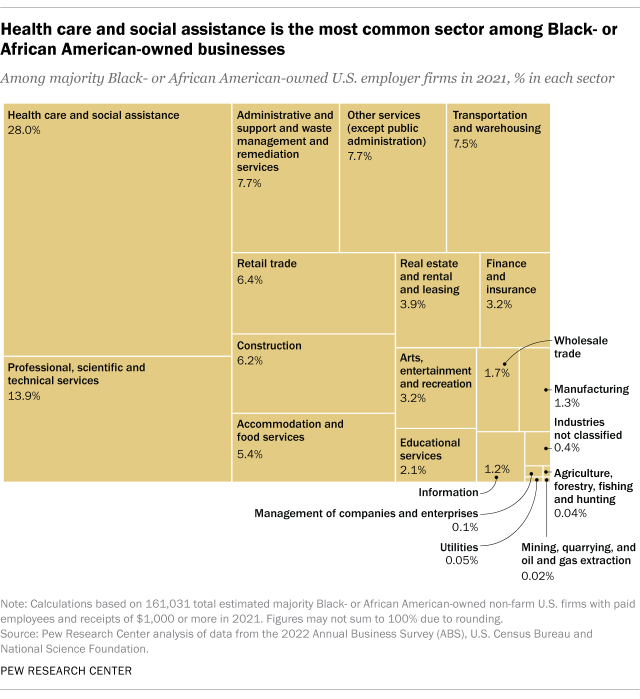
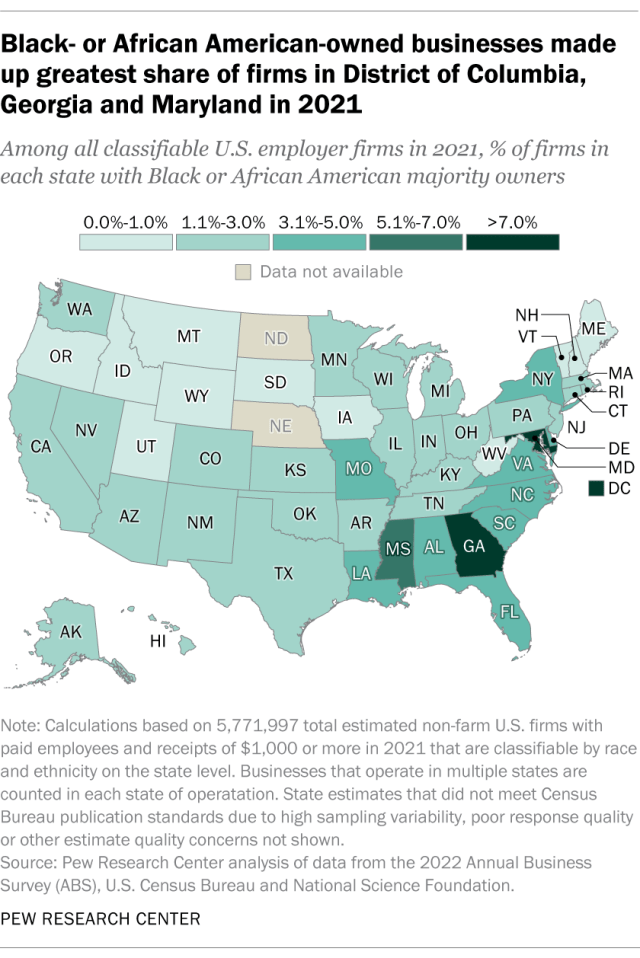
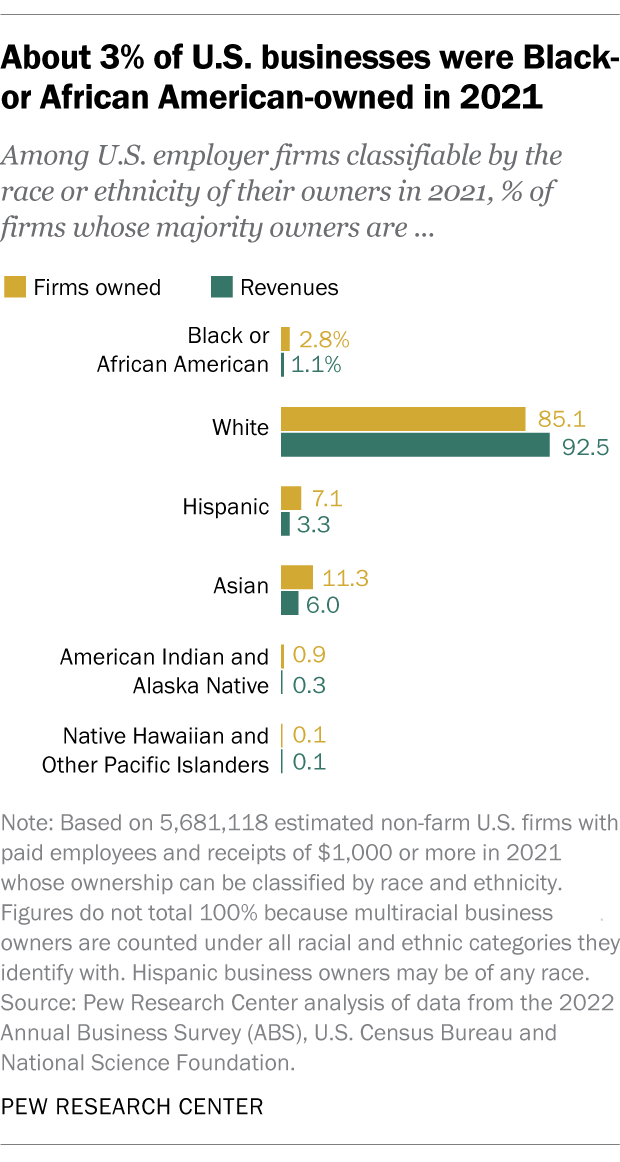
Pew Research Center highlights a look at the 161,031 U.S. firms with majority African American ownership as of 2021. Below are a few of the highlighted graphs that Pew Research showed in their report with HBCU Money commentary.

According to the SBA there were approximately 3.2 million African American-owned businesses as of 2018, but that is just the top layer. When you dig into the numbers by the Census of how many of those 3.2 million African American-owned businesses actually have paid employees and receipts exceeding $1,000 that number plummets to the previously mentioned 161,031 or only 5 percent of total African American-owned businesses.

A bar chart showing that about 3% of U.S. businesses were Black-or African American-owned in 2021.

African American businesses are highly concentrated in health care and social assistance. Businesses that often have low scale potential and high risk often times due their clients being predominantly African American and higher probability of being uninsured. Where are the African American-owned energy companies? Manufacturing companies? Multinational firms? These are the questions that need to be asked, considered, and discussed by HBCU business schools and African American organizations like the HBCU Chamber of Commerce.

A chart showing that health care and social assistance is the most common sector among Black-or African American-owned businesses.

It is no surprise that the highest concentration of African American-owned businesses are in locations with higher African American density populations and high concentrations of HBCUs. HBCUs and HBCU alumni unfortunately are not doing enough to create investment infrastructure to ensure the businesses are able to go into less explored and more profitable areas as the aforementioned graph highlighted.

A map showing that Black- or African American-owned businesses made up greatest share of firms in District of Columbia, Georgia and Maryland in 2021.

For the full Pew Research Center report click here.

HBCU Money™ Turns 12 Years Old

By William A. Foster, IV

“History shows that it does not matter who is in power or what revolutionary forces take over the government, those who have not learned to do for themselves and have to depend solely on others never obtain any more rights or privileges in the end than they had in the beginning.” – Carter G. Woodson, The Mis-education of the Negro

Last year, I said this was a marathon and not a sprint. However, at this moment a year later it does feel like we are picking up speed. Over the years there have been setbacks and bumps and ascending moments. Moments where I believed we were set to takeoff and moments where it felt like this was going to crash. It is truly amazing that 12 years in throughout everything, HBCU Money is still here and it is still strong.

There is nothing that I desire more than to see it expand, to see it be part of the fabric of representing the information of the HBCU nation and community. That we maybe empowered to shape our own narrative and that African America one days truly sees the value in our own institutions as others do. My goal is and continues to be that HBCU Money be part of the fabric of an ecosystem of HBCU Alumni Owned media that shows just how powerful we can truly be when we take ownership into our own hands.

As HBCU Money continues its path along with our sister blog HBCU Politics and more waiting in the weekends it will soon see the long transformation from caterpillar to butterfly – with a sting like a bee.

Keep your eyes on the horizon and know that the sunrise of our day is still upon us.

African America’s December 2023 Jobs Report – 5.2%

OVERALL UNEMPLOYMENT: 3.7%

AFRICAN AMERICA: 5.2%

LATINO AMERICA: 5.0%

EUROPEAN AMERICA: 3.5%

ASIAN AMERICA: 3.1%

Analysis: European and Latino Americans both saw an increase in their unemployment rate from November with an increase of 20 and 40 basis points, respectively. African and Asian Americans both had decreases in their unemployment rate with decreases of 60 and 40 basis points for both groups from November, respectively.

AFRICAN AMERICAN UNEMPLOYMENT RATE BY GENDER & AGE

AFRICAN AMERICAN MEN: 4.6%

AFRICAN AMERICAN WOMEN: 4.8% 

AFRICAN AMERICAN TEENAGERS: 18.0%

AFRICAN AMERICAN PARTICIPATION BY GENDER & AGE

AFRICAN AMERICAN MEN: 69.2%

AFRICAN AMERICAN WOMEN: 63.2%

AFRICAN AMERICAN TEENAGERS: 30.7%

Analysis: African American Men saw a significant decrease in their unemployment rates by 180 basis points while African American Women remain unchanged from November. African American Men and Women both had decreases in their participation rate from November of 10 basis points and 40 basis points, respectively. Extreme volatility with African American Teenagers remains as their unemployment rate skyrocketed by 5800 basis points, but also seeing their participation rate decrease by 80 basis points.

African American Men-Women Job Gap: African American Women currently have 665,000 more jobs than African American Men in December. This is a decrease from 890,000 in November.

CONCLUSION: The overall economy added 216,000 jobs in December while African America gained 66,000 jobs. From NPR, “For all of 2023, employers added 2.7 million jobs. That’s a slowdown from the two previous years, when the economy was red-hot, rapidly rebounding from pandemic layoffs. But last year’s job growth was still stronger than every other year since 2015.”