Category Archives: Business

African America’s Film Industry Should Look To Our Brethren In Nigeria

By William A. Foster, IV

I do not expect white media to create positive black (male) images. – Huey P. Newton

At the beginning of 2012 the release of a certain movie (remake) loosely based on historical facts created a civil war of sorts within African America. It had an all African American cast and African American director but was owned ultimately by a European American named George Lucas, net worth of $3.2 billion and creator of Star Wars franchise, and even more importantly distributed by an European American owned company that we all love to hate News Corp. (owners of Fox News). I’m sure Rupert Murdoch is thanking all of you who went out and supported the film as he can now pay Sean Hannity and Bill O’Reilly to stay on the air for a few more years. How many of our minds did that cross? African American supporters of the film drastically outnumbered the dissenters but most arguments in support were superficial much like measuring progress by the ability to sit at the front of the bus (instead of owning the bus company) or my favorite sign of progress African American athletes making millions (only 1 of the 92 major sports owners is African American meanwhile over 60% is African American labor). To succeed in capitalism you don’t need hard work or a lot of talent quiet as it’s kept. You need to understand two concepts and those are ownership and domination of as much of the economic food chain as possible. That is to say you need to be as close to a monopoly as legally allowed or that you can lobby to politicians to look a blind eye to. The monopoly can also be a certain Diaspora controlling the majority of an industry. An example would be the way Koreans have come to dominate the African American hair care industry. Apparently, according to many of us though you have to fight to sit at the front of the bus before you can think of owning the bus company. Imagine that.

As for Hollywood, every institution has a purpose. Every institution is owned and/or controlled by a certain Diaspora. Hollywood is an institution. Let me say again – Hollywood IS an European American institution. What is Hollywood’s purpose? Have you ever wondered why so many around the world want to come to America? Where do 60% of Hollywood’s profits come from? It comes from non-US markets. European America is “exporting” an image of paradise, its values, its idea of democrazy, and opportunity despite as we see in “America Builds an Aristrocracy”  that America is just as much an aristocracy as many other countries we claim to be anti-democratic and anti-opportunity. The social capital entertainment and movies generate make as Kanye said in his song All Falls Down “cause they make us hate our-self and love they wealth” makes many non-Americans desire for the perceived windfall of American opportunity and riches instead of staying and building up their country and its institutions. America benefits by ciphering some of the world’s best talent to become labor in its universities and businesses while maintaining a dominant European American ownership of these institutions. A domination that certainly seems to be crumbling to Asia and China more specifically but that isn’t to say they are falling far. A movie is of course more than just a story on a screen. Its shapes viewpoints and cultures. We know simplistically speaking it is why European American women have become the most desired women in the entire known world. Entertainment in general does this which is why we also see hip-hop’s presence abroad so impactful and now kids all over the world are break-dancing and have even become rappers themselves and yet African America owns and controls a marginal piece of hip-hop at best. Now, if you want to keep a people psychologically dependent and desiring to assimilate then you can’t give them strong images of themselves like stories of Black Wall Street and Harriet Tubman. Imagine that.

Nigeria has created Nollywood, which as of 2009 has become the 2nd largest film producer in the world behind Bollywood in India. Now while I personally could do without the knock-off Hollywood names they give themselves I can appreciate their desire to cultivate an industry of their own that represents them on the big screen and not waiting for Hollywood to do so. Even more so it provides counter social weight to the depiction of what it means to be a Nigerian and African which can be depicted and usually is in a negative light from Hollywood who has their own social idea of what Africa is. What is even more amazing is the number of African American actors going to Nollywood to star in films. The likes of Vivica Fox, Hakeem Kae-Kazim, Tom Sizemore, Michael Madsen, and even Kimberly Elise. That is what you call true African Dispora social and economic capital circulation. Franco Sacchi, director of documentary This is Nollywood, states that it has created tens of thousands of jobs and the industry is expanding and that Nigerians have complete control of the cinematic medium. Imagine that.

We are so romanticized with the idea of ONE America sometimes I’m convinced we will forsake our own interest to advance this ideology despite the reality that no other group practices it. We are like a child playing on the playground that sees the rules of the game written down and realizes that nobody else is playing by them so we spend all of our time trying to get the other players to play by them – so much so that we always end up coming in last. Our inability or indifference in dreaming of a world where we are masters of our own fate for the sake of a “united” America despite the fact that all other groups have shown through policy and action no desire for this to truly happen and honestly why should or would they? Is it because it is the “right” thing to do? By whose definition are we using for right or for determining morality? These are things that simply vary too much from culture, gender, ancestry, and others to have some universal meaning. And while some will argue me down there can be an agreed upon definition – do me a favor and don’t hold your breath waiting on it to happen. I’ve said it before and I’ll say it until I die (I might even get it etched on my tombstone) that no group of people in power in the history of mankind has ever voluntarily relinquished any of its power for the betterment of other groups. We get mad at groups who seek to protect their power and its self-interest ultimately because we refuse to do so. If we would spend more time doing the same we would have made real inroads to building up our institutional power as a people by now and not this as Malcolm said in jest “Progress is sitting next to white folks on a toilet” nonsense. Imagine that.

The answer is not magic. It’s simply pursuing vertical integration and ownership. This would give us a counterweight to the caricatures of how we are presented in Hollywood. As opposed to waiting on others having some moral awakening and treating us “fair”. I’ve heard the arguments well of course they have their own country in Nigeria so it’s possible. Is there something stopping us from building our own Nollywood in Atlanta? New York? Richmond? Is there not land we can buy and build? Control the medium as Mr. Sacchi stated from script to production to screen. Simply put there is no reason we can’t control the vertical integration of our movie industry from script to screen (even the vendors who serve the coffee and food on set). This would be true circulation of the African American talents and dollars. Pick any industry and repeat. Too often we are slaves to what is and don’t allow ourselves the freedom to imagine what could be. Yes, imagine that.

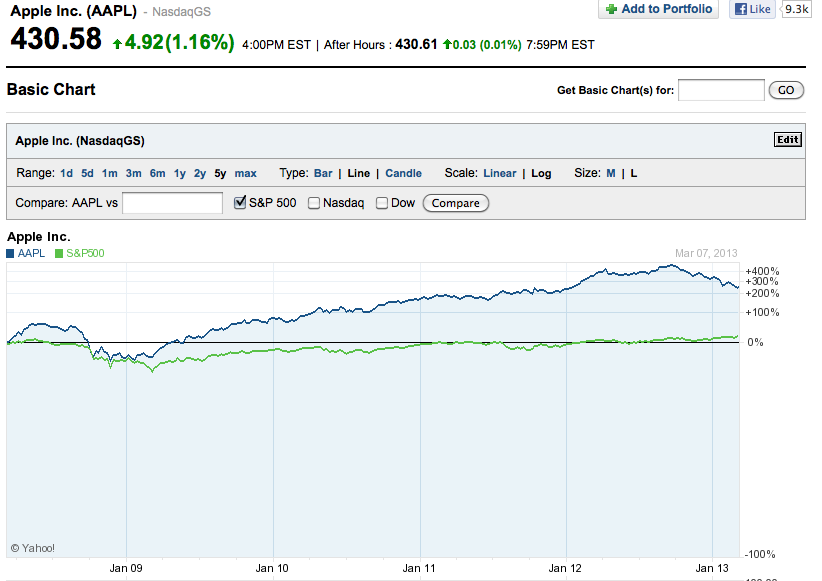
Just How Much Is Apple’s $117 Billion Cash Pile

“Cash is king.” – Unknown

Let’s compare the amount of Apple’s cash holdings to a few things:

If divided over all 40 million African Americans it would average out to $2,925 per person. The median net worth of African America is $2,170 (the lowest among all diaspora groups in the US).

It is 3.7 times the size of Harvard’s endowment (largest HWCU endowment and largest U.S. college endowment) and 216.7 times the size of Howard’s endowment (largest HBCU endowment).

It is 265.9 times the size of all HBCU research budgets combined.

It is 7.8 times the size of Jamaica’s GDP and 15.9 times the size Haiti’s GDP.

It is 6.2% of Africa’s entire GDP.

This is not to take any particular shot at Apple. It just happens to be the company with the largest corporate cash holdings at the time. US companies as a whole have $1.24 trillion in cash currently combined according to Moody’s which is 66% of the GDP of entire Africa. We’re talking “straight cash, homey” as Randy Moss said once.

Disclaimer: There is no ownership of any of the companies mentioned in this article by myself, my business, or my family as of this article’s publishing.


HBCU Construction: Revisiting Work Study & Trade Training

By William A. Foster, IV

Labor is the great producer of wealth; it moves all other causes. – Daniel Webster

We’ve all heard the stories as HBCU alum of the former slaves who initially upon attending their HBCU were involved in not only taking classes but also in the actual building of the HBCU. Their expertise as former blacksmiths and farmers on slave plantations allowed them to have a needed expertise to help build the initial buildings on our campuses. For these institutions and African America as a whole who were just getting its “start” in the 1870s and now charged with trying to close at that time a 300 year social, economic, and political gap there was significant benefit socially and economically in having students who could provide the initial labor to build the school. It created both pride in their new institution and a fiscal savings as these students typically not only provided the labor but in some instances made the bricks. One had to assume this was an amazing time to be a student. To see the birth of your own institution coming from your hands into buildings that would become the birthplace of African minds generations to come.

Today, the scene is much different. On almost every HBCU campus I’ve visited and even a few I’ve worked, the construction of new buildings is outsourced. Not only is it outsourced its virtually never outsourced to an African American construction company. The financing also almost never comes from an African Diaspora owned financial institution which why the establishment of the HBCU Credit Union is so vital.  Both of these points highlight a problem when it comes to circulation of our economic capital. Too often we forget about the business to business circulation and only seem to be focused on the consumer to business circulation. Now, certainly today’s student is different than that of our ancestors over 100 plus years ago in terms of upbringing and training. However, we have seen the over reliance on the DuBois model and not enough balance with the Washington model leaving us extremely vulnerable in down economies. That is to say our students should be flexible enough that they graduate with not only a degree of their mind but the ability to perform a trade with their hands. This balance can provide both a hedge in a down economy when white collar jobs get the brunt of the slashing or it can be additional income that one earns on the side. It can also be the impetus that spurs entrepreneurship into areas we are sorely under represented like construction.

The rising cost of education requires our schools become more creative on how work study is provided to our students. An average construction worker makes $29,211 annually which isn’t much for someone trying to support a family but it is the equivalent of four years worth of undergraduate Stafford Loans. Now imagine a student for four years earning $12,000 a year for four years working construction projects or other various infrastructure projects the university is engaged in. You’ve just created a $48,000 package in financial aid to start. Now at the end of the four years you have a student with no debt, potentially some savings, trained with a trade, armed with a degree, and a student with an even deeper social connection to the care of their university because it was the sweat from their brow that built it.

I do not want to suggest that we go on a building spree or that you don’t still need professional construction workers. I am suggesting that we need to use African American construction companies to increase our business to business circulation and require those companies hire some of our students. They themselves would provide the training to our students in conjunction with having lower cost labor for the project. It both saves the cost of the project to the school and increases the profits to the company. This is just the start of what needs to be part of a comprehensive plan to find more creative ways to decrease our students’ student loan burden and given HBCUs serious infrastructure needs this is a win-win for both student and HBCU as we expand and try to build up our endowments.

Asian American and European America both have a median net worth north of $95,000. African America’s median net worth is $2,170. The student loan debt burden is going to hurt us more than any in the generations to come if we do not get serious about finding ways to counter it. We cannot simply copy the “playbook” of our counterparts who have almost 50 times our wealth.

We have a chance to allow our students to add to the history of building ourselves up with our own two hands and mind. It’s a lesson from the past we desperately need to revisit.

Three Terms Hindering Africa America’s Institutional Development: Affirmative Action, Diversity, & Minority

By William A. Foster, IV

“All cruel people describe themselves as paragons of frankness.” – Tennessee Williams

This article will probably get me in trouble with the politically correct police and let’s all hold hands and get along crowd who typically have an idealistic view that all the resources in the world can magically be distributed evenly across all populations. However, truth is truth especially as it pertains to social, economic, and political (SEP) interest and until we have their idealistic world we have to consider that groups will continue to battle over power to control the resources much like what happens with every one of God’s other creations – imagine that. SEP interest drives every group’s institutional and individual decision-making except for one – African Americans. African America continues to chase the ever elusive ghost of assimilation and inclusion into the (European) American Dream to the expense of its own power. Below are the three terms that to me psychologically have and continue hamper our development and why.

Affirmative Action

Simply put this has been one of the most damaging policies toward a stronger African-American institutional power development. Affirmative Action was a bill pushed for by certain Civil Rights Movement (CRM) groups and was signed into law by Lyndon B. Johnson in 1965. It owes its roots to desegregation and the court case Brown v. Board of Education of Topeka, KS in 1954.

Desegregation’s ultimate culmination into the affirmative action law was all but the signature that wiped out African-American institutional development. Prior, we built towns such as “Black Wall Street” in Tulsa, OK and Rosewood, FL and countless self-sufficient African-American towns. These towns would be torn apart ultimately because of our lack of ability to obtain political retribution for social and economic attacks against us which is where the aim of the CRM should have been. Instead, a movement within the CRM decided that equality meant to be assimilated into European American owned and controlled institutions. We would all but abandon towns which we built, businesses we started, and colleges that were founded for our interest and then begin to define success not by what we owned or controlled anymore but by being the “first” to break through into institutions where we weren’t wanted and out flanked socially, economically, and politically. Despite an understanding that in capitalism the ultimate power lies in what you control directly or indirectly and what you own.

Today, less than 15% of African-Americans who can go to college attend HBCUs despite the institutional implications that a college and university can bring to a community as noted in The University of Power & Wealth. “Success” is defined as moving out of our neighborhoods and then we wonder why our elementary and secondary schools are weak. They are weak because the demand that drives home values up which in turn increases the amount of taxes available to fund our schools and then allows them to develop and pay quality teachers was abandoned so that we could live in a “good” neighborhood. The educated and professionals instead of being a permanent presence in the community for children to see (positive social capital) instead leave children to look up to those hanging on the corner (negative social capital). It use to be that our doctors, teachers, and other professionals lived in the community and therefore set the barometer of that community. Yet, we’ll claim they can find role models or they should seek out mentoring programs missing the point of setting the rule in a community for kids instead of hoping they’ll find a way to be the exception. Before affirmative action, we started companies like C.R. Patterson, the only African-American owned automobile manufacturing company. Now, most of define our success by the car we drive not the ones we build.

Minority

The problem for African America allowing itself to be labeled a minority are numerous but I’ll address specifically as it relates to economic policy and actions. In 2008, Dr. Verna Dauterive, alum of Wiley College, donated $25 million to the University of Southern California in memory of her late husband. The money would be used to fund a scholarship for minority students that pursued a doctorate in education. Who is a minority? The answer is simply anyone who is not a European-American male. That means the scholarships from that donation, at a school whose African-American population is not even five percent, never even have to be used for an African-American. It means that if USC so chose they could give that scholarship to anyone that’s not of African descent from here on out and they would be meeting the requirements of that donation. It should also be noted that USC has a $3.5 billion endowment while her undergraduate alma mater Wiley College has a reported $50 million endowment. To say the $25 million would have gone further at Wiley impacting African-Americans is without question.

Recently it was noted by Jarrett Carter, Editor of HBCU Digest, that many HBCUs lead their states in minority purchases. In fact, Prairie View A&M University, Mr. Carter noted leads the state of Texas with 38% of its contracts awarded to minority businesses. Again, it should be pointed out that does not mean $1 has to go to African-American businesses. As a former employee and graduate assistant at Prairie View A&M University it was not unusual for us to hear stories about European American families with businesses making the wife 51% owner of the business in order to access minority contracts. You have to love loopholes.

Diversity

Every year certain business magazines release “Most Diverse Companies” and they are always speaking of the labor that works for these major corporations. The reality is that while the labor might be diverse the ownership is still typically 99.9% European American. The current idea of diversity just means you were able to get the most talented of other groups to work for another group’s economic interest. Again, I can’t state enough that it is ownership who gets rewarded the most long-term not labor. We see this in college football where schools like the University of Texas have 50,000 students of which only 500 are African-American males and 50% of them are on the football or basketball team. A football team composed of almost 70% African-American males, and is the most profitable college football program in the United States. The profits then go into non-revenue athletic scholarships which are predominantly European American (see golf, softball, swimming, baseball, etc.), along with aiding research, faculty salaries, and much more. The 1% of the population with no SEP power at the university providing immensely to the 99% with all of the SEP power. Now that’s a change.

It is always important to note who is defining what. I always get annoyed by “diversity” often being hijacked and/or pigeon holed to only mean multiple cultures. Diversity is also always talked about from a European American majority. That is to say in a room of 10 people if you have 7 European Americans, 1 African-American, 1 Asian American, and 1 Latino American you have diversity. However, if you have 7 African-Americans, 1 European American, 1 Asian American, and 1 Latino American it is not perceived as diversity. This is the hurdle that HBCUs often face in perception by not only society as a whole but even sadder by African-Americans themselves. Every time a conversation about diversity comes up I have to point out there are a number of variables by which one can create a diverse setting beyond ancestry. If I have a room of eight people of African descent with two from Jamaica, two from Ghana, two from America, and two from Brazil and each of those two is a mixture of male/female then do I not have a diverse room? Yes, I do. I just happen to have one foundational link of ancestry. I can add variables such as but not limited to geographical upbringing, economic class, education, gender, etc. Just for the record HBCUs have always been willing to take poor and underserved European Americans and others. The reverse still is not true unless of course you can do something exceptional on a football field.

We must define things from our point of social, economic, and political interest and not just blindly follow someone else’s idea of what is “good” as their idea of “good” is always from their point of view and interest. I was on a radio show where one of the guests proclaimed to me that Martin Luther King, Jr. was fighting for our right to move into someone else’s neighborhood. A clear problem of what happens when you allow someone else to control your history. Even a man who screamed for our self-sufficiency as many seem to forget has had his image and message watered down over the years. In capitalism, everything is ownership or labor. This is neither good nor bad. It just is and we all know that knowing is half the battle.

Dwayne Wayne And Ron Johnson Dropped The Ball – HBCUpreneurship

By William A. Foster, IV

The more an idea is developed, the more concise becomes its expression; the more a tree is pruned, the better is the fruit. — Alfred Bougeart

tumblr_m710k2fGEJ1qbrimro1_400

What if Sergey Brin and Larry page, founders of Google, went to Hillman? Would Google still have been created? Yes. Would they still become billionaires? Probably not. The two men combined are worth an estimated $37.4 billion. Their combined fortunes are greater than Harvard’s endowment, almost 30 times the size of all HBCU endowments, and over 90 times the size of all HBCU research expenditures combined. The last being vital because it was the very thing that allowed the two men, PhD research students at Stanford, to create the search engine that is now a verb. Instead, it could be argued they would end up creating a great new search engine and selling it for pennies on the dollar to Microsoft. Ensuring of course that whichever one (ended up being Dwayne) and wanted to work for said company would have secured themselves employment. Notice, I said very distinctly employment and not ownership.

It is in one of the final episodes of the legendary show “A Different World” Ron Johnson or Ron, the loveable sidekick and best friend of Dwayne Wayne, and ironically the one who has the most entrepreneurial spirit of all the characters on the show comes up with a video game concept that helps children learn. It is no coincidence that him growing up with a father who owned a car dealership inspires his constant risk taking, so the entrepreneurial bug pops up constantly throughout his time at Hillman. One of the more classic Ronpreneurial moments is when he and Mr. Gaines, who ran The Pit at the student center, purchase a nightclub together. An all too typical expression of African-American entrepreneurship and one that has little to no substantive impact. Dwayne Wayne on the other hand is the math genius who seems destined to “succeed” by programming amazing products for the likes of Kenishewa. In fact, in the episode this is exactly what happens as Dwayne takes Ron’s concept and uses his programming skills to bring the game to life. Dwayne tells Ron about bringing the concept to fruition and in the excitement Ron excitedly says “this could be the start of Wayne & Johnson”. For all of Dwayne Wayne’s brains his entrepreneurial IQ never got past zero. He never hesitated to cash in for the short-term payday, subsequently putting his friendship with Ron in jeopardy for not acknowledging it was his idea,  and never once thought about the long-term wealth and institutional impact their own company could have. The brains of these two men would have been the perfect balance that business relationships often need. Ron’s ability to create ideas, generate sales, and risk taking balanced with Dwayne’s ability to bring ideas to life, analytical strategy, and risk aversion would have made for an absolutely powerful business combo. Now, instead of this being the launching of a software company Dwayne Wayne runs with Ron’s concept develops it and simply sells it to Kenishewa and secures a job. Ownership? None. Paycheck? Sure. Bigger picture? Missed.

What could have been? One could ultimately imagine a very successful software company (See Google, Baby Einstein, Electronic Arts, or Microsoft) being born out of the Wayne & Johnson partnership. Years down the line Wayne & Johnson would be giving internships and employment opportunities for Hillman students and donating hundreds of millions back to Hillman for a new research facility, new stadium, higher faculty salaries, and scholarships to reduce Hillman student debt loads. Oh did I mention Wayne & Johnson becomes so successful that they end up acquiring Kenishewa?

No matter a student’s academic department at their HBCU there should be an entrepreneurship class specifically designed for their major and/or department that teaches them how to turn their major into a business that they can take back to our communities and build. From mathematics, engineers, psychology, and beyond every single major should be able to understand how to transform their entity into a business that they own and/or co-own. They should also be able know how to cross-pollinate with other majors. Biology major meets engineering major? What do they create? Behold a bioengineering firm. Mathematics meets sociology? I have no idea but the fact that the conversation is being had leads me to believe the brilliance in our students would come up with an answer and more important a company. We should not be producing labor but ownership as well from our institutions. Our HBCUs too often promote their “successful” students being those who go off and work for large European American companies (making their companies stronger and wealthier) while the masses of their students wait exorbitant amounts of time searching for employment hoping to become an affirmative action quota. It is ownership which will bring down our unemployment rate which is always double the national average, it will help close the wealth gap, provide the wealth to influence the political system in our favor instead of always begging for favor, and pump much-needed infrastructure capital back into our HBCUs and communities so we can compete. We know that when America catches a cold we catch pneumonia. If the latest AP report shows that 50% of recent graduates are unemployed or underemployed what do you think that number is for HBCU recent graduates? It is time for us to do for self as we know our ancestors did in places like Tulsa, Rosewood, and countless other African-American towns across this country. We can compete but we have to compete to be more than just labor. I’ve always said and continue to say capitalism doesn’t reward hard work. It rewards the ownership of hard workers.