Tag Archives: warren buffett

What Berkshire Buys Next: The Five Giants That Fit Buffett’s Playbook

In Omaha, Berkshire Hathaway’s cash pile has grown so large that even Wall Street marvels at its inertia. With over $380 billion in cash and short-term Treasuries, the conglomerate is sitting on more dry powder than most central banks. Yet Warren Buffett and his successor, Greg Abel, have long maintained that capital must only move when the odds of permanent capital loss are near zero.

Now, with global markets resetting post-2020 stimulus and inflation anchoring valuations, the question becomes: what could Berkshire buy next that would be both large enough to matter and philosophically sound enough to pass Buffett’s test of simplicity, durability, and trust?

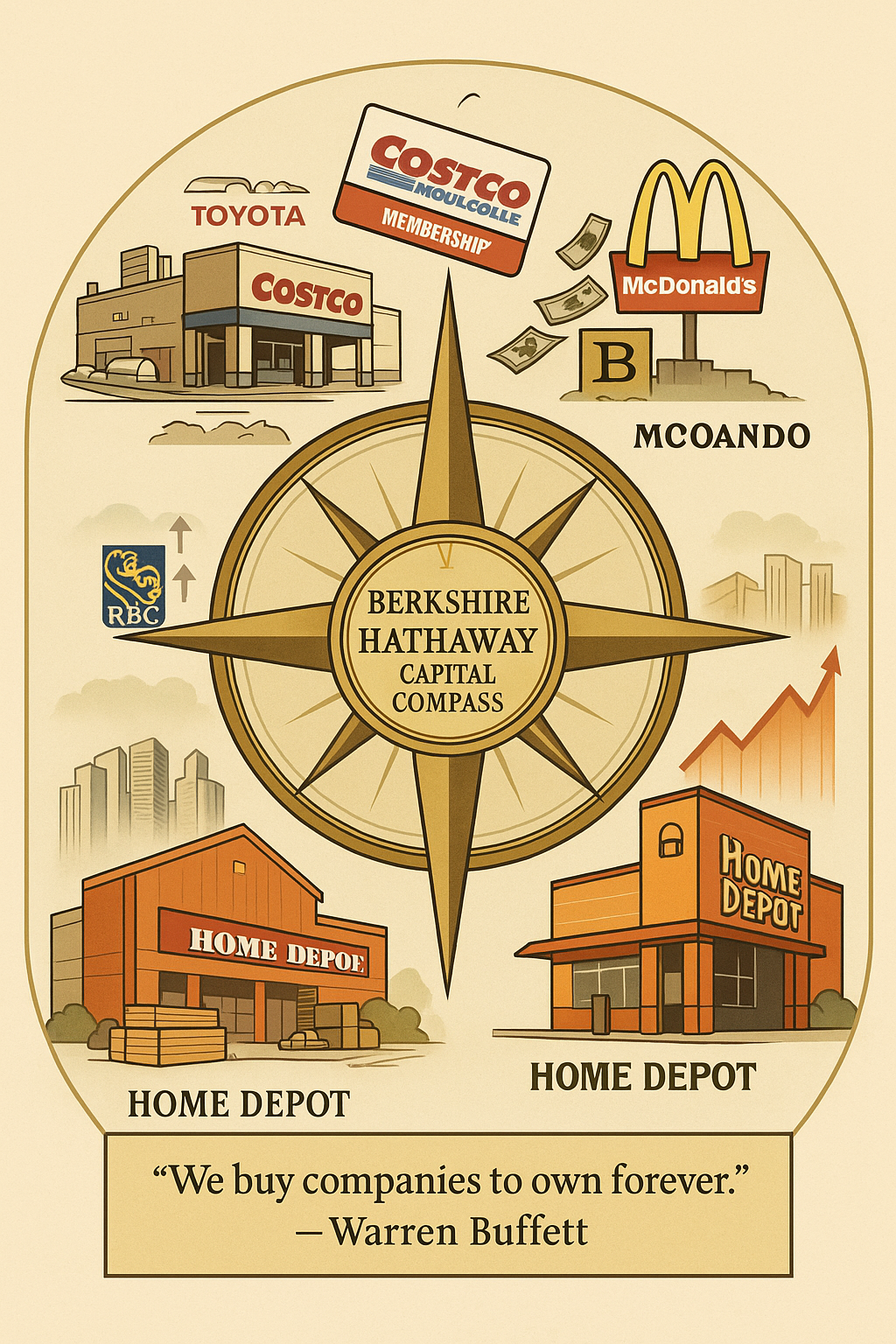
The five most plausible candidates — Costco, McDonald’s, Home Depot, Royal Bank of Canada, and Toyota — each satisfy that mix of prudence, predictability, and permanence that defines Berkshire’s century-long strategy of buying “businesses, not tickers.”

Buffett’s philosophy has been remarkably consistent for over six decades: buy simple, cash-rich, moated businesses led by trustworthy managers. Berkshire’s model of quasi-permanent ownership, decentralized operations, and disciplined capital allocation has made it the corporate equivalent of a sovereign wealth fund — except its sovereign is capitalism itself.

Greg Abel, the man expected to succeed Buffett, has only reinforced this model. Coming from Berkshire Energy, Abel represents the “real economy” side of the house preferring tangible assets, regulated returns, and predictable cash flow over the exuberance of speculative innovation.

Hence, the next Berkshire deal is not likely to be an AI startup or fintech disrupter. It will be a “forever asset” — a company that compounds quietly and defends its margins under any macro regime.

Given Berkshire’s sheer scale of over $1 trillion in market capitalization a target must have an enterprise value north of $200 billion to meaningfully “move the needle.” Anything smaller, and the math of compounding becomes negligible.

🧩 The Berkshire Universe: Themes and Tendencies

Berkshire’s portfolio reads like a map of the American and global economy’s most reliable arteries:

CategoryCore HoldingsTraits
FinancialsAmEx, Bank of America, Moody’s, ChubbHigh ROE, capital-light, recurring revenue
Consumer StaplesCoca-Cola, Kraft Heinz, DiageoGlobal brands, predictable demand
Energy / IndustrialsChevron, Occidental, MitsubishiReal assets, inflation hedge
TechnologyApple, Amazon (small), VeriSignCash-rich ecosystems
Infrastructure / InsuranceBNSF Railway, BH ReinsuranceTangible durability, “float” generation

This structure provides a blueprint for what comes next: reinforcement, not reinvention. Berkshire rarely pivots; it doubles down on what works. It will seek businesses that (1) resemble what it already understands, and (2) offer inflation-protected earnings streams in a world of higher nominal rates.

From the universe of firms valued between $200 billion and $450 billion, only a handful exhibit the balance of predictability, management integrity, and strategic fit Berkshire demands.

A closer look through Buffett’s filters narrows the field to Costco, McDonald’s, Home Depot, Royal Bank of Canada, and Toyota. Each operates in a sector Berkshire already knows and each represents a bridge between the company’s past and its post-Buffett future.

1. Costco Wholesale (Ticker: COST)

The Cult of Value Meets the Culture of Discipline

Buffett has long admired Costco’s operating model. It is a retailer that sells everything from fresh salmon to fine jewelry but in truth, it sells trust. Its membership model generates annuity-like revenue, while its relentless efficiency and scale provide a durable moat against both inflation and digital disruption.

Charlie Munger, Buffett’s late partner, once served on Costco’s board and famously said, “Costco is one of the most admirable capitalistic institutions in the world.” That legacy alone makes a partial acquisition symbolically powerful.

While a full buyout (market cap ≈ $405 billion) may be too expensive, a 20–30% stake would make sense. It would give Berkshire exposure to global consumer spending and provide a stabilizing counterpart to its stake in Apple, a brand built on loyalty, not leverage.

In the age of shrinking retail margins, Costco remains an inflation hedge, its pricing power born from scale, not greed. Buffett has always preferred such quiet dominance.

2. McDonald’s (Ticker: MCD)

Fast Food, Slow Capital

If there were ever a brand that personifies Buffett’s doctrine of “durable competitive advantage,” it is McDonald’s. With over 40,000 locations in 100+ countries and a business model centered on franchised cash flow, McDonald’s is the quintessential predictable earner.

Its asset-light structure means free cash flow margins north of 25%, while its real-estate footprint functions as an embedded REIT. In a world of digital payments, delivery, and global inflation, McDonald’s pricing agility is unmatched. It can raise prices by 5% globally without denting demand, a privilege of brand addiction.

Moreover, McDonald’s cultural synergy with Coca-Cola (another Berkshire cornerstone) cannot be overstated. Both are global empires built on ubiquity, habit, and nostalgia. A merger of ownership philosophy, if not of products, would anchor Berkshire’s consumer-staples dynasty for another half-century.

At ~$218 billion market cap, McDonald’s is one of the few full-scale acquisitions Berkshire could realistically afford outright.

3. Home Depot (Ticker: HD)

Owning the American Rebuild

Buffett once said that he bets on the “resilience of the American homeowner.” Home Depot, valued around $372 billion, is the most efficient expression of that belief.

As infrastructure spending rises and housing shortages intensify, Home Depot sits at the crossroads of construction, repair, and consumer credit. Its business model converts cyclical demand into steady dividend growth. For Berkshire, already owning materials firms and insulation producers, a significant stake in Home Depot would complete a “vertical household economy” from supply chain to consumer.

Its store footprint and brand loyalty parallel BNSF’s railroad network: both are national arteries essential to the domestic economy. Buffett loves owning irreplaceable distribution infrastructure and Home Depot’s logistics system is precisely that.

4. Royal Bank of Canada (Ticker: RY)

The Conservative Bank That Would Make Carnegie Smile

Berkshire’s financial core is deep, but largely American. A Royal Bank of Canada acquisition would expand its footprint across North America’s second-largest and most stable financial system.

RBC’s strengths are conservative underwriting, dominant market share in wealth management, and a culture of steady, compounding profitability which mirror Buffett’s historical love of American Express and Bank of America.

Moreover, Canada’s heavily regulated banking environment protects incumbents from competition. Berkshire thrives in such “wide-moat oligopolies.”

At a market cap of $208 billion, the bank is small enough for a full acquisition but large enough to deploy Berkshire’s idle cash meaningfully. It would also diversify currency exposure and hedge U.S. economic concentration, a quiet, Abel-style move.

5. Toyota Motor Corp. (Ticker: TM)

Japan’s Crown Jewel of Industrial Resilience

Berkshire already owns minority stakes in five major Japanese trading houses, a calculated bet on the nation’s industrial discipline. Extending that strategy into Toyota would be the logical next step.

Toyota’s balance sheet, manufacturing excellence, and hybrid-vehicle leadership make it a quintessential “Buffett business” hidden inside an automaker. Unlike the tech-saturated EV startups, Toyota’s philosophy of gradual innovation, prudence, and reliability mirrors Berkshire’s own.

The two even share a cultural ethos: long-termism over trend-chasing.

At roughly $268 billion market cap, a 10–20% strategic stake would echo Buffett’s Japanese diversification theme without the regulatory complexity of a full acquisition. It would also position Berkshire for the eventual rise of hybrid and hydrogen vehicles in emerging markets, aligning with its energy portfolio’s shift toward renewables.

💰 Financial Feasibility: Deploying $250 Billion Wisely

Even Berkshire’s cash hoard has limits. Deploying $150–$250 billion must pass both the Buffett test (certainty of cash flow) and the Abel test (inflation resilience).

A possible portfolio of acquisitions could look like this:

TargetMarket Cap (USD)Likely ApproachStrategic Rationale
Costco$405B20–30% stakeGlobal retail + subscription revenue
McDonald’s$218BFull acquisitionCash flow, brand power, inflation hedge
Home Depot$372B20–30% stakeU.S. infrastructure exposure
Royal Bank of Canada$208BFull acquisitionNorth American financial expansion
Toyota$268B10–20% stakeJapan industrial diversification

In total, such a deployment would utilize around $200 billion, leaving liquidity for buybacks and opportunistic purchases.

This mirrors Berkshire’s historical pattern: buying large minority stakes in global champions, then waiting for market corrections to accumulate more — the “silent control” strategy that has defined its rise.

Strategic Summary: The Post-Buffett Blueprint

The post-Buffett Berkshire era will be one of institutional continuity, not radical change. Greg Abel’s likely leadership ensures that the company remains disciplined, risk-averse, and industrially grounded.

These five potential acquisitions — Costco, McDonald’s, Home Depot, Royal Bank of Canada, and Toyota — collectively represent Berkshire’s five pillars of permanence:

  1. Consumer Trust (Costco) – Loyalty as an economic moat.
  2. Everyday Habit (McDonald’s) – Cash flow as culture.
  3. Infrastructure (Home Depot) – Building the backbone of America.
  4. Finance (RBC) – Conservative capital compounding.
  5. Industry (Toyota) – Global operational excellence.

Each adds a layer of diversification without diluting Berkshire’s DNA. Together, they form a defensive fortress against inflation, technological disruption, and economic cycles — precisely the environment Berkshire was built to survive.

For HBCU endowments and African American institutional investors, Berkshire’s approach holds a powerful parallel. The key lesson is patience married to scale. Berkshire’s compounding model demonstrates how disciplined reinvestment — not speculative churn — builds generational wealth.

Like Berkshire, HBCU financial ecosystems can create “institutional compounding engines” by investing in enterprises that share cultural familiarity, operational durability, and intergenerational value. Buffett calls it “the joy of owning good businesses forever.”

For African American institutions, that translates to owning — not merely funding — the infrastructure of our own economies.

Berkshire Hathaway stands at an inflection point. The post-Buffett era will not be about reinvention but reaffirmation — proving that its model of ethical capitalism can persist without its founding prophet.

The five plausible acquisitions ahead — Costco, McDonald’s, Home Depot, Royal Bank of Canada, and Toyota — are not just balance-sheet moves; they are philosophical statements.

Each embodies what Buffett has called the “virtue of patience in a speculative age.” And as markets oscillate between AI euphoria and geopolitical anxiety, Berkshire remains what it has always been: a monument to quiet power and compounding discipline.

For long-term investors — from sovereign funds to HBCU endowments — that discipline remains the truest asset class of all.

Disclaimer: This article was assisted by ChatGPT.

Bun B Advises African America To Get A Larger Worldview When It Comes To Wealth

”Investing should be more like watching paint dry or watching grass grow. If you want excitement, take $800 and go to Las Vegas.” – Paul Samuelson

The Walton Family, most notably known as the “owners” or dominant shareholders of Wal-Mart. As of March 31, 2022 they are worth an estimated $234.2 billion or 20 percent of African America’s $1.1 trillion buying power.

In an interview with Brandon Hightower, who is better known as B High and a journalist in Atlanta, on his YouTube channel BHighTV, Bernard Freeman, better known as hip-hop legend Bun B, lays down an immense amount of financial wisdom that he has accumulated over the years. Primarily speaking to up and coming hip-hop artists, the conversation could apply to any room in African America. According to an economic study done by McKinsey, African America continues to be the poorest racial group in America with a median net worth of only $24,000 and yet its financial behavior according to Mr. Freeman reflects anything but that.

Mr. Freeman immediately addresses the issue of ownership versus labor that many may have overlooked in the conversation. Asked about how to navigate the issues of artist feeling like they are being robbed by their labels Freeman says, “Don’t sign to a label. I mean that’s just it. Don’t sign to a label and take the slow road.” When pressed by Hightower of people not wanting to take the slow road, Freeman counters with, “Take the fast and get robbed then. Do you want to be famous or do you want to be rich? Because there is a likeliness that you might not be able to be both in this game. At a certain point you have to decide, do you want to be seen and known and look like you got bread and have everybody assume you got bread? Or do you really want to have bread and have people just assume you broke and not really getting it?” The slow road being an independent label that you own and own the masters and all rights to your music or going with a major label who owns the rights to everything you produce in exchange for a small royalty. Do you want to be the owner or do you want to be the labor? This is a question that is consistently overlooked in our community and institutions. HBCUs love to discuss how many of their students have gotten jobs, but when is the last time you saw an HBCU produce an entrepreneurship report detailing how many of their students started companies, hired other HBCU graduates, brought jobs to their community, wealth creation, and overall economic impact in the community? You do not because we do not have a focus there. Our community too often prides itself on finding a “good” job. Despite this push, our unemployment rate always remains twice the national average. Why? Because there is not nearly enough ownership within the community and therefore the ability to dictate employment, wages, and wealth in our community are always at the hands of others.

After a brief exchange on how the African American community seems to not believe that you can be famous and not be rich and be rich and not be famous, Mr. Freeman ask Mr. Hightower if he knows what the Walton Family (pictured above) looks like to which the latter replies no idea. The irony that members of the Walton family could walk into many Wal-Marts around the country and not be recognized, while controlling one of the world’s largest corporations and being one of the wealthiest families on Earth is not to be lost in this age of social media influencer and the like that more and more see as a path to riches. Again, associating being known with being financially successful. And while a few people listed on the Bloomberg Billionaires’ Index maybe well known, such as Bill Gates, Elon Musk, Mark Zuckerberg, 99 percent of that list could walk into many households and be absolutely unknown. However, one thing they all have in common? 100 percent of them are owners.

Mr. Freeman then says in response to Mr. Hightower asking how do we get kids to see beyond the drug dealers, ballplayers, and rap stars, “You have to give them a broader worldview so they can see what real money look like. Because I tell young people all the time everybody that you looking on TV and on the internet that’s rich, with the exception of a hand full of people, maybe ten people, somebody pay them.” He even goes on to discuss Shaquille O’Neal, who he believes either is close to or already a billionaire, but also states that a large portion of O’Neal’s wealth comes from people paying him, but who they themselves were already billionaires and O’Neal had no idea what they looked like before getting paid by them. We often hear of athlete’s salaries, but rarely if ever think about what the owner’s of these teams make. The NFL for instance, which is one of the worst paying professional sports leagues for players based on salaries and career expectancy, is also the most profitable sports league for owners. It is no coincidence that those two things go hand in hand. As of this article, Deshaun Watson, quarterback for the Cleveland Browns, recently signed to become the highest paid player in NFL history at 5 years, $230 million or $46 million per year. Compare that with Jerry Jones, owner of the Dallas Cowboys, who last year took home $280.4 million or six times what Deshaun Watson’s contract is. Even more so, Jerry Jones does not have to take one hit owning the team, can own it longer than any player can play, and then can pass it onto his children (as of this article the Dallas Cowboys are valued at $6.5 billion according to Forbes). Deshaun Watson can claim none of those things. Again, labor versus ownership.

This is not to say that Mr. Freeman is against having fun and enjoying your money as he points out discussing the trend of people who count money on the internet as a form of showing off. But he also follows it with, “Jay-Z is getting richer and richer and he is wearing less and less s**t that looks rich. And you keep going into these rooms with these people trying to look like money. No, you have to sound like money, think like money.” He points out that you will do little to impress Jeff Bezos or Warren Buffett walking into a meeting with them wearing a $4-5 million watch, number 2 and 5 on Bloomberg’s Billionaire Index and worth a combined $400 billion or 36 percent of African America’s buying power. One could argue that you may even turn them off by spending so lavishly. Spending $5 million on a watch versus leveraging that $5 million into $25 million worth of real estate and $2.5 million in annual income from that real estate looks like someone who is not really interested in building generational wealth. Especially for African America when every single dollar is going to count for families, communities, and institutions. In 2019, African Americans accounted for 13.2 percent of the population, but a heartbreaking 23.8 percent of poverty according to the U.S. Census.

“Wealthy does not have to prove to anybody that they are wealthy”, says Mr. Freeman in closing out the show’s segment. And to that point, the lack of wealth in our community and institutions continues to induce behavior that screams of lack. Unfortunately, wealth is not going to be generated by a job or even by starting a business per se. Wealth and power is generated by the building of an institutional ecosystem that is connected and circulates intellectual, social, economic, and political capital within it. African American banks having enough deposits to lend to an HBCU who wants to build a new research facility. An African American venture capital fund setting up and office at an HBCU to fund the next great idea in renewable energy. An HBCU alumni association putting money into an African American community to help ensure the K-12 system is providing the best education with the latest technology. Then all of those moments working together in unison. That is when we will see wealth and then power become not a scarcity in our community but a norm.

To watch the full interview segment, click below or go to http://www.bhightv.com.

Image

HBCU Money™ Business Book Feature – Makers and Takers: The Rise of Finance and the Fall of American Business

Eight years on from the biggest market meltdown since the Great Depression, the key lessons of the crisis of 2008 still remain unlearned—and our financial system is just as vulnerable as ever. Many of us know that our government failed to fix the banking system after the subprime mortgage crisis. But what few of us realize is how the misguided financial practices and philosophies that nearly toppled the global financial system have come to infiltrate ALL American businesses,  putting us on a collision course for another cataclysmic meltdown.

Drawing on in-depth reporting and exclusive interviews at the highest rungs of Wall Street and Washington, Time assistant managing editor and economic columnist Rana Foroohar shows how the “financialization of America” – the trend by which finance and its way of thinking have come to reign supreme – is perpetuating Wall Street’s reign over Main Street, widening the gap between rich and poor, and threatening the future of the American Dream.
Policy makers get caught up in the details of regulating “Too Big To Fail” banks, but the problems in our market system go much broader and deeper than that. Consider that:

· Thanks to 40 years of policy changes and bad decisions, only about 15 % of all the money in our market system actually ends up in the real economy – the rest stays within the closed loop of finance itself.
· The financial sector takes a quarter of all corporate profits in this country while creating only 4 % of American jobs.
· The tax code continues to favor debt over equity, making it easier for companies to hoard cash overseas rather than reinvest it on our shores.
· Our biggest and most profitable corporations are investing more money in stock buybacks than in research and innovation.
· And, still, the majority of the financial regulations promised after the 2008 meltdown have yet come to pass, thanks to cozy relationship between our lawmakers and the country’s wealthiest financiers.

Exploring these forces, which have have led American businesses to favor balancing-sheet engineering over the actual kind and the pursuit of short-term corporate profits over job creation, Foroohar shows how financialization has so gravely harmed our society, and why reversing this trend is of grave importance to us all. Through colorful stories of both “Takers” and “Makers,” she’ll reveal how we change the system for a better and more sustainable shared economic future.

— Financial Times – Best Books of 2016: Economics
— Bloomberg Businessweek- Best Books of the Year

Personal Finance Tips From Warren Buffett

f41ac52d9482eed7d93f50d7bcc7f6aa

The HBCU Money™ staff also adds some commentary to the subjects of Mr. Buffett’s quotes to provide more depth and better understand the points.

  • EARNINGS: There are three different types of income. Earned, passive, and investment income. Guess which is taxed the highest? The one you go to work for. Passive income (e.g. rental property, limited partnerships, intellectual property) if properly managed can be taxed at near zero income. Investment income (e.g. dividends from stock ownership) falls under 0, 15, or 20 percent based on taxable income. More importantly, these incomes are not based on you leaving the house or your boss liking you.
  • SPENDING: It is not how much you make, but what you do with what you make. There is nothing wrong with having nice things, however, in an era where people do things to project a social media lifestyle, keeping up with the Joneses, Smiths, and everyone else has become even more problematic. Use personal finance tools like Mint.com or others to help you track your spending and give yourself a grade on a month by month basis.
  • SAVINGS: Why is it so hard? Wages have been flat for a long time that is for sure, but we must play the hand we are dealt. The question is does pride get in the way of many people saving.  Most people’s biggest expense is housing, yet how many are willing to take on a roommate or two for a year or two to save? Saving must become a habit that can start small and snowball with time with discipline. Find a friend and compete with them if that helps, but find the thing that pushes your button to do it.
  • RISKS: Are you 50/50 about a coming raise and decide to buy that car you always wanted or put that foreign vacation on the credit card? Then you just failed at risk management. Risk is always about understanding the pros and cons of any financial decision and finding ways to mitigate that risk. You bought the car? Okay, so you Uber and add extra income until you get the raise. If you do not, then keep Ubering. Again, risk management is vital to one’s long-term financial planning.
  • INVESTMENT: When do you need a financial advisor? When you are rich you say? Think again. The moment you have a job you need a financial advisor and probably not just one. Checks and balances (risk management). Is your only investment account your retirement account? There are multiple financial investments to consider from owning stocks, owning a stake in a small business, to even owning land. All of these make up the ingredients that is your financial pie. How one distributes them is up to your own risk tolerance, but you have never eaten an apple pie using only apples. No one thing is going to make you wealthy or preserve it.
  • EXPECTATION: This is something that we must reflect on within ourselves and from those around us. We expect to be wealthy, but is our behavior matching it? Are we surrounding ourselves with likeminded people in our pursuits? We can not expect to be financially sound and surrounded by those who want to go to the mall every weekend. Are we patient with our investments? Or do we chase “get rich quickly” schemes because we have not educated ourselves properly to have the proper expectation of savings, budgeting, investing, and the TIME it takes to accomplish those goals.

Need in depth help on all of the above?

Watch this staff recommended Youtube video by Dan Griffin, CPA entitled “Saving & Investing Basics: A Guide for Young Adults” here.

Be sure to also read HBCU Money’s “Recommending Reading for African American Financial Starters” here.

2015 Ariel Investments Black Investor Survey Shows Investment Gap Stubbornly Unchanged

masthead1

“The stock market is a device for transferring money from the impatient to the patient.” – Warren Buffett

From 1998 to 2010 Ariel Investments, an African American owned investment firm headquartered in Chicago, has conducted a study on the state of the African American investor in comparison to European American counterparts. Absent for five years, in 2015 the company resumed its research and released an update on the state of the African American investor. Overall, African American participation still trails European Americans by nineteen percentage points and nothing seems to influence that participation among African Americans more than education and income, while European Americans saw negligible change in participation regardless of income or education in the study.

etc_hardchoices14__01__405x270

  • In 2015, black investing is at 67 percent, while white investing is at 86 percent.
  • African Americans between $50 000 and $100 000 per year in household income, 57 percent are investors, while that numbers jumps to 81 percent for households making over $100 000.African Americans earning over $100 000 are 47 percent more likely to be invested than those earning between $50 000 and $100 000. For European Americans, that gap is 10.8 percent.
  • African Americans with graduate degrees have a 72 percent participation rate, while those with a bachelors or less participate at 63 percent. That is a 14.3 percent gap, while for European Americans it is only 2.3 percent in regards to education.
  • Real estate for the first time is not considered the “best investment overall” by African Americans. After being at 61 percent in 2004, real estate dropped to 37 percent as best investment overall. On the flip side, stocks have climbed from 28 percent to 41 percent as best investment overall.
  • The state of retirement has drastically changed from a decade ago where 42 percent of African Americans expected to retire before the age of 60; now that sentiment stands at 17 percent.

Being at a company that offers a retirement plan is critical to African American investing than European Americans. There was a 40 percent more likelihood that for African Americans this was the entry into investing. The most baffling part of the report highlights African American economic illiteracy perhaps. 3 out of 4 African American households feel hopeful about the current U.S. economy, while European Americans were 2 out of 4. Two-thirds of African Americans feel the economy has or is almost fully recovered from the recession, while well under half of European Americans felt the same. And lastly on the economy, African Americans at a two-thirds clip feel bullish about the stock market, while just over half of European Americans do. Ariel Investments reports, “African American bullishness has increased since 2005, whereas for whites, it has decreased in the last decade.” The ascension of President Obama’s election in 2008 certainly can explain some of that, but not much explains the previous four years prior to his election. Even the presence of the President Obama during the greatest recession since the Depression has to make one question African American sentiment and what it was rooted in – if anything. A Great Recession that depleted 83 percent of African American wealth in large part because of that heavy dependency on the aforementioned real estate as the best investment overall. The conundrum is that despite this very bullish conviction on the economy, it is not causing a closure in the investment gap.

BlackFamily

Highlights & Solutions:

Overall investment participation. European Americans are almost 30 percent more likely to be invested.

  • Education and income being the primary drivers, which is a negative. In other words, how do we get less educated and lower income African Americans to participate. One solution is the reemergence of investment clubs tucked in neighborhood organizations. Using small monthly buy-ins of $5-15 per month can potentially be more enticing among lower income, while exposing them and allowing them to reap the benefits of pooled money.

Market participation among Baby Boomers is stark when it comes to race. European Americans over the age of 65 are invested 57 percent more than their African American counterparts.

  • The consequences of this is far reaching. As African American Baby Boomers pass away, the gap in potential inheritance for heirs and African American institutions will be acute to their counterparts. African American Baby Boomers reliance on government employment and its current contraction

In the past five years, African American for the first time find stocks to be a better investment than real estate. A sign that African America is becoming more willing to take on risk in their portfolios.

  • This trend hopefully will continue. However, in a follow up to the question, almost two-thirds of African American investors believe a home improvement is a better investment than stocks. A need for tangible investments versus abstract ones such as stock maybe a cultural hurdle that financial advisers must overcome to engage more African Americans. Investors must do research to make sure the home improvement they are thinking of engaging will actually add value to their home. Remember, there are only two ways to pull value out of a home – sell it or borrow against the equity. In either case, an investor must ask themselves what their plans are with the new capital and how it will impact their portfolio.

There has been no asset class over the past one hundred years with a better return than equities. African America’s lack of disposable income the past few generations have caused it to lose out on many of the wealth gains other groups have experienced. Having the lowest median income of all groups has certainly been a problem, but for those who can engage must do so if we are to have a formidable plan of closing the wealth gap for African Americans.

For the full Ariel Investment report, click here.