
Tag Archives: NAREB

The HBCUpreneur Corner – Florida A&M University’s Dimma Wright & Dimma Wright Real Estate Consulting

Name: Dimma Wright

Alma Mater: Florida A&M University

How long have you been in real estate investment? 6 years

What has been the most exciting and/or fearful moment during your HBCUpreneur career? The moment I decided to leave my full time job as a senior physical therapist at a top tier hospital and become a full time entrepreneur and manifest my destiny!

What made you want to start real estate investing? I wanted to create wealth and have the freedom with my time to spend it how I wanted. 

How do you handle complex problems? I simplify them to the basics on what is necessary to complete first then move to the least and unimpactful item last.

Who was the most influential person/people for you during your time in college? My professors, they were always encouraging and talked real life aspects to prepare me for the real world outside of school.

What is something you wish you had known prior to your first real estate investment? That I should have started investing in real estate ever since I was working and living at home with my mother after I graduated.  I didn’t have to have all the pieces in place before I started.

Would you advise someone to buy a primary home or investment property first? I would advise them to do both.  A primary home can be utilized to be your investment property, can house hack with a duplex or a single family home large enough to rent out rooms if you desired.  Or purchase a primary home that allows you to save for down payment to another investment property or home to move into and rent your current one out.
What is one current trend in real estate investing, and how can investors take advantage of it?  The updated fannie mae conventional loan to buy a multi-family (2-4 door unit), allows 5% down payment. Before it required 20-25% down payment, that is why all opted for FHA 3.5% down payment, now you can scale to more properties as a primary residence without having to refinance out of FHA loan every year or so.

Artificial Intelligence is everywhere and its presence in real estate is certainly likely to grow like everywhere else. How do you see it impacting real estate investing in particular? I would want it to underwrite a deal for me quick and fast or I upload a video of the house and it tells me all the repairs needed and estimated costs, that would be cool.

Do you see any potential headwinds that maybe facing real estate investors in the near future? No, true investors learn to adapt in any environment and any obstacle.  As long as your mind is right, you will persevere.

Is there anything you read or follow in order to stay an informed real estate investor?  I listen to podcasts all on the real estate subject, I take webinars and active at different networking events.

How do you believe HBCUs can help spur more aptitude for understanding real estate investment while their students are in school either as undergraduate or graduate students? I would say to offer more financial literacy courses, help students to understand you can make money but if you are not smart with those decisions Uncle Sam and bad habits will leave you with nothing.  Also, to understand all the different taxes that come out of paycheck, it helps to offset extra money with an llc.

How do you deal with rejection? I smile and say thank you for your time.

When you have down time how do you like to spend it? I spend it being harassed by my kids and/or watching movies.

What was your most memorable HBCU memory? I met my husband at a local nightclub in Tallahassee. He was also at FAMU grad school, different major than me.

Lastly, is there any advice you have for budding HBCUpreneurs in real estate? Discipline leads to habits, habits lead to consistency, consistency leads to growth.  Changing your mindset will open more doors for you!
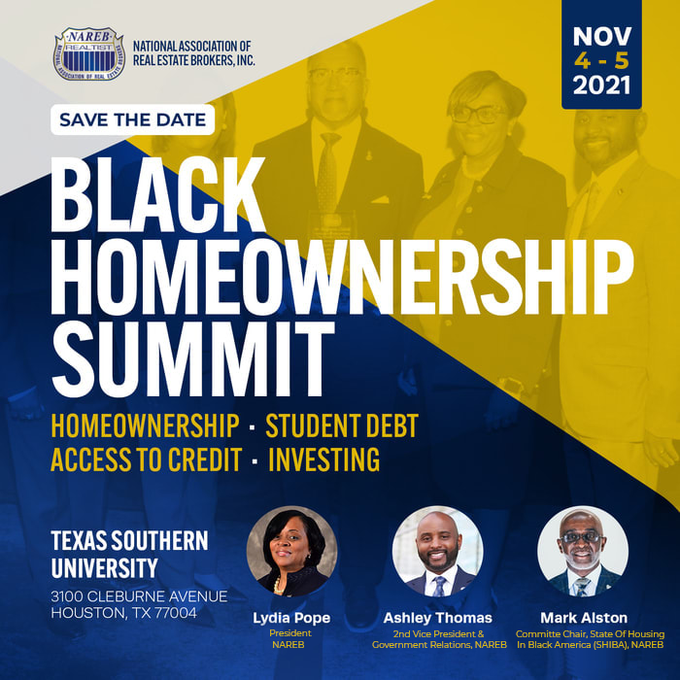
Texas Southern University Host NAREB’s Black Homeownership Summit

“We need to intentionally invest in health, in home ownership, in entrepreneurship, in access to democracy, in economic empowerment. If we don’t do these things, we shouldn’t be surprised that racial inequality persists because inequalities compound.” – Pete Buttigieg

On the campus of Texas Southern University on November 4th and 5th, the National Association of Real Estate Brokers, an organization representing the interest of African American real estate professionals, hosted a homeownership summit with focuses on not only homeownership, but also student debt, access to credit, and investing. The importance of such an event being held on an HBCU campus can not be understated.

Intertwining African American institutions with each other has long been a struggle for the community’s development with African American institutions often operating on islands instead of a connected ecosystem. Events like NAREB’s Black Homeownership Summit at Texas Southern University helps highlight the power, potential, and scalability of what happens when African American (and Diaspora) institutions work together. What better place to address Black homeownership after all than on the campus of an HBCU? Soon to be African American graduates and professionals will be at the vanguard of trying to close the acute homeownership crisis that African America continues to face (graph below).

One of the keynote speakers at the NAREB Black Homeownership Summit event was Teresa Bryce Bazemore, CEO and President of the Federal Home Loan Bank of San Francisco, speaking exclusively to HBCU Money about the event said, “We need all the parties in the housing finance industry and other stakeholders to collectively work to eliminate the barriers to homeownership. In this new environment, all consumers including Black and Brown people should be able to participate equally in the dream of homeownership. We need initiatives that can help potential buyers with improving their credit, saving for down payments and understanding the entire home buying process from A to Z. We also need to make sure that the lending rules are equitable.”

HBCU Money’s Suggested Five Initiatives For HBCUs Can/Should Be But Not Limited Too:

  • Making financial literacy a mandatory part of matriculation for HBCU students. This can be done through the financial aid office, workshops, or a class.
  • Providing HBCU students work study jobs that go into the community at African American K-12 schools and teaching financial literacy.
  • Partnering with African American owned banks and credit unions. Due to their deposit bases, many African American owned banks and credit unions simply can not participate in the primary mortgage market and there are few to none African American owned non-bank mortgage lenders. This leaves the African American community in an extremely vulnerable position to predatory lending as has been demonstrated and shown time and time again. HBCUs are a key to growing assets within African American financial institutions through students, alumni, and institutionally.
  • Offering more scholarships for ALL students. Scholarships are purposed to reduce student loan debt, but they are often resigned to high achieving students despite the majority of students being in the middle. This becomes highly problematic for African Americans who usually do not have the familial wealth to assist in paying down or off their student loan debt. HBCUs while cheaper than our PWI counterparts on the whole could be doing even more to reduce the student loan debt burden for African American students by ensuring that any student who is academically eligible has an opportunity to reduce their student loan debt burden. This provides an opportunity upon graduation that more of their initial paycheck is going towards wealth building and potential homeownership rather than debt burden.
  • Encouraging the use of startups like HBCU Real Estate, who has part of their mission statement to use a portion of their profits to provide down payment assistance for HBCU alumni who seek to purchase primary or investment properties.

Homeownership and real estate ownership have long been a cornerstone to establishing generational wealth in the United States. Despite this, the African American homeownership has never crossed over the 50 percent threshold and according to MarketWatch and has always maintained a 20-30 percentage point gap between African and European Americans. African America’s civilian noninsittuional population as of October 2021 was 33.7 million and its civilian labor force is 20.6 million and the African American labor force 20 and over is 19.9 million. Assuming that 44 percent of the 19.9 million are homeowners (8.7 million), it would take approximately 1.5 million more African Americans to become homeowners to get African America above 51 percent. Based on the most recent data provided by Zillow, the typical value of U.S. homes is $308,220 as of September 2021. Between 1999 and 2021, the median price has almost tripled from $111,000 to $308,220. This means in order for those 1.5 million to acquire homes they would need down payments of approximately $16.2 billion using FHA’s 3.5 percent down financing or $10,800 per potential African American homebuyer. While it does not on the surface seem like a lot to many, that number represents almost 45 percent of the African American median net worth, but a mere 6 percent of European American median net worth.

Just for perspective on that $16.2 billion, there are no African Americans with a net worth more than that, but there are 45 Americans whose single net worth exceeds $16.2 billion. The road to achieving more African American homeownership will be no small task, but events like NAREB/Texas Southern will go a long way in us doing the hard work together, lifting the heavy load together, and ultimately achieving our goal together.