
“There maybe no country more delusional about being “self-made” than the United States, when no one is. People forget that capitalism while rooted in the movement of capital because trading was so inefficient to meet basic needs of people, never absolved what truly matters to be successful – help – from family, community, and yes, even the government.” – William A. Foster, IV
A market town proclaimed itself the freest in the province: any merchant could sell, and the best price would win. Two cloth merchants kept shops on its main street. When a weaver from across the river offered them a bolt finer and cheaper than anything sold in the city, the first merchant refused it because of who had woven it, and went on paying more for worse cloth from familiar hands. The second bought it, undersold his neighbor, and within a few seasons was on his way to owning both shops. The first merchant did not change his mind. He changed the rules. He joined the guild, and the guild placed a toll at the town gate that fell heavily on goods from across the river and lightly on everything else. Within a year the weaver stopped coming, the second merchant lost his advantage, and the townspeople paid more for cloth every season and credited it to the market. The guild, prospering, commissioned a statue honoring free trade and set it beside the gate.
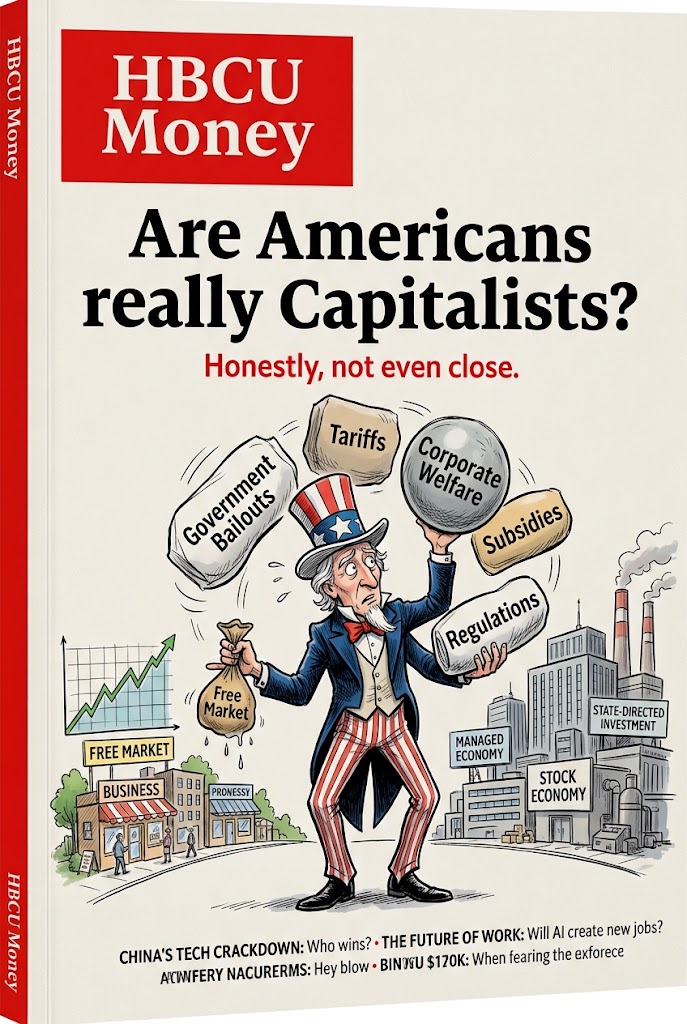
Americans speak of capitalism the way other nations speak of their founding faith, and they speak of socialism as a heresy imported from abroad. Both habits rest on the assumption that the United States is a working example of the former. It is not. Capitalism in its true form is an unsentimental mechanism: capital moves to its highest return, labor to its highest wage, and goods to whoever offers the best price. Such a system cannot accommodate racism, sexism, regional spite, or protectionism of any kind, because each is a decision to pay more than necessary for the privilege of keeping someone out, and paying more than necessary is exactly what competition punishes. These practices survive only where someone suspends competition, through statute, licensing, zoning, covenant, board appointment, or simple collusion. And when a committee rather than a price decides who may buy, sell, borrow, hire, build, or live where, the arrangement has adopted the operating method of the command economies Americans claim to oppose. The uncomfortable truth is that Americans are not, in practice, capitalists. They are protectionists who describe themselves as capitalists, and the protection runs along nearly every line the country has: profession, neighborhood, gender, ethnicity, region, and race. Every economy is a blend of market and authority. The question that matters is who controls the authority and whom it shields, and in the United States the answer has usually been whoever got to the guild first.
The case against this habit was made at the birth of market economics. Adam Smith’s The Wealth of Nations is remembered as a hymn to free enterprise, but much of it is an indictment of merchants and guilds that captured government to protect themselves from rivals. People of the same trade, Smith wrote, seldom meet together “but the conversation ends in a conspiracy against the publick, or in some contrivance to raise prices.” Two centuries later the economist Gary Becker formalized the cost of prejudice in The Economics of Discrimination (1957). An employer who refuses qualified workers because of who they are behaves as though he has taxed his own payroll; a competitor without the prejudice hires them, produces the same output more cheaply, and takes his market share. The logic generalizes to any exclusion on grounds other than price and quality. It is expensive, and in an open market the expense compounds until the excluder either reforms or loses. The persistence of an exclusion is therefore a reliable sign that the market has been closed by someone with the power to close it.
Begin with the professions, where the protection is overwhelmingly that of white Americans against other white Americans, and of incumbents against newcomers. Roughly a fifth of American workers now need a government license to do their jobs, and many of those licenses have little to do with public safety. In Louisiana, state law once permitted only licensed funeral directors to sell caskets. When the Benedictine monks of St. Joseph Abbey began building and selling simple wooden caskets to support their monastery, the state funeral board moved to shut them down, and it took a federal appeals court in 2013 to rule that the law served no purpose beyond protecting the funeral industry’s margins. The pattern recurs across the country. State franchise laws in much of the United States forbid automakers from selling cars directly to customers, preserving a mandatory middleman whose only defense is that he was there first. New York City’s taxi medallions, a government-capped license to pick up passengers, traded for more than $1 million each in the early 2010s; their value was not the car or the skill of the driver but the artificial scarcity the city enforced. When ride-hailing companies breached the cap, medallion prices collapsed and revealed how much of the old price had been pure rent.
Medicine shows the same structure at higher stakes. The Balanced Budget Act of 1997 capped the number of Medicare-funded residency positions, the training slots every new physician must pass through, near their 1996 levels. Medical schools expanded enrollment in the decades since, but the bottleneck downstream remained, and the result is a physician supply constrained by statute. Real estate brokerage offers a private version. For decades the commission structure for home sales held remarkably steady across a supposedly competitive national market, until antitrust litigation forced the National Association of Realtors into a $418 million settlement in 2024 and changes to how buyer-agent compensation is offered. The labor market has its own quiet version: the Federal Trade Commission estimated in 2023 that roughly 30 million American workers, about one in five, were bound by noncompete agreements that prevent them from taking their skills to a rival employer. A worker forbidden from selling his labor to the highest bidder is not participating in a free labor market, whatever his employer’s politics.
The neighborhood is where Americans practice protection most intimately, and where the resemblance to collectivism is sharpest. Zoning, upheld by the Supreme Court in Village of Euclid v. Ambler Realty in 1926, allows municipalities to dictate what may be built on private land, and single-family zoning across most American residential land restricts housing supply in precisely the places where demand is highest. Owners of existing homes are the beneficiaries; renters and first-time buyers pay the toll. Homeowners associations carry the principle further. According to the Foundation for Community Association Research, about 78.1 million Americans now live in some 373,000 community associations, which cover more than a third of the nation’s housing. Within them, a committee decides what color a house may be painted, whether it may be rented, what vehicles may be parked in the driveway, and whether a resident may run a business from home. Membership is compulsory with purchase, dues are mandatory, common property is owned collectively, and individual use of private property is subordinated to the judgment of the group. If a city council imposed such terms on a town, Americans would call it socialism. Inside a gated subdivision, they call it protecting property values.
The protection is real, and so is its price. Rental bans and design restrictions shrink the pool of eligible buyers, which reduces a home’s liquidity even as uniformity may raise its sticker price. The first generation of such covenants was explicit about whom it meant to exclude: racially restrictive covenants barred sale to Black, Jewish, Asian, and other buyers until the Supreme Court declared them unenforceable in Shelley v. Kraemer in 1948. The modern association rarely discriminates by race in writing, but its machinery for narrowing who may buy and how they may live descends directly from that design. A neighborhood that limits its own customers is choosing protection over price, which is to say it has chosen not to be a market.
Gender offers perhaps the clearest evidence that American institutions routinely leave money on the table. For much of the twentieth century, school districts and large employers enforced “marriage bars” that dismissed women once they married, a practice the economist Claudia Goldin documented in work that earned her the Nobel Prize in 2023. Until the Equal Credit Opportunity Act of 1974, lenders could and commonly did refuse credit to women who lacked a male co-signer, regardless of income. Banks declined interest income from millions of creditworthy borrowers for decades, a choice no profit-maximizing institution would make. The pattern persists at the summit of American business. In 2025, women led 55 companies on the Fortune 500, or 11 percent, the first time that share had exceeded one in ten; only two of those chief executives were Black women. If managerial talent is distributed even roughly evenly between the sexes, a board that draws its chief executives overwhelmingly from half the population is choosing from a deliberately shrunken pool. The cost lands on shareholders, who own the company but rarely choose its leaders. Boards are largely self-perpetuating, nominated by sitting directors from their own professional networks. That is a guild by any functional definition, and the fact that most newly appointed women CEOs in 2025 were promoted from inside their own firms suggests that the barrier lies less in the pipeline than in the gate.
Ethnic and religious protection among white Americans followed the same logic. In the 1920s, as Jewish enrollment at Harvard rose on academic merit, President A. Lawrence Lowell pursued an explicit quota, and when that proved politically awkward the university adopted admissions criteria emphasizing “character,” geography, and personal interviews that achieved much the same result. Legacy preferences, which reserve advantage for the children of prior graduates, are the surviving descendants of that system. They protect incumbent families from the competition of more qualified newcomers, and the institutions that practice them accept weaker classes in exchange for donor loyalty. Whatever one thinks of that trade, it is a political bargain, not a market outcome.
Race remains the most heavily documented case, and the record shows how often businesses resisted discrimination until the state compelled it. When Southern cities required segregated streetcars in the 1890s and early 1900s, many of the private transit companies objected, because separate cars cost money and enforcement drove away Black fare-payers; the economist Jennifer Roback documented this resistance in a 1986 study in the Journal of Economic History. In South Africa, the gold-mining houses of the Witwatersrand wanted to promote Black miners into skilled jobs, and it was white labor unions, many of them avowedly socialist, that demanded a legal color bar, culminating in the 1922 Rand Revolt under a banner that called on the workers of the world to unite for a white South Africa. In the United States, the federal government’s own housing agencies in the 1930s graded neighborhoods for mortgage lending with race as an explicit criterion, and the Federal Housing Administration recommended racially restrictive covenants in its underwriting manual. A 2018 Brookings Institution study by Andre Perry, Jonathan Rothwell, and David Harshbarger found that homes in majority-Black neighborhoods are still valued about $48,000 less than comparable homes elsewhere, a cumulative gap of roughly $156 billion. In a working market, a discount that large and that durable would attract buyers until it closed. Its persistence measures the market’s absence.
The same absence is visible in where Americans keep their money. Black-owned banks such as Citizens Trust Bank in Atlanta, Liberty Bank and Trust in New Orleans, and Carver Federal Savings Bank in Harlem carry the same FDIC insurance as any other bank and compete on rates, fees, and service. Yet white households, corporations, universities, and public treasurers almost never consider them for deposits, loans, or treasury services. The choice is not made on price, because the price is rarely examined. It is made on familiarity, network, and habit, which is another way of saying it is made the way guild members choose suppliers. On the rare occasions when large institutions have tested the alternative, as Netflix did in 2020 when it committed a share of its cash holdings to Black-owned financial institutions, the decision was treated as philanthropy. A deposit with an insured bank at a competitive rate is not charity. It is treasury management that happens to break with custom.
Higher education shows the state version of the same pattern. Public Historically Black Colleges and Universities, many of them land-grant institutions created under the Second Morrill Act of 1890, have been funded for generations as though federal requirements were optional. In 2023 the U.S. Secretaries of Education and Agriculture wrote to sixteen governors documenting that their historically Black land-grant universities had been underfunded relative to their white counterparts by roughly $12.6 billion over three decades, as reported by the Associated Press; Tennessee State University alone accounted for $2.1 billion, and the list included Alcorn State, Fort Valley State, Lincoln University of Missouri, and Florida A&M. Maryland went further, approving programs at traditionally white universities that duplicated the distinctive offerings of Morgan State, Coppin State, Bowie State, and the University of Maryland Eastern Shore, stripping them of the competitive advantages that drew students. After roughly fifteen years of litigation, the state committed $577 million in 2021 to settle. Taxpayers in every one of those states own these universities. Starving half of a state’s public research capacity is not a market verdict; it is a decision to run public assets below capacity for reasons that have nothing to do with return.
Geography supplies the final and perhaps most self-defeating category, because here communities protect themselves not from outsiders’ competition but from outsiders’ money. Regional protection is as old as the republic. The Tariff of 1828, which Southern critics called the Tariff of Abominations, shielded Northern manufacturers at the expense of Southern planters who bought manufactured goods and sold cotton abroad, and the resentment it produced nearly broke the Union in the Nullification Crisis. In the modern era, the impulse often runs the other way: states decline federal capital rather than accept a policy associated with political rivals. Under the Affordable Care Act, the federal government pays 90 percent of the cost of covering newly eligible adults, yet ten states have declined full Medicaid expansion, seven of them in the South, including Alabama, Mississippi, Texas, Tennessee, Georgia, South Carolina, and Florida. Their officials cite concern over the state’s long-term share of the cost. The economic effect is that those states forgo billions in federal dollars their own residents pay in taxes, uninsured rates run nearly twice as high as in expansion states, and rural hospitals operate with thinner margins. The reflex is not confined to one region or party. In 2010 and 2011, Ohio, Wisconsin, and Florida all returned federal funds earmarked for high-speed rail. Refusing capital in order to deny a political rival a victory is the precise opposite of the profit motive. It is the guild burning down part of its own market to keep the weaver out.
Arrayed together, these cases dissolve the American mythology. Every modern economy is a blend. The United States runs a federal sugar program that holds domestic prices above world levels, reserves coastal shipping for American-built vessels under the Jones Act, subsidizes agriculture heavily, and empowers the Federal Reserve to set the price of money itself. Singapore, routinely ranked among the world’s freest economies, houses most of its citizens in public housing built by a state agency. China calls itself socialist while running vast private markets. The Nordic countries that Americans describe as socialist combine open trade and globally competitive firms with high taxes and broad social insurance. The distinctions among them lie in which activities are left to competition, which are directed by authority, and whom the authority protects. America’s particular error is to treat capitalism as an identity rather than a tool. Once it becomes an identity, any arrangement that protects insiders can be defended in its name, whether it is a medallion, a covenant, a noncompete, or a board seat, and any measure that lets outsiders compete can be dismissed as socialism.
The cost of that error is borne by nearly everyone, because almost every American is a townsperson in somebody else’s guild. The homeowner pays inflated prices for medical care because of residency caps. The physician pays inflated housing costs because of zoning. The shareholder pays for boards that choose from half the talent pool. The worker pays for noncompetes, the car buyer for mandatory dealers, the renter for single-family zoning, and the taxpayer for public universities run below capacity and federal dollars sent back to Washington. Each toll seems modest to the people collecting it and invisible to those paying it. In aggregate, they amount to a planned economy administered by thousands of small committees, none of which answers to a price.
The remedy is not to choose between markets and government, but to subject every protection to the test Smith would have applied: does this rule protect the public, or does it protect the people who wrote it? Several practical steps follow, and each uses tools that already exist.
State legislatures can adopt sunset reviews requiring every occupational license to justify itself periodically on public-safety grounds, and can recognize licenses issued by other states so that a nurse, electrician, or cosmetologist who moves across a state line does not have to requalify from scratch. They can cap the power of homeowners associations to ban rentals or home businesses, and loosen zoning to permit more housing types on residential land. Congress can lift the cap on Medicare-funded residency slots that has constrained physician supply for nearly three decades.
Shareholders, particularly the public pension funds and university endowments that own large stakes in American companies, can demand that boards disclose how chief executive candidates are identified and require search processes that draw from beyond the directors’ own networks. A board that cannot explain why it considered only half the available talent is failing a fiduciary duty, not a social one.
Corporate treasurers, university endowments, and public finance officers can place deposits with Black-owned and other minority depository institutions on the same terms they apply to every other insured bank. Reciprocal deposit networks already allow large balances to be placed through a single community bank while remaining fully insured. The test is the rate and the service, not the familiarity of the name.
States can fund their land-grant universities as federal law requires and stop duplicating the distinctive programs of public HBCUs at nearby campuses. And they can accept federal capital on its economic merits rather than on its political provenance.
Finally, those who have been on the wrong side of the gate should draw the lesson every incumbent already knows. The guild in the parable prevailed because its members acted together. The weaver and the second merchant acted alone and lost. Women executives, independent professionals, new residents, Black-owned banks, and the public HBCUs of Tennessee or Maryland all improve their position when they coordinate: pooling capital, sharing information, funding litigation, and showing up in legislatures as constituencies rather than petitioners. Protection is not defeated by appeals to fairness; the guild has never been moved by those. It is defeated by competitors with enough organized strength to insist on an open gate.
Americans need not abandon their admiration for markets. They need to start practicing them. A country that truly believed in competition would buy the better cloth wherever it was woven, hire the best executive whoever she is, sell to any buyer who can pay, bank wherever the terms are best, and accept capital without asking which party sent it. Until then, the statue to free trade will keep standing beside the tollbooth, and most of the town will keep paying the toll while admiring the statue.
Disclaimer: This article was assisted by ClaudeAI.

