
“Let us put our moneys together; let us use our moneys; let us put our money out at usury among ourselves, and reap the benefit ourselves. Let us have a bank that will take the nickels and turn them into dollars.” — Maggie Lena Walker, address to the 34th Annual Session of the Right Worthy Grand Council of Virginia, Independent Order of St. Luke, August 20, 1901

In a river town known for its cloth, the finest weavers were women. Merchants traveled from three provinces to buy their work, and each spring the town crier read out the names of the best of them. The looms belonged to a family across the river. So did the cloth hall, the dye works, and the counting house that held the weavers’ wages. The crier’s list grew longer every year. The list of owners never changed. The town mistook a roll of honor for a ledger of wealth, and it did not learn the difference until the family across the river moved its looms elsewhere.
SmartAsset’s “Best and Worst Cities for Women in Tech — 2026 Study,” published on October 5 and since picked up by CultureMap and InnovationMap in Houston, ranks the 50 largest American cities on four measures. They are the gender pay gap in tech, women’s share of tech workers, tech’s share of the local workforce, and women’s median earnings adjusted for regional prices. The top three places go, unsurprisingly, to San Jose, Seattle and San Francisco.
Below them, the list begins to read like a map of African American institutional geography. Atlanta is fourth and the highest-ranked city outside the West Coast. Baltimore is fifth, Austin sixth, Oakland seventh and Boston ninth. Chicago, Charlotte, Memphis and Houston fill twelfth through fifteenth, with New York at eighteenth and Miami at twenty-second. Each of these eleven cities hosts an HBCU or a predominantly Black institution, or, in Oakland’s case, an organized campaign to acquire one.
The ranking measures how well a city’s labor market treats women as employees. HBCU Money reads it as something more consequential: a map of where HBCU-educated women’s talent is being priced, and of how much of the capital that talent generates stays inside the institutions that produced it. Communities rise or fall based on the strength of their institutions, not the brilliance of their individuals. A city can pay HBCU women handsomely while routing their earnings, savings, equity and ideas through institutions they do not own. It will then have improved a great many individual circumstances without strengthening the community at all.
The figures show both the strength and the ceiling. Memphis and Miami are the only two cities in the study where women in tech out-earn men, at 101.5 and 101.7 percent of men’s median respectively. Memphis also has one of the highest shares of women in tech anywhere, at 33.2 percent. Baltimore’s women hold 34.7 percent of tech jobs, the highest share in the top ten, and earn 92.7 percent of what men earn. In Atlanta, where 6.5 percent of the labor force works in tech, women make up 28.8 percent of those workers and earn 87.5 percent of men’s pay. Boston’s women hold 31.3 percent of tech jobs at 83.9 percent of men’s pay, and Charlotte’s hold 28.7 percent at 82.6 percent.
The larger markets tell a story of scale rather than parity. New York employs 43,595 women in tech, the most of any city in the study, at 86.3 percent of men’s pay. Chicago employs 17,940 at 90.2 percent, and Houston’s 9,456 earn 93.0 percent of men’s median. Austin employs 12,379, yet they are only 22.9 percent of its tech workforce and earn 80.0 percent of men’s pay, while Oakland’s gap is the widest in the top ten at 74.3 percent. Two patterns stand out. The two cities with the densest concentration of Black colleges, Atlanta and Baltimore, are the two highest-ranked cities outside the West Coast, and both cities where women out-earn men have an HBCU inside the local labor market.
SmartAsset does not break its figures down by race, so the share held by Black women must be inferred. The National Science Foundation’s Diversity and STEM 2023 report found that Black Americans were about 12 percent of the adult population in 2021 but only 9 percent of the STEM workforce, and UNCF puts Black women at roughly 3 percent of the tech workforce. On the supply side, HBCUs have long carried weight far beyond their size. NSF tabulations for the 1990s show HBCUs conferring roughly 30 to 41 percent of all computer science bachelor’s degrees earned by Black students in a given year. NSF also found that while 15 percent of Black bachelor’s recipients in 2016 graduated from an HBCU, 25 percent of Black science and engineering doctorate recipients from 2013 to 2017 had earned their bachelor’s degree at one. Research presented at the American Society for Engineering Education’s 2024 conference found that HBCUs raise women’s representation among computer science graduates. The reasonable inference is that in cities with HBCUs and predominantly Black institutions nearby, a disproportionate share of Black women in tech were trained by them.
The money involved is substantial. Multiplying each city’s count of women tech workers by their unadjusted median earnings gives a rough annual payroll of about $12.4 billion, earned by roughly 114,400 women across the eleven cities. If Black women hold only their national 3 percent share of those jobs, they earn about $370 million a year. In Atlanta, Baltimore, Memphis and Charlotte, where Black residents make up a large share of the population and HBCUs feed the local labor market directly, the share is almost certainly higher. At 15 percent across all eleven cities, the figure approaches $1.86 billion. That is wages alone; it excludes retirement contributions, home equity, stock grants and the patents these women’s work produces for their employers. Very little of it is retained. Paychecks are deposited with mainstream white-owned lenders, mortgages are written by them, and equity compensation stays tied to the employer.
The institutions that could hold this capital exist, but they are thin and unevenly spread. HBCU Money’s 2025 directories count 17 African American-owned banks with about $6.72 billion in combined assets and 205 African American-owned credit unions with about $8.15 billion. Only four of the eleven cities have an African American-owned bank headquartered locally: Citizens Trust Bank in Atlanta, GN Bank in Chicago, OneUnited Bank in Boston and Unity National Bank of Houston. Together they hold about $1.85 billion. Baltimore has no African American-owned bank, yet its two African American-owned credit unions, Municipal Employees Credit Union of Baltimore and Securityplus, hold about $1.84 billion between them. Atlanta’s two credit unions hold about $114 million. Chicago’s 18 hold only about $37 million, New York City’s 12 about $19 million, Houston’s seven about $25 million, and Memphis’s two about $15 million.
Austin, Oakland, Charlotte and Miami have neither a bank nor a credit union of their own, although Memphis and Miami are served by branches of Liberty Bank and Trust and OneUnited. Even the most direct link between Black universities and Black finance is eroding: five of the eleven HBCU-based credit unions operating in 2020 have since closed or been absorbed, among them Prairie View A&M’s after 85 years of independence. Deposits, however, are only the floor of institutional ownership. Intellectual property is the ceiling, and there the gap is wider still.
Dealroom’s ranking of the world’s best-funded university spinouts, updated October 15, counts 50 companies that have together raised $103 billion, 44 of them unicorns. Two are headquartered in this article’s cities, Houston’s Fervo Energy and Austin’s Apptronik, and neither traces back to an HBCU. AUTM’s STATT database tells the same story at the source. In 2024 the University of Colorado Boulder led American universities with 35 startups built on university intellectual property, followed by Michigan with 28 and Minnesota with 25, with MIT at 24 and New York University at 19. The University System of Maryland produced 20, and while that system includes three HBCUs (Coppin State, Bowie State and the University of Maryland Eastern Shore), its figure is reported system-wide. No HBCU appears in the top ten in its own right.
The leader on that list is the instructive case, precisely because it is not where startup ecosystems are supposed to be. CU Boulder is smaller than most of the universities around it on the list and sits far from the venture capital of the Bay Area or Cambridge. Bryn Rees of Venture Partners at CU Boulder reports that the university historically launched four to six startups a year before reaching 35 in fiscal 2024. AUTM data show only one university exceeding that count in any single year from 1991 through 2023. Its startups raised $504 million in fiscal 2023 and $426 million in fiscal 2024.
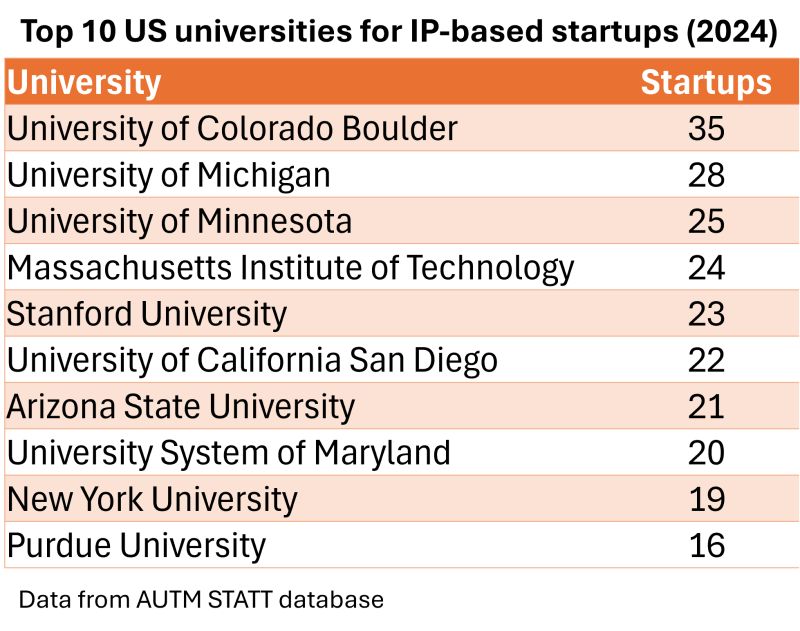
Rees attributes the change to deliberate institutional design rather than geography. The university adopted a standard, investor-endorsed set of startup license terms, Licensing with EASE, that makes licensing its technology fast and predictable. It integrated its accelerators, pitch competitions and intellectual property office into one continuous pipeline. It built a program called Embark that pairs outside entrepreneurs with its strongest technologies and produced 22 companies in its first year and a half. And it partnered with a venture fund, Buff Gold Ventures, that leads and syndicates seed and Series A rounds.
The HBCU starting point is not zero. Morgan State established its Office of Technology Transfer in 2018 and by 2023 was issued 13 utility patents, a record for any HBCU. That year it also became the only HBCU listed among the National Academy of Inventors’ top 100 American universities by utility patents granted. It added 10 more in 2025, bringing its total to 49, and is pursuing R1 research status by 2030. Since 2012 it has also been a partner in the Maryland Innovation Initiative, the state’s commercialization program run by TEDCO alongside Johns Hopkins and the University of Maryland campuses. The research engine, in other words, exists. What separates a patent from a company is everything CU Boulder built around its patents: standard terms, integrated programs, entrepreneurs ready to take technology to market, and capital committed to backing them.
The capital is where the gap is sharpest. Crunchbase data show that American startups with a Black founder or co-founder raised $942 million in 2025. That is 0.32 percent of all venture funding and less than a fifth of the $5.2 billion they raised in 2021. HBCUvc found that only 17 percent of Black-founded deals in 2024 reached a Series A round, against 37.7 percent across the market. Black women face the narrowest version of that funnel even as they form businesses faster than any other group in the country. Research from Wells Fargo and Ventureneer found that Black women-owned businesses grew about 13 percent last year, and a 2020 study by digitalundivided found that Howard University produced more Black women startup founders than any other undergraduate institution in the country.
Put together, the numbers describe a closed loop that runs in the wrong direction. HBCU-trained women earn an estimated hundreds of millions of dollars a year in eleven tech cities and save and invest it through institutions with no stake in Black founders. Black women founders, many of them HBCU-trained, then compete for a fraction of one percent of venture capital controlled by those same institutions. The case for reversing the loop rests on self-interest rather than charity. HBCU alumnae in tech hold the professional networks, the technical judgment and a share of the capital that the founders coming out of their own institutions need.
Europe treats the question of who captures university discoveries as a matter of strategic retention. The 2025 European Spinout Report, produced by a consortium that includes Dealroom, Cambridge Innovation Capital and Oxford Science Enterprises, values Europe’s deep tech and life sciences university spinouts at $399 billion. They span more than 7,300 companies and 167,000 jobs. Universities and research centers produced 40 percent of the new deep tech and life sciences startups launched there since 2019. Massimiliano Granieri, president of MITO Technology, told Il Sole 24 Ore that the aim is to commercialize European discoveries at home “instead of exporting ideas abroad.” African America faces the same problem at a different scale. An HBCU-trained engineer whose work becomes her employer’s patent has exported her ideas as surely as a European lab that licenses its discovery to a California firm.
Dr. John Henrik Clarke understood this logic. Asked by Jahannes about historically Black colleges, he said he believed in them profoundly because “people rise and fall within the context of these institutions.” He acted on that belief. Clarke left his personal library of African and African American history to the Robert W. Woodruff Library at Clark Atlanta University, citing his Georgia upbringing and Clark Atlanta’s capacity to maintain a collection of that size. He retained intellectual capital inside a Black institution when many others would gladly have taken it. Every HBCU-trained woman in these eleven cities faces a version of the same decision with each paycheck, each vested share and each invention disclosure.
Clarke’s essay “The Black Woman in History,” published in Black World in February 1975, widens the frame. Drawing on Cheikh Anta Diop, Clarke argued that African women were co-founders of institutional order rather than participants in societies built by others. In partnership with men they created the functioning family unit around which later societies and institutions were organized, and in Egypt, Kush and Ethiopia some of them ruled states. Applied to the SmartAsset data, that history changes the question. It is not enough to ask whether HBCU women are hired and paid fairly; the strategic question is whether they are positioned as builders and owners of institutions.
Each city starts from a different institutional base:
- Atlanta has the densest in the country. Its HBCUs include Clark Atlanta, Morehouse, Spelman, Morris Brown and Morehouse School of Medicine, and Atlanta Metropolitan State College, and Atlanta Technical College are among its predominantly Black institutions.
- Baltimore has Morgan State, Coppin State and the University of Baltimore.
- Houston has Texas Southern, with Prairie View A&M less than an hour away. Both belong to the HBCU CHIPS Network alongside Morgan State.
- Chicago has Chicago State University and two predominantly Black City Colleges campuses, Kennedy-King and Olive-Harvey.
- Charlotte has Johnson C. Smith University.
- Memphis has LeMoyne-Owen College.
- New York has Medgar Evers College and York College within CUNY.
- Miami has Florida Memorial University in neighboring Miami Gardens.
- Austin has Huston-Tillotson.
- Boston has Roxbury Community College.
- Oakland has no HBCU. The Oakland HBCU Initiative, launched in 2025 as a fiscally sponsored project of The Oakland Fund, is organizing to bring a satellite campus of a legacy HBCU to the city, built around an entrepreneurship and STEM innovation hub, and describes it as a priority of Mayor Lee’s administration.
Clarke also wrote that successful communities are “small role models for a successful nation,” and that the ideas and impetus for nation-building come from the community. That makes the city the right unit of action. What is missing everywhere is coordination, and six steps can begin now.
The first is for HBCU alumni associations to organize women-in-tech chapters in each city and give them an explicit banking relationship with the African American-owned institutions that already exist. That might mean Morgan State and Coppin State alumnae at Securityplus in Baltimore, Texas Southern and Prairie View alumnae at Unity National in Houston, or Chicago State alumnae at GN Bank. These institutions are undercapitalized, not absent, and a deposit does not need a branch on the corner. An engineer in Austin can hold her savings at a Houston bank as easily as at one down the street. Alumnae in Charlotte have Optus Bank in Columbia, South Carolina, and Mechanics & Farmers Bank in Durham. Those in Miami and Oakland have OneUnited. In Chicago, New York and Houston, where credit unions are numerous but small, alumnae can concentrate deposits in the strongest existing institution rather than spread them thin. Alumni associations at public HBCUs are legally independent of their institutions and can act without waiting for state approval.
The second is for HBCU foundations to actively solicit gifts of vested stock from alumnae in tech. Foundations already accept appreciated securities, and a gift of company shares moves equity from an employer into an endowment. Small private institutions such as Johnson C. Smith, LeMoyne-Owen and Huston-Tillotson have the most to gain, because a handful of such gifts can change the size of their endowments.
The third is to concentrate talent by appointing these women as adjunct and practitioner faculty. LeMoyne-Owen, Coppin State, Medgar Evers, Chicago State and Atlanta Metropolitan State all sit within commuting distance of thousands of working tech professionals. Bringing them into the classroom shortens the distance between the HBCU pipeline and the local labor market, and it builds the alumni networks that later direct hiring and capital.
The fourth is a shared commercialization pipeline, with alumnae in tech as its entrepreneurs and women faculty as its inventors. CU Boulder’s model translates directly, and coordination is the HBCU advantage. If HBCUs adopt a common, investor-endorsed set of startup license terms, a founder licensing technology from Morgan State would face the same fast, predictable deal as one licensing from Texas Southern or Prairie View. That is something no single small technology transfer office can offer investors on its own. Alumnae with product, engineering and venture experience are the natural Embark-style entrepreneurs to pair with HBCU inventions. Morgan State’s patent portfolio is the obvious first test case, and the semiconductor research conducted through the HBCU CHIPS Network is a natural second.
The pipeline also needs a faculty side, and HBCU women faculty are its least-organized source of founders. The HBCU Faculty Development Network is positioned to convene them. It was founded in 1994 at Tougaloo College with support from the Bush Foundation, with LeMoyne-Owen, Fisk, Xavier and Florida Memorial on its first steering committee. Today it is based in Prairie View, runs an annual conference that draws 150 to 200 faculty and administrators, and has held a summer institute since 2002. Its mission centers on teaching and learning, so commercialization would be an extension it has to choose, but the extension is a short one.
Partnering with HBCUvc, the Network could run an HBCU women faculty commercialization cohort through its summer institute. The Network would recruit the faculty and HBCUvc would supply investor education and introductions. A partner technology transfer office, with Morgan State’s the strongest candidate, would handle invention disclosures, patents and licenses for faculty at smaller institutions where a dedicated office is a heavy fixed cost. An Inventors’ Corner beside their Authors’ Corner would make women faculty’s patents and spinouts as visible across the HBCU network as their books are today.
The fifth is to give that pipeline its own capital by establishing an HBCU Women Fund in each HBCU athletic conference, in partnership with HBCUvc. HBCU Money argued in April that the SWAC, MEAC, SIAC and CIAA should each create an independent endowment foundation raising $100 million over ten years. Each would be governed by commissioners, presidents, alumni investment professionals and students, with assets held by Black asset managers, banks and venture firms. The logic extends to a fifth conference: the HBCU Athletic Conference, the only all-HBCU conference in the NAIA. Founded in 1981 as the Gulf Coast Athletic Conference, it rebranded in 2024 under Commissioner Kiki Baker Barnes. It grew to 15 members in 2025 when Huston-Tillotson and Paul Quinn joined institutions such as Dillard, Fisk, Philander Smith, Rust, Stillman, Talladega, Tougaloo and the University of the Virgin Islands. It has already shown the instinct this article argues for: its partnership with Hope Credit Union, the Mississippi-based African American-owned institution with about $700 million in assets, puts Hope’s name on the conference’s baseball championship.
The five conferences map neatly onto the cities in this study. The SWAC holds Texas Southern and Prairie View in Houston, and the MEAC holds Morgan State and Coppin State in Baltimore. The SIAC holds Clark Atlanta and Morehouse in Atlanta, along with LeMoyne-Owen in Memphis. The CIAA holds Johnson C. Smith in Charlotte, and the HBCU Athletic Conference holds Huston-Tillotson in Austin, extending the plan’s reach to small private HBCUs that rarely appear in any tech ranking.
HBCUvc supplies what the conference foundations would lack. It is a nonprofit built to organize HBCU alumni as investors. It estimates more than 25,000 accredited investors among HBCU alumni, fewer than 3 percent of them active in angel investing, and $5 million to $10 million a year in fragmented alumni capital. It has set a goal of unlocking $50 million in community investment by 2030. Because HBCUvc does not make grants or manage funds, it is the right partner rather than the vehicle, and the division of labor follows from that:
- The conference foundation anchors each HBCU Women Fund with a share of its endowment, sets governance and keeps the fund’s cash with African American-owned banks and credit unions.
- HBCUvc identifies and organizes accredited alumnae as co-investors, educates newer investors and trains the analysts who staff the funds.
- Alumnae in tech from each conference’s institutions sit on the investment committees and supply the technical diligence a generalist investor cannot.
- The fund invests in companies founded by HBCU women, including faculty from the commercialization cohort, and in companies built on HBCU intellectual property, across the whole ecosystem.
The arithmetic is within reach. If each of the five conference foundations reached HBCU Money’s $100 million target and committed 10 percent to its women’s fund, the five funds together would hold $50 million. That is more than 5 percent of everything Black-founded startups raised in 2025. If the HBCU-trained women in these eleven cities invested 1 percent of the low-end earnings estimate alongside them, they would add about $3.7 million a year. Alumnae from institutions outside the five conferences, such as Florida Memorial, Chicago State and Medgar Evers, can join as co-investors. The conferences have already organized rivalries, championships, media rights and, in one case, a credit union partnership across institutional lines; organizing capital is the same work at higher stakes.
The sixth is information. HBCU institutional research offices should publish alumni employment and earnings data by city, gender and field. SmartAsset could not disaggregate by race because the public data do not make it easy, but HBCUs and predominantly Black institutions hold the records that would answer the question directly. A coordinated release across these eleven cities would give every bank, credit union, foundation and HBCU Women Fund in the ecosystem the market data it needs to compete for these women’s business.
The SmartAsset ranking works like the town crier’s list. It confirms that HBCU women are among the best weavers in the market, but it does not show who owns the looms, the cloth hall, the counting house or the patterns themselves. In Atlanta, Baltimore, Memphis, Miami, Chicago, New York and five other cities, the talent has already been built. CU Boulder shows how quickly institutional design can change what a university produces, and Morgan State shows that the research is already there. Whether HBCU women’s talent becomes institutional power depends on whether HBCUs, their conferences, their faculty, their alumnae, and African American-owned banks and credit unions decide to function as one ecosystem.
Disclaimer: This article was assisted by ClaudeAI.

